Designing a uniform conductivity antistatic plastic formula for a twin screw mixing extruder is one of the most demanding jobs in polymer compounding because the result depends as much on dispersion quality as on the chemistry of the additive. Kerke, a Wanplas factory, has spent more than 12 years building parallel co-rotating twin-screw compounding extruders that are used around the world to turn raw resin, carbon black, carbon nanotubes, and permanent antistatic agents into pellets with a stable, predictable surface resistivity. This guide explains the antistatic mechanisms, the dispersion science, and the screw configuration choices that decide whether a compound reaches a surface resistivity below 10^9 ohm per square for antistatic duty or below 10^6 ohm per square for conductive duty. We also show concrete example formulas, real machine specifications from the Kerke KTE series, and a selection table that maps output and material requirements to a specific model. The objective is practical: help compounders, molders, and masterbatch producers build a repeatable process rather than a lucky batch.
Static electricity builds up when two surfaces separate and one keeps more electrons than the other. In a plastic part this charge cannot flow to ground because most polymers are excellent insulators, so the surface stays charged and can discharge as a spark or attract dust and fines. An antistatic plastic formula reduces that risk by giving the surface a controlled, continuous path for charge to leak away. A conductive plastic formula goes further and creates a percolation network dense enough to dissipate charge almost instantly. Both outcomes are achieved by mixing a conductive or semi-conductive phase into the polymer matrix on a twin-screw mixing extruder, but the mixing quality is what separates a consistent commercial product from a batch that passes the first test and fails the hundredth. The rest of this article focuses on how to get that consistency.
How Antistatic Behavior Works in Compounded Plastics
An antistatic plastic formula is defined by its ability to bleed surface charge to a harmless level, and that ability is measured as surface resistivity in ohm per square. The practical industry thresholds are clear: a compound is called antistatic when its surface resistivity sits below 10^9 ohm per square, and it is called conductive when the value drops below 10^6 ohm per square. Between those two limits a material is often described as static dissipative. Selecting the right target before compounding begins saves wasted filler, avoids brittle parts, and keeps the color and mechanical properties acceptable for the end use.
There are four main routes to reach those resistivity targets, and each behaves differently inside a twin-screw mixing extruder. Carbon black of the conductive grade builds a physical network of touching particles; carbon nanotubes build an even finer network at far lower loading; permanent antistatic agents are non-migratory polymeric additives that form a hydrophilic path without relying on moisture; and ionic antistatics are salt-like materials that move charge through mobile ions. The first two are true conductive fillers, while the second two are additive-based approaches that usually land in the antistatic range rather than the conductive range. Understanding which route fits the application is the first step of formula design.
Conductive carbon black and the percolation threshold
Conductive carbon black is the workhorse of antistatic and conductive compounds because it is inexpensive and robust. Its particles are small and irregular, and when enough of them are forced close together during mixing they touch and form a continuous chain, the so-called percolation network. The resistivity of the final part collapses sharply once the loading passes the percolation threshold, which for many polymers sits between roughly 8 percent and 15 percent by weight of carbon black. Below the threshold the part is still insulating; just above it the resistivity is antistatic; well above it the part becomes conductive but also dark, brittle, and difficult to process. The skill on a twin-screw mixing extruder is to reach the network uniformly without leaving local lean zones that act as insulating islands.
Carbon nanotubes for low-load conductivity
Carbon nanotubes reach percolation at a fraction of the carbon black loading, often in the 1 percent to 3 percent range by weight, because their high aspect ratio lets a sparse network still connect. That low loading preserves the base polymer color and mechanical properties far better than carbon black, which is why nanotubes appear in premium antistatic and electrostatic discharge safe components. The trade-off is cost, which puts them in the High to Very High cost band, and the need for very good dispersion because a single undispersed bundle is a wasted investment. A twin-screw mixing extruder with well-placed kneading blocks is the standard way to exfoliate and distribute nanotubes without breaking them into inactive short pieces.
Permanent antistatic agents versus migratory types
Permanent antistatic agents are polymeric, non-migratory additives that stay inside the compound and build a hydrophilic micro-path to the surface, giving long-term antistatic performance even after repeated cleaning. They are sometimes called internal antistatic agents. Ionic or migratory antistatics, by contrast, bloom slowly to the surface and depend on ambient humidity to carry charge; their effect fades with time and washing. For a uniform conductivity antistatic plastic formula that must survive molding, shipping, and service, the permanent type is preferred, and it is typically added at 2 percent to 6 percent by weight. These additives rarely reach conductive levels, so they are chosen when the antistatic target below 10^9 ohm per square is enough and color or transparency must be preserved.
Resistivity targets and how they are verified
Surface resistivity is measured with a concentric ring probe or a two-point probe under controlled humidity, usually 23 degrees Celsius and 50 percent relative humidity, following standards such as IEC 60093 or ASTM D257. Volume resistivity tells a related but different story and is useful for thick conductive parts. A compounder should agree the test method and conditioning time with the customer before locking a formula, because the same pellet can read differently under different humidity and dwell conditions. The table below summarizes the common target bands and the additive family that typically reaches each.
| Performance band | Surface resistivity (ohm per square) | Typical additive route | Common end use |
|---|---|---|---|
| Insulating (baseline) | Above 10^12 | None | General packaging, housings |
| Antistatic | 10^9 to 10^12 | Permanent antistatic agent, ionic type | Film, trays, cosmetic containers |
| Static dissipative | 10^6 to 10^9 | Low carbon black, carbon nanotube blend | Electronic handling, cleanroom |
| Conductive | Below 10^6 | Conductive carbon black, carbon nanotube | ESD flooring, cable shield, bins |
A reliable measurement protocol is what turns a one-off good reading into a saleable uniform conductivity antistatic plastic formula. The compounder should condition every specimen for at least 24 hours at 23 degrees Celsius and 50 percent relative humidity before probing, because moisture absorbed by a hydrophilic antistatic agent or by a polyamide carrier shifts the reading by orders of magnitude. A minimum of five measurements per plaque, taken at different points, exposes local lean zones that a single central reading would hide, and a moving average across consecutive production batches shows whether the screw map is drifting. When the standard deviation of surface resistivity across a batch stays inside one decade, the compound is ready for the field; when it wanders wider, the remedy is almost always better dispersion through repositioned kneading blocks or a side feeder rather than more filler. Documenting the protocol alongside the screw-element map means a new operator can reproduce the result on a different shift, which is the difference between a laboratory curiosity and a commercial masterbatch that a customer can specify with confidence.
Why a Twin-Screw Mixing Extruder Delivers Uniform Conductivity
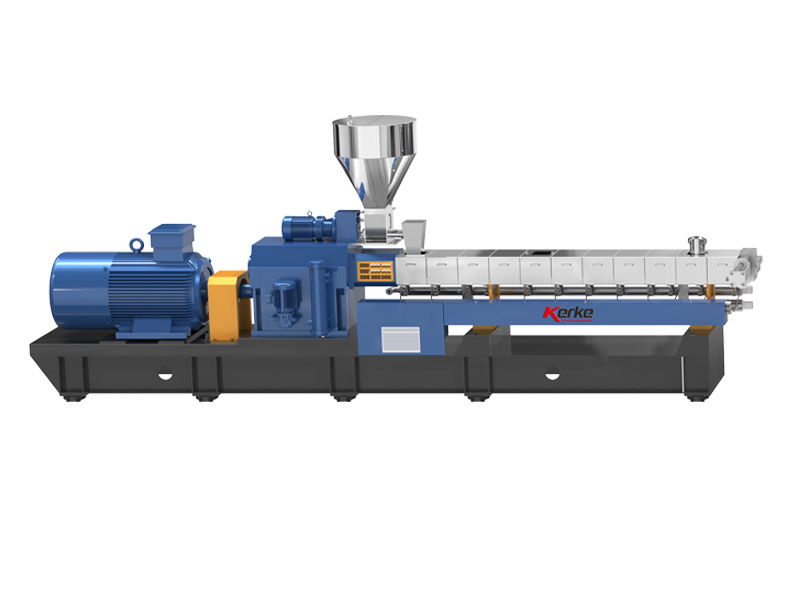
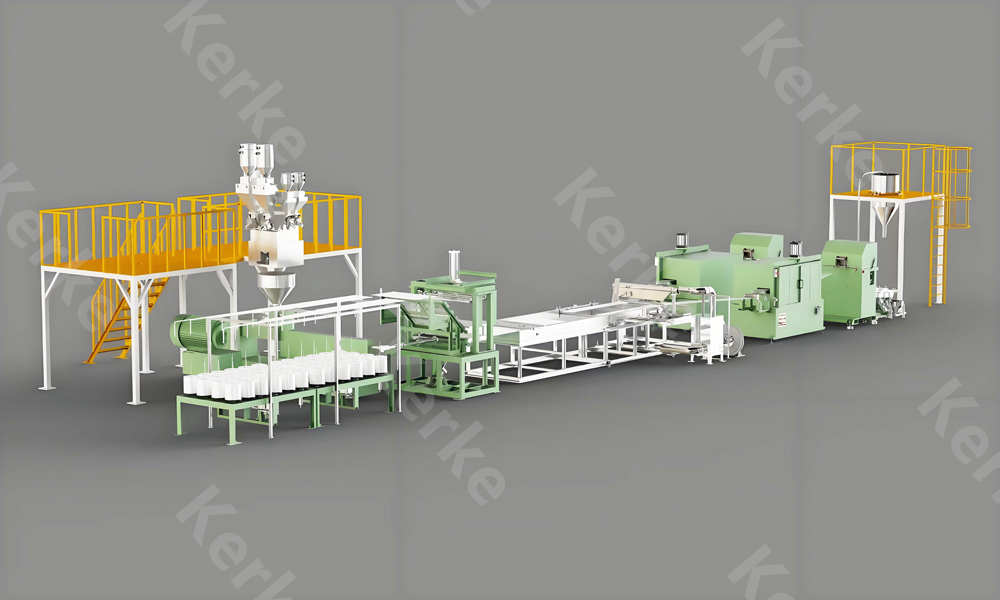
A twin-screw mixing extruder is the right machine for antistatic and conductive compounds because dispersion, not just melting, is the controlling step. Co-rotating parallel twin screws let the compounder place kneading blocks, reverse elements, and side feeders at exact positions along the barrel so that high-shear mixing happens after the polymer is molten but before the melt is pumped to the die. Kerke builds the KTE series of parallel co-rotating twin-screw extruders for exactly this class of work, and the design principles below are drawn from how those machines are configured for masterbatch and modified plastic production.
The role of kneading blocks in breaking agglomerates
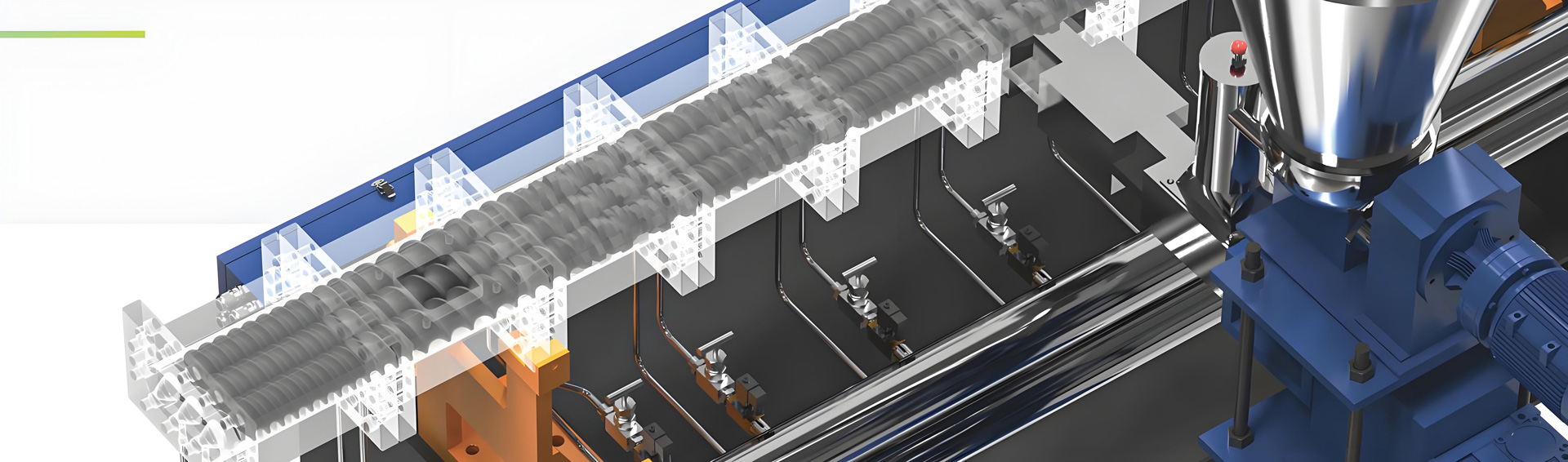
Kneading blocks are the heart of dispersion on a twin-screw mixing extruder. They are stacks of lens-shaped or bilobal elements whose offset angles create repeated stagnation and renewal of the melt, forcing agglomerates of carbon black or nanotubes to be squeezed and pulled apart. A 30-degree or 45-degree kneading block gives moderate shear for distributive mixing, while 60-degree or 90-degree blocks give aggressive dispersive mixing that breaks hard clumps. Placing two or three kneading block zones with a short low-shear region between them lets the melt relax and re-agglomerate less, which is the standard trick for reaching a uniform network without over-shearing the polymer into degradation.
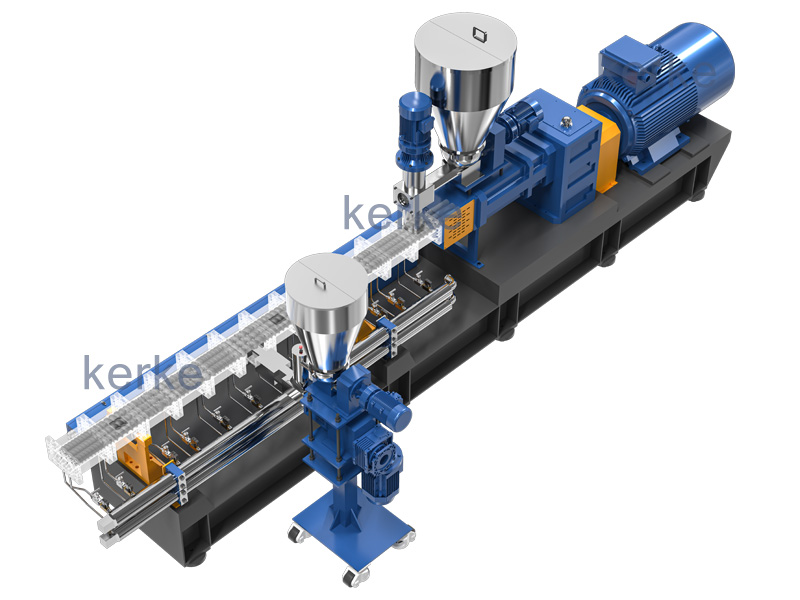
Side feeding for high filler loading
Carbon black and many conductive fillers have very low bulk density and trap air, so dumping 15 percent of filler through the main hopper floods the feed zone and causes poor mixing. A side feeder, especially a twin-screw side feeder, introduces the filler downstream after the polymer has melted and the melt is already pressurized, so the filler is pulled directly into the high-shear zone. This single change is often what takes a formula from patchy to uniform. Kerke supplies twin-screw side feeders, loss-in-weight feeders, liquid feeders, and crammer feeders as part of the feeding system, which lets the line meter carbon black, masterbatch, and liquid antistatic agent independently and repeatably.
Masterbatch pre-mixing to protect the base resin
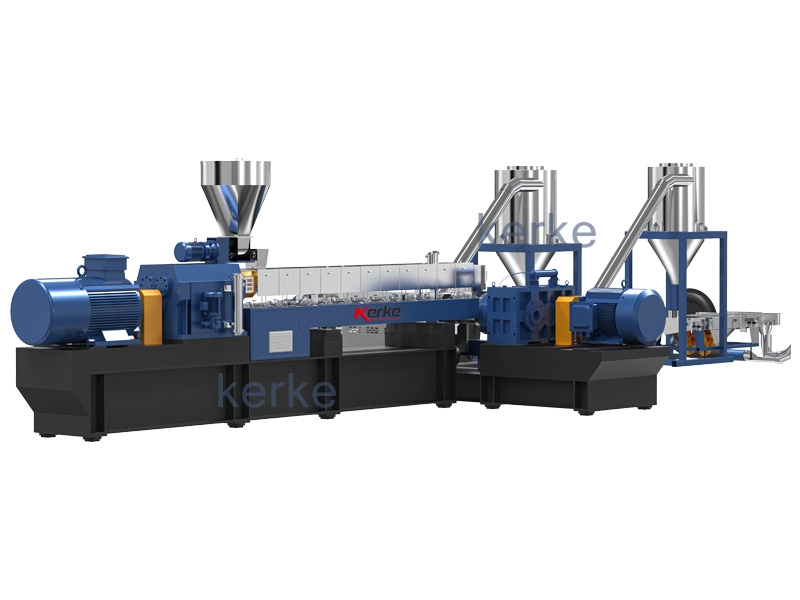
One reliable way to keep a uniform conductivity antistatic plastic formula stable is to make a concentrated masterbatch first, then let down the masterbatch into natural resin at the molding machine or in a second extrusion pass. Pre-mixing the carbon black or nanotube into a carrier at 30 percent to 50 percent loading on a twin-screw mixing extruder moves the hardest dispersion work to a controlled environment, and the let-down step is far more forgiving. This two-stage logic is why many producers run a KTE line for masterbatch and a second stage for final compound, and it is also the reason the double-stage extrusion system exists in the Kerke product range for materials that cannot be finished in one pass.
Self-cleaning screw geometry and consistency
The Kerke KTE screw assembly is computer-aided designed with a kneading co-type profile that gives excellent self-cleaning, which matters for antistatic compounds because residual conductive material left in the barrel from a previous color would contaminate the next run and create hotspots of conductivity. Good interchangeability of screw and barrel elements means the same machine can be re-configured for a black conductive masterbatch in the morning and a light-colored permanent-antistatic compound in the afternoon with a documented element map. That repeatability is what lets a factory claim a consistent surface resistivity batch after batch.
Product spotlight: KTE series twin-screw compounding extruder
The KTE series covers parallel co-rotating machines from the KTE-16B laboratory unit up to the KTE-135D production line, with screw diameter equal to the model number and an L/D ratio that is configurable to the formula. The lineup below gives the screw diameter and a typical output range for antistatic and conductive masterbatch work; exact output depends on the carrier resin, filler loading, and screw configuration, and Kerke confirms the final rate during a trial run.
| Model | Screw diameter (mm) | Typical L/D ratio | Typical output (kg/h) | Best fit role |
|---|---|---|---|---|
| KTE-16B | 16 | 36 to 44 | 0.5 to 5 | Formula trial, R&D |
| KTE-25 | 25 | 36 to 48 | 2 to 15 | Pilot line, color masterbatch |
| KTE-36 | 36 | 36 to 52 | 10 to 60 | Small batch antistatic |
| KTE-65 | 65 | 36 to 52 | 80 to 400 | Permanent antistatic compound |
| KTE-95 | 95 | 40 to 52 | 400 to 1500 | Conductive black masterbatch |
| KTE-135D | 135 | 40 to 52 | 1000 to 3500 | High-volume conductive line |
Every KTE machine is built so the barrel structure, screw arrangement, exhaust, feeding, and electrical control can be optimized for the material. A compounder developing a uniform conductivity antistatic plastic formula will usually start on a KTE-16B or KTE-25 to fix the element map, then scale the same map onto a KTE-65 or KTE-95 for production. Kerke, a Wanplas factory, supports that scale-up with shared screw-element libraries so the laboratory result transfers to the plant line.
Comparing Antistatic and Conductive Additives
Choosing the additive family is a balance of resistivity target, color, mechanical impact, and cost. The comparison table below is the practical summary a formulator needs before opening the twin-screw mixing extruder. Loadings are given as typical weight percent; the exact number is tuned on the machine. Cost is shown as a grade, Low, Medium, High, Very High, or Premium, because absolute resin and filler prices move with the market and should never be quoted as a fixed figure in a technical document.
| Additive | Typical addition (% wt) | Achievable surface resistivity (ohm per sq) | Cost grade | Color impact |
|---|---|---|---|---|
| Conductive carbon black | 8 to 15 | 10^3 to 10^7 | Low | Black, opaque |
| Carbon nanotube | 1 to 3 | 10^4 to 10^7 | Very High | Light gray to black |
| Permanent antistatic agent | 2 to 6 | 10^8 to 10^11 | Medium | Near natural, slight haze |
| Ionic (migratory) antistatic | 0.5 to 2 | 10^9 to 10^12 | Low | Transparent possible |
| Carbon fiber (short) | 10 to 20 | 10^2 to 10^6 | High | Speckled, fiber visible |
| Stainless steel fiber | 2 to 6 | 10^2 to 10^5 | Premium | Metallic speckle |
The table makes the central trade-off obvious: carbon black is cheap and reliably conductive but always black, while permanent antistatic agents keep the color but only reach the antistatic band. A formulator who needs a light-colored part below 10^9 ohm per square usually turns to carbon nanotubes or a steel-fiber blend, accepting the higher cost grade. On a twin-screw mixing extruder the dispersion requirement also rises as the additive gets more expensive, because poor mixing wastes a costly filler.
Compatibility and coupling for better networks
Carbon black and nanotubes are polar and do not wet non-polar polyolefins well, so a small amount of compatibilizer or a maleic anhydride grafted carrier improves dispersion and locks the network in place. For a polypropylene carrier this often means using a maleic anhydride grafted polypropylene as part or all of the carrier resin. The same logic applies when the additive is a permanent antistatic agent that must stay distributed rather than migrate to one skin. Good wetting reduces the agglomerate size and pushes the percolation threshold down, which means less filler for the same resistivity and a tougher final part.
Screw Configuration and Its Effect on Dispersion
The single biggest lever a compounder controls on a twin-screw mixing extruder is the screw configuration. The table below maps a few common element choices to the dispersion outcome for an antistatic or conductive formula. These are starting points; the final map is confirmed on the Kerke trial line. The key variables are the number and position of kneading blocks, the L/D ratio spent in the dispersive zone, and whether a side feeder is used for the filler.
| Configuration element | Kneading block count and position | L/D of dispersive zone | Dispersion effect | Best for |
|---|---|---|---|---|
| Gentle distributive | 2 blocks at 30 deg, mid-barrel | 4 to 6 | Low shear, even blend | Permanent antistatic agent |
| Standard carbon black | 3 blocks at 45 to 60 deg, after side feed | 8 to 12 | Breaks agglomerates | 8 to 15 percent black masterbatch |
| Aggressive nanotube | 3 to 4 blocks at 60 to 90 deg, split zones | 10 to 14 | Exfoliates bundles | Carbon nanotube let-down |
| Two-stage masterbatch | Heavy blocks first, light blocks second | 12 to 16 | Concentrate then homogenize | 30 to 50 percent concentrate |
Screw speed and melt temperature interact with the configuration. Higher screw rotation speed raises shear and helps dispersion, but it also raises melt temperature, and some antistatic agents and carriers degrade if the melt runs too hot. A good twin-screw mixing extruder run keeps barrel temperatures staged so the polymer melts early, the dispersive zone runs hot enough to lower viscosity for mixing, and the metering zone cools slightly before the melt pump or die to protect heat-sensitive additives. Kerke machines use closed-loop control on barrel zones and screw speed so the operator repeats the same thermal profile every run.
Venting and moisture control
Many antistatic compounds are sensitive to moisture, and conductive carbon black carries surface air that must be removed or it forms voids and weakens the network. A vented barrel with one or two devolatilization ports lets trapped air and residual moisture escape under vacuum. For a permanent antistatic agent in a polyamide carrier, drying the resin before feeding and venting during extrusion is essential to avoid hydrolysis that would drop molecular weight and ruin the mechanical properties. The KTE barrel can be configured with exhaust ports at the positions the formula needs.
Product spotlight: laboratory twin-screw extruder for formula development
Before committing to a production line, most Kerke customers develop the uniform conductivity antistatic plastic formula on the laboratory twin-screw extruder. It is built for formula trials, tests, and research, with the same co-rotating geometry as the production KTE units so the element map transfers directly. Typical specifications for the lab unit are listed below; they are sized for small batches where measuring resistivity and mechanical properties per screw change is the daily work.
| Parameter | Laboratory twin-screw extruder | Note for antistatic work |
|---|---|---|
| Screw diameter | 16 to 25 mm | Matches KTE-16B and KTE-25 |
| L/D ratio | 36 to 48 configurable | Room for kneading and vent |
| Screw speed | Up to 600 rpm | Wide shear sweep for trials |
| Feeding | Main hopper plus side feeder option | Tests downstream filler addition |
| Throughput | 0.5 to 15 kg/h | Enough for molding test coupons |
Worked Example Formulations and Target Resistivity
The following example formulas are starting points a compounder can load into a twin-screw mixing extruder and adjust. Carriers are polypropylene and acrylonitrile butadiene styrene because they are the most common bases for antistatic and conductive parts, but the same logic applies to polyethylene, polyamide, and thermoplastic elastomer. Carbon black loadings of 8 percent to 15 percent appear as the skeleton requires, and other additives such as antioxidant, compatibilizer, and slip agent are listed where they protect the compound. Target resistivity is the expected value after uniform dispersion; a poorly mixed run will read higher.
| Formula | Carrier (% wt) | Carbon black (% wt) | Other additives (% wt) | Target surface resistivity (ohm per sq) |
|---|---|---|---|---|
| PP conductive black | PP 85 | 12 | Antioxidant 0.3, compatibilizer 2.7 | 10^4 to 10^6 |
| PP static dissipative | PP 92 | 8 | Antioxidant 0.3, compatibilizer 1.7 | 10^7 to 10^9 |
| ABS antistatic agent | ABS 94 | 0 | Permanent antistatic agent 5, antioxidant 0.3, lubricant 0.7 | 10^8 to 10^10 |
| ABS nanotube conductive | ABS 97.5 | 0 | Carbon nanotube 2, compatibilizer 0.5 | 10^4 to 10^6 |
| PP nanotube light color | PP 97.7 | 0 | Carbon nanotube 1.5, compatibilizer 0.8 | 10^6 to 10^8 |
| PE black bin grade | PE 86 | 13 | Antioxidant 0.3, slip agent 0.7 | 10^3 to 10^5 |
These formulas are deliberately simple so the dispersion step, not the recipe, is the variable under test. In practice a color masterbatch or filler masterbatch may already carry part of the carbon black, and the twin-screw mixing extruder only needs to let it down and re-homogenize. When a customer runs the PE black bin grade, for example, the goal is a part that dissipates a static charge in a fractions of a second so it cannot ignite flammable vapor in a storage bin; the resistivity band below 10^6 ohm per square is the safety target, and the uniform network is what guarantees every pellet and every molded bin meets it.
Processing window for the example formulas
For the polypropylene based formulas, barrel temperatures typically run from 180 degrees Celsius at the feed to 220 degrees Celsius at the dispersive zone, then settle to 210 degrees Celsius at the die. Acrylonitrile butadiene styrene tolerates a similar window but is more heat sensitive, so the dispersive zone is kept near 210 degrees Celsius and screw speed is moderate to avoid thermal degradation that would yellow the part. Permanent antistatic agents are added through a side feeder or liquid feeder after the polymer is molten so they are distributed rather than prematurely degraded. Each of these windows is confirmed on the Kerke line during a trial and then saved as a recipe in the control system.
Application Industries and End Products
A uniform conductivity antistatic plastic formula reaches the market through many end products, and the twin-screw mixing extruder that makes the pellet is only the first step. Kerke, a Wanplas factory, serves masterbatch producers, engineering plastic compounders, and modified material makers who in turn supply the industries below. Mapping the formula to the terminal product keeps the development focused on the resistivity and color the customer actually buys.
Electronic component handling
The largest steady demand for antistatic and static-dissipative compounds is in electronics, where trays, tubes, reels, and tote boxes must protect sensitive devices from electrostatic discharge. These parts need a surface resistivity in the 10^6 to 10^9 ohm per square band and usually a light color so codes can be printed. A carbon nanotube or low carbon black formula on a KTE line is typical, and the part is often an ABS or PP molded component. The compounder’s job is to keep the resistivity uniform across a full pallet of pellets so no single tray is a weak point.
Packaging for flammable and powdered goods
Powder handling, solvent filling, and explosive-atmosphere sites require containers that cannot spark. Conductive bins, flexible intermediate bulk containers, and drum liners built from carbon-black-filled polyethylene or polypropylene fall in this group, with resistivity below 10^6 ohm per square. The formula is dark and cost-sensitive, so conductive carbon black at 12 percent to 15 percent on a high-throughput KTE-95 or KTE-135D is the economic choice. Wanplas group experience across many factories shows that consistent devolatilization is what prevents pinholes and weak spots in these safety-critical parts.
Automotive and cable shielding
Automotive interiors use antistatic compounds to stop dust attraction on dashboards and trims, while cable industries use conductive compounds for shield layers and semiconductive screens. Both need tight resistivity control and good mechanical properties, and both are commonly produced as masterbatch on a twin-screw mixing extruder then let down by the molder. Engineering plastics such as polyamide and polybutylene terephthalate filled with carbon black or carbon fiber are frequent here, and the KTE series handles the higher melt temperature these resins need.
Medical, cosmetic, and consumer goods
Where color and clarity matter more than reaching the conductive band, permanent antistatic agents dominate. Cosmetic jars, medical device housings, and premium consumer packaging use a near-natural compound that stays antistatic after washing, which only the non-migratory agent delivers. These formulas are lighter on shear, so a gentle distributive screw configuration on a KTE-65 is enough, and the color stays clean because no black filler is present.
Selecting the Right Extruder Model
The selection table below matches a typical requirement to a Kerke model from the KTE series. Output figures are indicative and confirmed by trial; the point is to show how carrier, filler loading, and annual volume drive the machine size. All models are parallel co-rotating twin-screw mixing extruders from Kerke, a Wanplas factory, and share the same screw-element logic so a formula developed small scales up cleanly.
| Requirement | Target resistivity | Recommended model | Why this model |
|---|---|---|---|
| New formula, lab validation | Any | KTE-16B or KTE-25 | Small batch, fast screw changes |
| Low-volume antistatic compound, 50 kg/h | 10^8 to 10^10 | KTE-36 | Gentle distributive config fits agent |
| Permanent antistatic, 300 kg/h | 10^8 to 10^11 | KTE-65 | Side feeder for agent, stable output |
| Conductive black masterbatch, 800 kg/h | 10^3 to 10^6 | KTE-95 | Aggressive kneading, high torque |
| High-volume bin grade, 2000 kg/h | Below 10^6 | KTE-135D | Maximum throughput, twin side feed |
| Two-stage hard material | Any | KTE double-stage system | Mother-baby for tough dispersion |
When the requirement spans both a masterbatch concentrate and a let-down compound, Wanplas as the parent brand can coordinate a matched line that pairs a large KTE extruder for concentrate with a smaller unit for finishing, or a sheet extrusion line that compounds and calenders in one step. This kind of integrated thinking is why buyers talk to a specialized factory rather than assembling unrelated machines. The recommendation above always starts from the resistivity target and the annual tonnage, then picks the smallest machine that meets both with margin.
Service, Testing, and Factory Support
Buying a twin-screw mixing extruder for antistatic compounds is only the beginning; the running result depends on testing, training, and support. Kerke, a Wanplas factory, backs every line with the shared Wanplas group promises, and the points below are what a compounder should expect when the machine arrives and starts production.
Factory acceptance and running test
Before shipment each KTE line is run on a representative material so the customer sees the output, the thermal profile, and the pellet quality. For an antistatic formula this test includes measuring the surface resistivity of the produced pellets with the customer’s own or an agreed probe, which is the only honest way to confirm the screw map works. Kerke documents the confirmed recipe and element layout so the plant line repeats the laboratory result without guesswork.
Installation, commissioning, and training
Engineers install and commission the line on site, then train the customer team on screw assembly, feeding setup, and recipe management in the control system. Because antistatic compounds are sensitive to small changes in screw speed and barrel temperature, this training focuses on keeping the process window tight and on reading the warning signs of poor dispersion, such as rising resistivity or dark streaks in a light compound. Remote monitoring through the control system lets the Kerke team check process data and advise from the factory when needed.
Spare parts and open factory policy
The Wanplas group policy includes USD 500 free parts every year for the covered line, plus free replacement of damaged parts within the warranty period. Screw elements, barrel liners, and kneading blocks are wear parts in any conductive compound run because carbon black is abrasive, so a planned parts buffer keeps the line running. Kerke also operates an open factory policy and welcomes customers to visit the 19,997 square meter plant, see the 2,000 plus machines already running in 70 plus countries, and review the 12 plus years of compounding extruder experience before placing an order.
Quality promise
Wanplas group promises cover production capacity, transportation, and quality standards, with a refund plus compensation commitment if quality fails to meet the agreed specification. For an antistatic plastic formula this means the agreed resistivity band and dispersion uniformity are part of the acceptance criteria, not just the mechanical running of the machine. That alignment of commercial promise with the technical target is what lets a compounder quote a stable product to its own customers.
Frequently Asked Questions
What surface resistivity defines an antistatic versus a conductive plastic?
An antistatic plastic is typically specified below 10^9 ohm per square, while a conductive grade is specified below 10^6 ohm per square. The target is chosen by the end application and the discharge-risk level of the environment, with the static-dissipative band sitting between the two.
Why use a twin-screw mixing extruder instead of a single-screw machine for conductive compounds?
Co-rotating twin-screw extruders provide intense, controllable shear through kneading blocks and allow side feeding of high-load fillers, which is essential to break agglomerates and reach a uniform percolation network without overworking the polymer. A single-screw machine lacks the independent element control needed for consistent dispersion.
How much carbon black is needed to make plastic conductive?
For most polymers the percolation threshold sits between 8 percent and 15 percent by weight of conductive carbon black, though the exact point depends on the grade of black, the carrier, and the dispersion quality from the twin-screw mixing extruder. Carbon nanotubes can reach the same conductivity at 1 percent to 3 percent loading.
Can a light-colored antistatic plastic be made without black filler?
Yes. Permanent antistatic agents or carbon nanotubes at low loading keep the compound near natural color while reaching the antistatic or low-conductive band. Carbon nanotubes raise the cost grade, while permanent antistatic agents are the economical choice when the target is below 10^9 ohm per square rather than fully conductive.
What screw configuration works best for carbon nanotube dispersion?
An aggressive but split dispersive zone with three to four kneading blocks at 60 to 90 degrees, placed after a side feeder, exfoliates nanotube bundles without breaking them into inactive short pieces. The L/D spent in the dispersive zone is usually 10 to 14, and the map is confirmed on a laboratory twin-screw extruder before scale-up.
Does moisture affect antistatic compounds during extrusion?
Moisture matters greatly for heat-sensitive carriers such as polyamide and for conductive carbon black that traps surface air. Drying the resin before feeding and venting the barrel under vacuum on the twin-screw mixing extruder removes moisture and air, protecting the network and preventing voids or hydrolysis.
Which Kerke model should a new formulator start with?
A new formulator developing a uniform conductivity antistatic plastic formula should start with the KTE-16B or KTE-25 laboratory twin-screw extruder to fix the screw map, then scale the confirmed map onto a KTE-65, KTE-95, or KTE-135D production line as volume grows.
Conclusion
A uniform conductivity antistatic plastic formula on a twin-screw mixing extruder succeeds when three things line up: the right additive route for the resistivity and color target, a screw configuration that disperses the filler without degrading the polymer, and a measurement discipline that confirms the surface resistivity batch after batch. Carbon black remains the low-cost path to conductivity but is always black, carbon nanotubes reach conductivity at low loading for a premium cost, and permanent antistatic agents keep the color while landing in the antistatic band. Kerke, a Wanplas factory, builds the KTE series of parallel co-rotating twin-screw extruders and the laboratory twin-screw extruder that take a formula from a first trial to a stable production line, with side feeding, configurable kneading blocks, and venting matched to the material. The selection table in this guide maps the resistivity target and annual volume to the correct model, and the shared Wanplas group promises cover testing, installation, training, USD 500 free parts per year, and an open factory visit. If you are developing an antistatic or conductive compound and want a tailored screw configuration and a confirmed resistivity on your own material, send your specification and sample to the Kerke team for a trial run and a factory review of the process.