Why an Antistatic Compounding Plant Needs a Disciplined Cost Model
Building an antistatic compound on a co-rotating parallel twin-screw line is fundamentally a formulation-and-throughput business. The product you ship is not simply plastic; it is a precisely dispersed conductive or dissipative network engineered to meet surface-resistance targets for packaging, electrostatic discharge (ESD) protection, and electronics applications. Because the value of the product is defined by performance rather than by raw tonnage, the economics of the plant are unusually sensitive to additive choice, energy intensity, and how fully the line is utilized. A clear fixed and variable cost breakdown is therefore the single most useful planning document for any owner, plant manager, or process engineer who intends to run carbon-black, carbon-nanotube, or permanent-antistatic-masterbatch formulations on a twin-screw compounding plant.
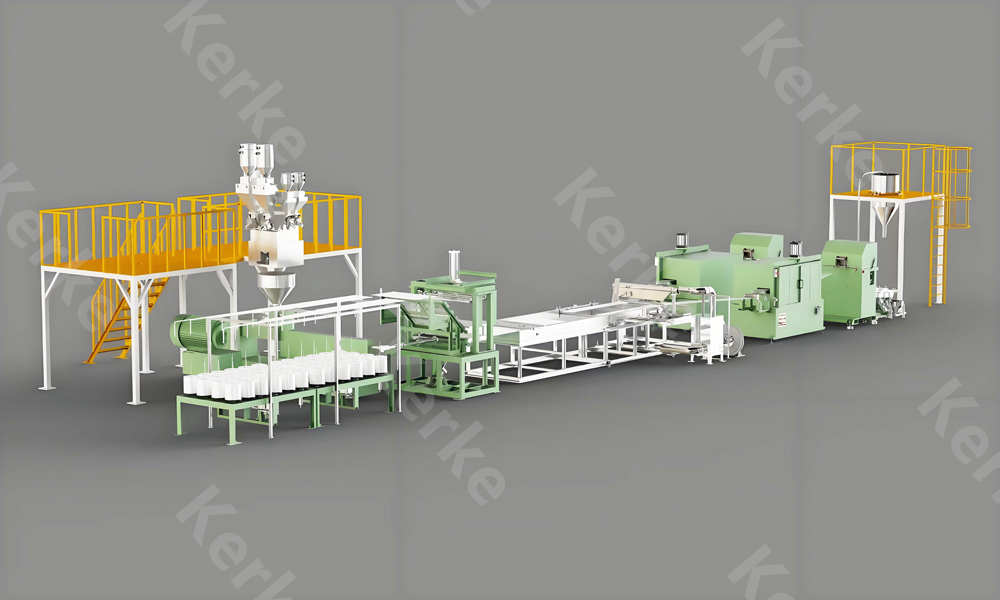
Kerke, a Wanplas factory, has supplied parallel co-rotating twin-screw compounding extruders to more than 70 countries and has over 2,000 machines running worldwide across masterbatch, engineering-plastic, cable, and antistatic compound producers. This article applies the Wanplas group’s plant-economics methodology to the specific case of an antistatic compounding plant, using the KTE-75B and KTE-95B as the reference machine platforms. The objective is to give you a dimensionless, currency-free view of where the money goes, expressed entirely in percentage shares, energy indices, kWh per ton, overall-equipment-effectiveness (OEE) percentages, and physical throughput, so that the analysis remains valid regardless of local resin pricing, electricity tariffs, or labor rates.
All figures below are expressed as proportions or indexed values. There are no currency amounts in this article. Relative cost levels are described as Low, Medium, High, Very High, or Premium, and the Wanplas shared spare-parts allowance is quoted in the service section as USD 500 free parts per year, written in letters rather than with a currency symbol. This keeps the cost model portable across regions and protects you from the volatility of commodity markets while still letting you benchmark one formulation against another.
Table of Contents
- Why an Antistatic Compounding Plant Needs a Disciplined Cost Model
- Antistatic Additive Families and How They Shape Cost
- Fixed Cost Structure of the Plant
- Variable Cost Structure of the Plant
- Consolidated Cost-Category Breakdown by Percentage Share
- Reference Machines: KTE-75B and KTE-95B Specifications
- Energy Consumption per Ton and Formulation Drivers
- Additive Loading versus Performance
- OEE, Capacity Utilization, and Unit-Cost Leverage
- Selection Guidance: Requirement to Model
- Application Industries for Antistatic Compounds
- Service and Support from Kerke, a Wanplas Factory
- Frequently Asked Questions
- Conclusion and How to Proceed
Antistatic Additive Families and How They Shape Cost
The three dominant antistatic technologies in twin-screw compounding each carry a completely different cost signature, and choosing among them is the first lever in any cost breakdown. A carbon-black-based compound is inexpensive per kilogram of additive but requires a high loading, which increases total formulation mass and raises melt viscosity, screw torque, and energy per ton. A carbon-nanotube (CNT) compound is the opposite: the additive is Premium cost but is used at a fraction of a percent, so its mass contribution is tiny while its per-kilogram price dominates the additive line. A permanent antistatic masterbatch built on migratory or intrinsically conductive polymer carriers sits between the two, offering durable performance at a Medium-to-High additive cost with moderate loading.
Carbon black remains the workhorse for commodity antistatic and conductive plastics because it is Low cost and widely available, and it also reinforces the matrix. The penalty is loading: typical antistatic grades run 10 percent to 30 percent by weight, and conductive grades can exceed 35 percent. At those loadings the carbon black is no longer a small additive; it becomes a major share of the total raw-material bill and a major driver of specific energy because dispersing a high filler fraction demands high shear and long residence with strong kneading blocks.
Carbon nanotube masterbatches are used where surface resistance must stay low at very low loading, or where transparency and mechanical retention matter. Because the active ingredient is deployed at roughly 0.5 percent to 2.0 percent, the resin remains the dominant mass and the screw sees lower viscous load, which can reduce energy per ton. The trade-off is the Premium price of the CNT concentrate, which can make the additive line a High or Very High share of unit cost even though the loading is small.
Permanent antistatic masterbatches, sometimes based on polymeric antistatic agents that bloom or form a hydrophilic layer, are favored for packaging and electronics handling where carbon black’s darkness is unacceptable. Loading is typically 3 percent to 8 percent, and the additive cost is Medium-to-High. Because these systems are sensitive to processing temperature and residence time, they reward a well-controlled twin-screw profile with side feeding and gentle melting zones rather than aggressive shear.
A hybrid approach is increasingly common in practice, where a small amount of carbon black or conductive pigment is combined with a permanent antistatic carrier to tune both the surface-resistance floor and the long-term stability. This blending strategy is a deliberate cost-management decision: it lets the formulator use just enough low-cost conductive filler to guarantee the dissipative window while relying on the masterbatch for durability, avoiding the Premium price of a fully CNT-based route. On a KTE line the hybrid is straightforward to run because both components can be metered independently through the loss-in-weight and side-feeding systems, giving the operator precise control over the additive cost share without sacrificing the performance envelope that the end customer requires.
The practical conclusion for the cost model is straightforward: the additive family you select determines which column of your variable-cost table grows. Carbon black grows the resin-plus-additive mass and the energy line; CNT grows the additive price line with little energy penalty; permanent masterbatch grows the additive line moderately while demanding process control that protects OEE. None of these choices can be made on price alone, because each also changes the throughput ceiling and the scrap rate.
Fixed Cost Structure of the Plant
Fixed costs are the expenditures that do not scale with the number of tons you compound in a given month. They are incurred whether the line runs at full capacity or sits idle, and they are the reason capacity utilization is such a powerful lever on unit cost. For an antistatic twin-screw compounding plant the fixed structure has three principal layers: equipment depreciation, plant and utilities infrastructure, and fixed labor.
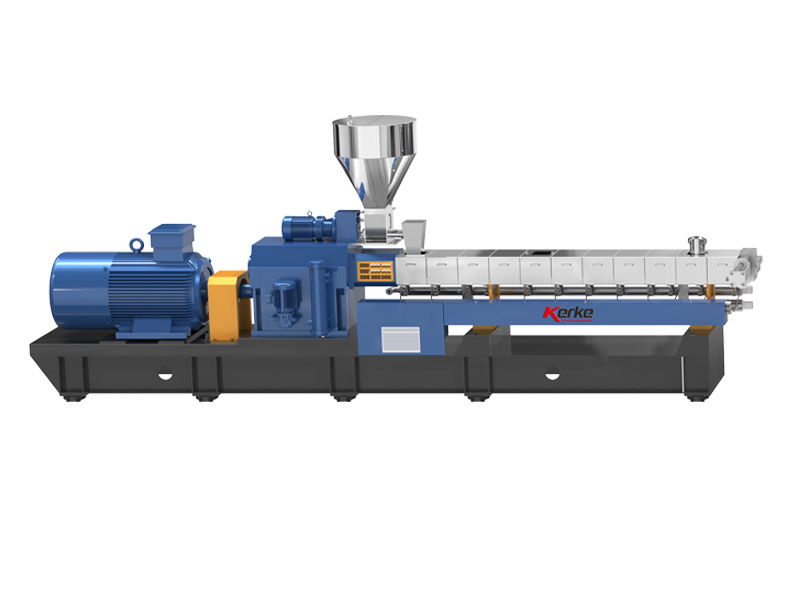
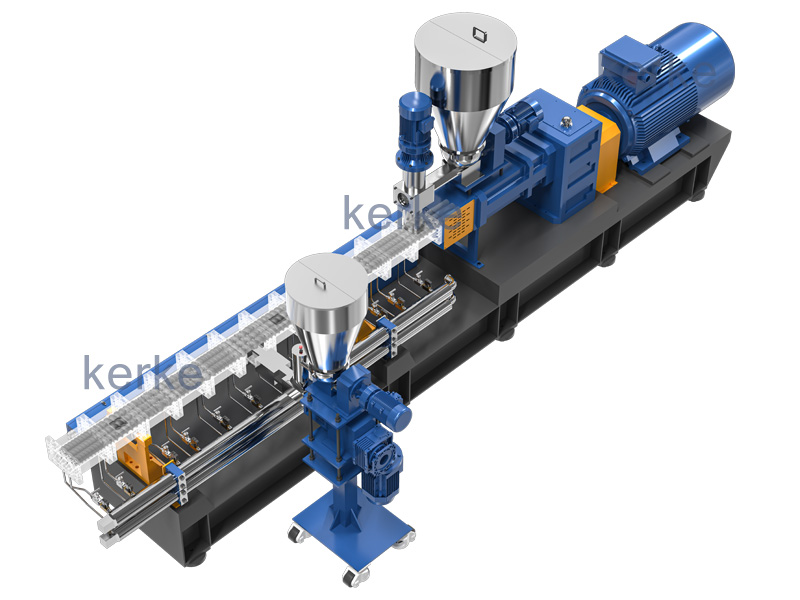
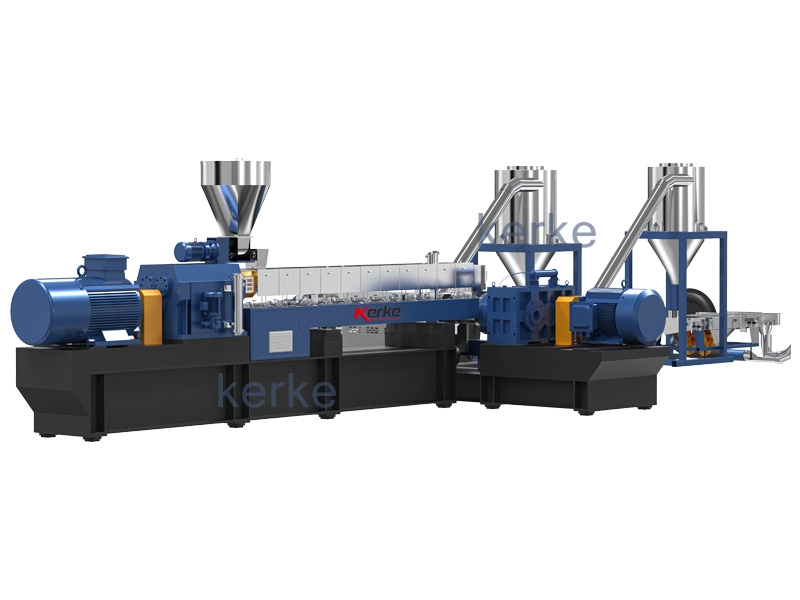
Equipment depreciation is anchored by the twin-screw line itself. The KTE co-rotating parallel twin-screw extruder, with its gearbox, barrels, screws, side feeders, loss-in-weight feeding system, pelletizing downstream, and control cabinet, represents the largest single depreciable asset. Within a standard straight-line depreciation horizon the line contributes a fixed charge per month that, when divided by actual tons produced, falls as utilization rises. A plant that runs the KTE-95B at a high load therefore spreads the same depreciation over many more tons than a plant that runs intermittently, and the per-ton depreciation share drops accordingly.
Plant and infrastructure fixed cost covers the building, the compressed-air system, the central dust extraction needed for carbon-black handling, the water chiller and cooling tower, the electrical transformation capacity, and the quality lab. Antistatic compounding is unusually infrastructure-heavy because carbon black demands dust control and because surface-resistance testing requires a controlled measurement environment; these fixed overheads do not disappear when the line stops.
Fixed labor covers the supervisory, planning, and quality staff whose presence is required regardless of hourly output: the production supervisor, the quality engineer, the maintenance lead, and the warehouse coordinator. In a single-line plant this fixed labor pool is a meaningful share of fixed cost, and it is the component most often underestimated during the planning phase. Treating fixed labor as a true fixed charge, rather than folding it into variable conversion cost, is essential for an honest breakdown.
What makes the fixed side manageable is that every fixed element becomes cheaper per ton as OEE and utilization improve. A plant designed around a KTE-75B that achieves an OEE of 85 percent with three-shift operation will report a fixed-cost share per ton roughly half that of an otherwise identical plant running one shift at 60 percent OEE. The machine is the same; the cost model is transformed by how relentlessly it is used.
Variable Cost Structure of the Plant
Variable costs move with production volume and with formulation. They are where the antistatic compounding plant lives or dies economically, because the dominant variable element, resin, is a commodity whose price swings with petrochemical cycles, and the second element, the antistatic additive, ranges from Low to Premium depending on the technology chosen.
Resin raw material is almost always the largest single share of total unit cost in a plastics compounding plant, and antistatic compounds are no exception. Whether the base is polypropylene, polyethylene, polystyrene, ABS, or a blend, the polymer typically accounts for the majority of the cost pie. Because antistatic grades frequently require a clean, low-contamination base resin to hit surface-resistance and cleanliness specs for electronics, the resin line can skew toward the upper end of its normal range, and the buyer often cannot substitute a cheaper off-spec grade without risking the performance claim.
The antistatic additive is the second variable line and the one most unique to this product family. As discussed, its share ranges from modest for carbon black at low conductive targets, to High for permanent masterbatch, to Very High for CNT concentrates used at low loading. This line is where formulation engineering pays for itself: a small reduction in required loading, achieved through better dispersion on the twin screw, directly reduces variable cost without changing the performance envelope.
Energy is a variable cost expressed most usefully as kWh per ton. Antistatic compounds are energy-intensive relative to unfilled polymers because dispersion of conductive fillers needs high specific mechanical energy. The kWh-per-ton figure is not fixed; it rises with filler loading, falls as screw diameter increases (larger screws are more specific-energy-efficient), and responds to screw-element design and melt-temperature strategy. We quantify this in the energy table below.
Maintenance and spare parts form a variable-but-sticky line. Twin-screw compounding wears barrels and screw elements, and carbon black is abrasive, accelerating wear relative to neat-resin running. A disciplined wear-management program converts this from a surprise expense into a planned variable cost, and the Wanplas group’s spare-parts policy (USD 500 free parts per year) offsets a portion of the routine consumable load.
Variable labor covers the operators and line technicians whose hours scale with runtime: shift operators, pelletizing-line attendants, and material handlers. On a well-automated KTE line with loss-in-weight feeders and centralized control, variable labor per ton is Low and becomes lower still as throughput per shift increases, because one operator supervises a larger tons-per-hour flow.
Quality and overhead complete the variable side: surface-resistance testing, RoHS and REACH compliance documentation, and the indirect consumables of running a clean antistatic line. These are small per ton but non-zero, and they grow with the documentation burden of serving regulated electronics and packaging customers.
A frequently overlooked variable element is pelletizing loss and rework. Antistatic compounds, especially those with high carbon-black loading, are unforgiving of strand breakage and die-face inconsistencies, and any off-spec material must be reground and recompounded rather than sold. This rework silently inflates the resin and additive lines because the same raw material is paid for twice, and it also consumes extra energy and labor. Treating pelletizing stability as a cost-control discipline, rather than a downstream afterthought, is one of the highest-leverage improvements available on a KTE line, because it reduces both material waste and the quality-line penalties tied to customer complaints.
Consolidated Cost-Category Breakdown by Percentage Share
The table below presents a dimensionless cost breakdown. The shares are expressed as a percentage of total unit conversion-plus-material cost and are given as representative ranges for an antistatic twin-screw compounding plant running a carbon-black or permanent-masterbatch formulation on a mid-size KTE line at healthy utilization. The exact position within each range depends on resin price, additive technology, and electricity tariff, but the relative ordering is stable across regions. No currency values are used; this is a share model.
| Cost Category | Sub-element | Typical Share of Total Unit Cost (%) | Cost Nature | Primary Sensitivity Driver |
|---|---|---|---|---|
| Resin raw material | Base polymer (PP / PE / PS / ABS / blend) | 55 – 70 | Variable | Commodity resin price cycle, grade cleanliness |
| Antistatic additive | Carbon black / CNT / permanent masterbatch | 8 – 22 | Variable | Additive technology, required loading, dispersion efficiency |
| Energy | Electricity for extrusion and pelletizing (kWh/ton) | 3 – 6 | Variable | Filler loading, screw size, OEE |
| Equipment depreciation | KTE twin-screw line and downstream | 6 – 12 | Fixed | Capacity utilization, depreciation horizon |
| Plant and infrastructure | Building, dust extraction, chiller, lab | 4 – 8 | Fixed | Facility scale, shift pattern |
| Fixed labor | Supervision, quality, maintenance lead | 4 – 8 | Fixed | Organizational structure, shift count |
| Variable labor | Operators, line attendants, handlers | 3 – 6 | Variable | Automation level, tons per shift |
| Maintenance and spare parts | Barrel and screw wear, consumables | 2 – 4 | Variable | Abrasion from carbon black, planned wear program |
| Quality and overhead | Surface-resistance test, compliance docs | 2 – 5 | Variable | Regulated-customer documentation burden |
Two readings of this table matter most. First, resin plus antistatic additive together normally represent 65 percent to 88 percent of unit cost, which means formulation engineering and resin sourcing dominate the economics far more than the machine purchase price does. Second, the entire fixed block (depreciation, plant, fixed labor) is only about 14 percent to 28 percent of unit cost at healthy utilization, which is precisely why maximizing utilization is the cheapest way to shrink unit cost without touching the formula. The machine you choose influences the fixed share through depreciation and the variable share through energy and scrap, but it does not displace resin and additive as the primary cost drivers.
Reference Machines: KTE-75B and KTE-95B Specifications
The KTE series from Kerke, a Wanplas factory, covers parallel co-rotating twin-screw extruders from KTE-16B up to KTE-135D. For an antistatic compounding plant, the KTE-75B and KTE-95B are the two most relevant mid-size platforms: the KTE-75B suits specialty, frequent-changeover, and moderate-volume production, while the KTE-95B suits higher-volume masterbatch and compound running. Both accept side feeders for later addition of carbon black, liquid feeders for antistatic agents, and the full range of KTE screw-element configurations for optimized dispersion.
The specification tables below use representative values for antistatic-compound service. Screw diameter corresponds directly to the model number, and the L/D ratio reflects a dispersion-optimized configuration with an optional venting zone for moisture and volatiles. Output ranges are stated as a band because antistatic formulations vary widely in filler loading and therefore in specific throughput.
| Specification | KTE-75B | KTE-95B |
|---|---|---|
| Screw diameter (mm) | 75 | 95 |
| L/D ratio | 40 – 48 | 40 – 48 |
| Max screw speed (rpm) | 600 | 500 |
| Main motor power (kW, representative) | 132 | 250 |
| Typical output, carbon-black compound (kg/h) | 250 – 600 | 600 – 1500 |
| Typical output, permanent-masterbatch compound (kg/h) | 300 – 700 | 700 – 1700 |
| Side feeder positions | 1 – 2 | 1 – 2 |
| Venting | Natural + vacuum optional | Natural + vacuum optional |
| Energy index (baseline = 100) | 100 | 85 |
| Target OEE (%) | 82 – 88 | 82 – 88 |
The energy index deserves explanation. With the KTE-75B normalized to a baseline of 100 index points for specific energy, the KTE-95B scores 85 because the larger screw diameter improves specific-energy efficiency: more material is processed per kilowatt-hour. This index is dimensionless and tariff-independent, so it travels cleanly across markets. The OEE target of 82 percent to 88 percent reflects realistic best practice for a well-run antistatic line once changeover discipline, feeder reliability, and pelletizing stability are under control.
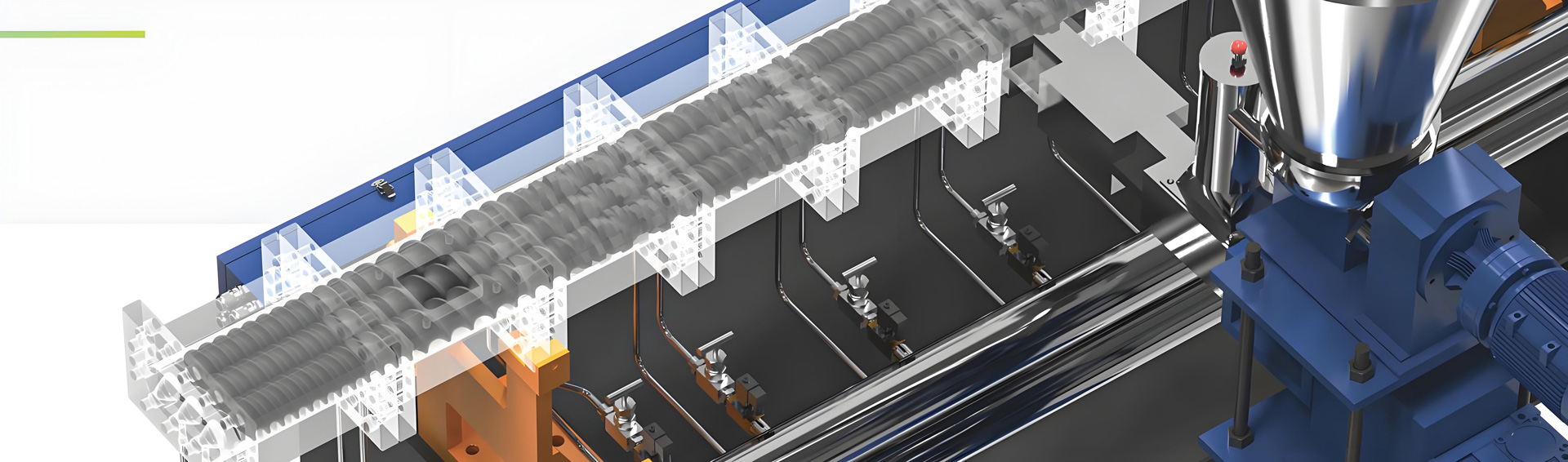
Both machines share the Kerke screw-design philosophy: computer-aided screw assembly with kneading co-type elements that provide excellent self-cleaning, good interchangeability, and the ability to realize material transport, plasticization, shearing, dispersion, homogenization, exhaust, and pressure building in a single continuous pass. For carbon black this self-cleaning behavior is critical, because it limits cross-contamination between dark and light runs and shortens changeover, which directly protects OEE and therefore fixed-cost recovery.
| Process Capability | KTE-75B | KTE-95B |
|---|---|---|
| Dispersion class | Fine to ultra-fine | Fine to ultra-fine |
| Recommended feeder set | Loss-in-weight main + side | Loss-in-weight main + side + liquid |
| Pelletizing compatibility | Strand, air-cooled die-face, underwater | Strand, water-ring, underwater |
| Typical changeover time (min) | 30 – 60 | 40 – 75 |
| Footprint suitability | Compact, flexible cell | Higher-volume dedicated line |
Energy Consumption per Ton and Formulation Drivers
Energy is best managed as kWh per ton rather than as a power rating, because the per-ton figure already captures both how hard the screws work and how much material flows. The table below gives representative kWh-per-ton bands for antistatic formulations on the two reference machines. These are dimensionless physical quantities and contain no currency.
| Formulation Type | Carbon-Black Loading | KTE-75B (kWh/ton) | KTE-95B (kWh/ton) | Note |
|---|---|---|---|---|
| Low antistatic (packaging) | 8 – 15% | 220 – 300 | 190 – 260 | Lower viscosity, easier dispersion |
| Medium antistatic (ESD) | 15 – 25% | 280 – 360 | 240 – 310 | Balanced shear and throughput |
| Conductive (high loading) | 25 – 35% | 340 – 450 | 300 – 390 | Highest specific energy, wear focus |
| Permanent masterbatch | 3 – 8% | 200 – 280 | 175 – 240 | Gentle profile, temperature control |
| CNT concentrate dilution | 0.5 – 2% | 190 – 260 | 165 – 225 | Low viscous load, Premium additive |
Two patterns are visible. First, energy per ton falls as you move from the KTE-75B to the KTE-95B at every formulation, confirming the 85 energy index. Second, energy rises steeply with carbon-black loading because dispersing more solid phase demands more specific mechanical energy and because higher viscosity pushes the motor closer to its torque limit at a given throughput. The CNT and permanent-masterbatch rows are the most energy-favorable, which means their higher additive price is partly offset by lower conversion energy; this is exactly the kind of trade-off the percentage-share model is built to reveal.
Reducing kWh per ton is a variable-cost lever you control directly on the machine. Optimizing the kneading-block configuration, using side feeding to add carbon black after the polymer is melted (which lowers the viscous work in the melting zone), maintaining barrel temperature profile for the base resin, and keeping the gearbox and screws in good wear condition all lower the per-ton figure. Each 10 percent reduction in kWh per ton typically removes about 0.3 to 0.6 percentage points from the energy share of unit cost, a small but compounding saving across a full production year.
Additive Loading versus Performance
The relationship between additive loading and performance is the heart of antistatic cost optimization, because it ties the most expensive variable lines to the property the customer pays for: surface resistance. The table maps representative loading bands to expected performance regimes and to the resulting cost posture. Exact thresholds depend on the specific resin and additive grade and must be validated by surface-resistance testing.
| Additive System | Loading Band | Surface-Resistance Regime | Additive Cost Posture | Processing Implication |
|---|---|---|---|---|
| Carbon black | 8 – 15% | Antistatic (ESD-safe) | Low – Medium | Moderate shear, good dispersion needed |
| Carbon black | 25 – 35% | Conductive | Medium (high mass) | High torque, higher kWh/ton, abrasion |
| Permanent masterbatch | 3 – 8% | Antistatic, durable | Medium – High | Gentle profile, avoid degradation |
| CNT concentrate | 0.5 – 2% | Antistatic to conductive | Very High – Premium | Low loading, dispersion-critical |
The strategic lesson is that the lowest-cost solution is not always the lowest-price additive. Carbon black is cheap per kilogram but its high loading inflates both the additive mass share and the energy share; CNT is expensive per kilogram but its tiny loading keeps mass low and can lower energy, so on a per-ton-performance basis the two can converge. Permanent masterbatch often wins for packaging and electronics-handling films where darkness is unacceptable and where a Medium-to-High additive cost is acceptable for the functional and aesthetic result. The correct choice is the one that meets the surface-resistance spec with the smallest total cost-share penalty across resin, additive, and energy combined.
OEE, Capacity Utilization, and Unit-Cost Leverage
Overall equipment effectiveness combines availability, performance, and quality into a single percentage that predicts how much of the calendar is actually producing saleable tons. For an antistatic compounding plant, OEE is the master variable of the fixed-cost block. Every point of OEE lost to unplanned downtime, slow cycles, or scrap is a point of fixed cost that fails to be recovered across the tons produced.
Consider the depreciation and plant fixed block, which together sit near 10 percent to 20 percent of unit cost at healthy utilization. If a plant designed for three-shift operation actually runs one shift with frequent stoppages, its effective OEE might fall from the mid-80s to the low 50s. The fixed share per ton then rises sharply because the same monthly depreciation and building cost is divided by far fewer tons. In percentage terms, fixed cost can climb from roughly 15 percent of unit cost to 25 percent or more, eroding margin without any change in resin price or additive loading.
Availability is protected by the planned-wear program: monitoring barrel and screw-element wear, keeping spare elements on hand, and using the Wanplas shared spare-parts allowance (USD 500 free parts per year) for routine consumables. Performance is protected by feeder reliability and by tuning the screw profile so the line runs at its design tons per hour without torque limiting. Quality is protected by in-line and lab surface-resistance testing so that off-spec material is caught before it becomes customer-facing scrap, which would otherwise add to the variable-cost and overhead lines simultaneously.
Capacity utilization interacts with OEE. A plant can have high OEE yet low utilization if demand is weak, and in that case the fixed share per ton remains elevated simply because the line is not being fed enough hours. The cost model therefore has two independent dials: run the machine well (OEE) and run it often (utilization). Both shrink the fixed block as a percentage of unit cost, which is why sales and operations planning deserve as much attention as screw design in an antistatic compounding business.
Demand planning is the connective tissue between these two dials. An antistatic compounding plant that batches similar formulations reduces changeover frequency, lifts effective OEE, and lets the line stay in a stable operating window where scrap is minimal and energy per ton is at its lowest. Conversely, a plant that chases many small, dissimilar orders pays a hidden tax in changeover time, purge material, and recommissioning risk. The percentage-share model makes this visible: every hour lost to avoidable changeover is an hour during which the fixed block is not being amortized, and that cost shows up directly in the depreciation and plant lines of the unit-cost table. Owners who treat the production schedule as a financial instrument, not merely a logistics task, consistently report a lower fixed share than peers with comparable equipment.
Selection Guidance: Requirement to Model
Choosing between the KTE-75B and KTE-95B is a function of required annual tonnage, formulation abrasiveness, and how many product changeovers the plant must absorb. The guidance table below maps common business situations to a recommended platform. It is a planning aid; final configuration should be confirmed against your exact formulation and throughput target.
| Business Requirement | Typical Annual Volume | Dominant Formulation | Recommended Model | Rationale |
|---|---|---|---|---|
| Specialty, frequent recipe changes | Low – Medium | Permanent masterbatch, CNT | KTE-75B | Compact, fast changeover, flexible cell |
| Single high-volume antistatic grade | Medium – High | Carbon black 15 – 25% | KTE-95B | Higher throughput, better specific energy |
| Conductive compound, abrasive | Medium | Carbon black 25 – 35% | KTE-95B | Lower kWh/ton, robust wear management |
| Two-color or multi-grade pilot line | Low | All families | KTE-75B | Rapid trials, lower capital fixed charge |
| Large masterbatch plant expansion | High | Carbon black, permanent | KTE-95B (possibly multiple) | Scale economies on fixed block |
The pattern is consistent with the cost model: when volume is high and formulation is energy-hungry, the larger screw wins on both energy index and fixed-cost recovery; when volume is low or changeovers dominate, the smaller, faster-changeover machine protects margin by keeping the fixed charge low and the line responsive. Neither machine changes the fact that resin and additive remain the largest cost shares, but the right choice minimizes the energy and depreciation lines that the operator does control.
Application Industries for Antistatic Compounds
Antistatic twin-screw compounds serve three core downstream worlds, each with its own cost and compliance profile. Mapping your plant to these applications clarifies which standards and which performance bands you must design for, and therefore which additive family is economically rational.
Packaging is the largest volume destination. Antistatic films, trays, and containers prevent dust attraction and protect sensitive contents during handling and transit. Permanent antistatic masterbatch is common here because end products must remain light-colored or transparent, and because packaging converters value durable performance through the supply chain. The cost model for packaging grades is volume-driven: thin margins reward the KTE-95B at high utilization and a formulation tuned for Low-to-Medium additive cost.
ESD protection covers bins, totes, component carriers, and floor and table mats used in assembly and storage. These parts must hold surface resistance in a defined dissipative window so that static discharges are controlled without creating a conductive hazard. Carbon-black compounds at 15 percent to 25 percent loading are typical, and the abrasion of carbon black makes the planned-wear program and the energy-efficient larger screw economically important.
Electronics applications are the most demanding. Semiconductor and device handling requires consistent surface resistance, low ionic contamination, and full documentation for RoHS and REACH compliance. Here the Premium CNT or clean permanent-masterbatch routes can be justified because the customer pays for reliability and traceability, and because the scrap cost of a non-compliant lot far exceeds any saving from a cheaper additive. Standards such as IEC specifications for ESD control, RoHS, REACH, and ISO 9001 quality management define the documentation and process-control burden that shows up in the quality-and-overhead line of the cost table.
Service and Support from Kerke, a Wanplas Factory
Kerke, a Wanplas factory, supports every antistatic compounding line with the full Wanplas group service framework, which is itself a fixed-cost stabilizer because it reduces unplanned downtime and protects OEE. Before shipment each KTE line undergoes factory acceptance testing that includes a representative run where feasible, verification of screw and gearbox parameters, and confirmation of control-system functions. This pre-shipment validation reduces commissioning risk and shortens the time to stable production.
On-site installation and commissioning are carried out by Kerke engineers who set the line to your formulation, tune feeder calibration, and train your operators on screw-profile changes and wear inspection. Training covers safe handling of carbon black dust, surface-resistance test method, and the planned-maintenance calendar that keeps the barrels and elements within tolerance.
The Wanplas shared policy provides USD 500 free parts per year for the life of the standard warranty, plus free replacement of damaged parts within warranty where the fault is covered. For an abrasive carbon-black operation this allowance offsets a meaningful slice of routine consumables and helps convert maintenance from a surprise variable cost into a planned one. Remote monitoring and support let Kerke engineers review control data and advise on process drift, which protects availability without requiring a permanent on-site presence.
Kerke also operates an open-factory policy: customers are welcome to visit the Nanjing facility, observe machines running, and audit the quality system. For an antistatic compounding investor, a factory visit is the most efficient way to confirm that the machine, the documentation discipline, and the service promise are real before committing capital.
Frequently Asked Questions
What is the single largest cost in an antistatic twin-screw compounding plant?
The resin raw material is almost always the largest single share, typically 55 percent to 70 percent of total unit cost, with the antistatic additive adding another 8 percent to 22 percent. Together they normally exceed two-thirds of the cost pie, which means formulation and resin sourcing dominate economics more than the machine purchase price does.
Why does carbon black raise energy consumption per ton?
Carbon black is added at high mass loading and must be dispersed into a fine, well-distributed network, which demands high specific mechanical energy. Higher filler fraction also raises melt viscosity, pushing the motor toward its torque limit at a given throughput. The result is a higher kWh-per-ton figure, especially on conductive grades at 25 percent to 35 percent loading.
Is the KTE-95B always cheaper to run than the KTE-75B?
Per ton of comparable product, yes, because the larger screw has a better specific-energy index (85 versus 100 baseline) and spreads fixed depreciation over more tons. But the KTE-75B can be the lower total-cost choice for low-volume or high-changeover operations, because its smaller fixed charge and faster changeover avoid idle-capital cost when the line is not heavily utilized.
How does OEE affect the fixed-cost share of unit cost?
OEE and utilization determine how many tons absorb the fixed block each month. Falling from the mid-80s to the low-50s in effective OEE can lift the fixed share from roughly 15 percent to 25 percent or more of unit cost, because the same depreciation and building cost is divided by far fewer saleable tons.
Which standards apply to antistatic compounds for electronics?
Typical requirements include IEC specifications for ESD control, RoHS and REACH compliance for restricted substances, and ISO 9001 for the quality-management system. These standards appear as plain-text compliance obligations; meeting them adds to the quality-and-overhead line but is mandatory for regulated electronics customers.
Can a permanent antistatic masterbatch cost less overall than carbon black?
Sometimes. Although the masterbatch additive price is Medium-to-High and carbon black is Low per kilogram, the masterbatch is used at 3 percent to 8 percent loading versus 15 percent to 35 percent for carbon black. Lower loading can mean lower total additive mass and lower energy per ton, so the all-in cost share can converge or favor the masterbatch for light-colored or performance-critical parts.
How should abrasion from carbon black be managed in the cost model?
Treat barrel and screw-element wear as a planned variable cost rather than a surprise. Keep spare elements on hand, monitor wear, and use the Wanplas shared allowance of USD 500 free parts per year for routine consumables. Good wear management protects availability and therefore OEE, which in turn protects the fixed-cost recovery.
Conclusion and How to Proceed
An antistatic twin-screw compounding plant is won or lost on a disciplined cost model, not on a single purchase decision. Resin and antistatic additive together normally represent 65 percent to 88 percent of unit cost, so formulation engineering and resin sourcing are the dominant levers. The machine you choose, whether the flexible KTE-75B or the higher-volume KTE-95B, influences the energy and depreciation lines and, through OEE and utilization, the entire fixed block. Expressed in dimensionless shares, kWh per ton, an energy index normalized to 100, and OEE percentages, this breakdown stays valid across every market and every tariff.
Kerke, a Wanplas factory, designs the KTE series specifically for this kind of dispersion-critical, abrasive, documentation-heavy compounding, and backs it with factory testing, on-site commissioning, training, remote support, and the Wanplas shared service commitments. If you are planning or upgrading an antistatic compounding line, the most useful next step is to send your target formulations, required annual tonnage, and performance specifications so a tailored KTE configuration and a site-specific cost breakdown can be prepared for you. You are also welcome to visit the Kerke facility to observe the machines running and to review the quality system in person before making any commitment.