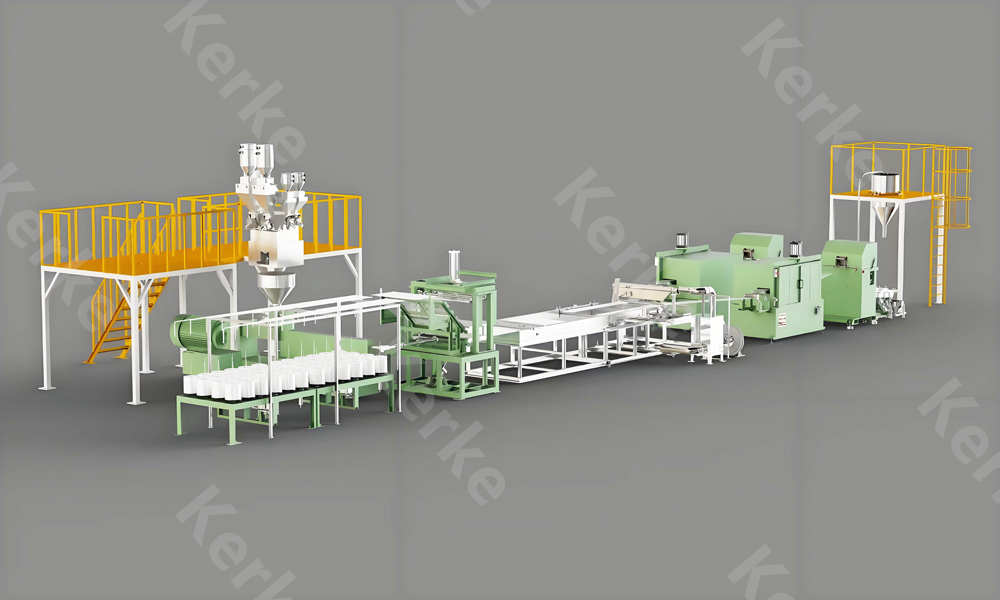
Profitable production of fiber reinforced plastic pellets depends far less on a single machine specification than on how the entire twin-screw pelletizing process converts metered feed into qualified, sellable granules at the lowest reachable cost per ton. Kerke, a Wanplas factory, has spent more than 12 years building co-rotating parallel twin-screw compounding extruders and supporting pelletizing systems for glass-fiber and mineral filled modified plastics, with a 19,997-plus square meter production base, more than 2,000 machines running in over 70 countries, and a technical team of more than 100 specialists. This article analyzes the gross and net profit structure of fiber reinforced plastic twin screw pellet production using relative, currency-free metrics: qualified-product yield, unit energy in kWh per ton, overall equipment effectiveness, and a margin index anchored at 100 baseline points. Every figure here is presented as a relative index or a percentage so that the analysis stays comparable across regions and resin price cycles without referencing any currency amount. Whether you run color masterbatch, glass-fiber reinforced engineering plastics, or mineral filled compounds, the principles of output structure, energy control, and utilization management remain the same, and the Kerke KTE series is used throughout as the concrete equipment reference.
What Drives Profitability in Fiber Reinforced Plastic Pellet Production
The gross and net profit of a fiber reinforced plastic twin screw pellet line is the product of three independent levers that operators can measure every shift: how much qualified pellet comes out relative to feed, how much energy and labor each ton consumes, and how fully the installed capacity is used. Fiber reinforced compounds add a fourth, quality-linked lever because the mechanical value of the pellet is tied directly to retained glass-fiber aspect ratio, so over-shearing the melt not only wastes power but also destroys the property that the customer pays a premium for.
In a twin-screw compounding context, gross profit represents the spread between the value of qualified output and the variable cost of converting feed into pellets, where variable cost is dominated by resin and filler purchase cost, electricity for the drive and peripherals, and consumed consumables such as screen packs and cutter blades. Net profit further subtracts fixed overhead including equipment depreciation, salaried labor, plant utilities allocation, and administrative cost. Because fiber reinforced production is capital intensive and continuous, the fixed portion of total cost is large, which makes net margin unusually sensitive to capacity utilization.
A useful way to keep the discussion honest across different markets is to express profitability as a margin index rather than a currency figure. The margin index is set to 100 baseline points at a reference condition where the raw material index equals 100, the electricity index equals 100, and capacity utilization equals 80 percent. When resin becomes cheaper or the line runs nearer full capacity, the index rises above 100; when material cost climbs or the line sits idle, the index falls. This relative framing lets a plant manager in one region compare a decision with a colleague in another region without converting exchange rates or disclosing contract prices.
The single most controllable lever is yield. A shift from 95 percent qualified yield to 98 percent qualified yield recovers three percentage points of feed that would otherwise become scrap or low-value regrind, and because that feed already carries material and conversion cost, the margin recovery is disproportionate. The next most controllable lever is energy intensity, because co-rotating twin-screw drives are the dominant electrical load in a compounding plant and small improvements in screw configuration or cooling translate into steady kWh-per-ton savings. The third lever, utilization, is managed through changeover discipline, preventive maintenance, and feed preparation so that the line is rarely waiting for material or tooling.
Equipment design binds all three levers together. A barrel with well-placed exhaust, a screw architecture tuned for the specific glass loading, and a pelletizing system matched to the melt viscosity determine the ceiling on yield and the floor on energy. That is why the remainder of this article pairs the profitability framework with concrete Kerke twin-screw configurations and their specification tables, so the analysis stays grounded in real, purchasable machinery rather than generic theory.
Output Structure and Yield of Glass-Fiber Reinforced Twin-Screw Pelletizing
The output structure of a glass-fiber reinforced twin-screw pelletizing line describes where every ton of metered feed ends up. Understanding this structure is the first step to improving gross profit, because the largest losses in fiber reinforced compounding are rarely dramatic breakdowns; they are quiet, continuous drains such as screened fines, off-spec transition material during grade changes, and filament that detaches from the strand or pellet surface and is removed before sale.
A representative output balance for a stable production campaign of 30 percent glass-fiber reinforced polypropylene is shown below. The numbers are typical relative shares rather than absolute tonnages, and they shift with glass loading, whether side feeding is used, and how tightly the pelletizing window is controlled. Higher glass content generally raises fines and dust loss slightly because more brittle fiber is handled, while side feeding and well-tuned strand protection reduce those losses.
Typical Output Balance for 30 Percent Glass-Fiber Reinforced Compound
| Output Stream | Share of Metered Feed (percent) | Disposition | Profit Impact |
|---|---|---|---|
| Qualified pellet (sellable) | 95.0 to 98.5 | Shipped to customer | Full margin contribution |
| Recoverable regrind | 1.0 to 3.5 | Re-fed in permitted ratio | Partial recovery, lower value |
| Screened fines and dust | 0.3 to 1.2 | Collected, limited reuse | Net loss of material cost |
| Start-up and transition loss | 0.2 to 1.0 | Quarantined, reprocessed | Lost conversion time |
| Moisture and volatile venting | 0.1 to 0.5 | Removed at exhaust | Expected, minimal impact |
The qualified-pellet yield, sometimes called good-product rate, is the headline number that feeds directly into gross profit. For a well-tuned co-rotating twin-screw line running glass-fiber reinforced compounds, the qualified-pellet yield normally lands between 95 percent and 98.5 percent of metered feed. The remaining balance is recovered as regrind or treated as loss through filament detachment, screening fines, and start-up transition material. Improving this by even two points is often worth more than a modest reduction in electricity rate, because the saved material carries both its purchase cost and the conversion cost already spent on it.
Recoverable regrind deserves a separate comment. In fiber reinforced production, regrind has shorter average fiber length than virgin pellet, so blindly re-feeding large amounts degrades mechanical properties. Best practice caps regrind at a controlled ratio and blends it into non-critical grades, which preserves the premium value of the main line while still recovering material cost. The discipline of regrind management is therefore a quiet profit lever that sits between pure yield and pure quality.
Transition loss during grade changes is the most variable component and the one most responsive to operator skill. A line that performs a fast, clean purge and reaches spec color and glass dispersion quickly loses less material and less time. Because time lost to transition is also time not producing qualified pellet, transition discipline improves both yield and utilization simultaneously, a double win that the margin index captures well.
Mineral filled compounds behave slightly differently from glass-fiber compounds. Calcium carbonate, talc, and barium sulfate fillers are less prone to filament loss but raise bulk density and abrasive wear, so the loss stream shifts from fines toward screw and barrel wear and higher screen-pack consumption. The yield table above still applies in shape, but the profit leak moves from dust to consumables and maintenance, which is why the service and support discussion later addresses spare-parts policy directly.
Kerke Co-Rotating Twin-Screw Lines for Glass-Fiber Reinforced Compounds
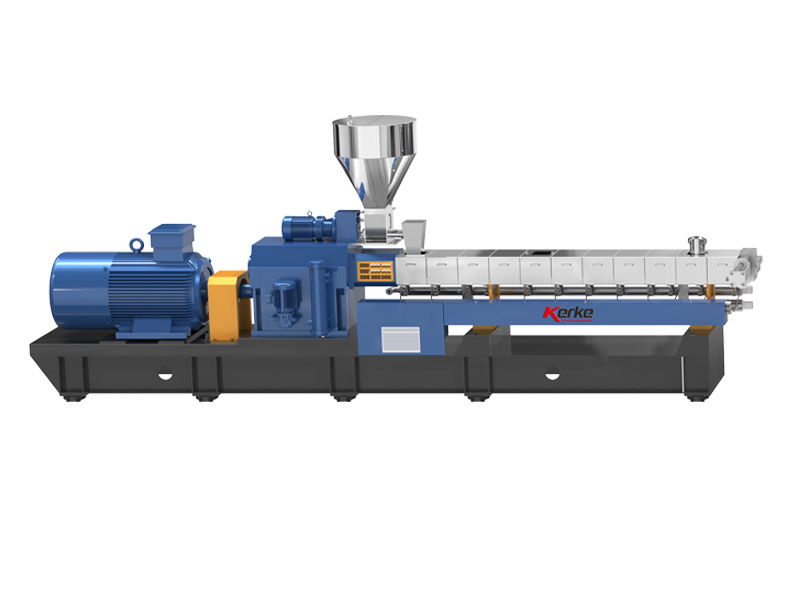
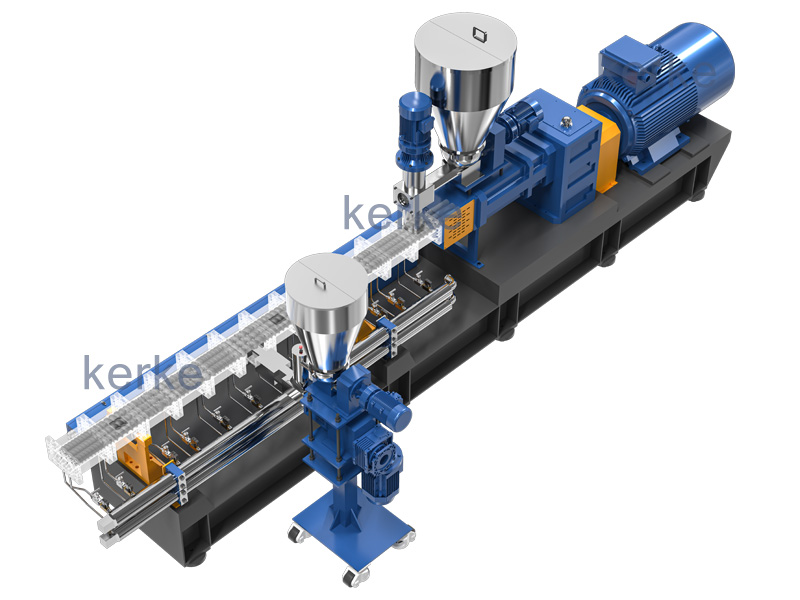
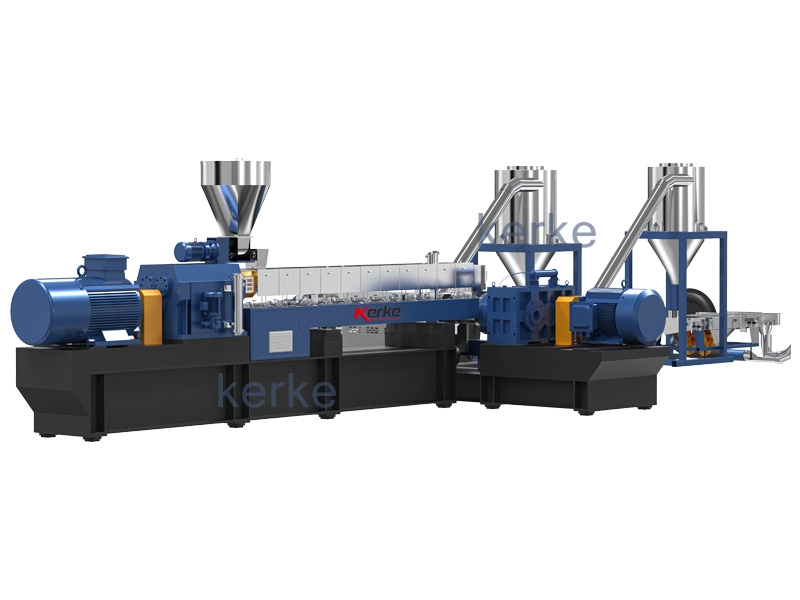
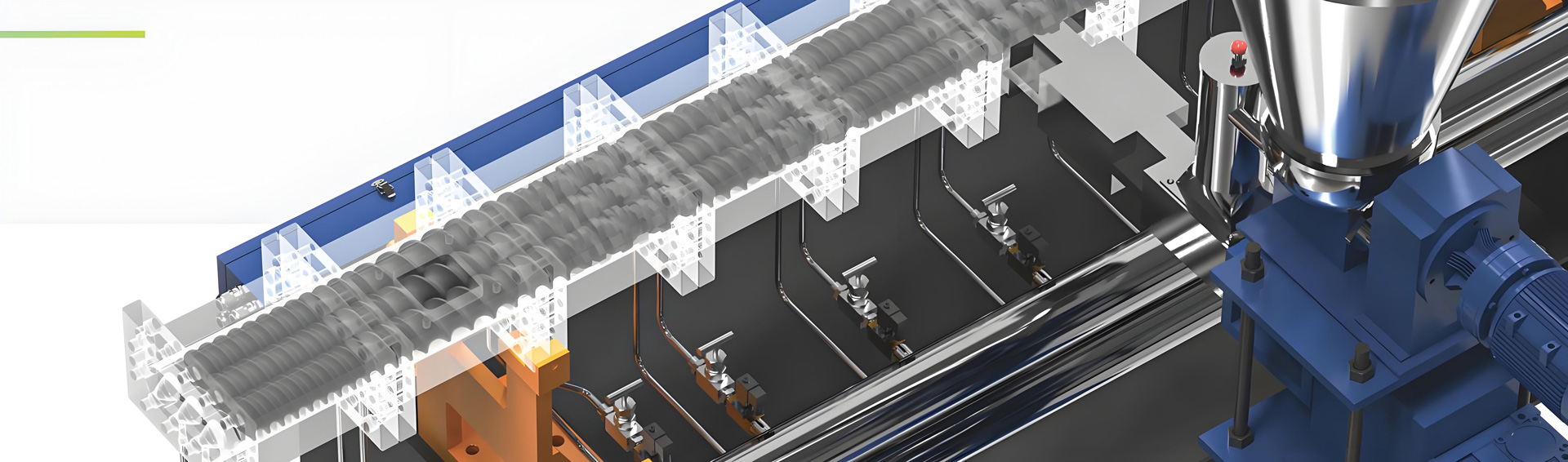
When the analysis turns from theory to machinery, the Kerke KTE series of parallel co-rotating twin-screw extruders is the concrete reference. The KTE series spans KTE-16B up to KTE-135D and is built around a modular barrel and screw system that can be reconfigured for aspect ratio, barrel section layout, screw element arrangement, exhaust position, feeding method, and electrical control. For glass-fiber reinforced compounds the relevant configurations emphasize a melting zone that fully plasticizes the polymer before fiber introduction, a side feeder port for glass roving or chopped fiber, and a gentle conveying and mixing zone that disperses fiber without over-cutting it.
The flagship of the range for continuous glass-fiber reinforced production is the KTE-135D. It is the workhorse for masterbatch and engineering compound plants that need high hourly throughput with stable pellet quality. The specification table below lists the parameters that most directly drive the profit framework: capacity in tons per hour, length-to-diameter ratio, and drive power, because those three numbers determine throughput ceiling, shear intensity, and energy draw.
Kerke KTE-135D Co-Rotating Twin-Screw Extruder Specification
| Specification | KTE-135D Value | Profit Relevance |
|---|---|---|
| Screw diameter | 135 mm | Sets free volume and throughput ceiling |
| L/D ratio | 40 to 52 (configurable) | Longer L/D improves dispersion and venting |
| Drive power | Up to 630 kW | Caps specific energy and output rate |
| Output (glass-fiber filled) | 2.0 to 4.5 t/h | Defines capacity utilization basis |
| Max screw speed | Around 400 rpm | Controls shear and fiber cutting |
| Side feeder | Twin-screw side feeder available | Protects fiber aspect ratio |
| Venting | Vacuum exhaust sections | Lifts qualified yield |
| Control system | PLC with recipe management | Shortens transition loss |
The KTE-135D is configured so that polymer is fully plasticized in the first barrel sections before glass fiber enters through a side feeder, which keeps the fiber in the high-shear melting zone for the shortest practical residence time. This single design choice protects retained fiber length, which in turn lets the formulator hit target mechanical properties at a lower glass loading. Lower glass loading means lower material cost per ton of qualified pellet, and that is exactly the kind of structural margin improvement that the relative profit framework rewards.
Equally important for profit is the exhaust layout. Glass-fiber and mineral filled compounds often carry moisture and volatile coupling-agent residues that, if not vented, produce porous or silver-streaked pellets that fail quality checks. The KTE barrel supports vacuum exhaust at one or more sections, so the qualified-pellet yield stays in the upper part of the 95 to 98.5 percent band rather than sliding toward the lower end where scrap and regrind multiply.
Kerke’s screw design uses computer-aided screw assembly with kneading blocks selected for self-cleaning behavior. Self-cleaning matters for profit in two ways: it reduces cross-contamination during grade changes, which shortens transition loss, and it improves interchangeability of screw elements, which lowers the cost and lead time of reconfiguration when a customer changes formulation. For a compounding plant serving many recipes, that flexibility is a real utilization and margin advantage.
Mid-Capacity and Laboratory Configurations
Not every profit analysis points to the largest machine. Many glass-fiber reinforced compounders run a product mix where a mid-capacity line carries the volume and a laboratory line protects formulation margin by de-risking recipes before they reach production. Kerke covers both ends of this spectrum with the KTE-95D, KTE-75D, KTE-50D, and laboratory-scale KTE-25 models, all sharing the same modular barrel and screw philosophy as the KTE-135D.
The KTE-95D is the natural choice for a plant targeting the 0.8 to 2.0 t/h band of glass-fiber reinforced compounds, while the KTE-75D fits the 0.4 to 1.0 t/h band and the KTE-50D serves specialty, low-volume, or highly filled grades. The specification table below groups these three production models so a buyer can see how capacity, L/D, and drive power scale together.
Kerke Mid-Capacity Twin-Screw Models Specification
| Model | Screw Diameter (mm) | L/D Ratio | Drive Power (kW) | Output GF-Filled (t/h) |
|---|---|---|---|---|
| KTE-95D | 95 | 40 to 48 | Up to 315 | 0.8 to 2.0 |
| KTE-75D | 75 | 40 to 44 | Up to 160 | 0.4 to 1.0 |
| KTE-50D | 50 | 40 to 44 | Up to 55 | 0.12 to 0.35 |
| KTE-25 (lab) | 25 | 40 | 5.5 | 0.5 to 5 kg/h |
The laboratory KTE-25 deserves emphasis in any profit discussion because formula trial cost is a hidden drag on net margin. Running a new glass-fiber recipe directly on a production line risks tons of off-spec material during learning. Running the same learning on a KTE-25 consumes grams of material and a fraction of the energy, so the production line only starts once the recipe is locked. This protects both yield and utilization on the revenue-generating machine, and over a year of active formulation work the saved scrap easily exceeds the laboratory machine’s operating cost.
For mid-capacity plants, the KTE-75D often pairs with a KTE-135D in a two-line strategy: the large line runs the steady high-volume grade, and the smaller line absorbs short runs, trials, and specialty mineral filled compounds without interrupting the main campaign. This division of labor raises overall utilization on both machines because each line stays in its optimal run-length window instead of being stopped for frequent changeovers.
All four models share Kerke’s loss-in-weight feeder compatibility, side feeder option, and the same control logic, so an operator trained on one can move to another with minimal relearning. That cross-model familiarity reduces human-error scrap and shortens commissioning of a second line, both of which flow straight into the qualified-yield and utilization terms of the margin index.
Relative Profit Sensitivity to Raw Material, Electricity, and Utilization
This is the core of the gross and net profit analysis. Because the article must avoid any currency amount, the entire sensitivity model is built on index points and percentages. The margin index starts at 100 baseline points under the reference condition: raw material index equals 100, electricity index equals 100, and capacity utilization equals 80 percent. The raw material index tracks the relative purchase cost of resin plus filler; the electricity index tracks the relative cost of power per kWh; capacity utilization is the share of available operating hours that the line actually produces qualified pellet.
Two margin measures are reported. Gross margin index responds mainly to variable cost: it falls when material or electricity becomes more expensive and rises only mildly with utilization, because gross margin is measured before most fixed overhead is absorbed. Net margin index adds the fixed-overhead effect, so it responds much more strongly to utilization. The illustrative sensitivity coefficients below are relative and meant for planning, not as a substitute for a plant’s own cost model, but they are chosen to reflect the usual cost structure of fiber reinforced compounding where material is the largest cost block and fixed overhead is substantial.
Margin Index Sensitivity Across Operating Scenarios
| Scenario | Raw Material Index | Electricity Index | Utilization (percent) | Gross Margin Index | Net Margin Index | Grade |
|---|---|---|---|---|---|---|
| Baseline reference | 100 | 100 | 80 | 100 | 100 | Medium |
| Material cost up 15 percent | 115 | 100 | 80 | 91 | 91 | Medium |
| Material up 15, power up 20 | 115 | 120 | 80 | 85 | 85 | Low |
| Above plus low utilization 70 | 115 | 120 | 70 | 84 | 79 | Low |
| Material down 10, power down 10 | 90 | 90 | 90 | 111 | 115 | High |
| High utilization 95, stable cost | 100 | 100 | 95 | 102 | 109 | High |
| Low utilization 60, stable cost | 100 | 100 | 60 | 97 | 88 | Medium |
The table shows the defining feature of fiber reinforced pellet profit: net margin is far more volatile than gross margin when utilization moves. Dropping from 80 percent to 60 percent utilization barely changes the gross margin index, which falls only to 97, but collapses the net margin index to 88 because fixed overhead is now spread over far fewer tons. Conversely, raising utilization from 80 to 95 percent while holding cost stable lifts the net margin index from 100 to 109, a nine-point gain with no change in resin or power price. For a capital-intensive continuous line, utilization management is therefore the highest-leverage internal control a plant owns.
Raw material index is the heaviest external drag. A 15 percent rise in the material index cuts both margin indices by nine points at stable utilization, and combining it with a 20 percent power increase drives the net margin index to 85, the Low grade. This is why compounders hedge formulation risk by qualifying alternative resin sources and by designing recipes that meet property specs at the lowest feasible glass and filler loading. Every percentage point of loading reduction that still passes the customer’s mechanical test is a permanent reduction in the raw material index exposure.
Electricity index matters less than material but more than many operators assume, because the twin-screw drive is a large, continuous load. A 20 percent power increase removes about six points from the margin index. The practical response is not only to negotiate the power rate but to cut specific energy through screw optimization, right-sized drive loading, and recovered heat where permitted. The next section quantifies the energy lever directly in kWh per ton.
The grade bands used above are a simple, transferable language for management: below 85 is Low, 85 to 100 is Medium, 100 to 115 is High, 115 to 130 is Very High, and above 130 is Premium. A plant can report its weekly margin index next to its grade without exposing any currency figure, which satisfies both internal review and the currency-free discipline required here.
Unit Energy Consumption and OEE Benchmarks
Unit energy consumption is the bridge between machine specification and profit. For co-rotating twin-screw compounding of glass-fiber reinforced plastics, specific energy normally falls between 250 and 480 kWh per ton, and the exact position depends on glass loading, mineral filler share, L/D ratio, melt temperature, and how aggressively the screw is driven. Glass-fiber compounds sit toward the higher end because dispersing and wetting fiber demands more mechanical work, and longer L/D barrels add conveying and mixing length that also add work.
Specific Energy by Model and Glass Loading
| Model | Compound Type | Specific Energy (kWh/ton) | Energy Index (baseline 100) |
|---|---|---|---|
| KTE-135D | 30 percent glass-fiber PP | 300 to 360 | 100 |
| KTE-95D | 30 percent glass-fiber PP | 320 to 390 | 108 |
| KTE-75D | 20 percent glass-fiber PA | 350 to 430 | 118 |
| KTE-135D | Mineral filled talc 40 percent | 260 to 320 | 92 |
| KTE-135D | 50 percent glass-fiber reinforced | 400 to 480 | 133 |
The energy index in the last column is the practical translation of the electricity discussion: a line running at 133 on the energy index versus 100 consumes about a third more power per ton, which the sensitivity model converts into roughly a ten-point lower margin index at equal power price. The levers to pull the energy index down are screw element selection that reaches dispersion at lower specific mechanical energy, operating at the lowest screw speed that still meets quality, keeping the melt temperature only as high as necessary, and maintaining the gearbox and barrel so the drive does not fight avoidable friction.
Overall equipment effectiveness, or OEE, is the multiplier that turns nameplate capacity into real qualified output. OEE is the product of availability, performance, and quality. Availability captures unscheduled downtime from breakdowns and changeovers; performance captures speed loss from running below target rate; quality captures the qualified-yield loss already discussed. A mature, well-supported line typically reaches an OEE between 78 percent and 88 percent, built from availability near 92 percent, performance near 95 percent, and quality yield near 97 percent. New lines usually start near 70 percent and climb as the crew gains experience.
Typical OEE Build-Up by Maturity
| Maturity Level | Availability (percent) | Performance (percent) | Quality (percent) | OEE (percent) |
|---|---|---|---|---|
| New commissioning | 85 | 88 | 94 | 70 |
| Experienced crew | 90 | 93 | 96 | 80 |
| Optimized plant | 92 | 95 | 97 | 85 |
| Best-in-class | 94 | 97 | 98 | 89 |
The OEE table explains why utilization dominates net margin. Moving from a 70 percent OEE new line to an 85 percent optimized plant raises real qualified output per calendar hour by more than 20 percent on the same machine, which is exactly the kind of utilization gain that lifts the net margin index from the Low or Medium grade into the High grade. Much of that gain is operational rather than capital: faster changeovers, planned maintenance that prevents breakdowns, and operator training that protects quality during start-up. Kerke’s commissioning and training services, described later, are aimed squarely at closing this gap quickly.
Application Industries: Glass-Fiber and Mineral Filled Modified Plastics
The profit framework above only matters because fiber reinforced and mineral filled modified plastics sit in high-value, growing end markets where consistent pellet quality is paid for. Kerke twin-screw pelletizing lines serve the modification of plastics across several application industries, and the most relevant for this article are glass-fiber reinforced engineering plastics and mineral filled compounds used as cost-performance replacements for neat resin.
In the automotive sector, glass-fiber reinforced polypropylene and polyamide replace metal in interior structural parts, under-hood components, and door modules. Here the profit driver is property consistency: a compounder that holds fiber dispersion and dryness batch after batch can command a stability premium and reduce customer rejects. Mineral filling with talc or calcium carbonate reduces warpage and cost in large semistructural parts, where the margin comes from hitting dimensional stability at the lowest resin content.
In electrical and electronic housings, glass-fiber reinforced and mineral filled compounds provide dimensional stability, tracking resistance, and flame behavior. Flame-retarded glass-fiber compounds for connectors and enclosures demand tight additive dispersion, which stresses the venting and mixing design of the barrel. The qualified-yield loss in these grades is often concentrated in plate-out and screw cleaning, so self-cleaning screw geometry directly protects margin.
Construction and building products use mineral filled and glass-fiber reinforced profiles, sheets, and fittings where stiffness-to-cost ratio is the buying criterion. Pipe and profile compounders value the ability to run highly filled recipes at stable output, and the energy index becomes a decisive cost factor at the high volumes typical of this sector.
Consumer goods and appliance components use glass-fiber reinforced compounds for strength and heat resistance, while calcium carbonate filled compounds reduce cost in less demanding parts. Masterbatch producers, a core Kerke application, concentrate pigment and additive into a carrier resin on the same twin-screw platform, and although masterbatch is less fiber intensive, the yield and energy discipline described here applies identically.
Across all these industries the common profit truth is that the twin-screw pellet line is not a commodity utility but a quality gate. The customer pays for the mechanical and processing properties of the pellet, and those properties are manufactured inside the barrel. Investing in the right screw architecture, venting, and side feeding is therefore not a premium purchase but a margin-protecting one, because it raises the qualified-yield ceiling and the property consistency that supports price.
Model Selection Recommendation by Production Requirement
Translating the profit framework into a buying decision means matching the required qualified output, glass or filler loading, and recipe count to a Kerke model. The table below is a requirement-to-model recommendation that any compounder can use as a first screen; final configuration still depends on exact formulation, filler abrasiveness, and local utility conditions, which Kerke confirms during technical quotation.
Requirement to Model Recommendation
| Production Requirement | Glass or Filler Loading | Recommended Model | Target Output (t/h) | Margin Note |
|---|---|---|---|---|
| High-volume engineering compound | 20 to 50 percent glass | KTE-135D | 2.0 to 4.5 | Best utilization leverage |
| Mid-volume compound plant | 10 to 30 percent glass | KTE-95D | 0.8 to 2.0 | Balanced capex and flexibility |
| Specialty and short runs | Up to 40 percent glass | KTE-75D | 0.4 to 1.0 | Protects big line utilization |
| Highly filled mineral grade | 30 to 60 percent filler | KTE-95D or KTE-135D | 1.0 to 4.0 | Watch abrasive wear cost |
| Formula trial and R&D | Any | KTE-25 lab | 0.5 to 5 kg/h | Cuts production scrap risk |
The selection logic follows directly from the profit model. A plant that needs maximum qualified output should choose the largest model it can keep utilized, because the net margin index rewards high utilization more than any other internal factor. A plant with a wide product mix should pair a production model with a laboratory model so that trials do not consume production capacity or generate scrap, protecting both utilization and yield on the revenue line.
For highly filled mineral grades the recommendation adds a caution about abrasive wear. High filler loadings accelerate screw and barrel wear, which quietly raises the energy index and eventually the quality loss as clearances open. This is where the spare-parts policy in the next section becomes a profit factor rather than a footnote, because planned replacement of worn elements keeps the line in the optimized OEE band instead of drifting toward the new-commissioning band.
Service and Support: USD 500 Free Parts and Commissioning
Profit does not end at the moment of purchase; it is realized across the operating life of the line, and service quality is a measurable input to both OEE and the energy index. Kerke, a Wanplas factory, delivers its twin-screw pelletizing lines with a service package designed to keep the margin index in the High grade long after commissioning.
Every line is run-tested before shipment so that the first production shift starts from a verified baseline rather than from a debugging exercise. On-site installation and commissioning by Kerke engineers bring the line from the new-commissioning OEE band toward the experienced-crew band faster, which is the single fastest route to recovering the utilization that drives net margin. Operator training covers recipe loading, start-up purge discipline, side feeder control, and pelletizing window setting, all of which directly reduce transition loss and quality scrap.
The Wanplas group shares a parts policy of USD 500 free parts per year, applied to the Kerke line as part of the brand-level commitment. This covers wear items such as screen packs, cutter blades, and selected screw and barrel consumables within the annual allowance, so planned maintenance does not wait for a purchase order and the line does not slip into the low-OEE band from deferred care. Damaged components within warranty are replaced free of charge, which protects the buyer from unexpected capital repair during the early operating years.
Remote monitoring support lets Kerke engineers read PLC data and spot drifting parameters before they become downtime, which protects availability. The open-factory policy welcomes customers to audit the 19,997-plus square meter base and observe machines running, supporting confidence in the quality standards behind the specification tables above.
For buyers comparing a Kerke line with older-generation or entry-level imported units, the service difference shows up precisely in the profit metrics discussed here: higher availability through responsive support, faster crew ramp through training, and controlled consumable cost through the annual parts allowance. None of these require a currency figure to be valued; they show directly as a higher, more stable margin index over the life of the equipment.
Frequently Asked Questions
What is the typical good-product yield in glass-fiber reinforced twin-screw pelletizing?
For a well-tuned co-rotating twin-screw line running glass-fiber reinforced compounds, the qualified-pellet yield normally lands between 95 percent and 98.5 percent of metered feed. The remaining balance is recovered as regrind or treated as loss through filament detachment, screening fines, and start-up transition material.
How is the margin index defined for relative profitability analysis?
The margin index uses a baseline of 100 points set at a reference condition where the raw material index equals 100, the electricity index equals 100, and capacity utilization equals 80 percent. Every shift in those drivers moves the index up or down in points, so profitability is compared relatively rather than in currency.
Why is net margin more sensitive to capacity utilization than gross margin?
Gross margin mainly reflects variable cost per ton, which changes little with output volume. Net margin must also absorb fixed overhead such as depreciation, labor, and administration, so spreading those fixed costs over more tons raises net margin sharply as utilization climbs.
What unit energy consumption should be expected for fiber reinforced pelletizing?
Co-rotating twin-screw compounding of glass-fiber reinforced plastics typically consumes 250 to 480 kWh per ton depending on glass loading, filler content, and L/D ratio. Higher glass content and longer screws raise shear work and therefore the kWh per ton figure.
Which Kerke model fits a 1.0 to 2.0 t/h glass-fiber compound line?
The KTE-95D co-rotating twin-screw extruder is positioned for the 0.8 to 2.0 t/h band of glass-fiber reinforced compounds, while the KTE-135D covers the 2.0 to 4.5 t/h range. Selection also depends on glass loading, filler share, and whether side feeding is required.
How does side feeding improve both quality and margin in fiber reinforced production?
Side feeding introduces glass fiber downstream of the melting zone, shortening fiber residence in high-shear regions and protecting aspect ratio. Better fiber length retention means stronger mechanical properties at lower glass loading, which lifts the effective margin index through material savings.
What OEE can a properly commissioned twin-screw pellet line reach?
A mature, well-supported line typically reaches an OEE between 78 percent and 88 percent, built from availability near 92 percent, performance near 95 percent, and quality yield near 97 percent. New lines usually start near 70 percent and climb as the crew gains experience.
What service support does Kerke provide after shipment?
Kerke, a Wanplas factory, provides run-test before shipment, on-site installation and commissioning, operator training, remote monitoring support, and a USD 500 free parts per year policy shared across the Wanplas group, plus warranty replacement of damaged components.
Conclusion
Gross and net profit in fiber reinforced plastic twin screw pellet production is won or lost in the ordinary numbers: qualified-pellet yield near the top of the 95 to 98.5 percent band, specific energy held toward the lower end of the 250 to 480 kWh per ton range, and capacity utilization pushed from the new-commissioning OEE band toward the optimized 85 percent band. The margin index framework lets any plant track these gains without referencing currency, using 100 baseline points and simple grade bands from Low to Premium. Kerke, a Wanplas factory, supplies the concrete machinery to act on that framework: the KTE-135D for high-volume glass-fiber reinforced compounds, the KTE-95D and KTE-75D for mid-capacity and specialty runs, and the KTE-25 laboratory line to de-risk formulations before they reach production. With modular barrel and screw design, side feeding for fiber protection, vacuum venting for yield, and a service package built around run-test, commissioning, training, remote support, and USD 500 free parts per year, the Kerke KTE series is positioned to keep the margin index in the High grade across the operating life of the line.
If you are planning or upgrading a fiber reinforced plastic pelletizing line, send your target qualified output, glass or filler loading, and recipe count to the Kerke technical team for a tailored configuration and a sample trial run. You are also welcome to visit the production base to observe the KTE series running and to review the commissioning and training program in person.