Low temperature resistant masterbatch is the silent defender of plastic parts that must survive freezing warehouses, Arctic pipelines, alpine roads, and the brutal cold of a refrigerated supply chain. When a polymer drops below its glass transition temperature it loses the molecular mobility that lets it absorb energy, and a part that was flexible at room temperature can shatter on the first impact. A well-designed low temperature resistant masterbatch pushes that failure point far below the service temperature, so frozen-food containers stay intact, automotive bumpers survive a winter parking lot, and geomembranes remain tough on a sub-zero construction site. This guide explains the science and the manufacturing technology behind cold-tolerant formulations, from the glass transition temperature and brittle point measured by ASTM D746 to the toughening agents, compatibilizers, carrier resins, let-down ratios, and the twin-screw compounding process that turns raw ingredients into a stable, dispersible pellet.
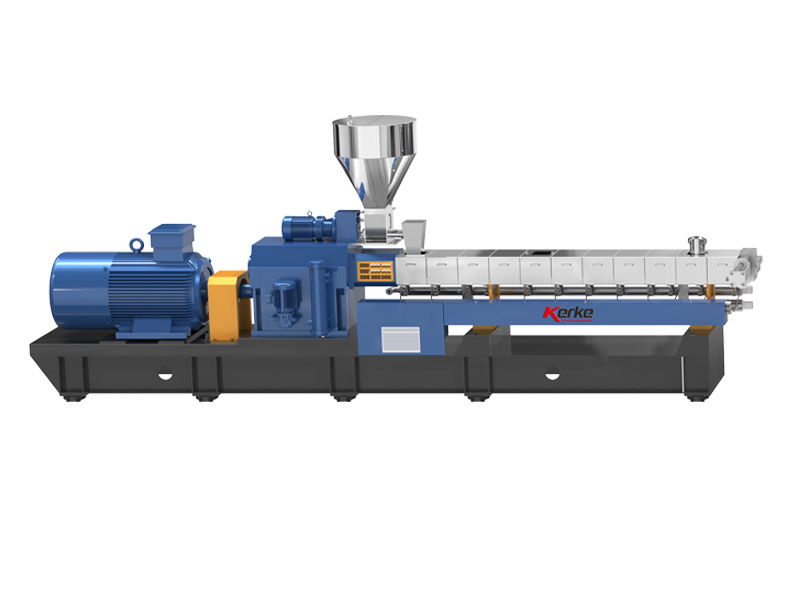
Kerke, a Wanplas factory with more than 12 years focused on twin-screw compounding extruders, builds the KTE series co-rotating parallel twin-screw extruders that produce masterbatches of this type at scale across more than 70 countries. The same principles apply whether you run a laboratory trial on a KTE-16B or a high-capacity KTE-135D line. Understanding how brittle-point masterbatch is formulated and compounded helps compounders, converters, and brand owners specify the right product and avoid costly cold-weather field failures. Throughout this article we reference the testing standards, material families, and process parameters that decide whether a masterbatch earns its “low temperature resistant” label.
What Is Low Temperature Resistant Masterbatch?
A low temperature resistant masterbatch is a highly concentrated mixture of elastomeric tougheners, compatibilizers, and sometimes nanofillers, carried in a polymer that matches the final article. It is metered into a base resin at a let-down ratio of 2 percent to 20 percent during film blowing, pipe extrusion, injection molding, or sheet extrusion, and it shifts the brittle point of the finished product downward. The masterbatch format exists because directly dispersing a rubbery toughener or a nanoclay into a production line is difficult; pre-compounding guarantees uniform dispersion, stable storage, and reproducible dosing.
The measurable goal of any cold-tolerant masterbatch is to lower the temperature at which a notched specimen fails in impact. For unfilled polypropylene that threshold often sits near -10 C; a properly toughened grade can remain ductile at -40 C. Polyethylene already performs well below -60 C, so the masterbatch there is used to fine-tune and protect that performance rather than to rescue a poor base. The function is always the same: keep the polymer in its tough, energy-absorbing state across the full service temperature range.
Low temperature masterbatch differs from ordinary impact modifier masterbatch in emphasis. General-purpose impact modifiers raise room-temperature toughness; cold-tolerant grades are optimized specifically for the sub-zero regime, which means selecting tougheners whose own glass transition temperature sits well below the target service temperature and ensuring the rubber particles stay finely dispersed and well bonded to the matrix. That distinction drives every formulation and process choice discussed below.
From a manufacturing standpoint, the masterbatch is a dispersion challenge. The active toughener usually enters as a pellet or powder with limited compatibility with the carrier, so the compounding step must break it into micron- or sub-micron droplets, stabilize that morphology, and encapsulate it with a compatibilizer so the particles do not coalesce. That is why twin-screw extrusion, rather than simple blending, is the standard route for serious cold-tolerant masterbatches.
Low-Temperature Brittleness Mechanism and Glass Transition Temperature
Low-temperature brittleness is governed by molecular mobility. A polymer chain segment can rotate and slide only above its glass transition temperature, written as Tg. When the service temperature falls below Tg, the amorphous regions freeze into a glassy, rigid state, and the material loses its ability to yield locally under a sharp load. A crack then propagates instead of blunting, and the part fails in a brittle, often catastrophic, manner. The glass transition temperature is therefore the single most important number for predicting cold behavior, although the practical brittle point also depends on crystallinity, stress concentrators such as notches, and impact speed.
Crystalline polymers such as polyethylene and polypropylene complicate the picture because they contain both crystalline and amorphous regions. The crystals act as physical crosslinks and give the material strength, but the amorphous tie segments between crystals are what must remain mobile at low temperature. A polymer like high-density polyethylene has an extremely low Tg near -120 C, which is why its amorphous segments stay mobile even in a freezer. Polypropylene has a much higher Tg near -10 C, so its low-temperature toughness is naturally poorer and benefits most from a toughening masterbatch.
Toughening works by introducing a second, low-Tg rubbery phase dispersed in the rigid matrix. When a crack tries to run, the rubber particles cavitate or debond and create many tiny voids that relax the local stress field; the matrix then yields in shear rather than cracking. The energy absorbed by this multiple-crazing and shear-yielding mechanism is what converts a brittle failure into a ductile one. The efficiency of the mechanism depends on three things: the rubber Tg must be below the service temperature, the rubber particles must be small and numerous, and the rubber-matrix interface must be strong enough to transfer stress but weak enough to cavitate.
Crystallinity also helps cold toughness indirectly. A higher degree of crystallinity raises the heat deflection temperature and stiffness, but it can also reduce impact if it creates large spherulites that act as flaw sites. Nucleating agents and controlled cooling during extrusion or molding therefore interact with the masterbatch effect. The table below summarizes typical room-relevant and low-temperature indicators for common host polymers; values are typical ranges and shift with grade, molecular weight, and copolymer content.
Typical Thermal and Impact Indicators of Common Host Polymers
| Base Polymer | Glass Transition Tg (typical) | Brittle Point (untreated, typical) | Notched Izod at 23 C (typical) | MFI range (g/10min, typical) |
|---|---|---|---|---|
| HDPE | about -120 C | below -100 C | 5 to 10 kJ/m2 | 0.2 to 30 |
| LLDPE / LDPE | about -110 C | below -80 C | 10 to 30 kJ/m2 (notched film) | 0.5 to 50 |
| PP (homopolymer) | about -10 C | near -10 C to -20 C | 2 to 4 kJ/m2 | 1 to 40 |
| PA6 / PA66 (dry) | about 50 C | near -40 C (conditioned lower) | 4 to 6 kJ/m2 | 1 to 30 |
| PC | about 145 C | below -40 C | 40 to 60 kJ/m2 | 3 to 30 |
| ABS | about 100 C to 110 C | near -30 C to -40 C (toughened) | 15 to 25 kJ/m2 | 5 to 40 |
The key takeaway is that Tg alone does not equal brittle point. Polypropylene’s Tg near -10 C is far warmer than its practical brittle point, because crystallinity and morphology matter; conversely, nylon’s high Tg does not prevent good sub-zero impact once conditioned, because its crystalline phase dominates mechanical response. A low temperature resistant masterbatch is engineered against the actual brittle point measured under the relevant standard, not against Tg in isolation.
Brittle Point and Low-Temperature Impact Testing Standards
Cold tolerance is a claim that must be proven by test, not assumed from formulation. Several standards define how to measure the brittle point and the low-temperature impact strength of plastics, and a credible low temperature resistant masterbatch is normally documented against at least one brittle-point method and one impact method. The most cited are ASTM D746 for brittle point, ASTM D256 for notched Izod impact, ASTM D6110 for Charpy impact, ISO 974 as the international brittle-point equivalent, and GB/T 5470 as the Chinese national brittle-point method.
ASTM D746 determines the brittle temperature by striking a notched specimen with a pendulum at a series of descending temperatures, usually in steps of 2 C or 5 C, and finding the temperature at which 50 percent of specimens fail by brittle fracture. The result, reported as the brittle point, is the temperature where the material transitions from predominantly ductile to predominantly brittle behavior. It is a pass-fail threshold test rather than a continuous energy measurement, which makes it ideal for specifying a minimum service temperature.
ASTM D256 measures the energy absorbed by a notched Izod specimen at a fixed temperature, most usefully at -20 C, -30 C, or -40 C to qualify cold performance. ASTM D6110 does the same in a Charpy pendulum configuration. Both express results in kJ/m2 (kilojoules per square meter) and reveal how much impact energy the part retains as temperature drops. A good cold-tolerant polypropylene might show notched Izod climbing from roughly 3 kJ/m2 at 23 C untoughened to well beyond 20 kJ/m2 at -20 C after modification, depending on grade and let-down ratio.
ISO 974 and GB/T 5470 mirror ASTM D746 in principle, using the same struck-specimen-at-descending-temperature logic, so results are mutually comparable for global supply chains. When a masterbatch is sold into markets covered by different regimes, reporting the brittle point under all three gives buyers confidence. The table below maps the standards to their purpose, specimen, and the metric they produce.
Cold-Weather Testing Standards Comparison
| Standard | Test Type | Specimen | Reported Metric | Typical Use in Masterbatch QC |
|---|---|---|---|---|
| ASTM D746 | Brittle point (impact at descending T) | Notched rectangular bar | Brittle temperature, C | Primary low-temperature spec claim |
| ASTM D256 | Notched Izod impact | Notched Izod bar | kJ/m2 at fixed T | Energy retained at -20 / -40 C |
| ASTM D6110 | Charpy impact | Notched Charpy bar | kJ/m2 at fixed T | Cross-check to Izod |
| ISO 974 | Brittle point (intl.) | Notched bar | Brittle temperature, C | EU / global equivalence to D746 |
| GB/T 5470 | Brittle point (China) | Notched bar | Brittle temperature, C | China market compliance |
For specifying a masterbatch, the practical sequence is to set the brittle point target from ASTM D746 (for example, below -40 C), then confirm the energy retained at that temperature with ASTM D256 or D6110. Reporting both prevents a grade that is technically “not brittle at -40 C” yet absorbs almost no energy from being accepted for a safety-critical part. Buyers should also request the test temperature and specimen thickness, because thin films and thick sections behave very differently.
Toughening Agent Systems for Cold Resistance
The heart of a low temperature resistant masterbatch is the toughening agent, and the choice among POE, EPDM, SBS, MBS, CPE, and EVA decides how low the brittle point can go, how well the rubber disperses, and what the cost tier will be. Each elastomer has its own glass transition temperature, polarity, and compatibility window, so the right pick follows the carrier resin and the target service temperature.
POE, or polyolefin elastomer, is a metallocene-made ethylene-octene copolymer with a Tg often near -60 C. It is the workhorse for polyolefin carriers because its polyolefin backbone disperses readily in PE and PP and gives outstanding low-temperature impact at a moderate cost tier. POE raises room-temperature toughness and, more importantly, keeps polypropylene ductile down to roughly -40 C at useful loadings. It is the default choice for cold chain film, frozen-food containers, and pipe where the host is PE or PP.
EPDM, ethylene propylene diene monomer rubber, shares the low Tg of the polyolefin family but brings superior heat aging and weather resistance because of its saturated backbone. It costs more than POE and is slightly harder to disperse, yet it is preferred where the article sees both cold and outdoor exposure, such as automotive exterior parts and geomembranes. EPDM also tolerates higher processing temperatures without degradation, which matters in some compounding routes.
SBS, styrene-butadiene-styrene block copolymer, is a versatile, lower-cost toughener whose butadiene mid-block stays mobile at low temperature, giving good cold impact in PS, ABS, and some PP blends. Its weakness is the unsaturated polybutadiene segment, which is vulnerable to UV and oxidation, so SBS-based masterbatches suit indoor or protected applications. MBS, methyl methacrylate-butadiene-styrene, is the classic clear-impact modifier for PVC and transparent systems; it raises low-temperature impact while keeping clarity, at a moderate cost tier, and is widely used in rigid PVC profiles and sheets that must survive winter.
CPE, chlorinated polyethylene, is a flexible, flame-retardant-friendly toughener used in PVC and some engineering blends; it gives moderate cold impact and excellent weatherability at a low cost tier, though its chlorine content and higher density must be considered for regulated applications. EVA, ethylene-vinyl acetate, lowers the effective Tg of polyolefin and polar blends, improves flexibility, and seals well; it is common in film and cable compounds where both low temperature and softness are wanted, at a low to moderate cost tier.
Toughening Agent System Comparison
| Toughener | Approx. Own Tg | Best Carrier Fit | Low-Temp Efficiency | Weather / Heat Aging | Cost Tier |
|---|---|---|---|---|---|
| POE | about -60 C | PE, PP | High | Medium | Medium |
| EPDM | about -50 C to -60 C | PE, PP, TPE | High | High | Medium-High |
| SBS | about -80 C (mid-block) | PS, ABS, PP blends | Medium-High | Low (UV sensitive) | Low-Medium |
| MBS | about -50 C | PVC, transparent blends | Medium-High | Medium | Medium |
| CPE | about -40 C (varies) | PVC, blends | Medium | High | Low |
| EVA | about -30 C to -60 C (by VA) | PE, polar blends | Medium | Medium | Low-Medium |
The practical rule is to match polarity. POE and EPDM live happily in polyolefins; MBS and CPE belong with PVC; SBS fits styrenic and some olefinic blends; EVA bridges polyolefin and polar systems. When the host and toughener are mismatched, no amount of loading restores proper dispersion, and the compound shows poor impact plus surface defects. That is where compatibilizers become essential.
Nanofillers and Compatibilizers in Cold-Tolerant Masterbatch
Nanofillers and compatibilizers are the supporting cast that turn a good toughener into a robust, process-stable masterbatch. Nanofillers such as nanoclay, nano-calcium carbonate, and surface-treated silica do not lower Tg themselves, but they refine the crystalline morphology, hinder crack propagation, and improve barrier and stiffness, which together raise the effective low-temperature performance of the composite. Their influence is indirect yet valuable in thin films and pipes where micro-cracks start at inclusions.
The bigger lever is the compatibilizer, and the most common in polyolefin cold-tolerant masterbatch is maleic anhydride grafted polypropylene, written PP-g-MAH. This molecule has a polypropylene backbone that mixes with the carrier and a maleic anhydride group that reacts with or anchors to polar surfaces, whether that is a polar toughener, a nanofiller, or a polar host such as PA or ABS. Without PP-g-MAH, a POE or EPDM droplet in a polypropylene melt tends to coalesce into large blobs and to debond under impact, so the toughening efficiency collapses. With the right graft level, the rubber particles stay small and tightly bound, and impact at -40 C improves dramatically.
For engineering-resin hosts, other grafted polyolefins or reactive coupling agents play the same role. In PA-based cold-tolerant masterbatch, a maleated polyolefin or a polyamide-compatible elastomer graft provides the bridge between the nylon matrix and the rubber phase. In PVC systems, MBS already carries methacrylate groups that bond to the matrix, reducing the need for a separate compatibilizer, while CPE is partially compatible by virtue of its chlorine content.
Dosing the compatibilizer is a balance. Too little and the interface is weak; too much and the grafted acid groups can catalyze degradation or add cost without benefit. Typical PP-g-MAH addition sits in the low single-digit percent of the masterbatch, often 2 percent to 6 percent of the formulation, with the exact level tuned by torque, dispersion, and the final impact result. Because the graft reacts in the melt, the twin-screw process must deliver enough shear and residence time for it to do its job without over-working the resin.
Carrier Resin Selection for Low Temperature Masterbatch
The carrier resin is the medium that carries the active ingredients and must be compatible with the final article so the masterbatch disappears into the matrix without creating a weak second phase. Choosing the carrier is as important as choosing the toughener, because a mismatched carrier causes plate-out, poor dispersion, and a drop in mechanical properties. The main carriers are PE, PP, PA, PC, and ABS, each matched to a host family.
For polyethylene films, pipes, and geomembranes, an LLDPE or LDPE carrier is ideal. It already performs well at low temperature, so the masterbatch only needs to deliver the toughener and protect the base properties. For polypropylene, a random or block copolymer PP carrier gives the best match and lets POE or EPDM disperse cleanly; homopolymer PP carriers are also used where stiffness must be preserved. For nylon parts, a PA6 or PA66 carrier carries the toughener into the engineering part and survives the higher processing temperature. For PC and ABS blends, a carrier of the same family avoids introducing a foreign phase that would haze or weaken the article.
Carrier melt flow index, or MFI, should track the host so the masterbatch and base resin mix uniformly. A carrier with much higher MFI than the host can migrate or bloom; one with much lower MFI may not disperse. Typical carrier MFI values range from about 1 to 50 g/10min depending on the process, with film grades often using higher-MFI carriers for quick melting and pipe grades using lower-MFI carriers for strength retention. The table below summarizes carrier choices and their implications.
Carrier Resin Selection Guide
| Carrier Resin | Typical Host Application | Inherent Low-Temp Behavior | Suggested Toughener | Cost Tier |
|---|---|---|---|---|
| LLDPE / LDPE | PE film, pipe, geomembrane | Excellent (below -80 C) | POE, EPDM, EVA | Low |
| PP (co / homo) | PP crates, automotive, containers | Moderate (near -10 C) | POE, EPDM, SBS | Low |
| PA6 / PA66 | Engineering parts, cable ties | Good (near -40 C conditioned) | Grafted POE, EPDM | High |
| PC | Transparent, impact parts | Excellent (below -40 C) | Silicone, MBS-type | Premium |
| ABS | Appliance, automotive interior | Good with toughener | MBS, SBS, EVA | Medium |
When the host is a blend, the carrier should mirror the continuous phase so it stays in the matrix rather than the dispersed phase. For a PP/PE blend, a PP-rich carrier is usually safe. For recycled-content articles, a carrier close to the recycle stream’s dominant resin keeps the masterbatch effective even when the post-consumer feed varies, which is a common concern for converters using recycled polyolefin.
Let-Down Ratio, Addition Level and Cost Tiers
The let-down ratio is the amount of masterbatch added to the base resin, expressed as a percentage of total. For low temperature resistant masterbatch it normally spans 2 percent to 20 percent. The lower end covers light-duty cold chain film where the PE host already performs well; the upper end covers demanding polypropylene or engineering applications targeting -40 C to -60 C. Choosing the minimum effective loading protects both properties and budget, because every percent of elastomer slightly lowers stiffness and heat deflection.
There is a non-linear relationship between loading and brittle point. The first few percent of a good POE masterbatch in polypropylene buys the largest gain, pulling the brittle point from near -10 C down toward -30 C; each further percent gives a smaller additional drop and eventually plateaus. That is why over-dosing is wasteful: once the rubber phase is saturated and well dispersed, extra toughener mainly costs money and softens the part. The table below links let-down ratio to expected performance and relative cost tier for a typical PP-host system using POE plus PP-g-MAH.
Let-Down Ratio, Performance and Cost Tier
| Let-Down Ratio | Typical Brittle Point (PP host) | Notched Izod at -20 C (typical) | Stiffness Impact | Masterbatch Cost Tier |
|---|---|---|---|---|
| 2 percent | about -20 C | 8 to 12 kJ/m2 | Negligible | Low |
| 5 percent | about -30 C | 15 to 22 kJ/m2 | Slight | Medium |
| 10 percent | about -40 C | 25 to 35 kJ/m2 | Moderate | Medium-High |
| 15 percent | near -50 C | 35 to 45 kJ/m2 | Noticeable | High |
| 20 percent | near -60 C (formulation dependent) | 45+ kJ/m2 | Significant | Very High |
Note that “cost tier” here refers only to the masterbatch addition cost relative to the base resin, on a Low to Very High scale; it deliberately excludes absolute prices and any currency figure. A converter should weigh that cost against the penalty of a field failure, which in cold-chain or automotive contexts can far exceed the saving from under-dosing. For polyethylene, the same table shifts upward because the host already sits below -60 C, so even a 2 percent to 5 percent let-down often satisfies the spec.
Twin-Screw Compounding Process for Low Temperature Masterbatch
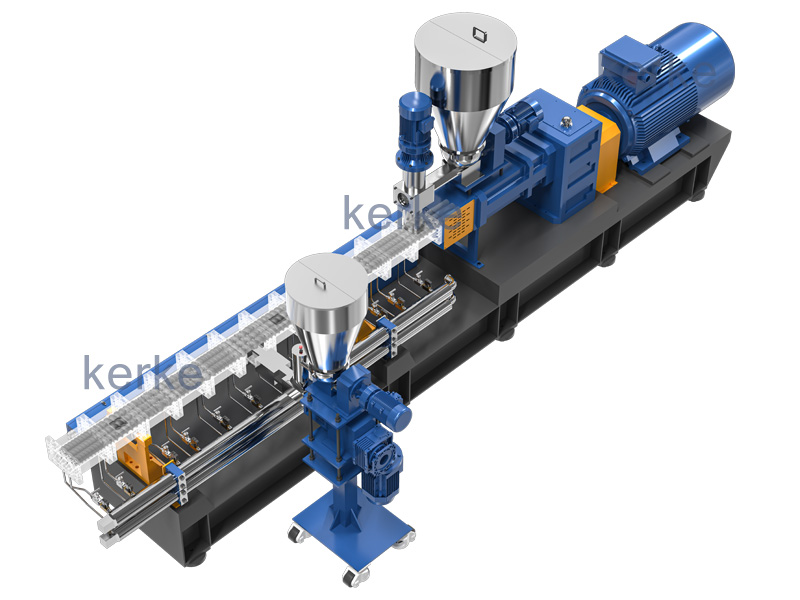
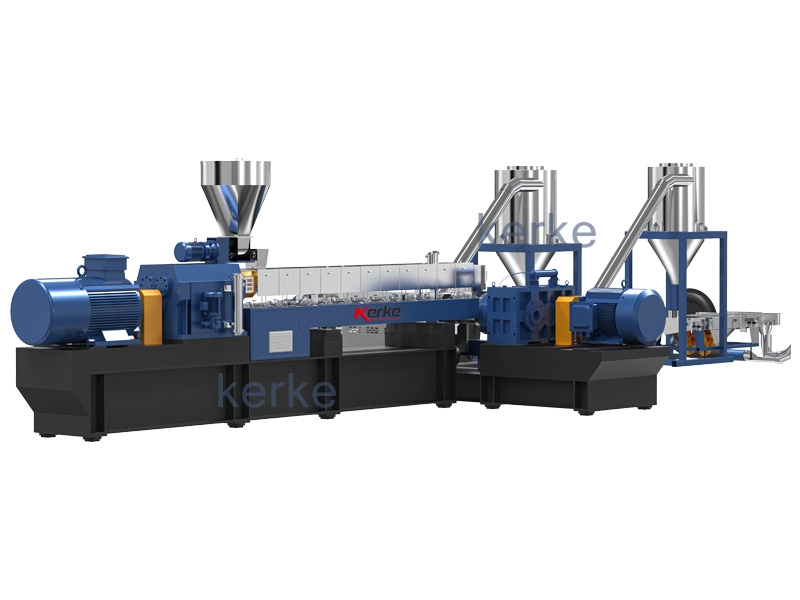
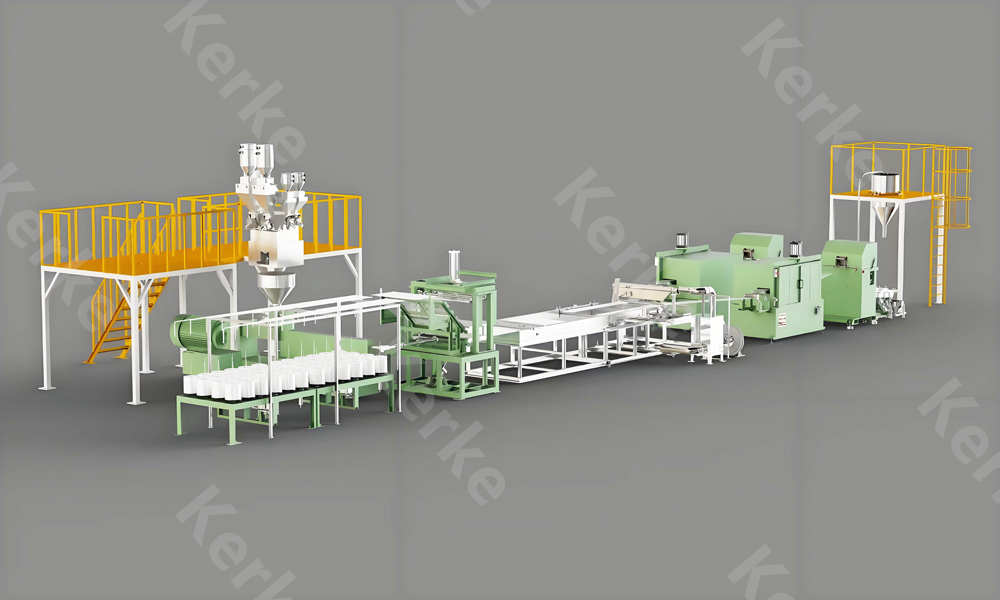
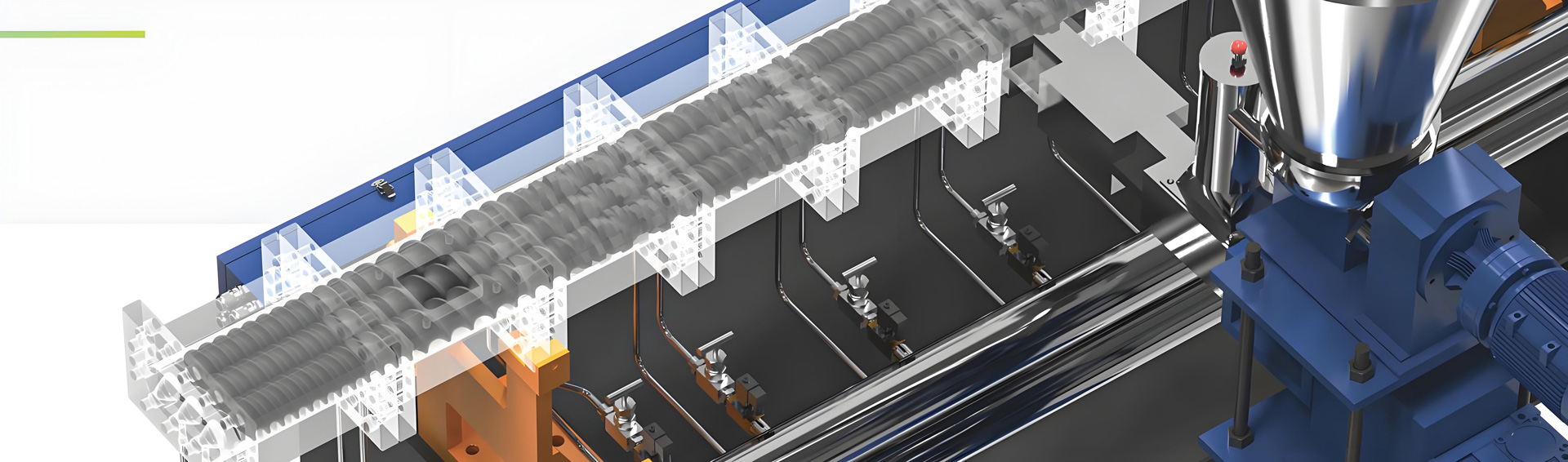
Making a cold-tolerant masterbatch is fundamentally a dispersion and stabilization problem, and the co-rotating parallel twin-screw extruder is the machine that solves it. Kerke, a Wanplas factory, builds the KTE series in sizes from the KTE-16B laboratory extruder up to the KTE-135D production line, with aspect ratios (L/D) configurable from 36 to 52. That long, modular barrel lets the compounder place distinct functional zones: feeding, melting, dispersive mixing, compatibilization, venting, and pressurization for pelletizing.
The screw is assembled from interchangeable elements rather than a fixed flight. Conveying elements move the melt forward; low-shear and high-shear kneading blocks and toothed or bilobal mixing elements do the dispersive work. For a toughener masterbatch, the design goal is to stretch the rubber into fine droplets and keep them there. Too little shear leaves coarse, uneven particles and weak impact; too much shear heats and can degrade the elastomer or the carrier. A typical layout uses a gentle melting zone first, then one or two kneading block clusters at a controlled stagger angle to generate the targeted shear, followed by a mixing zone and a vacuum vent.
Side feeding is important when the active loading is high or when a filler must be added downstream to avoid over-working it. A loss-in-weight feeder meters the toughener and compatibilizer with high accuracy, while a side feeder can introduce nanofiller partway down the barrel where the melt is already formed. Liquid feeders handle reactive additives or lubricants. Volumetric and crammer feeders handle fluffy or low-bulk-density powders. The precision of dosing directly sets the repeatability of the brittle point from batch to batch.
Vacuum venting removes trapped air, moisture, and volatile oligomers that would otherwise create voids and weaken low-temperature impact. On a 36 to 52 L/D line, one or two vent ports under vacuum are standard; the longer barrel of a 48 or 52 L/D machine gives extra residence time for both dispersion and devolatilization without raising screw speed to risky levels. Finally, the melt is pumped through a screen and die and cut into pellets by underwater granulation or strand pelletizing, depending on the formulation and desired pellet shape.
The table below lists the process zones and the function each serves in a typical cold-tolerant masterbatch run. These values are starting points; the exact screw configuration and setpoints are tuned per formulation on Kerke’s KTE lines and validated by brittle-point and impact testing.
Twin-Screw Process Zones for Low Temperature Masterbatch
| Barrel Zone | Function | Typical Element Type | Process Goal |
|---|---|---|---|
| Feed (1 to 4 D) | Solids conveying | Conveying flights | Stable, surged-free feed |
| Melting (4 to 12 D) | Plasticize carrier | Low-angle kneading blocks | Full melt, no degradation |
| Dispersive (12 to 24 D) | Break up toughener | High-shear kneading + mixing | Fine, uniform rubber particles |
| Compatibilize (24 to 32 D) | React PP-g-MAH | Medium kneading blocks | Strong rubber-matrix interface |
| Vent (32 to 40 D) | Devolatilize | Reverse element + vacuum port | Remove air, moisture, volatiles |
| Metering (40 to 52 D) | Build pressure | Conveying flights | Steady die pressure for cutting |
Competitors in the twin-screw field such as Coperion in Germany, JSW in Japan, and Leistritz in Germany set the global benchmark for this technology, and Kerke’s KTE series is built to the same co-rotating parallel principle with computer-aided screw assembly and a self-cleaning kneading design. The self-cleaning feature matters for masterbatch campaigns because it limits cross-contamination when switching colors or active systems, shortening changeover and protecting the cold-tolerance claim.
Temperature Profile and Process Windows
The barrel temperature profile must melt the carrier early, allow dispersive mixing in the mid-barrel, and avoid overheating the elastomer or compatibilizer later. For a polypropylene carrier with POE and PP-g-MAH, the profile typically rises from about 160 C at the feed to a peak near 200 C to 210 C in the dispersive zone, then eases slightly toward the die to keep the melt stable. Polyethylene carriers run a little lower, often 150 C to 200 C, while PA and PC carriers require substantially higher setpoints that must still respect the toughener’s thermal limit.
Screw speed and feed rate set the residence time and shear heating. A longer L/D (such as 48 or 52) allows a lower screw speed for the same mixing quality, which reduces thermal stress on the rubber. High screw speed generates more viscous heating, which can push local melt temperature above the setpoint and degrade the toughener; the compounder balances speed against cooling capacity. Torque should stay within the gearbox limit, and a sudden torque rise often signals poor feeding or a blocked screen.
The compatibilization reaction of PP-g-MAH is time and temperature dependent. Too cool or too fast and the graft does not couple the phases; too hot or too slow and the carrier can scorch. The vent zone must be hot enough that volatiles are mobile but cool enough that the melt does not drool out of the port under vacuum. Operators validate the window by testing impact at -20 C, -40 C, and -60 C on the first production lots and adjusting screw configuration or setpoints until the brittle point target is met with margin.
Cooling and pelletizing close the loop. Underwater granulation yields round, uniform pellets ideal for automated dosing and low dust, while water-cooled or air-cooled strand pelletizing is simpler and suits heat-sensitive or high-filler loads. Either way, the pellets must be dry and free-flowing so the converter’s gravimetric feeder can hold the let-down ratio steady, because dosing drift is a leading cause of inconsistent cold performance in the field.
Cold-Weather Application Scenarios
Cold-tolerant masterbatch earns its place wherever a plastic part meets freezing service and impact risk at the same time. Five scenarios dominate: cold chain packaging, polar and alpine pipelines, automotive exterior parts, frozen-food containers, and outdoor geomembranes. Each sets a different target brittle point and therefore a different formulation and let-down ratio.
Cold chain packaging and frozen-food containers must stay intact through freezing, transport, and drop on a warehouse floor. A polyethylene film or tub rarely needs much help because PE is already cold-tough, but a polypropylene container for frozen ready-meals benefits greatly from a 5 percent to 10 percent POE masterbatch that holds ductility at -20 C to -40 C. Polar and alpine pipelines, such as those for district heating or resource transport, demand the deepest ratings, often targeting -40 C to -60 C, and rely on PE or PP carriers with EPDM or POE plus careful compatibilization for long-term toughness in the ground.
Automotive exterior parts, including bumpers, claddings, and mirror housings, see winter impacts and must meet OEM brittle-point specs, frequently at -30 C to -40 C. PP-based compounds with POE or EPDM masterbatch are standard, with the loading tuned to keep both impact and stiffness in spec. Outdoor geomembranes for landfills, mining, and water containment must remain tear- and impact-resistant during cold installation; HDPE and LLDPE membranes use EPDM- or POE-containing masterbatch plus carbon black and UV stabilizers for a durable, cold-flexible liner.
Cold-Weather Application Scenarios
| Application | Typical Host | Target Service Temp | Suggested Toughener | Let-Down Ratio |
|---|---|---|---|---|
| Cold chain packaging film | LLDPE / LDPE | -20 C to -40 C | POE, EVA | 2 percent to 5 percent |
| Frozen-food containers | PP, PE | -20 C to -40 C | POE | 5 percent to 10 percent |
| Polar / alpine pipe | PE, PP | -40 C to -60 C | EPDM, POE | 10 percent to 20 percent |
| Automotive exterior | PP compounds | -30 C to -40 C | POE, EPDM | 8 percent to 15 percent |
| Outdoor geomembrane | HDPE, LLDPE | -40 C to -60 C | EPDM, POE | 5 percent to 12 percent |
Beyond these, low temperature masterbatch appears in cable jacketing for cold regions, agricultural film for high-latitude growing, and rigid PVC profiles for windows that must open smoothly after a frost. In every case the spec should be written in test terms: a brittle point from ASTM D746 and an impact value from ASTM D256 or D6110 at the actual service temperature, not a vague claim of “cold resistant.”
Quality Control and Testing Workflow
A disciplined quality workflow protects the cold-tolerance claim from raw material to finished pellet. It starts with incoming checks on the carrier MFI, the toughener grade, and the compatibilizer graft level, because batch variation in any of these shifts the result. The compounded masterbatch is then checked for dispersion quality, typically by microtomy and microscopy or by a melt filtration test, since coarse rubber particles are the most common cause of poor low-temperature impact.
Process monitoring during extrusion captures screw speed, barrel temperatures, torque, and vacuum level so any drift is caught in real time. Pellet quality is verified for shape, bulk density, and moisture. Finally, the masterbatch is let down into the host at the intended ratio, and the compound is tested: brittle point by ASTM D746 plus impact by ASTM D256 or D6110 at -20 C, -40 C, and where relevant -60 C. ISO 974 or GB/T 5470 brittle-point results are added for markets that require them. A passing lot is released with a certificate that states the exact let-down ratio and test temperatures used.
Good compounders also run a retention check: store the masterbatch and re-test after a set period to confirm the toughener has not bloomed or the compatibilizer has not degraded. Because low-temperature performance is invisible until failure, documentation is the only proof, and a credible supplier provides it per batch rather than per grade alone.
How Kerke Twin-Screw Lines Produce Low Temperature Masterbatch
Kerke, a Wanplas factory with more than 12 years in twin-screw compounding and a 19,997-plus square meter production base, supplies the KTE series co-rotating parallel twin-screw extruders that produce low temperature resistant masterbatch from laboratory scale to full production. The range spans the KTE-16B laboratory extruder for formula development up to the KTE-135D high-capacity line, with more than 2,000 machines running in over 70 countries. That installed base means a compounder can prove a formulation on a small KTE unit and scale it to production on the same screw philosophy.
For cold-tolerant masterbatch, Kerke’s design emphasizes the elements that matter most: a configurable L/D of 36 to 52 so the line can host both dispersive kneading blocks and a long vacuum vent, computer-aided screw assembly for repeatable morphology, and a self-cleaning kneading geometry that limits cross-contamination between campaigns. The pelletizing side offers water-cooled strand, air-cooled strand, water ring die-face, and underwater granulation, letting the compounder match cutting to the formulation’s sensitivity and the converter’s handling needs.
Kerke also supplies the feeding and auxiliary equipment that hold the let-down ratio accurate: loss-in-weight feeders for the toughener and compatibilizer, side feeders for nanofiller, and high-speed mixers for pre-blending. Because Wanplas is the parent brand covering the full plastic machinery value chain, a masterbatch producer can source compounding, feeding, and pelletizing from one group while keeping a single quality standard. As with other Wanplas factories, the shared service promise includes complimentary annual spare parts and warranty replacement, supporting continuous operation of masterbatch lines.
For compounders scaling up, Kerke’s triple-screw and double-stage extruder options handle special materials that a single stage cannot process cleanly, such as very high filler loads or heat-sensitive tougheners that need a gentler second stage. The engineering point is simple: cold-tolerant masterbatch succeeds or fails on dispersion and interface control, and the extruder must be specified for that, not just for throughput.
Frequently Asked Questions
What is low temperature resistant masterbatch?
Low temperature resistant masterbatch is a concentrated additive formulation that, when let down into a base polymer at 2 percent to 20 percent, lowers the brittle point of the final article so it survives impact at -20 C, -40 C, or even -60 C. It packages elastomeric tougheners, compatibilizers, and sometimes nanofillers in a carrier resin that matches the host polymer. The masterbatch format guarantees uniform dispersion and reproducible dosing compared with direct addition of raw rubber.
What brittle point can a low temperature masterbatch achieve?
With POE or EPDM tougheners at a 10 percent to 20 percent let-down ratio, a polypropylene article can typically be pushed from a brittle point near -10 C down to roughly -40 C, while polyethylene-based systems already sit below -60 C before modification. The exact value depends on carrier, grade, and impact test method, so it should always be confirmed by ASTM D746 or the equivalent ISO 974 and GB/T 5470 tests rather than estimated from formulation alone.
Which test measures the brittle point of plastics?
The brittle point is measured by ASTM D746 and the equivalent ISO 974 and GB/T 5470 methods, in which specimens are struck at descending temperatures until 50 percent fail by brittle fracture. Low-temperature impact strength is measured separately by notched Izod ASTM D256 and Charpy ASTM D6110, which report absorbed energy in kJ/m2 at a fixed temperature such as -20 C or -40 C. Together these define the cold-tolerance claim of a masterbatch.
Is POE or EPDM better for cold temperature impact?
POE gives the best balance of low-temperature impact, processability, and cost for polyolefin carriers, while EPDM offers superior heat aging and weather resistance at a higher cost tier. SBS, MBS, CPE, and EVA each suit specific carriers and temperature windows, so the choice follows the host resin and the exposure conditions. For outdoor or under-hood parts, EPDM’s weather resistance usually outweighs POE’s cost advantage.
What let-down ratio should be used for low temperature masterbatch?
Most formulations are dosed at 2 percent to 20 percent depending on the target brittle point and the base polymer. Light-duty cold chain film may need only 3 percent to 5 percent, while extreme -60 C automotive or polar pipeline applications approach 15 percent to 20 percent. The first few percent usually deliver the largest gain, so over-dosing mostly adds cost and softens the part without much extra benefit.
Why use a twin-screw extruder to make cold-tolerant masterbatch?
A co-rotating parallel twin-screw extruder with an L/D of 36 to 52 distributes the toughener into fine, stabilized rubber particles and fully disperses nanofillers and compatibilizers. Kneading blocks, shear sections, side feeding, and vacuum venting give the controlled mixing and devolatilization that a brittle-point masterbatch demands. Single-screw or simple blend methods cannot reliably reach the particle size and interface quality required for deep sub-zero performance.
Which carrier resin should the masterbatch use?
Match the carrier to the host polymer: LLDPE or LDPE for polyethylene films and pipes, random or block copolymer PP for polypropylene, PA for nylon parts, PC or ABS for engineering blends. A matched carrier preserves mechanical properties and avoids migration or plate-out that would weaken the article. For blends, the carrier should mirror the continuous phase so it stays within the matrix.
Can low temperature masterbatch be used for food contact?
Yes, provided the carrier, toughener, and any additive carry food-contact clearance under regulations such as FDA and EU 10/2011 and the relevant national food-safety standards. Confirm the specific grade documentation with the supplier before use in packaging that touches food, and request the compliance certificate per batch. Non-food grades must never be diverted into food-contact applications even if the cold performance is acceptable.
Conclusion
Low temperature resistant masterbatch is the formulation and process discipline that keeps plastic parts tough when the mercury falls. Its performance rests on a small number of physical facts: keep the rubber phase below its own glass transition, disperse it into fine particles, and bond those particles to the matrix with a compatibilizer such as PP-g-MAH. The brittle point from ASTM D746 and the impact energy from ASTM D256 or D6110, cross-checked by ISO 974 and GB/T 5470, are the only honest measures of success, and they should always be written into the specification.
For compounders, the route to a reliable cold-tolerant masterbatch is a configurable twin-screw line with an L/D of 36 to 52, well-placed kneading blocks, accurate loss-in-weight feeding, and vacuum venting, followed by clean pelletizing. Kerke, a Wanplas factory, builds the KTE series co-rotating parallel twin-screw extruders from the KTE-16B laboratory unit to the KTE-135D production line that deliver exactly this control for masterbatch producers worldwide. Whether the target is a -20 C frozen-food tub or a -60 C polar pipeline, the right toughener, carrier, let-down ratio, and compounding process turn a brittle polymer into a cold-weather survivor.