Masterbatch for bioplastics looks superficially like conventional masterbatch — a concentrated package of pigment, filler or functional additive on a carrier resin, let down into a base polymer at the converter. In practice it is one of the most constrained formulation problems in the compounding industry, because almost every degree of freedom that a conventional masterbatch designer relies on has been removed. The carrier resin cannot be polyethylene or ethylene vinyl acetate, because those polymers destroy the compostability certification that gives the finished article its commercial reason to exist. The processing temperature cannot be raised to improve dispersion, because polylactic acid begins to depolymerise around 210 degrees Celsius and polyhydroxyalkanoate degrades within roughly ten degrees of its own melting point. The moisture specification cannot be relaxed, because every ester linkage in these polymers is hydrolysable and molecular weight lost in the extruder never comes back. And the pigment palette is narrowed by heavy metal limits and ecotoxicity testing written into the compostability standards themselves.
This guide sets out the complete technical framework for designing and producing masterbatch intended for bio-based and biodegradable substrates: PLA, PBAT, PHA, PBS, thermoplastic starch and bio-based polyethylene. It covers the physical properties and processing windows of each substrate, the logic of carrier resin selection, drying and hydrolysis control, pigment screening against EN 13432 and ASTM D6400, filler and functional additive systems, chain extension with multifunctional epoxy oligomers, nucleation and heat resistance, certification of compostability and bio-based content under ASTM D6866, food contact compliance under FDA rules and Regulation EU 10/2011, and — the part most often underestimated — how to configure a co-rotating twin-screw extruder so that the compounding step does not consume the very molecular weight the formulation is trying to protect.
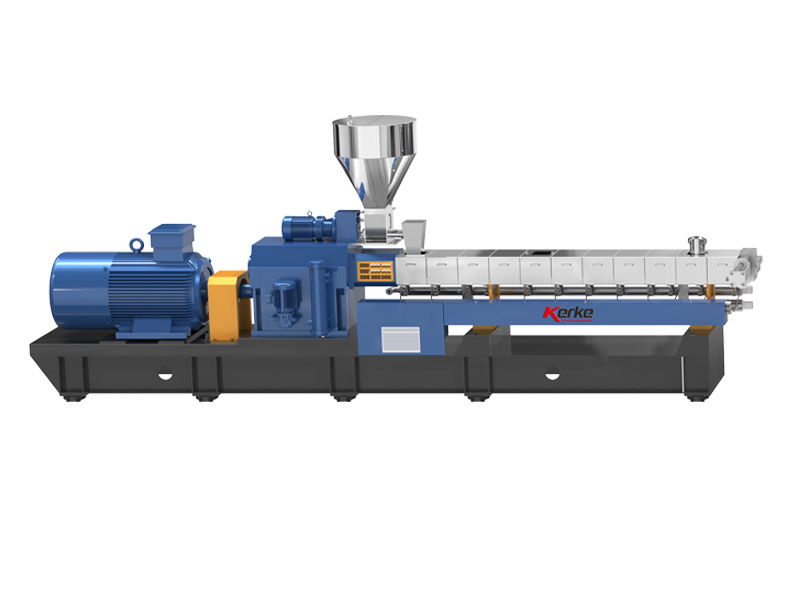
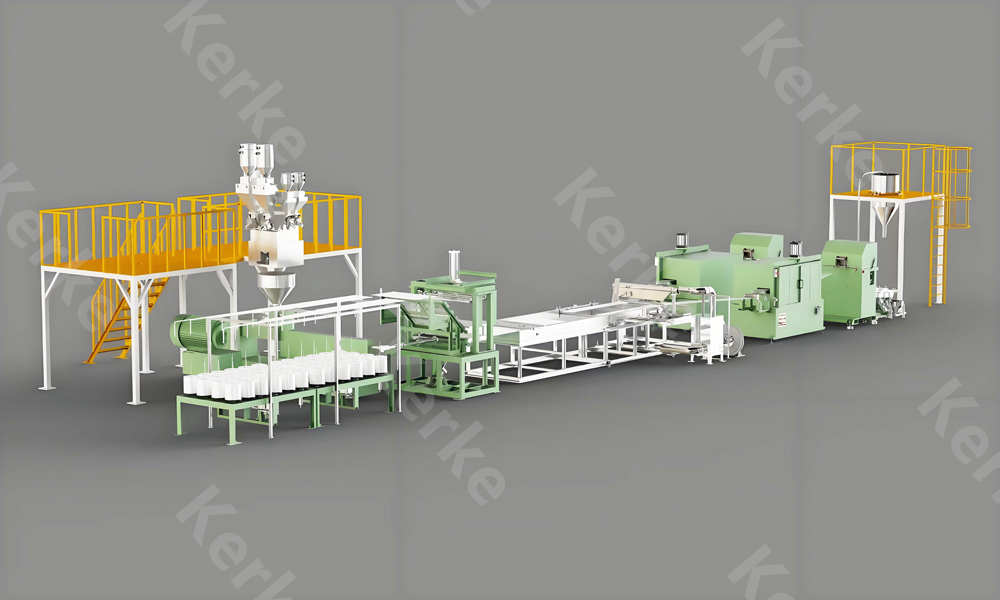
Kerke, a Wanplas factory specialising in parallel co-rotating twin-screw compounding extruders, lists biodegradable plastic compounding among its core application industries alongside colour, filler and additive masterbatch. With more than twelve years of dedicated twin-screw development, a factory of over 19,997 square metres, more than 2,000 machines running in over 70 countries and a team of more than 100 engineers and technicians, Kerke has supplied KTE-series lines configured specifically for the low-shear, low-residence-time, vacuum-devolatilised duty that bioplastic masterbatch demands. The guidance below reflects that production experience as it stands in 2026.
Why Bioplastic Masterbatch Is a Different Discipline
The single defining feature of bioplastic compounding is the narrowness of the gap between the temperature at which the polymer flows and the temperature at which it destroys itself. For a conventional polypropylene colour masterbatch the compounder has a working window of well over 100 degrees Celsius between melting and meaningful degradation. For polyhydroxybutyrate that window can be fifteen degrees. Every subsequent decision in the formulation and in the machine configuration follows from that fact.
The second defining feature is that the product’s value proposition is regulatory rather than purely functional. A conventional black masterbatch is judged on jetness, dispersion and cost. A compostable black masterbatch is judged on those criteria plus its ability to survive a certification audit in which every constituent above one percent must be demonstrably biodegradable, the heavy metal content of the finished article must sit below prescribed limits, and the compost residue must support plant germination and biomass growth at no less than ninety percent of a control. A formulation that performs beautifully but fails the ecotoxicity screen is worthless.
The third feature is hydrolytic vulnerability. PLA, PBAT, PBS, PHA and their copolymers are all aliphatic or aliphatic-aromatic polyesters. At melt temperature, water acts as a chain-scission reagent, cleaving ester bonds and generating new carboxyl end groups which then autocatalyse further hydrolysis. A single poorly dried batch of calcium carbonate filler can remove twenty to thirty percent of the number-average molecular weight of a PLA compound in one pass through the extruder, with a corresponding collapse in melt strength, impact resistance and film bubble stability. Unlike thermal degradation, which can sometimes be mitigated by antioxidants, hydrolysis is purely stoichiometric: the only defence is to remove the water before and during processing.
The commercial context
Global bioplastic production capacity has been expanding steadily, driven by single-use plastic restrictions in the European Union, China, India and a growing list of national and municipal jurisdictions, by extended producer responsibility schemes, and by brand-owner packaging commitments. Compostable film for organic waste collection, food service ware, fruit and vegetable bags, mulch film, coffee capsules, cutlery and rigid thermoformed packaging represent the highest-volume applications. Every one of these products requires colour, most require filler for cost and stiffness management, and nearly all require at least one functional additive — slip, antiblock, nucleation, chain extension or impact modification. The masterbatch layer is therefore not a niche within the bioplastic value chain; it is a prerequisite for it.
The relative cost position of bioplastic masterbatch sits at the High to Very High end of the masterbatch spectrum. The carrier resins themselves are more expensive than commodity polyolefins, the pigment palette excludes some of the cheapest inorganic options, the drying and handling burden adds energy and labour, throughput on a given extruder is lower because screw speed and specific energy must be constrained, and certification adds a recurring compliance cost. Formulators who attempt to close that gap by substituting a conventional carrier or an uncertified pigment typically discover the error at audit rather than in production.
The Bioplastic Substrate Family: PLA, PBAT, PHA, PBS, TPS and Bio-PE
Masterbatch cannot be designed without first fixing the substrate, because the substrate determines the carrier, the temperature ceiling, the pigment heat-stability requirement and the drying protocol. The six families below account for the overwhelming majority of commercial bioplastic volume, and they behave very differently from one another.
Polylactic acid
PLA is produced by ring-opening polymerisation of lactide derived from fermented sugar or starch feedstock, and it is the highest-volume bio-based, biodegradable polymer in commercial use. Commercial grades from suppliers such as NatureWorks and TotalEnergies Corbion vary principally in D-isomer content, which controls crystallinity: low D-content grades of one to two percent crystallise and reach melting points of 165 to 175 degrees Celsius, while grades above roughly eight percent D-isomer are effectively amorphous and soften near the glass transition.
Mechanically, PLA is stiff and strong but brittle: tensile strength commonly 50 to 70 megapascals, tensile modulus 3.0 to 3.6 gigapascals, elongation at break typically 3 to 8 percent, and notched Izod impact strength low without modification. The critical limitation for packaging is heat resistance. Unannealed amorphous PLA has a heat deflection temperature close to its glass transition, around 55 degrees Celsius, which means an unmodified PLA cup deforms in a hot car or a warm warehouse. Crystallisation raises that substantially, but PLA crystallises slowly, and accelerating it is one of the principal jobs of a nucleating masterbatch.
Thermally, PLA is the reference case for the whole category. Processing is normally conducted with melt temperatures between 170 and 200 degrees Celsius. Above roughly 210 degrees Celsius, chain scission, transesterification and lactide regeneration become measurable; above 230 degrees Celsius the rate rises steeply, generating volatile lactide that condenses on cold surfaces, fumes at the die, plates out on chill rolls and causes screw slippage. PLA is also strongly hydrolysis-sensitive, and its melt viscosity is highly shear-thinning with low melt strength, which makes film blowing and extrusion coating difficult without chain extension.
Polybutylene adipate terephthalate
PBAT is an aliphatic-aromatic copolyester, largely fossil-derived but fully biodegradable under industrial composting conditions, and it is the great toughener of the compostable world. Grades supplied under names such as ecoflex from BASF and equivalents from Chinese and Korean producers melt in the 110 to 120 degree Celsius range with a glass transition near minus 30 degrees Celsius, giving a soft, highly extensible material: tensile strength typically 20 to 35 megapascals with elongation at break commonly between 500 and 900 percent.
PBAT is rarely used alone. It is blended with PLA, starch or PBS to produce compostable film with the flexibility and tear strength of low density polyethylene. Its processing temperature window is broad on the low side and its degradation onset comfortably above its melting point, so it is the most forgiving of the biodegradable polyesters thermally. Its difficulties are downstream: PBAT pellets are soft and tacky, they block in storage and in feed hoppers, and the polymer is still an ester and therefore still hydrolysable. For a masterbatch carrier, PBAT’s low melting point is an advantage — it allows pigment dispersion at temperatures well below the PLA degradation threshold.
Polyhydroxyalkanoates
PHA is a family of polyesters produced directly by bacterial fermentation, and it is the only major bioplastic that biodegrades in soil, freshwater and marine environments as well as in industrial compost. The homopolymer polyhydroxybutyrate melts around 165 to 175 degrees Celsius, has a glass transition near 0 to 5 degrees Celsius, and is highly crystalline, stiff and brittle. Its defining problem is that thermal degradation by random chain scission and a cis-elimination mechanism begins near 180 degrees Celsius — perilously close to the melting point. Copolymers such as polyhydroxybutyrate-co-valerate and polyhydroxybutyrate-co-hexanoate lower the melting point to roughly 140 to 165 degrees Celsius depending on comonomer content, widening the window and improving toughness.
For masterbatch work, PHA is the most demanding substrate in the family. Melt temperature must be capped near 170 to 180 degrees Celsius, residence time must be minimised, and any local hot spot in the screw or die will show up as brown discolouration and a viscosity collapse. PHA also exhibits secondary crystallisation over days after processing, which embrittles parts, and it is prone to sticking in the pelletiser because crystallisation is slow relative to the cooling rate.
Polybutylene succinate
PBS and its adipate copolymer PBSA are aliphatic polyesters, available in partly bio-based grades derived from bio-succinic acid and bio-butanediol. PBS melts around 110 to 115 degrees Celsius with a glass transition near minus 32 degrees Celsius, giving tensile strength in the region of 30 to 40 megapascals and elongation typically between 200 and 400 percent. Its balance of stiffness, toughness and low processing temperature makes it attractive both as a blend component and as a masterbatch carrier, and it is notably easier to process than PLA. Heat resistance is modest and crystallisation, while faster than PLA, still benefits from nucleation.
Thermoplastic starch
Thermoplastic starch is produced by destructuring native starch granules with water and a plasticiser, usually glycerol or sorbitol, under heat and shear in a twin-screw extruder. It is the lowest relative cost bio-based material available and is almost always blended with PBAT or PLA rather than used alone, because unmodified TPS is highly hydrophilic, dimensionally unstable with humidity, and mechanically weak. Processing temperatures are low, typically 120 to 160 degrees Celsius, and the material is water-bearing by design, which means TPS compounding lines require a completely different devolatilisation strategy from PLA lines. Where masterbatch is added to a starch-based blend, the carrier is normally PBAT or a PBAT-PLA blend rather than starch itself.
Bio-based polyethylene and other drop-in polymers
Bio-PE, produced by dehydrating bio-ethanol to bio-ethylene and polymerising conventionally, is chemically identical to fossil polyethylene. It is bio-based — typically around 94 percent modern carbon by radiocarbon measurement under ASTM D6866 — but it is not biodegradable and not compostable. The same applies to bio-PET, partially bio-based bio-PA and bio-PP. For masterbatch purposes, drop-in bio-polymers require no special formulation: a conventional polyethylene-carrier masterbatch is fully appropriate. The commercial risk is one of communication rather than chemistry, since customers frequently conflate bio-based with biodegradable and specify compostable additives for a substrate that will never compost.
| Property | PLA | PBAT | PHA (PHB/PHBV) | PBS / PBSA | TPS (starch) | Bio-PE |
|---|---|---|---|---|---|---|
| Melting point, degrees Celsius | 150–175 | 110–120 | 140–175 | 90–115 | No sharp Tm | 110–132 |
| Glass transition, degrees Celsius | 55–60 | −30 to −35 | 0–5 (PHB) | −32 to −45 | Varies with glycerol | −110 (approx.) |
| Thermal degradation onset, degrees Celsius | 210–230 | Above 230 | 175–190 | Above 250 | 180–200 | Above 280 |
| Recommended melt temperature, degrees Celsius | 170–200 | 130–170 | 150–175 | 140–180 | 120–160 | 180–230 |
| Density, grams per cubic centimetre | 1.24 | 1.25–1.27 | 1.20–1.25 | 1.24–1.26 | 1.30–1.45 | 0.92–0.96 |
| Tensile strength, megapascals | 50–70 | 20–35 | 25–40 | 30–40 | 3–10 | 10–30 |
| Elongation at break, percent | 3–8 | 500–900 | 3–15 | 200–400 | 20–100 | 300–900 |
| Hydrolysis sensitivity | Very high | High | High | High | Water-bearing by design | None |
| Industrially compostable | Yes | Yes | Yes | Yes | Yes | No |
| Bio-based carbon content | Near 100 percent | Low unless bio-BDO used | Near 100 percent | Partial to high | Near 100 percent | Approximately 94 percent |
| Relative resin cost level | Medium–High | High | Premium | High | Low | High |
Carrier Resin Selection: The Compostability Constraint
Carrier selection is the first and most consequential decision in bioplastic masterbatch design, and the governing rule is simple: the carrier must be from the same polymer family as the substrate, or at minimum must itself be certified biodegradable under the same standard the finished article will claim. A polyolefin carrier is not merely suboptimal — it is disqualifying.
Why the one percent rule decides everything
EN 13432 and its American counterpart ASTM D6400 both permit small quantities of constituents whose biodegradability has not been demonstrated. Under EN 13432, any single such constituent must remain below one percent of the dry mass of the finished article, and the sum of all such constituents must remain below five percent. That allowance is intended to accommodate trace stabilisers, process aids and pigment residues. It is not large enough to accommodate a carrier resin. A colour masterbatch let down at a typical two to four percent will introduce roughly 1.4 to 3.2 percent of carrier into the finished article, which breaks the one percent single-constituent limit immediately if that carrier is polyethylene.
There is also a physical objection independent of certification. Polyolefins are immiscible with aliphatic polyesters. A polyethylene-carrier masterbatch dispersed in PLA produces discrete polyethylene domains that appear as gels and fisheyes in film, cause haze in transparent packaging, act as stress concentrators that reduce impact strength, and — because the pigment preferentially remains inside the incompatible domain — deliver poor colour development and streaking. The pigment simply does not transfer efficiently across the interface.
Practical carrier options
The workable carriers fall into four groups. First, the matched-substrate carrier: PLA for PLA-rich applications, PBAT for PBAT-rich film, PBS for PBS applications. This gives perfect compatibility and the cleanest certification story, at the cost of holding several carrier-specific inventories. Second, the universal compostable carrier, most often a PBAT-based or PBAT-PLA blend chosen because its low melting point allows dispersion at gentle temperatures and because it is miscible or at least finely compatible with most compostable blends. Third, polycaprolactone, a fossil-derived but readily biodegradable polyester melting near 60 degrees Celsius, which is used where extremely low dispersion temperature is needed, though its softness makes pelletising and storage difficult. Fourth, wax and oligomer-based carriers such as bio-derived fatty acid esters or low molecular weight polyester waxes for liquid or low-viscosity systems.
For PHA the safest choice is a PHA or PHA-PBAT carrier processed at the lowest viable temperature, because introducing PLA into a PHA article raises the melt temperature requirement of the let-down step and can push the PHA past its degradation threshold. Conversely, adding a small quantity of PBAT carrier to a PLA article is usually beneficial, since the PBAT provides a modest toughening effect at the same time.
| Carrier resin | Melting range, degrees Celsius | Best-matched substrates | Compostable | Key advantage | Key limitation |
|---|---|---|---|---|---|
| PLA (amorphous or low-crystallinity grade) | Softens 60; flows 150–170 | PLA rigid, PLA film, PLA fibre | Yes (industrial) | Perfect optical and mechanical match in PLA | Requires higher dispersion temperature; brittle pellets |
| PBAT | 110–120 | PBAT film, PLA-PBAT blends, starch blends | Yes (industrial) | Low dispersion temperature; toughening bonus | Tacky pellets; needs anti-block handling |
| PBS / PBSA | 90–115 | PBS injection and film, PLA-PBS blends | Yes (industrial; PBSA also soil) | Good stiffness-toughness balance, easy processing | Limited supply base relative to PLA and PBAT |
| PHA / PHBV | 140–170 | PHA articles, marine-degradable products | Yes (industrial, soil, marine) | Only carrier fully matched to PHA certification | Very narrow thermal window; Premium cost level |
| Polycaprolactone | 58–62 | Heat-sensitive systems, PHA, low-temperature let-down | Yes (industrial and soil) | Extremely low processing temperature | Very soft; storage and feeding difficulties |
| Bio-derived ester and polyester waxes | 50–100 | Liquid colour, additive concentrates | Generally yes; verify per grade | High pigment wetting efficiency | Can plasticise and lower heat resistance |
| Polyethylene or EVA (conventional) | 90–130 | Bio-PE, bio-PET, bio-PA only | No | Low cost, wide availability | Disqualifies compostability; immiscible with polyesters |
Thermal Windows and Degradation Limits in Compounding
The compounding temperature profile for bioplastic masterbatch must be built from the degradation limit downward, not from the melting point upward. The correct sequence is to identify the lowest degradation threshold in the formulation, subtract a safety margin of fifteen to twenty degrees Celsius to account for viscous dissipation, and then confirm that the resulting melt temperature is still high enough to develop the required dispersion. If it is not, the answer is to change the carrier or the pigment, not to raise the temperature.
Setpoint versus actual melt temperature
Inexperienced operators set barrel zones to the target melt temperature and assume the melt arrives at that value. In a co-rotating twin-screw extruder running a filled or highly pigmented formulation, mechanical energy input from the screws routinely raises melt temperature fifteen to thirty degrees Celsius above the barrel setpoint, and in aggressive kneading sections local melt temperature can spike considerably higher for short periods. This is why a PLA masterbatch line with barrel setpoints of 180 degrees Celsius can still produce lactide fume at the die and a compound with a badly reduced molecular weight.
The practical countermeasure is direct measurement. A melt thermocouple installed in the adapter with the tip protruding into the flow stream, rather than a flush-mounted sensor reading the metal wall, gives the number that matters. Many bioplastic lines run barrel setpoints deliberately below the target melt temperature in the mixing zones, allowing shear to make up the difference — a technique known as running a cold profile, which works well when specific energy input is stable.
Residence time as a process variable
Degradation is a rate process, so exposure time matters as much as temperature. For PLA, total residence time in the melt should generally be held below sixty seconds, with twenty to forty seconds achievable on a well-designed 40 L/D line. For PHA the target is tighter still. Residence time is reduced by increasing screw speed relative to feed rate — which raises specific energy and therefore temperature — or by shortening the barrel and simplifying the screw. This tension between mixing quality and thermal exposure is the central design compromise in bioplastic compounding, and it is why screw configuration expertise matters more here than in almost any other masterbatch category.
| Substrate / carrier | Drying temperature, degrees Celsius | Drying time, hours | Residual moisture target, ppm | Barrel setpoint range, degrees Celsius | Melt temperature ceiling, degrees Celsius | Target residence time, seconds |
|---|---|---|---|---|---|---|
| PLA (crystallised) | 80–100 | 4–6 | Below 250; below 100 preferred | 160–190 | 200 | 20–60 |
| PLA (amorphous) | 43–50 | 6–8 | Below 250 | 160–190 | 200 | 20–60 |
| PBAT | 60–80 | 3–4 | Below 500 | 120–165 | 190 | 30–80 |
| PBS / PBSA | 60–80 | 3–4 | Below 400 | 130–175 | 200 | 30–80 |
| PHA / PHBV | 70–80 | 2–4 | Below 300 | 140–170 | 175–180 | 15–40 |
| Thermoplastic starch (in situ) | Not pre-dried | n/a | Water added as plasticiser | 110–155 | 170 | 40–90 |
| Polycaprolactone carrier | 40–45 | 3–4 | Below 500 | 80–130 | 150 | 30–80 |
| Bio-PE (drop-in) | Not required | n/a | Not critical | 160–220 | 250 | 30–120 |
Moisture, Hydrolysis and Drying: The Non-Negotiables
Hydrolytic chain scission is the dominant cause of quality failure in bioplastic masterbatch production, and it is almost always avoidable. The mechanism is straightforward. At melt temperature, a water molecule attacks an ester carbonyl, cleaving the chain into an alcohol and a carboxylic acid. The newly created carboxyl end group is acidic and catalyses further hydrolysis, so the reaction accelerates as it proceeds. Because molecular weight enters melt viscosity at roughly the 3.4 power in the entangled regime, even a modest reduction in chain length produces a dramatic loss of melt strength.
Drying equipment specification
Ambient-air hopper dryers are inadequate for polyester bioplastics. A closed-loop desiccant dryer delivering a dew point of minus 40 degrees Celsius at the process air inlet is the baseline specification, and the dew point must be verified with an in-line sensor rather than assumed from the desiccant bed cycle timer. Airflow should be sized to the throughput, typically in the region of 1.8 to 2.5 cubic metres of process air per kilogram of resin per hour, and the hopper insulated so that the resin at the bottom of the cone is at drying temperature rather than fifteen degrees below it.
PLA introduces a specific complication. Efficient drying requires temperatures above the glass transition of 55 to 60 degrees Celsius, but amorphous PLA pellets soften and agglomerate above that point, bridging in the hopper and blocking the dryer. The standard solution is to use crystallised PLA pellets, which can be dried safely at 80 to 100 degrees Celsius, or to run amorphous grades at a conservative 43 to 50 degrees Celsius for a longer cycle. Regrind and reclaimed edge trim are usually amorphous regardless of the virgin grade, so they require the low-temperature protocol or a crystallisation step.
Filler and additive moisture
The polymer is not the only source of water. Calcium carbonate, talc, starch, cellulose fibre, silica antiblock, and hygroscopic organic additives all carry moisture, and because fillers are used at high loadings in the masterbatch, they frequently contribute more total water than the carrier does. Coated calcium carbonate should be specified at below 0.2 percent moisture and pre-dried at 100 to 120 degrees Celsius where the specification is tight. Natural fibres and starch require far more aggressive drying and dedicated venting. A useful discipline is to compute the mass-weighted moisture contribution of the entire recipe rather than checking only the resin.
Vacuum devolatilisation
Even with perfect upstream drying, water and other volatiles are generated or released in the melt, and vacuum venting is essential rather than optional. A bioplastic masterbatch line should have at least one and preferably two vacuum vents, positioned after the melting and mixing zones, operating at 20 to 50 millibar absolute pressure. Melt seals formed by short reverse or neutral kneading elements upstream of each vent create the pressure barrier required for effective stripping. Vent ports must be fitted with proper vent stuffers or plugs on a bioplastic line, because the low melt viscosity of PLA and PBAT at temperature makes vent flooding more likely than with polyolefins.
Where the formulation includes moisture-rich components such as starch or natural fibre, atmospheric venting upstream of the vacuum vent removes the bulk of the water at low cost and prevents the vacuum system from being overwhelmed. Kerke supplies KTE-series barrels with multiple vent positions, atmospheric and vacuum, and configures vacuum groups with condensate separation for exactly this duty.
Colour Masterbatch: Pigment Chemistry and Regulatory Screening
Colouring a compostable article is subject to constraints that do not exist in conventional plastics, and the constraints are cumulative: the pigment must be heat-stable at a low processing temperature, chemically inert toward the polyester backbone, free of restricted heavy metals, non-inhibitory in the compost ecotoxicity test, and — for packaging — acceptable under food contact rules.
Heavy metal limits
EN 13432 prescribes maximum concentrations of regulated elements in the finished article on a dry mass basis, and ASTM D6400 applies a comparable set. The limits eliminate several traditionally important pigment classes outright. Cadmium sulphoselenide reds and cadmium sulphide yellows are excluded by a cadmium limit measured in fractions of a milligram per kilogram. Lead chromate yellows, molybdate oranges and lead-containing chrome greens are excluded by the lead limit. Hexavalent chromium pigments are excluded. Because the limits apply to the finished article rather than to the masterbatch, a formulator must back-calculate: a pigment used at three percent in a masterbatch let down at three percent contributes only 0.09 percent to the article, which relaxes the arithmetic somewhat but does not change the exclusions for the most restricted elements.
Heat stability at low processing temperature
Counter-intuitively, the low processing temperature of bioplastics does not make pigment selection easier in every respect. Many organic pigments are specified with heat stability ratings determined in polyolefins at 240 to 300 degrees Celsius, and at bioplastic temperatures those ratings are not the binding constraint. The binding constraints instead become chemical interaction and dispersibility. Certain azo pigments and pigments carrying residual basic or acidic surface treatments can catalyse transesterification or accelerate hydrolysis in polyesters, causing a viscosity drop that appears only after several hours of production. Pre-screening candidate pigments by measuring melt flow index or intrinsic viscosity of a pigmented PLA sample before and after a controlled heat-hold is inexpensive insurance.
Dispersibility also becomes harder, not easier, at low temperature. Pigment agglomerates are broken down by shear stress, which is the product of viscosity and shear rate. Reducing temperature raises viscosity and therefore raises shear stress, which helps — but the total shear energy available is limited by the degradation ceiling. The practical resolution is to use pigment grades with fine primary particle size and effective surface treatment, to pre-disperse in a low-melting carrier such as PBAT or polycaprolactone, and to use distributive rather than high-intensity dispersive mixing elements.
Ecotoxicity and the plant growth test
EN 13432 requires that compost produced from the test material supports plant germination and biomass production at no less than ninety percent of a blank control, tested on two plant species. Pigments and their dispersion aids are the components most likely to fail this test, particularly copper-containing phthalocyanines at high loading and certain metal-complex organic pigments. Copper is itself on the regulated element list with a limit that, while generous relative to cadmium, can be approached by heavily pigmented blue or green articles. Certification bodies generally require documentation for each colourant, and many masterbatch producers maintain a pre-approved pigment library specifically to shorten the certification path for new colours.
| Pigment / colourant | Type | Typical heat stability, degrees Celsius | Status for compostable articles | Notes for polyester bioplastics |
|---|---|---|---|---|
| Titanium dioxide, rutile | Inorganic white | Above 300 | Widely accepted | Use surface-treated grades; can nucleate PLA and alter shrinkage |
| Carbon black | Inorganic black | Above 300 | Accepted with limits | Normally held below 1 percent of the article; verify near-infrared sortability requirements |
| Synthetic iron oxides (red, yellow, black) | Inorganic | 180–260 depending on type | Generally accepted | Yellow hydrated grades dehydrate and shift shade above about 180; check against melt temperature |
| Ultramarine blue | Inorganic | Above 250 | Generally accepted | Acid-sensitive; can react with carboxyl end groups and lose shade |
| Copper phthalocyanine blue 15:3 | Organic | Above 280 | Accepted subject to copper limit | Strong nucleating effect on PLA; watch total copper in heavy shades |
| Phthalocyanine green 7 | Organic | Above 280 | Accepted subject to copper limit | Contains chlorine; confirm acceptance with the certification body |
| Quinacridone red and violet | Organic | Above 280 | Generally accepted | Excellent lightfastness; good choice for mulch film |
| Diketopyrrolopyrrole red | Organic | Above 280 | Generally accepted | High tinting strength; Premium cost level |
| Isoindolinone and benzimidazolone yellows | Organic | 250–290 | Generally accepted | Preferred replacements for restricted inorganic yellows |
| Monoazo and diarylide yellows | Organic | 180–230 | Case by case | Some grades decompose or interact with polyester end groups; screen for viscosity drop |
| Cadmium yellows, oranges, reds | Inorganic | Above 300 | Excluded | Fails heavy metal limits in EN 13432 and ASTM D6400 |
| Lead chromate and molybdate pigments | Inorganic | Above 250 | Excluded | Fails lead and chromium limits; also restricted under other regulations |
Filler Masterbatch: Calcium Carbonate, Talc, Starch and Natural Fibre
Filler masterbatch serves three purposes in bioplastics that matter more than they do in polyolefins: it lowers the relative cost of an expensive resin base, it raises stiffness and heat resistance, and in the case of calcium carbonate it can slightly buffer the acidity generated by polyester hydrolysis. But every filler brings moisture and surface chemistry with it, and both must be controlled.
Calcium carbonate
Ground calcium carbonate is the workhorse filler for compostable film and sheet, typically incorporated as a concentrate at 60 to 80 percent active on a PBAT or PLA-PBAT carrier and let down to give 10 to 30 percent in the finished article. Particle size specification is critical for film: a median particle size of 1 to 3 micrometres with a top cut below 10 micrometres avoids the pinholes and bubble instability that oversized particles cause in blown film at 15 to 25 micrometre gauge. Surface treatment with 1.0 to 1.5 percent stearic acid improves wetting, reduces melt viscosity and cuts moisture pick-up. Moisture in the incoming filler must be below 0.2 percent, and dedicated pre-drying is common where the finished compound must hold high molecular weight.
Calcium carbonate is also used in mulch film and in food service ware to raise stiffness so that gauge can be reduced. Its effect on compostability is neutral — it is a mineral and is simply left in the compost as inert matter — but it counts toward the inorganic content limit in the standards, which require a minimum organic content typically expressed as at least fifty percent volatile solids.
Talc
Talc plays a dual role in PLA: it is both a filler and the most widely used nucleating agent. As a filler at 10 to 20 percent it raises modulus and heat deflection temperature; as a nucleant at 0.5 to 2 percent it dramatically shortens crystallisation half-time. Platelet aspect ratio determines the balance, and high-aspect-ratio grades give more stiffness for a given loading. Talc is abrasive relative to calcium carbonate, so screw and barrel metallurgy should be specified accordingly on a dedicated talc masterbatch line.
Starch and natural fibre
Starch-filled concentrates and natural fibre composites push the moisture problem to its extreme. Native starch carries ten to fifteen percent water as received, and cellulose fibre similar. In a TPS-producing line this water is a deliberate plasticiser, injected through a liquid feeder and later partially stripped through vacuum vents to hit the target residual level. In a filler masterbatch where starch is a solid additive, aggressive pre-drying plus atmospheric and vacuum venting is required, and even then the polyester matrix will suffer some molecular weight loss which chain extension must compensate. Natural fibres such as wood flour, bamboo, rice husk and bagasse also degrade thermally above roughly 200 degrees Celsius, releasing volatiles and causing discolouration, which conveniently aligns with the PLA temperature ceiling.
| Masterbatch type | Primary function | Active content in masterbatch | Typical let-down ratio | Active level in finished article | Principal constraint |
|---|---|---|---|---|---|
| Colour concentrate | Shade, opacity, branding | 15–50 percent pigment | 2–5 percent | 0.3–2.5 percent | Heavy metal limits and ecotoxicity screening |
| White concentrate (titanium dioxide) | Opacity and whiteness | 50–70 percent | 3–8 percent | 1.5–5 percent | Nucleation side effect; inorganic content limit |
| Black concentrate | Opacity, ultraviolet screening in mulch film | 20–40 percent carbon black | 2–4 percent | 0.4–1.6 percent | Keep carbon black below 1 percent of article |
| Calcium carbonate filler concentrate | Cost reduction, stiffness | 60–80 percent | 15–40 percent | 10–30 percent | Moisture below 0.2 percent; top cut below 10 micrometres |
| Talc concentrate | Stiffness and heat deflection | 50–70 percent | 10–30 percent | 5–20 percent | Abrasion on screws and barrels |
| Nucleating concentrate | Faster crystallisation, higher heat resistance | 10–30 percent active | 2–10 percent | 0.5–3 percent | Overdosing causes brittleness and haze |
| Chain extender concentrate | Molecular weight rebuild, melt strength | 5–20 percent epoxy oligomer | 3–10 percent | 0.3–1.5 percent | Over-addition causes gels and pressure surge |
| Anti-hydrolysis concentrate | Carboxyl end-group capping | 10–20 percent carbodiimide | 3–8 percent | 0.3–1.0 percent | Food contact clearance must be checked |
| Impact modifier concentrate | Toughness, elongation | 30–50 percent | 10–30 percent | 5–15 percent | Modifier must itself be biodegradable |
| Slip and antiblock concentrate | Coefficient of friction, film opening | 5–20 percent | 2–5 percent | 0.1–0.8 percent | Migration rate and food contact limits |
| Antimicrobial concentrate | Surface hygiene, shelf life | 5–20 percent active | 2–10 percent | 0.3–2 percent | May inhibit compost microorganisms; must pass ecotoxicity |
Chain Extenders, Anti-Hydrolysis Agents and Melt Strength
Chain extension is the single most valuable functional additive technology in bioplastic compounding, because it directly counteracts the two degradation mechanisms — hydrolysis and thermal scission — that the process cannot entirely eliminate. A chain extender is a low molecular weight multifunctional molecule that reacts with polymer end groups during melt processing, coupling chains together and rebuilding molecular weight in situ.
Multifunctional epoxy oligomers
The dominant chemistry is the styrene-acrylic copolymer bearing pendant glycidyl methacrylate groups, supplied as a solid oligomer with an epoxy functionality typically between four and twelve groups per chain and an epoxy equivalent weight in the region of 280 to 450 grams per mole. The epoxy ring opens readily under melt conditions in the presence of the carboxyl and hydroxyl end groups present on every polyester chain, forming a covalent link. Because functionality exceeds two, the reaction produces not just linear extension but long-chain branching, which is exactly what these polymers lack.
The practical effects are substantial and measurable. Melt flow index typically falls by thirty to seventy percent at addition levels between 0.3 and 1.0 percent. Zero-shear viscosity rises sharply while high-shear viscosity changes less, giving the shear-thinning, strain-hardening rheology that blown film and extrusion coating require. Bubble stability in PLA-PBAT film improves dramatically, sag in thermoforming sheet is reduced, and melt fracture at the die is suppressed. In recycled or reprocessed bioplastic streams, chain extension is often the only way to restore usable properties.
Dosage control matters. Below roughly 0.2 percent the effect is marginal. Above roughly 1.5 to 2.0 percent, gelation becomes a real risk: the branching density crosses the percolation threshold, cross-linked gel particles form, filter pressure climbs, and film shows hard fisheyes that no downstream adjustment will remove. Because the reaction is time and temperature dependent, the chain extender should be introduced where it will have sufficient residence time to react but not so early that it over-reacts — commonly at the main feed for a masterbatch concentrate, or through a side feeder in a reactive compounding step.
Anti-hydrolysis stabilisers
Polymeric carbodiimide operates on a different principle: rather than coupling chains, it caps free carboxyl end groups, removing the acid that autocatalyses further hydrolysis. Typical addition is 0.3 to 1.0 percent, and the effect is to extend the service life of a polyester article in humid or warm conditions and to reduce viscosity loss during processing. It is particularly valuable in PLA fibre, in PBAT mulch film that must survive a growing season before degrading, and in any application where the product is stored for extended periods before use. Monomeric carbodiimides are more mobile and act faster but raise migration and food contact questions; polymeric grades are preferred for packaging.
Other reactive systems
Pyromellitic dianhydride is an effective chain extender for polyesters but is difficult to disperse and can produce gels. Bisoxazolines react selectively with carboxyl groups and give clean linear extension without branching, which suits fibre applications where branching would harm spinnability. Diisocyanates are highly effective but raise occupational health concerns that generally exclude them from food-contact masterbatch. Peroxide-initiated reactive extrusion is used to graft and compatibilise PLA-PBAT and PLA-starch blends, often together with a coupling monomer, but requires precise control because peroxide also causes chain scission in PLA.
| Additive | Mechanism | Typical addition, percent of article | Main benefit | Risk if overdosed | Relative cost level |
|---|---|---|---|---|---|
| Styrene-acrylic epoxy oligomer | Reacts with carboxyl and hydroxyl end groups; branching | 0.3–1.5 | Melt strength, bubble stability, molecular weight rebuild | Gel formation, filter blockage, pressure surge | High |
| Polymeric carbodiimide | Caps free carboxyl end groups | 0.3–1.0 | Hydrolysis resistance, shelf life, viscosity retention | Cost without benefit; possible odour | High |
| Pyromellitic dianhydride | Anhydride-hydroxyl coupling | 0.1–0.5 | Rapid viscosity build | Gels, poor dispersion, colour | Medium |
| Bisoxazoline | Selective carboxyl coupling, linear | 0.3–1.0 | Linear extension without branching | Limited melt strength gain | Very High |
| Organic peroxide with coupling monomer | Radical grafting and compatibilisation | 0.05–0.3 | PLA-PBAT and PLA-starch compatibilisation | Chain scission, discolouration, odour | Low |
| Phosphite and hindered phenol antioxidants | Radical and hydroperoxide scavenging | 0.1–0.5 | Colour and viscosity retention during processing | Plate-out, ecotoxicity screening required | Medium |
Nucleating Agents, Impact Modifiers and Heat Resistance
Two performance gaps limit PLA in real packaging applications more than any others: it is brittle, and it loses shape above about 55 degrees Celsius unless crystallised. Masterbatch technology addresses both, and the two solutions interact, so they must be designed together.
Nucleation and crystallisation kinetics
PLA crystallises slowly because its chain conformation makes nucleation difficult. Left to itself, injection-moulded PLA emerges essentially amorphous from a cold mould, with a heat deflection temperature near the glass transition. A nucleating agent supplies heterogeneous nucleation sites, raising the crystallisation temperature on cooling, shortening crystallisation half-time from several minutes to under one minute, and allowing sufficient crystallinity to develop within a commercially acceptable cycle. When combined with a hot mould at 90 to 110 degrees Celsius, this can lift heat deflection temperature into the 100 to 130 degree Celsius range, which is the difference between a cup that survives hot liquid and one that does not.
Talc at 0.5 to 2 percent is the standard and lowest-cost nucleant. Ethylene bis-stearamide, zinc phenylphosphonate, orotic acid and specialised hydrazide compounds offer higher nucleation density at lower loading with less loss of transparency. The most elegant approach is stereocomplex nucleation: adding 2 to 5 percent of poly-D-lactic acid to a conventional poly-L-lactic acid matrix forms stereocomplex crystallites that melt around 220 to 230 degrees Celsius and therefore survive the processing temperature intact, acting as extremely effective nuclei. The trade-off is cost at the Premium level and the need to disperse the PDLA finely.
Nucleation must be dosed with care. Excess nucleant produces very high crystallinity, which increases stiffness and heat resistance but reduces impact strength and can cause haze in film. Pigments complicate matters further, because titanium dioxide and phthalocyanine blue are themselves effective nucleants; a colour change from natural to blue can measurably alter crystallisation behaviour, shrinkage and warpage, which is a common cause of unexplained dimensional variation in moulded compostable ware.
Impact modification within the compostability envelope
The conventional impact modifiers used in engineering plastics — core-shell acrylics, styrenic block copolymers, ethylene copolymers — are not biodegradable, so their use in a certified compostable article is limited by the one percent rule and is generally impractical at the five to fifteen percent loadings required. The workable routes are therefore polymeric blending and plasticisation with compostable materials.
PBAT is the most widely used toughener for PLA, at ten to thirty percent, and it transforms behaviour: elongation at break rises from single digits to well over one hundred percent, and notched impact strength improves several-fold. The limitation is that PLA and PBAT are immiscible, so the blend forms a dispersed droplet morphology whose fineness determines the toughening efficiency. A reactive compatibiliser — an epoxy chain extender, a maleic anhydride grafted species, or peroxide-initiated grafting — reduces the droplet size and strengthens the interface, and this compatibilisation step is precisely the kind of reactive compounding that a well-configured twin-screw extruder performs.
PBS, PCL and PHA can also be used as toughening phases. Plasticisation with acetyl tributyl citrate, polyethylene glycol or lactide oligomers at five to fifteen percent lowers the glass transition and increases ductility, but the effect degrades over time as the plasticiser migrates, and it lowers heat resistance — which directly opposes the nucleation strategy. Where both toughness and heat resistance are required, a nucleated PLA-PBAT blend with a reactive compatibiliser is the standard architecture.
Slip, Antiblock, Antifog and Antimicrobial Masterbatch
Functional surface additives are more critical in compostable film than in polyethylene film, because PLA and PBAT films block severely and because the polar surface chemistry behaves differently from polyolefins.
Slip additives
Erucamide and oleamide are the standard fatty amide slip agents, and bio-based grades derived from vegetable oils are readily available, which supports the bio-based content claim as well as compostability. Typical final concentration is 0.05 to 0.3 percent, delivered from a concentrate at 5 to 20 percent active. The migration behaviour differs from polyethylene: in PLA the amide blooms more slowly because the matrix is glassy at room temperature, so a longer conditioning period is required before the coefficient of friction stabilises, and converters who measure friction immediately after extrusion frequently over-dose as a result. In PBAT and PBAT-rich blends the matrix is rubbery and blooming is fast.
Antiblock
Natural and synthetic silica, diatomaceous earth, talc and fine calcium carbonate are all used, at 0.1 to 0.5 percent in the finished film from a 10 to 25 percent concentrate. Particle size must be matched to film gauge: for a 15 to 20 micrometre compostable bag film, a median particle size around 3 to 5 micrometres provides sufficient surface roughness without creating haze or perforation. Silica carries adsorbed moisture and should be dried before compounding into a polyester carrier.
Antifog
Fresh produce packaging in compostable film requires antifog performance, and the additives used are non-ionic surfactants such as sorbitan esters, glycerol esters and polyglycerol esters — most of which are food-grade, bio-derived and compostable. Typical addition is 0.5 to 2 percent. The additive migrates to the surface and lowers the water-air interfacial tension so that condensate spreads as a continuous film rather than forming light-scattering droplets. In PLA, the slower migration rate again means the antifog effect develops over hours to days, and cold-fog performance at refrigerated temperatures should be tested separately from hot-fog performance.
Antimicrobial systems
Antimicrobial masterbatch in compostable packaging is a genuine technical contradiction that must be handled deliberately: the article is designed to be consumed by microorganisms at end of life, while the additive is designed to kill microorganisms. Silver-based systems on zeolite or phosphate glass carriers at 0.3 to 2 percent, zinc oxide, and organic actives based on essential oil derivatives or chitosan are all in use. Any antimicrobial article intended for compostability certification must be tested carefully against the biodegradation and ecotoxicity requirements, because a sufficiently active biocide will slow the composting process below the ninety percent threshold. In practice, the loading window that delivers surface antimicrobial efficacy without inhibiting bulk composting is narrow, and silver-based systems at the low end of their range are the most commonly certified. Food contact clearance is a separate and equally demanding requirement, with specific migration limits applying to silver.
Certification: Compostability, Bio-Based Content and Food Contact
Three independent certification tracks apply to bioplastic masterbatch, and confusing them is the most common commercial error in this sector. Compostability describes end of life. Bio-based content describes feedstock origin. Food contact compliance describes consumer safety. A product can hold any combination of the three.
Compostability standards
EN 13432 is the European harmonised standard for packaging recoverable through composting and biodegradation, and it is the de facto global reference. It imposes four requirements. Chemical characterisation and heavy metal limits must be satisfied, with volatile solids of at least fifty percent. Biodegradation must reach at least ninety percent conversion of organic carbon to carbon dioxide within six months under controlled composting conditions, measured by the respirometric method of EN 14046, which corresponds to ISO 14855. Disintegration must reach at least ninety percent passing a two millimetre sieve after twelve weeks in a pilot composting test per EN 14045. Finally, compost quality must be unaffected, verified by the plant growth ecotoxicity test on two species.
ASTM D6400 is the North American equivalent for plastics designed to be aerobically composted in municipal or industrial facilities, using ASTM D5338 as the biodegradation test method and applying comparable ninety percent thresholds and heavy metal limits. ISO 17088 provides the international specification. ASTM D6868 extends the approach to coatings and laminates on paper and other substrates.
Home composting is a materially harder requirement because ambient temperatures are lower and the microbial population less aggressive. NF T 51-800 in France and AS 5810 in Australia set the criteria, and certification schemes such as OK compost HOME operate against them. PLA generally fails home composting because it requires temperatures above its glass transition to hydrolyse at a useful rate; PBAT, PHA, PCL and starch blends can pass. Soil biodegradation for agricultural mulch film is covered by EN 17033, and marine biodegradation by ASTM D6691 and related methods, with PHA the principal polymer capable of satisfying them.
Bio-based content measurement
Bio-based carbon content is determined by radiocarbon analysis. ASTM D6866 measures the ratio of carbon-14 to total carbon by accelerator mass spectrometry or liquid scintillation counting, exploiting the fact that fossil carbon contains no measurable carbon-14 while biogenic carbon contains the modern atmospheric level. The result is expressed as a percentage of modern carbon and converted to bio-based carbon content. ISO 16620 and EN 16785 provide equivalent European methodologies, with EN 16785-1 also permitting a mass-balance approach based on documented material inputs.
For masterbatch producers this matters because the additive package dilutes the bio-based content of the finished article. A PLA article at essentially one hundred percent bio-based carbon, coloured with a three percent masterbatch on a fossil-derived PBAT carrier and containing a fossil-derived pigment, will measure slightly below one hundred percent. Where a brand owner has specified a minimum bio-based percentage, the masterbatch selection must be checked against that arithmetic before production rather than after testing.
Food contact compliance
In the European Union, Regulation EU 10/2011 on plastic materials and articles intended to come into contact with food establishes a positive list of authorised monomers and additives, with specific migration limits for individual substances and an overall migration limit of 10 milligrams per square decimetre of contact surface. Every additive in a masterbatch destined for food packaging must appear on the Union list or be covered by an appropriate transitional or national provision, and the converter must be supplied with a Declaration of Compliance identifying dual-use additives and any restrictions. Colourants are notably not positively listed at Union level and are instead governed by national rules and purity criteria, which makes pigment documentation from the supplier essential.
In the United States, food contact substances are regulated by the FDA under Title 21 of the Code of Federal Regulations, either through existing clearances in the relevant sections, through the Threshold of Regulation exemption, or through the Food Contact Notification process. In China, the GB 4806 series governs food contact materials, with GB 4806.6 covering plastic resins and GB 9685 covering additives. Migration testing must use the food simulants and conditions appropriate to the intended use, and for PLA in particular the test temperature must be considered carefully because the polymer softens near 55 degrees Celsius.
| Standard | Region / scope | What it certifies | Key threshold | Typical timeframe | Notes |
|---|---|---|---|---|---|
| EN 13432 | European Union, packaging | Industrial compostability | 90 percent biodegradation; 90 percent disintegration | 180 days biodegradation; 12 weeks disintegration | Includes heavy metal limits and plant growth ecotoxicity test |
| EN 14995 | European Union, non-packaging plastics | Industrial compostability | Equivalent to EN 13432 | Same as EN 13432 | Applies to products outside packaging scope |
| ASTM D6400 | North America | Industrial compostability | 90 percent biodegradation | 180 days | Uses ASTM D5338 test method; basis for BPI certification |
| ASTM D6868 | North America | Compostable coatings on substrates | Comparable to D6400 | 180 days | Covers coated paper and board |
| ISO 17088 | International | Compostable plastics specification | 90 percent biodegradation | 180 days | International harmonised specification |
| NF T 51-800 | France | Home compostability | 90 percent biodegradation at ambient | Up to 365 days | Much harder than industrial; PLA usually fails |
| AS 5810 | Australia | Home compostability | 90 percent biodegradation at ambient | Up to 365 days | Includes earthworm ecotoxicity test |
| EN 17033 | European Union | Biodegradable mulch film in soil | 90 percent biodegradation in soil | Up to 24 months | Specific to agricultural mulch applications |
| ASTM D6691 | International | Marine biodegradation test method | Method, not pass criterion | Typically 90–180 days | PHA is the principal polymer able to satisfy marine claims |
| ASTM D6866 | International | Bio-based carbon content | Reported as percent modern carbon | Single analysis | Radiocarbon method; independent of biodegradability |
| ISO 16620 / EN 16785 | International / European Union | Bio-based content | Reported as percentage | Single analysis or mass balance | EN 16785-1 allows documented mass-balance route |
| EU 10/2011 | European Union | Food contact plastics | Overall migration 10 milligrams per square decimetre | Per migration test protocol | Positive list of monomers and additives; colourants nationally regulated |
| FDA 21 CFR / Food Contact Notification | United States | Food contact substances | Per substance clearance | Per clearance route | Clearance may exist by regulation, exemption or notification |
| GB 4806 series and GB 9685 | China | Food contact materials and additives | Per substance limits | Per migration protocol | GB 4806.6 covers resins; GB 9685 covers additives |
Twin-Screw Compounding Practice for Bioplastic Masterbatch
The co-rotating intermeshing twin-screw extruder is the only realistic machine for bioplastic masterbatch, because it provides independent control of feed rate and screw speed, modular screw geometry, staged feeding for fillers, and multi-point devolatilisation. But a screw configuration copied from a polypropylene colour masterbatch line will destroy a PLA compound, and this is where most first-time producers fail.
Screw configuration for low shear
The governing objective is to achieve dispersion with the minimum possible specific energy input and the minimum melt temperature rise. That translates into a set of concrete design rules. Melting should be accomplished with a short block of forward-conveying 30 and 45 degree kneading discs rather than a long aggressive melting section, because polyester bioplastics melt easily and do not require the energy that a semi-crystalline polyolefin does. Neutral 90 degree and reverse kneading elements should be used sparingly and only where a melt seal is genuinely required ahead of a vent or a side feeder. Distributive mixing elements — turbine mixers, slotted or toothed mixing elements, and gear-type mixers — should carry the burden of homogenisation, because they redistribute material without the high local shear stress and viscous heating of dispersive blocks.
Conveying elements between mixing zones should be relatively long-pitch to keep the melt moving and to prevent local accumulation. The discharge section should build only the pressure needed for the die and screen changer, since a long high-pressure zone adds both temperature and residence time. Wide-pitch discharge elements with a gear pump where high pressure stability is needed is a better arrangement than a long compression zone.
Length-to-diameter ratio and barrel configuration
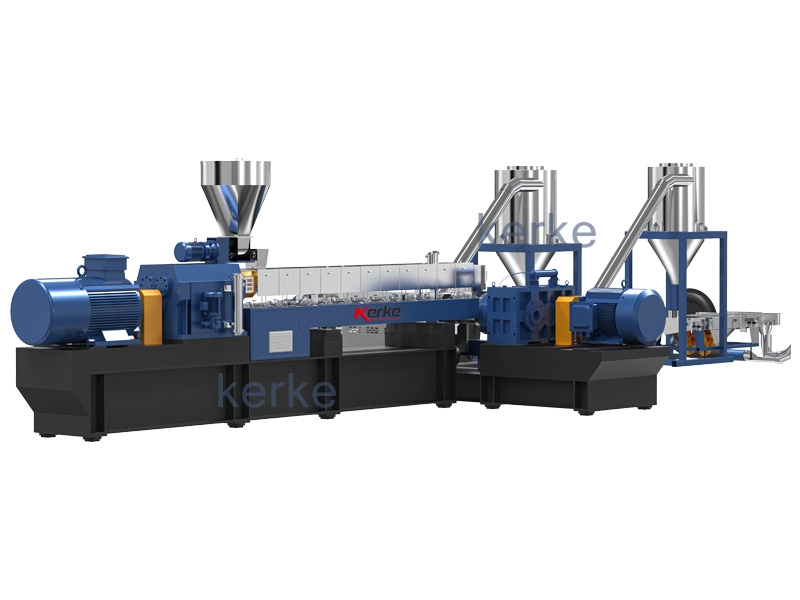
An L/D in the region of 40 is the general-purpose choice for bioplastic masterbatch. It provides enough length for main feeding, melting, a first vacuum vent, side feeding of filler, a second mixing zone, a second vacuum vent and a pressure build section, while keeping residence time within the target band. Longer barrels of 44 to 52 L/D, common in highly filled polyolefin compounding, add thermal exposure without benefit here. For PHA and other extremely heat-sensitive materials, a shorter 32 to 36 L/D barrel, or the two-stage mother-baby arrangement in which a hot compounding extruder discharges into a cool, slow single-screw or twin-screw pelletising extruder, gives better molecular weight retention. Kerke’s KTE-SE double-stage extrusion system is designed for exactly this class of problem, where the material cannot tolerate a single-stage process.
Feeding architecture
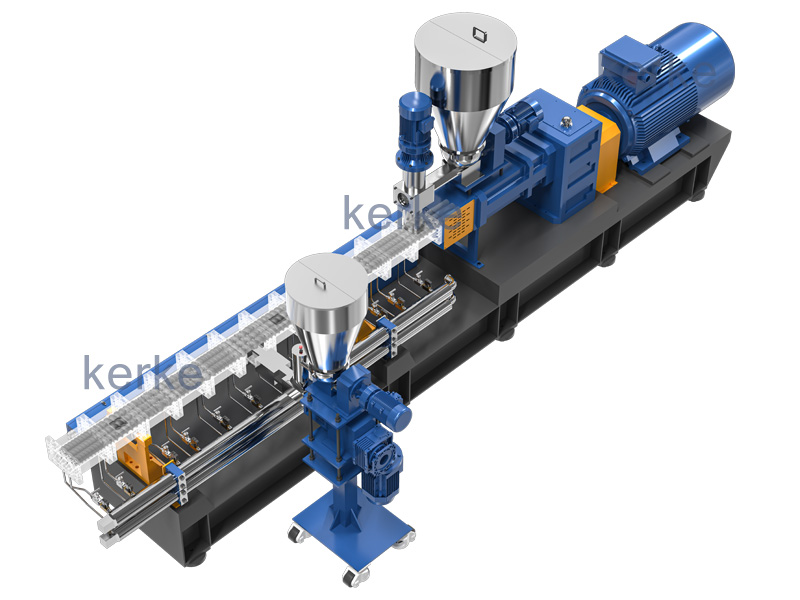
Loss-in-weight gravimetric feeding is standard for all components, and its accuracy directly determines colour consistency and additive dosage. Low-bulk-density powders — precipitated calcium carbonate, fumed silica, cellulose fibre, some pigments — must be introduced through a twin-screw side feeder rather than the main throat, because attempting to feed them into a barrel already containing melt causes venting back through the throat and feed limitation. Very low bulk density materials benefit from a crammer feeder, which compacts the powder before it enters the side feeder screws. Liquid components such as plasticisers, liquid slip agents and water for starch destructuring are injected through a metered liquid feeder into a filled, pressurised section of the barrel.
Splitting the filler feed between two side feeders, where high loadings are required, reduces the peak torque demand and prevents a single large addition of cold powder from quenching the melt and forcing the barrel heaters to compensate. Kerke supplies volumetric metering systems, twin-screw side feeders, crammer feeders, loss-in-weight feeders and liquid feeders as configurable options across the KTE range, which allows the feeding architecture to be matched to the specific recipe rather than compromised around a fixed layout.
Process parameters
Screw speed for bioplastic masterbatch typically runs 200 to 400 revolutions per minute, materially lower than the 500 to 900 revolutions per minute common in polyolefin colour masterbatch. Specific energy input should be targeted in the region of 0.12 to 0.22 kilowatt-hours per kilogram, compared with 0.25 to 0.35 for engineering plastic compounding. Torque utilisation should sit comfortably below maximum so that the machine is not the limiting factor. Vacuum should run at 20 to 50 millibar absolute. Melt pressure should be monitored continuously, because a rising trend at constant conditions is the earliest indicator of chain extender over-reaction or filter blinding, while a falling trend indicates molecular weight loss from hydrolysis or thermal degradation.
Metallurgy and cleaning
Bioplastic masterbatch lines change colour and recipe frequently, so cleanability is a production economics issue. Self-wiping co-rotating screw profiles with good conjugate geometry minimise stagnation, and Kerke’s computer-aided screw assembly design with kneading elements offering a self-cleaning function and full interchangeability supports fast changeover. Nitrided steel is adequate for unfilled and lightly pigmented work; bimetallic barrel liners and tool-steel or powder-metallurgy screw elements are warranted where talc, calcium carbonate above roughly forty percent, glass or natural fibre are processed. Because organic acids released by polyester degradation are corrosive, corrosion-resistant metallurgy is worth specifying on any line that will see PLA or PHA regularly.
Pelletising, Cooling and Downstream Handling
Pelletising is disproportionately troublesome in bioplastic masterbatch because the materials sit at opposite extremes: PLA-rich strands are brittle and shatter, while PBAT-rich and PCL-rich strands are soft and tacky and refuse to cut cleanly. The pelletiser choice must follow the formulation, not the other way round.
Strand pelletising
Water-cooled strand pelletising remains the most common and lowest relative cost route, and it suits PLA-rich and talc- or calcium-carbonate-filled products well. Because PLA crystallises slowly, the strand must be cooled sufficiently to be rigid at the cutter but not so cold that it becomes glass-brittle and fractures before reaching the knives. Bath water temperature in the 20 to 40 degree Celsius range with a short immersion length and a strongly effective air knife is the usual compromise. Residual surface water is the enemy: any moisture carried into the pellet will be redistributed during storage and will hydrolyse the polymer in the customer’s extruder, so air-knife drying followed by a centrifugal dryer is standard, and a post-pelletising dehumidified conditioning silo is good practice for premium products.
Air-cooled strand pelletising avoids water contact entirely and is attractive for highly hydrolysis-sensitive products, but it requires a long cooling conveyor and limits throughput, so it suits smaller-volume high-value grades.
Die face and underwater systems
Soft, low-melting, tacky products — PBAT carriers, PCL carriers, high-plasticiser systems — generally require die face cutting. Water-ring die face pelletising throws a curtain of water against the freshly cut pellet, cooling it rapidly and preventing agglomeration, and it handles tacky materials far better than a strand line. Eccentric water mist cutting uses a controlled fine spray, giving less water contact than a water ring while still preventing sticking, which is a useful compromise for moderately hydrolysis-sensitive tacky products. Underwater granulation with a temperature-controlled water loop, typically held at 15 to 25 degrees Celsius for these materials, produces uniform spherical pellets with excellent flow properties and is the preferred solution for high-throughput PBAT and PBS masterbatch, provided the drying section is properly specified. Kerke offers all of these — water-cooled strand, air-cooled strand, air-cooled die face hot cutting, water ring die face hot cutting, eccentric water mist hot cutting and underwater granulation — as configurable options on KTE lines, which matters because a single masterbatch plant will typically need at least two of them.
Storage and packaging
Finished bioplastic masterbatch must be packaged in moisture barrier material, typically aluminium foil laminate bags with a desiccant, and sealed immediately after pelletising while the product is still dry. Standard woven polypropylene bags with a polyethylene liner allow measurable moisture ingress over weeks of storage, and a masterbatch that arrives at the converter at 1,500 parts per million moisture will damage the customer’s product regardless of how well it was compounded. Soft PBAT-rich pellets also require anti-blocking measures during storage: cooling to ambient before bagging, limiting stack height, and in some cases a light dusting with a compostable anti-block powder.
Line Sizing and Equipment Selection Guide
Throughput on a bioplastic masterbatch line is lower than on an equivalent polyolefin line for the same screw diameter, because screw speed and specific energy must both be constrained. A useful planning assumption is to derate the polyolefin masterbatch rating of a given machine by twenty to thirty-five percent for PLA-based work and rather more for PHA. Sizing should be based on the most demanding product in the intended portfolio, not the average.
Kerke’s KTE series spans KTE-16B at laboratory scale through to KTE-135D for high-volume production, with output capability from around 30 kilograms per hour upward, and the aspect ratio, barrel configuration, screw arrangement, exhaust system, feeding arrangement and electrical control are all specified per project rather than fixed. That configurability is the key requirement for bioplastic work, where the correct machine for a PHA concentrate and the correct machine for a seventy percent calcium carbonate filler concentrate are not the same machine. The laboratory twin-screw extruder deserves particular attention in this application: because bioplastic formulations are so sensitive and because certification testing is slow and costly, the ability to run small formulation trials and measure specific energy, melt temperature and molecular weight retention before committing to production scale materially reduces development risk.
| Application | Suggested screw diameter class | Suggested L/D | Feeding arrangement | Devolatilisation | Recommended pelletiser |
|---|---|---|---|---|---|
| Formulation development and certification samples | Laboratory class, 16 to 26 millimetres | 36–40 | Twin loss-in-weight plus micro side feeder | One vacuum vent | Air-cooled or short water strand |
| PLA colour concentrate | 35 to 65 millimetres | 40 | Main gravimetric plus pigment side feeder | One to two vacuum vents | Water-cooled strand with centrifugal dryer |
| PBAT colour or additive concentrate | 35 to 75 millimetres | 36–40 | Main gravimetric plus side feeder | One vacuum vent | Water ring die face or underwater |
| Calcium carbonate filler concentrate, 60 to 80 percent | 65 to 135 millimetres | 40–44 | Split side feeding, crammer for fine grades | Atmospheric plus two vacuum vents | Water-cooled strand or underwater |
| PLA-PBAT reactive compatibilised compound | 50 to 95 millimetres | 40–44 | Main plus side feeder plus liquid injection | Two vacuum vents | Water-cooled strand or water ring |
| PHA concentrate or compound | 35 to 75 millimetres | 32–36, or two-stage system | Main gravimetric, minimal side addition | One vacuum vent, short melt path | Air-cooled die face or chilled underwater |
| Thermoplastic starch and starch-PBAT compound | 50 to 135 millimetres | 40–48 | Starch main feed, liquid water and glycerol injection | Atmospheric plus two to three vacuum vents | Water ring or underwater |
| Natural fibre and bio-composite compound | 50 to 95 millimetres | 40–44 | Crammer side feeder for fibre | Atmospheric plus two vacuum vents | Water-cooled strand |
Twin-screw compounding equipment for this duty is offered internationally by a number of established builders, including Coperion and Leistritz in Europe and Japan Steel Works in Asia, alongside Chinese specialists such as Kerke. What distinguishes suppliers in the bioplastic segment is less the headline torque rating and more the willingness to engineer the screw configuration, venting layout and pelletising system around a thermally fragile, hydrolysis-sensitive material rather than supplying a standard polyolefin configuration. Kerke’s position as a recognised top-five Chinese supplier of twin-screw extruders, with computer-aided screw design and a full auxiliary range including high-speed mixers, pulverisers, granulators and water chillers, reflects the Wanplas brand’s approach of supplying a complete, application-matched line rather than an extruder in isolation.
Troubleshooting Bioplastic Masterbatch Production
Most production problems in this sector trace back to one of four root causes: moisture, excess temperature, excess residence time, or a mismatch between carrier and substrate. The table below maps common symptoms to their likely causes and the corrective actions that resolve them.
| Symptom | Most likely causes | Diagnostic check | Corrective action |
|---|---|---|---|
| Melt viscosity falls progressively during a run | Hydrolysis from wet resin or wet filler; thermal degradation | Measure resin and filler moisture; verify dryer dew point; log melt temperature | Restore dew point to minus 40 degrees Celsius; pre-dry filler; lower melt temperature; add chain extender |
| Smoke or white fume at the die, deposits on cold surfaces | Lactide regeneration from PLA above roughly 210 degrees Celsius | Direct melt thermocouple reading, not barrel setpoint | Reduce screw speed; soften kneading blocks; lower front-zone setpoints; shorten pressure build zone |
| Brown or amber discolouration, burnt specks | Local overheating in kneading zone; dead spots in die or adapter; excessive residence time | Inspect screws and die for degraded material; check for stagnant flow geometry | Clean and streamline flow path; replace worn elements; reduce specific energy; increase output rate |
| Gels and hard fisheyes in downstream film | Chain extender over-addition or over-reaction; incompatible carrier; cross-linked material | Filter pressure trend; microscopy of gel; verify chain extender dosing | Reduce chain extender to below 1 percent; shorten reaction residence; confirm carrier compatibility; install melt filtration |
| Poor colour development, streaking, weak tinting strength | Insufficient dispersive mixing; incompatible carrier; pigment agglomerates | Filter pressure value test; optical microscopy of pressed film | Add distributive mixing elements; use finer pigment grade; pre-disperse in lower-melting carrier; raise viscosity by lowering temperature slightly |
| Strand breaks constantly at the pelletiser | Low melt strength; over-cooled brittle PLA strand; molecular weight loss | Measure melt flow index of product; check bath temperature and immersion length | Add chain extender; raise bath temperature toward 40 degrees Celsius; shorten immersion; add gear pump for flow stability |
| Pellets agglomerate in the bag or hopper | Soft tacky PBAT or PCL-rich formulation; pellets bagged warm; slow crystallisation | Measure pellet temperature at bagging; check storage stack height | Extend cooling; switch to water ring or underwater cutting; cool below 35 degrees Celsius before bagging; reduce stack height |
| Vent flooding, polymer extruding from vent port | Melt seal too weak or too strong; overfilled barrel; low melt viscosity | Observe vent behaviour at varying feed rate and screw speed | Adjust melt seal element configuration; reduce feed rate relative to screw speed; fit a vent stuffer |
| Torque limit reached at low output | Highly filled recipe at low melt temperature; undersized machine; excessive kneading | Compare specific energy against target band; check filler loading and particle size | Split filler feed across two side feeders; simplify screw; raise rear-zone temperature; consider larger diameter or higher-torque gearbox |
| Compostability test fails on disintegration | Article too thick; excessive inorganic filler; non-degrading carrier or additive | Review full bill of materials against the 1 percent and 5 percent rules; check volatile solids | Reduce wall thickness; lower filler level; replace non-compliant carrier or additive with a certified alternative |
| Ecotoxicity plant growth test fails | Pigment or additive inhibits germination; excess copper or zinc; antimicrobial active | Test constituents individually against control | Substitute the offending colourant; reduce loading; remove or reformulate antimicrobial package |
| Moulded parts warp or shrink inconsistently between colours | Pigment acting as an unintended nucleating agent; variable crystallinity | Differential scanning calorimetry on each colour; compare crystallisation temperature | Balance the formulation by adding nucleant to the non-nucleating colours; standardise total nucleation across the colour range |
Frequently Asked Questions
Can a conventional polyethylene-carrier masterbatch be used in PLA or PBAT?
Only in very small quantities, and never in a product that must carry a compostability claim. EN 13432 allows individual non-biodegradable constituents below one percent by dry mass, with a total of all such constituents below five percent. A polyethylene or ethylene vinyl acetate carrier used at a two to four percent let-down ratio therefore breaks the one percent single-constituent limit immediately. Beyond certification, polyolefin carriers are immiscible with aliphatic polyesters, producing gels, fisheyes, haze, weak weld lines and poor pigment transfer. The correct approach is a matched-family carrier or a certified compostable universal carrier.
What melt temperature limit should be applied when compounding PLA masterbatch?
Keep the actual melt temperature measured at the die below approximately 200 degrees Celsius, with 185 to 195 degrees Celsius as a practical working target. PLA begins measurable thermal degradation, chain scission and lactide regeneration above roughly 210 degrees Celsius, and the reaction accelerates sharply above 230 degrees Celsius. Barrel setpoints of 170 to 190 degrees Celsius combined with a low-shear screw configuration are normally required, because viscous dissipation in a pigmented or filled masterbatch can lift the melt temperature fifteen to thirty degrees Celsius above the barrel setting. Always verify with an immersed melt thermocouple rather than relying on zone setpoints.
How dry must PLA and PBAT be before compounding?
PLA should be dried to below 250 parts per million residual moisture, and below 100 parts per million where molecular weight retention is critical, using a desiccant dryer delivering a dew point of minus 40 degrees Celsius. Crystallised PLA is normally dried for four to six hours at 80 to 100 degrees Celsius, while amorphous PLA and regrind must be held below approximately 50 degrees Celsius to prevent agglomeration in the hopper. PBAT and PBS are typically dried three to four hours at 60 to 80 degrees Celsius to below about 400 to 500 parts per million. Fillers and hygroscopic additives must be included in the moisture budget, because at high loadings they often contribute more total water than the resin does.
Which pigments are acceptable in a certified compostable masterbatch?
Cadmium, lead, hexavalent chromium and mercury compounds are excluded by the heavy metal limits in EN 13432 and ASTM D6400, which removes cadmium yellows and reds, lead chromate yellows, molybdate oranges and chrome greens from the palette. Acceptable choices are normally rutile titanium dioxide, synthetic iron oxides, ultramarine blue, and heat-stable organic pigments including copper phthalocyanine blue and green, quinacridone, diketopyrrolopyrrole reds, isoindolinone and benzimidazolone yellows. Every pigment must still pass the plant growth ecotoxicity test, copper-containing pigments must be checked against the copper limit at heavy shade loadings, and carbon black is normally held below one percent of the finished article.
What does a chain extender actually do in a bioplastic masterbatch?
A multifunctional epoxy oligomer, typically a styrene-acrylic copolymer carrying four to twelve glycidyl groups per chain with an epoxy equivalent weight around 280 to 450 grams per mole, reacts with the carboxyl and hydroxyl end groups of PLA, PBAT, PBS and PHA. This rebuilds molecular weight lost to hydrolysis and thermal scission, introduces long-chain branching, raises zero-shear viscosity and melt strength, and delivers the strain-hardening behaviour needed for stable film bubbles and sag-free thermoforming. Typical addition is 0.3 to 1.5 percent of the finished compound, supplied as a five to twenty percent concentrate on a compatible polyester carrier. Above roughly 1.5 to 2.0 percent, gelation and filter blockage become likely.
What is the difference between biodegradable and bio-based content?
They are independent properties measured by entirely different standards. Biodegradability and compostability are certified against EN 13432, ASTM D6400 or ISO 17088, which require at least ninety percent conversion of organic carbon to carbon dioxide within 180 days plus disintegration and ecotoxicity performance. Bio-based content is measured by radiocarbon analysis under ASTM D6866 or ISO 16620, distinguishing modern biogenic carbon from fossil carbon. Bio-PE is approximately ninety-four percent bio-based but never biodegrades; PBAT is fully compostable but largely fossil-derived. A brand owner asking for a sustainable material should always be asked which of the two properties they actually require, since the answer changes the entire formulation.
Why do bioplastic masterbatch lines need a low-shear screw configuration?
Because the thermal degradation threshold sits only twenty to forty degrees Celsius above the melting point for most of these polymers, leaving almost no thermal headroom. Aggressive ninety degree neutral and reverse kneading blocks generate high viscous dissipation and can push melt temperature far above setpoint, producing lactide fume in PLA and brown degradation in PHA. Bioplastic screw designs therefore use narrow forward thirty and forty-five degree kneading discs for melting, distributive turbine and slotted mixing elements rather than dispersive blocks for homogenisation, short mixing zones, long-pitch conveying between them, and a minimal pressure build section — all aimed at keeping residence time and specific energy input low.
What L/D ratio and pelletising system suit a bioplastic masterbatch line?
An L/D of around forty is the usual choice, providing room for split filler feeding and two vacuum devolatilisation zones while keeping residence time within the twenty to sixty second target band. For heat-sensitive PHA, a shorter thirty-two to thirty-six L/D barrel or a two-stage mother-baby arrangement gives better molecular weight retention. Rigid PLA-rich strands pelletise well on a water-cooled strand line with a short bath at 20 to 40 degrees Celsius and an efficient air knife, whereas soft, tacky PBAT-rich, PBS-rich and PCL-carrier products usually require water-ring die face cutting, eccentric water mist cutting or underwater granulation with chilled, temperature-controlled water.
Do compostable masterbatches meet food contact requirements?
They can, but compostability certification and food contact compliance are entirely separate approvals and neither implies the other. In the European Union every monomer and additive must appear on the authorised list in Regulation EU 10/2011, with overall migration below 10 milligrams per square decimetre and applicable specific migration limits respected; colourants are handled through national rules and purity criteria rather than a Union positive list, so pigment documentation must be requested from the supplier. In the United States, components must be cleared under Title 21 of the Code of Federal Regulations or covered by a Food Contact Notification. In China the GB 4806 series and GB 9685 apply. Migration testing conditions must reflect the intended use, with particular care for PLA because the polymer softens near its glass transition.
How much throughput is lost compared with a polyolefin masterbatch line?
As a planning figure, expect twenty to thirty-five percent lower output than the same machine running an equivalent polyolefin colour masterbatch, and more for PHA. The loss comes from three sources: screw speed capped at roughly 200 to 400 revolutions per minute instead of 500 to 900, specific energy input restricted to around 0.12 to 0.22 kilowatt-hours per kilogram, and a simplified screw configuration that trades mixing intensity for thermal safety. Recovering some of that output is possible by improving cooling on the barrel jackets, using a gear pump so the extruder does not have to build die pressure, and using a lower-melting carrier so the whole process can run cooler.
Can bioplastic masterbatch be produced on an existing polyolefin line?
Usually yes, with modifications. The essential changes are a desiccant dryer capable of a minus 40 degrees Celsius dew point, a rebuilt screw configuration with the aggressive kneading and reverse elements removed, a functioning vacuum devolatilisation system with proper melt seals, gravimetric loss-in-weight feeding, and moisture barrier packaging on the finished product. Barrel cooling capacity is often the hidden constraint, since a machine designed to hold 230 degrees Celsius may struggle to hold 175 degrees Celsius against viscous heating. Cross-contamination is also a genuine risk: residual polyolefin left in a barrel will appear as gels in a compostable film and will compromise the certification, so a thorough purge and ideally a dedicated screw set is advisable.
Conclusion
Masterbatch for bioplastics is a constrained optimisation problem in which the thermal, hydrolytic and regulatory limits are all binding simultaneously. The substrate fixes the temperature ceiling — approximately 200 degrees Celsius for PLA, 175 to 180 for PHA, comfortably lower for PBAT and PBS. The compostability standard fixes the carrier, because the one percent single-constituent rule in EN 13432 and ASTM D6400 eliminates polyolefin carriers entirely and demands a matched polyester or a certified compostable alternative. The hydrolytic chemistry of the ester backbone fixes the moisture specification at below 250 parts per million for PLA, achievable only with a desiccant dryer at a minus 40 degrees Celsius dew point and enforced across fillers and additives as well as the resin. And the ecotoxicity requirement fixes the pigment palette, excluding cadmium, lead and hexavalent chromium chemistries and requiring documented screening of everything that remains.
Within those constraints the formulator has a well-developed toolkit. Multifunctional epoxy chain extenders at 0.3 to 1.5 percent rebuild molecular weight and deliver the melt strength that PLA and PBAT lack natively. Polymeric carbodiimide caps carboxyl end groups and buys shelf life. Talc, hydrazides and stereocomplex PDLA accelerate crystallisation and lift heat deflection temperature from around 55 degrees Celsius into the useful range. PBAT blending with reactive compatibilisation converts brittle PLA into a tough, extensible material. Calcium carbonate at controlled particle size and moisture manages cost and stiffness. Bio-derived slip, antiblock and antifog additives complete the surface performance package without compromising certification.
What determines whether that formulation reaches the customer intact is the compounding step. The machine must disperse pigment and filler thoroughly while adding as little thermal and shear history as possible — a genuine contradiction that is resolved only by careful screw configuration, an L/D near forty, distributive rather than dispersive mixing, split side feeding through twin-screw and crammer feeders, gravimetric loss-in-weight metering, effective vacuum devolatilisation at 20 to 50 millibar, and a pelletising system chosen to suit whether the product is brittle or tacky.
Kerke, a Wanplas factory with more than twelve years of specialisation in parallel co-rotating twin-screw compounding and recognition as a top-five Chinese supplier in this category, lists biodegradable plastic and masterbatch production among its core application industries. The KTE series from KTE-16B laboratory machines to KTE-135D production lines is configured per project across aspect ratio, barrel structure, screw arrangement, exhaust system, feeding architecture and electrical control, and the KTE-SE double-stage system addresses materials too heat-sensitive for single-stage processing. The full pelletising range — water-cooled strand, air-cooled strand, air-cooled and water-ring die face hot cutting, eccentric water mist cutting and underwater granulation — together with side feeders, crammer feeders, loss-in-weight feeders, liquid feeders, high-speed mixers, pulverisers and water chillers, allows a complete line to be matched to a specific bioplastic recipe rather than compromised around a standard polyolefin layout. Backed by the Wanplas brand’s shared engineering standards and service coverage across more than 70 countries, Kerke supports masterbatch producers from first laboratory trial through certification sampling to full production. If you are planning a bioplastic masterbatch programme in 2026, define the substrate and the target certification first, run a laboratory-scale trial to measure specific energy, melt temperature and molecular weight retention, and specify the line around the most thermally fragile product in your portfolio rather than the easiest one.