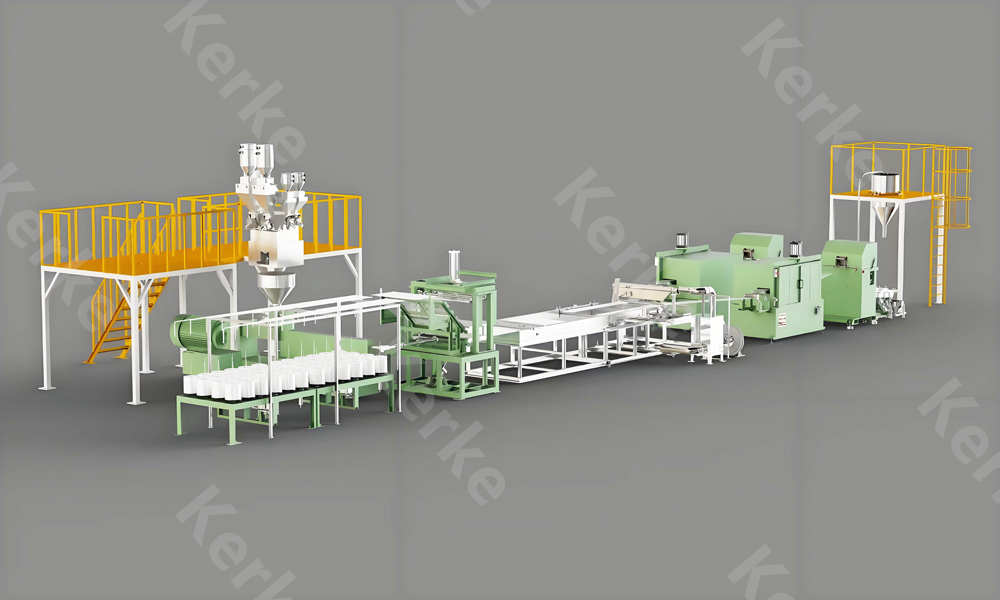
Kerke, a Wanplas factory, has spent more than 12 years designing and manufacturing parallel co-rotating twin-screw compounding extruders, operating from a 19,997-plus square meter plant with more than 2,000 machines running in over 70 countries. This article examines the market profit potential of biodegradable compound pellets produced through twin-screw manufacturing. Rather than quoting currency, we benchmark profitability with an index system: the processing gross margin of conventional polyethylene pelletizing is set at 100 index points, and every biopolymer formula tier is scored relative to that baseline. We then break the opportunity into demand drivers, a product profit matrix, the formula and process barriers that defend margin, the certification moat, a percentage-based cost structure, the twin-screw equipment that makes it feasible, real application end products, a demand-to-model selection table, service commitments, ten profit-improvement actions, a risk map, and a staged entry roadmap. By the end, a compounder or investor will understand not only where the money is made in biodegradable pelletizing, but why the margin concentrates in formula capability and process control rather than in raw throughput alone.
Demand Drivers Behind Biodegradable Compound Pellets
The profit potential of biodegradable compound pellets is not created by the extruder alone; it is pulled by three structural demand pillars that keep order books full even when commodity resin cycles turn. Understanding the intensity and timing of each pillar tells a compounder where to aim capacity and which formula tier to prioritize first.
Regulatory plastic restriction as the primary pull
Single-use plastic restriction policies across multiple regions form the strongest and most durable demand pillar. The EU single-use plastics restrictions have removed many conventional items from shelves and forced brand owners to qualify compostable alternatives. China’s plastic restriction policy continues to widen the scope of banned or restricted single-use formats, creating steady domestic substitution demand. Across Southeast Asia, national roadmaps are moving from pilot to enforcement, while several Middle East markets have begun publishing phased reduction targets. None of these policies names a supplier; they reshape the material specification of entire product categories, which is exactly the lever that lifts biodegradable pellet demand.
Brand ESG commitments as a second pillar
The second pillar is the public sustainability commitment made by large brand owners and retailers. When a multinational foodservice, packaging, or personal-care brand publishes a target to replace a share of fossil plastics with certified compostable or bio-based materials by a fixed year, it creates multi-year, contracted, and relatively price-insensitive procurement. That contracted demand is what converts a volatile resin market into a stable compound-pellet order book, and it is the foundation of the Premium and High profit tiers discussed later.
Consumer preference as the third pillar
The third pillar is end-consumer preference. Shoppers in many markets now associate compostable bags, fork-and-spoon sets, and coffee capsules with responsible choice, and they accept a price premium at the point of sale. Consumer willingness to pay is weaker than regulation and weaker than corporate ESG contracts, but it is broad and growing, which supports the general-purpose film grade and the small-batch 3D printing filament tier.
Taken together, the three pillars give a compounder a practical capacity-planning rule. Regulation and ESG contracts are predictable and multi-year, so they justify committed base capacity and locked formula development. Consumer preference is variable and season-sensitive, so it is better served by flexible, fast-changeover capacity than by dedicated lines. A balanced plant therefore runs a high-utilization volume line for regulated and contracted demand while keeping a flexible development line free to chase consumer-led and Premium opportunities.
The table below maps each driver to its impact intensity and the window during which it most strongly supports pellet demand. Intensity is expressed as Low, Medium, High, or Very High rather than as a currency figure, keeping the analysis compliant with a money-free profit review.
| Demand Driver | Impact Intensity | Time Window | Formula Tier It Supports |
|---|---|---|---|
| EU single-use plastics restrictions | Very High | Active and expanding through the current decade | Compostable film, cutlery, capsule grades |
| China plastic restriction policy | High | Active, scope widening year by year | Film, mulch, filler-heavy grades |
| Southeast Asia restriction roadmaps | Medium | Emerging, pilot to enforcement | General-purpose film grade |
| Middle East reduction targets | Low to Medium | Early stage, phased | Bag and packaging film grade |
| Brand ESG procurement commitments | High | Contracted through roughly 2025 to 2030 | Certified Premium and High tiers |
| Consumer willingness to pay | Medium | Steady, gradual growth | Film, 3D printing filament |
The strategic reading is simple: regulation builds the floor, ESG contracts build the ceiling, and consumer preference widens the middle. A compounder who aligns capacity with the regulatory and ESG pillars captures the most defensible margin, while one who competes only on the consumer-preference tier faces the most price competition.
Product Matrix and Profit Tiering by Formula
Profit in biodegradable pelletizing is decided first at the formula level. Different compound families serve different end products, carry different barriers to entry, and therefore earn different gross-margin index scores. We score every tier against a base of 100 index points, defined as the processing gross margin of conventional polyethylene pelletizing. A score above 100 means the biodegradable tier earns a richer margin per comparable unit of processing effort; a score near or below 100 signals a volume-driven, competition-heavy business.
| Product Tier (Formula Family) | Gross-Margin Index (base 100 = PE pellet) | Profit Tier | Volume Character | Barrier Level |
|---|---|---|---|---|
| General-purpose PLA/PBAT blown-film grade | 90 to 105 | Low to Medium | High volume, thin margin | Low |
| High-filler starch or calcium carbonate grade | 95 to 115 | Medium | Very high volume, cost-advantage | Low to Medium |
| Heat-resistant modified PLA (cutlery grade) | 120 to 140 | Medium-High | Medium volume | Medium |
| High-toughness PLA/PBAT alloy | 140 to 165 | High | Medium volume, sticky customers | High |
| Compostable mulch-film specialty grade | 135 to 160 | High | Seasonal, high repeat | High |
| Medical or food-contact certified grade | 180 to 230 | Premium | Lower volume, high value | Very High |
| Biodegradable 3D printing filament | 170 to 210 | Premium | Small batch, high value | Medium-High |
The general-purpose film grade scores at or slightly below the PE baseline because it is the easiest entry point and therefore the most contested. A compounder who only makes unreinforced PLA/PBAT film resin competes on price and must win through volume and cost, not margin. The high-filler grade lifts the index modestly because starch or calcium carbonate displaces expensive biopolymer per ton, but the real profit still depends on how well the filler is dispersed and how much mechanical property is preserved.
The middle of the matrix is where most durable profit lives. Heat-resistant PLA for cutlery needs nucleating agents and controlled annealing to raise the heat deflection temperature, which a generic film line cannot match. High-toughness PLA/PBAT alloys require a compatibilizer or chain-extender system to keep melt strength and bubble stability, raising both the technical barrier and the index score into the High tier. Compostable mulch film is doubly controlled: it must hold field mechanics through a growing season yet still disintegrate within a defined soil window, so customers stay loyal once validated.
The top of the matrix is protected by certification and specification rather than by volume. Medical and food-contact certified grades sit at the Premium tier because only a small number of compounders can document the full compliance chain, and the buyer is willing to pay for that assurance. Biodegradable 3D printing filament earns a similar Premium index because it is sold in small batches with tight diameter tolerance and color consistency, where the buyer pays for reliability rather than tonnage.
Profit in this market is a ladder. The bottom rung is open to anyone with a twin-screw line; each higher rung is guarded by a formula, process, or certification barrier that multiplies the index score.
Formula and Process Barriers That Protect Margin
The reason the profit index rises with formula complexity is that complexity is hard to replicate. A competitor can buy the same base resin, but cannot easily copy the screw configuration, venting strategy, and additive system that deliver consistent pellet quality. This section explains the engineering barriers that turn a commodity blend into a defensible product.
PLA thermal sensitivity and hydrolysis control
Polylactide is thermally sensitive and hydrolytically fragile. Its practical processing window is roughly 170 to 210 degrees Celsius, and above that range molecular chain scission accelerates. Worse, PLA hydrolyzes in the presence of moisture, so resin must be dried to below 250 ppm water content, typically at a dew point near minus 40 degrees Celsius, before it enters the feed throat. A line that neglects drying loses molecular weight and produces brittle pellets, which is why moisture control is the first barrier a compounder must clear.
Screw configuration: kneading-block angle and reverse elements
In a co-rotating parallel twin-screw extruder, the screw is built from modular elements: conveying flights, kneading blocks at 30, 60, or 90 degrees, and reverse elements. A 30-degree kneading block gives gentle distributive mixing with low shear; a 90-degree block gives intense dispersive mixing with high local temperature. Reverse elements build pressure and extend residence time for reactions such as chain extension. The art is balancing shear intensity against residence time so that fillers disperse and compatibilizers react without overheating the PLA. Misconfigured screws either under-mix (poor dispersion) or over-shear (molecular-weight loss), and either path destroys margin through rejects.
Compatibilizer and chain-extender system for melt strength
PLA and PBAT are immiscible at the molecular level, so a high-toughness alloy needs a compatibilizer or a multi-functional epoxy chain extender. The chain extender reacts with terminal carboxyl and hydroxyl groups, raising molecular weight and melt strength, which directly improves blown-film bubble stability. Getting the dosage and the reaction residence right is a barrier that generic compounders cannot cross without trial data, and it is exactly what supports the High index tier for alloys.
Multi-stage vacuum devolatilization
Biodegradable compounds must be stripped of residual monomer, water, and low-molecular-weight oligomers. A well-designed barrel uses two or more vent ports under vacuum, often in the low single-digit to low double-digit millibar range at the strong stage, to pull moisture and volatiles out of the melt. Poor devolatilization leaves foam, odor, and weak mechanicals, raising the quality-loss share of cost and eroding the index score. This is why vent arrangement is a process barrier, not a detail.
Filler dispersion and masterbatch pre-dispersion
Starch and calcium carbonate are cheap, but only when they are dispersed to a fine, stable state. Agglomerates create stress points that drop impact strength. Pre-dispersing filler in a masterbatch, or using a side feeder to introduce it downstream where shear is controlled, improves dispersion and protects properties at high loading. The ability to hold 30 to 50 percent filler while keeping acceptable toughness is a Medium barrier that defends the cost-advantage grade.
Nucleating agent and annealing effect on heat deflection temperature
For cutlery and hot-fill trays, the heat deflection temperature of PLA must rise well above room temperature. A nucleating agent accelerates crystal formation, and a post-extrusion annealing step lets crystals grow, lifting the heat deflection temperature by a meaningful number of degrees Celsius, often into the 100 to 130 degree range for properly nucleated and annealed grades. That thermal upgrade is what moves a film-grade resin into the Medium-High profit tier, because few lines can deliver it repeatably.
Barrel temperature zoning and residence-time distribution
Beyond element choice, the barrel temperature profile and the residence-time distribution decide whether a formula reaches its target without degradation. The feed and plasticizing zones run cool to protect PLA, the mixing and reaction zones rise to the kneading temperature needed for compatibilizer reaction, and the metering and devolatilization zones are tuned for uniform melt and volatile removal. A narrow residence-time distribution keeps every pellet at the same thermal history, which is why co-rotating geometry with strong self-cleaning beats a poorly tuned line on batch consistency. Tighter consistency lowers the quality-loss share and protects the index even when the formula itself is ordinary.
Quality and Certification Barriers
Certification is the clearest moat in the Premium tier. It is slow, documented, and expensive to repeat, so once a compounder holds the right certificates, buyers are reluctant to re-qualify a cheaper unknown source. The standards below are named as plain text only; the article contains no linked citations.
Compostability certification paths
Industrial compostability is demonstrated through EN 13432 in Europe and ASTM D6400 in North America, while ISO 17088 provides the international framework for compostable plastics. Home-compost claims follow related regional schemes and the widely recognized OK Compost type markings. Each program requires disintegration and ecotoxicity testing over a defined period, and a full compostability dossier typically needs several months to complete, sometimes approaching a year when field validation is included. That lead time is itself a barrier: a late entrant cannot simply undercut an established certified supplier within a single selling season.
Food-contact and medical compliance
Food-contact grades must satisfy FDA requirements in the United States and the EU 10/2011 framework in Europe, with full migration and substance-list documentation. Medical or pharmaceutical contact raises the bar further with additional biocompatibility and traceability expectations. These frameworks are plain-text references here; achieving them demands locked formulations, controlled raw-material sourcing, and auditable batch records, which is why the certified tier carries the highest index score.
Why certification protects the index
Certification converts a technical product into a regulated, auditable supply relationship. The buyer pays a Premium not for the resin alone but for the documented assurance that the pellet will pass inspection at the converter and at the brand owner. Because re-qualification is costly, certified supply is sticky, and sticky supply is what keeps the gross-margin index high instead of collapsing toward the PE baseline.
Cost Structure Breakdown Without Currency
To compare profit potential without currency, we express the cost stack as a share of total production cost and pair each share with the range by which it can be optimized through better equipment or process. The indices and percentages below are relative planning figures, not market-size numbers, and they deliberately avoid any money denomination.
| Cost Category | Share of Total Cost | Optimizable Range | Main Lever |
|---|---|---|---|
| Raw biopolymer and filler | 55% to 75% | 5 to 15 points lower via filler balance | Filler loading, source mix |
| Energy (kWh per ton) | 8% to 15% | 15% to 25% lower via high torque | Specific torque, L/D, motor efficiency |
| Labor (hours per ton) | 4% to 8% | 20% to 40% lower via automation | Loss-in-weight feeding, remote O&M |
| Depreciation and amortization | 5% to 12% | Spread by utilization gain | Capacity utilization, line uptime |
| Quality loss (yield loss) | 3% to 10% | 30% to 60% lower via process control | Venting, screw design, drying |
| Certification amortization | 1% to 3% | Shared across grades | Platform certification, reuse |
| Packaging and logistics | 3% to 7% | 5 to 15 points via local supply | Regional sourcing, bulk packing |
Two readings follow from this table. First, raw material dominates the stack, so the single biggest profit lever is formulation: raising filler within the property envelope, or shifting from a high-cost base resin to a blended alloy, moves the index more than any equipment tweak. Second, the controllable shares (energy, labor, quality loss) are where the twin-screw line earns its keep. A high-torque co-rotating extruder that cuts specific energy by 15 to 25 percent and a venting layout that halves yield loss can lift the effective gross-margin index by double digits without touching resin price.
A useful way to read the table is as a control loop. The raw-material share tells the formulator where to act; the energy, labor, and quality-loss shares tell the processor where the machine pays back; and the certification and logistics shares tell the planner where platform thinking and regional sourcing compound the gain. A compounder who optimizes only one column leaves index points on the table, while one who tunes all three together can raise the blended margin well above the PE baseline even on a mid-tier formula.
Kerke Co-Rotating Twin-Screw Extruder Solutions
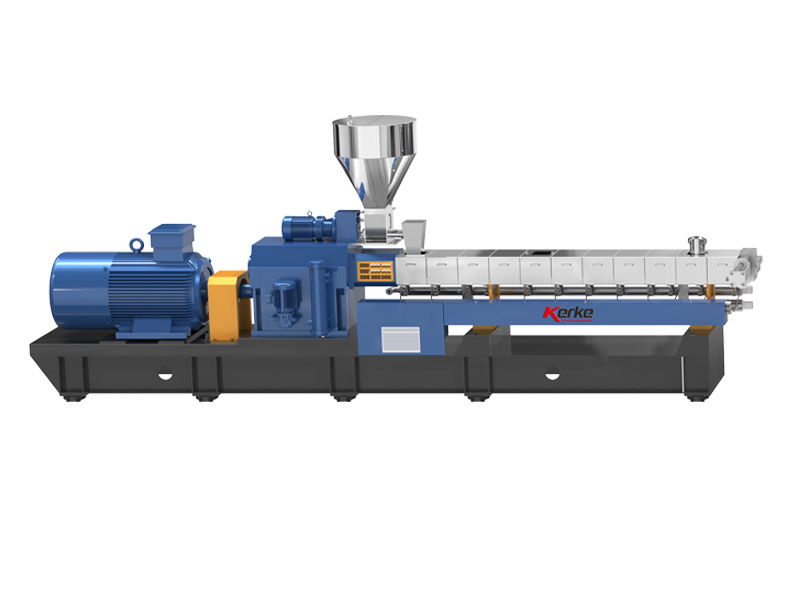
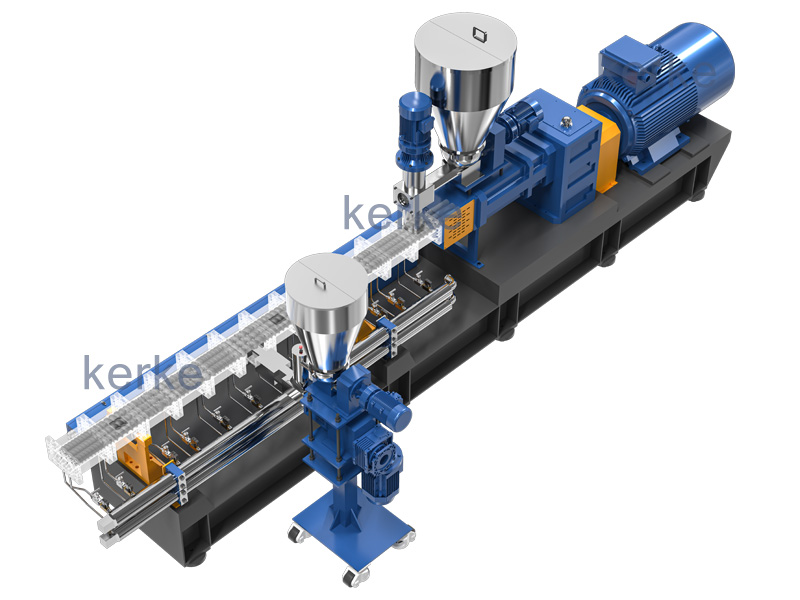
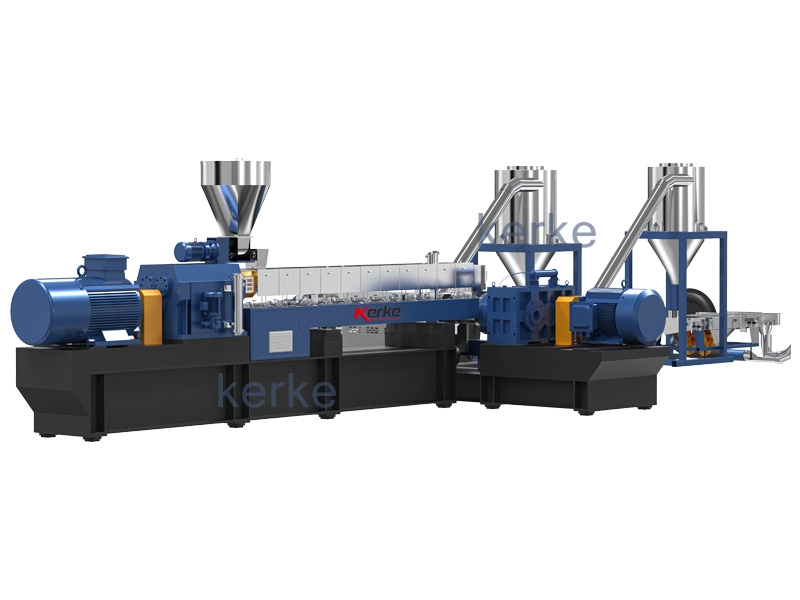
Kerke, a Wanplas factory, builds the KTE series of parallel co-rotating twin-screw compounding extruders, covering KTE-16B through KTE-135D. The following three production models are representative of the range and show how screw diameter, L/D ratio, specific torque, and venting translate into biodegradable-pellet capacity. Each is paired with the formula family it serves best.
KTE-65D for pilot and specialty biodegradable runs
| Parameter | KTE-65D Specification |
|---|---|
| Screw diameter (D) | 62.4 mm |
| L/D ratio | 40:1 |
| Main motor power | 90 kW |
| Screw speed (max) | 600 rpm |
| Specific torque | 11.3 Nm/cm3 |
| Capacity (biodegradable compound) | 200 to 400 kg/h |
The KTE-65D is the workhorse for formula development, small-batch Premium filament, and certified food-contact trials. Its 40:1 L/D gives room for a drying-coupled feed, a gentle mixing zone, and two vacuum vents, while the 11.3 Nm/cm3 specific torque protects molecular weight during chain extension. A compounder uses this model to build the formula library before scaling.
KTE-95D for mid-volume functional grades
| Parameter | KTE-95D Specification |
|---|---|
| Screw diameter (D) | 91 mm |
| L/D ratio | 44:1 |
| Main motor power | 315 kW |
| Screw speed (max) | 600 rpm |
| Specific torque | 11.3 Nm/cm3 |
| Capacity (biodegradable compound) | 600 to 1200 kg/h |
The KTE-95D fits the High and Medium-High tiers: high-toughness alloys, heat-resistant cutlery grades, and compostable mulch film. The longer barrel and higher torque let the line run a controlled side feed for filler and a strong devolatilization zone, which keeps quality loss low at meaningful throughput.
KTE-135D for full-scale film and filler grades
| Parameter | KTE-135D Specification |
|---|---|
| Screw diameter (D) | 133 mm |
| L/D ratio | 48:1 |
| Main motor power | 710 kW |
| Screw speed (max) | 500 rpm |
| Specific torque | 12 Nm/cm3 |
| Capacity (biodegradable compound) | 2000 to 3500 kg/h |
The KTE-135D is built for the volume tiers: general-purpose film resin and high-filler grades where cost-per-ton dominates. At 2000 to 3500 kg/h it spreads depreciation across large output, and the high specific torque keeps energy per ton low even at full fill. Kerke complements these extruders with water-cooled strand pelletizing, air-cooled die-face hot cutting, and underwater pelletizing options selected by the formula’s melt behavior.
Application Industries and End Products
Kerke’s compounding lines already serve masterbatch and biodegradable-plastic production across the following end-use chains. Mapping the pellet tier to the physical product clarifies where each profit index is realized in the market.
Shopping and carry bags
General-purpose PLA/PBAT blown-film grade becomes retail shopping bags and carry bags. This is the largest volume outlet and the most price-competitive, so it sits at the Low-to-Medium index tier and rewards low cost-per-ton more than formulation sophistication.
Agricultural mulch film
Compostable mulch-film specialty grade is laid over fields to suppress weeds and retain moisture, then tilled in to degrade in soil. Because the degradation rate must be matched to the crop cycle, this is a High-tier, repeat-order product with strong customer stickiness.
Cutlery, knives, forks, and spoons
Heat-resistant modified PLA, nucleated and annealed, is thermoformed or injection molded into cutlery. The thermal upgrade moves it to the Medium-High tier, and the converters pay for consistent heat deflection temperature.
Coffee capsules and packaging trays
High-toughness PLA/PBAT alloys and certified food-contact grades become coffee capsules and rigid packaging trays. These are Premium or High tiers where sealing integrity, aroma barrier, and compliance documentation justify a richer index score.
3D printing filament
Biodegradable 3D printing filament is extruded from compound pellets at tight diameter tolerance and sold in small spools. As a Premium, small-batch tier it earns one of the highest index scores despite low tonnage, because the buyer pays for dimensional stability and color uniformity.
Mapping the pellet tier to the physical product matters for margin because the same biopolymer can sit in two different tiers depending on the end use. A PLA/PBAT blend sold as loose film resin is a Low-to-Medium commodity; the identical blend, tuned and certified for a coffee capsule, becomes a High or Premium system. The compounder’s profit therefore depends less on which resin it buys and more on how precisely it matches each pellet to a defended end-product specification, then documents that match through certification and process data.
Demand-to-Model Selection Guidance
The table below connects a target formula family, intended annual capacity, and filler loading to a recommended Kerke model. It lets a buyer size equipment to the profit tier they intend to serve rather than over- or under-buying capacity.
| Target Formula System | Annual Output Target | Filler Loading | Recommended Model |
|---|---|---|---|
| General-purpose film grade | Above 10,000 tons per year | Low, below 15% | KTE-135D |
| High-filler starch or CaCO3 grade | 5,000 to 20,000 tons per year | 30% to 50% | KTE-95D or KTE-135D with side feeder |
| Heat-resistant cutlery grade | 2,000 to 8,000 tons per year | Low to medium | KTE-95D |
| High-toughness PLA/PBAT alloy | 2,000 to 10,000 tons per year | Low, below 20% | KTE-95D |
| Compostable mulch-film grade | 3,000 to 12,000 tons per year | Medium, 10% to 30% | KTE-95D |
| Food-contact or medical certified grade | Below 3,000 tons per year | Low | KTE-65D |
| Biodegradable 3D printing filament | Below 1,500 tons per year | Low | KTE-65D |
A buyer who intends to climb from volume film toward certified Premium grades should still begin with a KTE-65D for formula development, then add a KTE-95D for functional volume, and only scale to KTE-135D once the film-grade base load justifies it. This staged path matches the entry roadmap in the final sections.
Service and Support Commitments
Kerke, a Wanplas factory, supports buyers through the full life cycle so that equipment downtime and slow qualification do not erode the profit index. The Wanplas brand promise covers every factory in the group, and Kerke applies it specifically to biodegradable compounding lines.
Pre-shipment trial and testing
Before delivery, Kerke runs the buyer’s actual formula on the line and records throughput, melt temperature, devolatilization behavior, and pellet quality. This de-risks commissioning and shortens the customer validation cycle that otherwise delays revenue.
Installation, commissioning, and training
Engineers install and commission the line on site, then train operators on drying, screw configuration, venting, and changeover. Well-trained crews raise capacity utilization and lower the quality-loss share, both of which lift the index score.
Spare-parts allowance
Under the Wanplas brand promise, each Kerke line is backed by USD 500 free parts per year, covering wear items within the allowance so that routine maintenance does not become a surprise cost center.
Remote operation and maintenance
The control system supports remote monitoring and recipe management, letting Kerke engineers diagnose process drift from a distance. Remote support reduces labor hours per ton and shortens unplanned stoppages.
Open-factory audit
Kerke welcomes customer and third-party audits at its plant. An open-factory policy builds the traceability story that certified food-contact and medical buyers require, reinforcing the Premium-tier moat.
Recipe management and production data
Every Kerke line stores screw configuration, temperature profile, and feeder ratios as named recipes, so a validated formula can be re-run identically months later without re-engineering. This recipe discipline shortens re-qualification for repeat orders and supports the remote operation and maintenance service, where process drift is spotted from logged data before it becomes scrap. For a compounder, locked recipes are the operational foundation of the consistency that certified buyers insist on.
Ten Practical Ways to Improve Profitability
The index system is only useful if it drives action. The following ten measures move the gross-margin index without changing the base resin price, and most of them are implemented on the twin-screw line itself.
- Optimize filler loading within the property envelope. Raise starch or calcium carbonate to the highest level that still meets impact and elongation specs; each point of displaced biopolymer lowers raw cost per ton.
- Run a high-torque, longer L/D line. Specific torque near 11 to 12 Nm/cm3 and an L/D of 44:1 or higher cut specific energy by an estimated 15% to 25% and improve mixing per kWh.
- Control changeover loss. Purge with a compatible transition compound and preheat the barrel to the next formula’s setpoint; disciplined changeovers cut material waste from several percent to under one percent.
- Lift capacity utilization above the break-even band. Most lines need roughly 65% to 75% utilization before fixed cost is fully covered; shift mix toward custom grades to fill the calendar.
- Migrate order mix from generic to custom. Moving even a quarter of volume from film grade to alloy or certified grade can raise the blended index by double digits.
- Pre-disperse filler in masterbatch. Better dispersion protects toughness at high loading, deferring the point where filler destroys properties.
- Tighten devolatilization. Two-stage vacuum venting in the low millibar range removes volatiles that cause foam and weak welds, lowering the quality-loss share.
- Automate feeding and recipe control. Loss-in-weight feeders and stored recipes cut labor hours per ton by 20% to 40% and improve batch-to-batch consistency.
- Package technical service with the pellet. Offering converters processing support turns a commodity resin into a supported system, raising stickiness and index.
- Share certification across grades. Building a platform dossier that covers several grades amortizes the certification cost over more volume instead of per product.
Risk Map and Mitigation
Profit potential is only realized if the risks below are actively managed. Each is scored for probability and impact, then paired with a mitigation that protects the index.
| Risk | Probability | Impact on Index | Mitigation |
|---|---|---|---|
| Regulatory pace slower than expected | Medium | Medium | Diversify across regions and tiers; serve both regulated and consumer-preference demand |
| Raw material supply volatility | Medium-High | High | Multi-source base resin; hold buffer stock of certified grades |
| Long certification cycle | High | Medium | Start the track early; run parallel grades on one platform dossier |
| Homogeneous competition on film grade | High | Medium-High | Differentiate via functional and certified grades, not price |
| Long customer validation cycle | Medium | Medium | Provide samples, process data, and on-site technical service |
Three-Phase Market Entry Roadmap
For a compounder entering this market, the index ladder suggests a staged entry that builds capability before chasing volume. The roadmap below sequences equipment, formula, and certification so that margin grows with maturity.
Phase one: single-formula entry
Start with one reachable tier, typically general-purpose film grade or a high-filler grade, on a KTE-65D or KTE-95D. The goal is to prove consistent pellet quality, establish converter relationships, and learn drying, venting, and screw configuration on real resin. Capacity is deliberately moderate so that utilization stays high.
Phase two: build the formula library
Using the pilot line as the development engine, add heat-resistant cutlery grade, high-toughness alloy, and compostable mulch-film grade to the portfolio. Each new formula lifts the blended gross-margin index and reduces dependence on the contested film tier. Begin the certification tracks during this phase so the Premium door is open by phase three.
Phase three: upgrade to functional and certified scale
Once functional and certified grades show repeat orders, scale the winning tiers on a KTE-95D or KTE-135D and reserve the KTE-65D for ongoing development and small-batch Premium filament. At this stage the blended index sits well above the PE baseline, and the business is defended by formula, process, and certification barriers rather than by tonnage alone.
Frequently Asked Questions
What is biodegradable compound pellet manufacturing on a twin-screw extruder?
It is the continuous melt-compounding of biopolymers such as PLA and PBAT with fillers, tougheners, nucleating agents, and compatibilizers inside a co-rotating parallel twin-screw extruder, followed by pelletizing into reusable compound pellets sold to film, sheet, and molded-product makers.
Which biodegradable formula grade offers the highest profit index?
Medical and food-contact certified grades and small-batch biodegradable 3D printing filament sit at the Premium tier with the highest gross-margin index, because certification barriers and tight specifications protect pricing. High-toughness PLA/PBAT alloys rank just below them on the High tier.
Why is the PLA processing window so narrow and how is it managed?
PLA is thermally sensitive and hydrolyzes above 250 ppm moisture, so the safe melt window is roughly 170 to 210 degrees Celsius. Operators dry resin to below 250 ppm at a dew point near minus 40 degrees Celsius and run gentle kneading-block angles with strong vacuum venting to preserve molecular weight.
How does twin-screw extruder configuration affect profit?
Screw geometry, L/D ratio, specific torque, and venting layout decide residence time, shear, and molecular-weight retention. A high-torque, longer L/D co-rotating line raises capacity per kWh and yield, which lifts both throughput and gross margin index while lowering changeover loss.
What certifications are required for compostable products and how long do they take?
Industrial and home compostability are proven through EN 13432, ASTM D6400, and ISO 17088 test programs, while food contact follows FDA and EU 10/2011 frameworks. Full compostability certification typically spans several months of testing, so planning the track early protects the Premium-tier margin.
How does filler loading affect both cost and margin?
Raising starch or calcium carbonate loading cuts resin cost per ton and lifts material recovery, but above a balance point it lowers impact strength and elongates the degradation profile. The profit optimum is found where filler, toughness, and certification limits still meet the end-product specification.
What capacity utilization is needed to reach break-even?
Because depreciation and fixed labor are spread over output, most lines reach healthy break-even only above roughly 65% to 75% utilization. Moving order mix from generic film grade toward custom functional grades is the fastest route to lift effective utilization and margin together.
How does Kerke support buyers entering the biodegradable pellet market?
Kerke, a Wanplas factory, runs pre-shipment trials on the actual formula, supplies installation and commissioning, training, remote operation and maintenance, and an open-factory audit policy, plus a spare-parts allowance of USD 500 free parts per year under the Wanplas brand promise.
Conclusion
The market profit potential of biodegradable compound pellets made on twin-screw extruders is real but unevenly distributed. The index system shows that general-purpose film grade earns at or below the conventional PE baseline, while formula and certification complexity climbs the index to Medium-High, High, and Premium tiers. The margin is protected by engineering barriers: PLA drying and narrow processing windows, screw geometry and kneading-block angles, compatibilizer and chain-extender systems, multi-stage vacuum devolatilization, filler dispersion, and nucleating-agent control of heat deflection temperature. Certification under EN 13432, ASTM D6400, ISO 17088, FDA, and EU 10/2011 then locks the top tiers behind a slow, auditable moat.
The practical conclusion for any buyer is to treat the twin-screw line as a formula platform, not as a single-product machine. A KTE-65D builds the library, a KTE-95D delivers functional volume, and a KTE-135D defends cost on film and filler grades. Profit is then grown in steps: first consistent quality, then a wider formula range, then certified Premium supply, each step raising the blended gross-margin index while the equipment base stays reusable. That staged path is how a compounder converts regulatory and ESG demand into durable, defensible margin rather than into a race to the lowest cost per ton.
Operationally, profit is improved with a percentage and index toolkit rather than currency: raise filler within the property envelope, run a high-torque long L/D co-rotating line to cut kWh per ton, control changeover loss, lift utilization above the 65% to 75% band, and migrate mix from generic to custom and certified grades. Kerke, a Wanplas factory, supplies the KTE series from KTE-65D through KTE-135D with pre-shipment trials, installation and commissioning, training, remote operation and maintenance, an open-factory audit policy, and a spare-parts allowance of USD 500 free parts per year. If you are evaluating entry into biodegradable pelletizing, share your target formula, annual capacity, and filler plan with the Kerke technical team, and arrange a visit to the plant to run your compound on a live line before you commit to capacity.