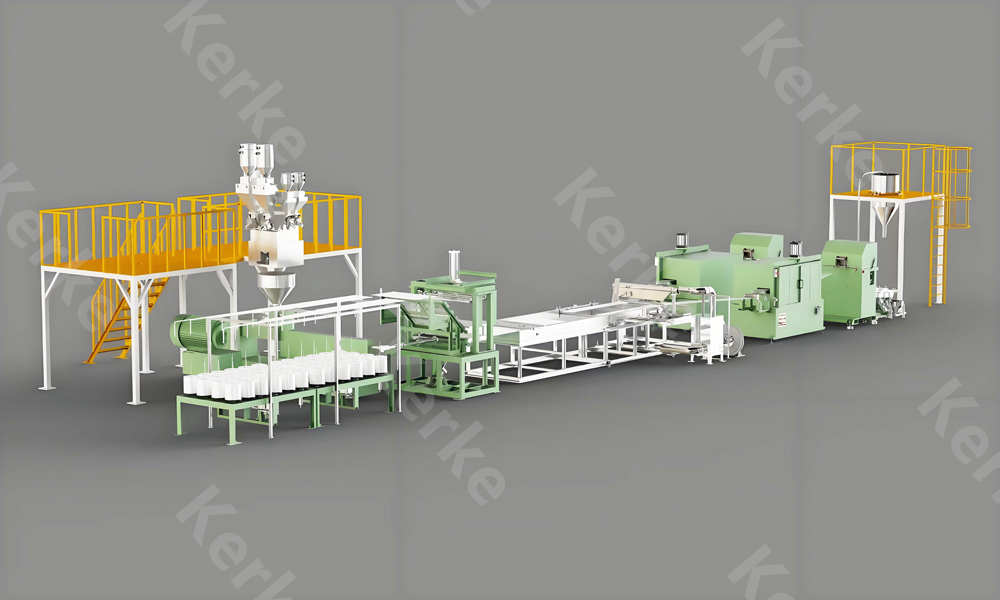
Defining a Medium-Scale Color Masterbatch Factory
A total investment budget estimation for a medium scale color masterbatch twin screw factory only becomes meaningful once the word “medium” is pinned to hard numbers. In compounding practice, medium scale describes a plant producing roughly 3,000 to 8,000 tonnes of finished color masterbatch per year, built around two to four independent pelletizing lines, occupying 2,000 to 4,000 square meters of production and storage floor, staffed by 25 to 45 people, and running a three-shift pattern that yields 6,000 to 7,000 effective operating hours per line per year. Every budget line in this article is anchored to that envelope, because a capacity band is the only honest starting point for a capital plan.
The arithmetic behind the envelope is straightforward and worth doing explicitly. A single co-rotating parallel twin-screw extruder in the SHJ-65 class delivers 300 to 500 kilograms per hour on typical color masterbatch recipes. At 6,500 effective hours and an 85 percent utilization factor after color changeovers, cleaning and planned maintenance, that machine yields roughly 1,700 to 2,800 tonnes per year. Two such lines therefore land squarely in the lower half of the medium band, while a three-line plant that includes one SHJ-75 or SHJ-95 for high-volume standard colors comfortably reaches 6,000 to 8,000 tonnes. Anyone budgeting a masterbatch factory should build this table first, because line count drives almost every downstream capital decision.
Color masterbatch differs from filler masterbatch and general plastic compounding in one commercially decisive way: batch sizes are small and color changes are frequent. A plant making 5,000 tonnes of color masterbatch might run 400 to 900 distinct production orders per year across dozens of pigment systems, whereas a filler masterbatch plant of the same tonnage might run fewer than 100. This changes the investment logic. Capacity per line matters less than changeover speed, self-cleaning screw geometry, dosing accuracy and the ability to isolate a contaminated line without shutting the plant. Budgets written by people who have only seen commodity compounding almost always under-provision for changeover infrastructure.
Kerke, a Wanplas factory based in Nanjing with a 19,997 square meter plant, more than 2,000 machines running in over 70 countries and 12 years of specialization in co-rotating parallel twin-screw compounding extruders, sees this pattern repeatedly in project enquiries. The Wanplas brand, which operates Kerke alongside six other specialized machinery factories, applies a shared engineering and after-sales framework across the network, and the budget structure described below reflects the configurations Kerke most often quotes for medium-scale masterbatch projects in 2026.
| Parameter | Lower bound | Upper bound | Planning note |
|---|---|---|---|
| Annual output of finished masterbatch | 3,000 t/a | 8,000 t/a | Below 3,000 t/a the fixed utility and laboratory load dominates; above 8,000 t/a the plant is large scale |
| Number of pelletizing lines | 2 | 4 | One line is an entry pilot plant, not a medium-scale factory |
| Production and warehouse floor area | 2,000 m² | 4,000 m² | Allow 35 to 45 percent of floor for raw material and finished goods storage |
| Total headcount | 25 | 45 | Includes production, quality, warehouse, maintenance and administration |
| Effective operating hours per line | 6,000 h/a | 7,000 h/a | Three-shift pattern; excludes color changeover and planned maintenance downtime |
| Installed transformer capacity | 400 kVA | 1,200 kVA | Scales with line count, pelletizing method and drying load |
| Typical production orders per year | 400 | 900 | Changeover frequency, not raw tonnage, drives layout and dosing investment |
The Indexed Budgeting Method: Points, Percentages and Intensity Tiers
Capital budgets for compounding plants are best expressed as structure rather than as absolute figures, because absolute figures decay within months while structure remains valid for years. This article therefore uses three instruments consistently: a percentage composition of total investment, an indexed baseline in which the complete project equals 100 index points and every category receives an allocation of those points, and a five-level relative intensity ladder of Low, Medium, High, Very High and Premium. Multiples such as 1.0×, 1.7× or 3.0× express how one configuration tier relates to another.
The indexed approach has practical advantages beyond avoiding stale numbers. It forces the planner to reason about proportion, which is where most masterbatch project budgets fail. A team that allocates 62 index points to the extrusion island and only 3 points to utilities has almost certainly under-scoped the electrical and cooling systems, and will discover the gap during commissioning when the chiller cannot hold water temperature across three simultaneously running lines. Proportional reasoning surfaces that error before the purchase orders are issued.
The intensity ladder is equally useful in supplier discussions. When a project engineer states that a requirement carries Very High investment intensity, the specification conversation shifts from haggling toward whether the requirement is actually necessary. Underwater pelletizing on a plant that produces only high-viscosity carrier-resin color masterbatch is a Very High intensity choice generating little operational return, whereas the same choice on a plant producing low-melt-viscosity, heavily pigment-loaded grades is the only technically viable option. Intensity labels make that trade-off explicit.
Throughout the framework, the 100-point baseline is defined as the total funded project, including working capital, from land or building preparation through to the first month of stable commercial production. Excluding working capital from the baseline is a frequent and expensive error, since a masterbatch plant carries substantial pigment and carrier resin inventory and cannot run on equipment alone.
Rule of thumb: if the process island (main equipment plus auxiliaries) exceeds 72 index points of a 100-point baseline, the project has almost certainly under-scoped buildings, utilities, laboratory or working capital, and the shortfall will appear as an unplanned funding request during commissioning.
Main Equipment: Twin-Screw Extruder Selection and Sizing
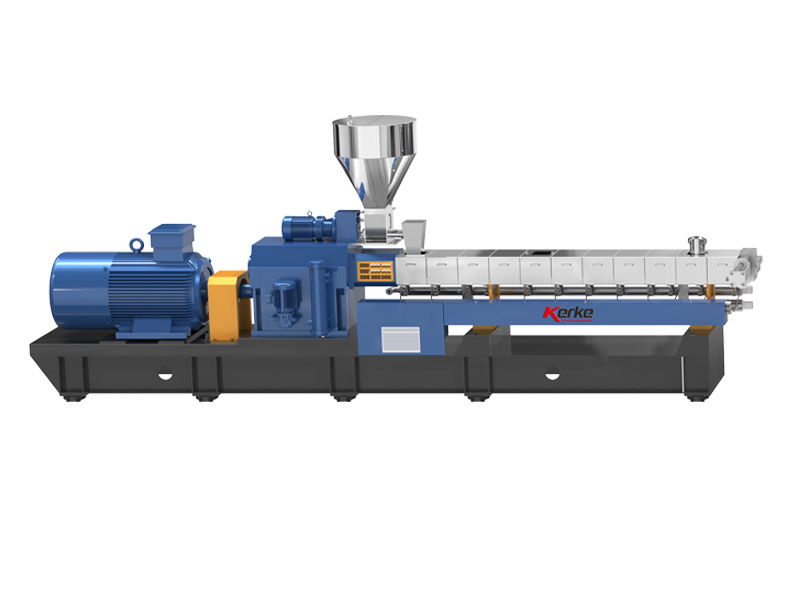
The co-rotating parallel twin-screw extruder is the single largest line item in a color masterbatch factory, and its selection cascades into every other budget category. Screw diameter sets throughput, throughput sets line count, line count sets floor area, transformer capacity, cooling load, headcount and packaging capacity. Getting the host model right is therefore not a procurement decision but the structural decision of the whole capital plan.
Four diameter classes cover the entire medium-scale range. The SHJ-52 handles 150 to 300 kilograms per hour and is the natural choice for high-value, small-batch, frequently changed colors and for pilot work that supports a larger plant. The SHJ-65 at 300 to 500 kilograms per hour is the workhorse of the industry and appears in nearly every medium-scale configuration. The SHJ-75 at 500 to 800 kilograms per hour serves high-volume standard colors, black masterbatch and higher filler loadings. The SHJ-95 at 800 to 1,500 kilograms per hour is reserved for plants that have secured long-run contracts and can keep a large machine loaded, since running a large barrel at 40 percent of rated output wastes both capital and specific energy.
| Model class | L/D ratio | Max screw speed | Torque grade Td/D³ | Output range | Typical application | Investment intensity |
|---|---|---|---|---|---|---|
| SHJ-52 | 40 to 48:1 | 500 to 600 rpm | 8 to 9 | 150 to 300 kg/h | High-value small-batch colors, frequent changeover, pilot and scale-up work | Low |
| SHJ-65 | 44 to 52:1 | 600 to 700 rpm | 9 to 10 | 300 to 500 kg/h | General-purpose color masterbatch backbone line, PE and PP carriers | Medium |
| SHJ-75 | 48 to 56:1 | 600 to 800 rpm | 10 to 11 | 500 to 800 kg/h | High-volume standard colors, black masterbatch, moderate filler loading | High |
| SHJ-95 | 48 to 56:1 | 600 to 800 rpm | 10 to 11 | 800 to 1,500 kg/h | Long-run contract volumes, filler masterbatch, dedicated single-color operation | Very High |
Why L/D ratio changes the budget more than diameter alone
Color masterbatch demands dispersion quality above almost everything else, and dispersion is a function of residence time, shear history and the number of mixing stages the melt passes. A 40:1 machine is adequate for easily dispersed organic pigments in a low-viscosity carrier. A 52:1 or 56:1 machine becomes necessary when the recipe carries high pigment loading, difficult inorganic pigments such as titanium dioxide at elevated concentration, carbon black requiring intensive dispersive mixing, or a two-stage devolatilization sequence. Each additional four L/D adds a barrel section, a heating and cooling zone, screw elements, and length in the machine footprint, so the budget effect is real but modest relative to the quality benefit. Specifying too short a machine to save capital is the classic false economy in masterbatch: the plant then runs at reduced screw speed to gain residence time, permanently sacrificing throughput.
Torque density and its consequences
Torque grade expressed as Td/D³ in the 8 to 11 range describes how much specific torque the gearbox and screw shafts can transmit. Higher torque density lets the machine hold high output at lower screw speed, which reduces melt temperature, protects heat-sensitive pigments and lowers specific energy consumption. For color masterbatch, specific energy typically falls between 0.18 and 0.32 kilowatt-hours per kilogram depending on carrier viscosity, pigment loading and filler content. A high-torque machine at grade 10 to 11 carries a higher purchase intensity than a grade 8 machine of the same diameter, but it also delivers 15 to 30 percent more throughput on the same barrel, which changes the number of lines needed and can reduce the total plant investment rather than increase it. This is one of the few places in a masterbatch budget where paying more at the component level reduces the system total.
Barrel, screw and gearbox specification
The barrel should be a segmented, bimetallic-lined design with independently controlled heating and cooling zones, typically eight to fourteen zones depending on L/D. Screw elements are supplied as a computer-designed modular assembly of conveying elements, kneading blocks and mixing elements, splined onto high-torque shafts. Kerke’s screw philosophy uses a kneading co-type geometry with strong self-cleaning behavior, which matters enormously for color work because residual pigment in a dead zone becomes tomorrow’s contamination complaint. Wear-resistant metallurgy for barrel liners and screw elements should be specified from the start when the recipe portfolio includes titanium dioxide, calcium carbonate, glass fiber or other abrasive additives; retrofitting wear-resistant elements later is a High-intensity correction. Benchmark European suppliers such as Coperion, Leistritz and Berstorff apply the same architectural principles, and reading their technical literature alongside a Kerke or comparable Asian quotation is a good way to validate that a specification is complete rather than merely cheap.
Feeding and Dosing System: Loss-in-Weight Feeders and Side Feeding
Dosing accuracy is the difference between a masterbatch plant that holds color within customer tolerance and one that reworks batches. In a medium-scale color masterbatch factory, each line needs three to eight loss-in-weight feeders, and this cluster is the second most consequential equipment decision after the host extruder.
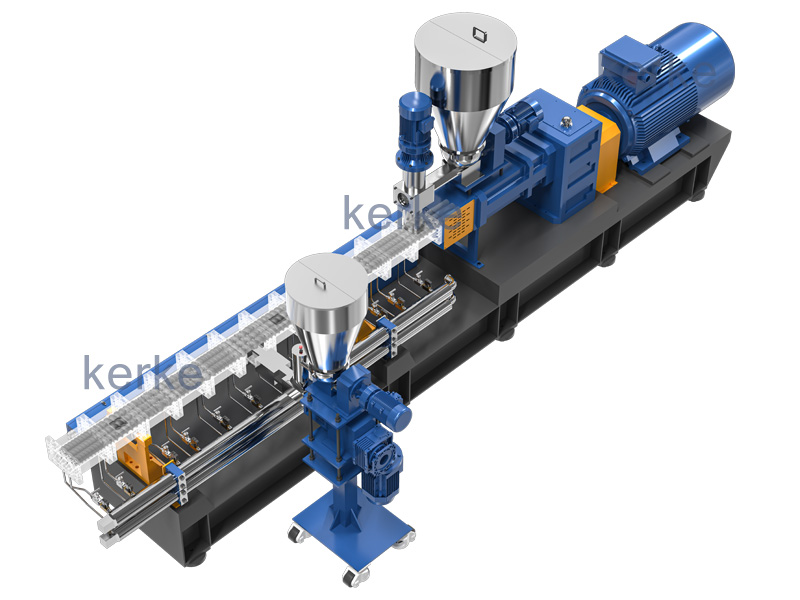
A minimal color masterbatch line requires three gravimetric feeders: one for the carrier resin, one for the pigment or pigment blend, and one for the additive package containing dispersant, lubricant and stabilizer. A well-equipped line runs five to eight: separate feeders for two or three pigment streams so that colors can be trimmed without premixing, a dedicated dispersant feeder, a wax or lubricant feeder, a liquid additive feeder for oils and liquid colorants, and a side feeder for fillers introduced downstream of the first melting zone. Metering accuracy should be specified at plus or minus 0.5 percent of setpoint on a rolling basis, which requires proper weigh-cell selection, mechanical isolation from vibration, and a controller capable of true loss-in-weight operation rather than volumetric operation with occasional weight correction.
| Recipe complexity | Gravimetric feeders per line | Streams handled | Side feeder | Liquid feeder | Dosing intensity |
|---|---|---|---|---|---|
| Basic single-pigment color | 3 | Carrier resin, pigment premix, additive package | Optional | No | Low |
| Standard multi-pigment color | 4 to 5 | Carrier, two pigments, dispersant, lubricant | Recommended | Optional | Medium |
| High-loading or filled color | 5 to 6 | Carrier, pigments, dispersant, filler via side feeder | Required, twin-screw type | Optional | High |
| Full formulation flexibility | 6 to 8 | Carrier, three pigments, dispersant, wax, liquid additive, filler | Required, with crammer option | Required | Very High |
Powder handling deserves separate attention. Fine organic pigments and carbon black bridge and rathole in hoppers, so pigment feeders need agitation, flexible-wall massaging or vibration assistance, and twin-screw metering augers rather than single augers. Carbon black feeding should be enclosed and vented to dust collection, because black pigment escaping into the workshop will eventually appear as specks in a white masterbatch batch on the neighboring line. Physical separation of black and light-color production, either by dedicated lines or by strict scheduling and cleaning protocols, is a layout decision with real capital consequences.
The side feeder introduces fillers, glass fiber or heat-sensitive additives downstream of the melting section, protecting them from the full shear and thermal history of the first barrel zones. For color masterbatch with calcium carbonate or talc extenders, a twin-screw side feeder positioned at roughly 50 to 65 percent of the barrel length is standard practice. Side feeders also need their own vent, otherwise entrained air travels back into the main barrel and destabilizes throughput.
Vacuum Venting, Melt Filtration and Melt Pressure Control
Vacuum venting removes moisture, monomer residue, pigment surface volatiles and entrained air from the melt, and a color masterbatch line normally operates one or two vent ports at minus 0.08 to minus 0.095 MPa gauge. The vacuum system is not merely a pump: it includes the vent housing with an anti-flooding insert, a knock-out separator, a cyclone or water-ring separator, and a filter that must be cleaned on a defined cycle. Plants that budget only for the pump discover that separator maintenance and vent cleaning are recurring tasks that need accessible design.
Vacuum level selection follows the recipe. Standard PE or PP carrier color masterbatch with dry pigments performs well at minus 0.08 to minus 0.085 MPa. Recipes carrying hygroscopic additives, recycled carrier resin or surface-treated pigments benefit from minus 0.09 to minus 0.095 MPa, which requires a stronger pump and better sealing of the barrel flange faces. Very deep vacuum on a low-viscosity melt risks pulling melt into the vent, so vent stuffers or vent screws are specified where that risk exists. The whole subsystem sits at Medium investment intensity but has outsized influence on pellet appearance and on downstream customer complaints about voids and streaking.
Melt filtration protects the pellet from carbonized material, unmelted pigment agglomerates and foreign contamination. A hydraulic plate screen changer with 60 to 200 mesh screen packs is standard for color masterbatch; continuous or backflushing screen changers are specified where filler content is high or where line stoppage for screen change is unacceptable. Screen changer selection interacts directly with the hidden cost discussion later in this article, because screen packs and seal rebuilds are consumables that budgets routinely forget.
A melt pump between the extruder and the die stabilizes melt pressure, which improves strand uniformity and pellet size consistency, and it allows the extruder to run at lower discharge pressure and therefore lower melt temperature. For masterbatch plants with tight pellet dimensional requirements or with underwater pelletizing, the melt pump moves from optional to recommended, adding Medium intensity to the line budget.
Pelletizing Method Selection and Its Budget Consequences
Pelletizing is where color masterbatch plants diverge most sharply in capital structure. The three practical routes are strand pelletizing, water-ring die face hot cutting, and underwater pelletizing, and each is matched to a different family of formulations. Choosing the wrong route does not merely raise cost; it can make certain recipes unproducible.
Strand pelletizing draws molten strands from a multi-hole die into a cooling water trough, dries them with an air knife, and cuts them in a rotary strand pelletizer. It is mechanically simple, tolerant of very high pigment and filler loading, easy to clean during color changeover, and carries Low investment intensity. Its weaknesses are strand breakage on low-viscosity melts, operator attention during startup and threading, and limited throughput scaling. For a medium-scale color masterbatch plant producing a broad portfolio of conventional PE and PP carrier grades, strand pelletizing remains the default and often the correct choice.
Water-ring die face hot cutting places rotating blades directly against the die face inside a housing where a ring of water carries the pellets away and cools them. It removes the strand threading problem, handles free-flowing compounds at higher throughput, produces a rounder pellet, and sits at Medium intensity. It is less tolerant of very high filler loading than strand cutting and requires careful die plate temperature control to prevent freeze-off.
Underwater pelletizing cuts at the die face inside a fully flooded, pressurized water chamber, then transports the pellets in the water stream to a centrifugal dryer. It is the only reliable route for very low-viscosity melts, heat-sensitive pigment systems, tacky compounds and certain highly filled grades, and it produces the most uniform spherical pellet with the least dust. The trade-off is High to Very High investment intensity: the package includes the cutter head with hydraulic advance, a heated die plate, a water circulation and temperature control loop, a pellet-water separator, a centrifugal dryer, and more demanding startup procedures. Underwater systems also impose a longer color changeover, because the whole water loop must be flushed.
| Route | Best-fit formulations | Practical throughput window | Color changeover effort | Pellet quality | Investment intensity |
|---|---|---|---|---|---|
| Strand pelletizing | PE and PP carrier colors, high pigment loading, abrasive fillers | 150 to 800 kg/h | Low, trough and die easily cleaned | Cylindrical pellet, some fines from cutting | Low |
| Water-ring die face cutting | Free-flowing compounds, medium filler content, standard colors | 300 to 1,000 kg/h | Medium, cutter housing must be opened | Rounded pellet, low dust | Medium |
| Underwater pelletizing | Low-viscosity melts, heat-sensitive pigments, tacky or highly filled grades | 400 to 1,500 kg/h | High, full water loop flush required | Spherical, most uniform, minimal dust | High to Very High |
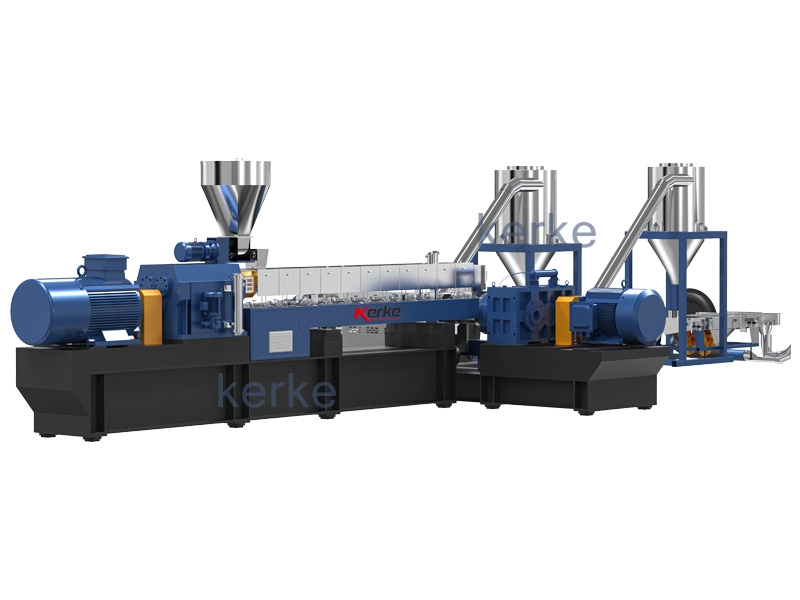
A practical medium-scale strategy is mixed provisioning: equip the first two lines with strand pelletizing for portfolio breadth and low changeover burden, then add an underwater line as the third when the order book contains enough low-viscosity or heat-sensitive volume to keep it loaded. This staged approach keeps the entry investment at Low to Medium intensity and defers the Very High intensity item until the commercial case exists.
Downstream Finishing, Storage and Packaging
After the cutter, the pellet still has to be classified, dried, checked, blended, stored and packed. The downstream train is individually inexpensive but collectively significant, and it is the section most often reduced during budget pressure, usually to the plant’s later regret.
A vibrating classifier screen removes oversize agglomerates, twins and fines, and should be sized generously because a restricted screen becomes the throughput ceiling of the whole line. Centrifugal dewatering follows any water-based cutting route, spinning surface water off the pellets. A fluidized-bed dryer then removes residual surface moisture with heated air; for color masterbatch, a fluidized-bed unit is preferred over a simple hot-air hopper because it treats pellets uniformly with short residence time and does not risk thermal exposure of sensitive pigments.
Metal detection is mandatory in any masterbatch plant selling into food-contact, medical or high-specification technical markets. A tube-type or free-fall metal detector positioned before the blending silo, with an automatic reject flap, catches wear debris from screw elements, screen changers and cutting blades. This is a Low intensity item with High consequence, and skipping it is one of the poorest budget decisions available.
Blending silos homogenize the output of several production batches into a single delivery lot, which is what makes color consistency claims defensible. A medium-scale plant typically installs four to twelve silos of 1 to 5 cubic meters, plus a smaller number of larger day silos for high-runners. Silo count grows with portfolio breadth, not with tonnage, so a plant with 200 active color codes needs more silos than a plant with 20 at the same output.
Packaging closes the chain. Automatic bagging into 25 kilogram valve or open-mouth bags with a check weigher and sealer covers most distribution channels, while 500 to 1,000 kilogram ton bags serve large converters. A semi-automatic packing station carries Low intensity, a fully automatic line with palletizer and stretch wrapper carries High intensity, and the choice should follow the customer mix rather than the desire for automation. Plants shipping predominantly ton bags gain very little from a bag palletizer.
| Equipment | Function | Typical provisioning for 3,000 to 8,000 t/a | Investment intensity | Consequence if omitted |
|---|---|---|---|---|
| Vibrating classifier screen | Removes oversize, twins and fines | One per line, sized 1.5× line output | Low | Customer complaints on pellet uniformity, feeder bridging at converter |
| Centrifugal dewatering unit | Removes bulk surface water after wet cutting | One per wet-cut line | Low to Medium | Wet pellets, dryer overload, caking in silo |
| Fluidized-bed dryer | Uniform removal of residual surface moisture | One per line or one shared per two lines | Medium | Moisture-related voids and streaks at the converter |
| Metal detector with reject | Detects ferrous and non-ferrous wear debris | One per line before blending | Low | Contamination claims, disqualification from food-contact supply |
| Blending and storage silos | Lot homogenization and buffer storage | 4 to 12 units of 1 to 5 m³ | Medium | Batch-to-batch color variation within one delivery |
| Automatic packing station | 25 kg bags and 500 to 1,000 kg ton bags | One or two stations depending on customer mix | Low to High | Packing becomes the plant bottleneck at three-shift operation |
Plant Infrastructure and Utility Systems
Infrastructure and utilities account for a combined 18 to 30 index points of a 100-point baseline, and they are the categories most likely to be underestimated by teams whose experience is in equipment rather than in project delivery. The rule is simple: utilities must be sized for the final configuration even if the plant starts with fewer lines, because retrofitting a transformer, a cooling loop or a dust extraction main into a running factory is disruptive and expensive.
Building and civil works
A 2,000 to 4,000 square meter workshop needs clear height of at least 7 to 9 meters to accommodate silos, mezzanine feeder platforms and an overhead crane. Floor loading should be specified for silo and machine foundations, with dedicated anti-vibration foundations under each extruder and blower. Civil works also include material flow separation between raw pigment intake, production and finished goods dispatch, a segregated pigment weighing room with its own dust extraction, and an area for cleaning screw elements and dies. Building and civil works absorb 10 to 18 percent of total investment; the upper end applies where a greenfield structure is built and the lower end where an existing shell is adapted.
Electrical supply and distribution
Installed transformer capacity in the medium-scale envelope runs from 400 kVA for an entry single-line plant up to 1,200 kVA for an advanced four-line plant with underwater pelletizing, heated silos and automated packaging. Distribution includes the main switchgear, motor control centers, cable trays, power factor correction and, increasingly in 2026, energy sub-metering per line so that specific energy consumption per kilogram can be tracked. Power factor correction and harmonic filtering matter because variable frequency drives on large extruder mains generate harmonics that can trip sensitive laboratory instruments on the same supply.
Cooling water, chilled water and compressed air
Every twin-screw line rejects heat from barrel cooling zones, the gearbox oil cooler, the strand trough or pellet water loop, and the vacuum system. A practical planning basis is 0.25 to 0.35 kilowatts of refrigeration per kilowatt of installed main drive power, plus the process water load. Most plants run a two-tier system: an open cooling tower loop for gearbox and general cooling, and a closed chilled water loop at 12 to 18 degrees Celsius for barrel cooling and pelletizing water. Compressed air at 0.6 to 0.8 MPa serves pneumatic conveying, valve actuation, air knives and bag handling; a screw compressor with a refrigerated dryer and a buffer receiver is standard. Utilities as a whole take 8 to 12 percent of total investment.
Dust collection, VOC treatment and fire protection
Pigment dust extraction at the weighing room, feeder inlets and packing station is both an occupational health requirement and a product quality requirement, since cross-contamination between colors is the most common cause of rejected batches. Cartridge filters with automatic pulse cleaning are standard. Extruder vent emissions and die-face fumes require capture and treatment; depending on local regulation this may mean activated carbon adsorption, catalytic oxidation or a scrubber. Fire protection includes hydrants, sprinklers or a foam system in the resin warehouse, extinguishers, smoke detection and an emergency lighting and evacuation scheme. Environmental and fire compliance are jurisdiction-specific and belong in the budget as a defined line rather than as an afterthought.
| Utility | Entry tier (1 line) | Standard tier (2 lines) | Advanced tier (3 to 4 lines) | Sizing note |
|---|---|---|---|---|
| Transformer capacity | 400 to 500 kVA | 630 to 800 kVA | 1,000 to 1,200 kVA | Size for final line count from day one |
| Chilled water capacity | Low | Medium | High | 0.25 to 0.35 kW refrigeration per kW of main drive |
| Cooling tower loop | Single tower | Single tower with standby pump | Dual tower with redundancy | Redundancy protects three-shift continuity |
| Compressed air | 0.6 to 0.7 MPa, single compressor | 0.6 to 0.8 MPa, plus dryer | 0.6 to 0.8 MPa, duty and standby | Include buffer receiver and condensate management |
| Dust collection | Local units at weighing and packing | Central cartridge filter | Central system with zoned ducting | Separate black pigment extraction from light colors |
| VOC treatment | Basic capture and filtration | Activated carbon adsorption | Catalytic oxidation or equivalent | Scope set by local environmental permit |
| Fire protection | Hydrants, extinguishers, detection | Add sprinkler in warehouse | Full sprinkler and zoned detection | Resin and pigment storage drives the classification |
Laboratory and Quality Control Investment
A color masterbatch factory without a competent laboratory is a compounding job shop, not a masterbatch supplier. The laboratory is what allows the plant to accept a color target, develop a matching formulation, verify each production lot and defend the result when a customer disputes it. Laboratory and testing investment occupies 3 to 5 percent of the total baseline, a small share with disproportionate commercial weight.
The core instrument set begins with a melt flow rate tester, which verifies carrier resin consistency and finished masterbatch flow behavior, and a spectrophotometer with the associated color management software, which is the single most important instrument in a color plant. A benchtop spectrophotometer capable of measuring in reflectance with multiple illuminant and observer conditions, paired with formulation software, allows the plant to quote color matches confidently and to run statistical process control on delta E values. Supporting instruments include a tensile testing machine for verifying that the masterbatch does not degrade the mechanical properties of the let-down resin, an ash furnace for determining pigment and filler content, a moisture analyzer, a laboratory press and injection molding unit for plaque preparation, and a filter pressure value test rig for quantifying pigment dispersion quality.
A laboratory-scale twin-screw extruder deserves its own consideration. Running formulation trials on a production line consumes 200 to 600 kilograms of material per trial and blocks a revenue-earning machine for hours. A small laboratory extruder in the SHJ-20 to SHJ-26 class runs trials on a few kilograms, which transforms both development speed and scrap generation. Kerke supplies laboratory twin-screw extruders alongside its production machines specifically for this reason, and a plant with an active development pipeline recovers the investment quickly in avoided line downtime and trial scrap.
Scanning electron microscopy is the optional Premium item. It provides direct visual evidence of pigment agglomerate size and dispersion morphology, which is valuable when supplying demanding technical customers or when troubleshooting persistent dispersion complaints, but most medium-scale plants outsource this analysis rather than owning the instrument.
| Instrument | Purpose in a color masterbatch plant | Priority | Investment intensity |
|---|---|---|---|
| Melt flow rate tester | Incoming carrier resin verification and finished lot flow control | Essential | Low |
| Spectrophotometer with formulation software | Color matching, delta E control, lot release | Essential | Medium to High |
| Ash furnace | Pigment and filler content verification | Essential | Low |
| Tensile testing machine | Confirms masterbatch does not impair let-down resin properties | Recommended | Medium |
| Filter pressure value test rig | Quantitative dispersion quality index | Recommended | Medium |
| Laboratory twin-screw extruder | Formulation development without occupying a production line | Recommended | Medium |
| Laboratory press and plaque molding unit | Sample preparation for color and mechanical testing | Recommended | Low |
| Scanning electron microscope | Direct observation of agglomerate size and dispersion morphology | Optional | Premium |
Investment Composition Framework on a 100-Point Baseline
With the equipment scope defined, the total investment can be structured as a percentage composition. The framework below expresses each category as a percentage band and as an allocation of index points on a baseline where the fully funded project equals 100 points. The mid-case column is calibrated so that the allocations sum exactly to 100, which makes it usable directly as a planning template.
| Category | Share of total | Index point range | Mid-case allocation | Principal contents |
|---|---|---|---|---|
| Main extrusion equipment | 40 to 50% | 40 to 50 pts | 43 pts | Twin-screw extruders, gearboxes, barrels, screw assemblies, drives, control cabinets |
| Auxiliary and downstream equipment | 15 to 20% | 15 to 20 pts | 16 pts | Feeders, side feeders, vacuum systems, pelletizers, dryers, classifiers, silos, packing |
| Building and civil works | 10 to 18% | 10 to 18 pts | 12 pts | Workshop adaptation, foundations, mezzanines, warehouse, weighing room, crane |
| Utility systems | 8 to 12% | 8 to 12 pts | 9 pts | Transformer and distribution, chillers, cooling towers, compressed air, dust and VOC, fire protection |
| Tooling and spare parts | 4 to 7% | 4 to 7 pts | 5 pts | Dies, die plates, screen packs, spare screw elements, cutting blades, seals, sensors |
| Laboratory and testing | 3 to 5% | 3 to 5 pts | 3 pts | Spectrophotometer, MFR tester, ash furnace, tensile machine, laboratory extruder |
| Working capital reserve | 10 to 15% | 10 to 15 pts | 12 pts | Pigment and resin inventory, work in process, finished stock, packaging, first operating cycle |
| Total | 100% | 100 pts | 100 pts | Fully funded project through first month of stable commercial output |
Several structural observations follow from this table. First, the process island of main equipment plus auxiliaries accounts for 55 to 70 points, meaning that the extrusion technology decision determines the majority of the budget but never the whole of it. Second, working capital at 10 to 15 points is comparable in weight to buildings, which surprises teams that think of a factory as a collection of machines. Third, tooling and spares at 4 to 7 points is the smallest tangible category and the one most often cut, yet it is the category whose absence stops production fastest.
The bands shift with project circumstances. A greenfield build pushes buildings toward 18 points and compresses everything else proportionally. Reusing an existing insulated workshop with adequate power can pull buildings down to 10 points and free capital for a higher-torque extruder or an additional line. A plant committed to food-contact certification from day one carries higher laboratory and utility allocations. A plant that intends to run a single carrier resin family with a narrow color range can operate with fewer feeders and fewer silos, moving points from auxiliaries toward working capital.
Tiered Configuration Plans: Entry, Standard and Advanced
The clearest way to communicate a masterbatch plant budget to a board or a lender is through tiered configurations with explicit multiples. Three tiers cover the medium-scale range, with the entry tier normalized to 1.0× and the others expressed relative to it.
| Item | Entry tier | Standard tier | Advanced tier |
|---|---|---|---|
| Extrusion lines | 1 line: SHJ-65 | 2 lines: SHJ-65 plus SHJ-75 | 3 to 4 lines: SHJ-52 plus 2 × SHJ-65 plus SHJ-95 |
| L/D configuration | 44:1 | 48:1 and 52:1 | 48:1 to 56:1 across the fleet |
| Torque grade Td/D³ | 8 to 9 | 9 to 10 | 10 to 11 |
| Gravimetric feeders per line | 3 to 4 | 4 to 6 | 6 to 8 plus liquid feeder |
| Side feeder | Optional | One per line | One per line, twin-screw with crammer option |
| Pelletizing | Strand pelletizing | Strand plus water-ring | Strand, water-ring and underwater pelletizing |
| Drying and finishing | Centrifugal dewatering plus hot air | Centrifugal plus fluidized-bed dryer | Full train with classifier, metal detection and blending silos |
| Packaging | Semi-automatic 25 kg bagging | Automatic 25 kg plus ton bag station | Automatic bagging, palletizing and stretch wrapping |
| Installed transformer capacity | 400 to 500 kVA | 630 to 800 kVA | 1,000 to 1,200 kVA |
| Indicative annual output | 1,800 to 2,800 t/a | 3,500 to 5,500 t/a | 6,000 to 8,000 t/a |
| Floor area | 1,200 to 1,800 m² | 2,000 to 3,000 m² | 3,000 to 4,000 m² |
| Headcount | 14 to 20 | 25 to 32 | 35 to 45 |
| Investment intensity | Low to Medium | High | Very High to Premium |
| Relative multiple | 1.0× | 1.7× to 2.1× | 2.6× to 3.4× |
The multiples are sub-linear relative to capacity, and understanding why is central to good budget reasoning. The advanced tier delivers roughly three times the output of the entry tier at 2.6 to 3.4 times the investment, because buildings, utilities, laboratory and management overhead do not scale one-for-one with line count. A single transformer upgrade serves three lines nearly as economically as two. One spectrophotometer serves the whole plant. One dust collection system with zoned ducting is cheaper than three standalone units. This is the classic scale effect in compounding, and it argues for sizing infrastructure to the target configuration even when equipment is installed in phases.
Point allocation also shifts across tiers. In the entry tier, main equipment tends toward the upper end at 48 to 50 points because a single machine cannot spread the fixed infrastructure burden. In the advanced tier, main equipment often settles at 40 to 43 points while buildings, utilities and working capital claim proportionally more, since the plant now carries a larger inventory, more silos and a more complex utility network. Planners who apply a single fixed percentage split across all tiers will misallocate in both directions.
Hidden Costs and Commonly Omitted Budget Lines
Every masterbatch project budget that overruns does so in roughly the same places. These are not exotic items; they are ordinary operational realities that equipment quotations do not include and that first-time investors do not anticipate. Listing them explicitly at the planning stage is the cheapest risk mitigation available.
Wear parts and consumables
Screw elements, particularly kneading blocks, are wear parts. In color masterbatch service the practical replacement interval for kneading blocks runs from about 4,000 hours with abrasive titanium dioxide or calcium carbonate loading up to roughly 12,000 hours with soft organic pigments in a clean carrier resin. On a three-shift schedule of 6,500 hours per year, an abrasive product mix means a significant element replacement roughly every eight months, while a benign mix stretches it toward two years. Barrel liners follow a longer but parallel curve. Screen packs are consumed continuously, screen changer hydraulic cylinders need periodic rebuild, and pelletizer blades and die plates wear against the cutting face. A spare parts reserve of 4 to 7 points at project stage, replenished annually thereafter, is the difference between a scheduled element swap and an emergency stoppage.
Color changeover and purging losses
Color changeover consumes material, time and labor, and it is invisible in equipment quotations. Depending on the color transition, the purge from a dark shade to a light shade on an SHJ-65 line can consume 30 to 120 kilograms of purge compound or carrier resin plus 30 to 90 minutes of line time. A plant running 600 orders per year is therefore committing a material and time budget line that dwarfs many equipment items over the life of the plant. This is also why screw geometry with strong self-cleaning behavior and quick-access barrel design pay back: they shorten changeover directly.
Regulatory assessments and permits
Environmental impact assessment and occupational safety assessment are mandatory in most jurisdictions before a compounding plant may operate. These involve consultant fees, monitoring, documentation and sometimes physical modifications required by the reviewing authority, such as additional VOC treatment or noise attenuation. The timeline is often longer than the equipment lead time, so this line has schedule risk as well as budget risk.
Trial production scrap
Commissioning a masterbatch line generates off-specification material. Between mechanical commissioning, formulation validation, dispersion optimization and color approval runs, a new line commonly produces several tonnes of material that cannot be sold at full value. Budgeting zero for trial scrap guarantees an unpleasant conversation at month two.
Training and knowledge transfer
Operating a co-rotating twin-screw extruder well requires understanding screw configuration, feed rate and screw speed interaction, torque and melt pressure limits, vent management and changeover discipline. Structured training for operators, a maintenance technician and a laboratory colorist is a modest line item with a large influence on first-year yield. Suppliers including Kerke provide installation, commissioning and operator training as part of the delivery scope, and the Wanplas network extends after-sales support across its factories, but the buyer still needs to budget internal time, travel and the productivity dip during the learning curve.
| Omitted item | Why it is missed | Impact level | Mitigation |
|---|---|---|---|
| Screen changer spare parts and screen packs | Treated as a consumable rather than a project line | Medium | Reserve within the 4 to 7 point tooling and spares allocation |
| Kneading block and screw element replacement | Wear only becomes visible after 4,000 to 12,000 operating hours | High | Order one spare element set with the machine; specify wear-resistant metallurgy upfront |
| Color changeover purging loss | Not part of any equipment quotation | High | Model purge volume per transition; prioritize self-cleaning screw geometry |
| Environmental and safety assessment | Assumed to be a formality | Medium to High | Engage consultants before equipment ordering; allow schedule float |
| Trial production scrap | Optimistic commissioning assumptions | Medium | Budget several tonnes of off-specification output per new line |
| Operator and laboratory training | Assumed to be included in supply scope | Medium | Confirm training days in the contract; budget internal backfill time |
| Freight, rigging and installation | Quoted separately from equipment | Medium | Clarify delivery terms and crane and rigging responsibility early |
| Machine foundations and anchoring | Falls between the equipment and civil scopes | Medium | Obtain foundation drawings before civil works are tendered |
| Cable, cable tray and control wiring | Excluded from both machine and building scopes | Medium | Assign to a single contractor with a defined interface list |
| Cooling water treatment and first-fill fluids | Considered too small to plan | Low | Include gearbox oil, glycol and water treatment chemicals in the spares reserve |
| Dust filter cartridges and replacement media | Recurring, so excluded from capital thinking | Low | Stock one full replacement set at handover |
| Packaging consumables and pallet stock | Assumed to be an operating expense from day one | Low to Medium | Fund the initial stock from the working capital reserve |
Standards, Compliance and Their Budget Footprint
Compliance requirements are specification drivers, not paperwork, and they should be fixed before equipment is ordered because several of them change the physical plant. A color masterbatch factory that intends to serve food-contact packaging converters must design for segregation and traceability from the first layout sketch, whereas a plant serving only technical and industrial customers can adopt a simpler configuration.
GB/T 24274 is the Chinese national standard covering color masterbatch product requirements, including appearance, moisture, ash content, heat stability and dispersion criteria. It defines much of the testing regime the laboratory must be able to perform, which links it directly to instrument selection. ISO 11469 governs the generic identification and marking of plastics products, relevant when the masterbatch enters articles that must carry resin identification. EU 10/2011 is the regulation on plastic materials and articles intended to come into contact with food, and it imposes constraints on every substance in the formulation, on migration testing and on documentation, including declarations of compliance passed along the supply chain.
RoHS restricts specified hazardous substances in electrical and electronic equipment, which matters when the masterbatch colors housings, connectors or cable compounds. REACH and its candidate list of substances of very high concern impose registration, communication and, for some substances, authorization obligations across the European market. AP(89)1 is the Council of Europe resolution on colorants used in plastic materials coming into contact with food, and it is routinely cited by European converters as a purchasing requirement for colorants and color masterbatch even where it is not legally binding.
| Standard or regulation | Scope | Effect on plant and equipment specification | Budget impact |
|---|---|---|---|
| GB/T 24274 | Color masterbatch product requirements and test methods | Defines the laboratory test suite: moisture, ash, dispersion, heat stability, color difference | Medium, mainly laboratory instruments |
| ISO 11469 | Generic identification and marking of plastics products | Documentation and labeling discipline; traceability from lot to delivery | Low |
| EU 10/2011 | Plastic materials and articles in contact with food | Raw material segregation, dedicated or thoroughly cleaned contact parts, migration testing, declarations of compliance | High, drives layout, cleaning regime and possibly a dedicated line |
| RoHS | Restriction of hazardous substances in electrical and electronic equipment | Pigment selection constraints, heavy metal screening, supplier declarations | Low to Medium |
| REACH and SVHC candidate list | Registration, evaluation and authorization of chemicals in the European market | Supply chain documentation, substance screening, communication duties | Medium, mainly documentation and testing |
| AP(89)1 | Colorants in plastics intended for food contact | Colorant purity criteria and heavy metal limits; restricts the usable pigment portfolio | Medium, affects pigment sourcing and inventory |
The practical budget conclusion is that food-contact capability is the single largest compliance-driven cost multiplier in a color masterbatch plant. It typically requires physically separated raw material storage, dedicated or rigorously validated contact surfaces, a documented cleaning and changeover protocol, additional migration and extraction testing, and a quality management system able to produce a complete declaration of compliance for every lot. A plant that decides to add food-contact capability after construction faces a High to Very High intensity retrofit, while a plant that designs for it from the start absorbs the requirement at Medium intensity.
Organization, Training and Commissioning Provisions
A medium-scale color masterbatch plant runs on 25 to 45 people, and the way that headcount is distributed affects both the capital plan and the plant layout. A representative structure for a three-line, three-shift operation is four shift teams of three to five production operators each, two to four warehouse and packing staff, three to five laboratory and quality personnel including at least one dedicated colorist, two to three maintenance technicians covering mechanical and electrical trades, and five to eight staff in production planning, procurement, sales support and administration.
Two roles deserve specific mention because they are frequently under-resourced. The colorist is the commercial engine of a color masterbatch plant: the speed and accuracy with which color matches are developed and approved determines how many enquiries convert to orders. A plant with one overloaded colorist becomes a bottleneck at the front of the business regardless of how much extrusion capacity it has installed. The maintenance technician with twin-screw competence is the second: a plant with three lines running three shifts needs someone who can dismantle and reassemble a screw assembly correctly, diagnose a torque or melt pressure anomaly, and manage the wear-part replacement schedule. Outsourcing this capability entirely to the equipment supplier works during warranty and becomes fragile afterward.
Commissioning provisions belong in the capital budget rather than in operating expense. A realistic commissioning package includes supplier installation and startup supervision, operator training on each machine class, laboratory method setup and instrument calibration, formulation validation runs for the initial product portfolio, and a performance acceptance test that verifies rated throughput, dosing accuracy and pellet quality on a defined recipe. Acceptance criteria should be written into the purchase contract before the order, specifying the test recipe, the throughput to be demonstrated, the permissible dosing deviation and the pellet quality metrics. Vague acceptance clauses are the most common source of post-delivery disputes in compounding projects.
Kerke’s delivery practice for masterbatch projects includes factory acceptance testing before shipment, on-site installation and commissioning support, and operator training, with the Wanplas brand’s shared after-sales framework providing spare parts support across its factory network. Buyers should nonetheless define their own acceptance protocol, because the recipes that matter commercially are the buyer’s, not the supplier’s demonstration formulation.
Budget Governance: Phasing, Sequencing and Contingency
A capital plan is a sequence, not a list. The order in which commitments are made determines how much flexibility the project retains when reality diverges from the plan, and masterbatch projects diverge routinely because the order book develops in parallel with construction.
The recommended sequence begins with the definitive product portfolio and capacity target, since these fix the line count and the pelletizing routes. Next comes the site and building decision, because building lead time and permit timelines are usually the critical path. Utilities are then sized for the final configuration, not the initial one. Only then should extrusion equipment be ordered, with the specification informed by the formulations the plant has actually committed to produce. Laboratory equipment follows, ideally arriving before the extrusion lines so that incoming raw materials can be characterized during commissioning. Working capital is drawn last but must be committed from the outset.
Contingency should be carried explicitly. For a first-time investor in compounding, a contingency of 8 to 12 percent of the equipment and construction subtotal is prudent; for an experienced operator adding capacity to a known process, 5 to 8 percent is usually adequate. Contingency is not a slush fund for scope additions, and the discipline of distinguishing genuine contingency draws from scope creep is what keeps a project inside its envelope. The most common scope creep in masterbatch plants is the late addition of a pelletizing route, typically underwater pelletizing, after a customer enquiry arrives for a formulation the installed lines cannot handle. Providing space, foundations, power and water connections for a future line during initial construction is inexpensive; retrofitting them is not.
Finally, the budget should be revisited against actual performance at three checkpoints: at equipment factory acceptance, at mechanical completion, and at the end of the first quarter of commercial operation. The third checkpoint is the most informative, because it reveals whether the plant’s real utilization, changeover frequency and wear-part consumption match the assumptions the budget was built on. Plants that formalize this review develop reliable internal planning factors for their second expansion, which is precisely the advantage that experienced compounders hold over new entrants.
Frequently Asked Questions
What output range defines a medium-scale color masterbatch factory?
A medium-scale color masterbatch plant produces roughly 3,000 to 8,000 tonnes per year of finished pellets, on two to four pelletizing lines, in a 2,000 to 4,000 square meter workshop, with 25 to 45 employees and a three-shift pattern delivering 6,000 to 7,000 effective operating hours per line per year. Below that band the fixed laboratory and utility burden dominates the economics; above it the plant behaves like a large-scale operation with different layout and logistics requirements.
Which twin-screw extruder model should a medium-scale plant start with?
The SHJ-65 class at 44 to 52:1 L/D is the standard starting point because its 300 to 500 kilogram per hour window covers most color masterbatch recipes at Medium investment intensity. An SHJ-52 is added when the portfolio includes many small, high-value, frequently changed colors, and an SHJ-75 or SHJ-95 is added later when long-run standard colors or filler-loaded grades justify a machine that must stay loaded to be economical.
How should investment be split between main equipment and everything else?
On a 100-point baseline, main extrusion equipment takes 40 to 50 points, auxiliary and downstream equipment 15 to 20, buildings and civil works 10 to 18, utilities 8 to 12, tooling and spares 4 to 7, laboratory 3 to 5, and working capital 10 to 15. A workable mid-case allocation that sums to exactly 100 is 43, 16, 12, 9, 5, 3 and 12 points respectively. If the process island exceeds about 72 points, something else in the project has been under-scoped.
How much more does an advanced configuration cost than an entry configuration?
Normalizing the entry tier of one SHJ-65 line to 1.0×, the standard tier of two lines lands at 1.7× to 2.1× and the advanced tier of three to four lines with underwater pelletizing and automated packaging lands at 2.6× to 3.4×. The multiple is sub-linear against capacity because buildings, utilities, laboratory and management overhead do not scale one-for-one with the number of extrusion lines.
What screw speed and torque grade should be specified for color masterbatch?
Screw speeds of 500 to 800 rpm and torque grades of Td/D³ between 8 and 11 cover the medium-scale range. A higher torque grade allows the same throughput at lower screw speed, which lowers melt temperature and protects heat-sensitive pigments, and it frequently reduces total plant investment by allowing fewer lines to carry the same tonnage. Specifying a low torque grade to save money on one machine is often a false economy at the plant level.
Why does vacuum venting matter enough to appear in a capital budget?
Vacuum venting at minus 0.08 to minus 0.095 MPa removes moisture, entrained air and volatiles that would otherwise appear as voids, streaks and surface defects in the customer’s finished article. The subsystem includes the pump, vent housing, knock-out separator and filtration, all of which need accessible design for routine cleaning. It sits at Medium investment intensity and directly determines whether the plant’s pellets are accepted by demanding converters.
Which budget lines are most often forgotten?
Screen changer spares and screen packs, kneading block and screw element replacement at a 4,000 to 12,000 hour service life, color changeover purging losses, environmental and safety assessment fees, trial-production scrap, structured operator training, freight and rigging, machine foundations, and control cabling that falls between the equipment and building contracts. Individually each is small; collectively they are the reason most first-time projects exhaust their contingency.
How does food-contact compliance change the plant budget?
Food-contact capability under EU 10/2011 and colorant criteria such as AP(89)1 requires segregated raw material storage, dedicated or rigorously validated contact parts, documented cleaning and changeover protocols, migration testing and lot-level declarations of compliance. Designing for it from the outset absorbs the requirement at Medium intensity; retrofitting it into a running plant is a High to Very High intensity exercise, which is why the decision must be made before layout is frozen.
Conclusion
Estimating the total investment for a medium-scale color masterbatch twin-screw factory is an exercise in structure rather than arithmetic. Fix the envelope first: 3,000 to 8,000 tonnes per year, two to four lines, 2,000 to 4,000 square meters, 25 to 45 people, 6,000 to 7,000 effective hours per line. Then select the host machines from the SHJ-52 to SHJ-95 range with L/D between 40:1 and 56:1, screw speeds of 500 to 800 rpm and torque grades of 8 to 11, because that decision cascades into line count, floor area, transformer capacity and headcount. Build the auxiliary package around three to eight loss-in-weight feeders at plus or minus 0.5 percent accuracy, a side feeder, vacuum venting at minus 0.08 to minus 0.095 MPa, and the pelletizing route that matches the formulation portfolio rather than the one that looks most advanced.
Express the result on a 100-point baseline: 43 points to main equipment, 16 to auxiliaries, 12 to buildings, 9 to utilities, 5 to tooling and spares, 3 to laboratory and 12 to working capital in the mid case, adjusted within the published bands for greenfield versus brownfield, food-contact ambition and portfolio breadth. Present the plan as three tiers at 1.0×, 1.7× to 2.1× and 2.6× to 3.4×, size the infrastructure for the final tier even if lines are phased, and carry explicit contingency of 5 to 12 percent depending on the team’s experience. Above all, write the hidden lines into the budget before they write themselves into the overrun: wear parts, purging losses, regulatory assessment, trial scrap, training, foundations and cabling.
Kerke, a Wanplas factory with 12 years of specialization in co-rotating parallel twin-screw compounding extruders, a 19,997 square meter plant and more than 2,000 machines operating in over 70 countries, configures medium-scale color masterbatch plants as complete process islands rather than as isolated machines, covering host extruder, feeding, venting, pelletizing, drying and packaging within one engineering scope. Because the Wanplas brand also operates specialized factories in recycling, pipe, sheet, blow molding and filling equipment, a masterbatch plant specified through this network can later integrate with adjacent lines under a shared quality and after-sales framework. For an investor building a color masterbatch factory in 2026, the most valuable step remains the first one: define the capacity envelope precisely, then let the indexed budget structure follow from it.