Polylactic acid, widely known as PLA, has moved from a niche bioplastic into a mainstream biodegradable material for packaging film, food-service ware, agricultural mulch, and fiber. As demand grows, more compounders are installing twin-screw extrusion lines dedicated to PLA masterbatch, filled biodegradable compounds, and reactive blending. Yet many production managers discover that PLA is unforgiving: it is hygroscopic, thermally sensitive, and prone to hydrolysis and thermal degradation if the surrounding workshop is not controlled. A constant-temperature workshop is not a comfort feature. It is a process requirement that protects molecular weight, color, and pellet quality from the moment raw material enters the building until the finished pellets are bagged.
This article defines a practical constant-temperature workshop area standard for PLA twin-screw extrusion compounding. It covers zone temperature and humidity setpoints, workshop zoning and material flow, HVAC and air-handling strategy, cooling-water stability, dust and cleanliness control, and the monitoring system that makes the standard auditable. The guidance is built around real Kerke compounding equipment, because environmental design must match the machine that runs inside it. Kerke is a Wanplas factory with more than 12 years of experience in twin-screw compounding extruders, a 19,997-plus-square-meter plant, more than 2,000 machines running in over 70 countries, and a recognized position among the top suppliers of co-rotating parallel twin-screw extruders in China. When a PLA line is planned around the Kerke KTE platform, the workshop envelope described here is the condition under which the quoted output and quality can be guaranteed.
1. Why Environmental Control Defines PLA Compounding Quality
Twin-screw compounding is a precise thermal and mechanical operation. The barrel heating zones, screw configuration, and feeding sequence determine how the polymer is plasticized, sheared, dispersed, and homogenized. But the machine is only half the story. The room around the machine controls two variables that the extruder cannot fix: the moisture and temperature of the feedstock before it enters the hopper, and the cooling-medium temperature on the barrel, die head, and pelletizing side. For most engineering plastics a modest ambient swing is tolerable. For PLA it is not.
PLA absorbs moisture from the air. At a relative humidity of 60 percent, dried PLA left in an open tote can climb past its safe moisture ceiling within a single shift. Water in the melt catalyzes hydrolysis, which chops the polymer chains and drops molecular weight. The result is lower melt strength, poorer tensile and impact performance, brittle pellets, and inconsistent extrusion. Thermal sensitivity compounds the problem: PLA begins to degrade above certain melt-temperature thresholds, and degradation accelerates if residence time or local hotspots are not managed. A constant-temperature, low-humidity workshop keeps the feedstock dry and the cooling side stable so the extruder only has to manage the melt, not fight the room.
The second reason is repeatability. A compounding line is validated against a set of process parameters. If the ambient temperature shifts by 6 degrees Celsius between summer and winter, the cooling-water temperature drifts, the barrel temperature control fights a moving target, and the strand pelletizer cools unevenly. Batches that passed quality control in March fail in August for no change in formula. A constant-temperature envelope removes the room as a variable, so the only variables left are the ones the operator intentionally sets.
Environmental control is the silent parameter in every PLA compounding recipe. Treat the workshop as part of the machine, and the machine will repay you with stable output.
2. Constant-Temperature Standard: Zone-by-Zone Temperature Setpoints
A constant-temperature workshop does not mean one single number for the entire building. It means a defined envelope for each functional zone, with tight tolerance inside each zone. The target for PLA compounding is an ambient operating range of 22 to 26 degrees Celsius in the main production area, held to a tolerance of plus or minus 2 degrees Celsius. The raw-material conditioning room is kept slightly cooler at 20 to 23 degrees Celsius because that is where moisture management begins. The packaging and warehouse buffer is held near 23 to 25 degrees Celsius to avoid condensation on cooled pellets when bags are sealed.
The tolerance matters more than the absolute value. A room that averages 24 degrees Celsius but swings between 19 and 29 degrees Celsius is worse than a room steady at 26 degrees Celsius. Constant-temperature control therefore emphasizes low cycling: the HVAC system should modulate capacity rather than bang on and off, and the control sensor should sit where the operator works, not next to the supply diffuser. For PLA, the recommended band is narrow enough that seasonal outdoor swings never reach the processing floor.
Recommended Zone Temperature Setpoints
| Workshop Zone | Target Temperature (deg C) | Tolerance (deg C) | Purpose |
|---|---|---|---|
| Raw-material conditioning room | 20 to 23 | plus or minus 1.5 | Stable pre-drying and crystallizing of PLA flake and regrind |
| Weighing and pre-mixing zone | 22 to 25 | plus or minus 2 | Prevent moisture pickup by dried resin and additives |
| Twin-screw extrusion floor | 22 to 26 | plus or minus 2 | Stable barrel and die-head cooling-water return |
| Pelletizing and cooling zone | 21 to 25 | plus or minus 2 | Consistent strand or die-face cooling and pellet shape |
| Screening, classification, packaging | 23 to 25 | plus or minus 2 | Avoid condensation on cooled pellets before bagging |
These setpoints assume the extruder barrel zones themselves are controlled independently by the machine, typically with melt temperatures for PLA in the range of 170 to 210 degrees Celsius depending on grade, filler load, and whether a reactive step is included. The room standard supports the machine; it does not replace the barrel profile. The two must be designed together.
3. Humidity and Moisture Control: The PLA Hydrolysis Boundary
Humidity is the single most important environmental parameter for PLA compounding. Dried PLA resin should enter the extruder below roughly 500 parts per million moisture, and many compounders target 250 to 400 parts per million for sensitive grades. At typical processing melt temperatures, free water hydrolyzes the ester bonds in PLA and reduces molecular weight within minutes of residence time. The workshop must therefore keep the surrounding air dry enough that dried material does not reabsorb moisture during transfer and feeding.
The practical standard is 45 to 55 percent relative humidity in the main compounding area, and 35 to 45 percent in the drying and conditioning zone. Holding below 30 percent is not recommended because static electricity increases sharply in very dry air, attracting dust to the resin and creating discharge hazards around sensitive feeders. Holding above 60 percent invites reabsorption and hydrolysis. A dew-point target of minus 10 to minus 20 degrees Celsius at the dryer outlet is the companion number for the drying equipment, and the room humidity standard protects that investment after drying is complete.
Humidity and Moisture Control Setpoints
| Parameter | Recommended Value | Why It Matters |
|---|---|---|
| Main compounding area RH | 45 to 55 percent | Slows moisture reabsorption by dried resin and masterbatch |
| Drying and conditioning zone RH | 35 to 45 percent | Maintains low dew point during crystallizing and drying |
| Pellet moisture after cooling | below 500 ppm, target 250 to 400 ppm | Prevents hydrolysis and preserves molecular weight |
| Dryer outlet dew point | minus 10 to minus 20 deg C | Stable drying of hygroscopic PLA flake and regrind |
| Minimum RH floor | not below 30 percent | Limits static buildup and dust attraction |
Moisture control is a chain with several links: the resin supplier’s packaging, the conditioning room, the crystallizer and dryer, the transfer line, the loss-in-weight feeder, and the feed throat. The constant-temperature, controlled-humidity workshop is the environment that keeps every link tight. A small breach, such as an open roll-up door near the hopper on a humid day, can undo an otherwise perfect drying cycle.
4. Workshop Zoning and Material Flow Layout
A constant-temperature workshop is organized as a sequence of zones, each with its own setpoint and air-handling logic, arranged so material flows in one direction from raw to finished pellet. This linear layout prevents cross-contamination, limits moisture pickup, and makes the environmental standard enforceable because each door is a controlled boundary rather than an open passage.
The first zone is raw-material receiving and conditioning. PLA flake, virgin resin, regrind, and additives arrive here and are held at the cooler, drier setpoint before use. The second zone is weighing and pre-mixing, where the high-speed mixer prepares the blend and where dried material must be protected from the room. The third zone is the twin-screw extrusion floor, the heart of the line, with the KTE extruder, side feeders, and liquid feeder. The fourth zone is pelletizing and cooling, where strands or die-face-cut pellets are solidified and screened. The fifth zone is classification and packaging, where pellets are sieved, possibly coated, and bagged. A final buffer warehouse holds finished product at a stable temperature before shipment.
Functional Zoning and Required Controls
| Zone | Key Control | Air Changes per Hour | Separation Note |
|---|---|---|---|
| Conditioning room | Low RH, cooler temp | 6 to 8 | Positive pressure vs outside |
| Weighing and pre-mixing | Dust extraction, RH control | 8 to 10 | Sealed transfer to extrusion |
| Extrusion floor | Stable temp, equipment heat load | 10 to 12 | Local exhaust at feed throat |
| Pelletizing and cooling | Cooling stability, humidity | 10 to 12 | Water-mist capture if used |
| Screening and packaging | Clean, low dust | 8 to 10 | Avoid condensation on pellets |
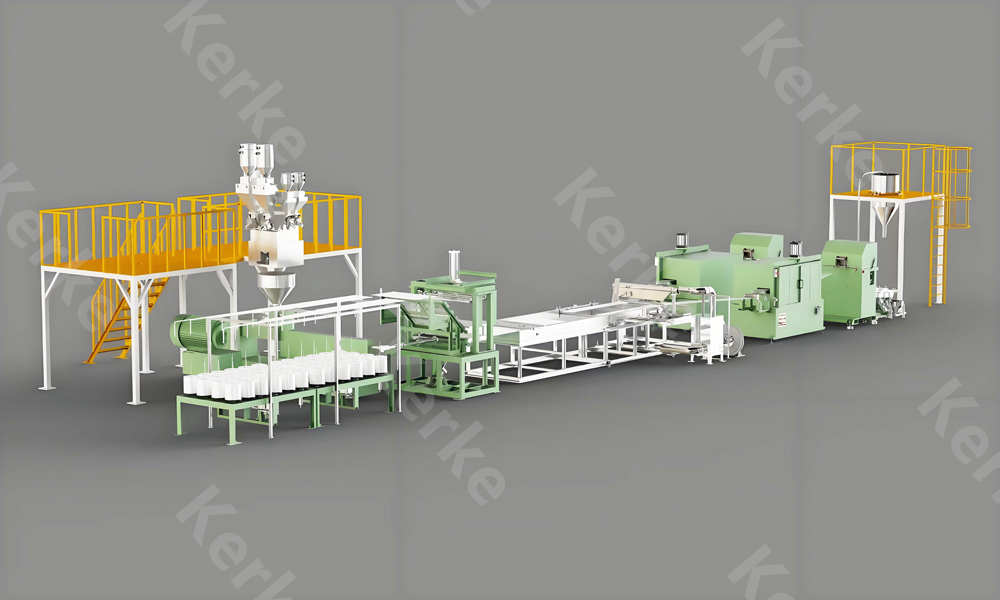
Floor area per line depends on model size. A pilot KTE-20B or KTE-35 line needs roughly 40 to 60 square meters of operating floor plus conditioning space, while a commercial KTE-65 to KTE-95 line needs 120 to 200 square meters including feeders, pelletizer, classifier, and maintenance clearance. Kerke engineers provide a 3D workshop layout as part of the turnkey proposal, positioning the extruder, auxiliary equipment, and utility routes so the zoning standard is practical rather than theoretical.
5. HVAC, Air Handling, and Air-Change Strategy
The HVAC system carries the constant-temperature and humidity standard. For a PLA compounding workshop it should be a dedicated system, not shared with offices or unrelated production, because the heat load from the extruder, chillers, and dryers is steady and significant. The design should include cooling, reheating, and humidification or dehumidification stages so the supply air can be tuned to the target regardless of outdoor weather.
Air changes per hour in the range of 8 to 12 are typical for the processing zones, higher near the feed throat and pelletizer where local exhaust is needed. The supply air should be distributed through diffusers that avoid blowing directly onto the extruder feed throat or the strand cooling bath, because a localized cold draft can cause condensation or uneven cooling. Return air should be drawn from the opposite side of the room so the air sweeps across the equipment rather than short-circuiting.
Filtration is part of cleanliness rather than temperature, but it belongs to the same HVAC package. A minimum efficiency reporting value of 8 to 11 on the supply side controls dust ingress, while local dust extraction at the weighing station and feed throat captures the powdered additives and filler that define masterbatch and filled biodegradable compounds. The air-handling units should be commissioned with the same care as the extruder, because an undersized system will never hold the setpoint during summer peak load.
Redundancy deserves mention. A single HVAC unit serving the entire compounding area creates a single point of failure: a compressor fault stops production because the room drifts out of spec. For lines running continuous PLA campaigns, a backup cooling source or a dual-unit arrangement with automatic lead-lag control is a sensible investment. Kerke’s factory consulting support can review the utility design, including HVAC load, as part of line planning.
6. Cooling Water and Thermal-Stability Standard
Many operators think of temperature control only as the barrel heaters. In reality the cooling side is equally decisive. The barrel, the die head, and the gearbox of a co-rotating twin-screw extruder are cooled by circulating water. If that water temperature wanders, the barrel temperature controller compensates by adjusting heater output, the melt profile shifts, and product properties drift. For PLA, where the safe melt window is narrow, stable cooling water is non-negotiable.
The standard calls for chilled process water supplied to the barrel and die head at 15 to 20 degrees Celsius with a stability of plus or minus 1 degree Celsius. The strand cooling bath, water ring, or underwater pelletizing loop is supplied at 10 to 15 degrees Celsius depending on the method, again with tight stability. The make-up water should be treated to control hardness and biological growth, because scale inside barrel cooling channels insulates the barrel and destroys temperature accuracy over time.
Process Cooling-Water Setpoints
| Cooling Circuit | Supply Temperature (deg C) | Stability | Note |
|---|---|---|---|
| Barrel and die-head cooling | 15 to 20 | plus or minus 1 deg C | Tight control of melt temperature |
| Gearbox lubrication cooling | 25 to 35 | plus or minus 2 deg C | Protects bearing and gear life |
| Strand cooling bath | 10 to 15 | plus or minus 1 deg C | Even pellet solidification |
| Water-ring or underwater loop | 12 to 18 | plus or minus 1 deg C | Stable die-face cutting |
A dedicated process water chiller, sized for the line plus a margin, is the right approach rather than sharing the building’s comfort cooling. Kerke lists industrial water chillers among its auxiliary equipment, and the chiller capacity is selected together with the extruder model during configuration. A closed-loop system with water treatment is preferred because it keeps the barrel cooling channels clean and maintains the temperature accuracy the PLA process demands.
7. Dust, Cleanliness, and Static Control
PLA compounding for masterbatch and filled biodegradable compounds involves powdered pigments, talc, calcium carbonate, and other fillers that generate fine dust. Dust is a problem on three fronts. It contaminates neighboring products and the room air, it settles on equipment and increases cleaning load, and in dry air it builds static charge that attracts more dust and risks discharge. A constant-temperature workshop standard therefore includes a cleanliness and static discipline.
The weighing and pre-mixing zone should have local dust extraction at each open transfer point, and operators should use grounded, anti-static containers and footwear. Floors should be seamless and easy to clean, and the room should be kept at the humidity floor of 30 percent or above specifically to suppress static. Regular scheduled cleaning of the extrusion and pelletizing area prevents cross-batch contamination, which is critical when a line alternates between white, colored, and filled PLA grades.
Cleanliness is also a product-quality issue. Fine dust on the strand or pellet surface becomes a visible defect in transparent or light-colored PLA articles. By holding the room clean and the air filtered, the compounder reduces off-spec pellets and customer complaints. Color-changeover procedure, including a purge compound and a documented clean-down, should be written into the standard operating procedure for the workshop.
8. Environmental Monitoring, Data Acquisition, and Traceability
A standard that is not measured is a wish. The constant-temperature workshop must be instrumented so the setpoints are continuously recorded and deviations are alerted in real time. This converts the environmental envelope from a maintenance habit into an auditable process parameter, which is increasingly required by brand owners sourcing biodegradable packaging.
At minimum, temperature and humidity sensors should be placed in every zone, not just one central point, and the cooling-water supply and return temperatures should be logged at the chiller and at the extruder. The data should feed a supervisory control and data acquisition or PLC-based logging system with alarm thresholds and historical storage. When a zone drifts beyond tolerance, the system alerts the shift supervisor so corrective action happens before the next batch is affected.
Monitored Parameters and Alarm Thresholds
| Monitored Parameter | Logging Interval | Alarm Condition |
|---|---|---|
| Zone temperature | every 1 to 5 minutes | outside plus or minus 2 deg C band |
| Zone relative humidity | every 1 to 5 minutes | above 55 percent or below 30 percent |
| Process water supply | continuous | beyond plus or minus 1 deg C |
| Dryer dew point | continuous | above minus 10 deg C |
| Dust concentration (optional) | every 10 minutes | above housekeeping limit |
Kerke extruders are built around a PLC and human-machine interface with recipe management, so the environmental logger can be integrated with the machine recipe by batch. That way each production lot carries not only the screw speed, barrel profile, and feeder rates, but also the room and cooling-water history. This end-to-end traceability is what separates a professionally run PLA compounding operation from an ad hoc one.
9. Kerke KTE Twin-Screw Extruder Platform for PLA Compounding
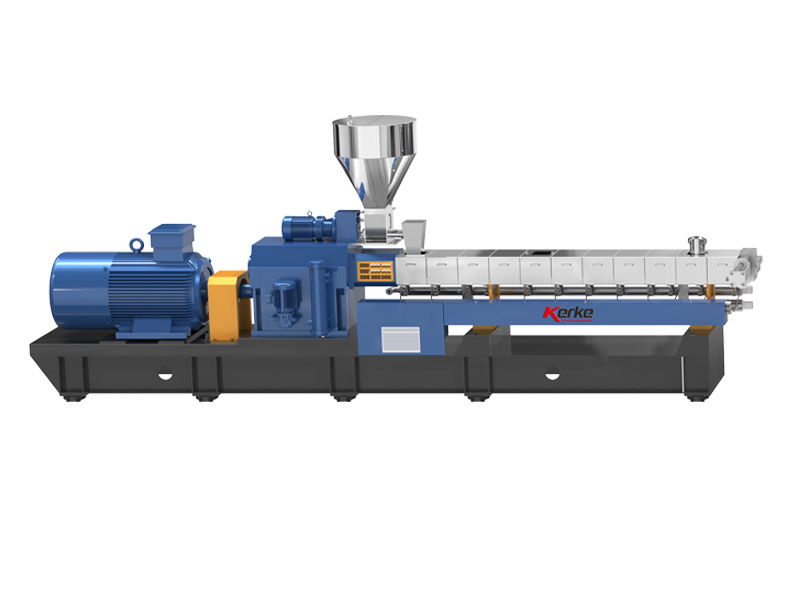
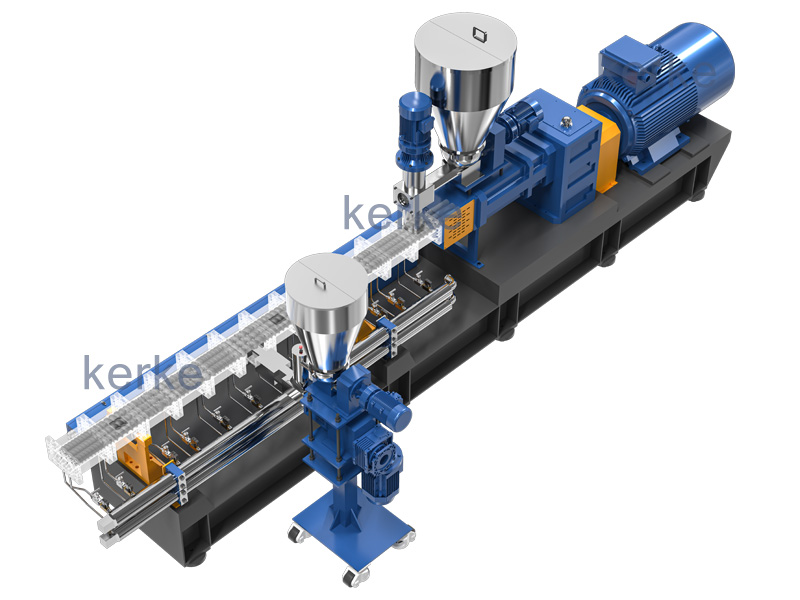
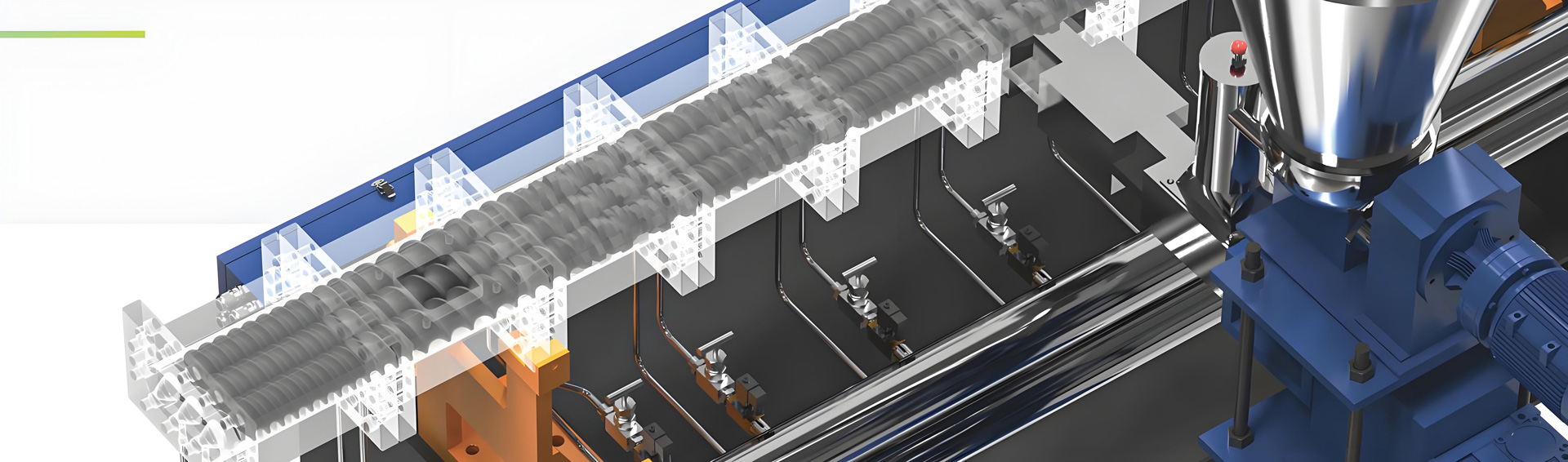
The environmental standard exists to serve the machine, so it is worth describing the machine it serves. Kerke’s core product is the KTE series of parallel co-rotating twin-screw extruders, built from the KTE-16B laboratory model up to the KTE-135D production model. These machines are designed for compounding applications including biodegradable plastic, masterbatch, engineering plastics, cable compounds, and wood-plastic composites. For PLA specifically, the co-rotating intermeshing screws provide strong self-cleaning, excellent dispersion, and the ability to tune the screw configuration to the exact shear and residence-time profile the grade requires.
The KTE platform is optimizable across aspect ratio, barrel structure, screw arrangement, venting, feeding, and electrical control, which lets the same series serve a pilot line and a high-capacity plant. The barrel is modular, so venting and side-feeding positions can be placed where the process needs them, for example to add filler downstream after the initial melting zone or to pull vacuum and remove residual moisture and volatiles. For PLA, vacuum venting is especially valuable because it strips trace moisture and low-boiling volatiles that would otherwise cause splay and porosity in the pellet.
Representative KTE-Series Configurations for PLA Compounding
| Model | Screw Diameter (mm) | Typical L/D Ratio | Main Motor (kW, typical) | Typical PLA Output (kg/h) |
|---|---|---|---|---|
| KTE-20B | 21 | 32 to 40 | 3 to 5 | 0.5 to 8 |
| KTE-35 | 35.6 | 32 to 44 | 11 to 22 | 30 to 80 |
| KTE-50 | 50.5 | 32 to 48 | 45 to 75 | 80 to 220 |
| KTE-65 | 62.4 | 32 to 52 | 90 to 160 | 200 to 450 |
| KTE-75 | 71 | 32 to 52 | 160 to 250 | 300 to 650 |
| KTE-95 | 93 | 36 to 56 | 315 to 500 | 500 to 1200 |
| KTE-135D | 133 | 36 to 56 | 630 to 1000 | 1500 to 3000 |
The values above are representative configuration ranges for the KTE series and are tuned per order; the exact motor power and output depend on the screw design, filler load, and whether a side feeder or double-stage arrangement is used. Kerke’s computer-aided screw assembly, with kneading co-type elements for self-cleaning and good interchangeability, realizes material transport, plasticization, shearing, dispersion, homogenization, venting, and pressure building in a single compact line. That is the machinery the constant-temperature workshop is built to protect.
10. Laboratory Extruder, Pelletizing, and Chiller Auxiliaries
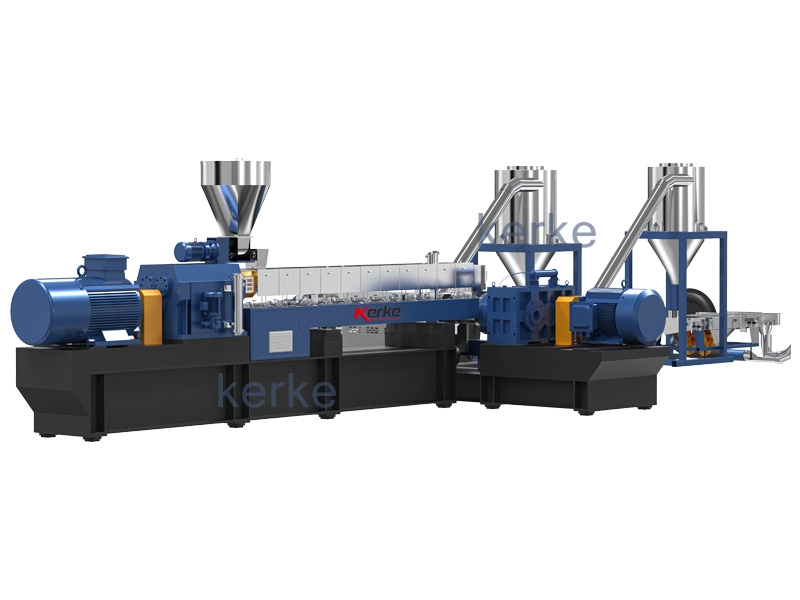
A complete PLA compounding cell includes more than the extruder. The Kerke product range covers the upstream and downstream equipment that together make the workshop standard work: a laboratory twin-screw extruder for formula trials, feeding systems for precise additive dosing, pelletizing systems matched to the product, and the water chiller that stabilizes the cooling side.
The laboratory twin-screw extruder is the right tool for developing a PLA compound before committing to production. It runs small batches, validates the screw configuration and barrel profile, and confirms that the dried-feed and cooling assumptions hold at pilot scale. Because PLA is sensitive, nearly every commercial grade is first proven on a lab line under the same environmental envelope described in this article, just in a smaller room.
Laboratory Extruder and Auxiliary Specification Summary
| Equipment | Model / Type | Key Specification | Role in PLA Line |
|---|---|---|---|
| Laboratory twin-screw extruder | KTE-16B / KTE-20B | screw 16 to 21 mm, 0.5 to 15 kg/h | Formula trials and process validation |
| Loss-in-weight feeder | gravimetric | accuracy plus or minus 0.5 percent | Precise additive and filler dosing |
| Side feeder (twin screw) | KTE side feeder | high filler loading | Downstream filler addition |
| Pelletizing system | strand or die-face | see comparison below | Solidify and cut pellets |
| Process water chiller | industrial chiller | 15 to 20 deg C supply, plus or minus 1 deg C | Stabilizes barrel and pellet cooling |
Pelletizing method choice interacts with the workshop humidity standard. Strand pelletizing pulls extruded strands through a water bath and then cuts them; it is robust for PLA and easy to clean between colors. Die-face hot cutting, water-ring, and underwater systems cut at the die and are well suited to higher outputs and dust-free operation, but they introduce process water that must be controlled. The table below compares the main methods on criteria that matter for a constant-environment PLA line.
Pelletizing Method Comparison for PLA
| Method | Output Range | Dust Level | Water Contact | Best Fit |
|---|---|---|---|---|
| Water-cooled strand | low to medium | low | bath, then dry | Pilot and color masterbatch |
| Air-cooled strand | low to medium | low | none | Heat-sensitive, low dust need |
| Air-cooled die-face hot cutting | medium | medium | none | Dust-managed plants |
| Water-ring die-face | medium to high | very low | ring loop | High-output commercial lines |
| Underwater granulation | high | very low | submerged cut | Large KTE-95 to KTE-135D lines |
For most PLA biodegradable compounds and masterbatches, water-cooled strand or water-ring die-face cutting paired with a stable chiller gives the best balance of pellet quality and clean operation. The choice is finalized during line configuration together with the extruder model and the required output.
11. Application Industries for Constant-Controlled PLA Compounding
The constant-temperature workshop standard pays off most where PLA product value is high and quality claims must be defensible. Kerke equipment serves several application families that all benefit from a controlled environment.
In masterbatch production, PLA color masterbatch, filler masterbatch, additive masterbatch, black masterbatch, and textile masterbatch all demand clean, low-dust, humidity-controlled rooms so the concentrated dispersion stays consistent and the carrier resin does not hydrolyze. In plastic compounding, biodegradable plastic compounds, engineering plastic blends, cable compounds, PVC compounds, thermoplastic elastomers, and wood-plastic composites each have their own thermal window, and PLA-based biodegradable compounds are the most environment-sensitive of the group.
Beyond classic compounding, Kerke lines also serve R-PET flake recycling, pet-food processing, and high-moisture-absorbing (HMMA/TVP) food processing, where drying and conditioning are equally critical. The through-line is simple: any process where moisture and thermal stability decide quality belongs in a constant-temperature workshop. End products made from PLA compounds include compostable shopping and garbage bags, agricultural mulch film, food-service cutlery and cups, thermoformed trays, and fibers for nonwoven and textile use.
12. Model Selection Recommendation
Choosing the extruder model starts from the target output, the filler or additive load, and the required L/D ratio for the reaction or dispersion. The table below maps common PLA compounding requirements to a recommended Kerke model. Output figures are typical and must be confirmed by a trial, because PLA grade, filler type, and moisture content shift the real number.
Requirement-to-Model Selection Guide
| Customer Requirement | Recommended Model | Why |
|---|---|---|
| New formula development, small batches | KTE-16B or KTE-20B lab extruder | Low material use, fast screw changes |
| Pilot production, 30 to 80 kg/h | KTE-35 | Bridge from lab to commercial scale |
| PLA color or additive masterbatch, 80 to 220 kg/h | KTE-50 | Good dispersion, compact footprint |
| Filled biodegradable compound, 200 to 450 kg/h | KTE-65 | Side feeder for high filler load |
| Commercial PLA compound, 300 to 650 kg/h | KTE-75 | Balanced output and flexibility |
| High-volume biodegradable line, 500 to 1200 kg/h | KTE-95 | Economies of scale, vacuum venting |
| Very large single-line capacity, 1500 kg/h plus | KTE-135D | Maximum throughput for dedicated plants |
When a compound needs two-stage devolatilization or a special reactive step, Kerke offers the double-stage mother-baby extrusion system and the triple three-screw extruder for special materials, both of which still run inside the same constant-temperature envelope. The selection is never only about screw diameter; it is about matching the whole cell, including the workshop, to the product.
13. Installation, Commissioning, and Maintenance of Environmental Controls
Building the workshop and installing the line are one project. Bringing the environmental standard online is another. Kerke supports installation and commissioning of the extrusion line, and the environmental systems, HVAC, chiller, dryer, and monitoring should be commissioned together so the setpoints are verified before the first commercial batch.
Commissioning steps include balancing the HVAC to hold each zone within tolerance under simulated summer and winter loads, verifying the chiller holds plus or minus 1 degree Celsius at the barrel and pelletizer, confirming the dryer dew point, and recording a 24 to 72 hour stability log of temperature and humidity across all zones. Only after the room passes does the extruder recipe get validated. This sequence prevents the common mistake of blaming the machine for problems that originate in the room.
Maintenance has two tracks. The machine track covers screw and barrel inspection, gearbox oil, and feeder calibration on the schedule Kerke recommends. The environmental track covers HVAC filter replacement, chiller water treatment and descaling, sensor calibration, and dust-extraction filter cleaning. Both tracks belong in the same preventive-maintenance calendar because a dirty chiller or a clogged filter is what eventually breaks the constant-temperature promise.
14. Quality Standards, Certifications, and Cost Considerations
Kerke operates as a high-technology Wanplas factory and builds equipment to recognized quality practices; the group references ISO and CE alignment across its factories and applies consistent quality standards to exported machinery. For PLA compounding lines, the relevant quality conversation is about process capability: can the line and its workshop hold the melt window, moisture limit, and pellet specification batch after batch. That capability, not a plaque on the wall, is what brand owners audit.
Cost is best expressed in relative tiers rather than absolute numbers. A basic pilot cell with a laboratory extruder and minimal environmental control sits at a Low to Medium investment tier. A commercial KTE-65 or KTE-75 line with a dedicated chiller, dehumidifying dryer, and zoned HVAC is a Medium to High tier. A large KTE-95 or KTE-135D plant with full monitoring, redundancy, and classified clean zones is a High to Very High tier. The environmental envelope is a meaningful share of that cost, but it is the difference between a line that makes saleable PLA pellets and one that makes scrap.
Energy is part of the operating cost. A constant-temperature workshop runs HVAC and chillers continuously, so selecting high-efficiency compressors, recovering heat where practical, and right-sizing the system to the real heat load keeps the running cost in check. Kerke’s PLC-based control with recipe management also reduces startup scrap, which is the hidden cost most often overlooked in PLA compounding.
15. Service and Support
Choosing Kerke means joining the Wanplas group of specialized factories, whose shared mission is to warm global customers with China plastic machinery. The group backs every line with concrete service commitments. Each customer receives USD 500 free parts per year, free replacement of damaged parts within the warranty period, and access to the open-factory policy that welcomes on-site visits and audits before purchase.
Kerke’s support covers pre-shipment testing, where the line is run and verified against the agreed specification; installation and commissioning by engineers who understand both the extruder and the environmental envelope; operator training on recipe management, cleaning, and changeover; and remote operation and maintenance support through the PLC and human-machine interface. With more than 12 years of experience, a 19,997-plus-square-meter plant, and over 2,000 machines running in 70-plus countries, Kerke brings proven compounding expertise to every PLA project.
Frequently Asked Questions
Why does PLA twin-screw compounding require a constant-temperature workshop rather than only machine-level heating control?
PLA is hygroscopic and thermally sensitive. The ambient temperature and humidity of the room change the moisture content of regrind and additives, the cooling-water temperature at the barrel and die head, and the dimensional stability of the strand pelletizing line. Machine heating zones control the melt, but the room controls the feedstock and the cooling side, so a constant-temperature envelope is required to keep output quality stable.
What is the recommended ambient temperature range for a PLA compounding workshop?
A practical constant-temperature envelope is 22 to 26 degrees Celsius for the main extrusion and pelletizing zones, with the raw-material conditioning room held at 20 to 23 degrees Celsius and the packaging room near 23 to 25 degrees Celsius. The key is a tight tolerance of plus or minus 2 degrees Celsius rather than the absolute number.
What relative humidity should be maintained and why?
Most PLA compounding areas should stay at 45 to 55 percent relative humidity, while the drying and conditioning zone is best held near 35 to 45 percent. Below 30 percent static buildup increases, and above 60 percent the resin reabsorbs moisture and hydrolyzes during melting, lowering molecular weight and mechanical properties.
How should the workshop be zoned for material flow?
A linear flow of raw-material conditioning, weighing and pre-mixing, twin-screw extrusion, pelletizing and cooling, screening and classification, and finally packaging prevents cross-contamination and moisture pickup. Each zone has its own setpoints and air-change rate, and traffic between wet and dry zones is controlled.
What cooling-water standard is needed for the barrel and pelletizer?
Supply the barrel and die head with chilled water at 15 to 20 degrees Celsius with a temperature stability of plus or minus 1 degree Celsius, and the strand cooling bath or water bath at 10 to 15 degrees Celsius depending on the pelletizing method. Stable cooling water is as important as stable room air because it governs barrel temperature control and pellet shape.
Which Kerke extruder model fits a given PLA output requirement?
For pilot and formula work the laboratory twin-screw extruder is used. For commercial PLA masterbatch and biodegradable compounds, the KTE-50 to KTE-95 co-rotating parallel twin-screw models cover most outputs from roughly 80 to 1200 kilograms per hour, while the KTE-135D serves large-capacity lines. The exact model is selected from the requirement-to-model table using target output, filler load, and L/D ratio.
How is the environmental standard verified after installation?
During commissioning the HVAC, chiller, dryer, and sensors are logged for 24 to 72 hours across all zones to confirm the temperature and humidity bands hold under simulated load. The data is then carried into routine production monitoring, where alarms trigger if any zone drifts outside tolerance, so the standard is auditable rather than assumed.
Conclusion
A constant-temperature workshop is the foundation on which successful PLA twin-screw compounding is built. By defining zone temperature setpoints of 20 to 26 degrees Celsius with tight plus-or-minus-2-degree-Celsius tolerance, holding relative humidity at 45 to 55 percent in processing areas and 35 to 45 percent in the conditioning zone, zoning the floor for clean one-way material flow, stabilizing cooling water to plus or minus 1 degree Celsius, controlling dust and static, and instrumenting everything with continuous monitoring, a compounder removes the room as a source of variation. The result is consistent molecular weight, stable color and dispersion, uniform pellets, and batches that pass audit.
Kerke, a Wanplas factory, supplies the KTE series of co-rotating parallel twin-screw extruders, from the KTE-16B laboratory model to the KTE-135D production line, together with feeding, pelletizing, and chiller auxiliaries that are designed to run inside exactly this kind of controlled environment. Whether you are scaling a new biodegradable PLA compound from the lab or building a dedicated high-volume plant, the right move is to design the workshop and the machine as one system. Send your target output, filler load, and product specification to the Kerke team for a custom configuration, arrange a factory audit to see the standard in practice, and request a trial run on the material you intend to compound.