Chemical resistant masterbatch addresses the demanding requirements of plastic products that must maintain performance integrity when exposed to aggressive chemical environments. Industrial equipment, chemical processing facilities, storage tanks, piping systems, and laboratory equipment face continuous exposure to solvents, acids, alkalis, and other reactive substances that can degrade standard plastics through swelling, embrittlement, surface attack, or complete structural failure. Masterbatch additives that enhance chemical resistance enable manufacturers to produce plastic products suitable for these challenging applications.
The production of chemical resistant masterbatch presents unique processing challenges that distinguish it from other masterbatch types. Chemical resistance additives often include high molecular weight polymers, specialized fluoropolymers, or reactive compounds that require intense processing energy for effective incorporation. Heavy-duty twin screw extruders provide the mechanical energy input and processing capacity necessary to handle these demanding formulations consistently and efficiently.
Kerke KHD Series heavy-duty twin screw extruders deliver the processing power necessary for chemical resistant masterbatch production, featuring robust construction designed for continuous operation and enhanced torque capacity for demanding formulations. This comprehensive guide covers all aspects of chemical resistant masterbatch manufacturing from formulation science through production optimization and quality assurance.
Understanding Chemical Resistance in Plastics
Chemical resistance in plastics involves complex interactions between polymer materials and aggressive chemical environments that can manifest through multiple degradation mechanisms. Understanding these mechanisms enables formulation scientists to develop masterbatch additives that effectively protect plastic products from chemical attack. The selection of appropriate protection strategies depends on the specific chemical environment and performance requirements of the end application.
Chemical attack on plastics varies significantly depending on polymer chemistry, chemical exposure conditions, and product design factors. Some polymers exhibit inherent chemical resistance while others are highly susceptible to attack by specific chemical classes. The effectiveness of chemical resistance protection depends on maintaining the protective mechanism throughout the expected service life under actual exposure conditions.
Chemical Degradation Mechanisms in Polymers
Solvent attack causes swelling and plasticization as chemical molecules penetrate the polymer matrix and separate polymer chains. This effect reduces mechanical strength and may cause dimensional changes that compromise product function. Severe solvent exposure can eventually dissolve polymer materials entirely. Non polar solvents affect non polar polymers while polar solvents attack polar polymer systems.
Chemical reaction degradation occurs when aggressive chemicals attack specific chemical bonds within the polymer structure. Acid hydrolysis breaks polymer chains in polyesters and similar materials. Oxidative degradation affects polymers containing susceptible chemical groups. Alkaline hydrolysis degrades polyesters and polyamides in high pH environments. Each degradation mechanism requires specific protective approaches based on the underlying chemistry.
Environmental stress cracking occurs when surface active chemicals cause crack propagation in stressed polymer regions without significant swelling or chemical attack. This mechanism can cause sudden failure of components that appear unaffected during visual inspection. Stress cracking agents include surfactants, oils, and various industrial chemicals that do not generally attack the bulk polymer.
Protection Strategies for Chemical Resistance
Barrier enhancement strategies reduce chemical penetration rates by increasing the tortuosity of diffusion pathways through the polymer matrix. Fluoropolymers and similar barrier materials create dense structures that resist chemical penetration at the molecular level. These additives may be incorporated at relatively low concentrations to provide meaningful protection without dramatically affecting other material properties.
Chemical resistance modifier additives work by absorbing or neutralizing aggressive chemicals that penetrate the surface layers. These additives provide active protection that addresses chemical species reaching the polymer surface, extending effective service life beyond what passive barrier mechanisms provide. The specific modifier chemistry must match the chemical environment for effective protection.
Crosslinking enhancement improves resistance to solvent attack and environmental stress cracking by creating chemical bonds between polymer chains that resist separation. Peroxide crosslinking and radiation crosslinking technologies may be incorporated into masterbatch formulations depending on polymer system and processing requirements. Crosslinked polymers exhibit improved chemical resistance alongside enhanced thermal and mechanical properties.
Formulation Ratios for Chemical Resistant Masterbatch
Chemical resistant masterbatch formulations vary significantly based on target polymer system, chemical exposure environment, and performance requirements. The formulation development process must balance protection effectiveness against cost, processing requirements, and compatibility with base polymer systems. Different application sectors require specific formulation approaches addressing their unique chemical exposure scenarios.
Standard Chemical Resistance Formulation
Standard chemical resistance formulations typically incorporate barrier enhancement additives at concentrations ranging from ten to twenty percent depending on the severity of anticipated chemical exposure. Fluoropolymer additives provide excellent barrier properties at relatively low concentrations due to their effectiveness at extremely low loading levels. The carrier resin system comprises approximately seventy to eighty percent of the formulation.
Loading rates in base polymer typically range from two to five percent for standard chemical resistance applications. This addition level provides adequate protection for industrial equipment, chemical storage containers, and processing equipment that encounters occasional or moderate chemical exposure. Standard formulations balance protection effectiveness against cost considerations for competitive market positioning.
Premium Chemical Resistance Formulation
Premium formulations for severe service conditions incorporate enhanced additive concentrations and multiple protective mechanisms. Barrier enhancement additive concentrations may increase to twenty to thirty percent, while chemical neutralizer systems add another five to ten percent. Crosslinking promoter systems may be included at concentrations appropriate for the target polymer chemistry and processing conditions.
Premium formulation loading rates typically range from four to eight percent depending on application requirements and base polymer characteristics. Chemical processing equipment, storage tanks for aggressive chemicals, and laboratory equipment require premium formulation protection levels. The enhanced additive package increases formulation cost but delivers performance necessary for critical applications where failure could cause safety incidents or significant economic loss.
Application Specific Formulation Development
Certain chemical exposure scenarios require specialized formulation approaches beyond standard and premium offerings. Acid storage applications require additives that resist acid attack and prevent acid permeation through tank walls. Alkaline environments require protection against base hydrolysis that degrades certain polymer systems. Solvent exposure scenarios require barrier enhancement to prevent swelling and plasticization effects.
Chlorinated solvent applications represent particularly demanding environments that attack many polymer systems. Fluoropolymer based formulations provide the highest level of chlorinated solvent resistance but at significant cost premium. Hydrocarbon solvent resistance requires different additive chemistry than polar solvent protection. Each specialized application requires careful analysis of exposure conditions and selection of appropriate protective mechanisms.
Production Process for Chemical Resistant Masterbatch
Manufacturing chemical resistant masterbatch requires processing capabilities that can handle challenging formulations with high additive loadings and demanding incorporation requirements. Heavy-duty twin screw extruders provide the mechanical energy input, torque capacity, and processing stability necessary for consistent production of these demanding formulations. Process optimization ensures effective additive incorporation while maintaining production efficiency.
Material Preparation and Handling
Raw material preparation for chemical resistant masterbatch requires attention to specific material handling requirements of each formulation component. Fluoropolymer additives often require special handling to prevent agglomeration and ensure uniform distribution. High molecular weight modifiers may require extended drying to remove moisture that could cause processing problems. Reactive compounds may require careful storage temperature control to maintain stability.
Carrier resin selection significantly influences processing behavior and final product characteristics. Polymer viscosity, melt temperature, and chemical compatibility with additive systems must be considered during formulation development. Some chemical resistance additives may require carriers with specific chemical resistance characteristics themselves to prevent additive carrier interactions during processing and storage.
Heavy-Duty Extrusion Processing
Heavy-duty twin screw extrusion provides the mechanical energy necessary to incorporate demanding chemical resistance additives effectively. The enhanced torque capacity enables processing of formulations with high viscosity or high loading levels that would exceed the capabilities of standard equipment. Counter rotating screw configurations provide excellent mixing efficiency while maintaining controlled residence time distribution.
Temperature profile configuration must balance melt viscosity requirements against thermal stability of sensitive additive components. Processing temperatures typically range from one hundred eighty to two hundred fifty degrees Celsius depending on carrier resin and specific additive systems. Higher processing temperatures may be required for high viscosity carriers while lower temperatures preserve thermally sensitive additives. Multiple heating zones enable progressive temperature management throughout the extrusion process.
Pelletizing and Quality Verification
Pelletizing systems convert extruded compound into finished product form suitable for customer use and subsequent processing. Heavy-duty extruders typically operate at higher throughput rates requiring pelletizing systems with corresponding capacity. Underwater pelletizers provide efficient cooling and produce uniform pellets suitable for most applications. Strand pelletizers offer flexibility for varying production requirements.
Quality verification for chemical resistant masterbatch includes testing beyond standard masterbatch specifications. Chemical resistance testing on sample plaques manufactured with the masterbatch provides direct verification of protection effectiveness. Extraction testing may be required for food contact or medical applications. Accelerated aging tests simulate long term chemical exposure to project service life performance.
Production Equipment Introduction
Equipment selection for chemical resistant masterbatch production must address the demanding processing requirements of these challenging formulations. Heavy-duty twin screw extruders provide the capacity, power, and reliability necessary for consistent production of high quality chemical resistance masterbatch. Understanding equipment capabilities and configurations helps manufacturers select appropriate equipment for their production requirements.
Kerke KHD Series Heavy-Duty Twin Screw Extruder
Kerke KHD Series heavy-duty twin screw extruders are designed specifically for demanding compound and masterbatch applications requiring maximum processing power. The series includes models with screw diameters from fifty to one hundred fifty millimeters, providing throughput capabilities ranging from approximately one hundred to over three thousand kilograms per hour depending on configuration and operating conditions.
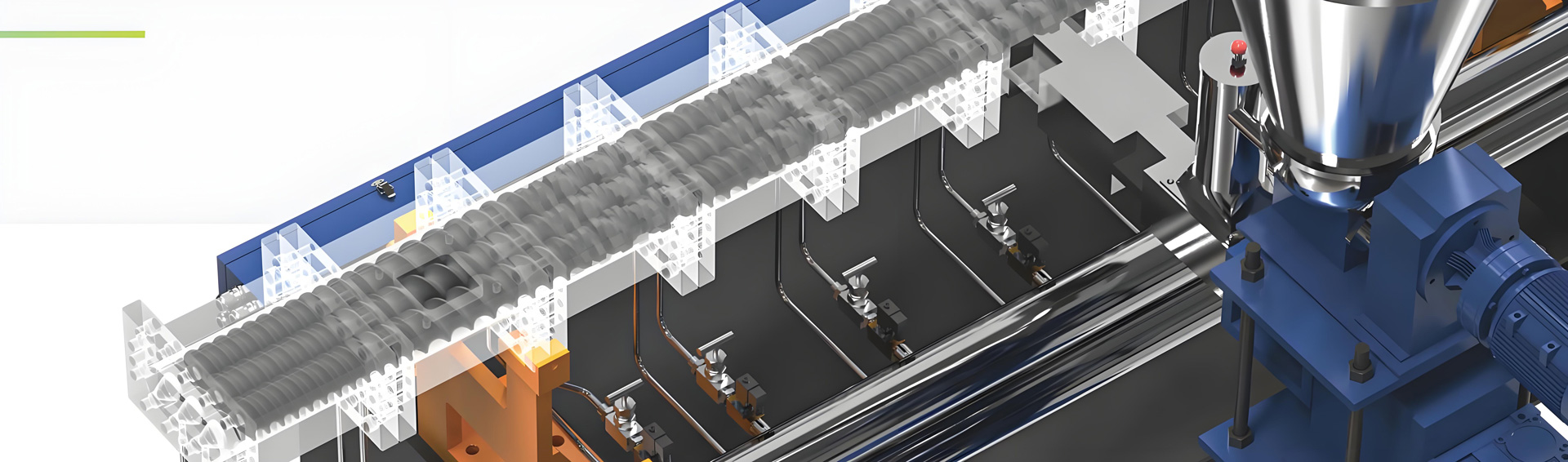
The KHD Series features robust construction designed for continuous heavy-duty operation including heavy wall barrel sections, high capacity drive systems, and precision manufactured screw elements. Torque ratings significantly exceed standard designs, providing processing reserves for the most demanding formulations. Advanced control systems provide precise process management while comprehensive monitoring capabilities support quality assurance and troubleshooting requirements.
Critical Features for Chemical Resistance Production
Production of chemical resistant masterbatch requires equipment features that provide consistent processing performance over extended production runs. High torque capacity enables processing of high viscosity formulations and elevated additive loadings that characterize chemical resistance masterbatch. Robust construction ensures reliable operation under the demanding conditions required for these challenging formulations.
Precise temperature control enables optimization of processing conditions for specific formulation requirements. Multiple independently controlled heating zones allow fine tuning of temperature profiles throughout the extrusion system. Vacuum venting capability enables removal of volatiles and moisture that could affect product quality. Advanced control features support process optimization and documentation requirements.
Production Line Integration
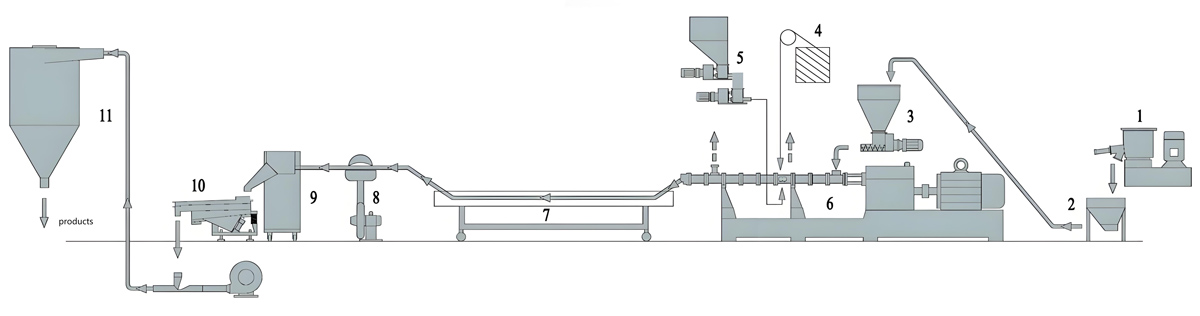
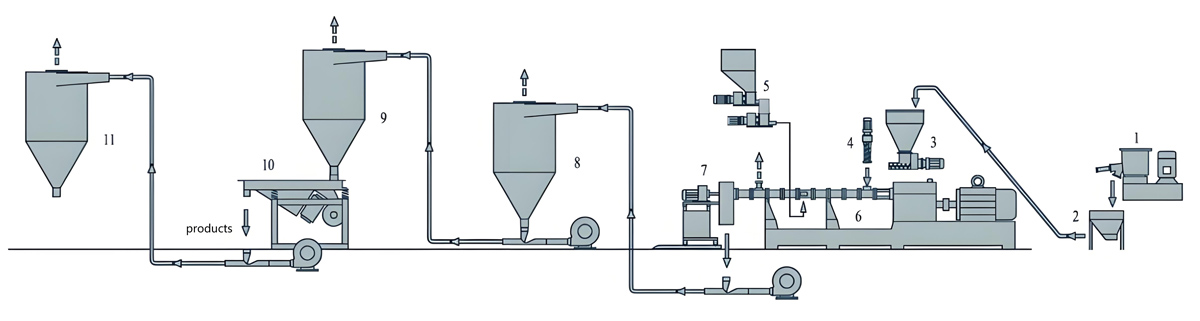
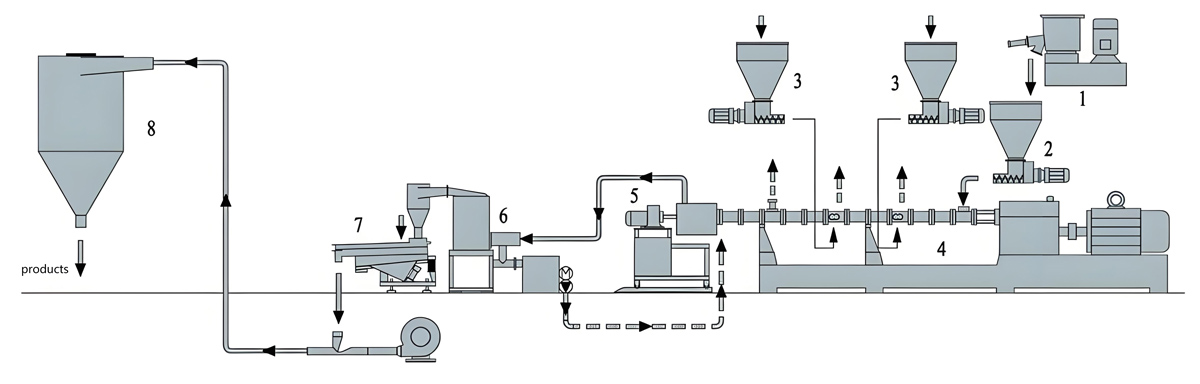
Complete chemical resistance masterbatch production requires integration of heavy-duty extrusion equipment with supporting systems including material handling, feeding, drying, and downstream processing. Material handling systems must accommodate higher throughput rates associated with production scale equipment. Gravimetric feeding systems provide accurate formulation compliance throughout extended production runs.
Downstream equipment including high capacity pelletizers, centrifugal dryers, and screening systems should match extrusion line throughput. Quality control laboratory equipment enables verification of formulation compliance and chemical resistance performance. Control system integration enables coordinated operation and data collection supporting quality documentation and process optimization.
Parameter Settings for Optimal Production
Parameter optimization ensures consistent quality and maximum efficiency in chemical resistance masterbatch production. Heavy-duty twin screw extruders offer extensive parameter control capabilities that enable optimization for specific formulation requirements. Understanding parameter effects helps operators achieve optimal results across varying production scenarios.
Temperature Profile Optimization
Temperature profile configuration significantly influences melt viscosity, mixing efficiency, and additive preservation during processing. For chemical resistance masterbatch, temperature profiles must be optimized for each specific formulation based on carrier resin characteristics and additive thermal stability. Typical processing temperatures range from one hundred eighty to two hundred fifty degrees Celsius depending on formulation requirements.
Feeding zone temperatures typically range from one hundred sixty to one hundred eighty degrees Celsius, providing gentle warming that facilitates feeding without exposing additives to excessive thermal stress. Processing zone temperatures increase to achieve complete melting and optimal viscosity for mixing, typically ranging from one hundred ninety to two hundred fifty degrees Celsius. Die temperatures complete the profile and should maintain melt flow consistency throughout the production run.
Screw Speed and Torque Management
Heavy-duty twin screw extruders operate across screw speed ranges typically from one hundred fifty to three hundred fifty rotations per minute depending on screw diameter and formulation requirements. Higher speeds increase throughput and mixing intensity while lower speeds reduce mechanical stress and residence time for temperature sensitive formulations.
Torque monitoring provides critical information about processing conditions and equipment status during heavy-duty operation. Operating torque should remain below eighty five percent of maximum rated torque for continuous operation to ensure equipment reliability and processing reserves. Heavy-duty equipment design accommodates sustained operation at higher torque levels than standard equipment, enabling processing of the most demanding formulations.
Throughput and Residence Time Optimization
Production throughput rates for heavy-duty equipment range from approximately one hundred to over three thousand kilograms per hour depending on screw diameter, configuration, and formulation requirements. Optimal throughput balances production efficiency against processing quality requirements for each specific formulation.
Residence time distribution influences product quality through processing history experienced by material during extrusion. Narrow residence time distribution ensures consistent treatment of all material, resulting in uniform product quality. Heavy-duty counter rotating twin screw extruders provide inherently narrow residence time distribution, making them well suited for chemical resistance masterbatch production requiring consistent processing conditions.
Equipment Price
Heavy-duty twin screw extrusion equipment represents significant capital investment appropriate for established production operations with substantial output requirements. Understanding pricing structures and total cost considerations helps manufacturers develop appropriate capital planning strategies and evaluate return on investment for capacity expansion or new equipment acquisition.
Kerke KHD Series Investment Overview
Kerke KHD Series heavy-duty twin screw extruders are priced according to screw diameter, torque capacity, and included features. Mid-range models with fifty to seventy millimeter screw diameters range from one hundred twenty thousand to two hundred fifty thousand dollars depending on torque rating and control system features. Large production models with eighty to one hundred millimeter screw diameters range from two hundred fifty thousand to five hundred thousand dollars.
Extra heavy-duty models with screw diameters from one hundred ten to one hundred fifty millimeters range from five hundred thousand to over one million dollars depending on configuration and included auxiliary equipment. Complete turnkey production lines including material handling, drying, pelletizing, and quality control systems may require total investments ranging from eight hundred thousand to over two million dollars for full scale production capabilities.
Return on Investment Considerations
Heavy-duty equipment investment justification considers production capacity, product value, and operational efficiency improvements. Higher throughput capabilities enable production of larger volumes that spread fixed costs across more output. Consistent quality reduces waste and customer complaints that impact profitability. Reliability reduces downtime and lost production that affect capacity utilization.
Heavy-duty equipment typically offers improved energy efficiency at optimal operating conditions compared to operating multiple smaller machines at equivalent total capacity. Labor efficiency improvements from automated operation and reduced changeover requirements contribute to operating cost reductions. Quality consistency improvements support premium pricing for high performance chemical resistance masterbatch products. These factors combine to justify heavy-duty equipment investment for established production operations.
Production Problems Causes Solutions and Prevention
Effective troubleshooting and problem prevention maintains production quality and efficiency in chemical resistance masterbatch manufacturing. The demanding nature of these formulations creates unique production challenges requiring systematic understanding and response. Proactive prevention strategies reduce problem frequency and severity while improving overall production performance.
Additive Dispersion Inadequacy
Problem description involves finished chemical resistance masterbatch exhibiting inconsistent protection performance that varies between batches or within individual production lots. Testing reveals inadequate dispersion of protective additives that results in localized areas with insufficient additive concentration. This manifests as inconsistent chemical resistance testing results or premature failure in demanding applications.
Root cause analysis examines screw configuration, processing parameters, and material handling procedures. Screw element wear reduces mixing efficiency and fails to break down additive agglomerates. Inadequate specific energy input provides insufficient mechanical work to incorporate challenging additives. High viscosity formulations resist mixing that would occur readily in lower viscosity systems. Feeding inconsistencies create concentration variations that persist through processing.
Solution implementation addresses identified issues through equipment adjustment and process modification. Screw element inspection and replacement restores mixing performance when wear exceeds specifications. Screw configuration modification increases mixing intensity in problematic zones. Temperature profile adjustment reduces melt viscosity and improves mixing efficiency. Processing parameter optimization increases specific energy input to levels adequate for the specific formulation.
Prevention strategies maintain mixing efficiency through scheduled maintenance and process control. Regular screw element inspection and replacement prevents performance degradation from wear. Process validation testing verifies adequate dispersion before production release. Statistical process control monitoring detects trends that might indicate developing issues. Standard operating procedures ensure consistent execution of validated processing conditions.
Fluoropolymer Agglomeration Problems
Problem description involves finished masterbatch containing visible fluoropolymer agglomerates or exhibiting inconsistent chemical resistance performance characteristic of fluoropolymer dispersion problems. These agglomerates may cause processing problems in customer equipment or create weak points in finished products that fail prematurely under chemical exposure.
Root cause analysis focuses on fluoropolymer handling, incorporation, and dispersion during processing. Improper preblending creates fluoropolymer concentrate regions that resist dispersion during extrusion. Insufficient dispersive mixing energy fails to break down fluoropolymer particles to effective size. Temperature conditions affect fluoropolymer viscosity and incorporation behavior. Equipment contamination from previous runs may interfere with fluoropolymer dispersion.
Solution implementation addresses fluoropolymer handling and processing optimization. Preblending procedure modification using appropriate equipment ensures complete fluoropolymer distribution before extrusion. Screw configuration optimization places high shear mixing elements in locations where fluoropolymer incorporation occurs. Processing parameter adjustment optimizes temperature and shear conditions for fluoropolymer handling. Thorough equipment cleaning eliminates contamination that interferes with fluoropolymer processing.
Prevention strategies ensure consistent fluoropolymer incorporation through validated procedures. Fluoropolymer handling training ensures operators understand specific requirements for these challenging additives. Preblending equipment qualification verifies capability for fluoropolymer incorporation. Regular quality testing of production samples verifies continued dispersion adequacy. Equipment configuration documentation ensures validated procedures are followed consistently.
Thermal Degradation of Protective Additives
Problem description involves chemical resistance performance falling below specifications due to degradation of protective additives during processing. Testing reveals reduced effectiveness of barrier enhancement additives or loss of chemical neutralizer functionality that indicates thermal damage during extrusion. This results in inadequate protection in end use applications despite correct formulation and loading.
Root cause analysis examines processing temperatures, residence time, and additive thermal stability characteristics. Excessive barrel temperatures accelerate thermal decomposition of sensitive additives. Extended residence time compounds thermal exposure effects. High shear mixing generates additional thermal energy beyond barrel heating. Additive addition location exposes temperature sensitive compounds to processing zone conditions inappropriate for their thermal stability.
Solution implementation reduces thermal exposure through process modification. Temperature profile reduction minimizes barrel heating contribution to thermal exposure. Screw speed increase reduces residence time while maintaining throughput. Screw configuration modification reduces shear heating in zones where sensitive additives are present. Additive addition location optimization introduces temperature sensitive compounds at downstream locations where temperatures are lower.
Prevention strategies optimize formulations and processes for thermal preservation. Small scale testing establishes acceptable processing windows before production scale implementation. Additive thermal stability characterization provides guidance for process optimization. Process parameter limits documented and enforced prevent inadvertent excessive thermal exposure. Regular testing of production samples verifies continued additive integrity.
Maintenance and Care
Systematic maintenance preserves equipment performance and extends service life for heavy-duty twin screw extrusion operations. The demanding nature of chemical resistance masterbatch production places significant stress on equipment components, requiring regular attention to ensure reliable operation. A comprehensive maintenance program addresses both scheduled preventive maintenance and condition based responses to equipment monitoring data.
Daily and Weekly Maintenance Operations
Daily maintenance activities for heavy-duty equipment include comprehensive operational verification and monitoring. Operators should verify feeding system accuracy, temperature controller performance, and extrusion output quality throughout production runs. Continuous torque monitoring during heavy-duty operation identifies developing problems before they cause failures. Visual and auditory inspection for unusual conditions identifies issues requiring attention.
Weekly maintenance extends inspection scope to include components subject to wear during heavy-duty operation. Gearbox oil condition monitoring through sampling and analysis provides early warning of developing problems. Cooling system performance verification ensures adequate heat removal during continuous operation. Drive system component inspection including couplings and belts identifies wear requiring attention. Screw torque trend analysis supports predictive maintenance planning.
Monthly and Quarterly Maintenance Schedule
Monthly maintenance addresses components requiring regular attention during heavy-duty operation. Torque transmit bearing condition assessment through vibration analysis and temperature monitoring identifies problems requiring intervention. Barrel liner wear measurements project remaining service life and plan for replacement before failures occur. Drive system alignment verification ensures efficient power transmission and minimizes wear.
Quarterly maintenance encompasses comprehensive system evaluation and service activities. Gearbox complete service includes oil change, filter replacement, and internal inspection. Temperature controller calibration ensures accurate process control. Motor current measurements establish baseline comparisons for electrical system health assessment. Complete equipment cleaning removes accumulated material deposits that could affect performance.
Annual and Long Term Maintenance Planning
Annual maintenance involves thorough equipment evaluation and major component service appropriate for heavy-duty continuous operation. Complete screw element inspection enables assessment of wear patterns and remaining service life. Barrel liner comprehensive evaluation identifies sections requiring replacement based on wear measurements. Gearbox major service including seal replacement and bearing inspection ensures continued reliable operation.
Long term maintenance planning addresses equipment lifecycle management for heavy-duty operations. Operating hour tracking and trend analysis supports prediction of major service requirements. Capital planning for major repairs or equipment replacement considers current equipment condition and production requirements. Technology upgrade evaluation identifies improvements that could enhance capabilities or reduce operating costs. Spare parts inventory optimization ensures availability of critical components while minimizing inventory carrying costs.
FAQ
What types of chemical exposure can chemical resistant masterbatch protect against?
Chemical resistant masterbatch formulations address specific chemical exposure categories including acid attack, alkaline exposure, solvent contact, and environmental stress cracking. The specific protection mechanisms and additive systems vary depending on the chemical environment and polymer system being protected. Effective formulation requires understanding of actual exposure conditions including chemical concentration, temperature, and exposure duration. Consultation with masterbatch suppliers helps identify appropriate formulations for specific chemical exposure scenarios.
How much chemical resistant masterbatch is needed for adequate protection?
Typical loading rates range from two to eight percent depending on formulation grade, base polymer type, chemical exposure severity, and performance requirements. Standard formulations at two to five percent loading provide adequate protection for moderate chemical exposure. Premium formulations at four to eight percent loading address severe exposure conditions. Specific recommendations should be obtained from the masterbatch supplier based on your application requirements and chemical exposure conditions.
Can chemical resistant masterbatch be used with any polymer system?
Chemical resistance masterbatch formulations are designed for compatibility with specific polymer families. Polyolefin compatible formulations work with polyethylene and polypropylene systems. Engineering plastic formulations address polycarbonate, polyester, and nylon applications. Fluoropolymer containing formulations may require specific carrier systems for optimal performance. Compatibility testing with your specific base polymer is recommended before production implementation.
How does chemical resistant masterbatch affect processing of the base polymer?
Chemical resistant masterbatch additives may affect melt viscosity, processing temperature requirements, and flow characteristics depending on specific formulation and loading level. Some additives may increase viscosity while others act as processing aids. Most formulations are designed to minimize processing impact while providing effective chemical resistance. Process adjustments may be required when adding chemical resistant masterbatch to established production processes.
What testing verifies chemical resistance performance?
Standard chemical resistance testing includes immersion testing in relevant chemical media with evaluation of weight change, mechanical property retention, and appearance change. Industry standards such as ASTM D543 provide guidelines for evaluating plastic resistance to chemicals. Application specific testing may be required for regulatory compliance or customer requirements. Accelerated aging testing projects long term performance based on short term exposure results.
What is the shelf life of chemical resistant masterbatch?
Typical shelf life ranges from twelve to eighteen months when stored in sealed original packaging under recommended conditions. Exposure to elevated temperatures, chemicals, or contamination may reduce effective shelf life. Some chemical resistance additives may migrate or degrade during extended storage. Periodic quality testing of stored inventory verifies continued compliance with specifications.
Conclusion
Chemical resistant masterbatch production serves critical industrial applications where plastic products must maintain performance despite exposure to aggressive chemical environments. The demanding processing requirements of these formulations, including high additive loadings and challenging incorporation characteristics, make heavy-duty twin screw extrusion technology essential for consistent, efficient production. Heavy-duty equipment provides the capacity, power, and reliability necessary to serve demanding chemical resistance masterbatch markets effectively.
Successful chemical resistance masterbatch production requires integrated attention to formulation development, process optimization, and quality assurance throughout the production operation. The formulation approaches outlined in this guide provide frameworks for developing products serving various chemical exposure scenarios from standard industrial applications to severe service conditions. Process optimization ensures effective additive incorporation while preserving protective functionality.
Investment in appropriate heavy-duty equipment such as the Kerke KHD Series provides the production capabilities necessary for competitive chemical resistance masterbatch manufacturing. Combined with systematic maintenance practices and quality focused operating procedures, heavy-duty equipment delivers reliable, efficient production that serves demanding customer requirements. Manufacturers committed to excellence in chemical resistance masterbatch production will find these capabilities essential for market success across diverse industrial application sectors.