1. Introduction
HIPS (High Impact Polystyrene) masterbatch manufacturing requires precision equipment to ensure consistent quality and efficient production. Among the key machines in this process, the high capacity twin screw extruder stands out for its ability to uniformly blend raw materials, achieve high throughput, and produce masterbatches with superior dispersion. This article explores the formulation, production process, equipment specifications, and operational considerations for manufacturing HIPS masterbatches using twin screw extruders, with a focus on Nanjing Kerke KTE Series machines.
2. Formulation Ratios (Different Types)
HIPS masterbatches typically consist of a carrier resin (HIPS), pigment or additive, and processing aids. The specific ratios vary based on the end application and desired properties. Common formulations include:
Color Masterbatches: These contain pigments (e.g., carbon black, titanium dioxide, organic dyes) dispersed in HIPS. Typical ratios: 20-30% pigment, 70-80% HIPS, and 1-5% processing aids (e.g., lubricants, dispersants). For example, a black masterbatch might use 25% carbon black, 70% HIPS, and 5% stearic acid.
Functional Masterbatches: These incorporate additives for specific functions like UV stabilization, anti-static properties, or flame retardancy. Ratios depend on the additive concentration: 5-15% additive, 80-94% HIPS, and 1-5% processing aids. For UV stabilization, 10% UV absorber + 1% antioxidant might be added to 89% HIPS.
Masterbatch Types for Special Applications: Applications like cable insulation or injection molding may require higher additive loadings. For instance, flame-retardant masterbatches could use 20-30% flame retardant compounds (e.g., brominated or phosphorus-based) blended with HIPS and processing aids.
3. Production Process (Detailed)
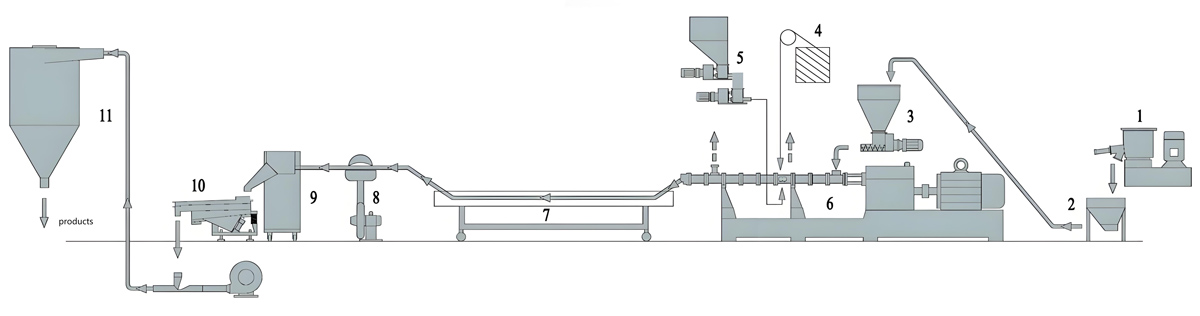
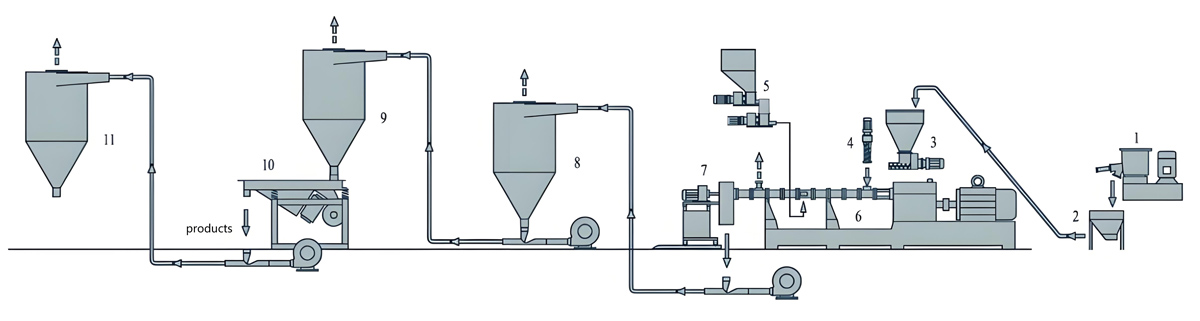
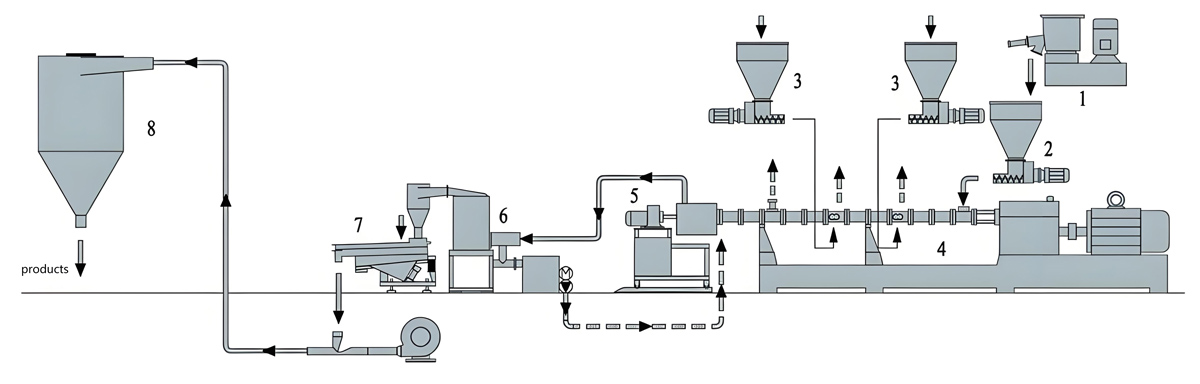
The manufacturing process of HIPS masterbatches using a twin screw extruder involves several sequential steps:
1. Raw Material Preparation: All raw materials (HIPS resin, pigments/additives, processing aids) are dried to remove moisture. Moisture-free materials prevent degradation and ensure smooth extrusion. HIPS is typically dried at 80-100°C for 2-4 hours.
2. Feeding: Materials are fed into the twin screw extruder’s hopper. The feeding system must ensure consistent material flow to maintain throughput. For high capacity production, gravimetric feeders are recommended to precisely control ratios.
3. Extrusion and Melting: The twin screw extruder’s intermeshing screws convey and compress the materials. The screws’ design (e.g., conveying flights, mixing elements) ensures thorough mixing and melting. The temperature profile (zones 1-5) is critical: zone 1 (feed) ~180-200°C, zone 2 ~200-220°C, zone 3 ~220-240°C, zone 4 ~210-230°C, and zone 5 (die) ~200-220°C. This gradual heating melts the HIPS and disperses the additives.
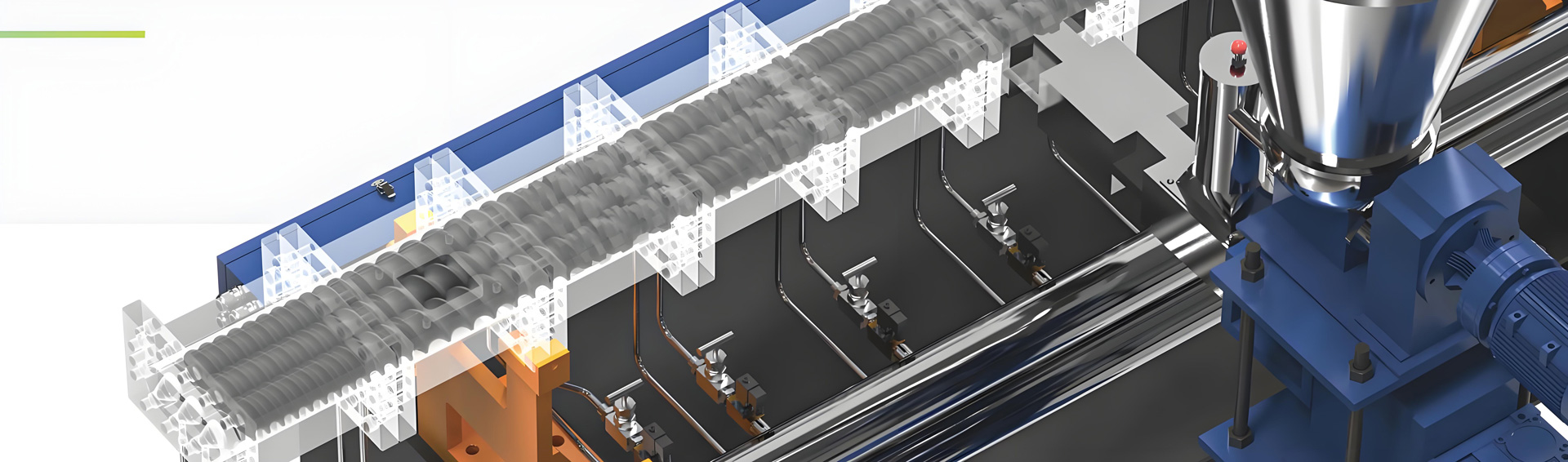
4. Kneading and Dispersion: The twin screws’ kneading blocks and reverse flights create high shear forces, breaking down agglomerates and ensuring uniform dispersion of pigments/additives. This step is vital for achieving a consistent color or additive distribution in the final masterbatch.
5. Cooling and Pelletizing: After extrusion, the molten masterbatch passes through a water bath or air cooling system to solidify. It is then pelletized using a cutting die (e.g., strand cutting or underwater pelletizing) to produce uniform granules. The pellet size is typically 2-4 mm for downstream processing.
6. Drying and Packaging: The final pellets are dried briefly to remove residual moisture and packaged in sealed containers to maintain quality.
4. Production Equipment Introduction (Twin Screw Extruder: Nanjing Kerke KTE Series)
The Nanjing Kerke KTE Series twin screw extruder is a robust, high-performance machine designed for large-scale masterbatch production. Key features include:
Design and Configuration: The KTE Series machines feature co-rotating, intermeshing twin screws with a self-wiping design to prevent material leakage. The screw elements are precision-engineered with conveying, kneading, and mixing segments to optimize material flow and dispersion. The extruder barrel is jacketed for temperature control, with separate heating/cooling zones.
Capacity and Throughput: KTE Series models range from 100 kg/h to 3000 kg/h, depending on the screw diameter (e.g., KTE-65 has a 65 mm screw diameter and a typical throughput of 500-1000 kg/h). This high capacity makes it suitable for continuous large-scale production.
Control System: The extruder is equipped with an intelligent control panel featuring PLC (Programmable Logic Controller) and HMI (Human-Machine Interface). Operators can monitor and adjust parameters like screw speed, temperature, and feed rates in real time, ensuring process stability.
Additional Equipment: To complete the HIPS masterbatch line, auxiliary equipment includes a gravimetric feeder, raw material dryer, cooling system (water bath or air-cooled), pelletizer, and automatic packaging machine. These components work in tandem to ensure seamless production.
5. Parameter Settings
Optimal parameter settings for the Nanjing Kerke KTE Series extruder depend on the formulation and desired output. Key parameters include:
Screw Speed: Typically 200-400 rpm for HIPS masterbatch. Higher speeds increase throughput but may reduce dispersion if not balanced with temperature.
Temperature Profile: As detailed earlier, zone temperatures are set to 180-240°C, with the die temperature slightly lower to prevent premature solidification.
Feed Rate: Gravimetric feeders maintain consistent material flow, with rates adjusted based on screw speed and desired throughput. For a 500 kg/h KTE-65 extruder, feed rates might be 450-550 kg/h of raw materials.
Die Pressure: Maintained at 10-30 MPa to ensure proper extrusion without causing screw damage or material degradation.
Water Cooling: The cooling system should maintain a water temperature of 20-30°C to ensure rapid solidification of the extruded masterbatch strands.
6. Equipment Prices (Twin Screw Extruder in USD: Nanjing Kerke KTE Series)
The price of Nanjing Kerke KTE Series twin screw extruders varies by model and configuration. As of 2024, approximate prices (USD) are:
KTE-65 (500-1000 kg/h): $80,000 – $120,000 (excluding auxiliary equipment like feeders, pelletizers, or dryers). Higher capacity models (e.g., KTE-95, 1500-2000 kg/h) range from $150,000 – $250,000. Custom configurations (e.g., underwater pelletizing systems) may add 10-20% to the base price.
Note: Prices are subject to market fluctuations, regional taxes, and additional equipment costs. For a complete masterbatch production line, including auxiliary equipment, the total investment could range from $150,000 to $500,000 depending on capacity.
7. Common Production Problems and Solutions
Problem 1: Poor Pigment Dispersion
Causes: Inadequate screw mixing, low temperature in dispersion zones, or high pigment loading. Agglomerates may form if pigments are not properly wetted by the carrier resin.
Solutions: Adjust screw configuration to include more mixing elements (e.g., kneading blocks) or increase the number of mixing zones. Optimize temperature settings to ensure the HIPS carrier is fully molten before pigment addition. For high pigment loadings, pre-disperse pigments with a small amount of carrier resin using a high-speed mixer.
Prevention: Use high-quality pigments with low agglomerate content. Pre-blend pigments with a dispersant masterbatch before feeding into the extruder.
Problem 2: Low Throughput
Causes: Clogged feed hopper, worn screw elements, or insufficient heating. Material bridging in the hopper can disrupt flow.
Solutions: Clean the feed system and check for blockages. Replace worn screws or barrels. Verify that all heating zones are functioning and adjust temperatures if material is not melting properly.
Prevention: Regularly inspect the feed system for foreign objects and maintain consistent raw material drying to prevent clumping.
Problem 3: Uneven Color in Final Product
Causes: Inconsistent pigment feeding, temperature fluctuations, or poor screw mixing. Variations in screw speed or feed rate can lead to uneven dispersion.
Solutions: Use gravimetric feeders to ensure precise pigment addition. Calibrate the control system to maintain constant screw speed and temperature. Increase mixing elements in the screw design to improve uniformity.
Prevention: Conduct regular quality checks during production and adjust parameters based on color testing results.
8. Maintenance and Care
Proper maintenance of the Nanjing Kerke KTE Series extruder is critical to ensure long-term reliability and performance:
Screw and Barrel Inspection: Regularly inspect screws and barrels for wear, scoring, or material buildup. Replace worn components promptly to avoid increased energy consumption or product defects.
Lubrication: Lubricate the screw bearings and gearbox according to the manufacturer’s schedule (e.g., every 500 operating hours). Use high-quality lubricants compatible with the machine’s specifications.
Cleaning: Perform thorough cleaning after production to remove residual materials, especially for color or additive changes. Use appropriate cleaning agents (e.g., hot water, cleaning pellets) and avoid aggressive chemicals that may damage the screw/barrel.
Electrical and Control System Checks: Inspect wiring, sensors, and the PLC/HMI system for loose connections or malfunctions. Calibrate temperature sensors and feeders periodically to ensure accuracy.
Documentation: Maintain detailed maintenance logs to track repairs, replacements, and performance metrics. This helps identify recurring issues and plan proactive maintenance.
9. FAQ
Q: What is the difference between single-screw and twin-screw extruders for HIPS masterbatch?
A: Twin-screw extruders offer better mixing, higher throughput, and superior dispersion compared to single-screw models. Their intermeshing screws create intense shear forces, ensuring uniform blending of additives and pigments, which is critical for high-quality masterbatches.
Q: Can Nanjing Kerke KTE Series extruders handle other resins besides HIPS?
A: Yes, the KTE Series can process various resins like ABS, PP, or PE, depending on screw configuration. However, for HIPS masterbatch, the co-rotating design is optimal for HIPS’s specific melting and flow properties.
Q: How long does it take to start production after installing a KTE Series extruder?
A: Installation and commissioning typically take 2-4 weeks, including equipment setup, calibration, and operator training. Regular maintenance and operator proficiency reduce startup time for subsequent batches.
10. Summary
The high capacity twin screw extruder, particularly the Nanjing Kerke KTE Series, is a cornerstone of efficient HIPS masterbatch manufacturing. By precisely controlling formulation ratios, optimizing the production process, and maintaining equipment, manufacturers can achieve high-quality, consistent masterbatches with excellent dispersion and throughput. Proper maintenance, parameter adjustments, and adherence to best practices ensure long-term reliability and profitability in this demanding industry. As technology advances, twin screw extruders continue to evolve, offering even higher efficiency and versatility for HIPS masterbatch production.