Introduction
Styrene Acrylonitrile (SAN) is a rigid, transparent copolymer widely used in packaging, containers, and household goods. SAN masterbatches often require high loadings of pigments, flame retardants, or reinforcing fibers. The high viscosity of SAN, especially when combined with high filler content, necessitates the use of a High Torque twin screw extruder. Standard extruders may stall or fail to generate enough pressure to push the viscous melt through the die. The Nanjing Kerke KTE Series, specifically engineered with high-torque gearboxes and reinforced screw elements, is the ideal solution for these demanding applications. This article details the production nuances of SAN masterbatches, focusing on the mechanical requirements and process control needed for this rigid polymer.
Formulation Ratios (Different Types)
Transparent Color Masterbatch
For general-purpose coloring, the formulation is typically 20% to 40% pigment (high-heat stable organic pigments) and 60% to 80% SAN carrier. Because SAN is rigid, the pigment must be very fine to avoid impacting transparency. Dispersing aids (0.5-1%) are crucial to prevent agglomeration.
Flame Retardant Masterbatch
SAN is flammable and often requires modification. A common formulation includes 50% SAN, 30% Brominated Flame Retardant (BFR) or Phosphorus-based FR, and 20% Synergist (like antimony trioxide or zinc borate). The high loading of solid additives creates a very high-viscosity melt, requiring maximum torque from the extruder.
Glass Fiber Reinforced Masterbatch
For structural applications, long glass fibers (LGF) or short fibers are used. The formulation might be 30% SAN, 60% Glass Fiber (with silane sizing), and 10% Coupling Agent. The presence of long fibers significantly increases the resistance to flow, demanding a high-torque, low-speed extrusion process to prevent fiber breakage and ensure good length retention.
Production Process
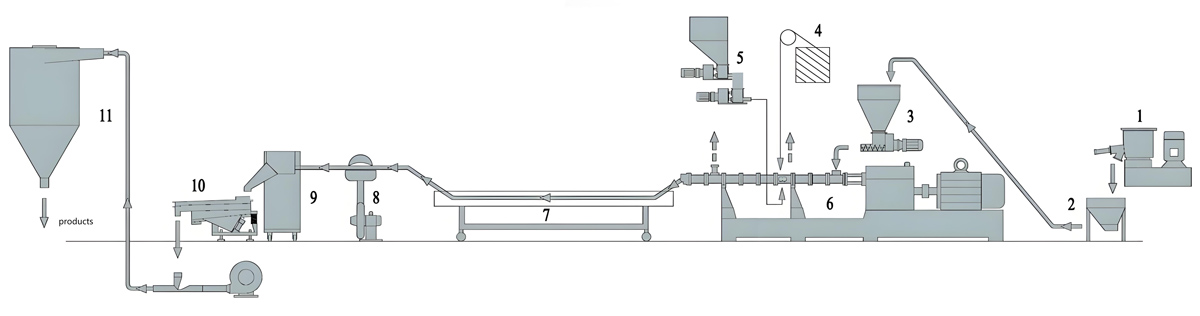
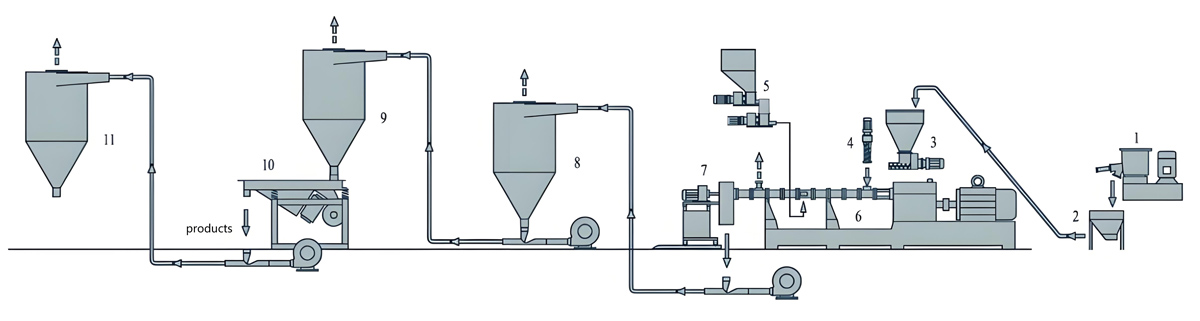
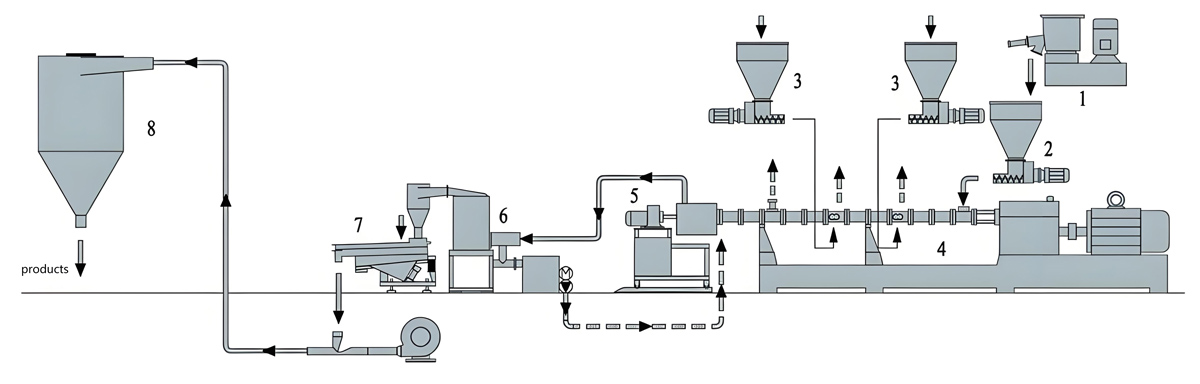
SAN is amorphous and has a relatively high melt viscosity. The production process starts with pre-drying the SAN pellets (moisture < 0.1%) as SAN can hydrolyze, though less severely than PETG. The High Torque KTE extruder is fed via a loss-in-weight system. The screw configuration is critical: it must include high-compression kneading blocks to generate the pressure needed to melt the high-viscosity SAN and incorporate high loadings of additives. The mixing section is intense, often utilizing 90° staggered kneading blocks to distribute fillers effectively. The melt temperature is typically maintained between 220°C and 260°C. After mixing, the melt passes through a back-flush screen changer to handle gels or unmixed fiber bundles. The strands are cooled and pelletized. Special care is taken to minimize “shear heating” which can degrade the styrene component, causing yellowing.
Production Equipment Introduction
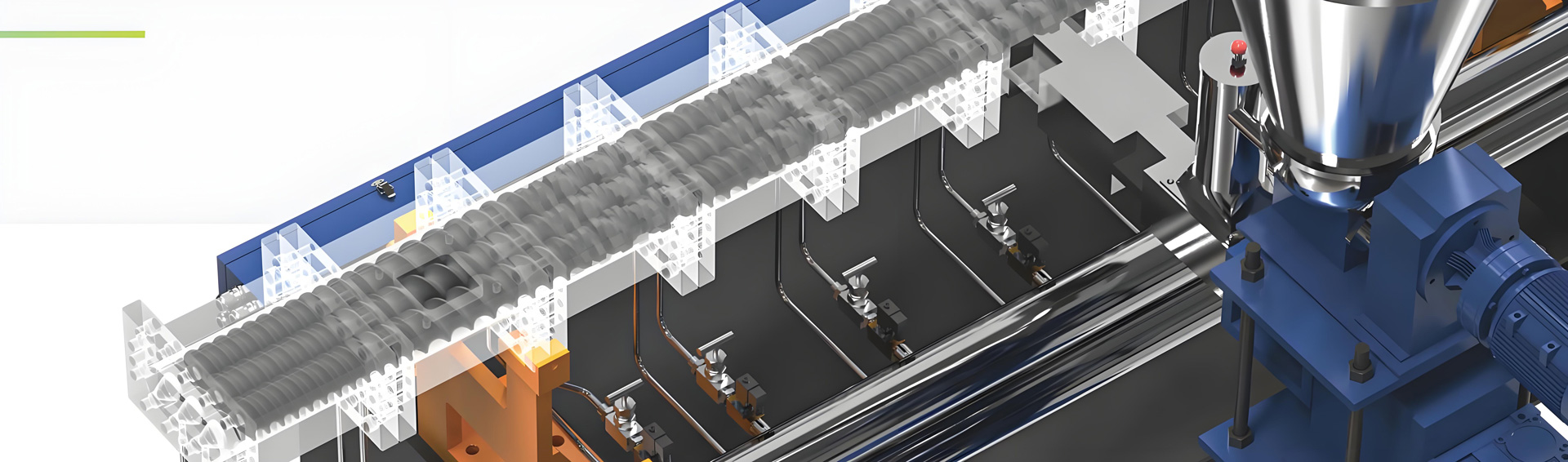
The Nanjing Kerke KTE Series High Torque extruder is designed with a reinforced gearbox capable of delivering specific torque values up to 18 Nm/cm³. The screws are made of high-strength tool steel with deep flights to handle high-viscosity melts without slipping. The barrel has a high number of temperature zones (10-12) to precisely control the thermal profile, preventing localized overheating. The drive motor is typically a high-power AC motor with vector control to maintain constant torque even during voltage fluctuations. For fiber-filled compounds, special screw elements with wide gaps are used to allow fibers to pass through without being cut excessively. The feeding system must be robust, often using side feeders for fillers to prevent bridging in the main hopper.
Parameter Settings
Temperature Profile
SAN requires higher temperatures to melt due to its rigidity. Zone 1-2: 180°C, Zone 3-5: 220°C – 240°C, Zone 6-8 (Mixing): 250°C – 270°C, Die Head: 260°C. Care must be taken not to exceed 280°C to prevent styrene degradation.
Torque and Speed
This is the defining parameter. The extruder should run at a lower speed (200-400 rpm) but at high torque (70-85% of max capacity). High torque ensures the mechanical energy is converted into mixing power rather than just heat. If torque drops, the mixing quality suffers. Screw speed is adjusted to maintain the target torque based on feed rate.
Back Pressure
Sufficient back pressure is needed to compact the melt and ensure good mixing. This is controlled by the screen changer resistance and die design. Typical back pressure ranges from 50 to 100 bar for filled SAN compounds.
Equipment Price
Reference Price for Nanjing Kerke KTE Series (High Torque Application):
- Model KTE-75 (High Torque Gearbox): $210,000 – $250,000 USD. Specific torque rating of 14-16 Nm/cm³.
- Model KTE-95 (Heavy Duty): $310,000 – $380,000 USD. Specific torque rating up to 18 Nm/cm³. Includes reinforced thrust bearing.
Note: The “High Torque” designation refers to the gearbox and motor sizing. Prices include heavy-duty auxiliaries. FOB Nanjing.
Production Problems, Solutions, and Avoidance
Problem: High Power Consumption / Stalling
Cause Analysis: If the formulation viscosity is too high for the screw design, or if the temperature is too low, the motor will draw excessive current. Another cause is the presence of large agglomerates or foreign contaminants that jam the screw elements. For glass fiber compounds, excessive fiber length or loading can cause plugging.
Solution: Increase the barrel temperature in the feeding zone to pre-melt the polymer. Reduce the feed rate to lower the load. Check the screw configuration; if using fibers, ensure the kneading blocks have wide gaps. Inspect the raw materials for oversized particles or contamination. If stalling occurs, immediately stop, reduce torque, and purge with a lower viscosity polymer.
Avoidance Method: Select an extruder with a specific torque rating at least 20% higher than the calculated requirement for the specific compound. Pre-screen fillers to remove oversized particles. Use a side feeder for fillers to introduce them downstream where the polymer is already molten, reducing the torque required in the feeding zone.
Problem: Surface Roughness of Pellets (Melt Fracture)
Cause Analysis: SAN is prone to melt fracture at high shear rates. If the shear stress at the die wall exceeds a critical value, the melt flow becomes turbulent, resulting in a shark-skin or rough surface on the extrudate. This is common when pushing high-viscosity melts through small die openings at high speeds.
Solution: Increase the die temperature to lower melt viscosity. Reduce the extruder speed. Polish the die land to a mirror finish. Use a processing aid (like a fluoropolymer) in small quantities (0.1%) to reduce friction at the die wall.
Avoidance Method: Design the die with a longer land length to reduce shear rate. Operate at the lowest possible speed that still achieves the required output. Avoid sudden changes in flow channel geometry within the die. For very high viscosity grades, consider a gear pump to stabilize pressure before the die, allowing the extruder to focus on mixing while the pump handles pressure generation.
Problem: Dispersion of Flame Retardants
Cause Analysis: Flame retardants like brominated compounds or phosphates are often high-melting solids. If the mixing energy is insufficient, they remain as undispersed particles, leading to “specks” and inconsistent fire performance. SAN’s high viscosity makes it harder to break down these agglomerates.
Solution: Reconfigure the screw to include more intensive kneading blocks in the melting zone. Increase the screw speed to raise shear rate (within limits of degradation). Ensure the additive feeding point is in a high-shear zone. Pre-compound the flame retardant with a carrier wax or low-viscosity polymer before adding to the main extruder.
Avoidance Method: Use nano-sized or coated flame retardants that are easier to disperse. Optimize the screw profile using simulation software before manufacturing the screws. Ensure the vacuum vent (if used for moisture) is not placed too early, as it might remove volatile components of the additive package.
Maintenance
High torque operation puts significant stress on the drive train. Daily checks of the gearbox oil temperature and pressure are mandatory. Weekly inspection of the screw elements for wear is crucial, especially the kneading blocks which experience high shear forces. For SAN, which can leave carbon deposits if degraded, a regular “acid wash” or chemical cleaning of the barrel and screws might be necessary every 3 months. The thrust bearing needs close monitoring; any abnormal noise indicates potential failure. The heating bands should be checked for uniformity, as “hot spots” can degrade the SAN locally.
FAQ
Q: What is the difference between SAN and ABS masterbatch production?
A: ABS contains rubber particles, making it tougher and less viscous than SAN. SAN is rigid and more heat-sensitive. SAN extrusion requires higher torque and more precise temperature control to avoid degradation compared to ABS.
Q: Can the KTE series handle 60% glass fiber loading?
A: Yes, but it requires a special screw design with wide-pitch elements and a high-torque gearbox (specifically the KTE-95 or larger). The output will be significantly lower than unfilled compounds, and the focus is on maintaining fiber length rather than just melting.
Q: Why is torque more important than speed for SAN?
A: For high-viscosity polymers like SAN, the resistance to flow is immense. Speed alone does not guarantee mixing; the force (torque) applied to the material is what breaks down agglomerates and melts the polymer. High torque at moderate speeds is the most efficient way to process SAN masterbatches.
Conclusion
Producing SAN masterbatches, especially with high loadings of fillers or flame retardants, is a mechanically demanding process. The Nanjing Kerke KTE Series High Torque extruder is specifically engineered to handle the high viscosity and shear requirements of SAN. By utilizing a high-torque gearbox, optimized screw geometry, and precise process control, manufacturers can achieve excellent dispersion and high-quality pellets. The key to success lies in matching the machine’s torque capability to the formulation’s viscosity and maintaining strict temperature control to prevent degradation of the styrene matrix. This investment in high-torque technology ensures consistent product quality and the ability to process challenging formulations that standard extruders cannot handle.