1. Introduction
Parallel twin screw extruders are essential equipment in the production of LDPE masterbatches, playing a crucial role in efficiently mixing, melting, and compounding raw materials to create high-quality colorants, additives, and functional masterbatches. LDPE (Low-Density Polyethylene) masterbatches are widely used in plastic processing industries for coloration, anti-aging, UV protection, and other functional enhancements. The parallel twin screw extruder’s design, with intermeshing screws rotating in parallel directions, ensures superior mixing, dispersion, and uniform distribution of additives within the polymer matrix, making it ideal for LDPE masterbatch production.
2. Formulation Ratios (Different Types)
LDPE masterbatch formulations vary based on application requirements, including color, functionality, and performance needs. Key components typically include a carrier resin (LDPE), pigment/dye, additives (stabilizers, dispersants, lubricants), and sometimes processing aids. Common formulation types and their ratios are outlined below:
Color Masterbatch: Consists of LDPE (carrier), pigment (e.g., titanium dioxide, carbon black, organic dyes), and dispersants/lubricants. Typical ratios: LDPE (60-80%), pigment (10-30%), dispersant (5-10%), lubricant (1-5%).
Functional Masterbatch (e.g., UV Stabilization): Includes LDPE (70-90%), UV stabilizers (e.g., hindered amine light stabilizers, benzotriazoles), antioxidants, and processing aids. Ratios: LDPE (75-85%), UV stabilizer (5-15%), antioxidant (1-3%), dispersant (1-5%), lubricant (1-2%).
Anti-blocking Masterbatch: Contains LDPE (80-90%), anti-blocking agents (e.g., silica, talc), slip agents (e.g., erucamide), and dispersants. Ratios: LDPE (85-90%), anti-blocking agent (5-10%), slip agent (1-3%), dispersant (1-5%).
Reinforcement Masterbatch: Used for adding strength or stiffness, combining LDPE (60-75%), reinforcing fillers (e.g., calcium carbonate, glass fibers), and coupling agents. Ratios: LDPE (60-75%), filler (20-40%), coupling agent (1-5%), dispersant (1-5%).
3. Production Process (Detailed)
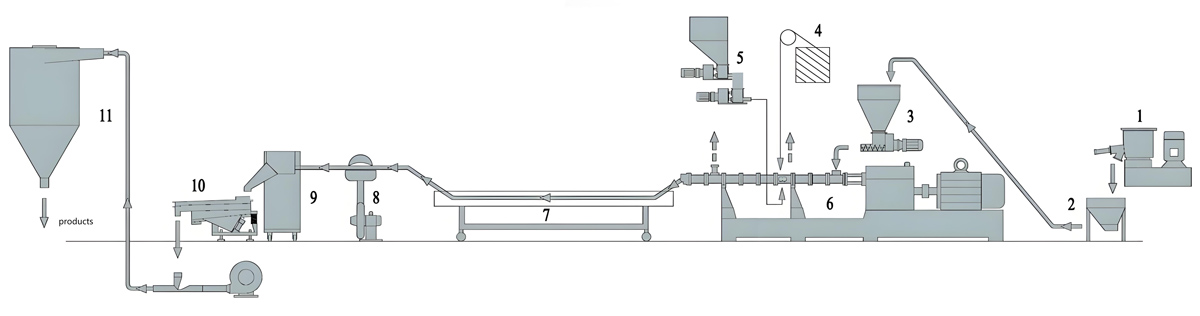
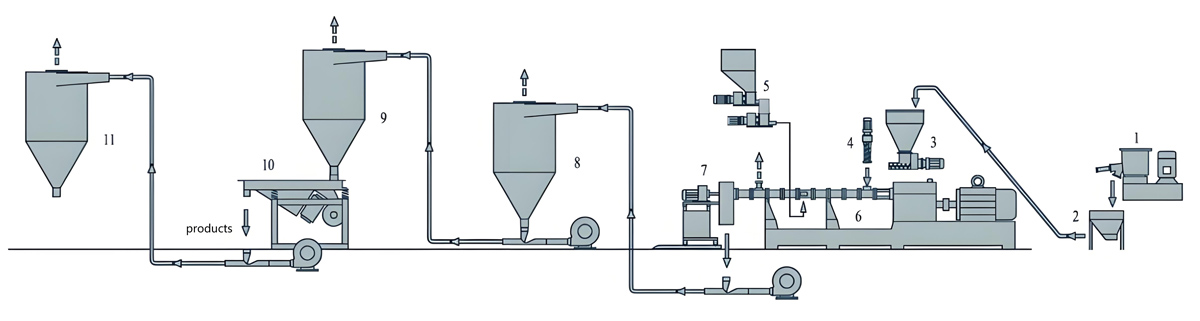
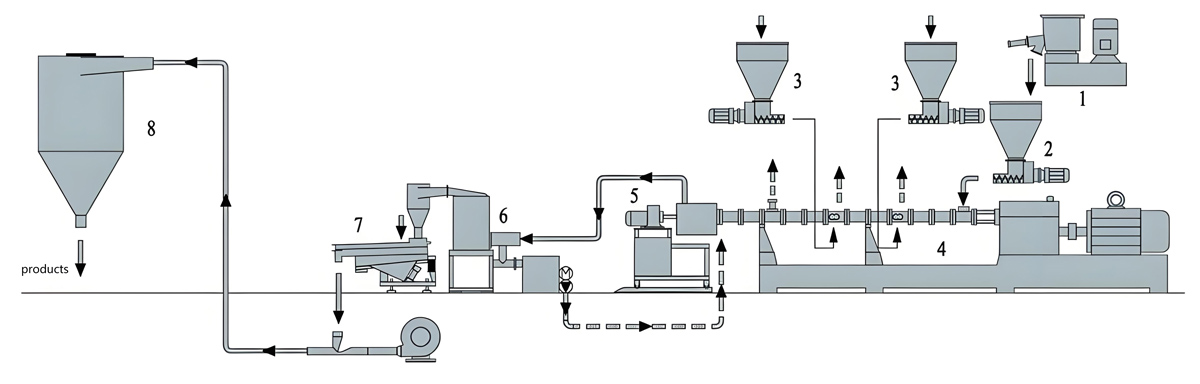
The production of LDPE masterbatches using a parallel twin screw extruder involves several sequential stages to ensure uniform mixing and quality output:
Step 1: Raw Material Preparation
All raw materials (LDPE resin, pigments, additives) are carefully weighed and dried to remove moisture, which prevents steam formation during extrusion and ensures better dispersion. Pigments and fillers are pre-blended with dispersants and lubricants to form a master mix, reducing agglomeration and improving processing efficiency.
Step 2: Feeding
Raw materials are fed into the extruder through a hopper. For parallel twin screw extruders, feeding can be gravity-fed or volumetrically controlled to maintain consistent material flow rates. The feed rate is critical to prevent underfilling or overloading, which affects product quality.
Step 3: Extrusion & Melting
The material enters the extruder’s feeding zone, where the twin screws convey and compress the feedstock. As it moves through the melting section (e.g., Nanjing Kerke KTE Series extruders often feature a segmented barrel with temperature control), the polymer melts due to friction, heat from the barrel heaters, and shear forces generated by the screw flight geometry. The parallel screw configuration ensures thorough mixing and dispersion of additives within the molten LDPE.
Step 4: Mixing & Dispersion
Within the mixing section, the screws’ intermeshing and reverse rotation create high shear forces, breaking down pigment agglomerates and uniformly distributing additives throughout the polymer matrix. The dispersion quality is enhanced by the extruder’s design, which may include mixing elements (e.g., kneading blocks, pin mixing elements) to ensure fine dispersion of fillers and pigments.
Step 5: Filtration & Degassing
To remove impurities and volatile byproducts, the extrudate passes through a screen pack (filter) and degassing section (if required). The screen pack removes foreign particles, while the degassing vent removes moisture or volatile additives, ensuring a clean, homogeneous product.
Step 6: Pelletizing
The molten compound exits the extruder through a die, forming a continuous strand. This strand is cooled in a water bath, then cut into uniform pellets using a pelletizer. Pellets are dried again to remove residual moisture before packaging.
Step 7: Quality Control
Final quality checks include color consistency, melt flow index (MFI), particle size distribution, and mechanical properties. Samples are tested for dispersion, tensile strength, and thermal stability to ensure compliance with application standards.
4. Production Equipment Introduction (for Twin Screw Extruder, use Nanjing Kerke KTE Series machines)
The Nanjing Kerke KTE Series parallel twin screw extruder is a robust, high-performance machine tailored for LDPE masterbatch production. Its design and features are optimized for efficiency, mixing, and durability:
Key Components of Nanjing Kerke KTE Series Extruder
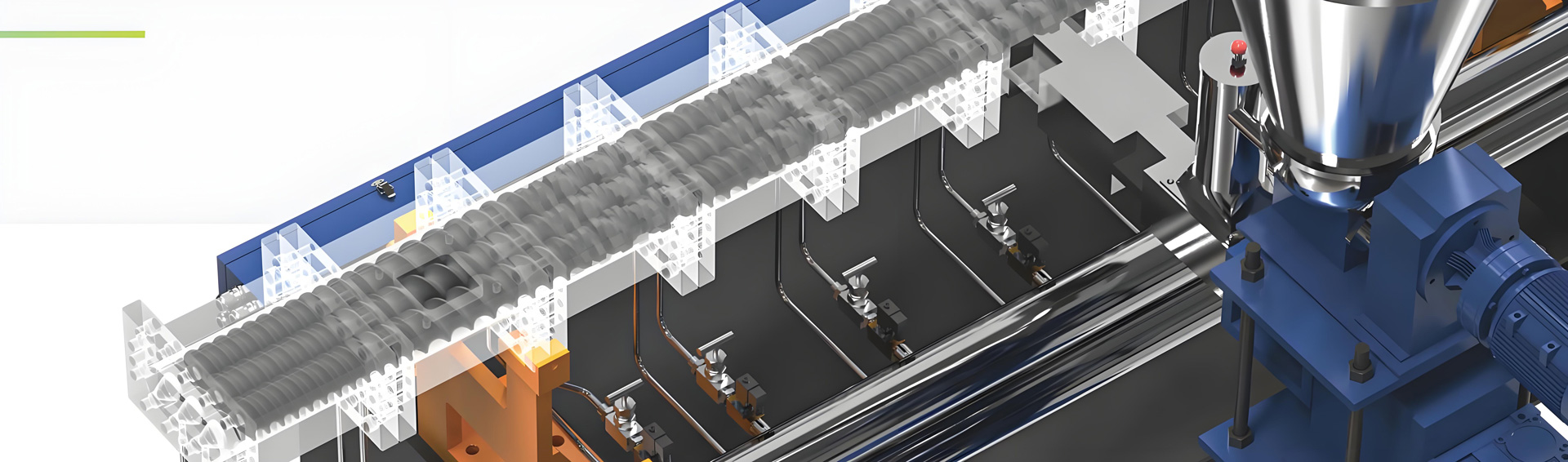
Barrel & Screw Configuration: The extruder features a modular, segmented barrel with precise temperature control zones (typically 5-10 zones) to maintain uniform melting and processing temperatures. The screw design includes conveying flights, mixing elements (e.g., kneading blocks, forward/backward elements), and metering sections. For LDPE masterbatch, the screw profile is optimized for high shear mixing and dispersion, ensuring thorough blending of additives.
Feeding System: Equipped with a gravity hopper and optional side feeders for precise material addition. The feed rate is adjustable to match production capacity and material flow requirements.
Heating & Cooling: Barrel heaters use PID-controlled electric heating elements, while cooling systems (water jackets or air-cooled sections) maintain temperature stability. Temperature zones are independently controlled to prevent overheating and ensure uniform melting.
Extrusion Die: A custom-designed die plate with a consistent flow channel ensures uniform extrudate diameter and thickness, which is critical for pelletizing consistency. The die can be adapted for different pellet sizes (e.g., 3-5mm diameter).
Electrical & Control System: Features a PLC-based control system with HMI (Human-Machine Interface) for real-time monitoring of parameters like screw speed, temperature, torque, and throughput. This allows operators to adjust settings dynamically and optimize production.
Additional Equipment: Paired with auxiliary systems such as a material dryer, pelletizer, cooling water system, and vacuum degassing unit (for moisture removal). These systems work in tandem with the extruder to ensure a seamless production process.
5. Parameter Settings
Parameter settings for the Nanjing Kerke KTE Series extruder depend on formulation, production capacity, and desired output quality. Below are typical recommended settings for LDPE masterbatch production:
General Parameters (KTE Series, e.g., KTE-65/132)
Screw Speed: 100-300 rpm (adjusted based on formulation; higher speeds for high-shear mixing, lower speeds for viscous materials). For color masterbatch, 150-250 rpm is common; for functional masterbatch, 100-200 rpm may be optimal.
Barrel Temperature Profile: Zones 1-2 (feeding): 150-170°C (to prevent material bridging); Zones 3-5 (melting): 170-190°C (LDPE melts at ~115-135°C, so temperature is set to ensure complete melting); Zones 6-10 (mixing/die): 180-200°C (maintain molten state for extrusion). Note: Temperatures may vary based on screw design and raw material properties.
Torque: 20-40% of maximum torque (indicates optimal load; excessive torque may signal overloading or poor flow). For LDPE masterbatch, typical torque ranges from 25-35% for stable operation.
Throughput: Depends on screw diameter (e.g., KTE-65 has a typical throughput of 50-200 kg/h for color masterbatch; larger models like KTE-90 can reach 150-350 kg/h). Throughput is adjusted by screw speed and feed rate.
Die Temperature: 180-200°C (maintain molten polymer flow through the die for uniform strand formation).
Pelletizer Speed: Matches the extruder’s output; typically 1000-3000 rpm, adjusted to produce uniform 3-5mm pellets.
6. Equipment Prices (Twin Screw Extruder in USD using Nanjing Kerke KTE Series)
Prices for Nanjing Kerke KTE Series parallel twin screw extruders vary based on model size, specifications, and optional features. Below are approximate USD prices for common LDPE masterbatch production models:
KTE-65 (65mm Screw Diameter):
Standard model (basic configuration): $80,000 – $120,000
With auxiliary systems (hopper, die, pelletizer, cooling): $120,000 – $180,000
KTE-75 (75mm Screw Diameter):
Standard model: $120,000 – $180,000
With full automation and high-precision controls: $180,000 – $250,000
KTE-90 (90mm Screw Diameter):
High-production model: $200,000 – $300,000
Customized for high-throughput (300+ kg/h): $300,000 – $450,000
Note: Prices exclude installation, shipping, and additional accessories (e.g., color measurement systems, advanced filtration). Higher prices reflect larger screw diameters, increased torque, and enhanced automation features.
7. Common Production Problems and Solutions (Detailed)
During LDPE masterbatch production, several challenges may arise. Below are common issues, their causes, solutions, and prevention measures:
Problem 1: Poor Pigment Dispersion
Causes: Agglomerated pigments, insufficient shear mixing, low screw speed, or improper feeding rate.
Solutions:
1. Pre-blend pigments with dispersants (e.g., EBS, PE wax) to break agglomerates.
2. Increase screw speed (within torque limits) to enhance shear forces.
3. Adjust barrel temperature profile to ensure complete melting before mixing.
4. Use a screen pack with finer mesh (e.g., 200-300 mesh) to filter out large agglomerates.
Prevention: Dry all raw materials, pre-blend pigments with carriers, and maintain consistent feed rates.
Problem 2: Uneven Color Distribution
Causes: Inconsistent feeding of pigments, poor mixing elements in the screw design, or temperature fluctuations.
Solutions:
1. Use volumetric feeders for precise pigment addition.
2. Modify screw configuration to include more mixing elements (e.g., kneading blocks) for better dispersion.
3. Calibrate temperature zones to ensure uniform melting and mixing.
Prevention: Regularly clean the extruder to prevent residue buildup, and maintain consistent raw material quality.
Problem 3: Extrudate Swelling or Surface Irregularities
Causes: Excessive die pressure, incorrect die temperature, or poor material flow.
Solutions:
1. Reduce screw speed to lower die pressure.
2. Adjust die temperature to ensure uniform cooling of the extrudate.
3. Check for screen blockages and clean the die regularly.
Prevention: Monitor die pressure during operation and maintain optimal screw speed for consistent throughput.
Problem 4: Pellet Contamination
Causes: Foreign particles in raw materials, screen pack failure, or die wear.
Solutions:
1. Use a pre-filter system (e.g., magnetic separator) to remove metal particles.
2. Replace screen packs regularly (e.g., every 2-4 hours of continuous operation).
3. Inspect and replace worn die plates.
Prevention: Conduct raw material quality checks, use clean production environments, and maintain equipment cleanliness.
8. Maintenance and Care
Regular maintenance ensures the Nanjing Kerke KTE Series extruder operates efficiently and extends its lifespan. Key maintenance practices include:
Daily Maintenance:
1. Clean the hopper and feeding system to remove residual material.
2. Check screw speed, torque, and temperature readings for anomalies.
3. Verify lubrication levels in gearboxes and bearings.
Weekly Maintenance:
1. Disassemble and clean the screen pack and filter system.
2. Inspect screws and barrels for wear, especially mixing zones.
3. Lubricate moving parts (e.g., gearbox, bearings) as per manufacturer guidelines.
Monthly Maintenance:
1. Replace worn screen packs and filters.
2. Check barrel heater elements for damage and test temperature control accuracy.
3. Verify die plate condition and replace if necessary.
Annual Maintenance:
1. Perform a comprehensive inspection of the screw and barrel for wear patterns.
2. Replace seals, bearings, and gaskets to prevent leaks.
3. Calibrate all control systems (PLC, HMI) to ensure precision.
Lubrication: Use high-quality gear oil (e.g., ISO VG 100) for gearboxes and lithium-based grease for bearings, following the manufacturer’s specifications.
9. FAQ
Q1: What is the minimum LDPE masterbatch production capacity for a Nanjing Kerke KTE Series extruder?
A1: The smallest KTE model (KTE-50) can produce as low as 20-50 kg/h, while larger models like KTE-90 can reach 300+ kg/h.
Q2: Can the extruder handle both color and functional masterbatches?
A2: Yes, the parallel twin screw design allows for versatile formulations. Adjust screw configuration and process parameters based on the masterbatch type.
Q3: How often should the screen pack be changed?
A3: Screen pack replacement frequency depends on raw material quality and production load, typically every 2-8 hours for continuous operation.
Q4: What is the expected lifespan of a Nanjing Kerke KTE Series extruder?
A4: With proper maintenance, the extruder can last 10-15 years, with screws and barrels lasting 5-8 years under normal operating conditions.
10. Summary
The parallel twin screw extruder, particularly the Nanjing Kerke KTE Series, is a cornerstone of LDPE masterbatch production, offering superior mixing, dispersion, and efficiency. By carefully formulating raw materials, optimizing process parameters, and implementing rigorous maintenance, manufacturers can produce high-quality masterbatches for diverse applications. Key advantages include uniform additive distribution, consistent coloration, and enhanced product performance. As the plastic processing industry evolves, the demand for advanced masterbatches will drive further innovations in extruder design, emphasizing automation, energy efficiency, and eco-friendly formulations. With proper equipment selection and operational expertise, LDPE masterbatch production using parallel twin screw extruders remains a reliable and cost-effective solution for coloration and functional enhancement in plastics.