Introduction
PBT (Polybutylene terephthalate) is a high-performance engineering plastic with excellent mechanical properties, electrical insulation, and chemical corrosion resistance. PBT masterbatch is a granular product made by uniformly dispersing high-concentration pigments or additives in PBT carrier resin, which is widely used in automotive, electronics, electrical and other fields. Stainless steel twin screw extruder is the core equipment for producing PBT masterbatch. It has excellent mixing performance, high output and good adaptability, which can meet different formula and process requirements.
Formula ratio (different types of formula ratios)
The formula ratio of PBT masterbatch mainly depends on the type and concentration of pigments, the type and performance of carrier resin, and the requirements of the final product. The following are the formula ratios of several common types of PBT masterbatch:
1. General color PBT masterbatch: The pigment content is generally 20% – 50%, and the carrier resin content is 50% – 80%. For example, the formula ratio of black PBT masterbatch may be 30% carbon black and 70% PBT resin; the formula ratio of red PBT masterbatch may be 25% red organic pigment and 75% PBT resin.
2. High-concentration PBT masterbatch: The pigment content can be as high as 60% – 80%, and the carrier resin content is 20% – 40%. This kind of masterbatch is suitable for occasions with high requirements for color concentration, which can reduce the amount of masterbatch added and reduce production costs.
3. Functional PBT masterbatch: In addition to pigments and carrier resins, various functional additives such as antioxidants, light stabilizers, flame retardants, etc. are added. The formula ratio is determined according to functional requirements. For example, the formula ratio of anti-ultraviolet PBT masterbatch may be 20% pigment, 75% PBT resin, and 5% ultraviolet absorber.
Production process
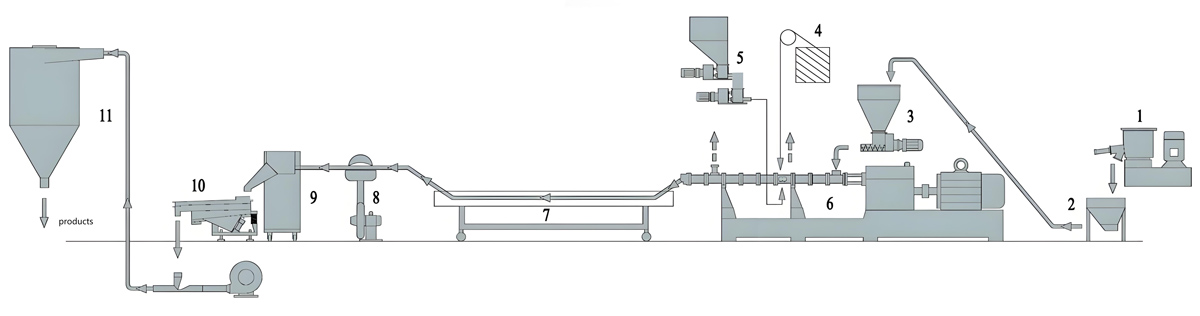
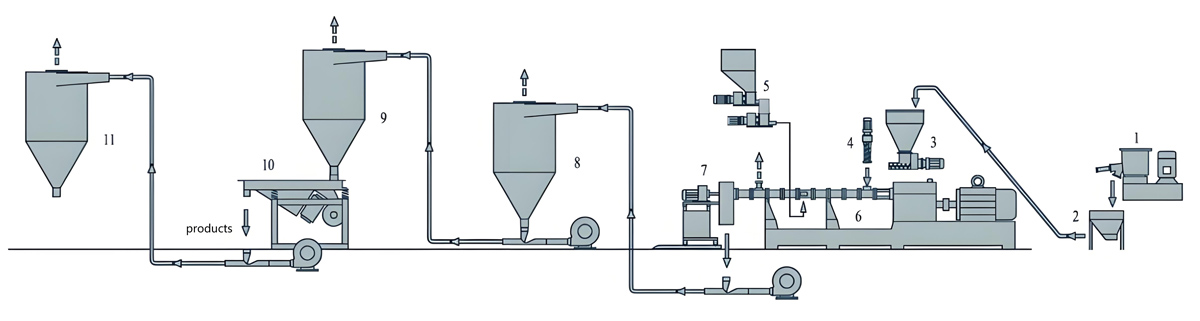
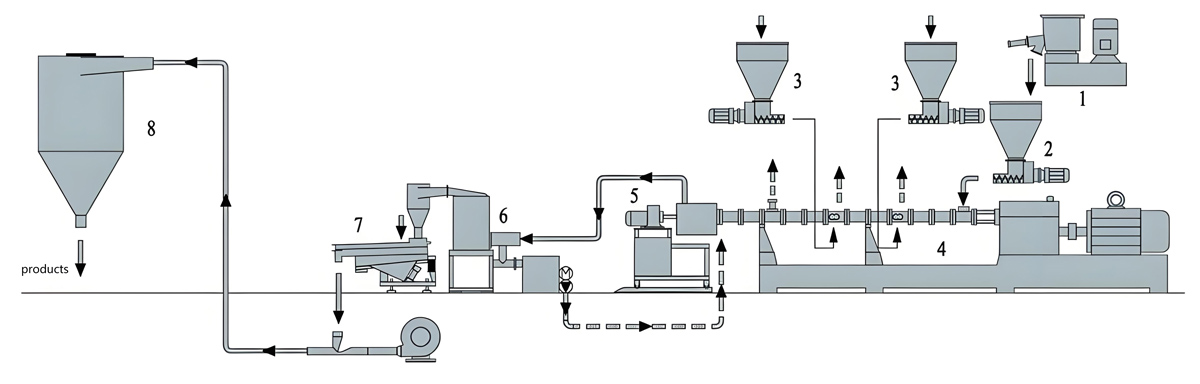
The production process of PBT masterbatch mainly includes raw material pretreatment, metering and mixing, melting and plasticizing, extrusion and granulation, and post-treatment. The following is the detailed production process:
1. Raw material pretreatment
– Resin drying: PBT resin has a certain hygroscopicity, so it needs to be dried before processing to remove moisture and avoid defects such as bubbles and silver streaks during extrusion. The drying temperature is generally 120°C – 140°C, and the drying time is 4 – 6 hours.
– Pigment pretreatment: For some difficult-to-disperse pigments, such as carbon black and titanium dioxide, pretreatment is required to improve their dispersibility. Pretreatment methods include grinding, surface modification, etc.
– Additive premixing: Mix various functional additives with a small amount of carrier resin to ensure that the additives are uniformly dispersed in the masterbatch.
2. Metering and mixing
– Cooperation between main feeding and side feeding: Resin (main component) is added from the main feeding port, while fibers and high-melting-point additives (such as flame retardants) are usually added from the side feeding port to avoid the fibers being broken due to too long shearing time and losing the reinforcing effect.
– Control of mixing time: The mixing time of the high-speed mixer (rotating speed 800 – 1500rpm) is generally controlled at 5 – 8 minutes. If the time is too short, the components will be unevenly dispersed; if the time is too long, some additives may decompose due to frictional heat.
3. Melting and plasticizing
– Screw combination: Different screw elements are selected according to the material properties. For example, for filling modification (adding calcium carbonate), strong shear kneading blocks (staggered angle 30° – 45°) are required; for elastomer toughening (adding POE), weak shear conveying blocks (staggered angle 60° – 90°) are needed to avoid excessive fragmentation of the elastomer.
– Temperature distribution: From the feeding section to the die head, the temperature generally shows a “low – high – low” distribution. The temperature of the feeding section (zone 1) is relatively low (10 – 20°C lower than the melting point of the resin) to prevent the material from melting prematurely and “bridging”; the temperature of the compression section (zones 2 and 3) rises above the melting point (such as 240°C – 260°C for PBT) to ensure sufficient melting; the temperature of the homogenization section (zones 4 and 5) is slightly lower (5 – 10°C lower than the compression section) to avoid material degradation due to excessive heating.
– Screw speed: The higher the screw speed, the stronger the shear force and the more uniform the mixing, but the shorter the material residence time (usually 30 – 90 seconds for twin screw extruders). Generally, the screw speed is controlled between 300 – 600rpm, and the specific speed is adjusted according to the material properties and formula requirements.
4. Extrusion and granulation
– Underwater cutting: Suitable for high-viscosity and sticky materials (such as PBT). The die surface is directly immersed in warm water (water temperature 50 – 80°C), and the cutter rotates at a high speed (300 – 1000rpm). The particles are cooled and formed in water, with a smooth and burr-free surface. However, the equipment cost is high, and the water temperature needs to be strictly controlled. If the water temperature is too low, the particles are prone to cracking; if the water temperature is too high, the particles are prone to adhesion.
– Air-cooled strand cutting: Suitable for low-viscosity and tough materials (such as PP and PE). After the material is extruded into strands, it is first solidified through a cooling water tank (water temperature 15 – 25°C), and then guided into the cutter (rotating speed 50 – 200rpm) by a traction machine. When operating, attention should be paid to the “strand pulling speed”. If the speed is too fast, the strands are easy to be pulled thin or even broken; if the speed is too slow, the strands will accumulate, resulting in uneven particle size.
5. Post-treatment
– Drying and dewatering: The particles from underwater cutting have water attached to the surface, which needs to be dried by a centrifugal dryer (rotating speed 1000 – 2000rpm) or a fluidized bed dryer (inlet air temperature 60 – 80°C). If moisture remains, the particles are prone to caking during storage and will produce “water marks” during injection molding.
– Screening and classification: Remove oversized or undersized particles through a vibrating screen (screen mesh size 10 – 20 mesh) to ensure uniform particle size.
Introduction to production equipment
1. Twin screw extruder
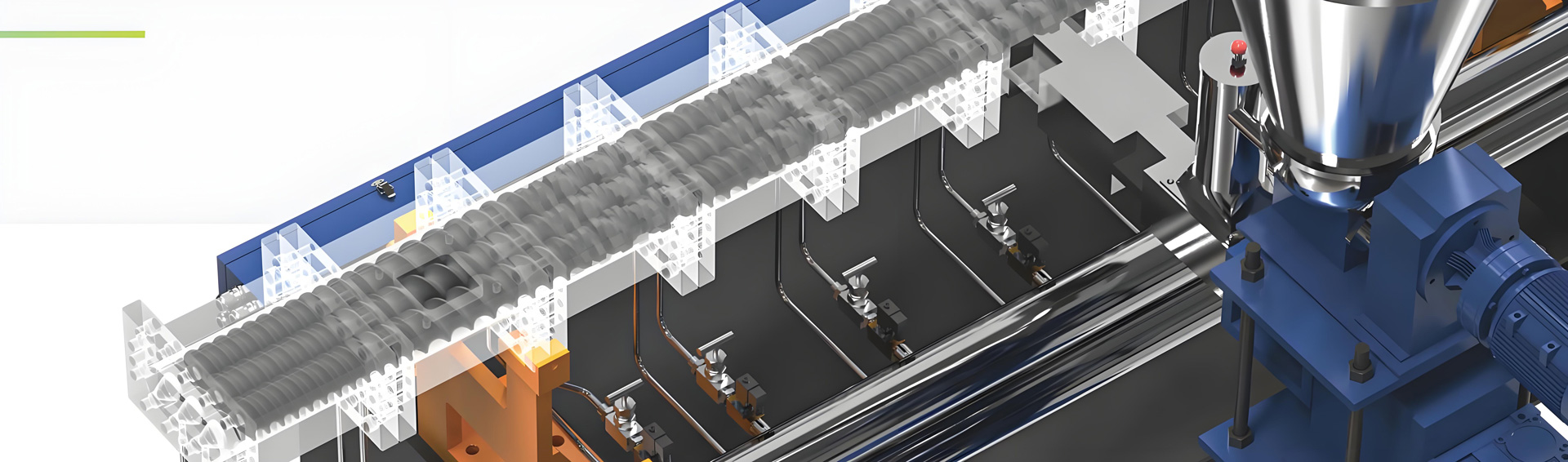
The KTE series parallel co-rotating twin screw extruder units of Nanjing Kerke Extrusion Equipment Co., Ltd. are ideal equipment for producing PBT masterbatch. This series of extruders adopts a modular design. According to the processing material system and process formula, the length-to-diameter ratio, barrel structure, screw arrangement, screw and barrel material, feeding method, exhaust position and number, electrical control method, etc. can be reasonably designed to realize multi-functional and multi-purpose processing of polymer materials.
– Main technical parameters: Taking KTE – 65B as an example, the screw diameter is 62.4mm, the length-to-diameter ratio is 28 – 60, the screw speed is 400 – 600rpm, the motor power is 90 – 110kW, and the output is 200 – 500kg/h.
– Features: It has excellent mixing performance, which can uniformly disperse pigments and additives in the carrier resin; high output, meeting the needs of large-scale production; good adaptability, which can process different types of PBT masterbatch formulas; easy to operate and maintain.
2. Other machinery
– High-speed mixer: Used for premixing raw materials to ensure uniform dispersion of each component.
– Drying equipment: Such as vacuum dryer, fluidized bed dryer, etc., used to remove moisture from raw materials.
– Cutter: Cut the extruded material into uniform particles. There are different types such as underwater cutter and air-cooled strand cutter.
– Vibrating screen: Used for screening and classification to remove unqualified particles.
Parameter setting
1. Temperature setting: According to the melting point of PBT resin, the heat resistance of pigments and process requirements, the temperature of each section is reasonably set. Generally, the temperature of the feeding section is 220°C – 230°C, the temperature of the compression section is 240°C – 260°C, the temperature of the homogenization section is 230°C – 250°C, and the temperature of the die head is 230°C – 240°C.
2. Screw speed setting: According to the viscosity, formula and output requirements of the material, set the appropriate screw speed. Generally, it is adjusted between 300 – 600rpm.
3. Feeding speed setting: According to the screw speed and output requirements, adjust the feeding speed to ensure that the material enters the extruder uniformly and stably.
4. Vacuum degree setting: During the extrusion process, turn on the exhaust system and set the appropriate vacuum degree to remove volatile substances and moisture in the material and improve the product quality. The vacuum degree is generally 0.06 – 0.09MPa.
Equipment price
The price of the KTE series twin screw extruders of Nanjing Kerke Extrusion Equipment Co., Ltd. varies according to the model and configuration. The following are the reference prices of some models:
1. KTE – 20B: The price is between 18,000 – 22,000 US dollars.
2. KTE – 36B: The price is between 42,600 – 45,000 US dollars.
3. KTE – 65B: The price is between 45,000 – 55,000 US dollars.
4. KTE – 75B: The price is between 60,000 – 100,000 US dollars.
The prices of other machinery vary greatly due to different brands, models and configurations. The specific price needs to be consulted according to the actual demand.
Problems that may occur during the production process and their solutions and prevention methods
1. Problem: Bubbles appear during extrusion
– Cause analysis: It is mainly due to the moisture or volatile substances contained in the raw materials, which evaporate when heated during extrusion to form bubbles; it may also be due to poor exhaust of the extruder, resulting in the inability to discharge volatile substances in time.
– Solution: Fully dry the raw materials to ensure that the moisture content is less than 0.1%; check the exhaust system to ensure smooth exhaust and appropriately increase the vacuum degree.
– Prevention method: Strictly control the drying process of raw materials, regularly check the working status of the exhaust system, and clean up the blockages at the exhaust port in time.
2. Problem: Uneven color of masterbatch
– Cause analysis: Poor pigment dispersion may be caused by insufficient pigment pretreatment, insufficient mixing time, unreasonable screw combination, etc.; it may also be due to uneven feeding, resulting in uneven distribution of pigments in the material.
– Solution: Fully pretreat the pigments, such as grinding and surface modification; extend the mixing time to ensure uniform dispersion of pigments; adjust the screw combination to increase the shearing and mixing effect; check the feeding system to ensure uniform and stable feeding.
– Prevention method: Choose pigments with good quality and dispersibility; strictly follow the process requirements for mixing and extrusion operations; regularly check the operation of the feeding system and adjust the feeding speed in time.
3. Problem: Low output of extruder
– Cause analysis: It may be due to too low screw speed, too slow feeding speed, high material viscosity, etc.; it may also be due to serious wear of the extruder screw, resulting in reduced conveying efficiency.
– Solution: Appropriately increase the screw speed and feeding speed; adjust the formula to reduce the material viscosity; check the wear of the screw and replace the seriously worn screw in time.
– Prevention method: Reasonably set the screw speed and feeding speed according to the material properties and process requirements; regularly maintain the extruder and replace the worn parts in time.
4. Problem: Rough surface of extruded strands
– Cause analysis: It may be due to too high extrusion temperature, resulting in material degradation; it may also be due to unreasonable screw combination, excessive shearing, resulting in material decomposition; it may also be due to die head blockage, resulting in poor material extrusion.
– Solution: Reduce the extrusion temperature to avoid material degradation; adjust the screw combination to reduce the shearing and mixing intensity; clean the die head to ensure smooth die head.
– Prevention method: Strictly control the extrusion temperature to avoid too high temperature; choose the appropriate screw combination according to the material properties; regularly clean the die head to prevent die head blockage.
Maintenance
1. Daily maintenance
– Clean the equipment: After daily production, clean the surface and interior of the extruder, mixer, cutter and other equipment in time to remove residual materials and impurities.
– Check the equipment: Check the various components of the equipment, such as the screw, barrel, feeding system, cutting system, etc., to ensure their normal operation; check the electrical system, hydraulic system, etc., to ensure their firm connection and no leakage.
– Lubricate the equipment: According to the requirements of the equipment manual, regularly lubricate the various lubrication points of the equipment to ensure the flexible operation of the moving parts of the equipment.
2. Regular maintenance
– Weekly maintenance: Check the transmission system of the equipment, such as the gearbox, pulley, etc., to ensure their normal operation; clean the filter to prevent blockage.
– Monthly maintenance: Check the seals of the equipment, such as sealing rings, gaskets, etc., and replace them in case of damage; check the cooling system of the equipment to ensure its normal operation.
– Quarterly maintenance: Conduct a comprehensive inspection and adjustment of the various components of the equipment, such as the screw clearance, cutter clearance of the cutter, etc.; conduct an insulation test on the electrical system to ensure its safety and reliability.
– Annual maintenance: Conduct a comprehensive disassembly, cleaning and overhaul of the equipment, replace the seriously worn parts; conduct a performance test on the equipment to ensure that its various indicators meet the requirements.
FAQ
1. Q: What is the shelf life of PBT masterbatch?
A: Under dry and sealed conditions, the shelf life of PBT masterbatch is generally 12 – 24 months. After the shelf life, the performance of the masterbatch may decline, so it is recommended to use it within the shelf life.
2. Q: How to choose the appropriate PBT masterbatch formula?
A: Choosing the appropriate PBT masterbatch formula needs to consider many factors, such as the type and concentration of pigments, the type and performance of carrier resin, the requirements of the final product, etc. It is recommended to conduct sufficient tests and evaluations before choosing the formula to ensure the rationality and feasibility of the formula.
3. Q: What should I do if there is color difference during the injection molding of PBT masterbatch?
A: First, check the quality of the masterbatch to ensure its uniform color; check the injection molding process parameters, such as temperature, pressure, injection speed, etc., to ensure their stability and rationality; check the injection mold to ensure its cleanliness and no impurities. If the color difference problem still exists, it may be necessary to adjust the formula of the masterbatch or replace the masterbatch.
4. Q: How to improve the dispersibility of PBT masterbatch?
A: The following measures can be taken to improve the dispersibility of PBT masterbatch: choose pigments with good quality and dispersibility; fully pretreat the pigments, such as grinding and surface modification; optimize the mixing process, extend the mixing time and improve the mixing effect; adjust the screw combination to increase the shearing and mixing intensity.
Summary
Stainless steel twin screw extruder plays an important role in the production of PBT masterbatch. Its excellent performance can meet different formula and process requirements, and produce high-quality PBT masterbatch. During the production process, it is necessary to strictly control the formula ratio, production process and equipment parameters, strengthen the maintenance of the equipment, and solve the problems that occur during the production process in time to ensure the smooth progress of production and the stability of product quality. At the same time, continuously optimize the production process and formula, improve production efficiency and product performance, and meet the growing market demand for PBT masterbatch.