Introduction
Polyamide (PA) masterbatch production requires precise control over processing parameters to ensure consistent quality and performance. The variable speed twin screw extruder has emerged as the industry standard for PA masterbatch manufacturing, offering unparalleled flexibility and efficiency. This comprehensive guide explores the key aspects of using variable speed twin screw extruders for PA masterbatch production, with a focus on the advanced KTE Series from Nanjing Kerke Extrusion Equipment.
Nanjing Kerke Extrusion Equipment has established itself as a leading manufacturer of high-performance extrusion solutions since 2009. The company’s KTE Series variable speed twin screw extruders combine innovative design with robust construction to deliver exceptional results in PA masterbatch production.
Formulation Ratios for PA Masterbatch
The formulation of PA masterbatch varies depending on the specific application requirements. Here are the most common types of PA masterbatch formulations:
Color Masterbatch
- PA carrier resin: 70-85%
- Pigment: 10-25%
- Dispersant: 2-5%
- Processing aids: 1-3%
Functional Masterbatch
- PA carrier resin: 60-80%
- Functional additives: 15-35%
- Dispersant: 2-5%
- Stabilizers: 1-3%
Glass Fiber Reinforced Masterbatch
- PA carrier resin: 50-70%
- Glass fiber: 25-45%
- Coupling agent: 1-3%
- Processing aids: 1-2%
Production Process for PA Masterbatch
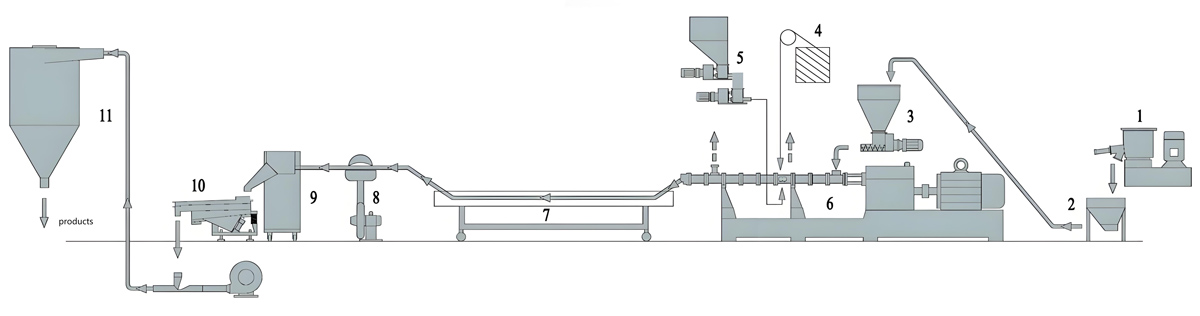
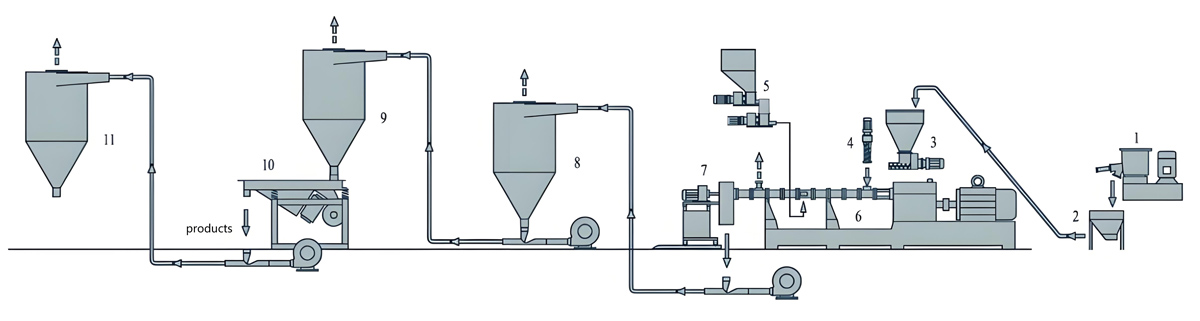
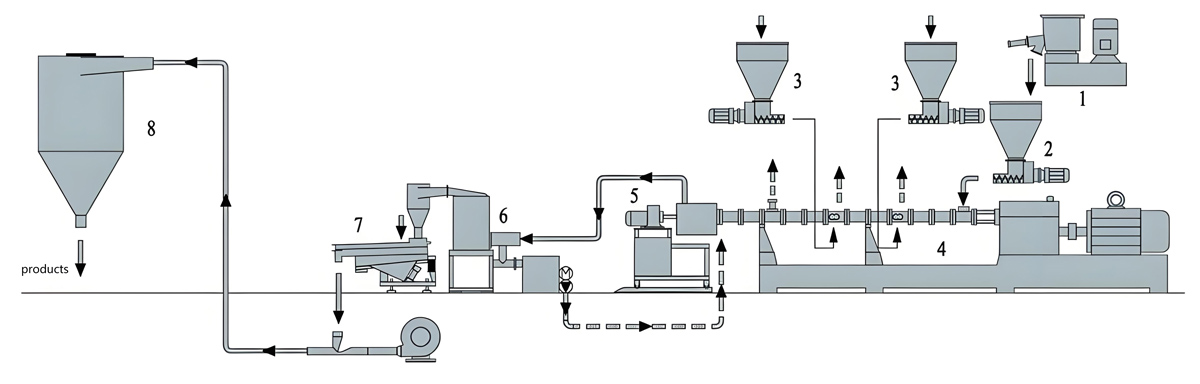
The production of PA masterbatch involves several critical stages that must be carefully controlled to ensure optimal results:
1. Raw Material Preparation
All raw materials must be thoroughly dried before processing to prevent moisture-related defects. PA resins typically require drying at 80-100°C for 4-6 hours to achieve moisture content below 0.02%.
2. Weighing and Pre-blending
Precision weighing is essential to maintain consistent formulation ratios. High-precision dosing systems measure ingredients down to grams, ensuring accurate batch-to-batch consistency. Pre-mixing is carried out in high-speed mixers to distribute pigments and additives evenly throughout the carrier resin.
3. Extrusion and Compounding
The pre-blended mixture is fed into the variable speed twin screw extruder. Inside the extruder, temperatures ranging from 220-280°C melt the resin while intense shear forces disperse pigments at the microscopic level. The variable speed feature allows operators to optimize screw speed for different formulations, ensuring ideal mixing and processing conditions.
4. Cooling
The molten masterbatch exits the extruder as hot strands and is cooled using either a water bath or air cooling system. Water bath cooling is the most common method, providing rapid and uniform cooling to solidify the strands.
5. Pelletization
After cooling, the hardened strands are cut into small, uniform pellets using strand pelletizers. The resulting pellets typically measure 2-5 mm in diameter, making them easy to handle and dose during subsequent processing.
6. Quality Control and Testing
Rigorous quality control measures ensure consistent product quality:
- Color measurement using spectrophotometers to verify shade accuracy
- Dispersion analysis under microscopes to check pigment particle size distribution
- Melt Flow Index (MFI) testing to ensure consistent processing behavior
- Thermal stability tests to confirm resistance under molding conditions
Production Equipment Introduction
Kerke KTE Series Variable Speed Twin Screw Extruder
The KTE Series from Nanjing Kerke Extrusion Equipment represents the latest in twin screw extrusion technology for PA masterbatch production:
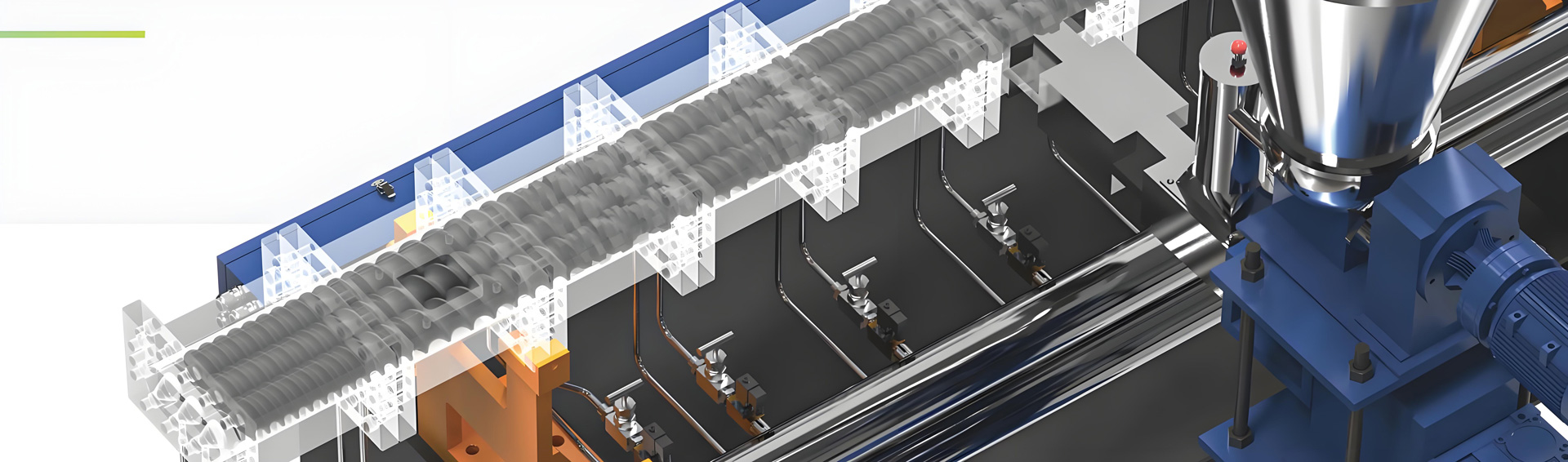
- Modular Design: The KTE Series features a modular construction that allows for easy customization of screw configurations and barrel lengths to suit specific production requirements.
- High Torque Transmission: Equipped with advanced gearbox technology, the KTE Series delivers exceptional torque for efficient processing of PA materials.
- Precision Temperature Control: Multi-zone temperature control ensures uniform heating throughout the extrusion process, preventing overheating and material degradation.
- Advanced Control System: The extruder is equipped with a Siemens PLC control system that provides precise control over all processing parameters, including screw speed, temperature, and feed rate.
- Wear-Resistant Components: Screw elements and barrels are manufactured using high-quality materials with wear-resistant coatings to withstand the abrasive nature of PA masterbatch production.
Supporting Equipment
Additional equipment required for PA masterbatch production includes:
- High-speed mixers for pre-blending raw materials
- Drying systems to remove moisture from PA resins
- Precision dosing systems for accurate ingredient measurement
- Cooling baths and pelletizers for processing the extruded material
- Quality control testing equipment
Parameter Settings
Optimal parameter settings for PA masterbatch production on the Kerke KTE Series extruder include:
Temperature Profile
- Feeding zone: 220-240°C
- Compression zone: 240-260°C
- Mixing zone: 250-270°C
- Die zone: 260-280°C
Screw Speed
Variable speed operation allows for optimization based on specific formulations and production requirements. Typical screw speeds range from 200-500 rpm, with lower speeds used for high-filler content masterbatches and higher speeds for color masterbatches.
Feed Rate
Feed rates are typically set between 50-300 kg/h, depending on the specific extruder model and formulation. The variable speed feature enables precise control over material throughput.
Vacuum Degassing
A vacuum system is used to remove volatile compounds from the melt, ensuring high-quality masterbatch. Vacuum levels are typically maintained between 0.08-0.1 MPa.
Equipment Pricing
The Kerke KTE Series variable speed twin screw extruders offer exceptional value for PA masterbatch production. Pricing varies depending on the specific model and configuration:
- KTE-36: $20,000 – $30,000
- KTE-50: $35,000 – $50,000
- KTE-75: $45,000 – $65,000
- KTE-95: $60,000 – $85,000
- KTE-135: $80,000 – $120,000
These prices include the extruder, control system, and basic accessories. Complete turnkey systems with supporting equipment range from $50,000 to $200,000 depending on production capacity and specific requirements.
Compared to imported equipment, Kerke’s KTE Series offers significant cost savings while maintaining comparable performance and reliability. The company’s competitive pricing and low maintenance costs make it an attractive investment for PA masterbatch producers.
Common Production Issues and Solutions
PA masterbatch production can encounter various challenges. Here are common issues, their causes, and effective solutions:
Issue 1: Poor Pigment Dispersion
Cause: Insufficient shear force during extrusion, improper pre-blending, or incompatible dispersants.
Solution: Increase screw speed to enhance shear mixing, optimize pre-blending parameters, or switch to a more compatible dispersant. Consider using specialized screw elements designed for improved dispersion.
Issue 2: Material Degradation
Cause: Excessive processing temperature, prolonged residence time, or moisture contamination.
Solution: Reduce processing temperatures, optimize screw speed to minimize residence time, and ensure thorough drying of raw materials. Implement proper cooling to prevent overheating.
Issue 3: High Torque Demand
Cause: Overloading the extruder, improper screw configuration, or contaminated raw materials.
Solution: Reduce feed rate, adjust screw configuration to improve material flow, and implement proper material handling and storage practices to prevent contamination.
Issue 4: Inconsistent Pellet Quality
Cause: Uneven cooling, inconsistent strand thickness, or worn pelletizer blades.
Solution: Optimize cooling system parameters, adjust die opening to ensure uniform strand thickness, and regularly inspect and replace worn pelletizer blades.
Issue 5: Die Buildup
Cause: Material degradation at the die exit, incompatible additives, or improper processing conditions.
Solution: Reduce die temperature, optimize formulation to eliminate incompatible components, and implement regular purging procedures to maintain die cleanliness.
Maintenance and Care
Proper maintenance is essential to ensure long-term performance and reliability of variable speed twin screw extruders:
Daily Maintenance
- Check oil levels in gearbox and lubrication systems
- Inspect heating elements and temperature sensors
- Clean feed hopper and remove any residual material
- Verify proper functioning of cooling systems
- Check for unusual noises or vibrations during operation
Weekly Maintenance
- Inspect screw elements for signs of wear or damage
- Check alignment of drive belts and adjust tension if necessary
- Clean filters in hydraulic and lubrication systems
- Verify calibration of temperature and pressure sensors
Monthly Maintenance
- Inspect gearbox for signs of wear or oil contamination
- Check electrical connections and control system components
- Clean and inspect die assembly
- Perform comprehensive safety checks
Annual Maintenance
- Complete disassembly and inspection of screw elements and barrel
- Replace worn or damaged components
- Perform gearbox oil change and filter replacement
- Calibrate all sensors and control systems
- Conduct performance testing and optimization
Frequently Asked Questions (FAQ)
Q: What is the ideal screw speed for PA masterbatch production?
A: The ideal screw speed depends on the specific formulation and production requirements. Typical speeds range from 200-500 rpm, with higher speeds used for color masterbatches and lower speeds for high-filler content formulations.
Q: How often should I replace screw elements?
A: Screw element lifespan depends on processing conditions and material abrasiveness. With proper maintenance, screw elements can last 1-3 years. Regular inspection is recommended to detect wear early.
Q: Can the KTE Series handle recycled PA materials?
A: Yes, the KTE Series is designed to handle both virgin and recycled PA materials. The variable speed feature allows operators to adjust processing parameters for different material qualities.
Q: What is the energy consumption of the KTE Series extruders?
A: Energy consumption varies depending on production rate and specific model. The KTE Series is designed for energy efficiency, with specific energy consumption typically ranging from 0.2-0.4 kWh/kg of processed material.
Q: Does Kerke provide training and technical support?
A: Yes, Nanjing Kerke Extrusion Equipment provides comprehensive training programs for operators and technical support to ensure optimal equipment performance. The company offers both on-site and remote support options.
Conclusion
The variable speed twin screw extruder has become the preferred equipment for PA masterbatch production due to its flexibility, efficiency, and precision. The KTE Series from Nanjing Kerke Extrusion Equipment stands out as an exceptional choice, offering advanced technology, robust construction, and competitive pricing.
By understanding the key aspects of PA masterbatch production, including formulation ratios, production processes, equipment selection, and maintenance requirements, manufacturers can optimize their operations and produce high-quality PA masterbatch consistently.
Investing in a high-performance variable speed twin screw extruder like the Kerke KTE Series can significantly improve production efficiency, reduce operating costs, and enhance product quality in PA masterbatch manufacturing.