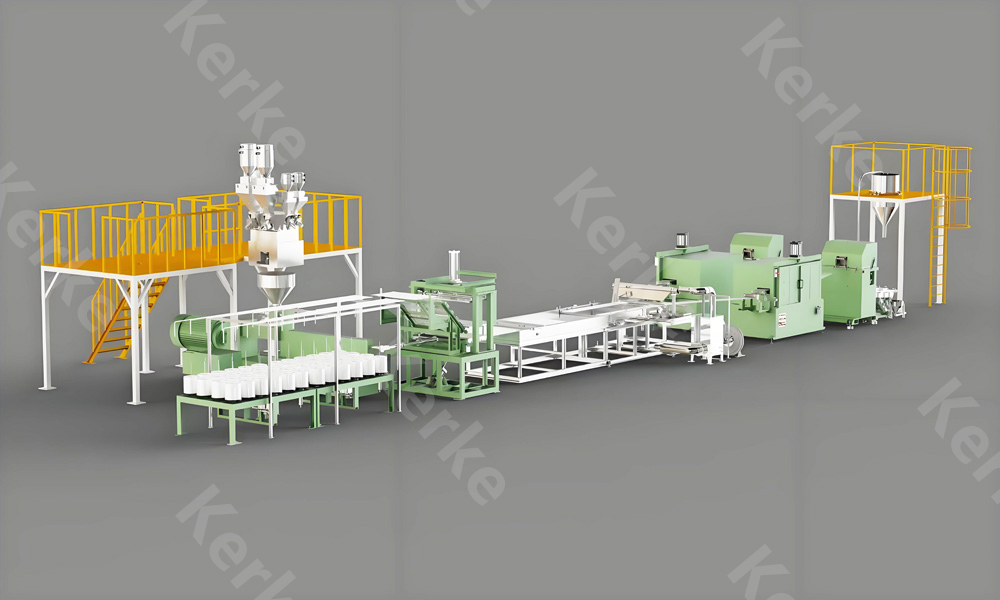
Introduction to Functional Masterbatch for Engineering Plastics
Functional masterbatch for engineering plastics represents a specialized category of concentrated additive systems designed to enhance the performance characteristics of high-performance polymers including polyamide, polycarbonate, and ABS materials. Unlike standard color masterbatch, functional masterbatch incorporates active ingredients that modify mechanical, thermal, electrical, or chemical properties of engineering plastics during processing. The production of these sophisticated additive systems requires advanced twin screw extruder technology capable of precise mixing and dispersion control.
Engineering plastics demand exceptional performance in demanding applications ranging from automotive components to electrical enclosures and consumer electronics. Functional masterbatch enables manufacturers to tailor polymer properties without changing base materials, providing flexibility and cost efficiency in product development. The compounding extruder process must carefully manage the incorporation of functional additives to maintain both additive effectiveness and polymer matrix integrity.
Compatibility between functional masterbatch carriers and engineering plastic base polymers proves critical for achieving target performance improvements. Polyamide, polycarbonate, and ABS each present unique compatibility challenges based on their chemical structures, processing temperatures, and mechanical property requirements. Masterbatch extruder manufacturers like Kerke understand these compatibility requirements and can configure equipment to produce functional masterbatch optimized for specific engineering plastic applications.
Understanding Functional Masterbatch Systems
Types of Functional Additives for Engineering Plastics
Functional masterbatch systems incorporate various additive categories depending on the performance requirements of target applications. Flame retardant masterbatch represents one of the largest segments, enabling engineering plastics to meet stringent fire safety standards in electrical and construction applications. Twin screw extruder production of flame retardant masterbatch requires careful control of additive dispersion and loading levels to achieve consistent flame retardant performance.
UV stabilizer masterbatch protects engineering plastics from degradation caused by sunlight and artificial UV sources. Polyamide and polycarbonate components used in outdoor applications require UV protection to maintain mechanical properties and appearance throughout service life. Compounding extruder systems optimized for UV stabilizer masterbatch ensure uniform distribution of stabilizer molecules throughout the carrier resin for effective protection.
Impact modifier masterbatch improves the toughness and impact resistance of engineering plastics, particularly important for polycarbonate and ABS applications requiring durability under mechanical stress. Antistatic masterbatch prevents static charge accumulation on plastic surfaces, essential for electronics packaging and clean room applications. Conductive masterbatch incorporating carbon black or metal fibers enables engineering plastics to dissipate electrical charges or provide electromagnetic shielding. Each functional additive type requires specific twin screw extruder processing conditions for optimal performance.
Carrier Resin Selection for Engineering Plastics
Carrier resin selection for functional masterbatch targeting engineering plastics requires careful consideration of compatibility, processing temperature, and performance requirements. The carrier must be miscible with the base polymer to ensure complete integration during injection molding or extrusion processing. Incompatible carriers can cause delamination, property degradation, and processing problems that compromise product quality.
Polyamide masterbatch typically uses PA6 or PA66 carrier resins that match the chemical structure of the base polymer. These carriers melt and blend completely with engineering polyamide compounds during processing. Twin screw extruder processing conditions for PA carrier resins require temperatures between 220°C and 280°C depending on the specific polyamide type. Masterbatch extruder barrel configuration must provide adequate heating capacity and temperature control for these elevated processing temperatures.
Polycarbonate masterbatch uses PC carrier resins with appropriate molecular weight and melt flow characteristics. PC processing temperatures range from 260°C to 320°C, requiring compounding extruder systems with high-temperature capability. ABS masterbatch typically uses SAN or ABS carriers that provide excellent compatibility with the base polymer while enabling high additive loading levels. Kerke twin screw extruder systems can be configured with appropriate heating capacity and screw designs for each engineering plastic carrier type.
PA, PC, and ABS Compatibility Considerations
Polyamide Compatibility Requirements
Polyamide materials present unique compatibility challenges for functional masterbatch due to their hygroscopic nature and high processing temperatures. PA6 and PA66 absorb moisture from the atmosphere, requiring thorough drying before processing to prevent hydrolysis and property degradation. Functional masterbatch for polyamide applications must also be dried properly before use to maintain processing consistency and product quality.
The polar chemical structure of polyamide creates strong intermolecular hydrogen bonding that influences compatibility with various additive types. Flame retardant additives, impact modifiers, and reinforcing fillers must be selected for compatibility with the polyamide matrix. Twin screw extruder processing must achieve complete dispersion of these additives while maintaining the polymer molecular weight that determines mechanical properties.
Masterbatch extruder configuration for polyamide functional masterbatch requires attention to temperature control and shear management. Excessive temperatures or shear can degrade polyamide, reducing molecular weight and mechanical properties. The modular screw design of Kerke compounding extruder systems enables optimization of mixing intensity and residence time for polyamide processing, achieving complete additive dispersion without polymer degradation.
Polycarbonate Compatibility Factors
Polycarbonate requires functional masterbatch with carriers and additives that can withstand high processing temperatures without degradation. PC processing temperatures of 260°C to 320°C exceed the thermal stability limits of many standard polymer additives. Flame retardant, UV stabilizer, and impact modifier additives for polycarbonate applications must be selected for thermal stability at these elevated temperatures.
The amorphous structure of polycarbonate creates unique optical properties that must be maintained when incorporating functional masterbatch. Additive particle size and dispersion quality significantly influence optical clarity in transparent PC applications. Twin screw extruder processing must achieve extremely fine dispersion of functional additives to minimize light scattering and maintain optical properties.
Moisture sensitivity of polycarbonate requires careful handling during masterbatch production and use. Hydrolysis of PC at processing temperatures rapidly degrades molecular weight and properties. Compounding extruder systems for polycarbonate masterbatch must include proper drying capability and protection against moisture absorption during processing. Kerke equipment can be configured with appropriate material handling systems to prevent moisture-related problems.
ABS Compatibility Characteristics
ABS combines the rigidity of acrylonitrile-styrene polymer with the toughness of butadiene rubber, creating unique compatibility requirements for functional masterbatch. The two-phase structure of ABS requires that functional additives locate in the appropriate phase for optimal performance. Flame retardant additives must distribute throughout the continuous phase for effective action, while impact modifiers should integrate with the rubber phase.
Processing temperatures for ABS typically range from 200°C to 260°C, moderate compared to polyamide and polycarbonate. This temperature range allows use of a broader range of functional additives without thermal stability concerns. Masterbatch extruder processing parameters for ABS masterbatch must balance dispersion requirements against thermal exposure that could degrade the butadiene rubber phase.
Color matching with functional masterbatch in ABS applications requires careful formulation development. Some functional additives, particularly flame retardants and UV stabilizers, can influence color development or cause discoloration. Twin screw extruder processing conditions affect how these additives interact with color pigments, requiring optimization for specific color and functional combinations. Kerke’s process development support helps customers achieve both functional performance and appearance requirements in ABS applications.
Key Performance Parameters for Functional Masterbatch
Mechanical Property Enhancement
Functional masterbatch designed to enhance mechanical properties must achieve uniform additive distribution and strong interfacial adhesion between additives and the polymer matrix. Impact modifiers, reinforcing fillers, and toughening agents require precise dispersion to provide consistent property improvement throughout the molded part. Twin screw extruder mixing capability directly determines the mechanical property enhancement achievable with functional masterbatch.
Impact modifier masterbatch improves the notched Izod impact strength of engineering plastics, enabling applications subject to mechanical shock and stress. The effectiveness of impact modifiers depends on particle size, distribution uniformity, and interfacial compatibility with the polymer matrix. Compounding extruder systems with dispersive mixing elements produce masterbatch with optimal impact modifier dispersion for maximum effectiveness.
Reinforcing filler masterbatch incorporating glass fibers, mineral fillers, or other reinforcing materials improves stiffness, strength, and dimensional stability. The aspect ratio and orientation of reinforcing fillers influence mechanical property enhancement. Masterbatch extruder processing must minimize fiber breakage while achieving complete wetting and dispersion of filler particles. Kerke twin screw extruder configurations for reinforced masterbatch balance dispersion requirements against fiber length preservation.
Thermal and Flame Retardant Performance
Flame retardant masterbatch represents one of the most critical functional additive categories for engineering plastics in electrical, construction, and transportation applications. Flame retardant effectiveness depends on additive type, loading level, and dispersion uniformity. Halogenated, phosphorus-based, and mineral flame retardant systems each require specific compounding extruder processing conditions for optimal performance.
Thermal stabilizer masterbatch protects engineering plastics from degradation during high-temperature processing and service. Polyamide and polycarbonate applications requiring extended high-temperature exposure benefit from thermal stabilizer systems that prevent oxidation and molecular weight degradation. Twin screw extruder production of thermal stabilizer masterbatch must incorporate stabilizers uniformly while avoiding thermal degradation during the compounding process.
Heat distortion temperature improvement through functional masterbatch enables engineering plastics to perform at elevated temperatures without deformation. Reinforcing fillers and nucleating agents in masterbatch form improve HDT while maintaining other properties. The masterbatch extruder process must achieve complete dispersion of these additives for uniform property enhancement throughout the polymer matrix.
Electrical and Surface Property Modification
Antistatic and conductive masterbatch systems modify the electrical properties of engineering plastics for applications requiring static dissipation or electromagnetic interference shielding. Carbon black, carbon nanotubes, and metal fibers in masterbatch form provide pathways for electrical conductivity. Twin screw extruder processing must achieve uniform dispersion of conductive particles to create percolation networks throughout the polymer.
Surface property modification through functional masterbatch includes slip additives, antiblock agents, and surface energy modifiers. These additives migrate to the polymer surface during processing to modify friction, adhesion, or surface energy characteristics. Masterbatch extruder production must ensure uniform initial distribution of these migratory additives while avoiding losses during processing.
The loading level of conductive additives must exceed the percolation threshold to achieve meaningful conductivity improvement. This threshold varies with additive type, particle shape, and dispersion quality. Compounding extruder systems with excellent mixing capability can achieve good conductivity at lower additive loadings, reducing cost and maintaining other polymer properties. Kerke equipment provides the mixing performance needed for efficient conductive masterbatch production.
Technical Specifications for Functional Masterbatch Production
Twin Screw Extruder Requirements
Production of functional masterbatch for engineering plastics requires twin screw extruder systems with specific capabilities. High-temperature processing capability enables processing of polyamide and polycarbonate carriers that require barrel temperatures exceeding 280°C. Precise temperature control throughout the barrel length ensures consistent melting and prevents degradation of temperature-sensitive functional additives.
Screw configuration design for functional masterbatch must accommodate varied additive characteristics. Fibrous additives like glass fibers require gentle mixing elements that prevent excessive fiber breakage. Fine particle additives like carbon black and pigments require intensive dispersive mixing for complete agglomerate breakdown. Modular screw designs in Kerke compounding extruder systems enable customization for specific functional masterbatch formulations.
Throughput capacity requirements for functional masterbatch production depend on market size and customer demand. Engineering plastic applications often require smaller batch sizes compared to commodity polymer masterbatch, making mid-range twin screw extruder sizes appropriate. The Kerke KTE-65B processing 200-450 kg/hour provides sufficient capacity for many functional masterbatch applications while remaining cost-effective.
Quality Control Parameters
Quality control for functional masterbatch extends beyond color and appearance to include performance testing specific to the functional additive system. Flame retardant masterbatch requires testing of limiting oxygen index, UL94 flammability rating, and other fire performance parameters. Impact modifier masterbatch needs mechanical testing to verify property enhancement. These performance tests supplement standard quality checks for dispersion, loading level, and carrier resin properties.
Additive concentration accuracy proves critical for functional masterbatch performance. Under-loading reduces effectiveness while over-loading wastes material and may compromise other properties. Twin screw extruder feeding systems with gravimetric control ensure precise additive dosing throughout production runs. Kerke equipment can be equipped with advanced feeding systems that maintain formulation accuracy within tight tolerances.
Documentation requirements for functional masterbatch often exceed those for color masterbatch due to regulatory compliance needs. Flame retardant masterbatch for electrical applications must meet specific standards and maintain traceability throughout the supply chain. Masterbatch extruder systems with integrated data collection support documentation requirements by recording process parameters and production data automatically.
Production Process and Workflow
Material Preparation and Feeding
Raw material preparation for functional masterbatch production requires careful attention to additive characteristics and handling requirements. Many functional additives are hygroscopic or sensitive to atmospheric moisture, requiring storage in controlled conditions and drying before processing. Twin screw extruder feeding systems must accommodate materials with varying bulk densities, particle sizes, and flow characteristics.
Feeding strategy for functional masterbatch production influences both product quality and process efficiency. Pre-blending of carrier resin, functional additives, and other ingredients creates a homogeneous feed mixture that simplifies downstream processing. Alternatively, individual component feeding using gravimetric feeders enables precise formulation control and real-time adjustment capability. Kerke compounding extruder systems can be configured with either feeding approach based on production requirements.
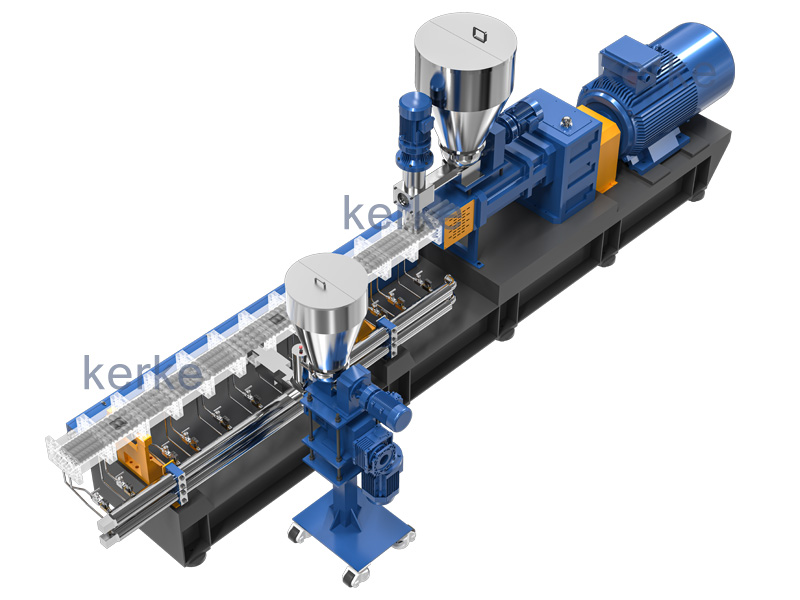
Side feeding of functional additives offers advantages for heat-sensitive materials and fiber-containing formulations. Introducing additives downstream in the extrusion process reduces thermal exposure time and preserves additive effectiveness. Twin screw extruder barrel configurations with side feeding ports enable this processing strategy. Kerke equipment features modular barrel construction that supports various feeding configurations for optimal processing of different functional masterbatch types.
Processing Parameter Optimization
Processing parameters for functional masterbatch production must balance mixing intensity, thermal exposure, and throughput requirements. Screw speed determines both mixing intensity and residence time in the twin screw extruder. Higher speeds provide better dispersion but increase shear heating and may degrade temperature-sensitive additives. Optimal screw speed depends on the specific formulation and additive sensitivity.
Barrel temperature profile significantly influences functional masterbatch quality. Temperatures must be high enough to completely melt the carrier resin and enable additive dispersion but not so high as to degrade additives or the polymer. Engineering plastic carriers like polyamide and polycarbonate require elevated temperatures that increase the risk of thermal degradation. Compounding extruder systems with precise temperature control enable optimization of thermal processing conditions.
Vacuum venting during extrusion removes volatiles and moisture that can cause voids, degradation, or appearance defects in the finished masterbatch. Polyamide and polycarbonate processing particularly benefits from vacuum venting to remove residual moisture. Kerke twin screw extruder barrels can be configured with vacuum zones at appropriate locations to maximize volatile removal without disrupting the melting and mixing process.
Common Challenges and Solutions
Additive Degradation and Stability
Thermal degradation of functional additives during masterbatch production represents a common challenge that compromises product performance. Many flame retardants, UV stabilizers, and other functional additives have limited thermal stability that constrains processing conditions. Twin screw extruder processing must minimize thermal exposure while achieving complete dispersion of these temperature-sensitive additives.
Solutions for additive degradation include optimized screw configuration, reduced barrel temperatures, and minimized residence time. Compounding extruder screw designs that achieve rapid melting and efficient mixing reduce the time that additives spend at elevated temperatures. Side feeding of heat-sensitive additives reduces thermal exposure by introducing materials later in the extrusion process. Kerke’s process engineering expertise helps customers develop processing strategies that preserve additive effectiveness.
Additive stability during storage and use also affects functional masterbatch performance. Some functional additives absorb moisture or react with atmospheric components during storage. Proper packaging and storage conditions help maintain additive effectiveness throughout the masterbatch shelf life. Technical data sheets for functional masterbatch should specify storage requirements and shelf life limits to ensure customers achieve expected performance.
Dispersion Quality Issues
Incomplete dispersion of functional additives reduces masterbatch effectiveness and can cause processing problems during customer use. Agglomerates of flame retardants, impact modifiers, or other functional additives create weak points in the polymer matrix and may cause surface defects in molded parts. Twin screw extruder mixing capability directly determines dispersion quality in functional masterbatch.
Improving dispersion quality requires attention to screw configuration, processing conditions, and raw material characteristics. Kneading elements and mixing sections must be optimized for the specific additive type and particle characteristics. Processing conditions including screw speed, barrel temperature, and throughput rate influence the shear and elongational flow that break down agglomerates. Pre-dispersion of additives in liquid carriers or through premixing can improve dispersion in the compounding extruder.
Quality testing for dispersion should be included in functional masterbatch quality control programs. Microscope examination reveals the presence and size of agglomerates. Mechanical testing correlates dispersion quality with property enhancement. Statistical analysis of dispersion quality across production lots helps identify processing conditions that produce consistent results. Kerke twin screw extruder systems provide the mixing performance needed for high-quality functional masterbatch dispersion.
Best Practices for Functional Masterbatch Applications
Optimizing Addition Rates and Processing Conditions
Functional masterbatch addition rates depend on the required performance level, additive concentration in the masterbatch, and base polymer properties. Flame retardant masterbatch addition rates typically range from 5% to 30% depending on the flame retardant system and required performance level. Impact modifier masterbatch may require addition rates of 5% to 20% to achieve target toughness improvement. Twin screw extruder production enables high additive loading levels that reduce required addition rates.
Processing conditions during final product manufacturing influence functional masterbatch effectiveness. Injection molding temperatures, screw speed, and back pressure affect how well functional masterbatch disperses in the base polymer. Engineering plastics often require higher processing temperatures than commodity polymers, creating thermal exposure that can affect some functional additives. Customer processing guidelines should specify appropriate conditions for achieving target performance.
Testing functional masterbatch performance under conditions representative of final applications verifies that masterbatch meets requirements. Flame testing, mechanical testing, and environmental exposure testing confirm that functional additives perform as expected. Statistical analysis of test results supports specification development and quality control. Kerke offers production trial capabilities that enable customers to evaluate functional masterbatch performance under realistic processing conditions.
Compatibility Testing and Validation
Compatibility between functional masterbatch and base engineering plastics requires validation before production use. Small-scale compatibility tests using laboratory twin screw extruder or injection molding equipment reveal potential problems before committing to full-scale production. These tests evaluate dispersion behavior, appearance, and initial performance characteristics.
Long-term compatibility evaluation includes aging studies that verify performance retention over time. Some functional additives may migrate to the surface or react with the polymer matrix during extended service. Accelerated aging tests at elevated temperatures predict long-term behavior and identify potential compatibility issues. Engineering plastic applications with extended service life requirements particularly benefit from thorough compatibility validation.
Documentation of compatibility testing and validation supports quality management and customer communication. Test reports should clearly identify materials, processing conditions, test methods, and results. This documentation helps customers qualify functional masterbatch for specific applications and supports regulatory compliance requirements. Kerke provides technical support for compatibility testing and can assist customers in developing validation protocols.
Equipment Selection and Recommendations
Selecting Twin Screw Extruder for Functional Masterbatch
Equipment selection for functional masterbatch production requires consideration of processing temperature capability, mixing intensity, and throughput requirements. Engineering plastic carriers including polyamide and polycarbonate demand high-temperature processing capability that not all twin screw extruder systems provide. The selected compounding extruder must achieve barrel temperatures exceeding 300°C with precise control throughout the barrel length.
Mixing capability for functional masterbatch varies with screw diameter, length-to-diameter ratio, and screw configuration design. Smaller diameter screws like the Kerke KTE-36B with 35.6mm diameter provide intensive mixing suitable for laboratory development and small-batch production. Larger diameter screws like the KTE-65B with 62.4mm diameter and KTE-95D with 93mm diameter offer production-scale capacity while maintaining mixing quality. Length-to-diameter ratios of 40:1 or greater provide sufficient processing length for complete melting, mixing, and devolatilization.
Throughput requirements influence equipment size selection. Functional masterbatch for engineering plastics often serves smaller market segments compared to commodity masterbatch, making mid-range production rates appropriate. The Kerke KTE-65B processing 200-450 kg/hour provides excellent capacity for many functional masterbatch applications. Larger systems like the KTE-95D suit high-volume applications or production facilities serving multiple product lines.
Kerke Equipment Solutions
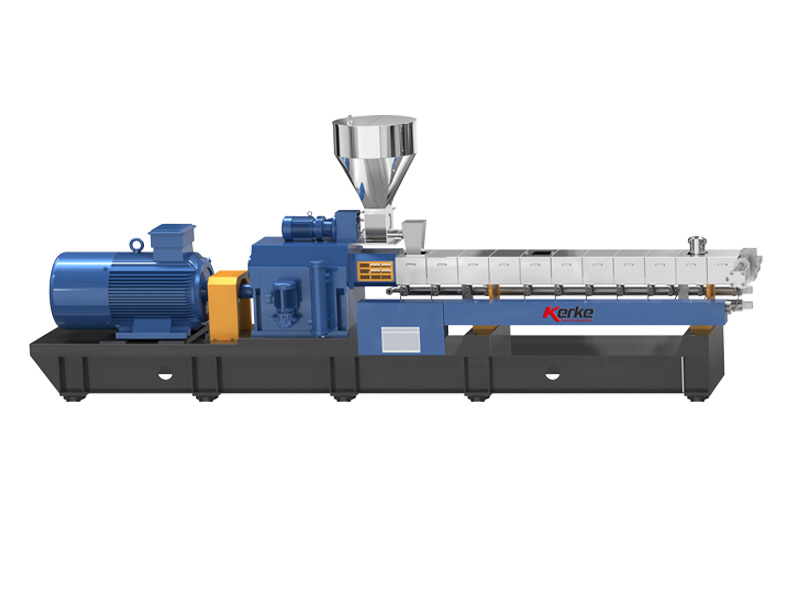
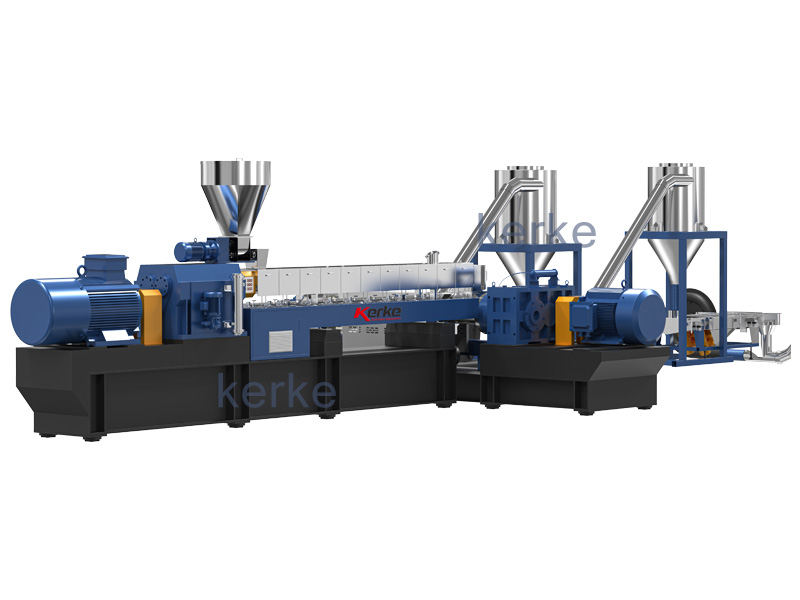
Kerke offers comprehensive twin screw extruder solutions for functional masterbatch production backed by over 13 years of manufacturing experience. The KTE series provides the temperature capability, mixing performance, and reliability required for engineering plastic functional masterbatch. High torque design enables processing of high-viscosity engineering polymers at the screw speeds needed for complete additive dispersion.
The Kerke KTE-36B suits functional masterbatch development and specialty production with throughput capacity of 20-100 kg/hour. This compact twin screw extruder provides full-scale processing capability in a laboratory-scale package. The 35.6mm screw diameter and 500-600 rpm speed capability deliver the mixing intensity needed for functional additive dispersion. Priced at $25,000-$35,000, the KTE-36B offers an affordable entry point for functional masterbatch production.
For production-scale functional masterbatch manufacturing, the Kerke KTE-65B represents an excellent choice. The 62.4mm screw diameter and 90-110KW motor power enable throughput rates of 200-450 kg/hour suitable for serving regional or specialized market segments. This compounding extruder achieves the mixing quality required for functional masterbatch while providing production efficiency. The $50,000-$80,000 investment delivers strong value for engineering plastic masterbatch production.
High-volume functional masterbatch operations benefit from the Kerke KTE-95D twin screw extruder. With a 93mm screw diameter and 315-500KW motor, this production-scale system achieves throughputs of 1000-2000 kg/hour. The KTE-95D can be configured with appropriate screw design and barrel configuration for engineering plastic functional masterbatch. At $120,000-$200,000, this system provides the capacity for large-scale masterbatch manufacturing operations.
Cost Analysis and Investment Considerations
Equipment Investment Analysis
Investment in functional masterbatch production equipment requires analysis of capital costs, operating expenses, and market potential. Twin screw extruder prices vary significantly with size and capability. Laboratory-scale systems like the Kerke KTE-16 and KTE-36B require investments of $15,000-$35,000, while production systems like the KTE-65B and KTE-95D represent investments of $50,000-$200,000. Equipment selection should balance production capacity requirements against capital investment constraints.
Operating costs for functional masterbatch production include raw materials, energy, labor, and maintenance. Functional additives for engineering plastics often command premium prices compared to color pigments, representing a significant portion of production costs. Energy costs vary with processing temperature requirements, with polyamide and polycarbonate processing requiring more energy than commodity polymer compounding. The high efficiency of modern compounding extruder systems helps control energy costs per unit of production.
Return on investment analysis for functional masterbatch equipment should consider market size, competitive dynamics, and pricing levels. Functional masterbatch typically commands higher prices than color masterbatch, reflecting the specialized additives and technical support required. Market development and customer relationships influence the revenue potential for functional masterbatch production. Kerke provides equipment and technical support that help customers build successful functional masterbatch operations.
Production Economics and Pricing
Production economics for functional masterbatch depend on throughput rates, material costs, and market pricing. Larger twin screw extruder systems achieve lower per-unit production costs through higher throughput and better energy efficiency. However, functional masterbatch markets may be limited in size, making excessive production capacity inefficient. Matching equipment capacity to realistic market potential optimizes production economics.
Pricing for functional masterbatch reflects the specialized additives, technical requirements, and value delivered to customers. Flame retardant masterbatch pricing varies with additive type and loading level, typically ranging from $3 to $15 per kilogram depending on formulation complexity. Impact modifier and other functional masterbatch systems fall within similar price ranges. Market positioning and customer service levels influence pricing strategy and margins.
Cost control in functional masterbatch production requires attention to raw material procurement, process efficiency, and quality management. Additive costs represent the largest variable cost component, making supplier relationships and purchasing strategies important. Process efficiency improvements through optimized twin screw extruder operation reduce energy and labor costs per unit. Quality management practices minimize waste and rework costs. Kerke equipment reliability and efficiency support competitive production economics.
Quality Standards and Testing Methods
Performance Testing Requirements
Quality testing for functional masterbatch extends beyond standard masterbatch quality checks to include performance testing specific to the functional system. Flame retardant masterbatch requires fire testing to verify that the formulation achieves required flammability ratings. UL94 vertical burn testing, limiting oxygen index measurement, and cone calorimetry provide quantitative flammability data. Twin screw extruder production must achieve consistent additive dispersion for reliable fire test performance.
Mechanical testing for impact modifier and reinforcing filler masterbatch verifies property enhancement. Notched Izod impact strength, tensile properties, and flexural modulus measurements demonstrate that functional masterbatch delivers expected improvements. Statistical analysis of test results across production lots confirms consistent quality. Engineering plastic applications often specify minimum property levels that functional masterbatch must achieve.
Environmental testing for UV stabilizer and thermal stabilizer masterbatch evaluates long-term performance retention. Accelerated weathering tests using QUV or xenon arc exposure simulate years of outdoor service in compressed time frames. Thermal aging tests evaluate property retention at elevated temperatures. These performance tests require extended time periods but provide essential validation of functional masterbatch effectiveness.
Quality Management Systems
Quality management systems for functional masterbatch production require comprehensive documentation and traceability. ISO 9001 certification provides a framework for quality management that many engineering plastic applications require. Functional masterbatch for automotive, electrical, and aerospace applications often requires additional quality certifications including IATF 16949 for automotive and AS9100 for aerospace.
Statistical process control methods help maintain consistent quality in functional masterbatch production. Monitoring process parameters including temperatures, pressures, and motor load provides early indication of process variations. Control charts establish limits for these parameters and trigger investigation when values exceed control limits. Masterbatch extruder systems with integrated data collection support statistical process control implementation.
Traceability requirements for functional masterbatch continue to increase as quality and regulatory demands evolve. Documentation must track materials from receipt through production and shipping to final customer delivery. Lot numbering systems, production records, and test reports enable complete traceability. Kerke twin screw extruder systems can incorporate data collection and production tracking capabilities that support traceability requirements.
Industry Applications for Functional Masterbatch
Automotive Engineering Applications
Automotive applications represent a major market for functional masterbatch in engineering plastics, demanding high performance and consistent quality. Under-hood components require thermal stability and chemical resistance provided by polyamide with appropriate functional additives. Interior components demand UV stability, flame retardancy, and appearance quality. Twin screw extruder production of automotive-grade masterbatch must meet stringent quality requirements.
Electrical systems in vehicles use engineering plastics with flame retardant and conductive masterbatch to meet safety and performance requirements. Battery components for electric vehicles require specialized functional masterbatch providing flame retardancy, thermal management, and electrical properties. These demanding applications drive innovation in functional masterbatch technology and compounding extruder processing.
Automotive quality standards including IATF 16949 require functional masterbatch suppliers to maintain comprehensive quality systems. Production part approval processes demand extensive documentation of material properties and process capability. Masterbatch extruder operations serving automotive markets must demonstrate consistent quality and process control. Kerke equipment reliability and process control capabilities support automotive quality requirements.
Electrical and Electronics Applications
Electrical and electronics applications require functional masterbatch providing flame retardancy, electrical insulation or conductivity, and thermal stability. Connectors, enclosures, and component housings use engineering plastics with flame retardant masterbatch to meet fire safety standards. Antistatic and conductive masterbatch enables engineering plastics to meet electrostatic discharge requirements for electronics packaging and handling.
Consumer electronics applications demand functional masterbatch that achieves performance requirements while maintaining appearance quality. Flame retardant masterbatch for electronic enclosures must meet fire safety standards without compromising color or surface finish. Twin screw extruder processing must achieve complete dispersion of flame retardant additives while maintaining polymer flow and appearance characteristics.
Electrical equipment standards including UL, IEC, and regional specifications define flame retardancy and electrical property requirements for plastic components. Functional masterbatch must be validated to meet these standards through appropriate testing. Kerke provides equipment and process support that help masterbatch producers meet the demanding requirements of electrical and electronics applications.
Why Choose Kerke for Functional Masterbatch Production
Technical Expertise and Support
Kerke brings over 13 years of twin screw extruder manufacturing experience to functional masterbatch production applications. This experience encompasses diverse engineering plastic systems and functional additive types, providing valuable expertise for equipment selection and process development. Kerke engineers understand the unique requirements of polyamide, polycarbonate, and ABS functional masterbatch and can recommend appropriate equipment configurations.
Process development support from Kerke helps customers optimize functional masterbatch formulations and processing conditions. Factory trial capabilities enable evaluation of formulations on production-scale compounding extruder systems before committing to equipment purchase. Technical support extends through equipment installation, commissioning, and ongoing operation to ensure successful functional masterbatch production.
The KTE series twin screw extruder from Kerke incorporates features specifically beneficial for functional masterbatch production. High torque capability enables processing of high-viscosity engineering polymers. Precise temperature control supports high-temperature processing of polyamide and polycarbonate. Modular screw design allows optimization for specific functional additive systems. These technical capabilities position Kerke equipment as an excellent choice for functional masterbatch manufacturing.
Service and Value Propositions
Kerke provides comprehensive service and support programs that maximize equipment value and minimize ownership costs. The annual $500 free spare parts program helps control maintenance expenses. Warranty coverage including free replacement of damaged parts provides protection against unexpected repair costs. Factory visit programs enable customers to evaluate equipment and conduct production trials.
Complete solution provision from formulation development through finished product helps customers establish successful functional masterbatch operations. Kerke’s experience across diverse applications provides valuable insights for market entry and product development. Technical support resources assist with troubleshooting, process optimization, and quality improvement. This comprehensive support differentiates Kerke from equipment suppliers offering only hardware.
Self-manufacture of core components including screws, shafts, barrels, and gearboxes enables Kerke to control quality and ensure spare parts availability. This vertical integration supports competitive pricing while maintaining quality standards. Customers benefit from direct access to component expertise and technical support for equipment optimization.
Maintenance and Operational Excellence
Preventive Maintenance Programs
Preventive maintenance for functional masterbatch production equipment requires attention to the specific demands of engineering plastic processing. High-temperature operation for polyamide and polycarbonate increases thermal stress on heaters, barrel components, and screw elements. Regular inspection and maintenance of these components prevents unexpected failures and maintains processing consistency.
Screw and barrel wear in functional masterbatch production depends on the abrasive characteristics of functional additives. Flame retardant additives, mineral fillers, and reinforcing fibers accelerate wear compared to standard color masterbatch production. Twin screw extruder operating hours between major maintenance interventions may be reduced for abrasive formulations. Kerke’s modular screw design enables economical replacement of worn sections.
Documentation of maintenance activities supports operational excellence and planning. Recording operating hours, maintenance interventions, and component conditions helps predict future maintenance needs. This documentation enables scheduling of maintenance during planned production breaks rather than reacting to unexpected failures. Kerke provides maintenance guidelines and technical support for maintaining equipment in optimal condition.
Operational Best Practices
Operational excellence in functional masterbatch production requires trained personnel, standardized procedures, and continuous improvement focus. Operators must understand the unique requirements of engineering plastic processing including temperature management, moisture control, and additive handling. Training programs should address both equipment operation and quality requirements for functional masterbatch.
Standard operating procedures ensure consistent production across shifts and operators. Procedures should cover material preparation, equipment startup and shutdown, process parameter settings, and quality checks. Documentation of procedures and training records supports quality management requirements. Masterbatch extruder operation for functional systems requires more attention to detail than commodity masterbatch production.
Continuous improvement programs drive operational excellence and competitive advantage. Statistical analysis of process data identifies opportunities for efficiency improvement and quality enhancement. Root cause analysis of quality issues leads to process improvements that prevent recurrence. Kerke supports continuous improvement through technical assistance and process optimization guidance.
Future Trends in Functional Masterbatch
Technology and Material Developments
Functional masterbatch technology continues to evolve with new additives, improved carriers, and enhanced processing capabilities. Nanotechnology enables development of masterbatch with nano-scale additives that provide superior performance at lower loading levels. Carbon nanotubes, nano-clays, and other nano-materials in masterbatch form offer property enhancement possibilities not achievable with conventional additives. Twin screw extruder processing must adapt to these new material characteristics.
Sustainability considerations drive development of bio-based functional additives and halogen-free flame retardant systems. Environmental regulations increasingly restrict halogenated flame retardants, creating demand for effective alternative systems. Bio-based impact modifiers and additives from renewable sources respond to sustainability demands. Compounding extruder processing must accommodate these new materials while maintaining performance and cost competitiveness.
Digital technology integration enables improved process control and quality management in functional masterbatch production. Twin screw extruder systems with advanced sensors, process modeling, and artificial intelligence support achieve consistent quality with reduced operator intervention. These technologies support Industry 4.0 manufacturing concepts and improve production efficiency. Kerke continues to develop equipment capabilities that incorporate advancing technology.
Market Evolution and Opportunities
Functional masterbatch markets continue to grow as engineering plastic applications expand and performance requirements increase. Electric vehicle development creates new opportunities for functional masterbatch in battery components, electrical systems, and structural applications. Renewable energy applications including wind turbines and solar installations require engineering plastics with specialized functional properties. Twin screw extruder capacity for functional masterbatch must expand to meet this growing demand.
Regional market development creates opportunities for local functional masterbatch production serving specific geographic markets. Transportation costs and lead times favor regional production facilities close to injection molding and extrusion customers. Mid-range compounding extruder systems like the Kerke KTE-65B suit regional production scales. Technical support and equipment reliability become increasingly important as functional masterbatch production spreads to new regions.
Specialization strategies enable functional masterbatch producers to develop competitive advantages in specific application segments or technology areas. Expertise in particular engineering plastic systems, functional additive types, or application requirements supports premium positioning. Investment in twin screw extruder capability and technical resources enables this specialization. Kerke equipment and support provide the foundation for successful functional masterbatch specialization.
Frequently Asked Questions
What functional additives can be incorporated in masterbatch for engineering plastics?
Functional masterbatch for engineering plastics can incorporate flame retardants, UV stabilizers, impact modifiers, thermal stabilizers, antistatic agents, conductive additives, and various other performance modifiers. Twin screw extruder processing must be optimized for each additive type to achieve complete dispersion and maintain additive effectiveness.
How does carrier resin selection affect functional masterbatch performance?
Carrier resin selection determines compatibility with the base engineering plastic, processing temperature requirements, and final product properties. The carrier must be chemically compatible with the base polymer and able to withstand required processing temperatures. Masterbatch extruder manufacturers like Kerke can provide guidance on carrier resin selection for specific applications.
What twin screw extruder capabilities are needed for functional masterbatch production?
Functional masterbatch production requires twin screw extruder systems with high-temperature capability for engineering plastic carriers, intensive mixing capability for additive dispersion, and precise process control for consistent quality. The compounding extruder must accommodate the specific requirements of the functional additives being processed.
How are functional masterbatch addition rates determined?
Addition rates for functional masterbatch depend on the required performance level, additive concentration in the masterbatch, and base polymer characteristics. Flame retardant masterbatch may require 5-30% addition rates while impact modifier masterbatch typically uses 5-20% addition. Testing under representative conditions confirms appropriate addition rates.
What quality testing is required for functional masterbatch?
Quality testing for functional masterbatch includes performance testing specific to the functional system in addition to standard quality checks. Flame retardant masterbatch requires fire testing, impact modifier masterbatch needs mechanical testing, and stabilizer masterbatch requires aging tests. Twin screw extruder production consistency supports reliable quality test results.
Conclusion
Functional masterbatch for engineering plastics represents a sophisticated technology requiring careful attention to compatibility, processing conditions, and performance validation. Achieving optimal performance enhancement for polyamide, polycarbonate, and ABS applications demands high-quality masterbatch produced using advanced twin screw extruder technology. Understanding the relationships between functional additive characteristics, carrier resin selection, and processing parameters enables manufacturers to develop effective masterbatch solutions for demanding engineering applications.
Investment in quality functional masterbatch production equipment like Kerke KTE series compounding extruders provides the foundation for successful manufacturing operations. The combination of technical capability, reliability, and comprehensive support services positions manufacturers for success in the growing functional masterbatch market. Proper equipment selection, process optimization, and quality management practices enable functional masterbatch producers to meet the demanding requirements of engineering plastic applications across automotive, electrical, electronics, and other high-performance segments.
The future of functional masterbatch for engineering plastics continues to evolve with advances in additive technology, sustainability requirements, and digital manufacturing capabilities. Staying current with these developments while maintaining focus on quality and customer service ensures long-term success. Kerke’s commitment to technology advancement and customer partnership makes the company an ideal supplier for functional masterbatch production equipment, supporting manufacturers in achieving their technical and business objectives in this specialized market segment.