Understanding High Concentration Masterbatch Technology
High concentration masterbatch represents an advanced category of colorants and functional additives designed to maximize pigment loading while maintaining excellent dispersion quality and processability. Unlike conventional masterbatch with typical pigment concentrations of 10-40%, high concentration masterbatch formulations contain pigment loadings ranging from 50% to 85%, with some specialty formulations exceeding 90% for specific applications. The exceptionally high pigment loading enables lower addition rates in final applications, reducing transportation costs, storage requirements, and processing impact while maintaining superior color development and functional performance. Mastering high concentration masterbatch technology requires deep understanding of pigment characteristics, dispersion mechanisms, and advanced processing capabilities.
The fundamental advantage of high concentration masterbatch lies in its cost efficiency and logistics optimization. By concentrating pigments to maximum achievable levels, manufacturers reduce the amount of carrier resin required, lowering raw material costs and improving transportation efficiency per unit of pigment delivered. Typical high concentration masterbatch can be used at addition rates of 0.2-2% compared to 2-8% for conventional masterbatch, representing a 75-95% reduction in material handling and storage requirements. The production cost of high concentration masterbatch ranges from $5,000 to $15,000 per ton depending on pigment quality and loading, with premium formulations reaching $20,000 to $40,000 per ton. However, the lower addition rates in final applications make high concentration masterbatch highly cost-effective despite higher per-ton prices. Kerke Twin Screw Extruder systems are specifically engineered to achieve the high shear energy and precise control necessary for producing excellent dispersion at extreme pigment loadings. The investment in specialized equipment for high concentration masterbatch typically ranges from $30,000 to $70,000 for enhanced screw configurations and processing capabilities.
The manufacturing challenges of high concentration masterbatch differ significantly from conventional masterbatch production. At pigment loadings above 50%, the mixture becomes highly abrasive and difficult to process due to reduced polymer content. The viscosity increases dramatically, placing additional stress on processing equipment. Achieving uniform dispersion becomes increasingly difficult as the polymer matrix becomes insufficient to wet and separate pigment particles. These challenges require specialized equipment design, optimized processing parameters, and advanced dispersant technologies. Kerke Masterbatch Extruder models, particularly the KSE-90 and KSE-110 series, provide the necessary mechanical energy, temperature control, and wear resistance for producing high concentration masterbatch with exceptional quality. The wear-resistant components and high-torque capabilities of Kerke extruders enable extended service life even when processing highly abrasive high-concentration formulations.
Carrier resin selection for high concentration masterbatch differs from conventional formulations. With reduced carrier resin content, the carrier must provide maximum effectiveness at minimal concentrations. High-performance carrier resins with excellent pigment wetting characteristics, appropriate melt flow properties, and strong compatibility with final application resins are essential. Specialized dispersing agents become increasingly important as pigment loading increases, often comprising 5-15% of the formulation to ensure proper wetting and prevent agglomeration. Kerke Compounding Extruder technology can produce high concentration masterbatch using optimized carrier systems that maximize dispersion while maintaining processability. The cost of premium carrier systems for high concentration masterbatch adds $1,000 to $3,000 per ton to production costs but delivers superior dispersion and processing characteristics.
Pigment Loading Optimization
Optimizing pigment loading represents the core challenge in high concentration masterbatch production. The goal is to achieve maximum pigment concentration while maintaining dispersion quality, processability, and final application performance. Understanding the factors that limit pigment loading and implementing strategies to overcome these limitations enables manufacturers to produce high concentration masterbatch with superior properties and cost efficiency. The optimal pigment loading depends on pigment characteristics, dispersing agent effectiveness, processing equipment capability, and final application requirements.
Pigment particle characteristics significantly influence achievable loading levels. Smaller particle size pigments provide higher surface area, requiring more dispersant and potentially limiting maximum loading due to increased tendency toward agglomeration. Larger particle size pigments are easier to disperse but may affect color properties and surface finish in final applications. Particle shape also impacts loading capacity, with spherical or cubic particles typically accommodating higher loadings than flake or needle-shaped particles. Pigment surface treatment can improve wetting and enable higher loadings by reducing pigment-particle attraction forces. Kerke Extruder application engineers can recommend pigment selection and surface treatment strategies to maximize loading while maintaining quality. The cost of surface-treated pigments typically adds $1,500 to $4,000 per ton to material costs.
Dispersing agent selection and dosage are critical for achieving high pigment loadings. As pigment concentration increases, the available polymer matrix becomes insufficient for proper wetting and separation of pigment particles. Advanced dispersing agents fill this gap by reducing inter-particle attraction forces and improving pigment wetting. Multi-component dispersant systems combining wetting agents, dispersants, and processing aids often provide superior results compared to single-component systems. The dispersant package typically represents 10-20% of high concentration masterbatch formulations, compared to 3-8% in conventional masterbatch. Kerke Masterbatch Extruder formulations incorporate optimized dispersant packages specifically developed for high loading applications. The cost of advanced dispersant systems typically ranges from $3,000 to $8,000 per ton depending on loading requirements and pigment characteristics.
Carrier resin optimization enables higher pigment loadings through enhanced wetting and compatibility. High-performance carrier resins with appropriate molecular weight and functional groups provide superior pigment wetting at low concentrations. The carrier resin must be compatible with both the pigment and the final application resin to ensure proper color development and performance. Special carrier resins designed specifically for high concentration applications can achieve loading increases of 10-25% compared to standard resins. Kerke Twin Screw Extruder technology can process a wide range of carrier systems, enabling optimization for specific high concentration formulations. The cost of specialized carrier resins for high loading adds $800 to $2,500 per ton to production costs.
Processing equipment capability limits achievable pigment loading. Higher loadings require greater shear energy for dispersion and increased torque capacity to process the high-viscosity mixture. Screw design with optimized mixing elements creates the shear conditions necessary for breaking down agglomerates and achieving uniform distribution. Barrel design must withstand abrasive wear from high pigment concentrations while providing adequate heat transfer. Kerke Compounding Extruder systems feature enhanced screw configurations, wear-resistant components, and high-torque drives specifically designed for high concentration masterbatch production. The investment in equipment upgrades for high loading capability typically ranges from $25,000 to $60,000 for screw and barrel enhancements.
Testing and optimization of pigment loading levels require systematic approaches to determine the maximum achievable loading while maintaining acceptable quality properties. Rheological testing identifies processing limits, while dispersion quality assessment ensures that acceptable dispersion is maintained. Color strength testing verifies that loading increases provide proportional color development. Kerke Extruder application laboratories provide comprehensive testing services for loading optimization. The cost of loading optimization studies typically ranges from $3,000 to $8,000 per formulation depending on testing requirements.
Advanced Dispersion Technology
Advanced dispersion technology represents the cornerstone of high concentration masterbatch production, as achieving excellent dispersion becomes increasingly challenging at high pigment loadings. The reduced polymer matrix provides insufficient medium for pigment wetting and separation, requiring sophisticated dispersion strategies that overcome fundamental thermodynamic limitations. Modern dispersion technology combines mechanical energy, chemical dispersants, and processing optimization to achieve pigment particle sizes typically below 5 microns even at pigment loadings above 70%. Understanding and implementing advanced dispersion principles enables manufacturers to produce high concentration masterbatch with superior quality and performance.
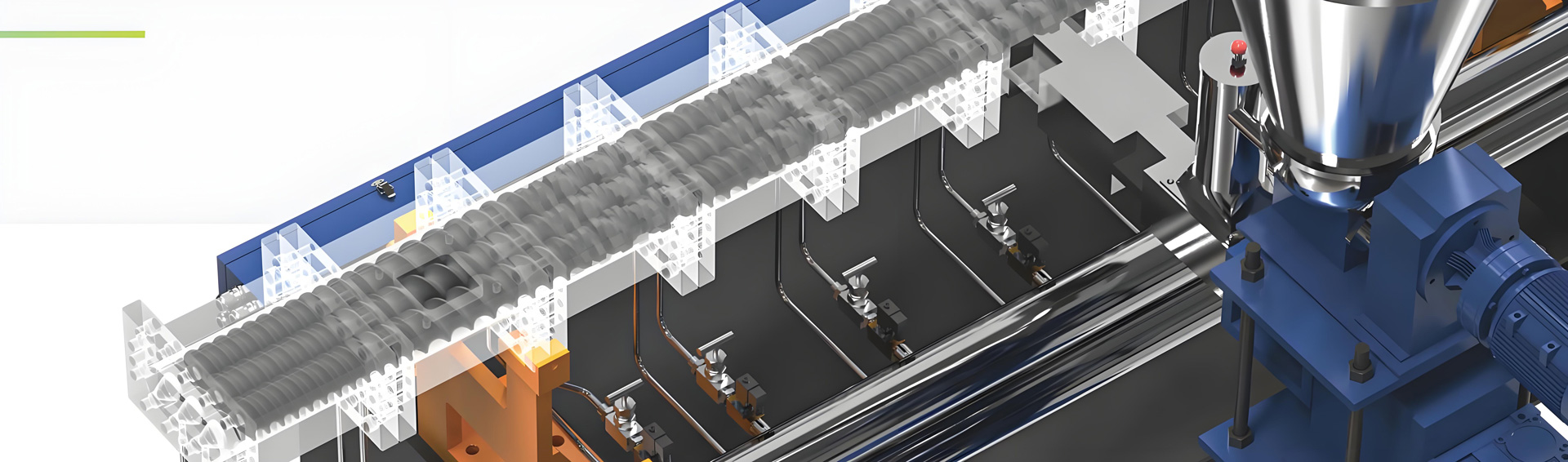
High-shear mixing represents the primary mechanism for breaking down pigment agglomerates and achieving uniform dispersion. At high pigment loadings, the mixture becomes highly viscous and resistant to flow, requiring substantial mechanical energy input. Co-rotating twin screw extruders provide superior dispersion capability compared to single screw systems, particularly for challenging high-loading formulations. Screw configuration optimization includes staggered kneading blocks, reverse-conveying elements, and special mixing elements that create intensive mixing zones. Kerke Twin Screw Extruder systems feature customizable screw configurations optimized for high concentration masterbatch dispersion. The cost of screw configuration optimization typically ranges from $18,000 to $45,000 for specialized high-loading designs.
Multi-pass processing through extrusion equipment can significantly improve dispersion quality at high pigment loadings. A two-pass process where material is extruded, pelletized, and re-extruded provides additional opportunity for agglomerate breakdown and pigment distribution. While this approach increases production costs and requires additional equipment, it enables higher loadings and superior dispersion quality. Kerke Masterbatch Extruder systems can be configured for single-pass or multi-pass processing depending on formulation requirements. The additional cost for two-pass processing typically ranges from $600 to $1,200 per ton of masterbatch produced.
Temperature profiling optimization significantly impacts dispersion quality at high pigment loadings. The processing temperature must be high enough to reduce viscosity and enable proper mixing while staying below degradation temperatures for pigments and additives. Optimal temperature profiles may vary across barrel zones, with lower temperatures in feeding zones to prevent premature melting and bridging, higher temperatures in mixing zones to reduce viscosity and enhance dispersion, and controlled cooling zones to stabilize the compound. Kerke Compounding Extruder systems provide precise temperature control across multiple barrel zones, enabling optimization for specific high loading formulations. The cost of temperature profiling studies typically ranges from $1,200 to $3,000 per formulation.
Residence time optimization ensures sufficient time for dispersion without excessive thermal exposure. At high pigment loadings, the high viscosity reduces material flow rates, naturally increasing residence time. However, proper residence time distribution ensures that all material receives adequate mixing. Screw configuration, throughput rate, and barrel temperature collectively determine residence time. Kerke Extruder application engineers provide residence time optimization recommendations for high concentration masterbatch. The cost of residence time optimization studies typically ranges from $1,000 to $2,500 per application.
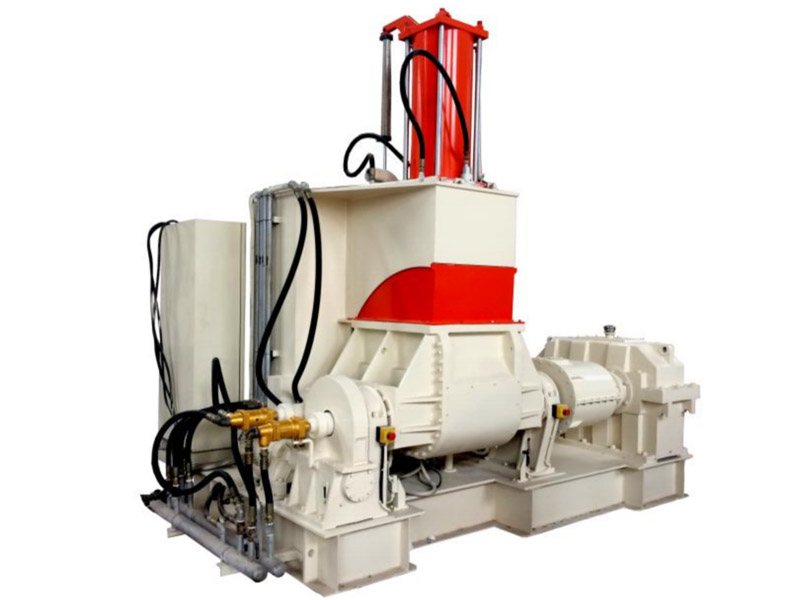
Pre-dispersion processing can improve dispersion quality for challenging high-loading formulations. Pre-mixing pigments with dispersing agents and a portion of carrier resin before extrusion helps wet pigments and break down large agglomerates. High-shear mixers or dissolvers can achieve preliminary dispersion before extrusion, reducing the load on the extruder and improving final dispersion quality. Kerke Twin Screw Extruder systems can integrate with pre-dispersion equipment for enhanced processing capability. The cost of pre-dispersion equipment typically ranges from $20,000 to $50,000 depending on capacity and complexity.
Dispersion quality assessment using advanced analytical techniques provides objective evaluation of dispersion effectiveness. Microscopy with image analysis quantifies agglomerate size and distribution. Laser diffraction particle size analysis provides statistical data on particle size distribution. Rheological measurements can indirectly assess dispersion quality through viscosity and flow properties. Kerke Extruder quality systems include comprehensive dispersion analysis capabilities. The cost of dispersion analysis equipment ranges from $20,000 to $55,000 for complete systems.
Production Efficiency Optimization
Production efficiency represents a critical economic factor in high concentration masterbatch manufacturing, as the processing challenges and equipment requirements significantly impact throughput, energy consumption, and operational costs. Optimizing production efficiency involves balancing processing parameters, equipment configuration, and operational practices to maximize output while maintaining quality. High concentration masterbatch typically requires slower processing speeds and higher energy input compared to conventional formulations, but strategic optimization can minimize these penalties and improve overall economics.
Throughput optimization focuses on achieving maximum sustainable production rates while maintaining dispersion quality. At high pigment loadings, the high viscosity limits material flow rates and increases mechanical resistance. Optimizing throughput involves finding the maximum sustainable rate that still achieves acceptable dispersion without excessive equipment stress. This balance depends on screw configuration, temperature profile, and pigment characteristics. Kerke Masterbatch Extruder systems feature process optimization capabilities that identify optimal throughput for specific formulations. The cost of throughput optimization studies typically ranges from $1,500 to $3,500 per formulation.
Energy efficiency represents a significant concern in high concentration masterbatch production due to the high mechanical energy required for dispersion. High pigment loadings increase viscosity, requiring greater motor power consumption. Optimizing screw configuration reduces energy input through efficient mixing element design. Temperature profile optimization can reduce thermal energy requirements. Variable frequency drives on main motors enable power consumption matching to load requirements. Kerke Twin Screw Extruder systems incorporate energy-efficient design features including optimized screw profiles, barrel insulation, and variable speed drives. The energy consumption for high concentration masterbatch typically ranges from 120 to 250 kWh per ton compared to 80 to 150 kWh per ton for conventional masterbatch. The investment in energy efficiency upgrades typically ranges from $15,000 to $40,000.
Equipment wear and maintenance considerations significantly impact production efficiency and operational costs. High pigment loadings, particularly with abrasive pigments such as titanium dioxide or iron oxide, cause accelerated wear on screw elements, barrel liners, and other wear surfaces. Wear-resistant components including hardened steel, tungsten carbide coatings, or ceramic materials extend service life and reduce maintenance downtime. Regular inspection and predictive maintenance prevent catastrophic failures and optimize maintenance scheduling. Kerke Compounding Extruder systems feature wear-resistant components specifically designed for high-loading applications. The cost of wear-resistant upgrades typically ranges from $20,000 to $55,000 depending on component selection and scope.
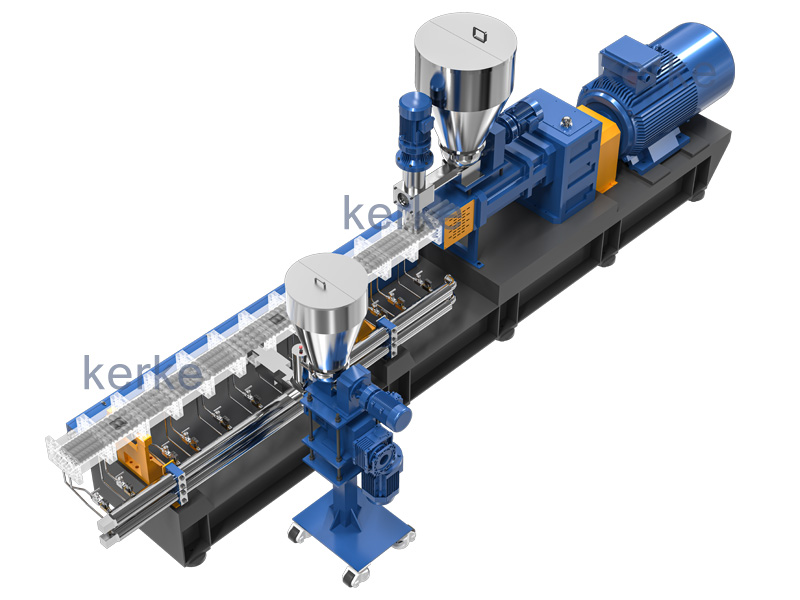
Material handling and feeding efficiency become increasingly important at high pigment loadings. The high pigment concentration creates handling challenges including poor flow characteristics, dust generation, and feeding inconsistency. Accurate feeding is critical for maintaining consistent composition and quality. Gravimetric feeding systems with special hoppers and agitators ensure consistent feeding of free-flowing pigments. Vacuum conveying systems reduce dust exposure and improve material flow. Kerke Extruder material handling systems are optimized for high-loading formulations. The cost of specialized material handling systems typically ranges from $25,000 to $65,000 depending on configuration.
Automation and process control enhance production efficiency by maintaining optimal processing conditions, reducing operator intervention, and preventing quality deviations. Advanced process control systems monitor critical parameters including temperature, pressure, torque, and motor load, automatically adjusting conditions to maintain optimal operation. Statistical process control identifies trends toward out-of-specification conditions, enabling proactive intervention. Kerke Twin Screw Extruder systems feature integrated automation and control capabilities. The investment in advanced automation typically ranges from $30,000 to $80,000 for complete systems.
Batch-to-batch consistency optimization reduces material waste and reprocessing requirements while maintaining product quality. Consistent raw material quality, standardized processing parameters, and thorough cleaning between formulation changes ensure reproducible results. Recipe management systems store and recall optimized processing conditions for each formulation, eliminating parameter setup errors. Kerke Masterbatch Extruder systems provide comprehensive recipe management and batch tracking capabilities. The cost of consistency optimization implementation typically ranges from $15,000 to $40,000.
Formulation Design Strategies
Formulation design for high concentration masterbatch requires systematic approaches that balance multiple competing requirements including pigment loading, dispersion quality, processing characteristics, and final application performance. Unlike conventional masterbatch where formulation approaches are well-established, high concentration masterbatch demands specialized formulation strategies that overcome the challenges of extreme pigment loading. Understanding these formulation principles enables manufacturers to develop high concentration masterbatch products that deliver superior performance and economic benefits.
Pigment selection for high concentration formulations emphasizes characteristics that facilitate high loading while maintaining performance. Pigments with optimal particle size distribution, appropriate surface chemistry, and good thermal stability enable higher loadings. Blending different pigments with complementary characteristics can achieve target color while maintaining processability. Surface-treated pigments with enhanced wettability typically achieve 10-25% higher loadings compared to untreated pigments. Kerke Extruder application engineers provide pigment selection guidance for high loading applications. The cost of pigment selection and evaluation services typically ranges from $2,000 to $5,000 per formulation.
Dispersant system design becomes increasingly critical at high pigment loadings. Multi-component dispersant packages combining wetting agents, dispersants, and processing addresses provide superior performance compared to single-component systems. The wetting agent reduces surface tension and improves pigment wetting. The dispersant provides steric or electrostatic stabilization to prevent agglomeration. Processing aids reduce melt viscosity and improve flow. The optimal ratio of components depends on pigment characteristics and loading level. Kerke Twin Screw Extruder formulations utilize optimized dispersant packages for specific high loading applications. The cost of dispersant package optimization typically ranges from $3,000 to $8,000 per formulation.
Carrier resin system selection for high concentration masterbatch differs from conventional formulations due to the reduced carrier content. The carrier must provide maximum effectiveness at minimal concentrations, requiring enhanced pigment wetting characteristics and compatibility with final application resins. Specialty carrier resins with controlled molecular weight distribution and functional groups enable higher loadings. In some cases, carrier blends combining different resins provide optimal performance. Kerke Masterbatch Extruder technology can process various carrier systems for high loading applications. The cost of carrier system optimization typically ranges from $2,500 to $6,000 per formulation.
Additive package design for high concentration masterbatch must address specific challenges of high loading formulations. Stabilizers protect both pigments and carrier resin from thermal degradation during processing. Processing aids reduce viscosity and improve flow characteristics. Anti-blocking agents prevent pellet sticking during storage and handling. The additive package must be carefully balanced to avoid interfering with dispersion or final application performance. Kerke Compounding Extruder formulations incorporate optimized additive packages for high loading applications. The cost of additive package optimization typically ranges from $2,000 to $5,000 per formulation.
Formulation testing and optimization require comprehensive evaluation of multiple performance parameters. Dispersion quality assessment identifies agglomerate size and distribution. Rheological testing evaluates processing characteristics. Color strength and development ensure proportional response to loading increases. Application testing verifies performance in final use conditions. Stability testing evaluates shelf life and processing stability. Kerke Extruder application laboratories provide comprehensive formulation testing services. The cost of comprehensive formulation testing typically ranges from $5,000 to $15,000 per formulation depending on test scope.
Cost optimization involves balancing material costs against performance requirements and market positioning. Premium pigments and dispersants enable higher loadings but increase material costs. Finding the optimal balance between material investment and production efficiency maximizes profitability. Life cycle cost analysis considering material costs, production costs, and application addition rates provides comprehensive economic evaluation. Kerke Twin Screw Extruder application engineers provide cost optimization analysis for high concentration formulations. The cost of cost optimization studies typically ranges from $3,000 to $7,000 per formulation.
Quality Control Considerations
Quality control for high concentration masterbatch presents unique challenges and requirements compared to conventional formulations. The extreme pigment loading increases the importance of dispersion quality, pigment content accuracy, and batch-to-batch consistency. Small variations in processing or raw materials can have amplified effects on final product quality. Implementing comprehensive quality control systems specifically adapted to high concentration masterbatch requirements ensures consistent product quality and customer satisfaction while minimizing waste and reprocessing costs.
Raw material quality control for high concentration masterbatch requires particularly rigorous standards due to the amplified impact of material variations at high loadings. Pigment quality must be verified for particle size distribution, surface treatment, color strength, and impurity content. Dispersant quality including functionality and batch consistency must be verified. Carrier resin characteristics including molecular weight distribution and compatibility must meet specifications. Kerke Extruder quality control systems include comprehensive raw material testing capabilities specifically adapted for high loading formulations. The cost of raw material testing typically ranges from $500 to $1,200 per material batch.
In-process quality monitoring tracks critical parameters during high concentration masterbatch production to ensure consistent quality. Key monitoring points include melt temperature, pressure, torque, motor load, and discharge rate. The high viscosity of high-loading formulations creates characteristic torque patterns that can indicate dispersion quality. Real-time viscosity monitoring can identify processing variations before quality defects occur. Kerke Masterbatch Extruder systems feature advanced process monitoring capabilities specifically adapted for high loading applications. The cost of in-process monitoring systems typically ranges from $25,000 to $60,000.
Finished product testing for high concentration masterbatch evaluates critical quality parameters including pigment content, dispersion quality, color strength, and processing characteristics. Pigment content analysis verifies accurate formulation and batch consistency. Dispersion quality assessment identifies agglomerate presence and size distribution. Color strength measurement ensures consistent color development. Rheological testing evaluates processing characteristics. Kerke Twin Screw Extruder quality laboratories include comprehensive testing capabilities for high concentration formulations. The cost of quality testing equipment ranges from $30,000 to $85,000 for complete laboratories.
Batch-to-batch consistency verification is particularly important for high concentration masterbatch due to the sensitivity of formulation performance to small variations. Statistical analysis of pigment content, dispersion measurements, color strength, and rheological properties establishes control limits for quality consistency. Tolerance testing validates that production batches remain within acceptable limits. Kerke Compounding Extruder systems produce high concentration masterbatch with exceptional batch-to-batch consistency, typically maintaining pigment content within plus or minus 1% of specification. The cost of consistency verification testing typically ranges from $400 to $900 per batch.
Application testing validates high concentration masterbatch performance in actual production conditions and end-use environments. This testing includes color development at recommended addition rates, dispersion quality in final articles, mechanical property evaluation, and performance under processing conditions. Application testing ensures that masterbatch meets specific customer requirements and performs reliably at low addition rates. Kerke Extruder application laboratories provide comprehensive application testing services for high concentration formulations. The cost of application testing typically ranges from $2,500 to $7,000 per application and formulation.
Stability testing evaluates high concentration masterbatch performance over time under various storage and handling conditions. Accelerated aging studies predict shelf life and identify potential problems such as pigment settling, agglomeration, or additive migration. Thermal stability testing evaluates performance during multiple processing cycles. Kerke Twin Screw Extruder systems can produce formulations with enhanced stability for demanding applications. The cost of stability testing typically ranges from $2,000 to $5,000 per formulation.
Cost Analysis and Economic Considerations
Understanding the cost structure of high concentration masterbatch production enables manufacturers to optimize their operations and make informed economic decisions. Cost analysis encompasses raw material costs, processing costs, equipment investment, and operational expenses. The unique economics of high concentration masterbatch require different evaluation approaches compared to conventional formulations, with emphasis on total delivered cost rather than per-ton masterbatch price. Comprehensive cost analysis helps manufacturers identify optimization opportunities and develop competitive pricing strategies.
Pigment costs represent the dominant cost component for high concentration masterbatch, typically accounting for 70-85% of raw material costs. Standard organic pigments range from $10,000 to $35,000 per ton. Inorganic pigments typically cost $5,000 to $20,000 per ton. Surface-treated pigments for high loading applications add 20-40% to pigment costs. Specialty pigments for high-performance applications can cost $50,000 to $150,000 per ton. For 70% pigment loading masterbatch using standard organic pigments, the pigment component costs approximately $7,000 to $24,500 per ton. Kerke Extruder can provide sourcing recommendations for pigments offering optimal balance of cost and high-loading performance. Bulk pigment purchasing contracts can reduce costs by 10-15% compared to spot market prices.
Carrier resin costs for high concentration masterbatch are significantly reduced due to the low carrier content in formulations. Even with premium carrier resins optimized for high loading, carrier costs typically range from $300 to $900 per ton for the complete masterbatch. However, the specialized nature of carrier resins for high loading applications adds 30-50% to per-ton carrier resin costs compared to standard grades. Kerke Masterbatch Extruder formulations utilize optimized carrier systems that maximize effectiveness at minimal concentrations.
Dispersant and additive costs represent a significant proportion of formulation costs at high pigment loadings. Advanced dispersant packages for high loading applications cost $4,000 to $12,000 per ton. Additional additives including stabilizers, processing aids, and antistatic agents add $1,000 to $3,000 per ton. The total dispersant and additive package for high loading masterbatch typically ranges from $5,000 to $15,000 per ton, representing 20-30% of raw material costs compared to 10-15% for conventional masterbatch. Kerke Compounding Extruder technology enables optimization of dispersant packages for cost-effective high loading formulations.
Processing costs for high concentration masterbatch are significantly higher than conventional masterbatch due to challenging processing requirements. Energy consumption typically ranges from 120 to 250 kWh per ton compared to 80 to 150 kWh per ton for conventional formulations, adding $15 to $35 per ton based on industrial electricity rates. Labor costs average $70 to $150 per ton due to increased complexity and monitoring requirements. Equipment depreciation based on specialized high-loading equipment represents $350 to $650 per ton. Maintenance costs average $80 to $150 per ton due to increased wear. Total processing costs typically range from $515 to $985 per ton, approximately 30-50% higher than conventional masterbatch. Kerke Twin Screw Extruder systems minimize processing costs through efficient design optimized for high loading applications.
Equipment investment for high concentration masterbatch production requires specialized features for processing challenges. Small capacity lines (400-800 kg/hr) typically cost $380,000 to $550,000. Medium capacity lines (800-1,800 kg/hr) cost $550,000 to $850,000. High capacity lines (1,800-4,000 kg/hr) require investment of $850,000 to $1,500,000. These costs are 20-40% higher than conventional masterbatch lines due to wear-resistant components, enhanced screw configurations, and higher-torque drives. Kerke Extruder offers specialized high concentration masterbatch production lines with competitive pricing. The payback period for high concentration masterbatch equipment typically ranges from 2.5 to 4.5 years based on market demand and profit margins.
Operational expenses for high concentration masterbatch include quality control, material handling, and overhead costs. Quality control costs average $60 to $150 per ton due to additional testing requirements. Material handling costs average $30 to $70 per ton due to challenges with high-loading materials. Overhead costs including administration, warehousing, and logistics average $80 to $180 per ton. Total operational expenses typically range from $170 to $400 per ton. Kerke Masterbatch Extruder systems minimize operational expenses through efficient design and automation.
Total production costs for high concentration masterbatch typically range from $6,485 to $13,785 per ton for standard formulations, with specialty high-performance formulations reaching $15,785 to $31,935 per ton. While these costs are significantly higher per ton than conventional masterbatch, the lower addition rates in final applications often make high concentration masterbatch more cost-effective overall. For a typical application requiring 5% addition of conventional masterbatch at $6,000 per ton versus 1% addition of high concentration masterbatch at $12,000 per ton, the high concentration option provides 60% cost savings per ton of final product. Profit margins in the high concentration masterbatch market typically range from 18-32% depending on formulation complexity and market positioning. Market prices for high concentration masterbatch range from $7,500 to $18,000 per ton for standard grades, with specialty formulations commanding $18,500 to $42,000 per ton.
Kerke Equipment Recommendations
Kerke Extruder offers specialized equipment specifically designed for high concentration masterbatch production, addressing the unique challenges of extreme pigment loading, high viscosity, and demanding dispersion requirements. The KSE series twin screw extruders provide superior mechanical energy, wear resistance, and precise control essential for high concentration masterbatch production. Selecting appropriate equipment depends on production requirements, loading levels, and quality standards.
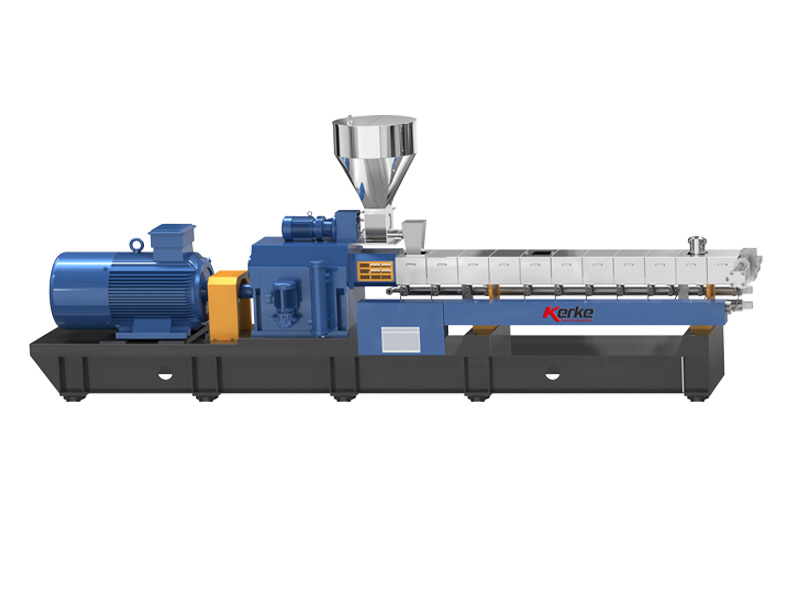
The KSE-90 Twin Screw Extruder represents an excellent choice for high concentration masterbatch production. With 90mm screw diameter and L/D ratio of 44:1, this model provides throughput capacity of 600-1,400 kg/hr for high loading applications. The enhanced screw configuration with staggered kneading blocks and reverse-conveying elements creates intensive mixing zones necessary for achieving excellent dispersion at high pigment loadings. The KSE-90 features wear-resistant barrel and screw components, high-torque drive system, and 12 heating zones for precise temperature control. Kerke Twin Screw Extruder technology enables high concentration masterbatch production with pigment loadings up to 80% while maintaining excellent dispersion. The base price for the KSE-90 high concentration masterbatch system is approximately $520,000 to $750,000 depending on configuration and wear protection options.
The KSE-110 Twin Screw Extruder offers increased capacity and enhanced performance for larger high concentration masterbatch production requirements. With 110mm screw diameter and L/D ratio of 48:1, this model achieves throughput of 1,200-2,800 kg/hr for high loading formulations. The KSE-110 features 14 heating zones, advanced mixing elements specifically designed for extreme pigment loadings, tungsten carbide coating on wear surfaces, and integrated process monitoring capabilities. This model is ideal for manufacturers producing high concentration masterbatch for demanding applications. The KSE-110 system typically costs $750,000 to $1,100,000 depending on automation level and wear protection specifications.
The KSE-75 Twin Screw Extruder provides an efficient solution for smaller capacity high concentration masterbatch production or product development. With 75mm screw diameter and L/D ratio of 40:1, this model delivers throughput of 300-600 kg/hr. The KSE-75 features wear-resistant components, enhanced mixing capability, and modular screw design for easy customization. This model is suitable for specialty high concentration masterbatch production or as a development line for new formulations. The base price for the KSE-75 high concentration system is approximately $380,000 to $550,000 depending on configuration.
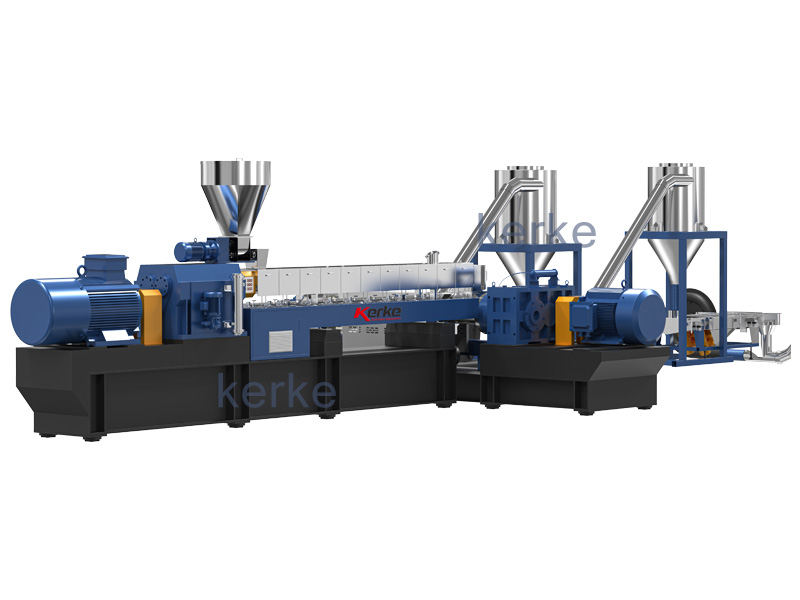
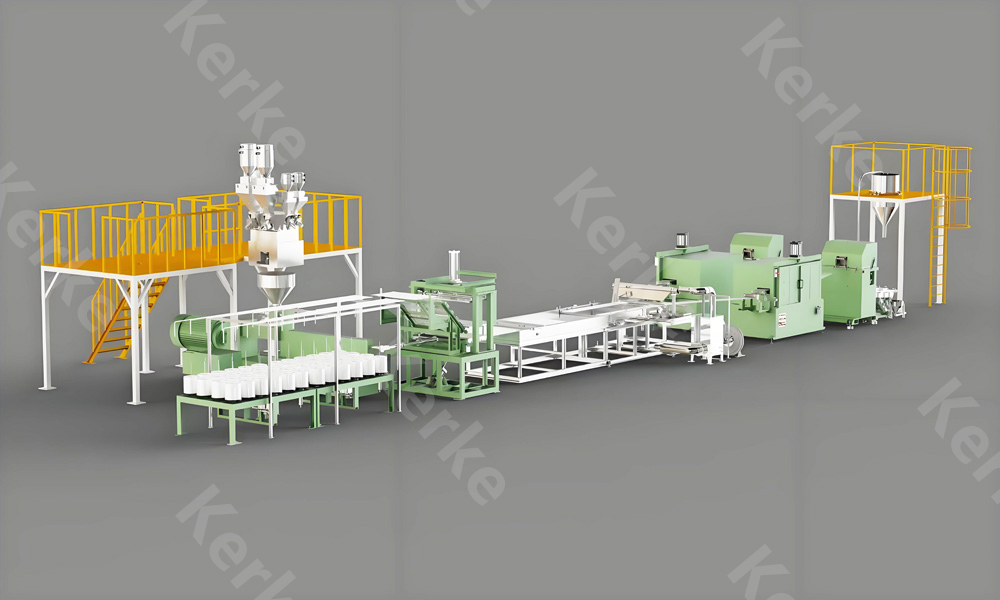
Kerke High Concentration Masterbatch Compounding Systems include complete turnkey solutions for high loading masterbatch production. These systems integrate twin screw extruder with enhanced mixing screw configuration, wear-resistant components, specialized material handling equipment, precise gravimetric feeding systems, cooling system, pelletizer, and comprehensive quality control equipment into a cohesive production line. The systems are designed for extreme pigment loadings, excellent dispersion, and maximum uptime for demanding applications. Turnkey system costs range from $550,000 for small capacity systems to $1,500,000 for high capacity, fully automated lines. Kerke Compounding Extruder technology ensures superior product quality and production efficiency for high concentration masterbatch applications.
Kerke Extruder also offers specialized components and accessories for high concentration masterbatch production. These include high-precision gravimetric feeding systems for accurate pigment dosing, wear-resistant screw and barrel components, high-torque drive systems, filtration systems, and advanced quality testing instruments. Gravimetric feeding systems cost $18,000 to $42,000. Wear-resistant component upgrades range from $25,000 to $70,000 depending on material selection and scope. High-torque drive system upgrades cost $35,000 to $80,000. Advanced quality testing systems range from $25,000 to $60,000. Kerke Twin Screw Extruder systems integrate seamlessly with these components for complete production solutions tailored to high concentration masterbatch requirements.
Market Applications and Opportunities
High concentration masterbatch finds diverse applications across multiple industries where cost efficiency, logistics optimization, and processing efficiency are valued. The market encompasses color masterbatch for plastics, functional additives, and specialty applications requiring high pigment or additive loading. Understanding market applications helps manufacturers identify opportunities and develop products that meet specific industry requirements.
The packaging industry represents the largest application segment for high concentration color masterbatch, driven by cost reduction initiatives and supply chain optimization. Packaging applications including films, bottles, and containers benefit from reduced addition rates and lower material handling costs. Typical addition rates for high concentration color masterbatch in packaging range from 0.2-1.5% compared to 2-8% for conventional masterbatch. Kerke Twin Screw Extruder systems produce packaging-grade high concentration masterbatch with excellent dispersion and consistent color development. The market price for packaging-grade high concentration color masterbatch ranges from $7,500 to $16,000 per ton, with specialty high-performance formulations commanding $14,000 to $28,000 per ton.
The automotive industry utilizes high concentration masterbatch for interior and exterior components where consistent color and cost efficiency are critical. Automotive applications require masterbatch with excellent thermal stability, lightfastness, and batch-to-batch consistency. High concentration formulations enable consistent color across multiple suppliers and production facilities. Kerke Masterbatch Extruder technology can produce automotive-grade high concentration masterbatch meeting stringent quality requirements. The market price for automotive-grade high concentration masterbatch ranges from $10,000 to $22,000 per ton.
Consumer goods applications including appliances, electronics, and household products benefit from high concentration masterbatch through reduced storage requirements and consistent color quality. These applications often require a wide color range with excellent batch consistency. High concentration formulations enable global color consistency across multiple manufacturing locations. Kerke Compounding Extruder systems can produce high concentration masterbatch with exceptional color consistency across production batches. The market price for consumer goods grade high concentration masterbatch ranges from $8,000 to $18,000 per ton.
Functional additive masterbatch applications include UV stabilizers, flame retardants, antistatic agents, and antimicrobial additives at high loadings. These applications require precise dispersion to ensure uniform functionality while minimizing effects on base polymer properties. High concentration formulations enable lower addition rates while maintaining functional performance. Kerke Extruder technology can produce high concentration functional masterbatch with excellent dispersion and consistent performance. The market price for high concentration functional masterbatch ranges from $12,000 to $35,000 per ton depending on additive type and loading.
Specialty applications include conductive masterbatch for EMI shielding, magnetic masterbatch for special effects, and high-loading mineral fillers. These applications often require pigment loadings above 80% and specialized processing approaches. Kerke Twin Screw Extruder systems can achieve loadings up to 90% for certain applications with appropriate formulation and processing optimization. The market price for specialty high concentration masterbatch ranges from $15,000 to $45,000 per ton.
Future Trends and Innovation
The high concentration masterbatch market continues to evolve with advancing technology, changing market demands, and emerging application requirements. Understanding current trends and future developments helps manufacturers identify growth opportunities and make strategic investment decisions. The global high concentration masterbatch market is projected to grow at 7-9% annually through 2030, driven by cost optimization initiatives and supply chain efficiency demands.
Technology trends emphasize advanced pigment surface treatments, nano-dispersant systems, and intelligent process control. Next-generation pigment surface treatments enable higher loadings through enhanced wettability and reduced inter-particle forces. Nano-dispersant systems provide superior stabilization at lower concentrations. Intelligent process control systems incorporate AI and machine learning for automatic optimization of processing parameters. Kerke Masterbatch Extruder systems incorporate the latest technology trends for high loading applications. The investment in advanced technology typically ranges from $40,000 to $120,000 for complete systems.
Formulation innovations include super-high loading technologies achieving pigment concentrations above 90% for certain applications. Hybrid pigment systems combining different pigment types enable higher loadings while maintaining color properties. Bio-based dispersants address sustainability concerns while maintaining high loading performance. Kerke Compounding Extruder technology supports formulation innovation through flexible processing capabilities. The development cost for innovative high loading formulations typically ranges from $35,000 to $100,000 per product family.
Market growth is particularly strong in Asia Pacific, driven by cost optimization initiatives and expanding manufacturing industries. China, India, and Southeast Asia represent high-growth regions for high concentration masterbatch. North America and Europe show moderate growth rates of 5-7% annually, with emphasis on specialty high-performance formulations. Kerke Extruder has established presence in key growth markets, providing local support and service for high concentration masterbatch production equipment.
Sustainability trends drive demand for recyclable high concentration masterbatch formulations that do not interfere with plastic recycling processes. This includes masterbatch compatible with both mechanical and chemical recycling technologies. Bio-based carrier resins and naturally derived dispersants are gaining market acceptance. Monomaterial solutions drive demand for high concentration masterbatch compatible with specific polymer types. Kerke Twin Screw Extruder systems can process both conventional and sustainable formulations, enabling manufacturers to adapt to changing market preferences. The cost premium for sustainable formulations typically ranges from 15-25% over conventional products.
Future market opportunities include high concentration masterbatch for biodegradable polymers, smart masterbatch with responsive properties, and specialty applications requiring extreme loadings. Investment in R&D and equipment flexibility enables manufacturers to capture emerging market segments. Kerke Extruder modular design allows rapid adaptation to new formulations and product innovations as market requirements evolve. The investment in R&D capabilities typically ranges from $150,000 to $400,000 annually for competitive high concentration masterbatch manufacturers.
Conclusion
High concentration masterbatch represents a sophisticated and valuable product category enabling manufacturers to achieve significant cost savings, logistics optimization, and processing efficiency. Success in high concentration masterbatch production requires deep understanding of pigment characteristics, advanced dispersion technology, specialized processing equipment, and comprehensive quality control. Investment in quality equipment from Kerke Extruder enables manufacturers to produce consistent, high-quality high concentration masterbatch that meets the demanding requirements of diverse applications.
The comprehensive approach to high concentration masterbatch production, from pigment selection through quality control to market delivery, ensures product excellence and customer satisfaction. Kerke Twin Screw Extruder technology provides the foundation for achieving excellent dispersion at extreme loadings, product consistency, and operational efficiency. Manufacturers investing in Kerke Extruder equipment benefit from competitive advantages in product quality, production capability, and market responsiveness.
The future of high concentration masterbatch production continues to evolve with advancing technology, changing market demands, and emerging applications. Companies maintaining technological leadership through equipment investment and product innovation will capture growth opportunities in this dynamic market. Kerke Extruder remains committed to advancing high concentration masterbatch production technology, supporting manufacturers in achieving excellence in this valuable product segment.