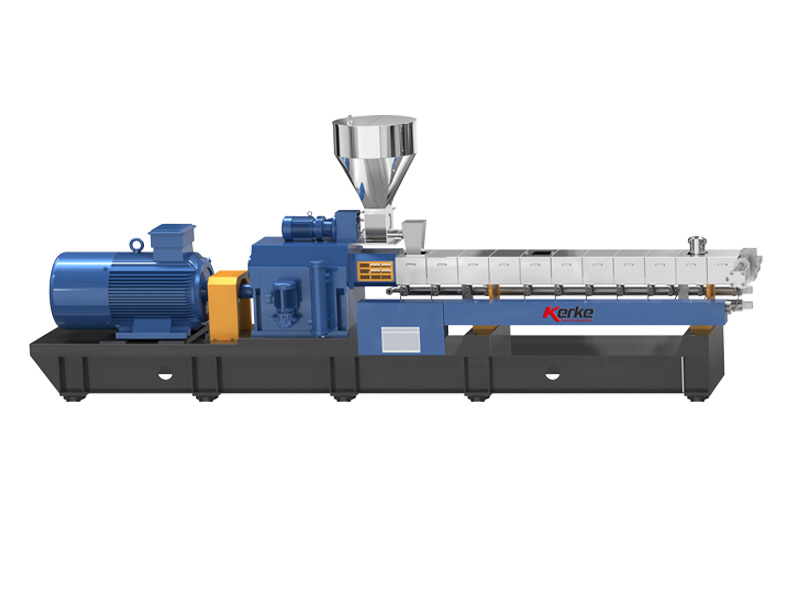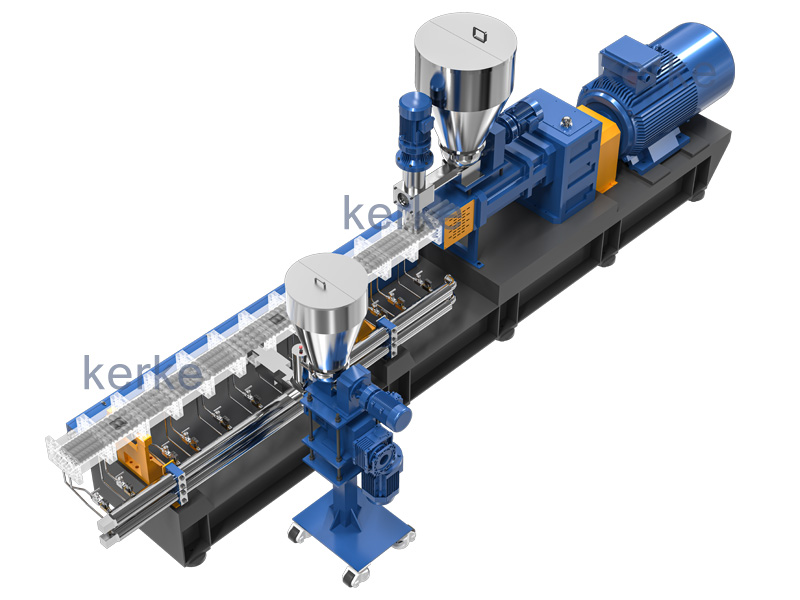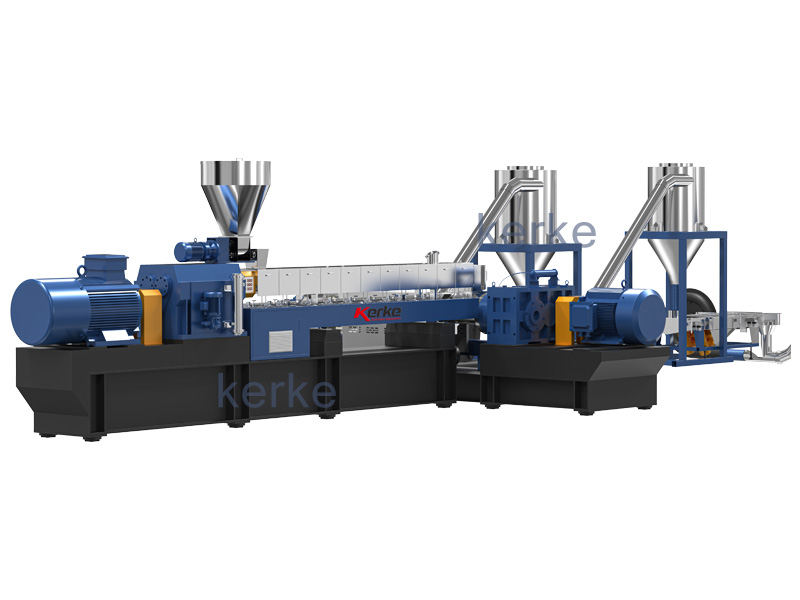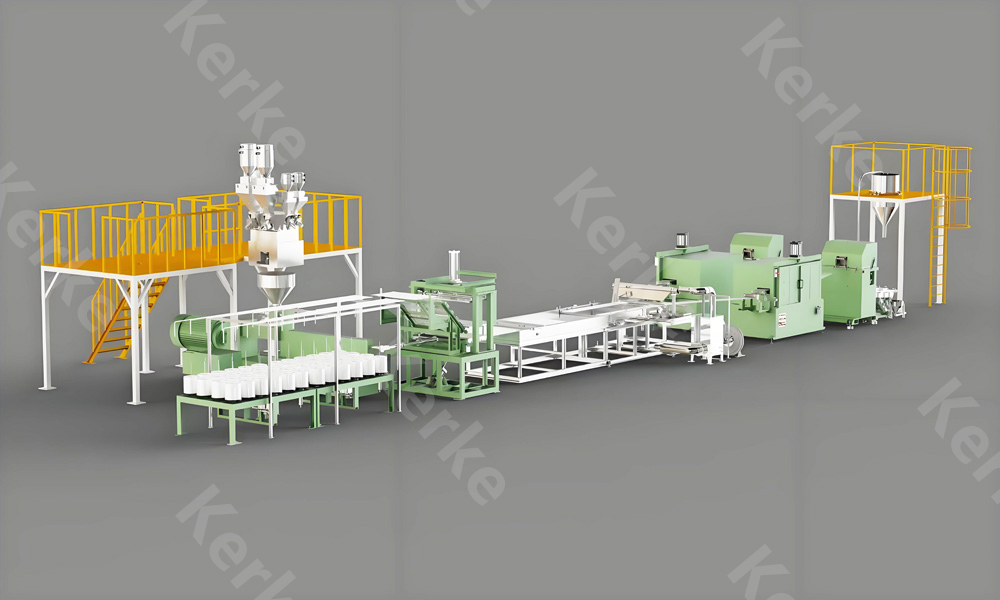
Flame retardant masterbatch has become one of the most technically demanding product families in the functional masterbatch industry. As electronics shrink, densify, and migrate into cars, homes, and industrial control systems, the plastics that house them must resist ignition, limit flame spread, and suppress the formation of toxic and corrosive smoke. For masterbatch producers and compounders, the challenge is no longer simply to pass a burn test, but to deliver a concentrate that survives high-temperature processing, disperses uniformly, meets global chemical regulations, and protects the surface quality of the final molded part. This guide explains the chemistry, standards, formulation strategy, and twin-screw compounding practice required to manufacture flame retardant masterbatch for electronic plastics, and it shows how a modern co-rotating twin-screw line such as the Kerke KTE series, a Wanplas factory product, supports consistent, high-throughput production.
Market Context: Why Flame Retardancy Defines Electronic Plastics
The global consumption of flame retardant additives is concentrated in electrical and electronic equipment, building wires, and transportation. Within electronics, the relevant polymers are dominated by styrenics such as high-impact polystyrene and acrylonitrile-butadiene-styrene, polyamide used in connectors and housings, polycarbonate and PC/ABS blends for thin-wall enclosures, and polypropylene for internal structural parts. Each of these resins burns readily in its neat form, and each demands a different flame retardant strategy because the polymer degradation temperature, melt flow, and char-forming tendency vary widely.
Regulatory pressure is the second driver. Consumer electronics sold in the European Union must comply with RoHS substance restrictions and the broader chemical controls of REACH. Appliances placed on the North American market are evaluated against UL 94 and related end-product safety standards. Equipment destined for data centers, rail, and automotive applications faces IEC 60695 glow-wire requirements and increasingly stringent smoke-density and toxicity limits. A masterbatch producer that serves export customers must therefore design a single concentrate that satisfies multiple regimes rather than a single local test.
From an equipment standpoint, the consistent theme is mixing intensity versus thermal sensitivity. Many high-performance flame retardants are mineral fillers or salt-like powders that must be dispersed at high load without overheating. Kerke, a Wanplas factory, supplies parallel co-rotating twin-screw compounding extruders of the KTE series, available from the lab-scale KTE-16B up to the high-capacity KTE-135D, with output ranging from 30 kg/h pilot scale to several tonnes per hour. The same computer-aided screw-assembly philosophy that gives Kerke its self-cleaning kneading blocks is what lets compounders balance dispersion against shear heating when running thermally fragile flame retardant systems.
Fundamentals of Flame Retardant Masterbatch Chemistry
Combustion of a polymer proceeds through a four-stage cycle: heating, decomposition into volatile fuels, mixing of those fuels with oxygen in the gas phase, and exothermic flame reactions that feed heat back into the material. Effective flame retardants interrupt one or more of these stages. Understanding which stage a given additive attacks determines how much of it is needed, how it interacts with the host resin, and what side effects the compounder must manage.
Gas-Phase Action
Halogenated flame retardants release halogen radicals when heated. These radicals scavenge the high-energy hydroxyl and hydrogen radicals that sustain the flame, slowing the chain reaction in the gas phase. The advantage is efficiency: relatively low loadings, often 8 to 18 percent of additive, can deliver a V-0 rating. The disadvantage is the formation of hydrogen halides and dense smoke, together with corrosive byproducts that attack metal contacts and circuit boards.
Condensed-Phase Action
Phosphorus-based systems, intumescent packages, and metal hydroxides act primarily in the condensed phase. Phosphorus promotes char formation, building an insulating barrier between the flame and the underlying polymer. Metal hydroxides such as aluminum hydroxide and magnesium hydroxide decompose endothermically, absorbing heat and releasing water vapor that dilutes combustible gases. Intumescent systems combine an acid source, a carbon source, and a blowing agent to inflate a protective foam char. These mechanisms generate far less smoke and no corrosive halogens, which is why they dominate halogen-free electronic applications.
Barrier and Heat-Sink Action
At very high loadings, mineral fillers function partly as a heat sink and partly as a physical barrier that slows heat and mass transfer. This is the domain of aluminum trihydroxide and magnesium hydroxide, which can be incorporated at 50 to 65 percent by weight in polyolefin compounds. Such loadings transform the rheology of the melt and demand extrusion equipment capable of conveying and devolatilizing large volumes of powder without surging.
Synergy and Antagonism
Formulators exploit synergy constantly. A brominated compound paired with antimony trioxide is the classic gas-phase synergy, where antimony trioxide reacts with halogen to form antimony halides that are even more effective radical scavengers. In halogen-free systems, nitrogen-phosphorus synergy and the combination of melamine polyphosphate with specific char-formers are common. Antagonism is equally real: some pigments, lubricants, and stabilizers degrade flame performance or accelerate plate-out, so every component of the masterbatch must be screened, not only the primary flame retardant.
Halogenated vs Halogen-Free Flame Retardant Systems
The strategic choice between halogenated and halogen-free chemistry is the single most important decision in product development. It sets the ceiling on regulatory acceptance, the cost structure, and the processing window.
| Property | Halogenated (Brominated + Sb2O3) | Halogen-Free (Mineral / Intumescent) |
|---|---|---|
| Typical additive loading | 8 to 18 percent | 25 to 65 percent |
| Efficiency to reach V-0 | High | Medium to High (depends on resin) |
| Smoke and corrosivity | High smoke, corrosive fumes | Low smoke, low corrosivity |
| RoHS / REACH acceptability | Restricted; deca-BDE banned in EU | Generally favorable |
| Impact on mechanical properties | Low (low loading) | Higher stiffness, lower impact at high loading |
| Processing torque demand | Low to Medium | High (especially hydroxides) |
| Relative cost level | Medium | Medium to High |
Within halogen-free chemistry, the resin strongly governs results. Polyamide tolerates melamine polyphosphate and reacts well with phosphorus synergists, which is why halogen-free FR polyamide is common in connectors. Polyolefins and styrenics are less char-forming and rely heavily on mineral hydroxides or intumescent packages, which pushes loadings upward and makes dispersion the central engineering problem. Reference suppliers such as ICL, Lanxess, and Albemarle publish resin-specific guidelines, and a compounder should validate each recommended pairing on a lab twin-screw extruder before committing to a production run.
Key Performance and Regulatory Standards
Masterbatch producers must speak the language of the test standards their customers cite, because the rating printed on a datasheet is only meaningful at a defined thickness and under a defined method. The most cited standards in electronic plastics are listed below.
| Standard | Scope | What It Controls |
|---|---|---|
| UL 94 | Vertical and horizontal burn of plastics | Burning rate and after-flame time; ratings V-0, V-1, V-2, HB |
| IEC 60695 (glow-wire) | Glow-wire ignition and flammability | Resistance to incandescent wire at 550 to 960 degrees C |
| ISO 1210 / ISO 9773 | Laboratory burning behavior | Comparative flame spread and thin-material tests |
| RoHS | Substance restriction in EEE | Limits lead, cadmium, mercury, PBB, PBDE, phthalates |
| REACH | EU chemical registration | SVHC candidate list and authorization obligations |
| GB standards (China) | National flame and glow-wire tests | GB/T 2408 burn, GB/T 5169 glow-wire for domestic market |
| ASTM E662 / smoke | Smoke density | Specific optical smoke density in flaming and non-flaming modes |
It is essential to report the rating together with the thickness, because UL 94 V-0 at 1.5 mm is a very different achievement from V-0 at 0.8 mm. A thin-wall enclosure may require 30 to 50 percent more flame retardant than a thick-wall part to retain the same classification. The masterbatch should therefore be characterized at the customer’s actual part thickness, not at a convenient laboratory coupon thickness.
Formulation Design and Typical Loadings
A flame retardant masterbatch is rarely just flame retardant plus carrier. A complete formulation usually contains a carrier resin matched to the end polymer, the primary flame retardant, one or more synergists, a thermal stabilizer to survive processing, a lubricant or dispersing aid, and sometimes a coupling agent to preserve mechanical properties at high filler loading.
Carrier Resin Selection
The carrier should be compatible with the host polymer so that the concentrate disperses into a homogeneous melt. For ABS and HIPS applications, an SAN or PS-based carrier is typical. For polyamide, a polyamide-based carrier or a reactive compatibilizer prevents a weak interface. Mismatched carriers cause specking, poor surface finish, and reduced mechanical strength even when the flame rating is met.
Representative Formulation Windows
| Target System | Primary FR | Masterbatch FR Content | Dosing at Mold |
|---|---|---|---|
| ABS / HIPS enclosure | Brominated + antimony trioxide | 50 to 70 percent | 10 to 18 percent |
| Halogen-free HIPS | Intumescent (APP / PER / MEL) | 60 to 75 percent | 20 to 30 percent |
| Polyamide connector | Melamine polyphosphate | 50 to 65 percent | 15 to 25 percent |
| Polypropylene internal part | Magnesium hydroxide | 70 to 80 percent | 30 to 50 percent |
| PC/ABS thin wall | Silicone / phosphate blend | 40 to 55 percent | 8 to 15 percent |
These windows are starting points, not specifications. The actual masterbatch FR content is chosen so that the dosing percentage at the customer’s machine yields the target final concentration. Producing a high-active masterbatch reduces logistics and pigmentation dilution but raises torque and heat load during production. The extrusion line must therefore be engineered for the chosen active level, which is where screw configuration becomes decisive.
Twin-Screw Compounding: Screw Configuration and Feeding
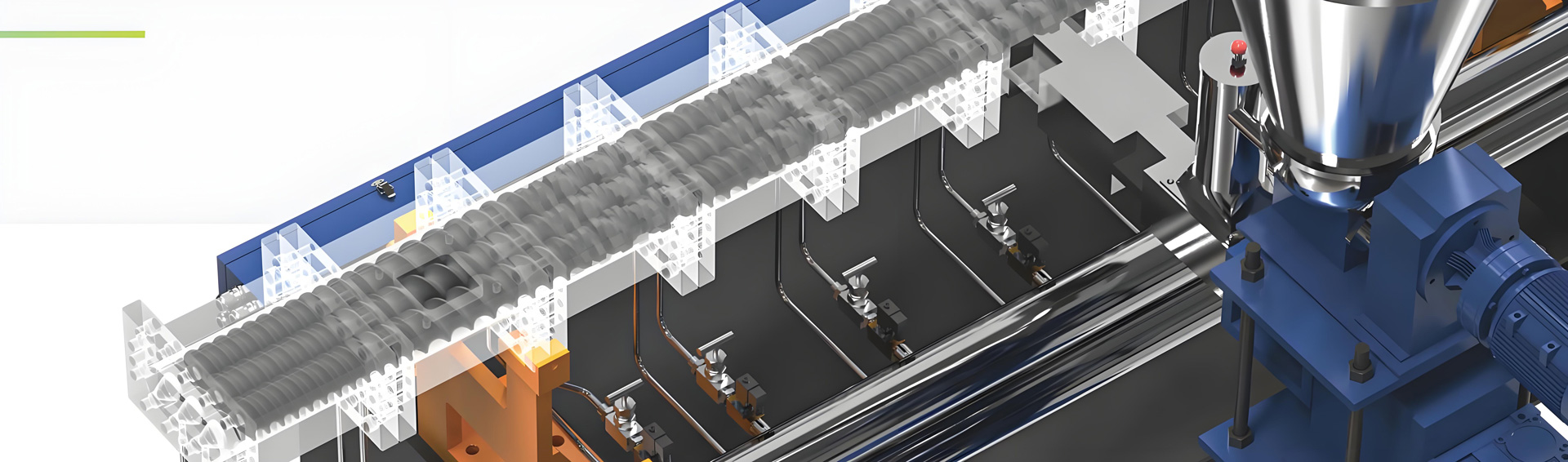
The co-rotating twin-screw extruder is the workhorse of flame retardant masterbatch because it offers modular screw elements, intense and controllable shear, multiple side-feeding and venting ports, and excellent self-cleaning. Kerke, a Wanplas factory, applies computer-aided screw assembly to the KTE series so that each element sequence can be tuned to the specific additive system rather than copied from a generic profile.
Screw Configuration Principles
- Feed zone: Fully flighted, low-shear conveying that moves powder and carrier into the melting section without premature heating.
- Melting zone: A gentle kneading block or bilobal element that melts the carrier while minimizing temperature spikes that would degrade heat-sensitive flame retardants.
- Mixing zone: Staggered kneading discs and toothed elements that break agglomerates and disperse the flame retardant to the sub-micron level needed for uniform combustion behavior.
- Venting zone: One or two atmospheric or vacuum vents that remove moisture released by metal hydroxides and volatiles from synergists.
- Metering zone: A short, low-compression section that builds stable pressure for the die and pelletizer.
Side Feeding for High Loadings
When aluminum hydroxide or magnesium hydroxide exceeds roughly 40 percent of the total compound, feeding all powder through the main hopper floods the screw and overloads the drive. A side feeder introduces the mineral downstream, after the carrier has melted, so the screw conveys melt plus powder rather than dry powder. Kerke supplies twin-screw side feeders and loss-in-weight feeders for precisely this purpose. The side feed location also reduces residence time of the filler in the high-shear zone, limiting degradation.
Screw Configuration Guidance by System
| FR System | Recommended L/D | Kneading Intensity | Venting |
|---|---|---|---|
| Brominated + Sb2O3 | 36 to 40 | Medium | Single vent |
| Intumescent | 40 to 44 | Medium-High | Single vent |
| Metal hydroxide | 44 to 52 | Low-Medium (protect filler) | Double vent (vacuum) |
| Phosphorus in PA | 40 to 44 | Medium | Single vent |
Temperature profiling must track the chemistry. Metal hydroxides begin endothermic decomposition around 200 to 340 degrees C depending on grade; the barrel setpoints should stay below the onset until the vent, then rise to ensure complete drying and pellet integrity. Brominated systems tolerate higher shear but the synergist and any antimony trioxide dust demand good venting to prevent agglomeration at the die.
Pelletizing Choice
Flame retardant masterbatches are commonly strand-pelletized (water-cooled or air-cooled strand) or die-face cut. Water ring and underwater systems suit high-throughput mineral loads but require careful drying to avoid hydrolysis in the finished pellet. For lab and pilot work, the Kerke laboratory twin-screw extruder with a strand pelletizer lets formulators validate dispersion and burn performance before scaling to a KTE production line.
Processing Challenges: Thermal Stability, Dispersion, Plate-out
Three recurring problems determine whether a flame retardant masterbatch is commercializable: thermal degradation during compounding, inadequate dispersion, and plate-out on tooling.
Thermal Stability
Every flame retardant has a decomposition temperature. If the melt temperature at the die exceeds it, the additive begins to break down, releasing gas that creates voids, odor, and loss of efficiency. The remedy is a conservative temperature profile, a stabilizer package compatible with both carrier and additive, and screw design that avoids hot spots. Co-rotating self-cleaning screws reduce dead-flow regions where material can over-reside and scorch.
Dispersion Quality
Flame performance depends on uniform distribution of the retardant throughout the matrix. Poorly dispersed agglomerates create local lean regions that ignite first. Measurement methods include microscope image analysis of microtomed sections and, indirectly, the standard deviation of limiting oxygen index across multiple coupons. Achieving sub-micron dispersion of intumescent components typically requires optimized kneading-block stagger angles and sufficient residence time in the mixing zone.
Plate-out
Plate-out is the deposition of a waxy or powdery layer on dies, filters, and mold surfaces. It is driven by low-molecular-weight additive migration, excess lubricant, and incomplete incorporation of the flame retardant. Plate-out ruins surface gloss, causes streaking, and forces frequent mold cleaning. Control measures include selecting higher-molecular-weight stabilizers, balancing internal and external lubricants, ensuring full dispersion, and operating the devolatilization zone at adequate vacuum. A sacrificial purge compound run between campaigns also extends mold-cleaning intervals for the customer.
Testing Protocols and Quality Control
A disciplined QC program protects both the masterbatch producer and the customer. The following in-process and finished-goods checks are standard for a serious flame retardant operation.
In-Process Checks
- Melt temperature and motor load trended continuously; an unexpected torque rise signals agglomeration or feed instability.
- Strand or pellet appearance for voids, gloss, and color uniformity.
- Online or offline melt flow rate to confirm the carrier has not degraded.
- Moisture of incoming metal hydroxide to predict venting load.
Finished-Goods Tests
| Test | Method | Acceptance Logic |
|---|---|---|
| UL 94 burn | UL 94 vertical at part thickness | After-flame and dripping within class limit |
| Limiting oxygen index | ISO 4589 | Above target, low batch-to-batch variance |
| Glow-wire | IEC 60695-2 | No ignition at specified temperature |
| Dispersion rating | Microtome + image analysis | Agglomerate count below limit |
| Chemical compliance | RoHS / REACH screen | Substances below threshold |
Because flame retardancy is sensitive to thickness, the producer should mold test plaques at the same thickness the customer will use and record it on the certificate of analysis. Supplying a reference molding guideline with the masterbatch reduces customer-side failures and supports technical service claims.
Equipment Selection: Choosing the Right Extruder
Selecting compounding equipment for flame retardant masterbatch is a matter of matching screw volume, torque, and feeding flexibility to the most demanding formulation in the portfolio. Kerke, a Wanplas factory, ranges the KTE series so that a producer can start on a KTE-25 or KTE-36 laboratory and pilot line and scale into KTE-65, KTE-75, or larger production machines with the same screw-element logic.
Evaluation Criteria
- Specific torque: High-filler hydroxides need high torque per free volume; undersized gearboxes surge and overheat.
- Modularity: The ability to re-arrange kneading blocks and add side feeders protects the line when a new FR chemistry is qualified.
- Venting: At least one vacuum vent, preferably two, for hydroxide and intumescent systems.
- Feeding: Loss-in-weight main and side feeders with gravimetric accuracy better than 0.5 percent.
- Self-cleaning: Co-rotating, closely intermeshing screws minimize cross-contamination between colored and non-colored campaigns.
Competitive twin-screw suppliers such as Coperion, Leistritz, and Bühler set the benchmark for high-torque compounding, and Kerke positions the KTE series as a cost-effective alternative with the same modular philosophy and the Wanplas group’s shared service commitments, including 500 USD worth of free spare parts per year and a quality-standard guarantee that offers refund plus compensation if agreed specifications are not met. For very high-volume mineral masterbatch, a double-stage or mother-baby extrusion system can separate intensive mixing from devolatilization and pelletizing, improving stability.
Production Scale-Up Checklist
Scaling from lab to production is where many flame retardant programs fail. Use the following checklist before committing a full campaign.
| Step | Verification |
|---|---|
| 1. Raw material qualification | Moisture, particle size, and supplier CoA for each additive |
| 2. Lab extrusion + burn test | UL 94 and LOI at target thickness confirmed |
| 3. Screw and feed design | L/D, kneading stagger, side feed, and vent map locked |
| 4. Thermal profile set | Max melt temp below FR decomposition onset |
| 5. Dispersion validation | Microtome image confirms no lean regions |
| 6. Plate-out screening | Short molding run shows clean tooling |
| 7. Compliance documentation | RoHS and REACH declarations assembled |
| 8. Pilot campaign | One to two hours stable at target throughput |
| 9. Production release | SPC limits set; first three lots fully tested |
Frequently Asked Questions
What is the difference between halogenated and halogen-free flame retardant masterbatch?
Halogenated systems use brominated or chlorinated additives that act in the gas phase and deliver high efficiency at low loadings, but release corrosive and smoke-dense fumes. Halogen-free systems use phosphorus, nitrogen, metal hydroxides or intumescent chemistry that act in the condensed phase, generating less smoke and meeting RoHS and REACH expectations, at the cost of higher loadings and greater torque demand.
Which screw configuration is best for processing aluminum hydroxide or magnesium hydroxide?
High-load metal hydroxide compounds require low-shear conveying and strong venting. Use a longer L/D ratio of 44 to 52, a fully flighted feed section, side feeding of the hydroxide to protect the polymer melt, and two-stage venting. Avoid aggressive kneading blocks in the melting zone to reduce localized overheating of the filler.
How do I prevent plate-out on extruder dies and molds?
Plate-out is caused by low-molecular-weight additive migration. Minimise it by using higher-molecular-weight stabilizer packages, balancing lubricant levels, improving dispersion with optimized kneading blocks, and running devolatilization zones at adequate vacuum. Regular die cleaning and a sacrificial purge compound also help.
What UL 94 rating is typically required for consumer electronics enclosures?
Most consumer electronics housings target V-0 at 1.5 mm or 0.8 mm thickness, while internal components such as connectors may accept V-1 or V-2. The required thickness and rating are defined by the end-product safety standard and the certification body.
Can flame retardant masterbatch be produced on a single-screw extruder?
Single-screw machines can disperse liquid and low-filler FR systems but struggle with high-load mineral hydroxides and intumescent packages that need intensive mixing and strong devolatilization. A co-rotating twin-screw extruder is preferred for consistent quality and throughput.
What should a masterbatch producer verify before submitting parts for UL 94 or IEC 60695 testing?
Verify consistent thickness, representative pigmentation, stable additive dispersion, and that the base resin and additive system match the certified formulation. Run in-house glow-wire and limiting oxygen index screening first, document the full bill of materials for RoHS and REACH, and confirm the flame class at the actual finished-part thickness.
Conclusion
Flame retardant masterbatch for electronic plastics sits at the intersection of polymer chemistry, fire science, and precision extrusion. The producer who wins repeat business is the one who treats the concentrate as a complete system: a compatible carrier, a chemistry matched to the regulatory target, a dispersion strategy that closes lean regions, and a twin-screw process engineered for thermal sensitivity and devolatilization. Kerke, a Wanplas factory, supports this work with the KTE series of co-rotating twin-screw compounding extruders, from the KTE-16B laboratory machine through the high-capacity KTE-135D, backed by modular screw design, loss-in-weight and side-feeding systems, and the Wanplas group’s shared commitments to quality and spare-parts support. For masterbatch producers scaling halogen-free or high-filler formulations, the right equipment and a disciplined scale-up checklist turn a difficult flame rating into a reliable, repeatable commercial product.