1. Introduction to High Concentration Pigment Masterbatch
High concentration pigment masterbatch is a specialized colorant material widely used in the global plastic processing, extrusion, injection molding and film production industries. Unlike conventional standard masterbatch with low and medium pigment content, high concentration pigment masterbatch features ultra-high pigment loading capacity, compact formula structure, low carrier resin occupancy and excellent color dispersion performance. It is defined as a concentrated composite material formed by uniformly dispersing 30% to 70% high-purity organic or inorganic pigment particles in a small amount of thermoplastic carrier resin through professional compounding and extrusion processing. This high-efficiency colorant has gradually replaced traditional low-concentration masterbatch and powdered pigment coloring materials, becoming the mainstream choice for high-efficiency, low-cost and high-precision plastic coloring production.
The core advantages of high concentration pigment masterbatch focus on production cost optimization, coloring uniformity improvement and processing efficiency upgrade. In actual industrial production, high-concentration masterbatch only needs a small proportion of addition to achieve ideal coloring effects, which greatly reduces the consumption of masterbatch raw materials, lowers the mixing and processing pressure of molding equipment, and effectively avoids common defects such as color spots, color difference and uneven dispersion caused by excessive carrier resin addition. It is widely applicable to HDPE, PP, PVC, ABS, PET and other plastic raw materials, covering plastic pipe, plastic film, plastic profile, injection molded parts and other product production scenarios.
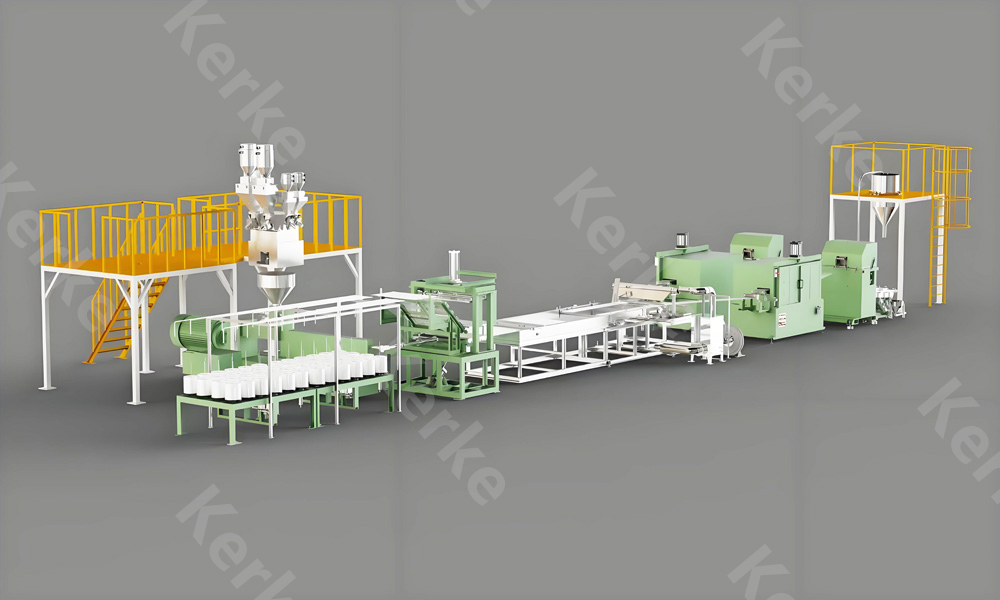
The production quality and comprehensive efficiency of high concentration pigment masterbatch are directly determined by masterbatch extrusion and compounding equipment performance. Twin screw extruder, masterbatch extruder and compounding extruder are the core processing equipment for high-concentration pigment masterbatch production. As a professional manufacturer of high-performance extrusion equipment, KERKE focuses on the research and development and production of customized twin screw extruder and compounding extruder for masterbatch production. Its equipment is specially optimized for high pigment loading, high dispersion uniformity and high production efficiency, solving the technical pain points of difficult high-concentration pigment dispersion, low yield and high defect rate in traditional masterbatch production. This comprehensive guide systematically elaborates the core knowledge of high concentration pigment masterbatch loading technology, efficiency improvement methods, equipment matching schemes and cost control strategies, providing practical technical guidance for masterbatch production enterprises.
2. Basic Definition and Core Characteristics of High Concentration Pigment Masterbatch
2.1 Standard Definition of High Pigment Loading Concentration
In the masterbatch industry, the concentration grade of pigment masterbatch is divided according to the mass fraction of effective pigment components. Conventional low-concentration masterbatch has a pigment loading of 10% to 25%, medium-concentration masterbatch ranges from 25% to 30%, and masterbatch with a pigment loading higher than 30% is uniformly defined as high concentration pigment masterbatch. For special inorganic pigment masterbatch such as titanium dioxide and carbon black, the high-concentration standard can reach 50% to 70% loading rate due to the small particle size and strong dispersion adaptability of pigments. The ultra-high loading feature is the core difference between high-concentration masterbatch and ordinary masterbatch, and also the key factor affecting coloring efficiency and production cost.
High-quality high concentration pigment masterbatch requires that while realizing ultra-high pigment loading, the pigment particles maintain nano-level uniform dispersion, no agglomeration, no precipitation, and have good compatibility with various plastic carrier materials. The product has stable color difference tolerance, strong coloring power, and will not produce color fading, migration and blooming in long-term plastic product application, meeting the high-standard coloring requirements of food-grade, medical-grade and outdoor engineering plastic products.
2.2 Core Performance Characteristics of High Concentration Masterbatch
First, it has ultra-high coloring efficiency. The high pigment loading rate enables the addition ratio of high-concentration masterbatch in plastic molding production to be reduced to 1% to 3%, while ordinary masterbatch requires 3% to 8% addition. The coloring coverage rate per unit mass of masterbatch is increased by more than 60%, which significantly improves the overall coloring efficiency of the production line. Second, it has excellent dispersion stability. Professional compounding and extrusion processing can fully break pigment agglomerated particles, realize uniform fusion of pigment and carrier resin, and avoid color defects caused by uneven dispersion.
Third, it has low processing loss and high environmental protection. High-concentration masterbatch reduces the use of carrier resin and auxiliary additives, reduces plastic raw material waste and volatile organic compound emission in the processing process, and conforms to global environmental protection production standards. Fourth, it has strong formula adaptability. It can be customized according to different plastic substrates, processing temperatures and application scenarios, and is compatible with various extrusion, injection molding and blow molding processes, with wide industrial applicability.
2.3 Industrial Application Scenarios
High concentration pigment masterbatch is widely used in multiple high-precision plastic processing fields. In the packaging industry, it is used for color coloring of food packaging films, plastic bottles and flexible packaging materials, with uniform color and no migration, meeting food safety standards. In the building materials industry, it is applied to the coloring of plastic pipes, profiles and waterproof coiled materials, with strong weather resistance and anti-aging performance, suitable for long-term outdoor use.
In the automotive and electronic industry, high-concentration masterbatch is used for the coloring of automotive plastic parts, electronic shell accessories and insulating materials, with stable color difference and high product consistency. In the daily chemical and toy industry, it meets the non-toxic and odorless coloring requirements of daily plastic products and children’s toys. With the upgrading of plastic product quality standards, the market demand for high concentration pigment masterbatch is increasing year by year, putting forward higher requirements for masterbatch compounding and extrusion equipment performance.
3. Key Principles of High Concentration Pigment Loading Technology
Pigment loading is the core process of high concentration masterbatch production. The loading quality directly determines the dispersion effect, coloring power and product stability of the finished masterbatch. Ultra-high pigment loading is not a simple physical mixing of pigment and resin, but a systematic process of particle crushing, dispersion, wetting, fusion and shaping. This chapter elaborates the core technical principles of high-efficiency pigment loading, and analyzes the key technical points restricting loading effect.
3.1 Pigment Particle Wetting and Permeation Principle
Most pigment particles have high surface tension and are easy to agglomerate into large particle clusters due to electrostatic adsorption. In the high loading process, the core technical goal is to use molten carrier resin and professional dispersants to fully wet the surface of pigment particles, penetrate into the gaps of agglomerated particles, and break the particle cluster structure. Good wetting effect can eliminate particle agglomeration, make single pigment particles uniformly wrapped by resin, and lay a foundation for high-concentration stable loading.
The wetting effect is affected by three core factors: pigment surface activity, resin melt viscosity and dispersant matching degree. High concentration loading needs to select targeted dispersant formulas according to different pigment types. Organic pigments need lipophilic dispersants to improve resin compatibility, while inorganic pigments need coupling agents to modify surface activity and enhance wetting effect. The twin screw extrusion process of compounding extruder can provide high shear force and uniform melt temperature field, which maximizes the wetting and permeation effect of resin on pigments.
3.2 Shear Dispersion and Uniform Mixing Principle
After wetting and permeation, pigment agglomerated particles still need strong shear force to be completely crushed and dispersed. In the masterbatch extrusion process, the twin screw structure of the compounding extruder produces continuous high shear, stretching and kneading effects on the mixed melt of pigment and resin. This mechanical force can effectively break micron and submicron pigment agglomerates, realize uniform distribution of pigment particles in the carrier resin, and avoid local high concentration and low concentration zoning.
Different from single screw extruder, twin screw extruder has independent material conveying and mixing functions, with stronger shear controllability and mixing uniformity. In high-concentration loading production, precise shear force matching is required: excessive shear force will cause pigment particle fragmentation and discoloration, while insufficient shear force will lead to incomplete dispersion and residual agglomeration. KERKE twin screw extruder realizes stepless adjustment of shear force through screw element combination optimization, which perfectly matches the shear demand of different high-concentration pigment formulas.
3.3 Melt Plasticization and Stabilization Principle
High pigment loading will significantly change the melt viscosity and plasticization performance of the mixed material. A large number of solid pigment particles will increase melt friction and reduce resin fluidity. Unreasonable plasticization control will lead to uneven material plasticization, material scorching and poor masterbatch molding. High-efficiency loading technology needs to match graded temperature control and stable material conveying process to ensure that the resin is fully plasticized, the pigment is uniformly dispersed, and the melt state is stable and consistent.
Stable melt plasticization can avoid pigment decomposition and color deviation caused by local overheating, and also prevent incomplete resin melting leading to poor pigment wrapping and easy shedding. The masterbatch extruder needs to have precise temperature zoning control and stable feeding system to ensure the consistency of melt state in the high-concentration loading process and improve the overall qualification rate of products.
4. Key Factors Affecting High Concentration Masterbatch Loading and Efficiency
The loading effect and production efficiency of high concentration pigment masterbatch are affected by formula design, equipment performance, process parameters and operation management. Any link deviation will lead to insufficient loading concentration, uneven dispersion, reduced coloring efficiency and increased production cost. This chapter analyzes all key influencing factors in detail to provide targeted optimization direction for production.
4.1 Pigment Raw Material Performance Factors
Pigment particle size, purity and surface activity are the basic factors determining loading limit. Fine particle size pigments have large specific surface area and strong adsorption force, which are easy to agglomerate, requiring higher shear dispersion conditions, but can achieve higher loading concentration and better coloring uniformity. Coarse pigment particles have poor dispersion effect, and excessive loading will lead to particle precipitation and color spots on the product surface.
Pigment purity and impurity content directly affect loading stability. High-purity pigments have stable chemical properties, no impurity interference, and can maintain stable color and dispersion effect under high loading conditions. Pigments with excessive moisture and impurities will cause melt bubbles, material scorching and dispersion failure in the extrusion process, reducing masterbatch quality and production efficiency. Therefore, high-concentration masterbatch production must select high-purity dry pigment raw materials and carry out pre-treatment such as drying and impurity removal.
4.2 Carrier Resin and Auxiliary Formula Factors
The selection of carrier resin determines the compatibility and loading capacity of high-concentration masterbatch. The carrier resin needs to have good fluidity, wetting performance and compatibility with the pigment and the final plastic substrate. Low-viscosity resin is conducive to pigment wetting and dispersion, which can improve the pigment loading limit; high-toughness resin can improve the mechanical properties of masterbatch and avoid particle fragmentation in the mixing process.
Dispersants, coupling agents and lubricants are key auxiliary materials to improve loading efficiency. Scientific auxiliary formula can reduce pigment surface tension, inhibit particle agglomeration, reduce melt viscosity, and significantly improve dispersion uniformity and loading concentration. Unreasonable auxiliary proportion will lead to pigment floating, masterbatch blooming, reduced coloring power and other problems. Excessive lubricant addition will reduce the bonding force between pigment and resin, resulting in pigment shedding and affecting product durability.
4.3 Extrusion Equipment Performance Factors
Equipment performance is the core factor restricting high-concentration loading and production efficiency. Ordinary single screw extruders have insufficient shear mixing capacity, unstable feeding and poor temperature control accuracy, which can only meet low and medium concentration masterbatch production needs, and are prone to agglomeration and uneven dispersion when producing high-concentration products. Professional twin screw extruder, masterbatch extruder and compounding extruder are specially designed for high-load compounding production, with strong shear dispersion ability, stable feeding and precise temperature control, which are the essential equipment for high-quality high-concentration masterbatch production.
Key equipment parameters such as screw speed, length-diameter ratio, shear element configuration and feeding accuracy directly affect loading effect. Extruders with large length-diameter ratio have longer material kneading time, more sufficient pigment dispersion and higher loading concentration limit; high-precision quantitative feeding system ensures stable material proportioning, avoids formula deviation, and guarantees consistent product quality in batch production.
4.4 Production Process Parameter Factors
Temperature, speed, feeding ratio and vacuum degree are the key process parameters affecting loading efficiency. Unreasonable temperature setting will lead to insufficient resin plasticization or pigment thermal decomposition; too high screw speed will cause excessive shear heating and material scorching, while too low speed will lead to incomplete dispersion; unstable feeding speed will cause formula proportion fluctuation and uneven product concentration.
Vacuum exhaust parameters are particularly important for high-concentration masterbatch production. A large amount of gas will be generated by moisture and volatile components in pigments and auxiliaries during extrusion. Insufficient exhaust will lead to bubble defects inside the masterbatch, reducing product compactness and coloring stability. Reasonable vacuum degree setting can completely exhaust internal gas and improve masterbatch density and quality.
5. KERKE Professional Extrusion Equipment for High Concentration Masterbatch Production
Combined with the technical pain points of high concentration pigment masterbatch loading and high-efficiency production, KERKE has independently developed and optimized full-series twin screw extruder, masterbatch extruder and compounding extruder. All equipment is targeted at high pigment loading, ultra-fine dispersion, stable batch production and low energy consumption optimization, which can effectively solve the problems of insufficient loading concentration, uneven dispersion, low yield and high defect rate in traditional production. The following is a detailed introduction of core applicable models, performance advantages and project cost price analysis.
5.1 KERKE Twin Screw Extruder for Masterbatch Compounding
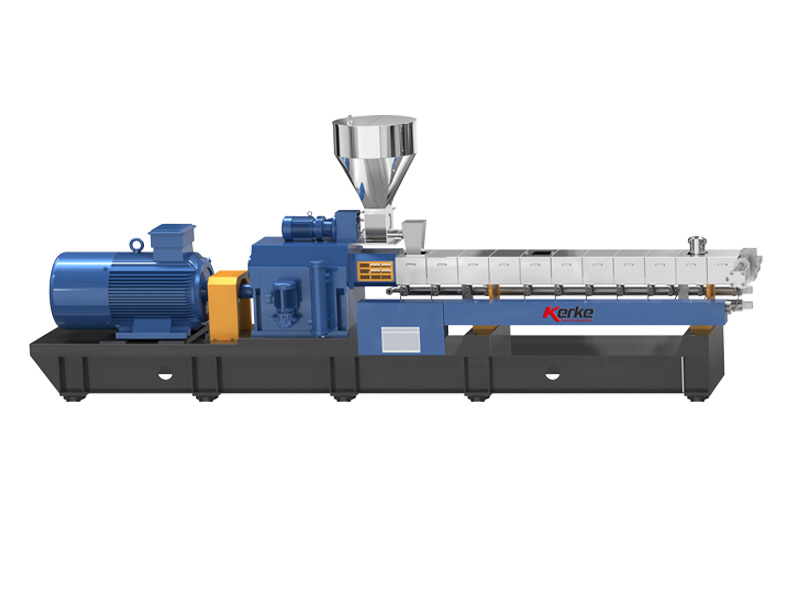
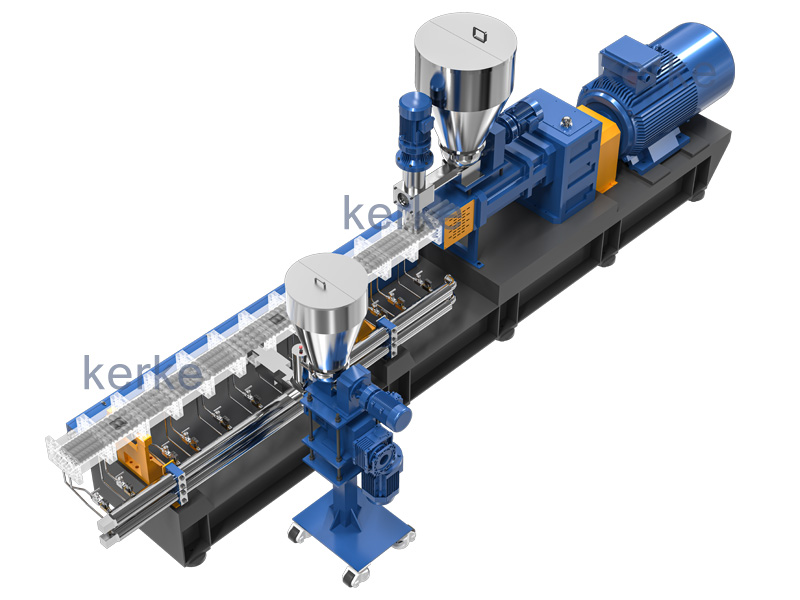
KERKE twin screw extruder is the core equipment for high concentration pigment masterbatch production, adopting optimized parallel twin screw structure and modular screw element design. The equipment can flexibly adjust the combination of conveying, kneading and shearing elements according to different pigment formulas such as organic pigment, inorganic pigment and carbon black, realizing precise matching of shear force and kneading time, which can stably realize 30%-70% ultra-high pigment loading, and the pigment dispersion uniformity reaches the international high standard.
This twin screw extruder is equipped with a high-precision quantitative feeding system, which realizes synchronous and stable feeding of pigment, resin and auxiliaries, with a feeding accuracy error controlled within ±0.5%, ensuring consistent formula proportion in batch production. The multi-stage independent zoning temperature control system realizes accurate temperature adjustment of each processing section, avoids pigment thermal decomposition and resin scorching, and effectively guarantees the color stability of high-concentration masterbatch. The built-in high-efficiency vacuum exhaust system can completely remove moisture and volatile gas in the melt, eliminating bubble defects and improving masterbatch compactness.
In terms of production efficiency, KERKE twin screw extruder has a high production speed and stable operation performance. The hourly output of medium-sized models can reach 300-600kg, which is 30% higher than that of traditional ordinary extruders, greatly improving production capacity. The equipment has low failure rate and long continuous operation cycle, which is suitable for large-scale batch production of high-concentration masterbatch.
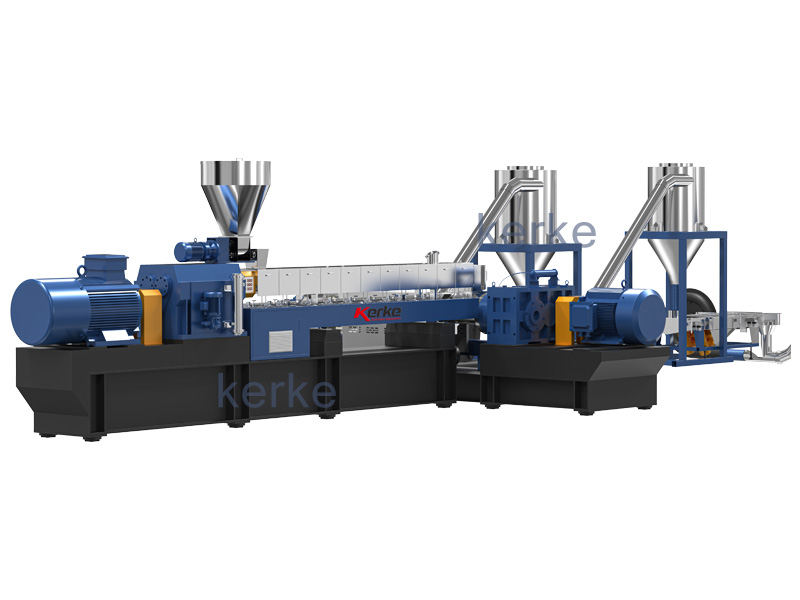
In terms of project cost and price, the factory price of KERKE medium and small-sized twin screw extruder for masterbatch production ranges from $38,000 to $65,000, and the price of large-scale high-output models ranges from $68,000 to $115,000. The complete equipment set includes feeding system, extrusion host, temperature control system, vacuum system, cooling and pelletizing system. The equipment has low daily energy consumption and maintenance cost, and the comprehensive production cost per ton of masterbatch is reduced by 8%-12% compared with traditional equipment, with extremely high cost performance.
5.2 KERKE Masterbatch Extruder Special for High-Load Coloring Masterbatch
KERKE masterbatch extruder is a customized special equipment developed for the characteristics of high concentration pigment masterbatch production, optimized and upgraded on the basis of traditional compounding equipment. The equipment adopts a high-torque screw design, which can provide stronger shear kneading force, effectively break pigment agglomerated particles, and solve the dispersion difficulty of ultra-high concentration pigments. The optimized melt flow channel structure reduces material residual and dead corners, avoids material scorching and color difference defects in long-term production, and improves product qualification rate.
This masterbatch extruder is equipped with an intelligent linkage control system, which can automatically match temperature, speed and vacuum parameters according to different masterbatch formulas, realizing one-key switching of production parameters and reducing manual debugging errors. The equipment is specially optimized for color stability, with stable melt pressure and uniform material plasticization, which can ensure zero color difference fluctuation in batch production of high-concentration masterbatch, meeting the high-precision coloring requirements of high-end plastic products.
The production capacity of KERKE special masterbatch extruder covers small batch customization and large-scale mass production, with an hourly output range of 200-800kg. The equipment is easy to operate and low in maintenance difficulty, and ordinary operators can master the production operation after simple training. The factory price of the equipment is $35,000 to $98,000 according to different output configurations and automation levels. Compared with universal compounding equipment, the targeted optimization design reduces the scrap rate of high-concentration masterbatch production by more than 15%, and the long-term economic benefit is very significant.
5.3 KERKE Compounding Extruder for High-Precision Masterbatch Production
KERKE compounding extruder is a high-end precision compounding equipment, which is suitable for the production of high-standard high concentration pigment masterbatch such as food grade, medical grade and outdoor weather-resistant grade. The equipment adopts ultra-precision screw processing technology and imported temperature control components, with extremely high processing accuracy and operation stability. It can realize ultra-fine dispersion of high-concentration pigments, and the masterbatch product has uniform color, no particle impurities, strong coloring power and excellent weather resistance.
The compounding extruder has a fully enclosed dust-free production structure, which avoids external dust and impurity pollution in the production process, ensuring the high purity of high-end masterbatch products. The intelligent energy-saving control system optimizes the operation power of the equipment, reduces invalid energy consumption, and the unit energy consumption is reduced by 10% compared with ordinary equipment. The equipment supports personalized formula customization production, and can meet the high-load production needs of various special pigments and special carrier resins.
The price of KERKE high-precision compounding extruder ranges from $72,000 to $138,000. Although the initial equipment investment is slightly higher, the product added value and qualification rate are far higher than ordinary equipment. It is very suitable for enterprises focusing on high-end high-concentration masterbatch market. The annual comprehensive cost saving of equipment operation, defect loss reduction and high-value order income can quickly recover the initial investment difference, with excellent long-term return on investment.
6. Systematic Optimization Methods for High Concentration Masterbatch Loading and Production Efficiency
To maximize the loading concentration and production efficiency of high concentration pigment masterbatch, it is necessary to carry out systematic optimization from formula design, equipment parameter debugging, production process management and post-processing links. This chapter sorts out operable full-process optimization schemes to help enterprises achieve high-load, high-efficiency and low-defect masterbatch production.
6.1 Scientific Formula Optimization and Matching
According to different pigment types and target loading concentration, optimize the carrier resin and auxiliary formula pertinently. For organic pigments with fine particles and easy agglomeration, select low-viscosity high-fluidity carrier resin and add high-efficiency wetting dispersant to improve pigment dispersion and loading limit. For inorganic pigments such as titanium dioxide and iron oxide, use coupling agent for surface modification to enhance the bonding force between pigment and resin, avoid pigment shedding, and support ultra-high loading of 50%-70%.
Strictly control the proportion of auxiliaries, avoid excessive lubricant leading to masterbatch blooming and reduced coloring power, and ensure that the formula can not only meet the high-load production demand, but also maintain the mechanical properties and coloring stability of the masterbatch. Establish exclusive formula database for different products to ensure formula consistency in batch production and avoid quality fluctuation caused by formula adjustment.
6.2 Extrusion Equipment Parameter Precision Debugging
Optimize the screw speed and shear element matching according to the formula characteristics. Appropriately increase the screw speed for pigments that are easy to disperse to improve production efficiency; reduce the speed and increase the kneading elements for agglomeration-prone pigments to ensure sufficient shear dispersion. Adopt graded temperature control scheme: set low temperature in the feeding section to avoid material premature melting and caking, set medium temperature in the kneading section to ensure full pigment dispersion and resin plasticization, and set stable temperature in the extrusion section to ensure uniform melt extrusion.
Calibrate the feeding system regularly to ensure stable feeding proportion and avoid formula deviation caused by uneven feeding. Adjust the vacuum degree of the exhaust system according to the material moisture content, completely remove internal gas, and improve the compactness and surface finish of the masterbatch. For KERKE intelligent extrusion equipment, store the optimal parameter scheme of each formula to realize one-click parameter calling in subsequent production, reducing debugging time and improving production efficiency.
6.3 Raw Material Pre-Treatment Process Standardization
Establish standardized raw material pre-treatment process to eliminate raw material defects affecting loading efficiency. Carry out constant temperature drying treatment on pigment and resin raw materials to control raw material moisture below 0.02%, avoid bubble generation and pigment agglomeration caused by moisture. Screen and filter raw materials to remove large particle impurities and agglomerated materials, ensuring the uniformity of raw material particle size.
Pre-mix pigment, resin and auxiliaries evenly through a high-speed mixer before extrusion production, which can preliminarily disperse pigment particles, reduce the shear pressure of the extruder, improve the dispersion effect and loading efficiency of high-concentration masterbatch, and reduce the operation load of extrusion equipment.
6.4 Post-Processing and Quality Inspection Optimization
Optimize the cooling and pelletizing process of masterbatch to ensure uniform particle size and stable shape of finished masterbatch. Too fast cooling will cause internal stress of masterbatch and particle cracking, while too slow cooling will lead to particle adhesion and agglomeration. Adopt graded cooling mode to ensure stable molding of high-concentration masterbatch particles.
Establish a full-process quality inspection mechanism, detect the pigment content, dispersion uniformity, coloring power and color difference of finished masterbatch in real time, find out loading defects and process deviations in time, and adjust production parameters dynamically. Standardized post-processing and quality inspection can effectively stabilize product quality, reduce defective product rate, and improve comprehensive production efficiency.
7. Full-Cycle Cost and Benefit Analysis of High Concentration Masterbatch Production
High concentration pigment masterbatch production has obvious cost advantages compared with ordinary masterbatch production. Although high-load production puts forward higher requirements for equipment and process technology, the comprehensive economic benefits of raw material saving, efficiency improvement and defect reduction are very prominent. This chapter conducts quantitative analysis of production input and output benefits to clarify the economic value of high-concentration masterbatch production and professional extrusion equipment configuration.
7.1 Production Input Cost Analysis
The initial input cost is mainly equipment purchase cost and workshop transformation cost. Investing in KERKE professional twin screw extruder, masterbatch extruder and compounding extruder requires one-time equipment investment of $35,000 to $138,000 according to different models. Compared with ordinary low-cost extruders, professional equipment has higher initial investment, but it has absolute advantages in production stability, efficiency and yield.
The daily operating cost includes raw material cost, energy consumption cost and maintenance cost. High-concentration masterbatch reduces the use proportion of expensive carrier resin, and the raw material cost per ton of finished masterbatch is reduced by 5%-10%. The energy consumption of KERKE energy-saving extrusion equipment is 10%-15% lower than that of traditional equipment, and the daily power consumption cost is significantly reduced. The daily maintenance cost of the equipment is low, with only regular cleaning, lubrication and parameter calibration required, and the monthly maintenance consumable cost is controlled within $60-$120.
7.2 Economic Loss of Low-Efficiency Traditional Production
Using ordinary extrusion equipment to produce high-concentration masterbatch is prone to insufficient dispersion, unbalanced loading and frequent defective products. The defective product rate of traditional production mode is 6%-12%, resulting in a large amount of raw material waste and rework cost. Taking a production line with an annual output of 500 tons of high-concentration masterbatch as an example, the annual defective product loss reaches 30-60 tons, with a direct economic loss of $12,000-$28,000.
Traditional equipment has low production efficiency and unstable output, which cannot meet large-scale order demand, resulting in order delay and customer loss. The low loading capacity of ordinary masterbatch increases the addition amount in downstream plastic processing, improves the downstream production cost of customers, reduces product market competitiveness, and brings huge intangible economic losses to masterbatch manufacturers.
7.3 Comprehensive Benefit of High-Efficiency High-Load Production
After adopting KERKE professional extrusion equipment and standardized high-load production process, the defective product rate of high concentration masterbatch is reduced to below 1.5%, and the annual defective product loss is reduced by more than 85%. The high loading capacity reduces the unit raw material cost of masterbatch, and the production efficiency is increased by 25%-35%, which can greatly improve the annual output and order delivery capacity of the production line.
High-quality high-concentration masterbatch products have higher market recognition and product added value, which can help enterprises undertake high-end high-value orders and increase product profit margin by 10%-20%. From the perspective of long-term operation, the equipment investment cost can be fully recovered within 1-2 years through cost saving and profit improvement, and the subsequent continuous stable profit space is huge, with excellent comprehensive return on investment.
8. Common Production Defects and Targeted Solutions for High Concentration Masterbatch
In the high-load production process of pigment masterbatch, due to unreasonable formula, parameter deviation and equipment failure, various quality defects are easy to occur, which affect loading effect and production efficiency. This chapter summarizes common typical defects and professional solutions to help enterprises quickly troubleshoot and optimize production problems.
8.1 Pigment Agglomeration and Uneven Dispersion
This defect is manifested as local pigment particle agglomeration in the masterbatch, uneven color distribution, and color spots on the surface of downstream plastic products. The main causes are insufficient shear force of extrusion equipment, unreasonable dispersant proportion, incomplete raw material pre-drying and unstable feeding speed. The solutions include optimizing the screw shear element combination of twin screw extruder and compounding extruder to improve shear dispersion capacity, adjusting the dispersant formula proportion, strengthening raw material drying treatment, and calibrating the feeding system to ensure stable and uniform feeding.
8.2 Low Pigment Loading and Insufficient Coloring Power
The masterbatch has low effective pigment content, poor coloring coverage, and needs to increase the addition ratio in use, losing the cost advantage of high-concentration products. The main inducements are unreasonable carrier resin matching, insufficient plasticization temperature, low equipment shear efficiency and excessive auxiliary dosage. The optimization methods are to replace high-adaptability carrier resin, adjust extrusion temperature parameters to ensure full plasticization, upgrade high-efficiency masterbatch extrusion equipment, and optimize the auxiliary formula to reduce invalid component occupancy.
8.3 Masterbatch Particle Bubbles and Low Compactness
There are internal bubbles and loose structure in the masterbatch particles, resulting in reduced product density, easy color fading and poor weather resistance. The main reasons are excessive raw material moisture, insufficient vacuum exhaust, unreasonable cooling process and unstable melt pressure. The solutions are to strictly control raw material moisture content, improve the vacuum degree of the extrusion exhaust system, optimize the graded cooling process, and adjust the extrusion speed to stabilize melt pressure.
8.4 Color Difference and Color Deviation in Batch Production
The color of masterbatch products in different batches is inconsistent, with obvious color difference, which cannot meet the requirements of standardized batch production. The core causes are unstable equipment operation parameters, formula proportion deviation, inconsistent raw material batch performance and incomplete equipment cleaning. The improvement measures are to store fixed production parameters for different formulas, calibrate the feeding system regularly, unify raw material batch standards, and carry out thorough equipment cleaning when switching production formulas to avoid cross-color pollution.
9. Industry Development Trend of High Concentration Pigment Masterbatch Production
With the continuous upgrading of global plastic environmental protection standards and product quality requirements, the plastic coloring industry is developing towards high concentration, high dispersion, high efficiency and environmental protection. Traditional low-concentration masterbatch has been unable to meet the market demand for low consumption, high precision and low carbon production, and high concentration pigment masterbatch has become the mainstream development direction of the industry.
In terms of production technology, intelligent high-precision compounding extrusion technology has become the core development trend. The traditional manual empirical debugging production mode is gradually replaced by intelligent parameter linkage control, automatic formula matching and real-time quality monitoring technology. High-efficiency twin screw extruder and compounding extruder with intelligent control function will become the standard equipment for high-end masterbatch production, realizing unmanned precise production and zero-defect product output.
In terms of product development, ultra-high concentration, multi-functional and environmental-friendly masterbatch will be the mainstream market demand. The market puts forward higher requirements for masterbatch weather resistance, migration resistance, environmental protection performance and coloring stability, which further promotes the technical upgrading of masterbatch extrusion and compounding equipment. KERKE continues to focus on the technical research and development of masterbatch special extrusion equipment, continuously optimizing equipment shear dispersion performance, intelligent control level and energy-saving and environmental protection capacity, providing high-efficiency and low-cost equipment solutions for global high-concentration masterbatch production enterprises, and promoting the high-quality development of the masterbatch industry.
10. Conclusion
High concentration pigment masterbatch is an indispensable high-efficiency coloring material in the modern plastic processing industry, and its loading technology and production efficiency directly determine the production cost and product quality level of downstream plastic products. The ultra-high pigment loading production mode can effectively reduce masterbatch consumption, optimize production costs and improve product coloring accuracy and stability. The realization of high-load and high-efficiency masterbatch production cannot be separated from scientific formula design, standardized process management and high-performance extrusion equipment support.
Professional twin screw extruder, masterbatch extruder and compounding extruder are the core equipment to break through the technical bottleneck of high-concentration masterbatch production. KERKE series extrusion equipment is specially optimized for high pigment loading and high-precision compounding production, with excellent dispersion performance, stable operation efficiency and significant cost-saving advantages, which can perfectly solve various quality and efficiency problems in high-concentration masterbatch production. For masterbatch production enterprises, selecting high-quality professional extrusion equipment and matching systematic production optimization schemes is the key to improve market competitiveness, reduce comprehensive production costs and realize long-term sustainable development in the increasingly competitive industry market.