Slip anti-blocking masterbatch is an essential additive for polyolefin film production, addressing two of the most common processing and end-use challenges in the film industry: high surface friction that impedes film handling and the tendency of film layers to stick together during winding, storage, and conversion. By combining slip agents and anti-blocking agents in a single masterbatch formulation, manufacturers can improve film processability, enhance downstream conversion performance, and deliver products that meet the stringent handling requirements of high-speed packaging operations. Kerke, a Wanplas factory specializing in twin-screw compounding extruders with 12+ years of experience and 2,000+ machines running in 70+ countries, provides the equipment and process expertise needed for high-performance masterbatch production. This complete guide covers the chemistry, formulation, production, testing, and application of slip anti-blocking masterbatch.
Introduction to Slip and Anti-blocking Additives
Polyolefin films, particularly polyethylene (PE) and polypropylene (PP) films, exhibit inherently high surface friction and a strong tendency for adjacent film layers to adhere to each other. These properties create significant challenges during film production, conversion, and end use. Without appropriate additives, polyolefin films cannot be efficiently wound into rolls, unwound for printing or lamination, or processed on high-speed packaging machinery.
The Blocking Problem
Blocking refers to the tendency of adjacent film layers to adhere to each other when in contact under pressure, particularly at elevated temperatures. This phenomenon occurs because polyolefin surfaces are relatively soft and have low surface energy, causing molecular chains at the interface to interdiffuse when pressed together. The blocking force increases with contact pressure, temperature, and time, making it particularly problematic for films wound into tight rolls at elevated production temperatures.
Blocked film rolls are difficult or impossible to unwind, causing production interruptions, film damage, and increased waste. In severe cases, blocking can render an entire roll unusable, representing a significant economic loss. The problem is exacerbated for thin films (below 50 microns), films produced at high line speeds where the film is wound while still warm, and films stored in hot environments.
The Friction Problem
Polyolefin films exhibit high coefficients of friction (COF) in their unmodified state, typically 0.6 to 0.8 for PE and 0.4 to 0.6 for PP. These high COF values create difficulties in film handling: films slide poorly on metal surfaces during conversion, packages become difficult to open, and films tend to jam in high-speed packaging machinery. For efficient processing on modern packaging lines, the COF typically needs to be reduced to 0.1 to 0.3, depending on the application.
High friction also affects the end-use performance of film products. In consumer packaging, high friction makes packages difficult to handle and open. In industrial applications such as pallet wrap and industrial liners, high friction prevents smooth film payout and application. Slip additives reduce the COF to levels appropriate for each application, ensuring smooth handling from production through end use.
The Role of Masterbatch
Slip and anti-blocking additives are most efficiently delivered to the film through masterbatch, which is a concentrated formulation of the active additives in a carrier resin compatible with the film material. Masterbatch allows precise dosing of additives at low addition rates (typically 1-5%), uniform dispersion throughout the film, and the convenience of a solid pellet form that can be handled using standard material handling equipment. Combined slip anti-blocking masterbatch incorporates both additive types in a single product, simplifying material handling and ensuring consistent additive ratios.
Slip Agents: Types, Mechanisms, and Performance
Slip agents are amphiphilic molecules that migrate to the film surface and form a molecular layer that reduces the coefficient of friction. Understanding the chemistry and migration behavior of slip agents is essential for formulating masterbatch that delivers the target COF at the right time in the production cycle.
Primary Fatty Acid Amides
The two most widely used slip agents are erucamide (cis-13-docosenamide) and oleamide (cis-9-octadecenamide), both primary fatty acid amides. Erucamide, derived from erucic acid found in rapeseed oil, has a 22-carbon chain length and is the dominant slip agent for PE and PP films. Oleamide, derived from oleic acid, has an 18-carbon chain length and migrates faster than erucamide due to its shorter chain, making it suitable for applications requiring rapid slip development.
The difference in chain length between erucamide and oleamide affects their migration rate, blooming behavior, and thermal stability. Erucamide migrates more slowly but provides more stable long-term slip performance due to its lower volatility and stronger anchoring in the polymer matrix. Oleamide migrates faster, providing quicker slip development, but may continue to migrate and deposit on processing equipment over time, a phenomenon known as plate-out.
Secondary Fatty Acid Amides
Secondary amides, such as stearyl erucamide and oleyl palmitamide, offer controlled slip performance for applications where very low COF is not desired. Secondary amides migrate more slowly than primary amides due to their higher molecular weight and more complex molecular structure. They are used in applications where moderate slip is needed but excessive slip could cause problems such as poor print adhesion or difficulty in heat sealing.
Migration Mechanism and Kinetics
Slip agents function by migrating from the bulk of the film to the surface, where they form a thin molecular layer that acts as a lubricant. The migration is driven by the incompatibility between the amphiphilic slip agent and the non-polar polyolefin matrix. The amide group of the slip agent is polar, while the hydrocarbon chain is non-polar, creating thermodynamic pressure for the molecule to orient at the surface with the polar group facing inward and the non-polar chain facing outward.
The migration rate depends on several factors: the slip agent’s molecular weight and compatibility with the polymer, the film thickness, the polymer crystallinity, the storage temperature, and the presence of other additives. Thinner films achieve equilibrium COF faster than thicker films because the migration distance is shorter. Amorphous polymer regions allow faster diffusion than crystalline regions, so materials with lower crystallinity develop slip faster. Higher temperatures accelerate migration, which is why films often show continued COF reduction during the first 24-48 hours after production.
COF Targets for Common Applications
Different film applications require different COF ranges, and the slip agent loading in the masterbatch must be adjusted accordingly. High-speed form-fill-seal packaging typically requires COF of 0.12-0.20 on the film-to-metal surface. Pallet wrap and stretch films require COF of 0.15-0.25 for smooth unwind. Shopping bags and merchandise bags typically target COF of 0.20-0.30. Films for lamination printing may require higher COF (0.30-0.50) to ensure good ink adhesion and prevent film slippage during printing.
| Slip Agent | Chain Length | Migration Speed | Thermal Stability | Best Application |
|---|---|---|---|---|
| Erucamide | C22 | Moderate | High (220C) | PE and PP films, general purpose |
| Oleamide | C18 | Fast | Medium (200C) | Rapid slip development, thin films |
| Stearyl Erucamide | C40 | Slow | Very High (250C) | Controlled slip, high-temp processing |
| Oleyl Palmitamide | C34 | Slow | High (230C) | Moderate slip, printing films |
Anti-blocking Agents: Materials and Selection Criteria
Anti-blocking agents function by creating micro-roughness on the film surface, which reduces the contact area between adjacent film layers and prevents the molecular interdiffusion that causes blocking. The selection of anti-blocking agent depends on the film clarity requirements, the polymer type, the processing conditions, and the regulatory requirements for the end-use application.
Synthetic Silica
Synthetic silica, including precipitated silica and fumed silica, is the premier anti-blocking agent for high-clarity film applications. Silica particles have a refractive index close to that of polyolefins, which minimizes light scattering and preserves film clarity. The particles are irregular in shape with high surface area, providing effective anti-blocking performance at low addition rates. Synthetic silica is the preferred choice for optical-grade films, food packaging films, and other applications where clarity is critical.
The particle size of synthetic silica for anti-blocking applications typically ranges from 2 to 8 microns, with narrow particle size distributions to ensure consistent performance. Particles larger than 10 microns can cause visible haze and surface roughness, while particles smaller than 1 micron may not provide sufficient anti-blocking effect. The particle size distribution should be tightly controlled during masterbatch production to ensure uniform performance.
Natural Silica (Diatomaceous Earth)
Natural silica, in the form of diatomaceous earth, offers a cost-effective alternative to synthetic silica for applications where moderate film clarity is acceptable. Diatomaceous earth consists of fossilized diatom skeletons with complex, highly structured particle shapes that provide effective anti-blocking performance. However, the natural origin results in wider particle size distributions and potential impurities that can affect film clarity and consistency. Natural silica is typically used in industrial films, agricultural films, and other applications where cost optimization is prioritized over optical clarity.
Talc
Talc is a platy mineral that provides anti-blocking performance through its lamellar particle structure. The flat talc particles create surface roughness while providing additional benefits such as improved stiffness and heat resistance. Talc is particularly effective in PP films, where its compatibility with the polymer matrix enhances dispersion. However, talc particles are larger than silica particles and can cause more haze, making it less suitable for high-clarity applications. Talc is commonly used in industrial films, heavy-duty packaging, and applications where the mechanical benefits of talc addition are valued.
Calcium Carbonate
Calcium carbonate (CaCO3) is the most economical anti-blocking agent, offering both anti-blocking performance and cost reduction through filler replacement of resin. CaCO3 particles are irregular in shape and available in a range of particle sizes. While CaCO3 provides effective anti-blocking at higher addition rates, it causes significant haze and is generally unsuitable for transparent films. CaCO3 is widely used in opaque films, garbage bags, and other applications where clarity is not required and cost optimization is the primary driver.
Organic Anti-blocking Agents
Organic anti-blocking agents, including certain waxes and polymers, provide anti-blocking through surface modification rather than physical micro-roughness. These agents migrate to the film surface and form a low-tack layer that reduces adhesion between film layers. Organic anti-blocking agents are used in applications where inorganic particles would cause unacceptable haze or where food contact regulations restrict the use of certain inorganic materials. However, organic agents generally provide lower anti-blocking performance than inorganic alternatives and may be used in combination with inorganic agents for optimal results.
| Anti-blocking Agent | Clarity Impact | Typical Loading | Relative Cost | Best Application |
|---|---|---|---|---|
| Synthetic Silica | Very Low | 500-2000 ppm | High | High-clarity films, food packaging |
| Natural Silica (DE) | Low-Medium | 1000-3000 ppm | Medium | Industrial films, general purpose |
| Talc | Medium-High | 1000-3000 ppm | Medium | PP films, industrial packaging |
| Calcium Carbonate | High | 2000-10000 ppm | Low | Opaque films, garbage bags |
| Organic (waxes) | Very Low | 500-1500 ppm | Medium | Ultra-clear films, food contact |
Combined Slip Anti-blocking Masterbatch Formulation
Combined slip anti-blocking masterbatch integrates slip agents and anti-blocking agents in a single carrier resin, providing the convenience of a single additive product while ensuring consistent additive ratios. The formulation must balance several competing requirements, including additive compatibility, dispersion quality, migration kinetics, and end-use performance.
Formulation Design Principles
The first principle of combined masterbatch formulation is ensuring compatibility between the slip agent and anti-blocking agent. Inorganic anti-blocking agents can adsorb slip agents onto their high-surface-area particles, reducing the effective slip agent concentration and slowing migration. This interaction must be accounted for in the formulation by slightly increasing the slip agent loading or by selecting anti-blocking agents with lower adsorption characteristics.
The carrier resin selection is critical for combined masterbatch. The carrier must be compatible with both the additive types and the end-use application resin. For PE film applications, an LLDPE or LDPE carrier with an MFI of 2-10 g/10min is typically used. For PP film applications, a PP carrier with an MFI of 10-20 g/10min is appropriate. The carrier MFI should be higher than the application resin MFI to ensure good dispersion during let-down, but not so high that it compromises the mechanical properties of the final film.
Typical Formulation Composition
A typical combined slip anti-blocking masterbatch for LLDPE film contains 5-10% erucamide (slip agent), 10-20% synthetic silica (anti-blocking agent), 1-3% dispersing aid, and the balance carrier resin. The exact composition depends on the target film thickness, the desired COF, the required anti-blocking force, and the film clarity specifications. For high-clarity films, lower silica loadings with smaller particle sizes are used, while for industrial films, higher loadings with natural silica or talc may be used for cost optimization.
Dispersing Aid Selection
Dispersing aids are critical for achieving uniform dispersion of inorganic anti-blocking particles in the carrier resin. Polyethylene wax, oxidized polyethylene wax, and fatty acid derivatives are common dispersing aids. The dispersing aid reduces the interparticle forces that cause agglomeration and improves wetting of the inorganic particles by the polymer melt. The selection and loading of dispersing aid depends on the anti-blocking agent type, particle size, and surface treatment. Insufficient dispersing aid results in agglomerates that cause film defects and inconsistent anti-blocking performance, while excessive dispersing aid can affect film mechanical properties and surface characteristics.
Production Process Using Twin-Screw Extruders
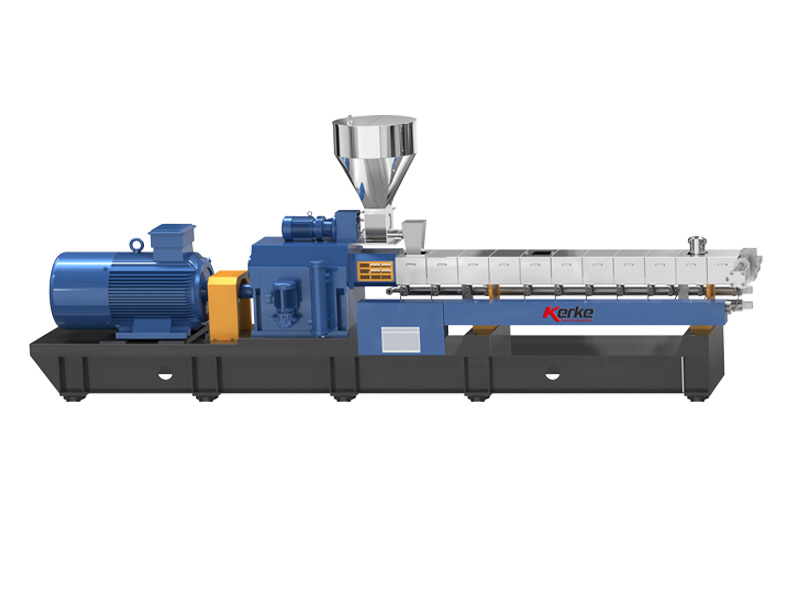
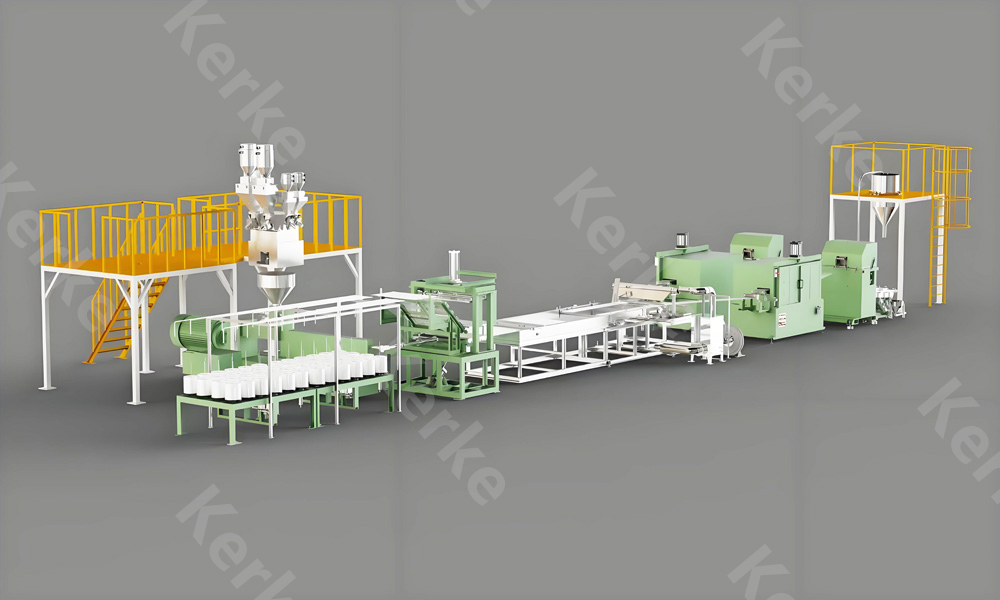
The production of slip anti-blocking masterbatch requires compounding equipment that can achieve uniform dispersion of inorganic anti-blocking particles while maintaining the thermal stability of the organic slip agents. Twin-screw compounding extruders are the industry standard for this application due to their superior mixing capabilities, precise temperature control, and modular screw design.
Kerke KTE Series Configuration for Masterbatch Production
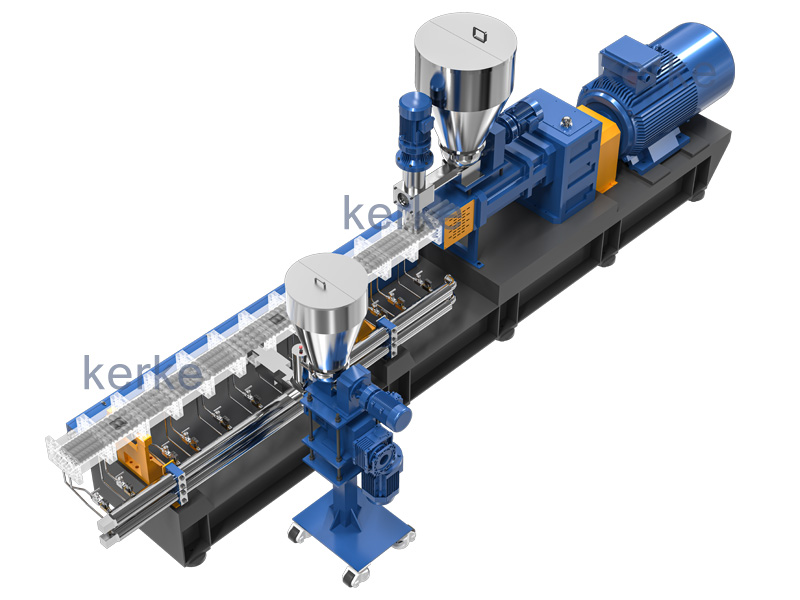
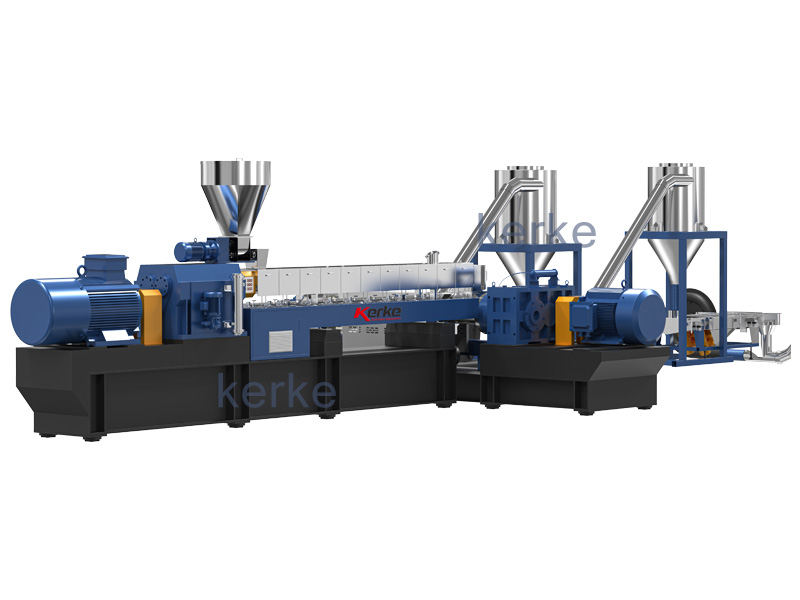
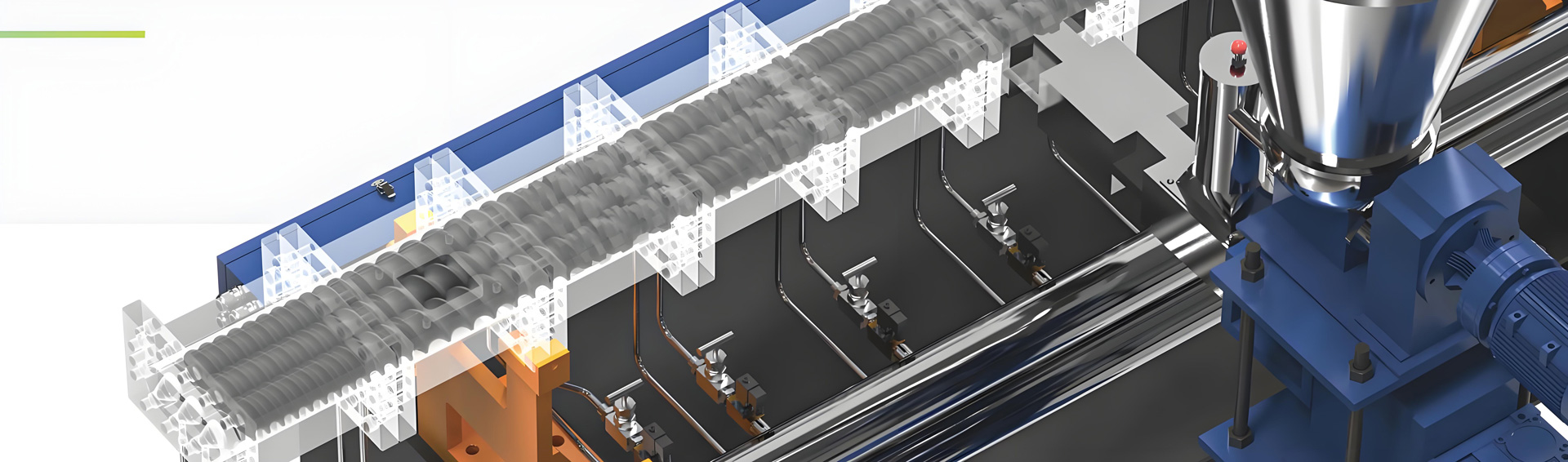
Kerke’s KTE series twin-screw extruders, ranging from KTE-16B for laboratory scale to KTE-135D for high-capacity production, are specifically designed for masterbatch compounding applications. The co-rotating twin-screw design provides the intensive dispersive mixing needed to break up anti-blocking particle agglomerates, while the modular screw elements allow configuration optimization for each formulation.
For slip anti-blocking masterbatch production, the KTE extruder is typically configured with a melting zone, a mixing zone with kneading blocks for particle dispersion, a venting zone for moisture removal, a homogenization zone, and a devolatilization zone. The barrel temperature profile is set to melt the carrier resin while keeping the slip agent below its degradation temperature. Typical barrel temperatures for PE carrier formulations are 160-200C, while PP carrier formulations may require 180-220C.
Feeding Strategy
The feeding strategy for combined masterbatch production typically involves multiple feed ports. The carrier resin is fed through the main feed port at the first barrel section. The anti-blocking agent, which may be a fine powder, is fed through a side feeder downstream of the melting zone, after the carrier resin has melted. This prevents powder loss through the vent and ensures immediate incorporation into the melt. The slip agent, which may be a powder or flakes, can be fed through the same side feeder or a separate side feeder at a downstream location.
Loss-in-weight feeders are recommended for all solid feed streams to ensure consistent additive concentration. The feeders must be calibrated regularly and checked for drift, as even small variations in additive feed rate can significantly affect film performance. For liquid additives, such as liquid slip agents or dispersing aids, liquid injection systems with precision metering pumps are used.
Process Control Parameters
Several process parameters must be controlled to produce consistent quality masterbatch. The screw speed, typically 200-400 RPM for KTE series extruders, affects mixing intensity and residence time. The specific mechanical energy (SME) input, which depends on screw speed, feed rate, and screw configuration, should be maintained within a target range to ensure consistent dispersion quality. Melt temperature at the die should be monitored and maintained below the slip agent’s degradation temperature.
The vacuum venting system should be operated at 0.05-0.1 bar absolute pressure to remove moisture and volatiles from the melt. Moisture in the masterbatch can cause film defects during end-use processing, particularly in moisture-sensitive applications. The vent port should be inspected regularly for material buildup that could obstruct the vacuum flow path.
As part of the Wanplas brand network, Kerke’s KTE extruders feature computer-aided screw design with kneading elements optimized for dispersive mixing, excellent self-cleaning function, and good interchangeability of screw elements. The KTE series realizes material transport, plasticization, shearing, dispersion, homogenization, exhaust, and pressure building in a single pass, ensuring comprehensive processing of slip anti-blocking formulations.
Performance Testing and Quality Standards
Comprehensive performance testing is essential for ensuring that slip anti-blocking masterbatch delivers the expected performance in the end-use film application. The testing program should address both additive performance and masterbatch quality.
Coefficient of Friction Testing
The coefficient of friction is the primary performance metric for slip agent effectiveness. COF testing is conducted according to ASTM D1894 or ISO 8295, using a sled-type friction tester. The test measures both static COF (the force required to initiate sliding) and kinetic COF (the force required to maintain sliding). Film-to-film COF is measured by placing a film-covered sled on a film-covered plane, while film-to-metal COF is measured by placing a film-covered sled on a metal surface.
COF testing should be conducted on film samples prepared at the intended masterbatch addition rate and processed using the intended film production method. The samples should be conditioned for at least 24 hours after production to allow the slip agent to migrate to equilibrium. COF should be measured on both the treated and untreated sides of the film, as slip agent migration may differ between the two surfaces.
Blocking Force Testing
Blocking force is measured according to ASTM D3354 or ISO 11502, which quantify the force required to separate two film layers that have been in contact under controlled pressure and temperature. The test involves pressing film samples together at a specified pressure and temperature for a defined period, then measuring the peel force required to separate them. The blocking force is typically reported in grams per 100 mm2 of contact area.
The blocking test conditions should simulate the worst-case storage conditions for the film. Common test conditions include 50 kPa pressure at 50C for 24 hours, or 70 kPa at 60C for 1 hour as an accelerated test. The acceptance criteria depend on the film application, with high-speed packaging films typically requiring blocking forces below 15 g/100mm2.
Haze and Clarity Testing
For transparent film applications, the effect of anti-blocking agents on film optical properties must be measured. Haze is measured according to ASTM D1003, which quantifies the percentage of transmitted light that is scattered by the film. Total transmission measures the total light passing through the film, while clarity measures the ability to see fine details through the film. Anti-blocking agents increase haze and reduce clarity, and the magnitude of these effects depends on the agent type, particle size, and loading.
Dispersion Quality Assessment
The dispersion quality of anti-blocking particles in the masterbatch is critical for consistent film performance. Poor dispersion creates agglomerates that cause film defects, uneven anti-blocking performance, and potential film breaks during production. Dispersion quality can be assessed by examining thin sections of the masterbatch or let-down film under a microscope, counting agglomerates larger than a specified size. Automated image analysis systems can provide quantitative dispersion metrics.
Applications Across Film Types and Industries
Slip anti-blocking masterbatch is used in virtually every segment of the polyolefin film industry, with specific formulation requirements for each application. Understanding the performance requirements of different film types is essential for selecting or formulating the appropriate masterbatch.
Flexible Packaging Films
Flexible packaging films, including food packaging, shopping bags, and merchandise bags, represent the largest application segment for slip anti-blocking masterbatch. These films require moderate to high slip (COF 0.15-0.25) for smooth operation on packaging machinery and effective anti-blocking for roll unwinding. Food packaging films may require food-grade compliance for both slip and anti-blocking agents, with FDA-approved erucamide and synthetic silica commonly used.
Stretch and Shrink Films
Stretch films used for pallet wrapping require controlled slip for smooth unwind while maintaining sufficient film-to-film friction to prevent pallet load shifting. The COF target for stretch films is typically 0.15-0.20, achieved with erucamide loadings of 1000-1500 ppm in the final film. Anti-blocking is critical for stretch films to prevent roll blocking during storage, particularly for films wound at high tension and elevated temperatures.
Agricultural Films
Agricultural films, including greenhouse films, mulch films, and silage films, use slip anti-blocking masterbatch for processability and handling. These films may use higher loadings of natural silica or talc for cost optimization, as optical clarity is less critical than in packaging films. Greenhouse films require careful selection of anti-blocking agents to avoid excessive haze that would reduce light transmission essential for plant growth.
Industrial and Heavy-Duty Films
Industrial films, including heavy-duty sacks, FIBC liners, and construction films, prioritize cost effectiveness and may use calcium carbonate as both an anti-blocking agent and a filler for cost reduction. These films typically require lower slip performance (COF 0.25-0.40) and higher anti-blocking performance to prevent blocking under the heavy loads and high pressures encountered in industrial applications.
Integration with Wanplas Brand Network
Within the Wanplas brand network, Kerke’s masterbatch production capability connects with multiple downstream film production operations. Wanplas’s YuanSu factory specializes in film extrusion lines with multi-layer co-extrusion capability and thickness tolerances of 2%, providing the downstream equipment that uses slip anti-blocking masterbatch. Wanplas’s Faygo factory offers pipe and profile extrusion lines that may use slip additives for surface enhancement. This integrated capability within the Wanplas ecosystem enables end-to-end solutions from masterbatch production through film manufacturing, all backed by the Wanplas brand’s quality guarantees including $500 in free parts annually and quality standards assurance.
Troubleshooting Common Performance Issues
Even with well-formulated masterbatch and properly operated extrusion equipment, performance issues can arise during film production. Systematic troubleshooting helps identify the root cause and implement effective corrections quickly.
Insufficient Slip (High COF)
If the film COF is higher than the target, several potential causes should be investigated. The masterbatch addition rate may be too low for the film thickness and processing conditions. The slip agent may not have fully migrated to the surface; waiting 24-48 hours after production and retesting can confirm whether the issue is migration time or insufficient loading. The anti-blocking agent may be adsorbing the slip agent, requiring formulation adjustment. Other additives in the film formulation, particularly stearate lubricants or antistatic agents, may interfere with slip agent migration. Finally, high crystallinity in the film can slow slip migration, particularly in HDPE films processed with rapid cooling.
Excessive Slip (Low COF)
If the film COF is lower than desired, the masterbatch addition rate may be too high, or the slip agent loading in the masterbatch may be excessive. Excessive slip can cause problems such as poor print adhesion, unreliable heat seals, and film slippage on packaging machinery. Reducing the addition rate or selecting a masterbatch with lower slip agent concentration can correct this issue. In some cases, switching from a fast-migrating slip agent (oleamide) to a slower-migrating one (erucamide) can provide more controlled slip performance.
Persistent Blocking
If blocking persists despite anti-blocking masterbatch addition, the anti-blocking agent loading may be insufficient, or the particle size may be too large or too small for the application. The film may be wound at too high a temperature or tension, requiring process adjustment. The film may be stored at elevated temperatures that increase blocking tendency. The anti-blocking agent may be poorly dispersed in the masterbatch, creating areas with insufficient anti-blocking protection. Microscopic examination of the film can reveal whether the anti-blocking particles are uniformly distributed or if agglomerates and bare spots exist.
Excessive Haze
If the film haze exceeds specification, the anti-blocking agent may be causing excessive light scattering. This can result from particle size being too large, anti-blocking loading being too high, or poor dispersion creating agglomerates. Switching to a smaller particle size synthetic silica or reducing the anti-blocking loading can address this issue. The carrier resin in the masterbatch may also contribute to haze if it is not fully compatible with the film resin, requiring carrier resin selection review.
Plate-out on Processing Equipment
Plate-out refers to the accumulation of additives on film production equipment, particularly the die and chill roll. Plate-out is caused by excessive slip agent migration or the use of incompatible additive combinations. It appears as a white or waxy deposit on metal surfaces that can cause film defects and require cleaning. Reducing the slip agent loading, switching to a higher molecular weight slip agent, or using a secondary amide can reduce plate-out. Regular cleaning of the die and chill roll surfaces helps prevent plate-out buildup.
Frequently Asked Questions
What is the difference between slip agent and anti-blocking agent?
Slip agents are organic molecules (typically fatty acid amides like erucamide) that migrate to the film surface and reduce the coefficient of friction by forming a lubricating molecular layer. Anti-blocking agents are inorganic particles (such as silica or talc) that create micro-roughness on the film surface, reducing the contact area between film layers and preventing them from sticking together. Slip agents address friction; anti-blocking agents address adhesion between layers.
What addition rate of slip anti-blocking masterbatch should I use?
The typical addition rate is 1-5% depending on the masterbatch concentration, film thickness, and target performance. Thin films (below 25 microns) generally require lower addition rates than thick films. For a standard masterbatch containing 5% erucamide and 20% silica, a 2-3% addition rate typically achieves COF of 0.15-0.25 and effective anti-blocking in LLDPE films. The optimal rate should be determined through testing at the intended production conditions.
How long does it take for slip agents to reach equilibrium COF?
Slip agent migration is a time-dependent process. The COF typically decreases rapidly in the first 24 hours after film production, then continues to decrease more slowly for 48-72 hours until equilibrium is reached. The exact time depends on the slip agent type, film thickness, polymer crystallinity, and storage temperature. Erucamide typically reaches equilibrium in 48-72 hours, while oleamide may reach equilibrium in 24-48 hours due to its faster migration rate.
Can slip anti-blocking masterbatch be used in food contact films?
Yes, erucamide and oleamide are approved for food contact use in most major markets, including FDA 21 CFR 178.3860 in the US and EU 10/2011 in Europe. Synthetic silica is also approved for food contact. However, the specific formulation must be verified for compliance with the applicable regulations, and migration testing must demonstrate that all components remain within their specific migration limits. Food-grade carrier resins must also be used.
Why does my film have different COF on the two sides?
Differential COF between film sides is common and can result from several factors. The side contacting the chill roll during production may have different surface properties than the air side. If the film is corona-treated on one side, the treatment can affect slip agent migration. Multi-layer films may have different additive concentrations in different layers. The slip agent may migrate preferentially to one surface depending on the film’s symmetry and processing conditions. Measuring COF on both sides is recommended.
Does anti-blocking agent affect film strength?
At typical addition rates, inorganic anti-blocking agents have minimal effect on film tensile strength. However, higher loadings or large particle sizes can create stress concentration points that reduce impact resistance and tear strength. Poorly dispersed anti-blocking agents with agglomerates can cause more significant mechanical property reduction. Proper dispersion through twin-screw compounding minimizes these effects. Calcium carbonate at high loadings can actually improve stiffness but reduce elongation.
Can slip and anti-blocking agents interfere with film printing?
Yes, excessive slip agent on the film surface can interfere with ink adhesion, particularly for solvent-based and UV-cured inks. The slip agent layer can act as a barrier between the ink and the film surface. This is why films for printing applications often use lower slip loadings or secondary amides that provide moderate slip. Corona treatment immediately before printing can improve ink adhesion by activating the surface and partially removing the slip agent layer.
What Kerke equipment is recommended for slip anti-blocking masterbatch production?
For production-scale masterbatch manufacturing, the KTE-75D to KTE-135D models provide the capacity and process control needed. The extruder should be configured with kneading blocks for anti-blocking particle dispersion, side feeders for powder addition, and a vacuum venting system for moisture removal. An underwater pelletizing system is recommended for uniform, dust-free pellets. Kerke’s engineering team can provide customized screw configurations based on specific formulation requirements and production capacity targets.
Conclusion
Slip anti-blocking masterbatch is an essential additive for polyolefin film production, enabling the smooth handling, processing, and conversion that modern film applications demand. The combination of slip agents and anti-blocking agents in a single masterbatch provides convenience and consistency, but requires careful formulation to balance the competing effects of these two additive types. Understanding the chemistry, migration behavior, and interaction mechanisms of slip and anti-blocking agents is essential for producing masterbatch that delivers reliable performance across diverse film applications.
The production of high-quality slip anti-blocking masterbatch depends on the compounding equipment’s ability to achieve uniform dispersion of inorganic anti-blocking particles while preserving the thermal stability of organic slip agents. Kerke, as a Wanplas factory with 12+ years of twin-screw extruder experience, 2,000+ machines running in 70+ countries, and a top 5 position in China’s twin-screw extruder market, provides the KTE series extruders specifically engineered for masterbatch compounding. The modular screw design, precise process control, and food-grade compatible construction of KTE extruders ensure consistent production quality for even the most demanding masterbatch formulations.
As the film industry continues to evolve with trends toward thinner films, higher line speeds, and more stringent quality requirements, the importance of properly formulated and precisely compounded slip anti-blocking masterbatch will only increase. The Wanplas brand’s comprehensive support, including $500 in free parts annually, quality standards guarantees, and open factory policies, provides the long-term partnership that masterbatch manufacturers need to succeed. By combining proven equipment, systematic quality control, and deep formulation expertise, manufacturers can produce slip anti-blocking masterbatch that consistently meets the performance, safety, and cost requirements of the global film industry.