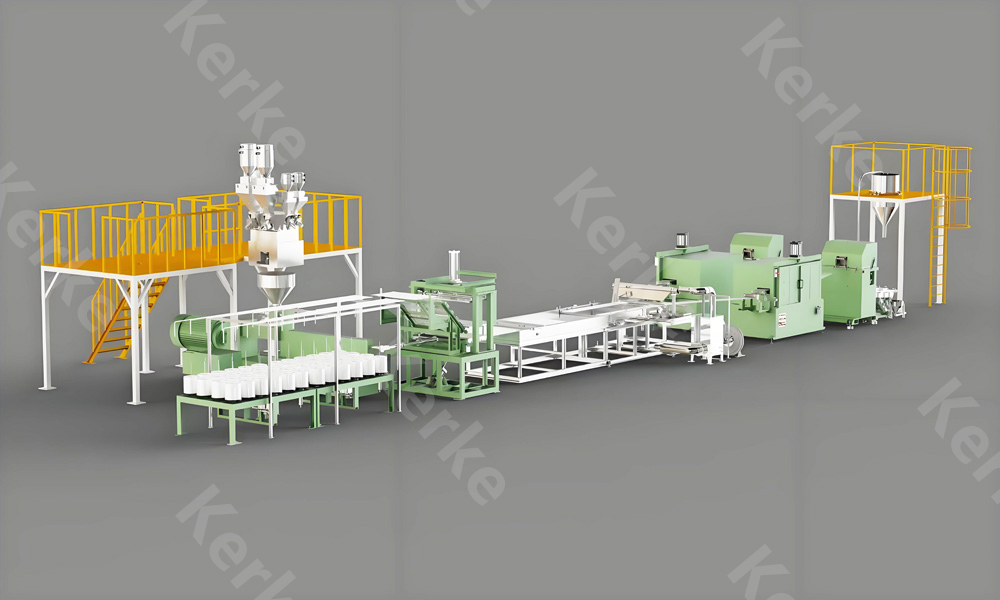
As a core raw material in the field of plastic modification, calcium carbonate filler masterbatch is widely used in the production of plastic products such as films, flat yarns, injection molding, and pipes, thanks to its advantages of reducing production costs and improving the rigidity and heat resistance of products. As the core equipment for granulating calcium carbonate filler masterbatch, the rationality of extruder selection directly determines the dispersion uniformity, particle regularity, production efficiency and comprehensive production cost of the masterbatch. When selecting a model, it is necessary to combine the characteristics of calcium carbonate materials, production scale, downstream application requirements and core performance of the equipment, systematically avoid industry pain points such as “fast wear, low productivity, and many crystal points”, and achieve a balance between productivity, quality and cost. The detailed selection analysis is as follows.
I. Core Premise of Selection: Clarify Own Production and Material Requirements
The primary premise of selection is to accurately match the own production scenario and material characteristics, avoid “using a large machine for small tasks” or “overloading a small machine”, which is the basis for subsequent equipment selection. The core points to be clarified are as follows:
(I) Calcium Carbonate Material Parameters
The mesh size, filling amount and surface treatment method of calcium carbonate directly affect the structural selection and parameter setting of the extruder: First, the filling amount. The proportion of calcium carbonate in conventional filler masterbatch is 50%-75%, that in high-filling masterbatch can reach 75%-85%, and ultra-high filling (>85%) requires special equipment adaptation. The higher the filling amount, the higher the requirements for the shear dispersion capacity and wear resistance of the equipment; Second, the mesh size. The mainstream selection is 1250-mesh calcium carbonate (maximum particle size ≤10μm). The higher the mesh size, the finer the powder, which requires stronger dispersion capacity to avoid agglomeration, and pre-drying treatment (moisture content <0.3%) must be done well; Third, surface treatment. Calcium carbonate coated with coupling agent and lubricant has good fluidity, which reduces the pressure on equipment feeding and dispersion, while untreated calcium carbonate needs to strengthen the pre-mixing and shearing links.
(II) Production Scale and Capacity Requirements
Productivity directly determines the model specification of the extruder, which needs to be reasonably planned in combination with the own production line layout and market order volume to avoid productivity waste or failure to meet order requirements: Small-scale production (productivity 200-500kg/h) is suitable for small and medium-sized twin-screw extruders; Medium-scale production (productivity 500-1000kg/h) can use standard twin-screw extruders; Large-scale production (productivity >1000kg/h) recommends triple-screw extruders or large twin-screw extruders, and some high-end scenarios can be equipped with internal mixers to achieve ultra-high filling production. For example, the SAT75 twin-screw model, for the PP+80%CaCO₃ formula, has a stable output of 800-1000kg/h, which is suitable for medium-sized high-filling production needs.
(III) Downstream Application Scenarios
Different downstream products have great differences in the quality requirements of calcium carbonate filler masterbatch, which directly determines the core configuration of the extruder:
- Film and packaging field: The core requirements are no crystal points and high transparency. It is necessary to select an extruder with a high length-diameter ratio (48-52:1) and a high-vacuum exhaust system to completely remove trace moisture and small molecules in the material and ensure dispersion uniformity;
- Flat yarn and woven bag field: The core requirements are high tensile strength and no yarn breakage. It is necessary to use an extruder with a mild shear design to retain the length of the resin molecular chain and avoid excessive degradation affecting yarn strength;
- Injection molding and sheet field: The core requirements are high filling amount and low cost. It is necessary to select an extruder with side feeding technology, which can push the calcium carbonate filling amount to the limit of 85% and significantly reduce raw material costs.
(IV) Budget and Automation Requirements
Combine the investment budget and the factory’s automation level to select the appropriate equipment configuration: For start-up enterprises and small-batch production with frequent formula changes, an economical pre-mixing feeding system can be selected, which has low cost and flexible operation; For large-scale factories with 24-hour continuous production and extremely high requirements for formula accuracy (±0.5%), a high-precision loss-in-weight feeding system is recommended to realize full-automatic closed-loop control and avoid manual feeding errors.
II. Core Selection Dimensions: Focus on Key Equipment Performance and Configuration
Due to the high wear and high filling characteristics of calcium carbonate filler masterbatch, the requirements for the core configurations of the extruder, such as wear resistance, dispersion capacity, feeding system, temperature control and exhaust system, are significantly higher than those of ordinary plastic extruders. The following dimensions should be focused on:
(I) Extruder Type Selection (Core Dimension)
At present, the extruders suitable for calcium carbonate filler masterbatch production on the market are mainly divided into three types: single-screw, twin-screw and triple-screw. The performance differences among the three are great, and the model should be selected according to the own needs. The specific comparison is as follows:
1. Single-Screw Extruder
Core advantages: Simple structure, convenient operation, low equipment cost and low maintenance difficulty. It is suitable for the production of conventional filler masterbatch with calcium carbonate filling amount ≤70%, and is suitable for small-scale entry-level production scenarios. Defects: Weak shear dispersion capacity, unable to solve the problem of calcium carbonate agglomeration, resulting in poor dispersion uniformity of masterbatch; Insufficient feeding stability, easy to occur material jamming and return during high filling; The screw and barrel wear quickly and have a short service life, so it is not suitable for high-filling and high-mesh calcium carbonate production.
2. Twin-Screw Extruder (Mainstream Selection)
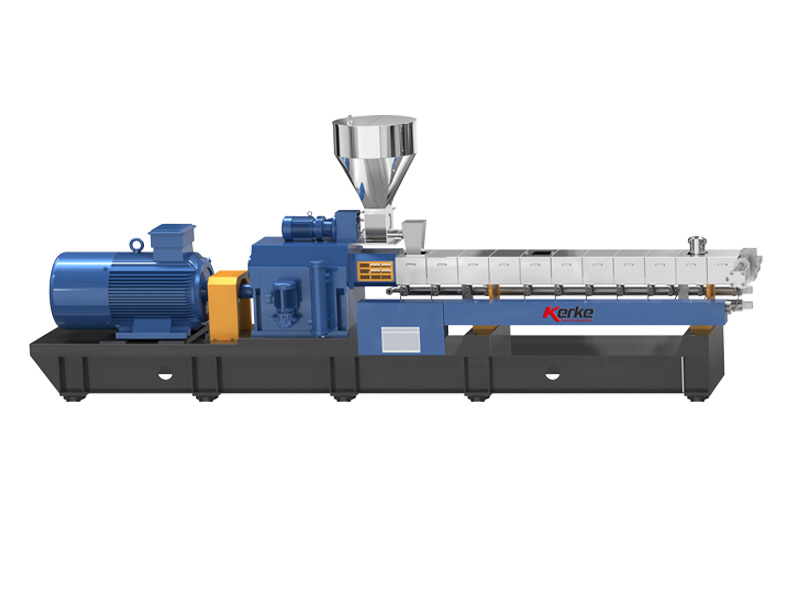
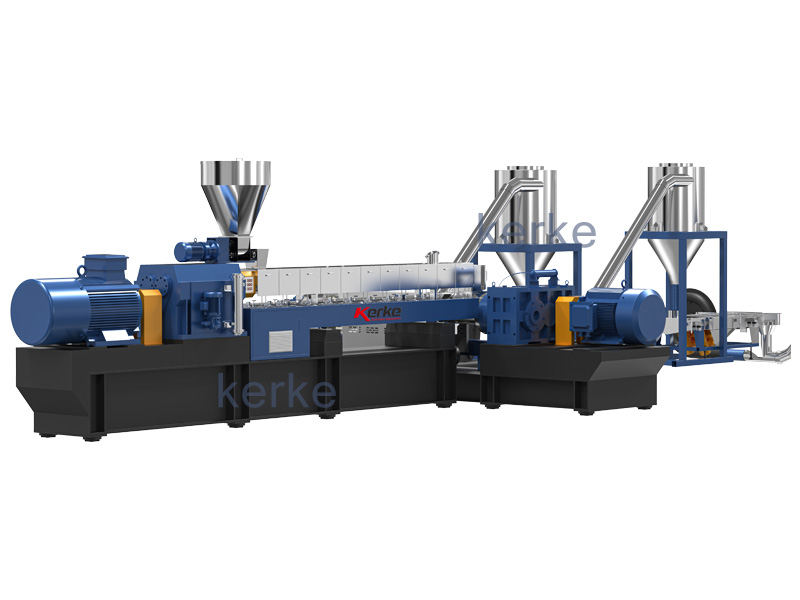
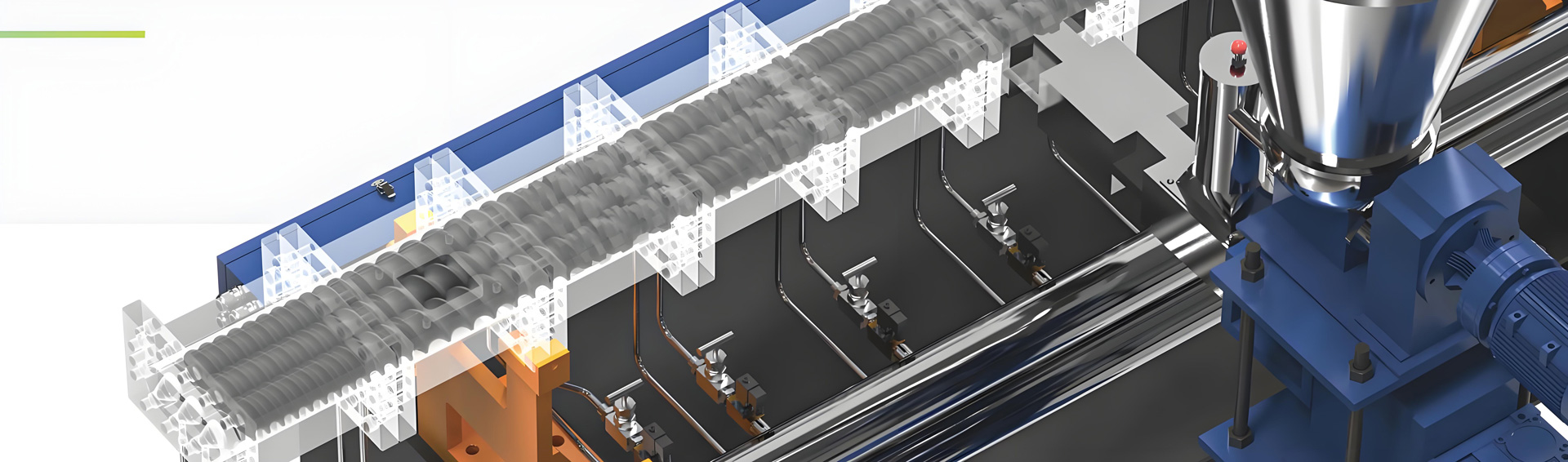
It is divided into co-rotating twin-screw and counter-rotating twin-screw. Among them, the co-rotating twin-screw extruder is the mainstream choice for calcium carbonate filler masterbatch production at present due to its strong shear dispersion capacity and stable feeding, especially suitable for 75%-85% high-filling production needs. Core advantages: Adopt modular screw design, which can flexibly adjust the distribution of shear blocks, balance shear strength and material degradation, and ensure uniform dispersion of calcium carbonate; Forced feeding design, which can adapt to low bulk density calcium carbonate powder and avoid feeding backflow; The core components can be made of wear-resistant materials to extend the service life. Defects: The equipment cost is higher than that of single-screw, the maintenance difficulty is moderate, and professional personnel are required for operation. At present, mainstream models such as SAT series twin-screws are technologically mature and cost-effective, suitable for most conventional high-filling masterbatch production scenarios.
3. Triple-Screw Extruder (High-End Selection)
Core advantages: Under the same energy consumption, the number of shears is more, the output is 30%-50% higher than that of traditional twin-screws, and the dispersion effect is improved by one level; The feeding and exhaust performance are better, which can easily handle high-filling and difficult-to-disperse formulas, and is suitable for production scenarios pursuing extreme dispersion and ultra-large output (such as SAT-T75 triple-screw model, whose output can reach 2 tons per hour). Defects: High equipment cost and high maintenance difficulty, suitable for large-scale and high-end masterbatch production enterprises, and its application scope is relatively narrow at present.
(II) Key Structure and Material Selection (Avoid Wear Pain Points)
Calcium carbonate powder has high hardness and causes serious wear to the core components of the extruder. “Replacement every six months” is a common problem of traditional equipment. It is necessary to focus on material and structural design:
- Screw: It is recommended to select W6Mo5Cr4V2 high-speed tool steel or bimetallic screw (tungsten carbide coating), which has high hardness and strong wear resistance, and can extend the service life of core components to 2-3 times that of ordinary twin-screws; The screw structure needs to be optimized, such as adopting gradual pitch + staggered kneading blocks, which can improve the mixing uniformity by more than 25% and avoid resin degradation caused by excessive shearing.
- Barrel: The core section of the barrel adopts Cr26MoV integral alloy sleeve (hardness HRC60+), which has excellent wear resistance and is suitable for the wear demand of high-filling calcium carbonate; The feeding section can adopt a special Undercut grooved bushing to enhance the material grabbing capacity and avoid screw slipping and output reduction caused by excessive lubricant.
- Gearbox: Select a high-torque gearbox (maximum specific torque up to 14Nm/cm³, higher than the industry average), equipped with a dual cooling system to control the temperature within 60℃, avoid high-temperature wear, and extend the service life of the screw and gearbox.
(III) Feeding System Selection (Solve Feeding Problems)
Calcium carbonate powder has low bulk density and high gas content. Feeding difficulty and gas return are common pain points in high-filling production. It is necessary to select the appropriate feeding system according to the filling amount and automation requirements:
- Conventional filling (≤70%): Select a volumetric feeder equipped with a screw feeder, which has a simple structure and low cost, and can meet the basic feeding needs;
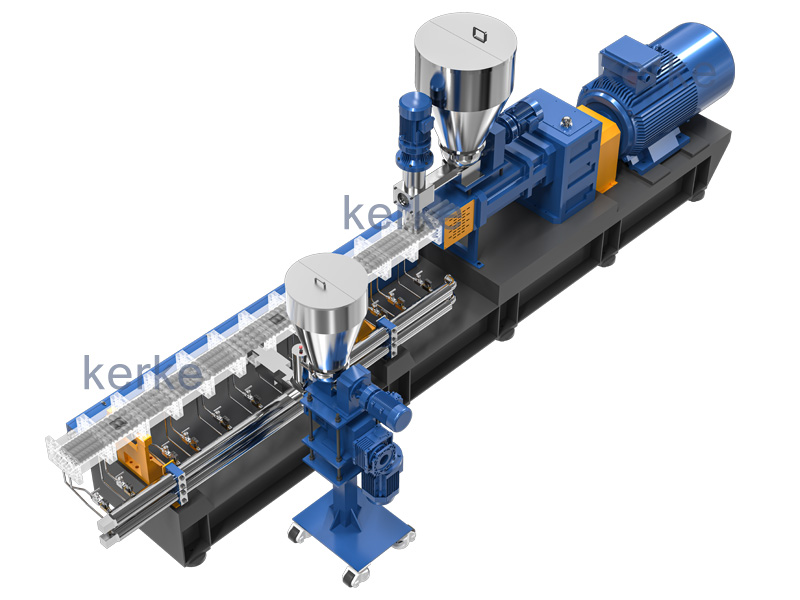
- High filling (≥75%): It is necessary to select a CWS twin-screw side feeder for forced exhaust and material pressing to extrude the air in the powder and avoid feeding gas return; At the same time, it is equipped with a loss-in-weight feeding scale. The main feeding port adds resin separately, and the side feeding port adds calcium carbonate powder separately to achieve precise material control (accuracy ±0.5%), which is the standard configuration for realizing 85% ultra-high filling.
(IV) Temperature Control and Exhaust System Selection (Ensure Masterbatch Quality)
- Temperature control system: Adopt multi-zone independent temperature control (zone 1: 120-140℃, zone 2: 140-160℃, zone 3: 160-180℃, machine head: 170-190℃), with accuracy controlled within ±1℃, to avoid resin degradation and calcium carbonate discoloration caused by local excessive temperature, or insufficient plasticization and uneven dispersion caused by too low temperature; Electromagnetic induction heating is recommended, which can preheat the material temperature to 50-60℃, improve feeding efficiency by 30%, and reduce energy consumption.
- Exhaust system: In high-filling masterbatch production, the moisture and small molecular volatile substances contained in the material will cause bubbles and pores in the masterbatch, affecting product quality. It is necessary to select a multi-stage vacuum exhaust system. Among them, the film-grade masterbatch production needs to be equipped with a 10th zone high-vacuum system to completely remove trace impurities and ensure the gloss and compactness of the masterbatch.
(V) Pelletizing and Cooling System Selection (Match Productivity and Quality)
The pelletizing and cooling system determines the particle regularity of the masterbatch, which needs to be selected according to the productivity:
- Water ring pelletizing: Economical and stable, with round particles and no dust. It is suitable for most conventional productivity (≤1000kg/h) production and is the current mainstream choice;
- Underwater pelletizing: A fully automatic production scheme for productivity >2 tons per hour, with high pelletizing accuracy and efficiency, suitable for large-scale production;
- Cooling system: For productivity ≤300kg/h, air-cooled die-face hot cutting can be selected; For productivity >300kg/h, conveyor belt cooling (≥15m long-distance air cooling + natural cooling) is recommended to avoid particle adhesion.
III. Practical Selection Guidelines: Match the Optimal Scheme According to Scenarios
Combined with the above selection dimensions, clear selection schemes are given for different production scenarios to facilitate direct implementation:
(I) Entry-Level Conventional Filling Production (Filling Amount 50%-70%, Productivity 200-500kg/h)
Core needs: Low cost, easy operation, meeting basic quality, suitable for start-up enterprises or small-batch production. Selection scheme: Co-rotating twin-screw extruder (screw diameter 45-52mm, length-diameter ratio 40-48:1), equipped with an economical pre-mixing feeding system (high-speed mixer + volumetric feeder); The screw is made of bimetallic material, and the barrel is made of ordinary wear-resistant alloy; Equipped with a single-stage vacuum exhaust and water ring pelletizing system; Temperature control adopts conventional electric heating to meet basic plasticization needs. Recommended models: SAT52 twin-screw extruder (output 250-350kg/h), Changzhou Lanxiang small twin-screw model.
(II) Mid-End High-Filling Production (Filling Amount 75%-85%, Productivity 500-1000kg/h)
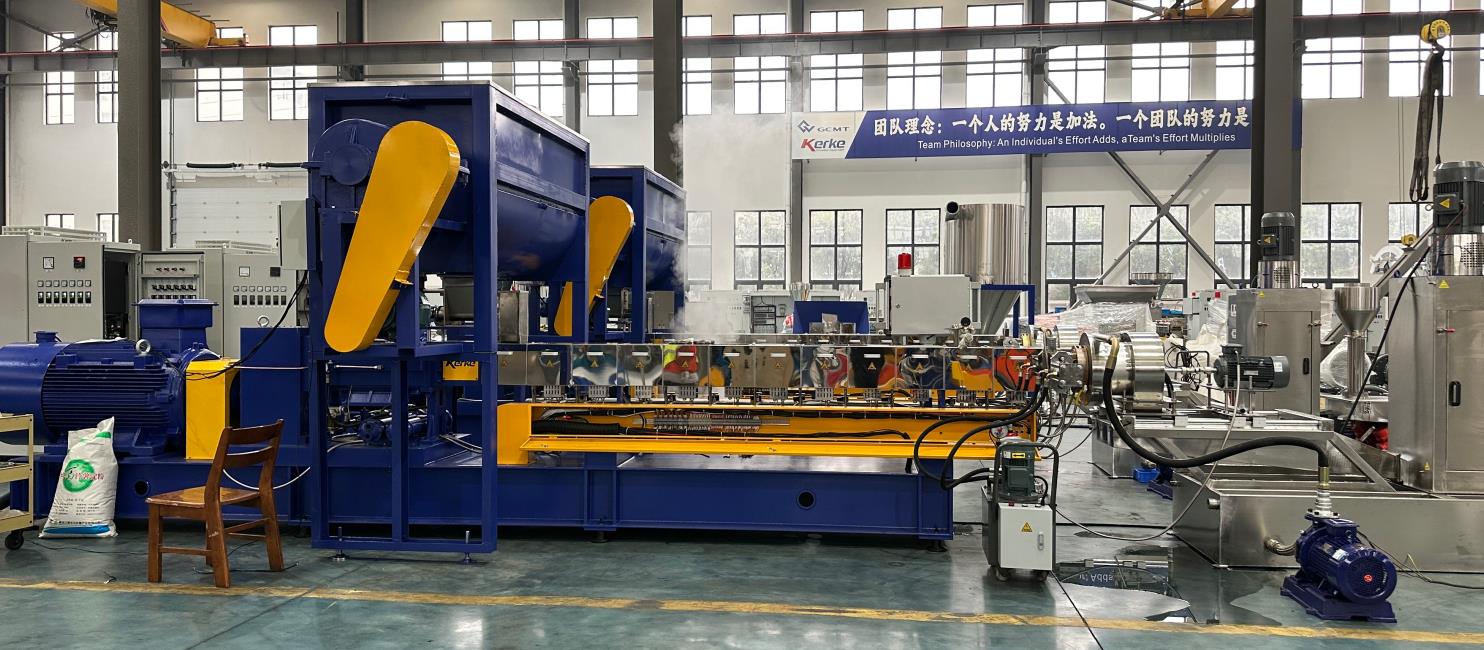
Core needs: High dispersion, wear resistance, stable productivity, suitable for medium-sized enterprises or mainstream market needs. Selection scheme: Standard co-rotating twin-screw extruder (screw diameter 65-75mm, length-diameter ratio 48-52:1), equipped with a high-precision loss-in-weight feeding system and CWS side feeder; The screw is made of W6Mo5Cr4V2 high-speed tool steel, and the barrel is made of Cr26MoV integral alloy sleeve; Equipped with a multi-stage high-vacuum exhaust system (≥2 stages) to completely remove volatile substances; Equipped with water ring pelletizing and conveyor belt cooling system; PLC control system can be optionally equipped to realize real-time parameter monitoring. Recommended models: SAT65/SAT75 twin-screw extruder, Jiangsu Kunwei Langsheng high-torque twin-screw model.
(III) High-End Ultra-Large Productivity Production (Filling Amount 75%-85%, Productivity >1000kg/h)
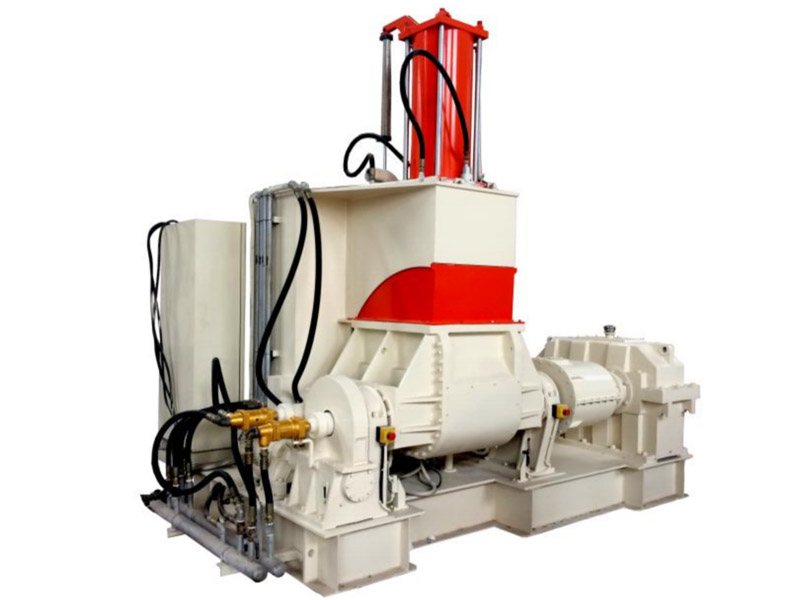
Core needs: Ultra-high output, extreme dispersion, low energy consumption, suitable for large-scale enterprises or high-end masterbatch production. Selection scheme: Triple-screw extruder (screw diameter 75-95mm, length-diameter ratio 48-52:1), or internal mixer + twin-screw extruder combination (suitable for ultra-high filling >85% scenarios); Equipped with a fully automatic loss-in-weight feeding system and closed-loop control to realize unmanned continuous production; The core components are made of top-grade wear-resistant materials, equipped with a heat-dissipating gearbox and electromagnetic induction heating system to reduce energy consumption by more than 30%; Equipped with multi-stage high-vacuum exhaust and underwater pelletizing system; AI process optimization system can be optionally equipped to realize automatic parameter adjustment. Recommended models: SAT-T series triple-screw extruder (SAT-T75 output can reach 2 tons per hour), Suzhou Jinwei intelligent twin-screw model.
(IV) Special Scenario Selection (Film Grade/Ultra-High Filling)
- Film-grade masterbatch (no crystal points, high transparency): Select a co-rotating twin-screw extruder with a high length-diameter ratio (52:1), equipped with a 10th zone high-vacuum exhaust system and precision temperature control system, optimize the distribution of screw shear blocks, improve dispersion uniformity, and avoid crystal points;
- Ultra-high filling masterbatch (>85%): Select an internal mixer + twin-screw extruder combination, use the strong shear pre-mixing advantage of the internal mixer to solve the problem of calcium carbonate agglomeration, and then plasticize and granulate through the twin-screw extruder to ensure uniform dispersion and regular particles.
IV. Common Selection Misunderstandings and Avoidance Suggestions
Many enterprises are prone to fall into the misunderstandings of “valuing price over performance” and “valuing productivity over adaptation” when selecting models, leading to problems such as fast wear, substandard quality, high energy consumption and soaring maintenance costs after equipment is put into production, which need to be focused on avoiding:
- Misunderstanding 1: Only focus on equipment price and ignore wear-resistant materials. Avoidance suggestion: Calcium carbonate filler masterbatch causes extremely strong wear to equipment. Low-cost equipment mostly uses ordinary materials, and core components need to be replaced within half a year, resulting in higher long-term maintenance costs. It is recommended to give priority to equipment with bimetallic screws and Cr26MoV barrels. Although the initial investment is higher, it can extend the service life by 2-3 times and reduce long-term costs.
- Misunderstanding 2: Blindly pursue high productivity and ignore own needs. Avoidance suggestion: Productivity is positively related to equipment specifications and energy consumption. Blindly selecting large models will lead to soaring energy consumption, high equipment no-load rate and increased production costs; It is necessary to select models with matching productivity according to own order volume, and reserve 10%-20% productivity redundancy.
- Misunderstanding 3: Ignore the feeding and exhaust system, leading to quality problems. Avoidance suggestion: In high-filling production, uneven feeding, gas return and incomplete exhaust are the main reasons for masterbatch bubbles and poor dispersion. It is not allowed to omit the side feeder or high-vacuum exhaust system to save costs. It is necessary to configure the appropriate feeding and exhaust system according to the filling amount.
- Misunderstanding 4: Ignore the manufacturer’s technical support and after-sales service. Avoidance suggestion: The production of calcium carbonate filler masterbatch involves many links such as material formula and equipment commissioning. High-quality manufacturers can provide full-process services such as formula verification, equipment commissioning and personnel training, and have timely after-sales response (such as 24-hour response from national outlets). It is recommended to give priority to manufacturers with good industry reputation and practical experience (such as Jiangsu Yuesheng, Kunwei Langsheng, etc.) to avoid failure to solve equipment problems in time and affect production.
- Misunderstanding 5: Confuse the equipment requirements of different application scenarios. Avoidance suggestion: Film-grade and injection-grade masterbatches have great differences in equipment requirements. For example, film-grade requires high length-diameter ratio and high vacuum, while injection-grade requires high filling adaptability. It is necessary to clarify the downstream application when selecting models to avoid substandard quality caused by “one machine for multiple uses”.
V. Selection Summary
The core of selecting an extruder for calcium carbonate filler masterbatch is “adaptability” — adapting to the characteristics of calcium carbonate materials (filling amount, mesh size), production scale and downstream application requirements, while focusing on the four core points of equipment: wear resistance, dispersion capacity, feeding system and temperature control and exhaust system, so as to balance productivity, quality and cost.
Suggestions on selection priority: First, clarify own production needs (filling amount, productivity, downstream application) → Determine the extruder type (twin-screw for conventional filling, triple-screw for high productivity, single-screw for entry-level) → Screen core component materials and configurations (wear-resistant materials, suitable feeding/exhaust system) → Select manufacturers according to budget and after-sales service → Reserve reasonable productivity redundancy.
In addition, when selecting models, priority can be given to manufacturers that provide “turnkey project for the whole line”, which provide full-process supporting services from raw material formula verification and equipment selection to installation and commissioning and personnel training, so as to reduce the risk of selection and commissioning; At the same time, pay attention to the energy saving and intelligence level of the equipment, which is in line with the current development trend of the plastic processing industry of “high filling, low energy consumption and high performance”, so as to realize long-term stable and efficient production.