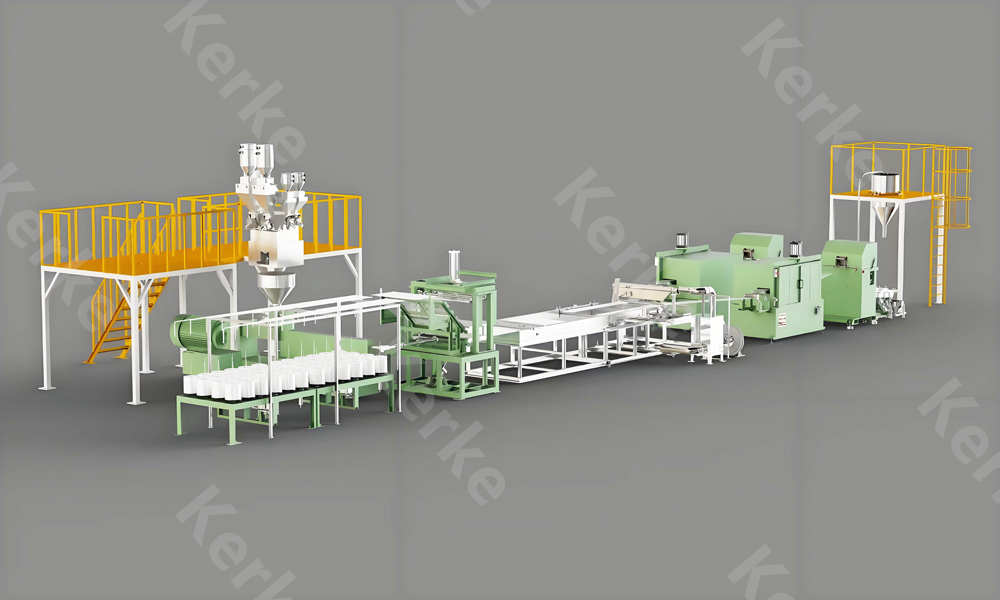
Kerke, a Wanplas factory with more than twelve years dedicated to parallel co-rotating twin-screw compounding extruders, works with compounders who measure every equipment choice by a single question: how fast does the line pay for itself. For plants built around high-filler formulations, the answer is unusually favorable, because loading calcium carbonate, talc, barium sulfate, or wood flour at high ratios displaces expensive base resin while a properly engineered twin-screw line keeps throughput, energy, and scrap under control. This article explains the engineering and configuration decisions that compress payback for a high-filler plastic compounding factory, and shows where the Kerke KTE platform and Wanplas group services remove the largest cost and risk items. The analysis uses a normalized cost index with the reference twin-screw compounding line set at 100, so every payback driver can be compared without quoting currency, and configurations are graded into Small, Medium, and Large payback tiers.
Why high-filler compounding compresses the payback window
The core economic lever in a high-filler plant is resin substitution. Base polymers such as polypropylene, polyethylene, and polyvinyl chloride sit at the top of the material cost index, while mineral fillers cost a fraction of that index and are added at loadings that often reach seventy to eighty-five percent in a filler masterbatch. When a twin-screw compounding extruder distributes that filler uniformly into the polymer melt, the compounder sells a pellet whose selling value tracks the resin while its material cost tracks the much cheaper filler. The capital spent on the line is therefore recovered against a wide spread between resin and filler indices, and the spread widens as filler loading rises. A plant that compounds at high filler content converts the same kilogram of resin into far more finished compound, which means each production hour retires a larger slice of the equipment investment.
Payback is not driven by material savings alone. A co-rotating twin-screw extruder with strong self-cleaning kneading blocks reaches stable quality at high filler content without the repeated shutdowns that plague poorly matched equipment, and stable quality protects the second payback driver: yield. Every rejected lot because of agglomerates, black spots, or poor dispersion erases the material saving that justified the filler in the first place. The third driver is energy per kilogram, because high filler compounds are stiff and abrasive, so screw geometry, barrel wear protection, and feeding strategy decide whether specific energy stays in a profitable band. The fourth driver is labor and changeover, where automated loss-in-weight feeding and die-face pelletizing remove manual dosing and strand handling. When all four drivers point the same direction, the payback tier lands in the Small band even though the capital cost index is higher than a bare entry line.
The cost index of filler loading and throughput
To keep the discussion free of currency, the reference compound is assigned a material cost index of 100, and filler substitution is shown as the index drop at the finished-pellet level. The table below maps common high-filler formulations to their loading tier, the resulting compound cost index, and the effect on throughput. Higher filler content generally improves the cost index but demands more careful feeding and dispersion, which is why the payback advantage belongs to plants that match the screw and barrel to the filler rather than to plants that simply overload a generic line.
| Filler type | Loading tier | Compound cost index | Throughput effect |
|---|---|---|---|
| Calcium carbonate (CaCO3) | High (75-85%) | 42 | High, masterbatch |
| Talc | Medium (30-45%) | 68 | Medium-High |
| Barium sulfate (BaSO4) | High (55-70%) | 55 | High |
| Wood flour (WPC) | Medium-High (45-60%) | 60 | Medium |
| Glass fiber | Medium (25-35%) | 75 | Medium |
The cost index falls hardest for calcium carbonate masterbatch, which is why filler masterbatch is the classic shortest-payback product on a twin-screw line. Barium sulfate and wood-plastic composites also land in the favorable band, while glass fiber grades trade some material saving for higher engineering value. The practical conclusion for a new high-filler factory is to start with the formulation that has the lowest compound cost index and the most stable demand, then extend the same line into medium-index products once the payback tier is secured.
The Kerke KTE twin-screw platform for high filler
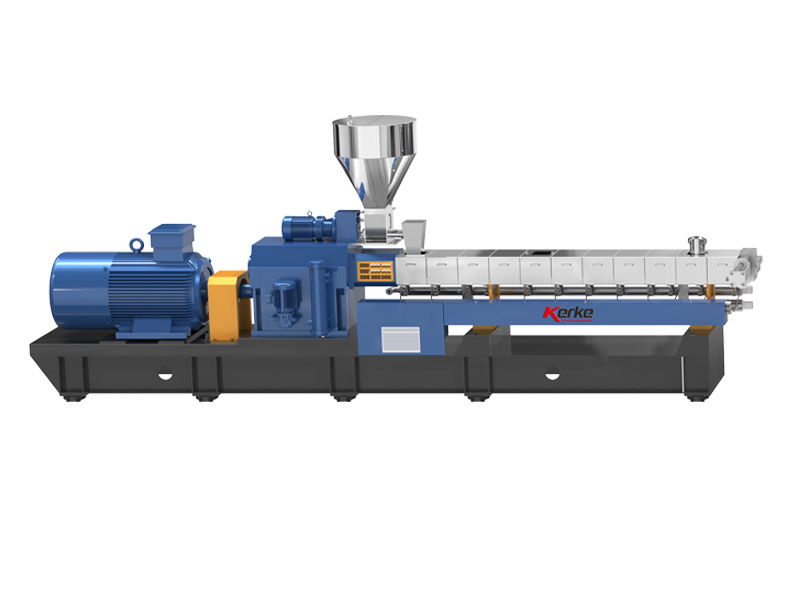
Kerke designs parallel co-rotating twin-screw compounding extruders as the KTE series, spanning from the KTE-16B laboratory unit used for formula trials up to the KTE-135D production flagship, with the production frames covering screw diameters from roughly 65 mm to 135 mm and length-to-diameter ratios that are optimized per application. Every screw assembly is computer-aided designed with kneading co-type elements that give excellent self-cleaning, good interchangeability, and full control of material transport, plasticization, shearing, dispersion, homogenization, exhaust, and pressure building. For high-filler work those functions are exactly what protect yield, because dispersion quality decides whether the low compound cost index actually converts into a saleable pellet.
The platform is engineered so the same barrel and screw building blocks serve many filler types, which keeps spare-part complexity low and lets a plant reconfigure for a new formulation without a second capital project. Barrel structure, screw arrangement, exhaust position, feeding port, and electrical control are all optimizable, and the line accepts side feeding and loss-in-weight feeding as standard options rather than custom retrofits. The table below summarizes the KTE frames a high-filler factory evaluates, using documented output ranges from the Kerke program rather than fixed promises for a specific formulation.
| Model frame | Screw Ø | L/D | Output | Role |
|---|---|---|---|---|
| KTE-16B | 16 mm | 40 | 0.5-5 kg/h | Lab, scale-up |
| KTE series (production) | 65-135 mm | 40-52 | 30 kg/h to high | Filler masterbatch |
| KTE-135D | 135 mm | 48 | High capacity | Heavy-filler flagship |
Choosing the right frame is the first payback decision. A plant that begins with the KTE-16B to prove the formulation avoids scaling an unproven recipe straight onto a large line, which removes the most expensive failure mode: commissioning a high capital index line against a formulation that still needs rework. Once the recipe is fixed, the production frame carries the volume that retires the investment, and the KTE-135D carries the highest-volume filler masterbatch where scale alone shortens payback.
Screw and barrel engineering that resists filler abrasion
High filler content is abrasive, and abrasion is the silent payback killer because it raises maintenance cost index and unscheduled downtime. Kerke answers this with a barrel structure built around a wear-resistant liner and a screw arrangement that balances shear against residence time, so the filler is dispersed without over-grinding the polymer or overheating the melt. Co-rotating parallel screws with well-matched kneading blocks generate the localized high shear needed to break filler agglomerates, while the self-cleaning profile stops material from baking onto the screw root and forming black spots that would scrap a lot.
Exhaust is another payback factor that is easy to overlook. Mineral fillers carry moisture and air, and unfilled compounds trap volatiles that surface as silver streaks or porous pellets; a properly positioned vent port on the KTE barrel removes those volatiles online, protecting both appearance and mechanical properties of the finished compound. The electrical control and feeding layout are optimizable so the operator tunes screw speed, torque, and feed rate against the live melt pressure, holding the line in its most efficient specific-energy window. Wanplas group standards apply across the Kerke program, so the wear parts, liners, and spare screws follow a documented specification rather than ad-hoc sourcing, which keeps the long-term cost index predictable for the full payback period.
KTE-135D flagship for heavy filler masterbatch
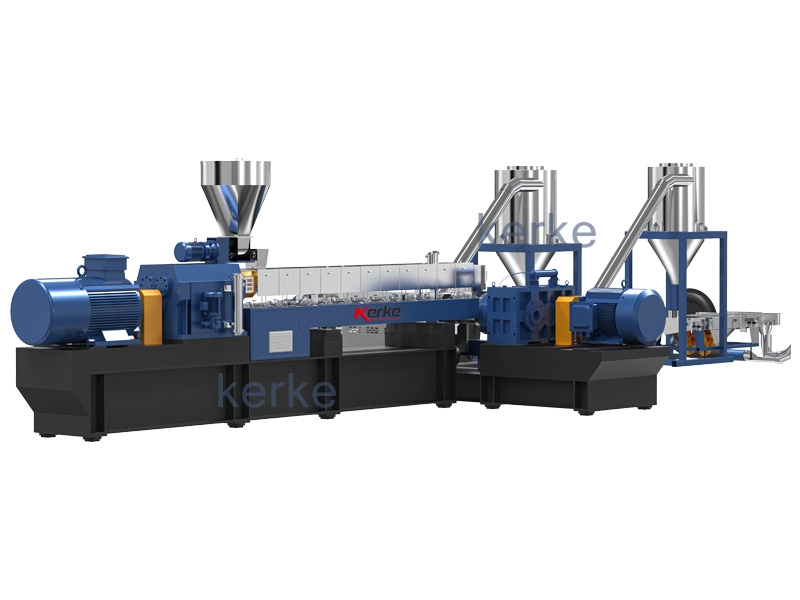
When the business case is a high-volume calcium carbonate or barium sulfate masterbatch, the KTE-135D is the frame that turns scale into the shortest payback. Its 135 mm screw and long L/D give the residence time and mixing length needed to wet very high filler loadings uniformly, while the high torque co-rotating drive sustains output without overloading the main feed throat. Plants running at this scale usually pair the KTE-135D with a side feeder and a water-ring die-face pelletizing system, because at Large throughput tiers the manual labor of strand pelletizing would erase part of the payback advantage.
| Parameter | KTE-135D | Payback note |
|---|---|---|
| Screw diameter | 135 mm | High volume per hour |
| L/D ratio | 48 | Dispersion at high filler |
| Output | High capacity | Scale shortens payback |
| Barrel liner | Wear-resistant alloy | Lowers maintenance index |
| Feeding | Side feeder ready | Lower torque per kg |
| Pelletizing | Water-ring die-face | Low labor index |
The KTE-135D is the right answer when demand already justifies Large throughput, because spreading the capital cost index over more kilograms per year is the most direct route to a Small payback tier. For a plant still building volume, the mid production frame of the KTE series reaches the same compound cost index at a lower capital index, which is often the faster route to positive cash flow during the first operating year.
Feeding and pelletizing systems that shorten payback
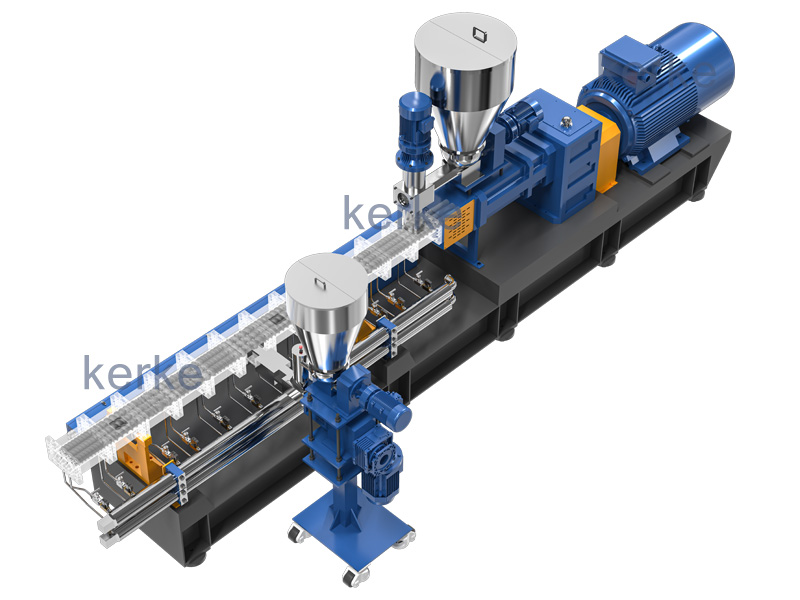
How filler enters the line decides both quality and cost. Dropping all filler through the main feed throat loads the screw at the start of the barrel, where it competes with resin for conveying capacity and spikes torque, capping output. A side feeder introduces filler downstream into an already melted, low-viscosity polymer stream, so the main screw handles resin plasticizing while the side screw meters filler into the melt; the result is higher total throughput at the same drive torque, which improves the payback index directly. Loss-in-weight feeding replaces volumetric guessing with gravimetric accuracy, so the filler ratio stays on target and expensive resin is never over-dosed to compensate for drift.
| System | Role | Payback effect |
|---|---|---|
| Volumetric metering | Entry dosing | Low cost, Medium tier |
| Loss-in-weight feeder | Gravimetric accuracy | Resin saving, Small |
| Side feeder | Downstream filler | Higher output, Small |
| Liquid feeder | Coupling agents | Quality, Medium |
| Water-ring die-face | Automated cutting | Low labor, Small |
| Strand pelletizing | Manual cutting | Flexible, Medium |
The Wanplas group supplies matched auxiliary equipment for the Kerke line, including high-speed mixers, granulators, pulverizers, and water chillers, so the compounding cell is specified as one integrated system rather than a collection of unrelated machines. Integration matters for payback because the bottleneck is always the weakest unit: a fast extruder behind a slow feeder still only produces at feeder speed, and a matched cell removes that hidden cost index. Kerke also offers the double-stage extrusion system for special materials that cannot be processed on a single-stage line, protecting the payback case when a formulation needs mother-baby configuration.
Application industries for high-filler compounds
High-filler twin-screw compounding serves several large, steady-demand industries, and serving more than one is how a plant keeps utilization high and payback in the Small tier through demand cycles. Masterbatch production is the anchor: color masterbatch, filler masterbatch, additive masterbatch, black masterbatch, and textile masterbatch all run on the same KTE platform with recipe changes rather than hardware changes. Plastic compound applications extend to engineering plastic, biodegradable plastic, cable compounding, PVC compounding, thermoplastic elastomer, and wood-plastic composites, each of which tolerates high filler content and rewards low compound cost index.
Beyond plastics, the Kerke twin-screw technology also processes recycled PET flakes and supports pet food and plant-protein texturization, which gives a high-filler factory optional revenue streams that share the same capital base. For a new plant the marketing logic is simple: lead with filler masterbatch where the cost index is lowest, then expand into WPC and cable compounds as customers are won, using the Wanplas open-factory policy to invite those customers to witness trial runs on the actual KTE line. Higher utilization is the quiet payback multiplier, because every extra hour of running spreads the fixed capital cost index over more salable kilograms.
Selection recommendation for a high-filler factory
The table below maps a typical high-filler business case to the Kerke model and configuration that reaches the best payback tier. The guidance follows the documented KTE range and avoids over-specifying a frame that exceeds real demand, because an oversized line raises the capital cost index without raising utilization, which pushes payback from Small toward Medium.
| Customer need | Kerke model | Configuration |
|---|---|---|
| Formula trial, scale-up | KTE-16B | Lab twin-screw |
| Small filler masterbatch | KTE series mid frame | Loss-in-weight main feed |
| Heavy CaCO3 masterbatch | KTE-135D | Side feeder + die-face |
| WPC, wood-plastic | KTE-135D | Sheet option, one step |
| Cable compounding | KTE series | Side feeder, exhaust |
Two patterns stand out. First, every high-filler case benefits from gravimetric or side feeding, so those options should be treated as standard rather than optional on the payback math. Second, the KTE-135D earns its higher capital index only when volume is genuinely Large; below that point the mid production frame reaches the same compound cost index at a lower capital index and therefore a faster first-year payback. Kerke engineers tune aspect ratio, barrel structure, screw arrangement, exhaust, feeding, and electrical control to the specific filler, so the recommended model is a starting point confirmed by a trial run rather than a fixed catalog guess.
Payback index by configuration
The final comparison normalizes the whole investment into a capital cost index against the reference line at 100, and grades payback into Small, Medium, and Large tiers where Small is the fastest recovery. The index deliberately excludes currency; it is a relative planning tool that compounds, resin prices, and filler indices can be dropped into once the local market is known. The pattern is consistent with the earlier sections: higher filler loading and better feeding push the payback tier down even when the capital index rises, because the recurring material saving dominates the one-time capital.
| Configuration | Capital index | Payback tier | Driver |
|---|---|---|---|
| Standard single-feed line | 100 | Medium | Resin cost only |
| High-filler + side feeder | 118 | Small | Substitution + yield |
| KTE-135D masterbatch | 135 | Small | Scale + throughput |
| KTE-16B lab unit | 28 | Formula risk | De-risks scale-up |
Reading the table, the fastest true payback belongs to the high-filler lines, not the cheapest line. The KTE-16B deserves a separate note: its tiny capital index is not a production payback but an insurance policy that the large line behind it runs the right formula, which is why Kerke recommends proving the recipe on the lab unit before committing the production frame. Wanplas group promises back the whole program with the same quality standards, so the payback plan is not exposed to a weak link in service or spare parts.
Service and support that protect the payback plan
A payback model is only as durable as the support behind the line. Kerke, as a Wanplas factory, applies the Wanplas group promises: USD 500 free parts every year, free replacement for damaged parts within warranty, a transport guarantee, a production capacity guarantee, and quality standards with refund plus ten percent compensation if quality fails. The shared open-factory policy welcomes customers and owners to visit the 19,997 plus square meter Kerke facility, where more than 2,000 machines already run in over 70 countries, and where the team of 100 plus members with 12 plus years of experience demonstrates the KTE line under real conditions before shipment.
Commissioning is part of the payback, not an extra. Kerke supplies installation and commissioning, operator training, and remote monitoring options so the line reaches its specified output quickly and stays there, and the group maintains average ten plus years of experience per equipment type. The USD 500 annual free parts policy caps a recurring cost index that would otherwise vary with local supply, and the warranty replacement removes the capital risk of an early component failure. For a high-filler plant where barrel liners and screws are wear items, that predictability is what keeps the long-term payback tier in the Small band instead of drifting into Medium as maintenance accrues.
Energy efficiency and specific energy per kilogram
Specific energy, measured as the drive and heating energy spent per kilogram of finished compound, is the payback variable most sensitive to screw design in a high-filler plant. Stiff, abrasive compounds resist mixing, so a poorly profiled screw spends energy churning material instead of dispersing it, and that wasted energy shows up as a higher recurring cost index that quietly lengthens payback. The Kerke computer-aided screw assembly places kneading and conveying elements so the filler meets high shear only where it is needed, then relaxes the melt before the next zone, which keeps torque and melt temperature in the efficient window and avoids the over-heating that forces a slower line speed. A longer L/D on the KTE-135D spreads the mixing work over more barrel length, lowering the peak specific energy even at very high filler loading.
Barrel heating strategy and exhaust also affect the energy index. Removing filler moisture through a properly positioned vent reduces the load on the downstream dryer and prevents steam pockets that waste power, while the Wanplas-grade electrical control holds screw speed and feed rate against live melt pressure instead of running at a fixed conservative setting. Plants that monitor specific energy per kilogram can spot a worn liner or a drifting feeder before it damages yield, because a rising energy index at steady output is an early warning that the line is working harder for the same pellet. Keeping that index flat across the payback period is what separates a line that compounds the saving into profit from one that gives the saving back through the utility bill.
Capacity utilization and demand planning for a Small-tier payback
The single biggest lever after formulation is how many hours per year the line actually runs, because the capital cost index is spread over annual output and idle hours never retire investment. A high-filler factory reaches a Small payback tier when it serves several steady-demand industries from one KTE platform, switching recipes instead of machines: filler masterbatch anchors the base load, then WPC, cable compound, and PVC compound fill the swings, and optional PET flake or protein texturization runs use the same capital during soft periods. This utilization logic is why Kerke recommends confirming the recipe on the KTE-16B first, so the production frame is committed to a formulation with real, repeatable demand rather than a hopeful estimate.
Demand planning also decides the frame size, and frame size decides the capital index. A mid production frame of the KTE series hits the lowest compound cost index at a capital index near the reference line, which usually yields the fastest first-year payback for a plant still climbing volume; the KTE-135D only wins once annual demand is genuinely Large, because below that point its higher capital index is spread over too few kilograms and payback slides toward Medium. Wanplas group support helps here too, with installation, training, and remote monitoring that shorten the ramp from first shipment to full utilization, and the open-factory policy that lets customers witness a trial run and place orders sooner. The shortest payback is therefore an operating plan as much as a machine specification: right filler, right frame, high utilization, and predictable support.
Frequently asked questions
How does filler loading shorten the payback of a twin-screw compounding line?
High filler loading displaces expensive base resin with low-index mineral filler, so the finished compound carries a much lower material cost index while its selling value still tracks the resin. The wider the spread between resin and filler indices, the more each production hour retires of the equipment capital, which moves the payback tier toward Small. The saving only converts to profit when the screw and barrel disperse the filler without scrap, so the payback advantage belongs to a line matched to the filler rather than an overloaded generic machine.
Which Kerke twin-screw model fits a high calcium carbonate masterbatch plant?
For high-volume calcium carbonate masterbatch the KTE-135D is the production flagship, with its 135 mm screw and long L/D giving the residence and shear needed at seventy to eighty-five percent loading. A plant still building volume reaches a faster first-year payback on a mid production frame of the KTE series, because the lower capital cost index is spread over fewer kilograms. Kerke recommends proving the recipe on the KTE-16B lab unit before committing the large frame.
Why use a side feeder for high filler content?
A side feeder introduces filler downstream into the already melted polymer, so the main screw plasticizes resin while the side screw meters filler into a low-viscosity melt. This avoids the torque spike of dumping all filler at the main throat, raises total throughput at the same drive power, and protects dispersion quality. On the payback math the side feeder lifts the configuration from Medium toward Small tier by increasing output without raising capital proportionally.
What barrel and screw features resist filler abrasion?
Kerke uses a wear-resistant barrel liner and a computer-aided screw assembly with self-cleaning kneading blocks that disperse agglomerates without over-grinding the polymer or baking material onto the screw root. A well-placed exhaust port removes filler moisture and volatiles online, preventing silver streaks and porous pellets. These features lower the maintenance cost index and unscheduled downtime, which is what keeps the long-term payback tier in the Small band.
How much floor space and utility does a high-filler line need?
A high-filler twin-screw cell needs the extruder, gravimetric or side feeders, a pelletizing system, a water chiller, and material handling, laid out so the weakest unit is not the bottleneck. Utility load scales with screw diameter and throughput, so the KTE-135D draws more than a mid frame but produces far more kilograms per hour, which is why scale lowers the cost index per kilogram. Kerke engineers review layout and utility during commissioning to keep the cell balanced.
Does Wanplas provide commissioning and spare parts for Kerke lines?
Yes. As a Wanplas factory, Kerke applies the group promises: installation and commissioning, operator training, remote monitoring, USD 500 free parts every year, warranty replacement, and an open-factory policy. The shared quality standards and spare-part specification keep the recurring cost index predictable across the full payback period, so the support behind the line never becomes the weak link that pushes payback from Small toward Medium.
Build your high-filler compounding line with Kerke
The shortest payback for a high-filler plastic twin-screw compounding factory comes from pairing the lowest compound cost index formulation with a Kerke KTE line configured for that filler, then protecting the saving with gravimetric or side feeding, wear-resistant barrel engineering, and Wanplas-grade commissioning and parts support. Start on the KTE-16B to de-risk the recipe, scale to the mid KTE frame or the KTE-135D once demand is real, and let high utilization do the rest. Kerke invites you to share your target filler ratio, output, and material so its engineers can configure a matched twin-screw compounding cell and arrange a trial run at the factory, where you can verify dispersion, throughput, and payback before the line ships.