1. Introduction
LLDPE (Linear Low-Density Polyethylene) masterbatch granulation is a critical process in polymer processing, where additives such as pigments, stabilizers, and fillers are uniformly dispersed into LLDPE resin to create functional compounds for various applications. The PLC-controlled twin screw extruder has emerged as the gold standard for this process, offering precise mixing, efficient dispersion, and consistent output. This article explores the formulation, production process, equipment, parameters, costs, troubleshooting, maintenance, and FAQs related to LLDPE masterbatch granulation using Nanjing Kerke KTE Series twin screw extruders.
2. Formulation Ratios (Different Types)
LLDPE masterbatch formulations vary based on application requirements, including color, mechanical properties, and processing needs. A typical formulation consists of four main components: LLDPE resin, pigment/concentrate, additives, and processing aids. Below are common formulations:
Color Masterbatch: LLDPE resin (70-85%), pigment/concentrate (10-25%), dispersant (2-5%), and anti-blocking agent (1-3%).
Functional Masterbatch (e.g., UV Stabilizer): LLDPE resin (80-90%), UV absorber (2-5%), hindered amine light stabilizer (HALS) (1-3%), antioxidant (1-2%), and lubricant (1-3%).
Filler Masterbatch (e.g., Calcium Carbonate): LLDPE resin (60-75%), CaCO₃ filler (20-35%), coupling agent (1-3%), dispersant (1-3%), and lubricant (1-2%).
Key considerations include resin melt flow index (MFI), which affects extrusion speed, and additive compatibility to avoid agglomeration or degradation.
3. Production Process (Detailed)
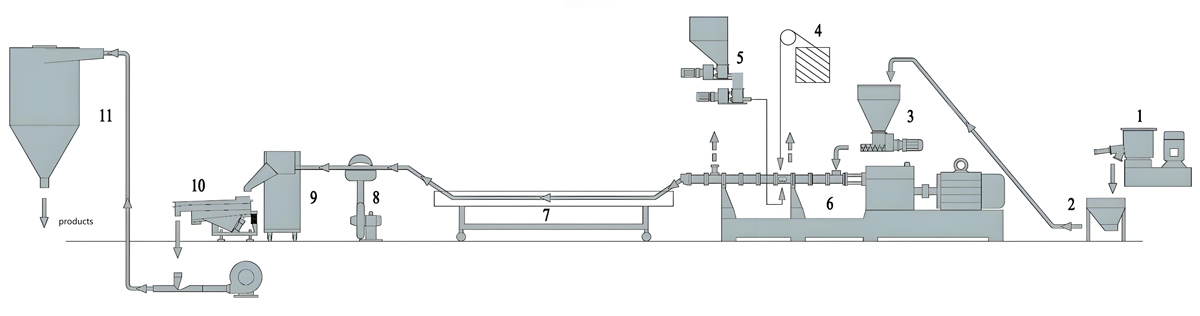
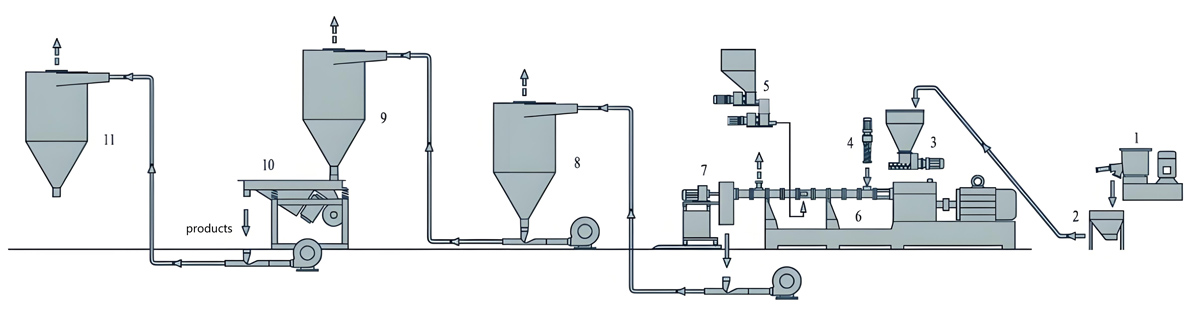
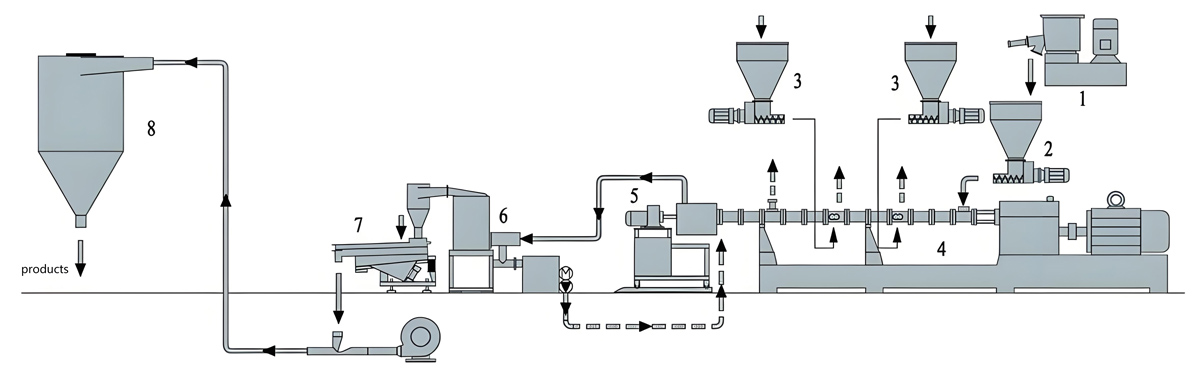
The granulation process for LLDPE masterbatch using a twin screw extruder involves several sequential steps:
Step 1: Raw Material Preparation
All components are pre-blended to ensure homogeneity. Pigments and fillers are dried to remove moisture, preventing steam formation during extrusion. Resins are sieved to remove large particles, and additives are weighed precisely using digital scales for consistency.
Step 2: Feeding
Pre-blended materials are fed into the twin screw extruder through a hopper. The feed rate is controlled by a variable frequency drive (VFD) to match the extruder’s throughput capacity. For LLDPE, a gravity-fed or volumetric feeder may be used, with the PLC system adjusting feed rates based on real-time torque and temperature feedback.
Step 3: Extrusion and Mixing
As materials enter the extruder, they undergo intense mixing, conveying, and shearing in the screw channels. The twin screw design—typically intermeshing with self-wiping or non-intermeshing configurations—creates high shear forces that disperse additives into the LLDPE matrix. The barrel is divided into temperature zones (5-8 zones) to control melting and viscosity, with the feed zone at 150-180°C, compression zone at 180-200°C, and metering zone at 190-210°C for LLDPE processing.
Step 4: Melt Pumping and Filtration
The molten compound passes through a gear pump to ensure constant pressure and flow, followed by a screen pack (30-100 mesh) to remove impurities and agglomerates. The screen pack is replaced periodically to maintain product quality.
Step 5: Pelletizing
The extruded strand is cooled in a water bath or air-cooled system to solidify the polymer. A pelletizer with rotating blades cuts the strand into uniform pellets (3-6 mm length). The pelletizer speed is synchronized with the extruder output to prevent strand breakage or uneven pellet size.
Step 6: Drying and Screening
Pellets are dried in a hot air dryer at 60-80°C for 2-4 hours to remove residual moisture, then screened to separate oversized or undersized pellets. The final product is bagged and stored.
4. Production Equipment Introduction (Twin Screw Extruder: Nanjing Kerke KTE Series)
The Nanjing Kerke KTE Series twin screw extruder is a robust, high-performance machine designed for LLDPE masterbatch production. Key features include:
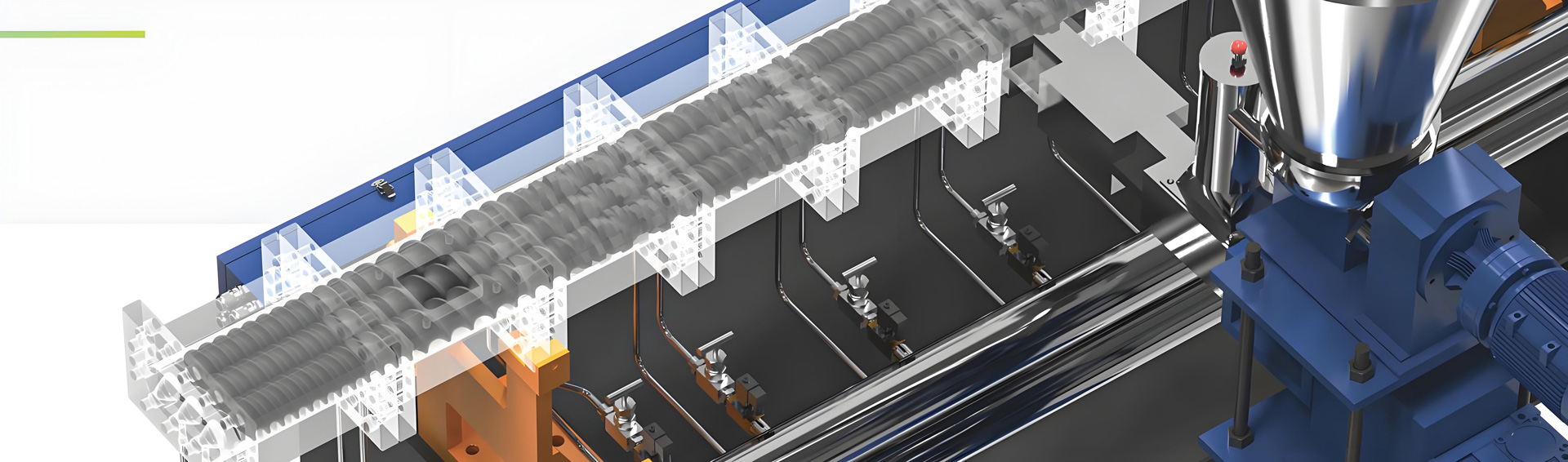
Extruder Screw Configuration: The KTE Series typically uses a 36:1 L/D (length-to-diameter) ratio screw with a conveying section, compression section, and metering section. The screw elements are precision-machined with intermeshing flights and mixing elements (e.g., kneading discs, pins) to ensure thorough dispersion and uniform mixing.
PLC Control System: Equipped with a Siemens or Mitsubishi PLC, the system monitors and adjusts temperature, pressure, screw speed, and feed rate in real time. HMI (Human-Machine Interface) allows operators to set parameters, view production data, and troubleshoot issues remotely.
Barrel and Heating/Cooling: The barrel is jacketed for temperature control, with ceramic heaters and water-cooled zones. The temperature zones are independently controlled to maintain the required melt temperature profile.
Feeding System: A twin-screw feeder with variable speed drives and a hopper with a sight glass ensures consistent material feeding. Optional side feeders can be added for liquid additives or high-viscosity components.
Additional Components: Includes a gearbox with high-precision helical gears, a die head with interchangeable die plates, a water ring pelletizer, and a post-extrusion cooling system.
5. Parameter Settings
Optimal parameter settings for the KTE Series extruder depend on the masterbatch type and resin characteristics. Typical settings for LLDPE masterbatch (MFI = 2-5 g/10min at 190°C/2.16 kg) are:
Screw Speed: 150-300 rpm (adjusted based on throughput and melt viscosity). Higher speeds increase shear but may cause overheating; lower speeds improve dispersion but reduce output.
Barrel Temperature Zones (°C): Zone 1 (feed): 140-160, Zone 2: 160-180, Zone 3: 170-190, Zone 4: 180-200, Zone 5: 190-210, Zone 6: 190-205 (metering zone).
Die Head Temperature: 190-210°C (maintaining melt consistency for uniform strand formation).
Feed Rate: 50-200 kg/h (varies by model; KTE-65 can handle up to 200 kg/h, KTE-95 up to 500 kg/h). The PLC adjusts feed rate to maintain a constant torque (50-70% of maximum torque) to prevent overload.
Pelletizer Speed: 100-300 rpm (synchronized with extruder output; typically 1.5-2 times the extruder screw speed).
Water Cooling Temperature: 20-30°C (maintaining strand solidification without thermal shock).
6. Equipment Prices (Twin Screw Extruder in USD: Nanjing Kerke KTE Series)
Prices for Nanjing Kerke KTE Series twin screw extruders vary by model and configuration. Below are approximate ex-factory prices (USD) for standard configurations (excluding auxiliary equipment like pelletizers and dryers):
KTE-65 (65 mm screw diameter): $80,000 – $120,000 (depending on barrel length, control system, and optional features like side feeders).
KTE-95 (95 mm screw diameter): $150,000 – $220,000 (higher throughput, larger barrel, and heavier construction).
Key Cost Factors: Custom screw designs, PLC upgrades (e.g., Siemens S7-1200 vs. basic PLC), water ring pelletizers, and post-extrusion cooling systems can increase costs by 10-30%.
Total Investment: For a complete production line (extruder, feeder, pelletizer, dryer, cooling system), expect $150,000 – $350,000 for a small to medium-scale operation.
7. Common Production Problems and Solutions
Problem 1: Uneven Color Dispersion
Causes: Poor mixing due to low screw speed, incorrect screw configuration, or agglomerated pigments.
Solutions: Increase screw speed (15-20 rpm), replace mixing elements with more aggressive kneading discs, or pre-disperse pigments in a solvent before adding to LLDPE. Screen pack changes may also help remove agglomerates.
Prevention: Use pre-blended pigment concentrates with high dispersion quality and maintain consistent feed rates to avoid fluctuations in mixing time.
Problem 2: Pellet Size Inconsistency
Causes: Variations in extruder speed, uneven die head temperature, or worn pelletizer blades.
Solutions: Calibrate the PLC to maintain constant screw speed and feed rate; check die head temperature zones and adjust heaters/coolers; replace worn blades with sharp, evenly spaced knives.
Prevention: Regularly inspect die heads for blockages and clean them with a solvent before shutdown; schedule blade sharpening every 500-1000 hours of operation.
Problem 3: Extruder Jamming
Causes: Overloading the extruder with high-viscosity materials, foreign objects in the feed, or incorrect temperature settings causing material degradation.
Solutions: Reduce feed rate, remove foreign objects, and increase barrel temperature in the feed zone to lower melt viscosity. If jamming occurs, reverse the screw direction to clear the blockage.
Prevention: Install a metal detector in the feed line, maintain proper material drying, and use a VFD to limit feed rate during startup.
Problem 4: Melt Pressure Fluctuations
Causes: Clogged screen pack, uneven barrel temperature, or inconsistent feed rate.
Solutions: Replace the screen pack, adjust barrel temperature zones, and calibrate the feeder to maintain constant material flow.
Prevention: Monitor screen pack pressure drop (aim for <100 bar) and replace screens every 2-4 hours of operation; use a melt pressure transducer to detect early blockages.
8. Maintenance and Care
Daily Maintenance: Clean the hopper and screw flights, check oil levels in the gearbox, and verify that all safety interlocks are functional.
Weekly Maintenance: Inspect and tighten drive belts, clean the pelletizer blades, and calibrate the feeders. Check barrel temperature sensors for accuracy.
Monthly Maintenance: Change the gearbox oil, inspect screw elements for wear, and clean the die head and screen changer. Verify PLC software for updates.
Annual Maintenance: Overhaul the screw and barrel (resurface if worn), replace bearings, and perform a full system alignment. Lubricate all moving parts with high-temperature grease.
Long-Term Care: Store the extruder in a dry environment when not in use, cover exposed components to prevent dust accumulation, and keep spare parts (screws, screen packs, blades) on hand for quick replacement.
9. FAQ
Q1: What is the minimum batch size for LLDPE masterbatch production with a KTE Series extruder?
A1: The minimum batch size is typically 50-100 kg, depending on the extruder model. Smaller batches may require manual adjustments to the feed rate and screw speed.
Q2: Can the KTE Series extruder handle LLDPE with high MFI?
A2: Yes, the KTE Series can process LLDPE with MFI up to 10 g/10min at 190°C/2.16 kg, but higher MFI resins may require lower screw speeds to prevent overheating.
Q3: How often should the screen pack be replaced?
A3: Screen packs should be replaced every 2-8 hours, depending on the masterbatch type and additive load. Monitor pressure drop across the screen pack to trigger replacement.
Q4: Is the KTE Series suitable for continuous production?
A4: Yes, the KTE Series is designed for 24/7 continuous operation with proper maintenance, offering a production lifespan of 10+ years.
10. Summary
The PLC-controlled twin screw extruder, particularly the Nanjing Kerke KTE Series, provides an efficient, reliable solution for LLDPE masterbatch granulation. By optimizing formulations, process parameters, and equipment maintenance, manufacturers can achieve uniform dispersion, consistent quality, and high throughput. Key benefits include precise control over mixing, reduced energy consumption, and adaptability to various masterbatch types. While initial equipment costs are significant, the long-term ROI, combined with improved product quality, makes the KTE Series a worthwhile investment for polymer processors.