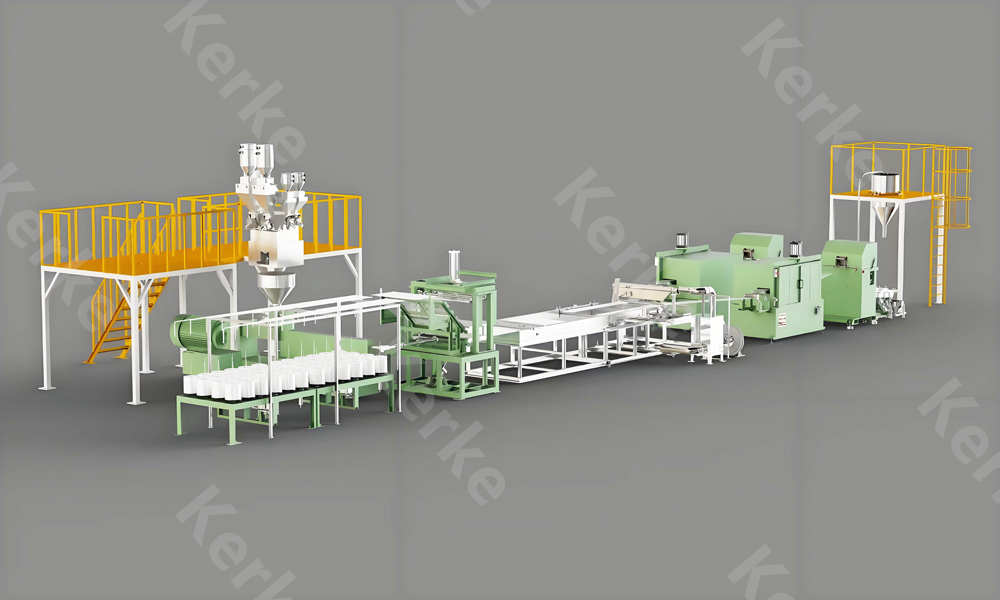
Why reactive twin-screw extrusion is the right route for stable PLA composites
Biodegradable polylactic acid, or PLA, has moved from a niche bioplastic into a mainstream engineering polymer for packaging, food serviceware, agriculture film, and fiber. Yet neat PLA fails two requirements that most converters cannot accept: it is brittle at room temperature, and its heat deflection temperature sits close to the boiling point of water. A stable biodegradable PLA composite formula for twin-screw reaction extruder solves both problems inside a single continuous process, using chemistry as much as mechanical mixing. The twin-screw reaction extruder is not a passive blender. It is a continuous reactor in which tougheners are coupled, nucleating agents are dispersed, plasticizers are distributed, fillers are wetted, and chain extenders rebuild molecular weight that thermal and hydrolytic degradation would otherwise destroy.
Kerke, a Wanplas factory and a specialist in parallel co-rotating twin-screw compounding extruders, has spent more than 12 years building the KTE series and supporting laboratory, triple-screw, and double-stage systems for exactly this class of work. With a 19,997-plus square meter plant, more than 2,000 machines running worldwide, and equipment shipped to over 70 countries, Kerke positions the reactive compounding line as a complete formula-to-pellet solution rather than a bare extruder. The Wanplas group, the parent brand behind Kerke, unites specialized factories under one quality standard and one service promise, so a PLA compounder buys process certainty as well as hardware.
This article explains how to design a stable biodegradable PLA composite formula for twin-screw reactive extrusion. It covers the resin behavior that drives instability, the additive system that restores toughness and heat resistance, the reactive chemistry that locks the blend together, the rPET route for recycled content, and the screw configuration that keeps the reaction controlled. It then maps the formula to real Kerke machines, including the KTE co-rotating twin-screw series, and closes with a selection guide, quality practice, and service commitment. The objective is practical: give a compounder or product developer a defensible formulation framework and the machine architecture to run it at scale.
Reactive extrusion turns the twin-screw barrel into a chemical reactor. Stability in a PLA composite is an outcome of correct chemistry under correct shear and residence time, not of a single magic additive.
PLA resin fundamentals and the degradation behavior that threatens stability
PLA is a linear aliphatic polyester most often made by ring-opening polymerization of lactide, the cyclic dimer of lactic acid. It is typically supplied as a semi-crystalline or amorphous pellet with a density near 1.24 grams per cubic centimeter, a melting point around 150 to 170 degrees Celsius depending on optical purity, a glass transition temperature near 55 to 60 degrees Celsius, and a melt flow rate that varies widely by grade. Its tensile strength is respectable, but its notched impact strength is low, often below 3 kilojoules per square meter at room temperature, and its crystallinity develops slowly unless nucleated. These three traits, brittleness, slow crystallization, and heat sensitivity, define the formulation problem.
The deeper risk is degradation inside the barrel. PLA undergoes two coupled breakdown modes during melt processing. Thermal degradation cleaves ester backbone chains at high temperature, lowering molecular weight and melt strength. Hydrolytic degradation does the same wherever residual moisture remains in the pellet, because ester bonds are vulnerable to water above the glass transition. Both modes are accelerated by shear heating and by long residence time. A stable biodegradable PLA composite formula for twin-screw reaction extruder must therefore fight degradation on two fronts at once: it must protect the chain during melting, and it must rebuild the chain where breakdown has already occurred.
This is why the reaction extruder matters. A conventional single-screw plasticizing unit cannot introduce multifunctional chain extenders at a controlled point, cannot vent volatiles from condensation, and cannot distribute reactive compatibilizers finely enough to couple phases. The co-rotating twin-screw extruder, with its modular barrel and screw elements, lets the compounder place each additive at the precise axial location where it does the most good, starve-feed for controlled residence time, and pull moisture and reaction byproducts out through side vents. The result is a composite that leaves the die with higher molecular weight, tighter morphology, and reproducible properties batch after batch.
Moisture control is the first stability rule and cannot be skipped. PLA should be dried to a moisture content below 250 parts per million, preferably near 100 parts per million, before it enters the feed throat. Crystallized and dried resin resists hydrolytic cleavage during plasticization. Kerke lines are typically paired with a dehumidifying dryer and a crystallizing dryer upstream, and the feed zone barrel temperature is kept conservative so the pellet surface plasticizes before the core overheats. Dry resin plus a gentle feed zone is the foundation on which every reactive step is built.
Core formulation building blocks of a stable biodegradable PLA composite
A stable biodegradable PLA composite formula is built from six functional blocks, each chosen for a job and each placed at a defined stage of the screw. The matrix is PLA itself, usually a blend of high-optical-purity grade for strength and a lower-cost grade for economy. The toughener restores impact resistance. The nucleating agent drives crystallization for heat resistance and cycle speed. The plasticizer adds flexibility for film and flexible packaging. The filler reduces cost and tunes stiffness, and the compatibilizer or chain extender performs the reactive work that holds immiscible phases together. The table below summarizes a practical additive selection framework that Kerke application engineers use when scouting a new PLA composite on a KTE line.
Additive selection framework for reactive PLA composites
| Functional block | Representative materials | Typical loading | Function in the composite | Reactive note |
|---|---|---|---|---|
| Matrix | PLA homopolymer and copolymer grades | 60 to 95 percent | Base resin, stiffness, bio-content | End-capped or branched grades accept chain extender |
| Toughener | PBAT, PCL, POE-g-MAH, elastomer masterbatch | 10 to 25 percent | Impact resistance, ductility | Maleated grades react at interface |
| Nucleating agent | Talc, sodium stearate, PLA stereocomplex | 0.5 to 3 percent | Crystallinity, heat resistance | Fine dispersion in kneading zone |
| Plasticizer | ATBC, TBC, citrate esters, PEG | 3 to 12 percent | Flexibility, lower Tg | Use non-phthalate, food-contact grades |
| Filler | Talc, CaCO3, starch, wood flour | 5 to 40 percent | Stiffness, cost reduction | Coupling agent improves wetting |
| Reactive agent | Multifunctional epoxy, MDI, PMDA, Joncryl-type | 0.3 to 2 percent | Chain extension, coupling | Core of reactive extrusion step |
| Stabilizer | Phosphite, hindered phenol, antioxidant | 0.1 to 0.5 percent | Radical capping, color control | Protects during high shear |
The toughener is the single most important block for a useful product. Neat PLA shatters; a toughened PLA composite can fold. Polybutylene adipate terephthalate, or PBAT, is the workhorse bio-based elastomer because it is itself compostable and compatible enough with PLA to form a finely dispersed rubber phase. Polycaprolactone, or PCL, offers lower temperature toughness. Maleic anhydride grafted polyolefin elastomer, written POE-g-MAH, adds a reactive handle that bonds to the PLA matrix during the extrusion pass. The loading window of 10 to 25 percent typically lifts notched impact strength from below 3 kilojoules per square meter to above 20, while a reactive coupling agent keeps the rubber domains small enough that optical clarity is not destroyed in films.
Nucleating agents convert slow-crystallizing PLA into a material that can be demolded quickly and survive warm use. Talc is cheap and effective. Sodium stearate and related stearate salts are highly active organic nucleators. The most advanced approach uses a PLA stereocomplex formed from D- and L-enantiomer rich fractions, which nucleates at a higher melting point and lifts the heat deflection temperature toward 100 to 130 degrees Celsius. The dosing is small, 0.5 to 3 percent, but the dispersion must be excellent, which is why nucleation is placed in the high-shear kneading zone of the screw rather than dumped at the feed throat.
Plasticizers give flexible film and flexible packaging their hand-feel. Acetyl tributyl citrate, called ATBC, and tributyl citrate, called TBC, are the standard non-phthalate, food-contact-approved choices. Polyethylene glycol, or PEG, is used where faster biodegradation is wanted. The risk with plasticizers is migration and blooming, where the low-molecular-weight additive surfaces over time and weakens the part. Reactive plasticizers that graft into the chain, or carefully capped loadings under 12 percent, keep the composite stable. Filler selection then trades stiffness and cost against impact; talc and calcium carbonate are common, while starch and wood flour push bio-content higher for WPC-style composites.
Reactive chemistry inside the barrel: chain extension, coupling, and grafting
The phrase stable biodegradable PLA composite formula for twin-screw reaction extruder exists because the stability comes from reactions, not just mixing. Three reactive mechanisms do the heavy lifting. Chain extension rebuilds molecular weight. Coupling ties two immiscible phases together. Grafting puts a reactive group onto an inert polymer so it can bond. All three run in the melt, in seconds, under shear, inside the barrel.
Chain extension targets the molecular weight loss from thermal and hydrolytic degradation. Multifunctional epoxy oligomers, isocyanates such as MDI, and anhydrides such as pyromellitic dianhydride, called PMDA, react with the terminal hydroxyl and carboxyl groups of degraded PLA. One multifunctional molecule links two or more PLA chain ends, raising melt viscosity and restoring melt strength for foaming, blowing, and thin-film extrusion. The reactor must be dry and the chain extender must be metered precisely, because overdosing crosslinks the melt into a gel that jams the die. A loss-in-weight feeder placed at the reaction zone gives the control needed.
Coupling is what makes a PLA and PBAT or PLA and rPET blend behave as one material. Without a compatibilizer, these polyesters form large droplets that become failure points. A maleic anhydride grafted carrier, or a dedicated interfacial transesterification promoter, reacts at the phase boundary to form a graft copolymer that stabilizes droplet size at the micron or sub-micron level. The screw must deliver high mixing intensity at the point where the second polymer is introduced, which is why side feeding of the toughener or recycle stream is standard practice on Kerke KTE lines.
Grafting broadens the formulation toolbox. Maleic anhydride, glycidyl methacrylate, or acrylic acid can be grafted onto a polyolefin or onto PLA itself in the barrel, creating a tailored compatibilizer in-line rather than buying a pre-made masterbatch. This is valuable when a filler such as natural fiber or calcium carbonate needs a strong interface. The reaction needs a peroxide initiator metered carefully and a vent to remove unreacted monomer. The barrel must therefore include both a reaction zone with kneading blocks and a devolatilization zone downstream of it.
Residence time and temperature are the control variables for every one of these reactions. Too short and the reaction is incomplete; too long and the chain degrades again. The co-rotating twin-screw extruder manages this with starve feeding, where the screw is only partially filled so material moves as a plug with predictable transit, and with L/D ratio, where a longer barrel gives more reaction length at a lower specific energy. A typical reactive PLA profile runs the melt at 170 to 210 degrees Celsius across a 40 to 52 L/D barrel, with vents pulling water and volatiles at the midpoint and near the die.
The reactive agent is the smallest component by weight and the largest by consequence. A 0.5 percent chain extender can mean the difference between a film that tears and a film that runs.
rPET and PLA reactive blends for recycled-content composites
Recycled PET, or rPET, is the most important route to lower-cost, higher-recycled-content PLA composites, and it is also the clearest case for reactive extrusion. PLA and PET are both polyesters, but they are immiscible, and both degrade during reprocessing. A simple melt blend gives poor interfacial adhesion, dull appearance, and weak mechanicals. A reactive blend, by contrast, uses transesterification at the interface to build a PLA-g-PET copolymer that welds the phases.
The formulation starts with carefully dried rPET flakes or regrind and dried PLA, each below 250 parts per million moisture. A multifunctional chain extender is introduced at the melt-mixing zone where both polyesters are molten. The extender simultaneously rebuilds the degraded PET chain ends and promotes exchange reactions with PLA chain ends. The output is a composite with improved melt strength, finer morphology, and mechanical properties well above the unreacted blend. Depending on the rPET level, the compounder can reach 20 to 50 percent recycled content while keeping the part compostable only where the rPET fraction is small enough not to break the standard, or positioning the composite as a recycled-content engineering blend where full compostability is not required.
Representative rPET and PLA reactive blend formulation
| Component | Weight percent | Role | Addition point |
|---|---|---|---|
| PLA, dry | 55 | Matrix, bio-content | Main feed throat |
| rPET flakes, dry | 30 | Stiffness, recycled content | Side feeder |
| PBAT toughener | 12 | Impact resistance | Side feeder |
| Talc nucleator | 2 | Crystallization, heat resistance | Main feed or side |
| Multifunctional chain extender | 0.8 | Transesterification, coupling | Liquid or loss-in-weight at reaction zone |
| Stabilizer package | 0.2 | Radical control | Main feed |
This blend illustrates the discipline of reactive formulation. Each component enters at a defined point: the dry PLA at the main throat, the rPET and toughener through a side feeder so they meet the melt already formed, the chain extender metered at the reaction zone, and the stabilizer early to protect the chain. The pelletizing step that follows, typically strand pelletizing or underwater pelletizing on Kerke cutting systems, locks the stabilized morphology into reusable pellets. The resulting composite serves rigid packaging, thermoformed trays, and fiber where recycled content and stiffness both matter.
Kerke KTE co-rotating twin-screw platform for reactive compounding
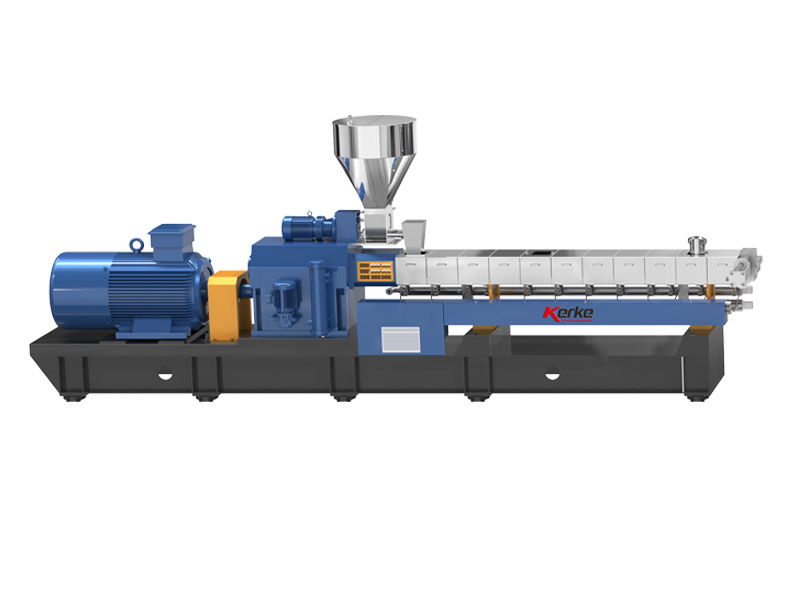
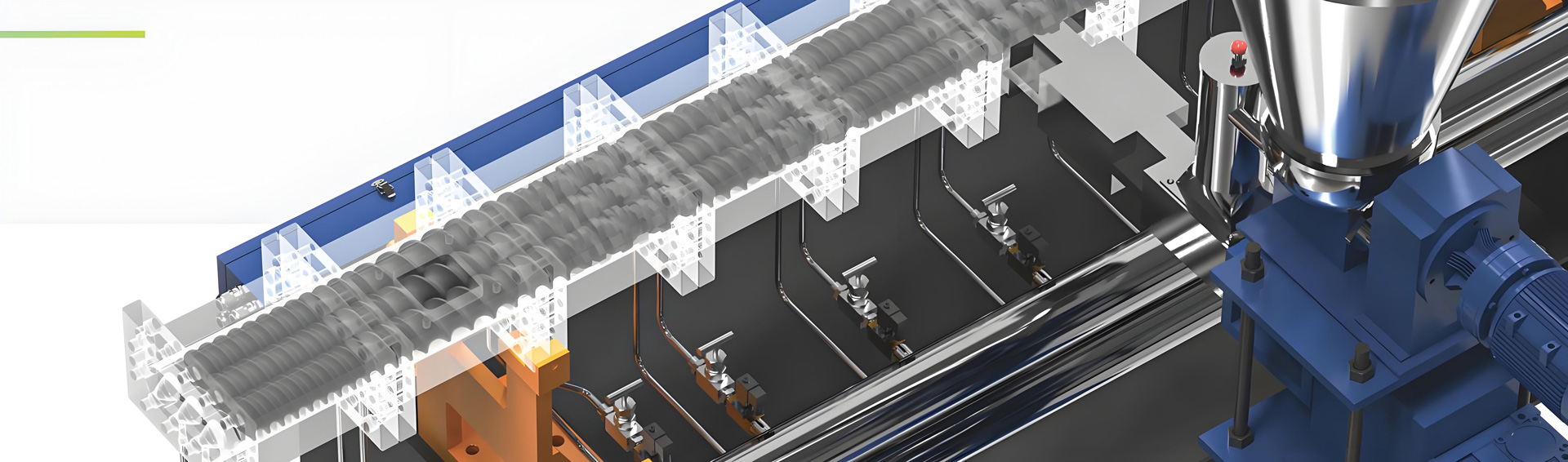
The KTE series is Kerke’s parallel co-rotating twin-screw extruder family, spanning from the KTE-16B laboratory unit up to the KTE-135D production machine. Every model is built around the same modular principle that reactive PLA compounding demands: the aspect ratio, barrel structure, screw arrangement, exhaust layout, feeding configuration, and electrical control can all be optimized for the specific formula. The screw assembly is computer-aided designed with a kneading co-type geometry that gives excellent self-cleaning, strong interchangeability of elements, and the full sequence of functions the reaction needs: material transport, plasticization, shearing, dispersion, homogenization, exhaust, and pressure building.
For a stable biodegradable PLA composite formula for twin-screw reaction extruder, the KTE platform is attractive because the barrel can be opened into independently heated and cooled zones, each matched to a reaction stage. The feed zone stays cool to protect dry resin; the plasticizing and reaction zones climb into the 180 to 210 degree Celsius window; the vent zones drop slightly and pull vacuum; and the metering zone builds the pressure needed for die-face or strand pelletizing. The table below lists representative models across the KTE-16B to KTE-135D range with typical diameters, L/D, drive power, and output. Exact figures are confirmed against the specific screw configuration ordered.
KTE series co-rotating twin-screw extruder specifications
| Model | Screw diameter (mm) | Typical L/D | Main motor (kW, typical) | Output for PLA composite (kg/h, typical) | Best fit use |
|---|---|---|---|---|---|
| KTE-16B | 16 | 40 to 48 | 2.2 | 0.5 to 5 | Formula R&D, trial |
| KTE-25 | 25 | 40 to 48 | 5.5 | 2 to 15 | Pilot scale |
| KTE-35 | 35 | 40 to 52 | 11 | 5 to 40 | Small batch, specialty |
| KTE-50 | 50 | 40 to 52 | 37 | 20 to 150 | Compact production |
| KTE-65 | 65 | 40 to 52 | 75 | 80 to 400 | Standard production |
| KTE-75 | 75 | 40 to 52 | 110 | 150 to 600 | Mid-volume PLA composite |
| KTE-95 | 95 | 44 to 52 | 200 | 400 to 1200 | High-volume compounding |
| KTE-110 | 110 | 44 to 52 | 315 | 700 to 2000 | Large-scale masterbatch |
| KTE-135D | 135 | 44 to 52 | 450 | 1500 to 3500 | Maximum capacity |
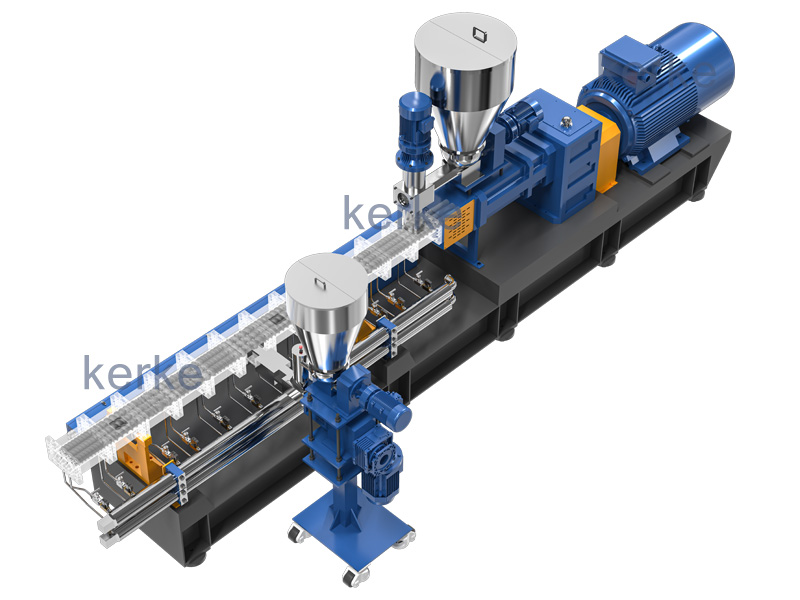
The KTE-75 and KTE-95 deserve special mention for PLA composites because their diameter and torque support the starve-fed, high-L/D profile that reactive compounding needs without over-shearing the melt. The high torque gearbox and co-rotating geometry allow a high specific energy only where it is wanted, in the kneading blocks, while the conveying elements move material gently. Kerke pairs these extruders with the full feeding system range: volumetric metering for powders, loss-in-weight feeders for precise liquid and solid dosing, side feeders for delayed addition of rPET or filler, crammer feeders for low-bulk-density regrind, and liquid feeders for chain extender or plasticizer addition at the reaction zone.
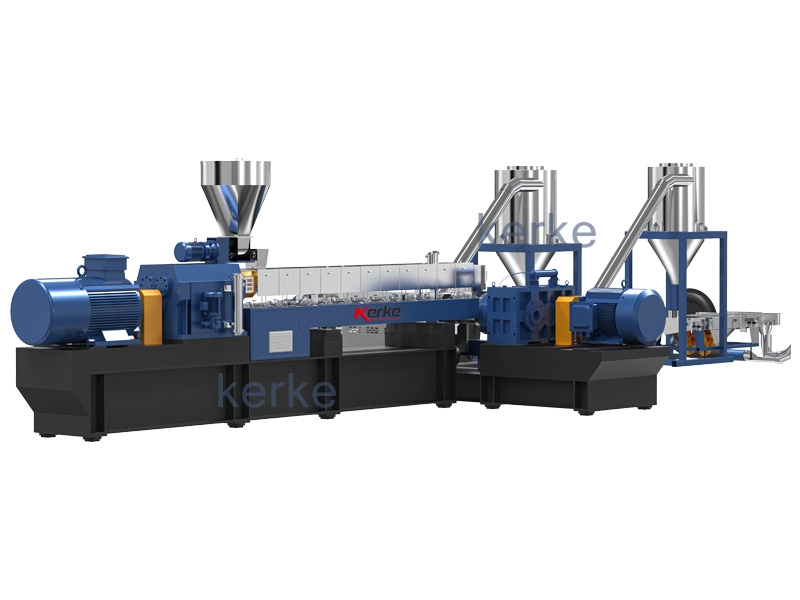
Pelletizing downstream is chosen by formula. Water-cooled strand pelletizing and air-cooled strand pelletizing suit most toughened and filled PLA composites. Air-cooled die-face hot cutting and water ring die-face hot cutting suit higher output and cleaner operation. Underwater pelletizing and eccentric water mist hot cutting suit heat-sensitive or low-viscosity formulas that need fast quench. Kerke’s cutting systems cover all of these, so the same KTE machine can serve a brittle nucleated grade and a soft plasticized film grade by changing only the die and cutting head.
Screw configuration and L/D strategy for reactive PLA stabilization
The screw is the reactor, and its element sequence decides whether the formula stabilizes or degrades. A reactive PLA screw is divided into functional zones, each built from conveying elements, kneading blocks, and mixing discs. The table below shows a representative zone layout for a 48 L/D KTE machine running a toughened, nucleated, chain-extended PLA composite. The exact element count is tuned during commissioning, but the logic is fixed: gentle start, intense reaction only after full melting, venting, then gentle pressurization.
Representative screw zone layout for reactive PLA compounding
| Zone (L/D position) | Element type | Barrel temperature (deg C) | Purpose |
|---|---|---|---|
| Feed (0 to 6 L/D) | Deep conveying, mild pitch | 40 to 60 | Accept dry resin, avoid premature melt |
| Plasticizing (6 to 16 L/D) | Conveying to medium kneading | 160 to 185 | Melt and wet filler, stabilizer active |
| First vent (16 L/D) | Reverse element, open barrel | 170 to 190 | Remove residual moisture |
| Reaction (16 to 32 L/D) | Kneading blocks, side feed here | 185 to 210 | Toughener, chain extender, coupling |
| Second vent (32 L/D) | Strong reverse, vacuum | 185 to 200 | Pull volatiles, unreacted monomer |
| Metering (32 to 48 L/D) | Conveying, low shear | 190 to 205 | Build pressure for die and pelletizing |
The kneading blocks in the reaction zone set shear intensity. For PLA, overly aggressive staggered kneading discs raise melt temperature through viscous dissipation and accelerate degradation, so the block width and stagger angle are chosen for dispersion rather than maximum shear. Side feeding the toughener or rPET at the start of the reaction zone lets it meet already-molten PLA, improving wetting and reducing the energy needed to disperse it. The two vents are non-negotiable for stability: the first removes the last moisture that would otherwise hydrolyze the chain, and the second removes condensation water from chain extension and any residual monomer from grafting.
L/D ratio is the reserve capacity for reaction. A 40 L/D barrel is the practical minimum for a reactive PLA composite because it must fit feed, plasticizing, two vents, reaction, and metering in one length. Moving to 48 or 52 L/D lets the compounder lengthen the reaction and metering zones, lowering the specific energy and melt temperature for the same output, which directly improves stability and color. Kerke configures the KTE barrel structure on request, so a customer targeting a heat-sensitive, highly filled WPC or a chain-extended rPET blend can order the longer barrel rather than pushing a short barrel to its limit.
Lab, triple-screw, and double-stage systems for formulation development
Scale-up is where many PLA formulas fail, and Kerke covers the full ladder from discovery to volume. The laboratory twin-screw extruder is the entry point for any stable biodegradable PLA composite formula for twin-screw reaction extruder project. It runs the same co-rotating principle as the production KTE at a fraction of the material cost, so a developer can map the reaction window, find the chain-extender overdose limit, and confirm pellet appearance with a few kilograms. Formulas proven on the lab unit transfer to production with predictable screw element logic.
The triple-screw extruder, Kerke’s three-screw technology, is a newer option for special materials where mixing intensity and residence-time control must both be extreme. Three intermeshing screws create more kneading surface per unit length than a twin, which helps disperse nanoscale nucleators and couple high-rPET blends with less thermal load. For materials that simply cannot be processed on a single-stage machine, because they degrade before they homogenize or because a volatile by-product must be removed continuously, the double-stage extrusion system uses a mother-baby configuration: a first stage reacts and vents, and a second stage finishes and pressurizes. This is the route for the most demanding biodegradable composites and for heat-sensitive masterbatches.
Kerke development and special-process machine specifications
| Machine | Screw diameter (mm) | Typical L/D | Output (kg/h) | When to choose |
|---|---|---|---|---|
| Lab twin-screw extruder | 16 to 25 | 40 to 48 | 0.5 to 15 | Formula trial, R&D |
| Triple (3 screws) extruder | 35 to 75 | 40 to 52 | 20 to 600 | Intense mixing, low thermal load |
| Double-stage (mother-baby) | 50 + 100 | 48 + 12 | 80 to 800 | Degrade-before-homogenize materials |
| SE single-screw (reclaim) | 60 to 150 | 28 to 33 | 30 to 800 | Reclaim pelletizing support |
Choosing the development path correctly saves months. A trial that begins on the lab twin-screw extruder, moves to a KTE-65 or KTE-75 for pilot volume, and then scales to a KTE-95 or KTE-110 for production follows the same element logic at every step, so the formula behavior is preserved. Kerke’s computer-aided screw design and interchangeable element system mean the kneading block set proven in the lab can be reproduced on the production barrel, which is the practical definition of a transferable, stable formula.
Application industries for reactive PLA composites
A stable biodegradable PLA composite formula for twin-screw reaction extruder serves a wide set of end markets because the same reactive toolkit tunes the material from rigid and heat-resistant to flexible and tough. Kerke’s compounding lines are used across masterbatch production and plastic compound manufacturing, and the biodegradable plastic category is a core application. The end products below are the concrete forms these composites take.
- Biodegradable packaging film and flexible packaging: plasticized, nucleated PLA with PBAT for retail bags, produce film, and lamination where compostability is required.
- Thermoformed food serviceware and trays: nucleated, chain-extended PLA with higher heat deflection temperature for cups, lids, and trays that survive warm filling.
- Rigid recycled-content articles: rPET and PLA reactive blends for boxes, displays, and sheets where stiffness and recycled content both matter.
- Agriculture and mulch film: starch- or filler-loaded biodegradable composites that break down in soil after the season.
- Color, filler, and additive masterbatch: concentrated PLA-carrier masterbatches for downstream bio-resin converters, made on the same KTE lines.
- Wood-plastic and natural-fiber composites: WPC-style biodegradable profiles using wood flour or natural fiber with coupling agent for decking and molded goods.
- Compostable fiber and nonwoven: toughened PLA for spunbond and melt-blown where melt strength rebuilt by chain extension is essential.
- Specialty food and textured vegetable protein processing support: Kerke lines also serve HMMA and TVP food processing, showing the hygiene-grade cleaning discipline available on the platform.
The through-line is that the reactive extruder lets one factory make all of these from the same base resin by changing the additive recipe and the screw configuration, not by buying a different machine. That flexibility is the economic argument for investing in a configurable KTE platform rather than a fixed single-purpose line.
Model selection guide for PLA reactive compounding lines
The right machine follows from three variables: target output, filler or recycle loading, and how reactive the formula is. Higher output and higher filler loading push toward larger diameter and higher torque. Highly reactive formulas with grafting or heavy chain extension benefit from longer L/D and a double vent, which the larger KTE models accommodate more easily. The selection table below maps common customer needs to a recommended Kerke model from the real lineup.
Customer need to recommended Kerke model
| Customer need | Recommended model | Why this model | Typical output |
|---|---|---|---|
| New formula development, low material use | Lab twin-screw extruder (KTE-16B/25) | Low cost per trial, same principle as production | 0.5 to 15 kg/h |
| Small-batch specialty PLA composite | KTE-35 or KTE-50 | Compact footprint, configurable L/D | 5 to 150 kg/h |
| Standard production PLA composite, moderate filler | KTE-65 | Balanced torque and output, proven platform | 80 to 400 kg/h |
| Mid-volume toughened and rPET blend | KTE-75 | Side feeder and liquid feeder ready, 48 to 52 L/D | 150 to 600 kg/h |
| High-volume chain-extended masterbatch | KTE-95 | High torque for viscous reactive melt, double vent | 400 to 1200 kg/h |
| Very high output, low thermal load needed | KTE-110 or KTE-135D | Maximum capacity, long barrel option | 700 to 3500 kg/h |
| Material degrades before homogenizing | Double-stage mother-baby system | Separates reaction and pressurization stages | 80 to 800 kg/h |
This guide is a starting point, not a substitute for a configuration review. Kerke application engineers confirm the screw arrangement, vent count, feeder set, and pelletizing method against the actual formula and target output before a machine is built. Because the KTE platform is modular, the same model can later be reconfigured for a different PLA composite by swapping screw elements and barrel sections, which protects the original investment as the product line grows.
Process control, quality standards, and stability verification
A stable formula is only stable if the process is controlled and verified. Reactive PLA compounding demands discipline at four levels: incoming material, in-line measurement, pellet quality, and finished-part testing. Kerke lines support this with gravimetric feeding for repeatable dosing, zone temperature control with closed-loop barrels, melt pressure and melt temperature sensing at the die, and recipe management in the PLC so a proven formula is recalled exactly rather than re-typed. The Wanplas group quality standard backs this with a refund plus 10 percent compensation commitment where quality fails to meet the agreed specification, which aligns the factory’s interest with the customer’s stability target.
Incoming PLA and additives should be verified for moisture, melt flow rate, and lot-to-lot color. During the run, melt pressure trend and motor load are the early warnings of gel formation or over-reaction; a rising motor load at fixed throughput signals crosslinking and calls for lower reaction-zone temperature or less chain extender. Pellets are checked for homogeneity, strand breakage, and fish-eye count. Finished composite is verified by melt flow rate before and after extrusion to confirm molecular weight was maintained or rebuilt, by differential scanning calorimetry for crystallinity and glass transition, and by mechanical testing for tensile and impact strength.
Stability verification parameter set
| Checkpoint | Method | Acceptance signal | Why it matters |
|---|---|---|---|
| Resin moisture | Moisture analyzer | Below 250 ppm | Prevents hydrolytic chain scission |
| Melt flow rate before and after | Melt flow rate tester | MFR held or raised | Confirms chain extension worked |
| Crystallinity and Tg | Differential scanning calorimetry | Tg near 55 to 60 C, raised crystallinity | Validates nucleator effect |
| Impact strength | Notched Izod impact | Above 15 to 20 kJ/m2 for toughened grade | Confirms toughener dispersed and coupled |
| Motor load trend | PLC trend at fixed throughput | Stable, no climb | Detects gel or over-reaction early |
Standards shape the verification language. Food-contact and compostability claims reference recognized frameworks such as FDA food-contact status for the chosen plasticizer, EU 10/2011 for food contact materials, ASTM and ISO test methods for mechanicals, and industrial compostability standards for the finished article. Kerke does not certify the end compound on the customer’s behalf, but the line is built so that well-characterized,standard-traceable pellets leave the die, and the documentation package supports the customer’s own certification work. CE and ISO alignment apply to the machine build itself.
Service, support, and open-factory commitment
Buying a reactive PLA line is the start of a relationship, and Kerke, a Wanplas factory, structures its support around keeping the formula stable in production, not just shipping hardware. The shared Wanplas group promises cover free parts, transportation guarantee, production capacity guarantee, and quality standards, and they are delivered through concrete services.
- Pre-shipment testing: each KTE line runs a continuous operation test on a representative formula before delivery, so commissioning risk is removed at the factory rather than at the customer site.
- Installation and commissioning: Kerke engineers travel to the customer plant to install, align, and commission the line, transfer the proven screw configuration, and tune the feeder and vent settings to the agreed formula.
- Spare-parts policy: the Wanplas group provides USD 500 free parts per year, and damaged parts within warranty are replaced free, protecting uptime cost predictably.
- Training: operators receive hands-on training in formula loading, screw element changeover, vent management, pelletizing changeover, and the stability checks above.
- Remote operation and maintenance: the control system supports remote monitoring and diagnosis, so Kerke specialists can review PLC data and advise on process drift without delay.
- Open-factory visits: customers are welcome to visit the 19,997-plus square meter plant to audit build quality, review the KTE series, and run their own material on a demo line before purchase.
This support model matters specifically for reactive PLA because the difference between a stable and a failed run is often a half-degree of vent temperature or a slightly mistuned feeder. Having the original application engineer reachable through remote monitoring, and a free annual parts allowance, turns those small risks into managed ones. The Wanplas parent brand means the same promise applies across the group’s specialized factories, so a customer scaling from PLA into related bio-composites stays inside one support network.
Frequently Asked Questions
What makes PLA compounding reactive rather than simple melt blending?
Reactive compounding uses functional additives that form covalent bonds in the barrel: chain extenders rebuild molecular weight, maleic anhydride grafted polymers couple phases, and transesterification links PLA and rPET. The screw is configured as a continuous reactor with controlled residence time and venting, whereas simple melt blending only disperses immiscible components without improving interfacial adhesion.
Which toughener works best for PLA without sacrificing compostability?
Bio-based and compostable elastomers such as PBAT, PCL, and POE-g-MAH are preferred because they remain within the biodegradability envelope. Loading around 10 to 25 percent lifts notched impact strength sharply while reactive coupling suppresses phase size for transparency retention. Non-compostable rubbers should be avoided when the part must meet industrial compostability.
How do nucleating agents improve the heat resistance of PLA?
Nucleating agents such as talc, sodium stearate, and PLA stereocomplex crystallites raise crystallization rate and crystallinity, lifting the heat deflection temperature toward 100 to 130 degrees Celsius and shortening cycle time. They are dosed at 0.5 to 3 percent with good dispersion in the kneading zone, which is why nucleation is placed in the high-shear section of the screw.
Can rPET be blended with PLA on a twin-screw reactive extruder?
Yes. rPET and PLA are immiscible, but a multifunctional chain extender promotes transesterification at the interface, forming a graft copolymer that stabilizes morphology and recovers melt strength lost to thermal and hydrolytic degradation of both polyesters. The composite can reach meaningful recycled content while keeping improved mechanical properties over a simple blend.
What screw configuration prevents thermal degradation of PLA during reaction?
Use moderate shear kneading blocks, distributed exhaust vents, and starve feeding with a high L/D of 40 to 52 so reaction completes at lower melt temperature. Keep the barrel profile below 210 degrees Celsius where possible, add a stabilizer package to cap radicals, and place the chain extender at a dedicated reaction zone metered by a loss-in-weight feeder.
Why run formulation trials on a lab twin-screw extruder first?
A lab unit such as the Kerke lab twin-screw extruder validates the reaction window, additive loading, and venting strategy with a few kilograms of material before committing full-scale output. It de-risks scale-up because the same co-rotating element logic transfers to the production KTE series, saving resin cost and avoiding failed production batches.
Which Kerke model fits a 500 kg/h PLA composite line?
A KTE-75 or KTE-95 co-rotating twin-screw extruder paired with a side feeder and loss-in-weight gravimetric feeding typically covers 400 to 1200 kg/h of reactive PLA composite, depending on formulation bulk density and filler loading. The KTE-95 is chosen when the reactive melt is viscous or double venting is required.
How does Kerke support commissioning of a reactive PLA line?
Kerke, a Wanplas factory, provides pre-shipment continuous operation testing, on-site installation and commissioning, operator training, remote operation and maintenance support, an open-factory visit policy, and the group USD 500 free parts per year commitment. These services keep the proven screw configuration and formula stable from the first production run onward.
Conclusion
A stable biodegradable PLA composite formula for twin-screw reaction extruder is an engineering system, not a single recipe. It starts with dry, well-characterized PLA; builds toughness with a compostable elastomer such as PBAT or POE-g-MAH; adds a nucleating agent for heat resistance; uses a non-phthalate plasticizer where flexibility is needed; and brings in filler or rPET for cost and recycled content. The stability that makes the composite usable comes from the reactive step: a precisely metered chain extender or coupling agent that rebuilds molecular weight and welds immiscible phases, run inside a co-rotating twin-screw barrel configured with gentle feed, intense but controlled reaction, and double venting.
Kerke, a Wanplas factory, delivers this capability through the KTE co-rotating twin-screw series from the KTE-16B laboratory unit to the KTE-135D production machine, supported by the lab twin-screw extruder for formula development, the triple-screw extruder for low-thermal-load intensive mixing, and the double-stage system for the most demanding degrade-before-homogenize materials. With more than 12 years of compounding extruder experience, a 19,997-plus square meter plant, over 2,000 machines running worldwide, and shipment to more than 70 countries, Kerke frames the line as a complete formula-to-pellet solution under the Wanplas group quality promise.
If you are developing or scaling a biodegradable PLA composite, send your target output, filler or recycled-content level, and required properties to Kerke for a tailored screw configuration and machine recommendation. You are welcome to visit the factory, run your own material on a demonstration line, and review the full KTE series before committing. A stable formula deserves a stable process, and the right reactive twin-screw line is where the two meet.