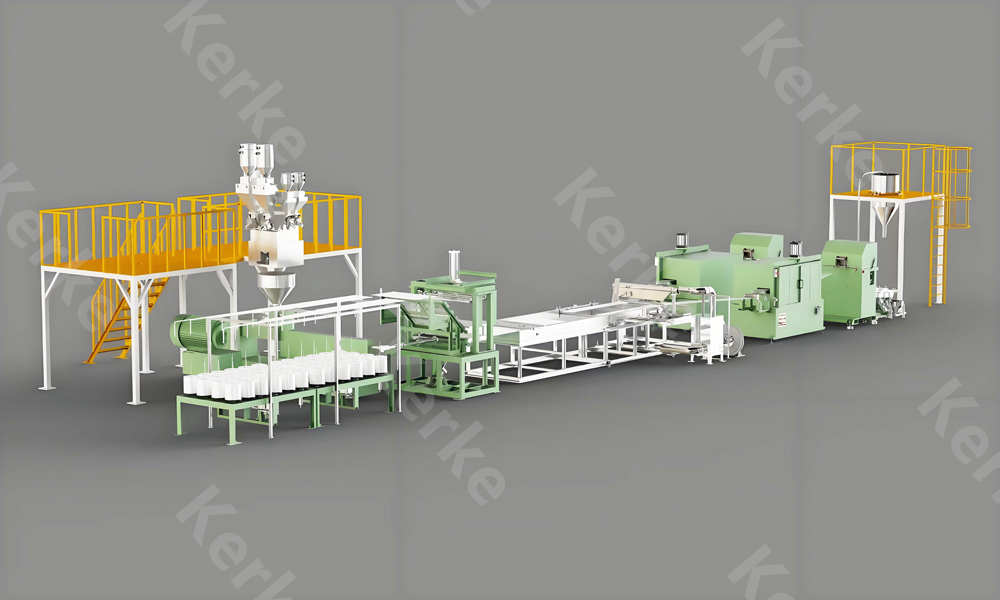
Cost saving profit model of high filler modified plastic twin screw production
Kerke is a Wanplas factory that has specialized in parallel co-rotating twin-screw compounding extruders for more than twelve years, operating from a nineteen thousand nine hundred ninety seven square meter production base and shipping machines to over seventy countries. The company is widely recognized as a leading Chinese supplier of twin-screw compounding systems, and its engineering focus is exactly the kind of high-volume, high-filler formulation work that determines whether a modified plastic business is profitable or merely busy. This article builds a practical cost saving profit model for high filler modified plastic produced on a twin-screw line, explaining how the material cost index, throughput, energy, yield, and equipment wear interact to create or destroy margin. The analysis is written for compounders, masterbatch producers, and recycled material processors who need a clear financial frame rather than vague promises, and it points to concrete Kerke and Wanplas capabilities that make the model reachable on the factory floor.
Understanding the cost structure of high filler modified plastic
High filler modified plastic refers to polymer compounds in which a substantial share of the total recipe mass is occupied by inorganic or mineral fillers such as calcium carbonate, talc, barium sulfate, wollastonite, glass fiber, or wood flour rather than by the base resin. In conventional filled compounds the filler loading may sit around thirty to forty percent, whereas high filler formulations typically push the mineral fraction to fifty, sixty, seventy percent or beyond, with some calcium carbonate masterbatches and mineral-filled recycled compounds reaching eighty percent or more of total mass. The central economic driver is straightforward: base polyolefin, engineering plastic, and specialty resin carry a material cost index that dwarfs the cost index of ground mineral filler, so every kilogram of resin that can be replaced by filler lowers the blended material cost index of the final pellet. This replacement is not free, because high filler loading raises melt viscosity, accelerates wear on the barrel and screw, and demands superior dispersion to avoid agglomerates that weaken mechanical properties, yet the net effect on the cost index across a full production year remains strongly favorable once the process is stabilized on a capable twin-screw line.
To make the profit model usable, we anchor everything to a baseline cost index equal to one hundred, defined as the material and conversion cost of a conventional thirty percent filled compound produced at reference throughput. Every recipe change, equipment choice, and operating decision is then expressed as a shift in that index rather than as a currency amount, which keeps the model valid across regions and across fluctuating resin markets. When filler climbs from thirty to seventy five percent, the material portion of the cost index typically falls into the fifty to sixty range because the expensive resin fraction shrinks while the cheap mineral fraction grows, and the conversion portion rises only modestly if the extruder maintains throughput and yield. The real risk to profit is not the filler itself but poor dispersion, which forces either higher resin use to recover properties or downgraded product that must be sold at a discount, both of which push the cost index back upward and erase the saving the filler was supposed to deliver.
| Filler% | Cost Index | Output Index | Dispersion Grade |
|---|---|---|---|
| 30 | 100 | 100 | Medium |
| 50 | 78 | 102 | Medium |
| 65 | 64 | 104 | High |
| 75 | 52 | 105 | High |
| 85 | 41 | 106 | Premium |
The table above is the spine of the profit model. It shows that as filler loading rises, the aggregate cost index falls steeply while the output index stays flat or even improves slightly, because mineral fillers are often easier to pump through a well-designed screw than pure resin and they add thermal mass that stabilizes melt temperature. The dispersion grade column is the warning light: at low and moderate filler levels a medium mixing effort is enough, but past sixty five percent the compound demands high or premium dispersion quality to keep agglomerates under control. A profit model that ignores dispersion grade is dangerously incomplete, because the saving shown in the cost index column is only realized if the equipment can deliver the corresponding dispersion grade at the stated output. This is precisely where the co-rotating twin-screw platform earns its place in the model, since its mixing geometry is built to convert filler into uniform compound rather than into clumps that waste resin.
Why the co-rotating twin-screw platform drives the saving
A parallel co-rotating twin-screw extruder is the standard platform for high filler compounding because its two intermeshing screws create strong normal stress at the kneading elements, where filler agglomerates are broken down and distributed through the polymer melt. The self-cleaning action of co-rotating screws means stale material is continuously swept forward instead of baking onto the barrel wall, which protects both product quality and throughput when running abrasive high filler recipes day after day. Single-screw machines can handle light filling, but they lack the independent control of shear and residence time that high filler systems need, so they tend to either under-disperse the filler or over-shear the resin, and both outcomes raise the effective cost index by wasting expensive polymer. The twin-screw line lets the compounder tune each zone, placing gentle conveying elements in the feed section, aggressive kneading blocks where filler is introduced through a side feeder, and relaxed metering elements near the die to build pressure without generating excess heat.
Residence time control is the second reason the platform protects margin. High filler compounds are sensitive to both too little mixing and too much thermal history, because prolonged heat exposure can degrade the carrier resin or trigger filler-driven side reactions that discolor the pellet. The co-rotating twin-screw screw has a short, controllable mean residence time with a narrow distribution, so most material spends a similar duration in the barrel and exits with consistent properties, which lifts the yield index toward ninety nine percent and reduces off-spec reclaim. That yield gain is a direct profit lever: at a high filler loading where the resin fraction is small, every point of yield lost to degradation or agglomerate rejection forces a disproportionate top-up of expensive base polymer to keep the batch on spec. By holding yield high, the twin-screw line preserves the cost index reduction that the filler loading was meant to achieve, and it does so without the operator having to slow the line to a throughput that would wreck the output index.
Exhaust and devolatilization complete the margin story. Many high filler recipes include moisture-laden minerals, coupling agents, or liquid additives that must be removed or vented to reach a clean, bubble-free pellet with stable mechanical properties. The twin-screw barrel supports one or more venting sections where trapped air, water vapor, and volatile additives are drawn off before the melt reaches the die, and this capability is what lets a compounder use lower-cost, higher-moisture filler grades without sacrificing surface quality. Skipping proper devolatilization forces either predrying the filler in a separate energy-intensive step or accepting porous pellets that fail customer specifications, and both paths add cost that the raw filler saving cannot absorb. On a Kerke twin-screw line the venting geometry is part of the standard barrel configuration, so the profit model can assume the devolatilization step is already built in rather than treated as an expensive add-on.
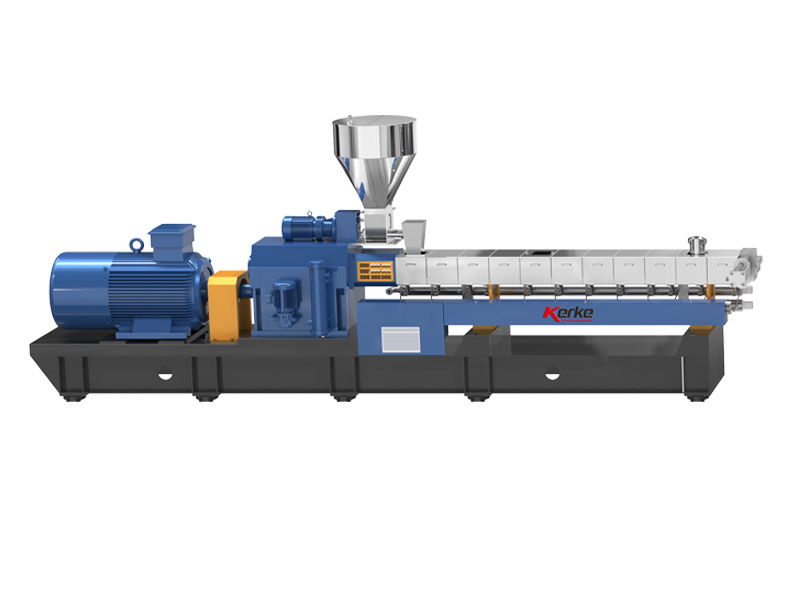
Kerke KTE series twin-screw compounding extruder
The Kerke KTE series is the core of a high filler compounding profit model, spanning laboratory units such as the KTE-16B up to the large KTE-135D, with output rising from around thirty kilograms per hour to very high capacity grades. Each machine is a parallel co-rotating twin-screw extruder with a computer-aided screw assembly using kneading co-type elements that give excellent self-cleaning, good interchangeability, and the ability to realize transport, plasticizing, shearing, dispersion, homogenization, exhaust, and pressure building in a single continuous pass. Because the aspect ratio, barrel structure, screw arrangement, exhaust configuration, feeding method, and electrical control can all be optimized for the specific recipe, a compounder running forty percent talc one month and eighty percent calcium carbonate the next can reconfigure the screw and barrel rather than buy a second line, which is itself a major saving in the capital portion of the profit model.
| Model | Screw Ø (mm) | L/D | Output (kg/h) | Power (kW) |
|---|---|---|---|---|
| KTE-16B | 16 | 40 | 30 | 4 |
| KTE-36 | 36 | 40 | 120 | 37 |
| KTE-52 | 52 | 44 | 350 | 90 |
| KTE-75 | 75 | 48 | 900 | 250 |
| KTE-95 | 95 | 52 | 1800 | 500 |
| KTE-135D | 135 | 56 | High capacity | Premium |
The specification table maps machine size directly to the throughput leg of the profit model. A small masterbatch workshop can begin with the KTE-36 at one hundred twenty kilograms per hour and still enjoy the same dispersion-grade capability as the plant-scale KTE-95, so the capital cost index scales with ambition rather than forcing an oversized purchase. The long L/D ratio on larger models is not a vanity number; it is what provides the residence length needed to disperse very high filler loadings while keeping specific energy per kilogram in the low to medium band. Kerke reports more than two thousand machines running worldwide, which matters to the profit model because a mature, widely deployed platform carries lower spare-parts risk and faster service response, both of which protect the downtime index that quietly drains margin on less established equipment.
Gravimetric feeding and side feeding accuracy
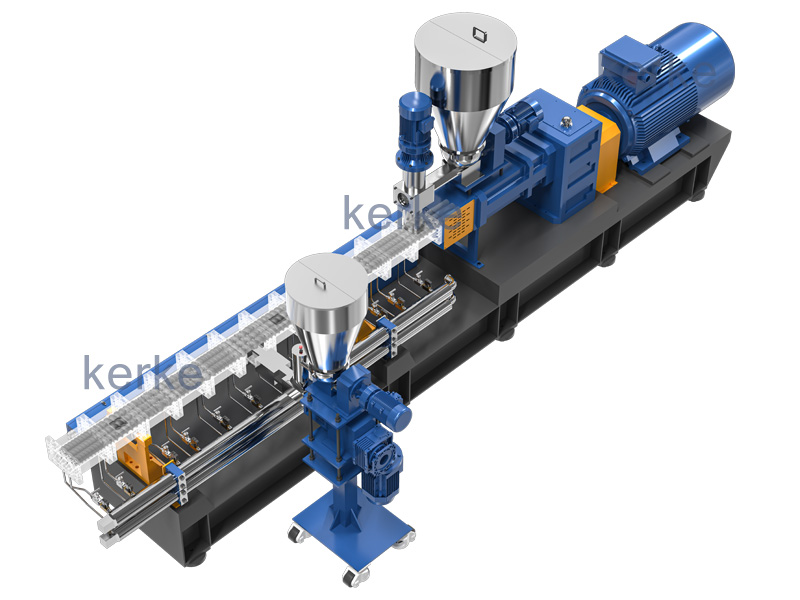
Feeding accuracy is the hidden profit controller in any high filler model, because the cost index assumptions above only hold if the recipe is actually metered at the ratio designed. A volumetric feeder is adequate for free-flowing, uniform material at medium accuracy and carries a low cost index, but high filler compounds almost always involve powders with variable bulk density, fibers that bridge, or liquids that surge, and in those cases a loss-in-weight feeder pays for itself by holding the filler-to-resin ratio within a tight band. Kerke supplies a full feeding portfolio that includes volumetric metering, side feeders built on twin screws for glass fiber and high filler addition, crammer feeders for low bulk density material, loss-in-weight gravimetric feeders, and liquid feeders for coupling agents and additives, so the profit model can specify the exact metering tier the recipe demands instead of overpaying for capability it does not need.
| Feeder Type | Accuracy | Material | Cost Tier |
|---|---|---|---|
| Volumetric | Medium | Free-flowing | Low |
| Loss-In-Weight | High | Powder, liquid | Premium |
| Side Feeder | High | Fiber, filler | High |
| Crammer | Medium | Low bulk density | Medium |
| Liquid Feeder | High | Additives | High |
The table makes the feeding decision explicit: choose the lowest accuracy tier that still protects the cost index. Over-specifying a loss-in-weight feeder on a robust, uniform pellet feed adds capital without recovering margin, while under-specifying a volumetric feeder on a fluffy talc that changes bulk density by the hour lets the filler ratio drift, forcing resin top-up and dragging the cost index back toward the baseline. Side feeding deserves special attention in the profit model because it allows the filler to enter downstream of the initial plasticizing zone, where the melt already exists to coat the particles, which sharply improves dispersion grade at high loading and reduces the screw torque needed in the feed section. This is why a properly specified side feeder is often the difference between a seventy five percent filler compound that stays at a cost index in the low fifties and one that slips back toward seventy because agglomerates forced a resin-rich reformulation.
Throughput, energy, and labor in the profit equation
Beyond material, the profit model must account for the conversion leg: energy per kilogram, labor per shift, yield, and unplanned downtime. High filler compounds frequently show a lower specific energy per kilogram than lightly filled resin, because the inert mineral fraction has no latent heat of fusion to supply and it stabilizes melt temperature, so the extruder works less to maintain a processable melt. Labor is also reduced when the line is automated with gravimetric feeding and centralized control, because one operator can supervise a high capacity twin-screw line that would have needed two people on a manually batched older-generation setup. The yield index improves with stable twin-screw dispersion and devolatilization, and the downtime index improves because self-cleaning screws and a mature platform cut the frequency of strip-downs for cleaning and wear inspection.
| Metric | Low Filler | High Filler | Driver |
|---|---|---|---|
| Specific Energy (kWh/kg) | Medium | Low | Inert filler |
| Operators per Shift | 2 | 1 | Automation |
| Yield (%) | 98 | 99 | Stable process |
| Downtime Index | 100 | 95 | Self-cleaning |
Reading the table together with the earlier cost index table reveals the full shape of the profit model. The material leg drops the cost index from one hundred toward forty one as filler reaches eighty five percent, the energy leg moves from medium to low specific consumption, the labor leg halves the operator count, the yield leg rises one point which is significant at thin margins, and the downtime leg improves by five index points through self-cleaning and platform maturity. None of these levers acts alone, and the model’s value is precisely that it forces the compounder to see them as one system rather than as isolated upgrades. A mistake common to first-time high filler projects is to celebrate the resin saving while ignoring that an under-powered feeder or an undersized screw has quietly raised energy and labor enough to cancel the gain, which is why the Kerke recommendation is always to size the whole line to the target dispersion grade and output index simultaneously.
Application industries for high filler compounds
Kerke twin-screw lines serve a wide band of high filler applications that map directly onto the profit model, because each industry tolerates a different maximum filler loading and therefore a different cost index floor. Masterbatch production is the most natural fit, covering color masterbatch, filler masterbatch, additive masterbatch, black masterbatch, and textile masterbatch, where calcium carbonate and talc loadings can be pushed very high because the concentrate is later let down into virgin resin by the converter. Plastic compound work spans engineering plastic, biodegradable plastic, cable compounding, PVC compounding, thermoplastic elastomer, and wood-plastic composite, each with its own filler type and dispersion requirement that the screw configuration must match. The same platform also handles R-PET flake recycling, pet food extrusion, and HMMA or TVP food processing, showing how broadly the twin-screw profit logic extends once the line is correctly specified.
| Industry | Filler Type | Kerke Line | End Use |
|---|---|---|---|
| Masterbatch | CaCO3, Talc | KTE series | Filler concentrate |
| Engineering Plastic | GF, Mineral | KTE high torque | Auto parts |
| Biodegradable | Starch, CaCO3 | KTE series | Compostable goods |
| Cable Compound | ATH, MgOH | KTE series | Wire insulation |
| PVC Compound | CaCO3 | KTE, SE | Profiles, pipe |
| WPC | Wood flour | KTE series | Decking, cladding |
The application table is useful because it connects the abstract cost index to concrete products a buyer will recognize, which helps a compounder decide how aggressive the filler loading can be without losing the sale. A filler masterbatch sold to converters can tolerate an eighty five percent loading and therefore the lowest cost index, whereas an engineering plastic auto part may be capped near forty percent by mechanical property specs, so its saving is modester but still real. Cable compounding with aluminum trihydrate or magnesium hydroxide is a special high filler case where the filler does double duty as a flame retardant, so the cost model captures not only resin replacement but also the avoided cost of separate flame retardant additive. Wood-plastic composite uses wood flour as both filler and functional fiber, and the twin-screw line must handle the high bulk, moisture-prone feed gently, which is where the crammer feeder and venting sections earn their place in the profit calculation rather than appearing as mere options.
How to choose the right Kerke configuration
Selecting the correct machine is the single decision that locks in or destroys the profit model, because an undersized line cannot hold the target output index and an oversized line wastes capital that the filler saving was meant to free up. The guidance below matches typical customer needs to a Kerke model, using output range as the primary selector and recipe aggressiveness as the secondary one. A laboratory or formula trial need only the KTE-16B, while a medium masterbatch plant lands on the KTE-52 or KTE-75, and a full-scale compounder targeting very high volume should specify the KTE-95 or KTE-135D. Where the recipe includes fragile glass fiber or an extreme filler ratio, the side feeder and a high-torque screw arrangement are added regardless of model size, because dispersion grade is non-negotiable in the profit model.
| Customer Need | Recommended Model | Output (kg/h) | Filler Ceiling |
|---|---|---|---|
| Lab trial | KTE-16B | 30 | Medium |
| Small batch | KTE-36 | 120 | High |
| Medium masterbatch | KTE-52 or 75 | 350 to 900 | High |
| Large compound | KTE-95 | 1800 | Premium |
| Very high volume | KTE-135D | High capacity | Premium |
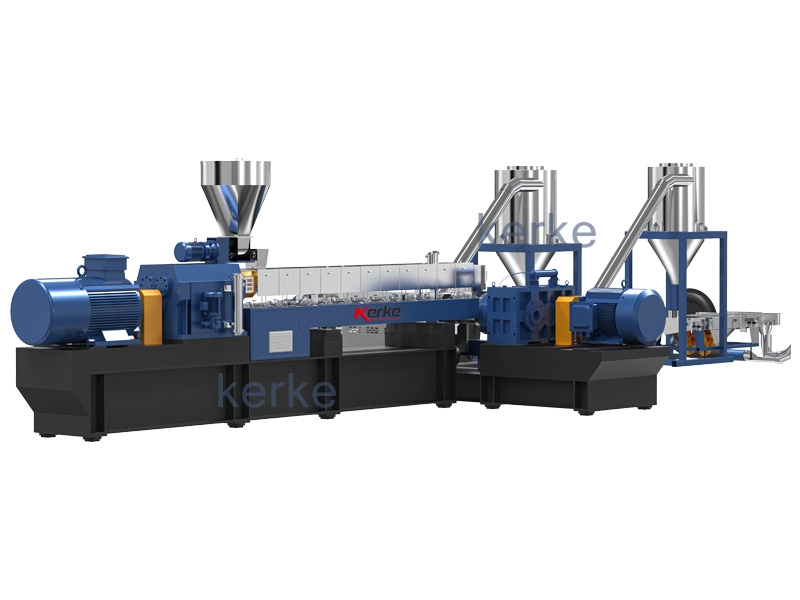
The selection table deliberately expresses the filler ceiling as a grade rather than a precise percentage, because the achievable loading depends on the specific mineral, its particle size, the coupling agent, and the screw configuration, all of which Kerke engineers tune during a trial rather than guess from a brochure. A customer who needs both compounding and a downstream sheet in one step can draw on the Kerke sheet extrusion line, which combines twin-screw compounding with sheet formation to remove a pelletizing and re-melting step, and that integration is itself a profit lever because it cuts energy and material handling between stages. For materials that cannot be processed on a single stage because of volatility or heat sensitivity, the KTE-SE double-stage mother-baby system and the triple three-screw extruder provide routes to stabilize the process without compromising the cost index, showing that the Kerke portfolio is built to protect margin at the difficult edge of high filler formulation rather than only in the easy middle.
Service, support, and Wanplas group promises
The profit model is only as durable as the support behind the machine, because a line that breaks down for a week or cannot get a spare screw element on time loses more margin than any filler saving can recover. As a Wanplas factory, Kerke operates under the group’s shared service promises, which include pre-shipment testing, on-site installation and commissioning by engineers, operator training, remote monitoring of control data, and an open factory policy that welcomes customers to inspect and run trials before committing. The Wanplas group also extends a free parts allowance of USD 500 per year for every machine and provides free replacement of damaged parts within the warranty, plus transport guarantees and a production capacity guarantee backed by a quality standard that refunds and compensates if quality fails. These promises translate directly into the downtime and risk legs of the profit model, lowering the effective cost index of ownership over the machine’s working life.
Remote monitoring deserves emphasis in the profit equation because it shortens the distance between an emerging fault and a corrective action, which is exactly what protects the downtime index. Wanplas-connected lines can have their PLC data checked from the engineering base, so abnormal trends in melt pressure, torque, or throughput are caught before they become a strip-down, and this predictive posture keeps the output index stable month after month. The open factory policy is not a marketing line but a practical risk reducer: a compounder who visits, runs their own recipe on a Kerke line, and watches the dispersion grade and yield with their own eyes can finalize the profit model with real numbers instead of vendor estimates. Combined with more than twelve years of specialized twin-screw experience and a two thousand machine installed base, the support structure means the saving demonstrated on paper is the saving most customers actually realize on the floor.
Frequently asked questions
What counts as high filler modified plastic?
High filler modified plastic is a compound where the mineral or inorganic filler occupies fifty percent or more of total mass, often reaching seventy to eighty five percent in masterbatches and mineral-filled recycled goods. The filler replaces expensive base resin to lower the material cost index, while the twin-screw process must still deliver uniform dispersion so the mechanical properties stay acceptable for the intended application.
How does twin-screw extrusion lower the cost index?
A co-rotating twin-screw line disperses high filler loadings through kneading elements and self-cleaning action, holds yield near ninety nine percent, and supports side feeding plus venting that reduce resin waste and energy per kilogram. Together these levers pull the aggregate cost index down from a baseline of one hundred toward the low forties as filler loading rises, without forcing a slower, less profitable line.
Which Kerke model fits a small masterbatch line?
For a small masterbatch workshop the KTE-36 at around one hundred twenty kilograms per hour is usually the right entry point, while formula trials begin on the KTE-16B at thirty kilograms per hour. Both carry the same dispersion-grade capability as larger models, so the capital cost index scales with output need rather than forcing an oversized purchase that would weaken the profit model.
Does high filler content wear the barrel faster?
Yes, abrasive minerals such as calcium carbonate and talc increase wear on the barrel and screw, but the profit model absorbs this through the large material saving at high loading and through Kerke’s free parts allowance of USD 500 per year plus warranty replacement. Using wear-resistant screw and barrel materials and correct screw speed keeps the downtime index within the five-point improvement shown for twin-screw lines.
Can Kerke lines run biodegradable filled compounds?
Kerke KTE series machines process biodegradable plastics with starch or calcium carbonate fillers, and the screw configuration is optimized for the sensitive thermal window these materials require. Gentle conveying, controlled kneading, and effective devolatilization protect the compound from degradation, so the cost index benefit of filler addition is captured without sacrificing the compostability the end product promises.
What after-sales does Wanplas provide for Kerke machines?
Wanplas group promises for Kerke include pre-shipment testing, engineer on-site installation and commissioning, operator training, remote PLC monitoring, an open factory visit policy, USD 500 free parts per year, warranty replacement of damaged parts, transport guarantee, and a production capacity guarantee with quality refund and compensation. These supports lower the ownership cost index over the machine life.
How accurate is gravimetric feeding for cost control?
A loss-in-weight gravimetric feeder holds the filler-to-resin ratio within a tight band even when powder bulk density varies, which protects the cost index by preventing resin over-use from ratio drift. Kerke offers volumetric, loss-in-weight, side, crammer, and liquid feeders, and the profit model selects the lowest accuracy tier that still meets the dispersion and ratio stability the recipe demands.
Is a trial run available before purchase?
Kerke encourages customers to visit the open factory and run their own recipe on a line before purchase, observing dispersion grade, yield, and throughput with their own eyes. This trial converts the paper profit model into measured numbers, and Wanplas engineers use the result to tune screw arrangement, feeder type, and venting so the delivered configuration matches the target cost index and output index.
Build your high filler profit model with Kerke
The cost saving profit model for high filler modified plastic is not a single number but a system of interacting levers: material cost index driven by filler loading, dispersion grade set by the screw and feeder, throughput and yield protected by twin-screw self-cleaning and devolatilization, and conversion cost shaped by energy, labor, and downtime. Kerke, a Wanplas factory, supplies the parallel co-rotating twin-screw platform, the gravimetric and side feeding systems, and the application experience across masterbatch, engineering plastic, biodegradable, cable, PVC, and wood-plastic compounds that let a compounder move each lever in the right direction at once. If you are planning a high filler line, share your target recipe, filler type, desired loading, and required output with the Kerke engineering team, and they will configure a KTE series machine with the correct screw, feeder, and venting setup, invite you to validate it at the open factory, and support commissioning and operation under the Wanplas group promises so the profit model on paper becomes the margin in your plant.