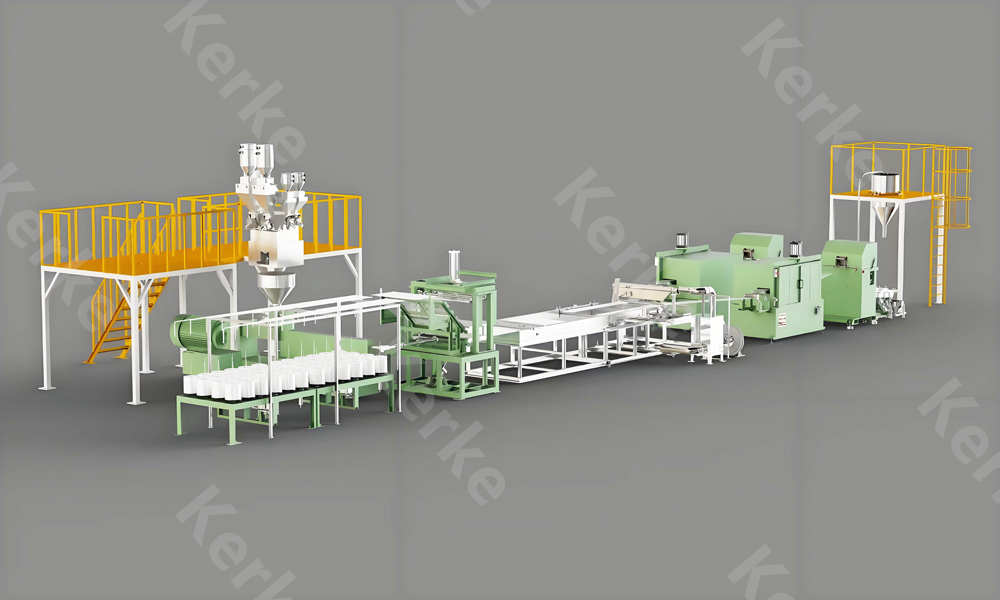
Anyone asking how much total budget is required to launch a small twin screw extruder compound plant is really asking three different questions at once: what equipment must be bought, what proportion of the money goes where, and how much cash has to sit idle in inventory and receivables before the first invoice is paid. This guide answers all three using a currency-neutral method that survives exchange-rate swings, regional labour differences and resin market cycles. Instead of quoting figures that would be obsolete before the feasibility study is signed, every line item is expressed as a share of total fixed investment, an index-point allocation against a baseline of 100, and a relative cost grade from Low through Premium.
That approach is not a dodge. It is how experienced compounding project engineers actually work. A twin screw extruder compound plant built in Southeast Asia, in Eastern Europe and in Latin America will have wildly different absolute numbers, yet the internal architecture of the budget stays remarkably stable: the extruder and its screw set dominate, gravimetric feeding is the silent second-largest block, the building swings the whole picture depending on whether it is leased or built, and working capital is almost always underestimated by first-time entrants. Once you know the shape of the budget, you can plug in your own local quotations and immediately see whether a supplier proposal is balanced or distorted.
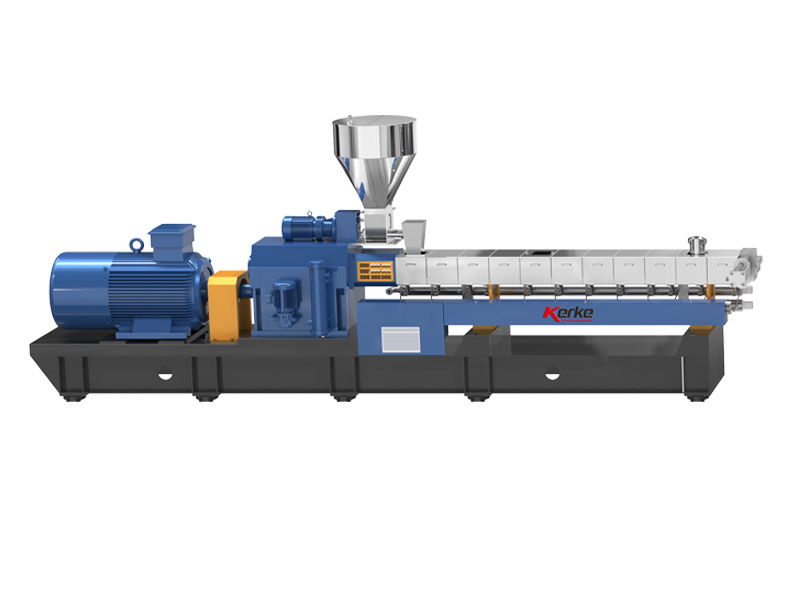
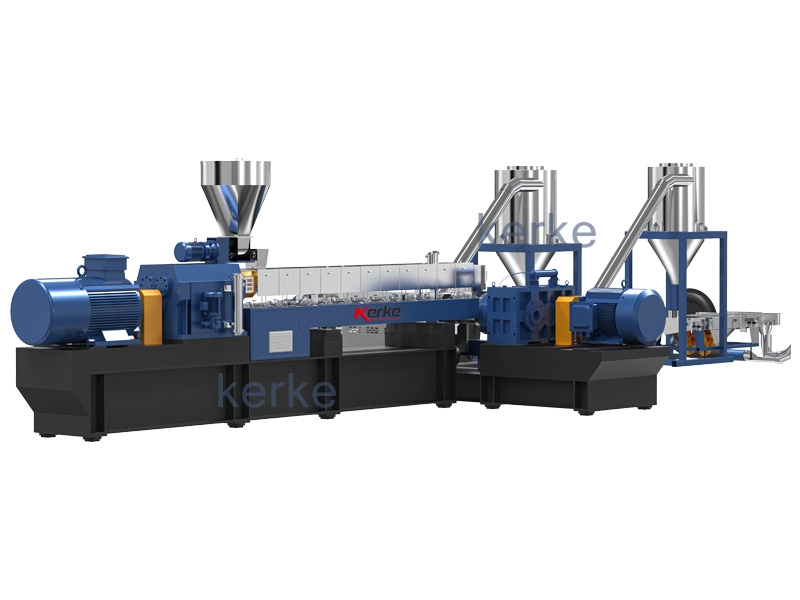
The scope here is deliberately narrow and practical. We are looking at a single co-rotating parallel twin screw line in the 300 to 1000 kg/h band, built around an SHJ-52, SHJ-65 or SHJ-75 class machine, producing filled and reinforced thermoplastic compounds, colour and filler masterbatch, cable compounds or thermoplastic elastomers. Kerke, a Wanplas factory that has focused on parallel co-rotating twin screw compounding extruders for more than twelve years and has over two thousand machines running in more than seventy countries, supplies exactly this class of line, and the structure below reflects what those projects consistently look like once they are fully costed rather than optimistically sketched.
Read the tables carefully. There are thirteen of them, and they carry more decision-grade information than the prose between them. Every percentage band is a range rather than a point value because compounding plants are configuration-driven: the same nominal 500 kg/h capacity can differ by a factor of two in installed cost depending on whether you are making a simple carbonate-filled polypropylene or a halogen-free flame-retardant polyamide with a glass-fibre side feed, an underwater pelletizer and a UL-listed formulation portfolio.
What Counts as a Small Twin Screw Extruder Compound Plant
A small twin screw extruder compound plant is a single-line compounding facility with a nameplate output between 300 and 1000 kg/h, operated by a crew of six to fourteen people across two or three shifts, and occupying between 400 and 900 square metres of production floor. This definition matters for budgeting because it is the band in which one extruder carries the entire revenue of the business, which changes how you think about redundancy, spare screw elements and maintenance reserve.
Below roughly 300 kg/h the economics stop behaving like a factory and start behaving like a development or toll-trial unit; fixed overheads per kilogram become punishing and the plant is usually justified by formulation development rather than volume. Above 1000 kg/h the utility infrastructure, the number of storage silos, the packing automation and the management layer all step up discontinuously, and the project stops being “small” in any meaningful commercial sense. The 300 to 1000 kg/h window is therefore the sweet spot for a new entrant, a captive compounder inside a moulding business, or a regional masterbatch producer serving local converters.
Capacity Tiers and Matching Machine Classes
Two tiers cover almost every small project. The lower tier, 300 to 500 kg/h, is served by an SHJ-52 class machine. The upper tier, 500 to 1000 kg/h, is served by SHJ-65 or SHJ-75 class machines. In the Kerke naming convention these correspond to the KTE-52, KTE-65 and KTE-75 models within the KTE series of parallel co-rotating twin screw extruders, which spans KTE-16B laboratory units up to KTE-135D production machines. The numeric suffix is the nominal screw diameter in millimetres.
Output is not a property of the machine alone. It is the product of screw diameter cubed, specific torque, screw speed and the volumetric or torque limit imposed by the formulation. A carbonate-filled polypropylene at 70 percent loading will run near the volumetric limit; a glass-fibre reinforced polyamide will run near the torque limit; a heat-sensitive flame-retardant compound will run near the melt-temperature limit. That is why every capacity figure below is stated as a band with the governing constraint named.
| Parameter | SHJ-52 class (KTE-52) | SHJ-65 class (KTE-65) | SHJ-75 class (KTE-75) |
|---|---|---|---|
| Nominal screw diameter | 51 to 52 mm | 62 to 65 mm | 71 to 75 mm |
| Typical L/D range | 40 to 48 | 40 to 52 | 44 to 52 |
| Specific torque T/A³ | 7 to 10 | 8 to 11 | 8 to 11 |
| Main drive motor | 55 to 75 kW | 75 to 90 kW | 90 to 110 kW |
| Maximum screw speed | 500 to 600 rpm | 500 to 600 rpm | 500 to 600 rpm |
| Filled PP, 50 to 70 percent CaCO₃ | 350 to 500 kg/h (volume limited) | 600 to 850 kg/h (volume limited) | 850 to 1100 kg/h (volume limited) |
| Glass-fibre reinforced PA6 or PA66 | 250 to 350 kg/h (torque limited) | 400 to 550 kg/h (torque limited) | 550 to 750 kg/h (torque limited) |
| Flame-retardant ABS or PP | 280 to 400 kg/h (temperature limited) | 450 to 650 kg/h (temperature limited) | 650 to 900 kg/h (temperature limited) |
| Colour masterbatch, high pigment load | 200 to 320 kg/h (dispersion limited) | 320 to 480 kg/h (dispersion limited) | 480 to 650 kg/h (dispersion limited) |
| Recommended pelletizing method | Strand or water-ring | Water-ring or underwater | Underwater or water-ring |
| Typical production floor area | 400 to 550 m² | 550 to 720 m² | 700 to 900 m² |
| Indicative total installed load | 150 to 210 kVA | 200 to 280 kVA | 260 to 350 kVA |
Reading Specific Torque Correctly
Specific torque, written as T/A³ and expressed in newton-metres per cubic centimetre, is the single most useful number for comparing twin screw extruders across suppliers because it normalises torque against screw centreline distance. A machine with T/A³ of 7 and a machine with T/A³ of 11 may share the same nominal diameter and the same catalogue output, but the higher-torque machine will hold that output on a glass-fibre reinforced polyamide while the lower-torque machine derates by thirty percent or more.
European reference machines from Coperion, Leistritz and KraussMaffei Berstorff established the high-torque design language, and Chinese manufacturers including Kerke have converged on comparable specific torque bands in the 8 to 11 range for production machines. When comparing quotations, insist that specific torque, gearbox service factor and the barrel material specification are all stated explicitly. A budget that looks attractive because the extruder line item is unusually low is often buying a lower-torque gearbox, which then caps the plant’s output on precisely the high-margin formulations you were hoping to sell.
The Budgeting Framework: Shares, Index Points and Cost Grades
The framework used throughout this guide has three layers, and understanding them prevents the most common misreading of compounding plant budgets. Layer one is the share of total fixed investment, expressed as a percentage band. Layer two is an index-point allocation, where total fixed investment is set at a baseline of 100 index points and every line item receives a whole or half point value that sums exactly to 100. Layer three is a relative cost grade that tells you how much scrutiny each item deserves during negotiation.
The critical caveat, and the one that trips up most first-time readers, is that percentage bands are not additive at their midpoints. If you add the midpoint of every band in the master table you will exceed 100, and that is expected behaviour rather than an error. The bands describe independent scenario extremes. A project sitting at the top of the extruder band, meaning a high-torque machine with an extensive screw set, will almost always sit at the bottom of the building band because it is being installed in a leased shell. A project sitting at the top of the building band, meaning greenfield construction with a crane bay and full fire protection, will proportionally compress every equipment share. Two fully reconciled scenarios that do sum to exactly 100 are given later in this article.
| Cost grade | Relative intensity | Typical share of fixed investment | Negotiation leverage | Consequence of buying cheap |
|---|---|---|---|---|
| Low | Baseline reference, 1× | Under 2 percent each | High, commodity supply | Minor, easily replaced later |
| Medium | 1.5× to 3× baseline | 2 to 4 percent each | Moderate | Increased downtime, tolerable |
| High | 3× to 6× baseline | 4 to 9 percent each | Limited, specification driven | Direct yield and accuracy loss |
| Very High | 6× to 12× baseline | 9 to 20 percent each | Low, few qualified suppliers | Structural capacity ceiling |
| Premium | Above 12× baseline | Above 20 percent | Very low, core technology | Project-defining, irreversible |
Complete Capital Expenditure Breakdown, Line by Line
The master capital expenditure table below is the analytical core of this article. It lists every block that must appear in a complete compounding plant budget, the share of total fixed investment each block typically absorbs, its cost grade, and the specific technical decision that drives it toward the top or the bottom of its band. Nothing in a small twin screw extruder compound plant should be missing from this list; if a supplier proposal omits a row, that omission is a future variation order.
| Budget block | Share of total fixed investment | Cost grade | What pushes it to the top of the band |
|---|---|---|---|
| Twin screw extruder, gearbox, barrels and segmented screw set | 28 to 38 percent | Premium | High specific torque, L/D of 52, bimetallic or tungsten-carbide barrel liners, two or three alternative screw configurations |
| Loss-in-weight gravimetric feeders, main plus 2 to 4 auxiliary units | 8 to 14 percent | High | Twin-screw powder feeders, glass-fibre feeder, vibratory refill, central recipe control, 0.5 percent accuracy class |
| Side feeder and liquid injection pumps | 2 to 4 percent | Medium | Two side feeders, side devolatilization stuffer, heated and metered liquid dosing with mass-flow feedback |
| Vacuum devolatilization: water-ring pump or Roots vacuum package | 2 to 4 percent | Medium | Two vacuum zones, Roots booster set for deep vacuum, condensate separation and volatile scrubbing |
| Melt pump and screen changer | 3 to 5 percent | High | Hydraulic continuous-flow screen changer, melt pump with closed-loop pressure control, backflush capability |
| Pelletizing system: strand, water-ring or underwater | 5 to 9 percent | High | Underwater die-face system with hot-oil heated die plate, process water loop and centrifugal dryer |
| Vibrating classifier, pneumatic conveying and homogenising silo | 3 to 5 percent | Medium | Two-deck screening, dense-phase conveying, multiple blending silos for batch homogenisation before packing |
| High-speed mixer and low-speed cooling mixer | 2 to 4 percent | Medium | Larger batch volume, jacketed cooling, dust-tight discharge, dedicated pigment premix station |
| Drying: desiccant dryer and hopper dryers | 1 to 3 percent | Medium | Hygroscopic portfolio such as PA, PC, PBT or PET requiring dew point at or below minus 40 degrees Celsius |
| Cooling water: chiller, cooling tower, pumps and treatment | 3 to 5 percent | Medium | Separate closed loop for underwater pelletizing, redundant pumps, softening and filtration to protect die plates |
| Compressed air: compressor, receiver and air dryer | 1 to 3 percent | Low | Oil-free screw compressor, higher flow for dense-phase conveying and pulse-jet filter cleaning |
| Power distribution, transformer and switchgear, 150 to 350 kVA | 5 to 8 percent | High | New utility connection, harmonic filtering for multiple drives, power factor correction, standby feeder |
| Dust extraction and VOC abatement: activated carbon, photo-oxidation or RTO | 2 to 5 percent | Medium to High | Regenerative thermal oxidiser required by local emission limits instead of a simple carbon bed |
| Packing and weighing: bulk bag and 25 kg bag stations, automatic bag sewing | 2 to 4 percent | Medium | Automatic bag placement, metal detection, palletiser and stretch wrapper instead of manual handling |
| Quality control laboratory instruments | 3 to 6 percent | High | Full mechanical suite plus HDT, ash, moisture, colour and density, needed for reinforced and flame-retardant portfolios |
| Installation, commissioning, trial runs and operator training | 3 to 5 percent | Medium | Overseas engineer deployment, extended formulation trials, multiple recipe qualification runs |
| Building, flooring, overhead crane and fire protection | 15 to 25 percent if built, 6 to 10 percent if leased | Very High when built | Greenfield construction, deep foundations, 5 t crane, sprinkler system, dedicated resin warehouse |
| Initial spare parts package and contingency | 1.5 to 3 percent | Medium | Full spare screw element set, spare die plate, spare cutter hub and knives, critical electrical spares |
| Working capital (outside the fixed-investment baseline) | 25 to 45 percent of total fixed investment | Very High | Long receivable terms, imported additives with sea freight lead times, broad SKU portfolio requiring safety stock |
Why the Extruder Alone Is Not the Extruder Budget
The Premium grade on the extruder row reflects a reality that catalogue browsing hides: the machine you quote is rarely the machine you install. A compounding extruder is a modular platform, and the delivered cost depends on how many barrel sections are supplied, how many of them are vented or side-fed, what liner material is specified, and above all how many screw configurations are purchased. Kerke describes its screw assemblies as computer-aided designs using kneading blocks with strong self-cleaning behaviour and full interchangeability, and that interchangeability is exactly what makes a multi-product small plant viable. It is also what makes the screw line item elastic.
A single screw configuration optimised for filled polypropylene will disperse pigment poorly and will shear glass fibre excessively. A configuration optimised for glass-fibre reinforcement uses gentler conveying elements downstream of the side feed to preserve fibre length. A configuration for heat-sensitive flame-retardant compounds minimises high-shear kneading zones to keep melt temperature down. If your business plan includes all three product families, budget for all three screw sets at the outset. Purchasing them later, one at a time, under production pressure, is the classic route to a fifteen to twenty percent overshoot on the equipment block.
Feeding: The Silent Second-Largest Block
Gravimetric loss-in-weight feeding is where inexperienced buyers save money and experienced compounders refuse to. A twin screw compounding extruder is a starve-fed device: output and formulation accuracy are set entirely by the feeders, not by the screw. Volumetric feeding is acceptable for a single-recipe filler masterbatch operation but fails immediately on multi-additive engineering compounds where a half-percent error in a stabiliser package shows up as a field failure eighteen months later.
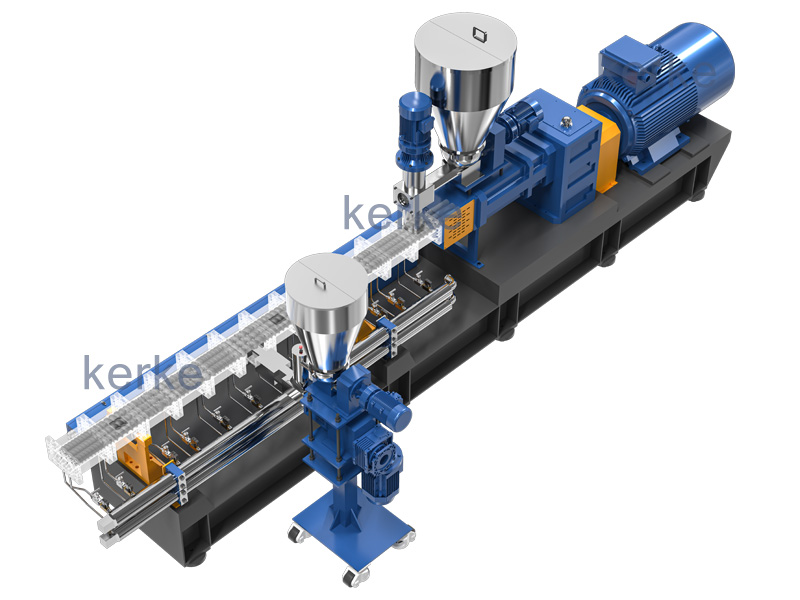
A realistic small plant needs one main resin feeder plus two to four auxiliary units. Powder feeders with twin concave screws and agitation are required for calcium carbonate, talc and flame-retardant powders that bridge readily. Glass fibre needs its own feeder, usually a vibratory tray or a dedicated screw feeder discharging into a side stuffer, because chopped strand does not flow like pellets. Liquid additives such as silicone, plasticiser or coupling agents need a metered injection pump tied into the same recipe controller.
| Product family | Feeder count and type | Side feeder | Liquid injection | Feeding block share of fixed investment |
|---|---|---|---|---|
| Filler masterbatch, CaCO₃ in PE or PP | 1 pellet feeder plus 1 large powder feeder | Required, high volume | Optional, coupling agent | 8 to 10 percent |
| Colour masterbatch | 1 pellet feeder plus 2 to 3 micro powder feeders | Optional | Sometimes, dispersing aid | 10 to 13 percent |
| Glass-fibre reinforced PA, PBT or PP | 1 pellet feeder, 1 fibre feeder, 1 to 2 additive feeders | Mandatory, downstream fibre feed | Rare | 11 to 14 percent |
| Halogen-free flame-retardant compounds | 1 pellet feeder plus 2 to 3 powder feeders | Mandatory for high FR loading | Common, silicone synergist | 11 to 14 percent |
| Thermoplastic elastomer, TPE and TPV | 2 pellet feeders plus 1 powder feeder | Optional | Mandatory, oil injection | 10 to 13 percent |
| Cable compound, PE or halogen-free | 1 pellet feeder plus 2 powder feeders | Recommended | Common | 10 to 13 percent |
| Wood-plastic composite, WPC | 1 pellet feeder plus 1 bulky fibre feeder | Mandatory, crammer type | Occasional | 9 to 12 percent |
| Biodegradable compound, PLA or PBAT blends | 2 pellet feeders plus 1 to 2 powder feeders | Common, starch feed | Common, plasticiser | 11 to 14 percent |
Devolatilization, Melt Handling and Filtration
Vacuum devolatilization is a small line item with a large quality consequence. A single atmospheric vent plus one vacuum zone driven by a water-ring pump is adequate for filled polyolefins and most masterbatch. A polyamide or polyester compound, a recycled feedstock, or any formulation carrying residual monomer or moisture needs deeper vacuum, which means a Roots booster set and proper condensate handling. The delta between these two configurations is roughly a doubling of the vacuum line item, moving it from about 2 percent to about 4 percent of fixed investment, but it is the difference between pellets that mould cleanly and pellets that produce silver streaking.
Melt pumps and screen changers together take 3 to 5 percent. A gear-type melt pump decouples die pressure from screw speed, stabilises pellet size and, on filled compounds, can allow a modest output gain by relieving the extruder of pressure-building duty. Screen changers range from a manual slide plate through hydraulic plate types to continuous backflushing units. For a small plant running clean virgin feedstock a hydraulic quick-change plate changer is the pragmatic choice; for recycled or contaminated feedstock a continuous screen changer earns its cost back in avoided stoppages within months, and this is where Kerke’s twin screw lines frequently integrate with washing systems supplied by Polyretec, another Wanplas factory.
Pelletizing Method Selection and Its Budget Consequences
Pelletizing method is the single configuration decision that most strongly couples product portfolio to capital cost, and it deserves its own analysis rather than being treated as a downstream afterthought. The three practical options for a small twin screw extruder compound plant are strand pelletizing, water-ring die-face cutting and underwater die-face cutting. Each has a distinct cost grade, footprint, labour intensity and product suitability, and choosing wrongly at the design stage is expensive to reverse because the die, the water loop, the drying equipment and the floor layout all follow from it.
| Criterion | Strand pelletizing | Water-ring die-face cutting | Underwater die-face cutting |
|---|---|---|---|
| Share of total fixed investment | 5 to 6 percent | 6 to 7 percent | 7 to 9 percent |
| Relative cost multiple | 1.0× baseline | 1.2× to 1.4× | 1.6× to 2.0× |
| Cost grade | Medium | High | Very High |
| Best-suited products | Glass-fibre reinforced PA and PBT, engineering compounds, rigid materials with good melt strength | Filler and colour masterbatch, filled PP and PE, cable compounds, medium-viscosity materials | TPE and TPV, low-viscosity and tacky compounds, hot-melt adhesives, spherical pellet requirement |
| Poorly suited products | Tacky elastomers, very low viscosity melts, highly filled brittle strands | Long glass fibre, very high viscosity, moisture-sensitive resins | Frequent small colour changes, moisture-sensitive resins without downstream drying |
| Pellet shape | Cylindrical | Lens to near-spherical | Spherical, most uniform |
| Fines generation | Moderate to high | Low to moderate | Lowest |
| Colour change and cleaning time | Shortest, open and accessible | Moderate | Longest, die plate and water chamber |
| Operator attention required | Highest, strand breaks need intervention | Low | Lowest once stable |
| Startup difficulty | Low | Moderate | High, requires trained start-up sequence |
| Additional floor length required | 6 to 9 m for water bath and air knife | 3 to 4 m | 3 to 5 m plus water skid area |
| Process water and drying demand | Low, open bath plus air knife | Medium, centrifugal dryer required | High, closed loop, filtration, temperature control |
| Recommended for a first small plant | Yes, if portfolio is engineering compounds | Yes, best all-round default | Only if the portfolio demands it |
The practical recommendation for most small twin screw extruder compound plants is water-ring die-face cutting. It sits in the middle of the cost band, tolerates a broad product range, needs far less operator attention than strand cutting, and does not impose the closed-loop water treatment burden of a true underwater system. Kerke’s cutting system portfolio covers water-cooled strand, air-cooled strand, air-cooled die-face hot cutting, water-ring die-face hot cutting, eccentric water-mist hot cutting and full underwater granulation, so the decision can be made on process grounds rather than on what a supplier happens to stock.
One nuance often missed: if your plan includes glass-fibre reinforced grades as a significant share of output, strand pelletizing deserves a second look despite its higher labour intensity. Strand cutting preserves fibre length better than die-face methods because the melt is not subjected to the additional shear of a rotating cutter against a heated die plate, and residual fibre length correlates directly with the tensile and impact performance you can claim on a datasheet.
Two Reconciled Allocation Scenarios That Sum to 100
Because percentage bands are not additive, the table below gives two fully reconciled allocations that each sum to exactly 100 index points. Scenario A is a 400 kg/h SHJ-52 line installed in a leased industrial shell with water-ring pelletizing and a masterbatch-oriented portfolio. Scenario B is an 800 kg/h SHJ-75 line in a self-built facility with underwater pelletizing, glass-fibre capability and a broader engineering compound portfolio. Use whichever is closer to your own project as the skeleton, then adjust individual rows.
| Budget block | Scenario A: 400 kg/h, leased shell (index points) | Scenario B: 800 kg/h, self-built (index points) | Comment on the difference |
|---|---|---|---|
| Twin screw extruder and screw sets | 30.0 | 26.0 | Absolute machine cost rises, but building dilutes its share |
| Loss-in-weight feeders | 11.0 | 9.5 | Feeder count rises from 3 to 5 units |
| Side feeder and liquid injection | 2.5 | 2.5 | Second side feeder added in Scenario B |
| Vacuum devolatilization | 3.0 | 2.5 | Roots booster added but share falls |
| Melt pump and screen changer | 4.0 | 3.5 | Continuous screen changer in Scenario B |
| Pelletizing system | 6.0 | 6.5 | Water-ring versus underwater, 1.5× absolute step |
| Screening, conveying and blending silos | 3.5 | 3.0 | Two additional silos in Scenario B |
| High-speed and cooling mixers | 2.5 | 2.0 | Larger batch volume, similar unit count |
| Drying equipment | 2.0 | 1.5 | Desiccant unit sized for PA in both cases |
| Cooling water system | 3.5 | 3.0 | Second closed loop for pelletizer water |
| Compressed air package | 2.0 | 1.5 | Larger compressor, smaller relative share |
| Power distribution and transformer | 6.0 | 5.5 | 180 kVA versus 320 kVA installed |
| Dust extraction and VOC abatement | 3.0 | 3.5 | Higher emission duty with FR portfolio |
| Packing and weighing | 2.5 | 2.0 | Semi-automatic in both scenarios |
| Quality control laboratory | 4.5 | 3.5 | Similar instrument list, different denominator |
| Installation, commissioning and training | 4.0 | 3.5 | Longer commissioning in Scenario B |
| Building, flooring, crane and fire protection | 8.0 | 19.0 | Fit-out only versus full greenfield construction |
| Initial spares and contingency | 2.0 | 1.5 | Both are minimum prudent levels |
| Total fixed investment | 100.0 | 100.0 | Baseline definition |
| Working capital requirement | 28 to 38 | 32 to 45 | Wider SKU range and longer terms in Scenario B |
| Total funding requirement | 128 to 138 | 132 to 145 | The number that must actually be financed |
Two observations follow immediately from this table. First, the extruder’s share falls in the larger project even though its absolute cost rises, which is why quoting equipment shares without stating the building assumption is meaningless. Second, in both scenarios the true financing requirement exceeds the fixed investment by roughly a third. A business plan that raises exactly enough to buy and install the equipment has, in practice, raised about seventy percent of what the project needs.
Building, Utility and Electrical Load Requirements
A small twin screw extruder compound plant needs between 400 and 900 square metres of usable floor area, a clear internal height of at least six metres, and an overhead travelling crane of 3 to 5 tonnes covering the extruder bay. Those three parameters drive most of the civil cost and are the first things to verify when evaluating a leased building, because retrofitting height or crane capacity into an existing shell is frequently more expensive than building new.
Why Six Metres of Height Is Not Negotiable
The height requirement is set by the feeder platform, not by the extruder. Loss-in-weight feeders discharge by gravity into the extruder feed throat, which means they sit on a mezzanine roughly 2.5 to 3.5 metres above floor level. Above the feeders sit their refill hoppers and the pneumatic conveying receivers that fill them, adding another 1.5 to 2 metres. Add crane hook height for lifting a barrel section or a gearbox during maintenance and six metres becomes the practical minimum, with seven metres preferred if a blending silo is to be installed indoors.
Floor loading is the second civil parameter. The extruder base frame, the gearbox and a full barrel assembly concentrate significant static load over a small footprint, and the pelletizer water tank plus the resin storage area impose distributed loads. Specify a floor slab rated for at least 3 tonnes per square metre in the general production area and 5 tonnes per square metre under the extruder and silo positions, with a flatness and abrasion specification suitable for forklift traffic. Epoxy or polyurethane topping in the powder handling area simplifies housekeeping and reduces dust accumulation, which in turn simplifies the explosion-risk assessment.
Explosion Zoning Where Powders Are Handled
Any compounding plant that handles calcium carbonate, talc, carbon black, metal hydroxide flame retardants or organic pigment powders must complete a combustible dust assessment. Carbon black and many organic pigments are combustible; some metal-based additives are aggressively so. The assessment defines zones around bag dump stations, mixer charging points, powder feeder refill points and dust collector interiors, and those zones then dictate motor and instrument protection classes, earthing and bonding, explosion venting or suppression on the dust collector, and housekeeping procedures.
Budget consequence: a plant that handles only pelletised feedstock and coated mineral filler may need only basic bonding and a standard cartridge filter. A plant that handles carbon black and organic pigments will need rated equipment in the classified zones, explosion venting on collectors, and a documented dust hazard analysis. That difference can move the dust and environmental block from the bottom of its 2 to 5 percent band to the top, and it is not something to discover after the layout is frozen.
Electrical Load: From Connected kW to Transformer kVA
Transformer sizing follows a four-step calculation that every project should perform explicitly rather than accepting a supplier’s round number. Step one: sum the connected load in kW of every motor, heater and auxiliary. Step two: apply a diversity factor, typically 0.60 to 0.75 for a compounding line, because barrel heaters cycle and not every auxiliary runs simultaneously at full load. Step three: divide the resulting running demand by the power factor, generally 0.85 after correction, to convert kW into kVA. Step four: multiply by a 1.25 safety and expansion factor to cover startup surges, future auxiliary additions and voltage regulation margin.
| Item | 300 to 500 kg/h tier (SHJ-52) | 500 to 750 kg/h tier (SHJ-65) | 750 to 1000 kg/h tier (SHJ-75) |
|---|---|---|---|
| Main drive motor | 55 to 75 kW | 75 to 90 kW | 90 to 110 kW |
| Barrel and die heating, connected | 30 to 45 kW | 45 to 60 kW | 55 to 75 kW |
| Side feeder and feeder motors | 6 to 10 kW | 9 to 14 kW | 12 to 18 kW |
| Pelletizer and cutter drive | 5 to 9 kW | 9 to 15 kW | 15 to 22 kW |
| Vacuum pump package | 4 to 7 kW | 7 to 11 kW | 11 to 15 kW |
| Chiller and cooling water pumps | 15 to 25 kW | 25 to 38 kW | 35 to 50 kW |
| High-speed mixer and cooling mixer | 15 to 25 kW | 22 to 37 kW | 30 to 45 kW |
| Air compressor and dryer | 11 to 15 kW | 15 to 22 kW | 22 to 30 kW |
| Conveying blowers and dust collector | 8 to 14 kW | 14 to 22 kW | 20 to 30 kW |
| Desiccant dryer, when required | 12 to 20 kW | 20 to 30 kW | 28 to 40 kW |
| Lighting, office, laboratory and HVAC | 10 to 15 kW | 12 to 18 kW | 15 to 22 kW |
| Total connected load | 171 to 260 kW | 253 to 357 kW | 333 to 457 kW |
| Diversity factor applied | 0.65 | 0.68 | 0.70 |
| Running demand | 111 to 169 kW | 172 to 243 kW | 233 to 320 kW |
| Converted at power factor 0.85 | 131 to 199 kVA | 202 to 286 kVA | 274 to 376 kVA |
| Transformer selection with 1.25 factor | 160 to 250 kVA | 250 to 315 kVA | 315 to 400 kVA |
| Cooling water circulation demand | 18 to 28 m³/h | 28 to 42 m³/h | 40 to 60 m³/h |
| Chilled water duty | 30 to 50 kW thermal | 50 to 80 kW thermal | 75 to 110 kW thermal |
| Compressed air demand at 0.7 MPa | 1.2 to 1.8 m³/min | 1.8 to 2.6 m³/min | 2.5 to 3.5 m³/min |
| Production floor area | 400 to 550 m² | 550 to 750 m² | 700 to 900 m² |
| Clear internal height | 6.0 m minimum | 6.5 m preferred | 7.0 m preferred |
| Overhead crane capacity | 3 t | 3 to 5 t | 5 t |
Note the gap between the bottom and top of each tier. A 500 kg/h plant can require anywhere from 160 to 250 kVA depending on whether it runs hygroscopic resins needing a desiccant dryer, whether the pelletizer water loop is chilled, and how much pneumatic conveying is installed. Sizing the transformer at the bottom of the band because the initial product list is simple is the single most common infrastructure mistake in small compounding projects, and correcting it later means a utility application, a new transformer and a switchgear modification that together can consume several index points of unbudgeted cost.
Staffing Model for Two-Shift and Three-Shift Operation
A small twin screw extruder compound plant is run by six to nine people on two shifts and by ten to fourteen people on three shifts, plus a small day-shift support layer. Labour is not a capital item, but the staffing model belongs in the launch budget because payroll during commissioning and the ramp-up period is funded out of working capital before any revenue arrives, and because the number of trained operators available on day one determines how quickly the plant reaches stable output.
The roles are non-negotiable rather than optional. Someone must own the extruder, someone must own the batch weighing and premix, someone must own packing and traceability, someone must release product against a specification, and someone must maintain the equipment. In a small plant these can be combined, but they cannot be eliminated. The most damaging false economy is to run without a dedicated quality technician and rely on the extruder operator to also perform melt flow and moisture testing, because that person is by definition busiest exactly when quality problems occur.
| Role | Per shift | Two-shift total | Three-shift total | Core responsibilities and skill level |
|---|---|---|---|---|
| Shift leader | 1 | 2 | 3 to 4 | Production schedule, recipe release, first-off approval, shift handover, deviation escalation. Experienced compounder. |
| Extruder operator | 1 | 2 | 3 to 4 | Startup and shutdown, temperature and torque monitoring, screen changes, pelletizer adjustment, screw configuration changes. Skilled. |
| Batching and premix operator | 1 | 2 | 3 | Raw material weighing, mixer charging, feeder refill, lot traceability records, dust housekeeping. Semi-skilled. |
| Packing and warehouse operator | 1 | 2 | 3 | Bagging, labelling, palletising, silo discharge, finished goods staging, forklift operation. Semi-skilled. |
| Quality control technician | 0.5 to 1 | 1 to 2 | 2 to 3 | Melt flow, moisture, ash, colour, mechanical specimens, certificate of analysis issuance. Trained technician. |
| Maintenance technician | Day shift plus on-call | 1 | 1 to 2 | Mechanical, electrical and hydraulic maintenance, preventive schedule, screw element inspection. Multi-skilled. |
| Plant or production manager | Day shift | 1 | 1 | Planning, formulation development, customer technical support, supplier management. Senior. |
| Total headcount | — | 11 to 12 | 16 to 20 | Excludes sales, finance and administration |
| Minimum viable lean crew | — | 7 to 8 | 11 to 13 | Combines batching with packing; accepts slower changeovers |
| Training lead time before full rate | — | 6 to 10 weeks | 8 to 14 weeks | Third shift is usually recruited after the first two are stable |
A pragmatic launch strategy is to start on two shifts with a lean crew, prove the process, then recruit the third shift from within by promoting proven operators and backfilling the semi-skilled positions. Attempting to staff three shifts from day one dilutes the available training attention across too many people and typically extends the ramp-up period rather than shortening it. It also front-loads payroll into the exact period when working capital is tightest.
Energy Benchmarks and Operating Cost Structure
Line-level specific energy consumption for a properly configured small twin screw extruder compound plant falls between 0.25 and 0.45 kWh per kilogram of finished pellet, measured at the plant boundary and including all auxiliaries rather than the extruder drive alone. That single benchmark is the most useful operating metric in compounding because it is directly comparable across plants, formulations and regions, and because it converts immediately into an energy cost per tonne once you apply your own tariff.
The variation within that band is driven almost entirely by formulation. Highly filled polyolefins sit at the bottom because the mineral filler carries no melting enthalpy and the melt temperature target is modest. Glass-fibre reinforced polyamide sits at the top because the polymer melts at a high temperature, the fibre must be wetted and dispersed, and the compound is usually dried before and sometimes after compounding. Flame-retardant systems sit in between, with the added complication that they are temperature-limited, so you cannot simply push screw speed to gain output.
| Product family | Line SEC (kWh/kg) | Typical melt temperature | Governing constraint | Screw wear intensity |
|---|---|---|---|---|
| Filled PP, 50 to 70 percent CaCO₃ | 0.25 to 0.30 | 180 to 210 °C | Volumetric, feed intake | High, abrasive filler |
| Talc-filled PP for automotive | 0.26 to 0.32 | 190 to 220 °C | Volumetric and dispersion | High |
| Colour masterbatch in PE carrier | 0.28 to 0.36 | 170 to 200 °C | Pigment dispersion quality | Moderate |
| Cable compound, halogen-free | 0.30 to 0.38 | 170 to 195 °C | Temperature, hydroxide decomposition | High |
| Flame-retardant ABS | 0.32 to 0.40 | 200 to 230 °C | Temperature, thermal degradation | Moderate |
| Thermoplastic elastomer, TPE | 0.30 to 0.38 | 170 to 200 °C | Oil absorption rate | Low to moderate |
| Glass-fibre reinforced PBT, 30 percent | 0.34 to 0.42 | 240 to 265 °C | Torque and fibre length retention | Very high |
| Glass-fibre reinforced PA6 or PA66, 30 percent | 0.38 to 0.45 | 270 to 300 °C | Torque, drying, fibre length | Very high |
| Wood-plastic composite | 0.30 to 0.40 | 160 to 190 °C | Moisture removal and feed intake | High |
| Biodegradable PLA and PBAT blend | 0.30 to 0.40 | 150 to 185 °C | Hydrolysis sensitivity | Low to moderate |
Operating Cost Composition Excluding Raw Material
Resin and additives dominate the total cost of a compound, typically representing the large majority of the delivered cost of goods, which is why the conversion cost structure is analysed separately. Within conversion cost, the proportions are remarkably stable across small plants: energy and utilities take the largest single slice, followed by direct labour, then depreciation, then consumables and maintenance, then packaging, then quality and compliance overhead.
- Energy and utilities: 26 to 34 percent of conversion cost. Driven by specific energy consumption, tariff structure and how much of the load runs during peak-price periods.
- Direct labour: 20 to 30 percent. Highly regional; a two-shift lean crew in a low-wage region sits at the bottom, a three-shift crew in a high-wage region at the top.
- Depreciation of fixed assets: 15 to 22 percent. Directly proportional to the fixed investment index and inversely proportional to capacity utilisation.
- Maintenance, spares and wear parts: 8 to 14 percent. Screw elements and barrel liners dominate; abrasive and glass-filled portfolios sit at the top of the band.
- Packaging materials: 6 to 10 percent. Bulk bags are materially cheaper per tonne than 25 kg bags, so packaging mix is a real lever.
- Quality, laboratory and compliance: 4 to 8 percent. Rises sharply if the portfolio carries listed flame-retardant grades requiring periodic third-party retesting.
- Waste, scrap and startup transition material: 3 to 7 percent. The most controllable item, and the one most improved by disciplined changeover procedures.
Practical Levers That Move Specific Energy Consumption
Four measures reliably reduce specific energy consumption in a small compounding plant. First, correct screw configuration: excess kneading block length converts electrical energy into unwanted melt temperature that the cooling system must then remove, paying twice. Second, barrel cooling control: proportional water valves rather than on-off solenoids prevent the heat-then-cool cycling that wastes energy in both directions. Third, motor and drive selection: high-efficiency motors with modern variable-frequency drives on the main extruder, the pelletizer and the conveying blowers. Fourth, insulation of barrel and die zones, which is inexpensive, frequently omitted, and typically reduces heating load noticeably while also improving temperature stability and workplace safety.
Certification, Permitting and Compliance Budget
Compliance is a budget block that first-time compounders systematically underestimate because most of it is invisible in an equipment quotation. It splits into three categories: machinery safety certification of the equipment itself, management system and product certification of the business, and environmental and safety permitting of the site. All three have lead times measured in months, and two of them can block production entirely if not started early.
| Requirement | Applies to | When it must be started | Typical lead time | Cost grade | Consequence of skipping |
|---|---|---|---|---|---|
| CE marking of the extrusion line | Equipment sold into or operated in the European Economic Area | At order placement, written into the contract | Concurrent with manufacture | Low to Medium | Customs and insurance refusal, legal exposure |
| Electrical safety to IEC 60204-1 | Control cabinet and machine wiring | Specification stage | Concurrent with manufacture | Low | Insurance and inspection failure |
| ISO 9001 quality management system | The compounding business | Month 3 to 4 of the project | 4 to 8 months to certification | Medium | Excluded from most industrial tenders |
| RoHS declaration | Compounds sold into electrical and electronic applications | Before first customer sample | 2 to 6 weeks per grade | Medium | Customer rejection at incoming inspection |
| REACH and SVHC statement | Compounds sold into or through the European market | Before first export shipment | Ongoing obligation, list updated periodically | Medium | Supply chain disqualification |
| UL yellow card listing | Flame-retardant grades sold to appliance and electrical customers | As soon as the formulation is frozen | 4 to 9 months per grade family | High | Locked out of the highest-margin segment |
| Environmental impact assessment | The site, before construction or occupancy | Month 1 to 2, before civil works | 2 to 5 months | Medium | Construction halt, project blocked |
| Pollutant discharge permit | Air emissions, wastewater, solid waste | After EIA approval, before trial production | 1 to 3 months | Medium | Cannot legally operate |
| Combustible dust hazard analysis | Any powder handling area | Layout design stage | 4 to 8 weeks | Medium | Uninsurable, severe safety exposure |
| Occupational safety standardisation | The operating site | During commissioning | 3 to 6 months | Low to Medium | Regulatory penalty, audit failure |
| Food contact compliance, where applicable | Compounds for packaging or food equipment | Before first food-sector sample | 2 to 4 months | Medium to High | Excluded from packaging customers |
The UL yellow card deserves particular attention because it is the compliance item with the longest lead time and the largest commercial consequence. Appliance, connector and electrical enclosure customers will not qualify a flame-retardant compound without a listing, and the listing process requires stable formulations, consistent production and a full test programme covering flammability class, relative thermal index and electrical properties across the thickness and colour range you intend to sell. If flame-retardant grades are in your business plan, the listing programme should start during commissioning rather than after the first customer asks for it.
The Quality Laboratory: The Most Underestimated Block
The quality control laboratory absorbs 3 to 6 percent of total fixed investment and carries a High cost grade, yet it is the block most frequently cut during value engineering and the block most frequently re-purchased at premium urgency six months after startup. A compounder without a laboratory is not selling a compound; it is selling unqualified pellets, and the difference shows up in customer claims, rejected lots and an inability to enter any specification-driven market.
The instrument list below is the minimum credible set for a small twin screw extruder compound plant addressing engineering compounds and masterbatch. Test methods are given because they are what customers write into their purchase specifications, and because the instrument you buy must be capable of the method, not merely of the measurement.
| Instrument | Test method | What it controls | Share of lab budget | Priority |
|---|---|---|---|---|
| Melt flow indexer | ISO 1133 and ASTM D1238 | Batch-to-batch viscosity consistency, degradation detection | 10 to 14 percent | Day one, non-negotiable |
| Universal tensile testing machine | ISO 527 | Tensile strength, modulus, elongation at break | 20 to 26 percent | Day one for engineering compounds |
| Izod and Charpy impact tester with notcher | ISO 180 and ISO 179 | Toughness, impact-modifier dispersion quality | 12 to 16 percent | Day one for reinforced grades |
| Heat deflection and Vicat apparatus | ISO 75 and ISO 306 | Thermal performance claims on the datasheet | 10 to 14 percent | Phase one |
| Muffle furnace for ash content | ISO 3451 | Filler and glass-fibre loading verification | 5 to 8 percent | Day one, filled grades |
| Moisture analyser, Karl Fischer or loss on drying | ISO 15512 | Drying adequacy for PA, PBT, PC and PET | 6 to 10 percent | Day one, hygroscopic grades |
| Spectrophotometer or colour difference meter | ISO 11664 colour space | Colour matching and shade consistency | 10 to 15 percent | Day one for masterbatch |
| Density balance | ISO 1183 | Formulation verification, void detection | 3 to 5 percent | Day one, low cost |
| Laboratory injection moulding machine for specimens | ISO 294 specimen preparation | Consistent test specimens for all mechanical tests | 14 to 20 percent | Day one if mechanical testing is done in-house |
| Sample dryer and conditioning cabinet | ISO 291 conditioning atmosphere | Repeatability of every mechanical result | 3 to 5 percent | Phase one |
| Laboratory twin screw extruder for formulation trials | Not a standard test, a development tool | New recipe development without stopping production | Separate capital item | Phase two, high strategic value |
| Flammability test chamber | UL 94 pre-screening | In-house screening before third-party listing | 8 to 12 percent | Phase two, mandatory for FR portfolio |
A useful sequencing rule: buy day-one instruments before commissioning begins, not after. During the trial production phase you will be running dozens of formulation and parameter variants, and without a melt flow indexer, an ash furnace and a colour meter you have no objective way to compare them. The commissioning period is precisely when laboratory capability generates the most value, and it is exactly when most projects have not yet installed it.
A laboratory twin screw extruder is treated separately because it is a strategic rather than a routine investment. Kerke’s laboratory twin screw extruder range exists for formula trials and R&D, and running development work on a small dedicated machine instead of on the production line converts lost production hours into productive development hours. For a plant whose competitive position depends on formulation know-how rather than on price, that trade is usually favourable within the first two years.
Project Timeline from Feasibility to Full Rate
A small twin screw extruder compound plant takes 6 to 10 months from feasibility approval to stable commercial output, with 8 months being the realistic central case for a leased-building project and 10 months for a greenfield build. The timeline is driven not by extruder manufacturing lead time, which is typically 3 to 5 months, but by the parallel critical path of environmental approval, civil works and utility connection, all of which are outside the equipment supplier’s control.
| Activity | M1 | M2 | M3 | M4 | M5 | M6 | M7 | M8 | M9 | M10 |
|---|---|---|---|---|---|---|---|---|---|---|
| Feasibility study, market and formulation scoping | ■ | ■ | ||||||||
| Site selection, lease or land negotiation | ■ | ■ | ■ | |||||||
| Environmental impact assessment and permitting | ■ | ■ | ■ | ■ | ||||||
| Equipment specification, supplier audit and order | ■ | ■ | ||||||||
| Extruder and auxiliary manufacturing | ■ | ■ | ■ | ■ | ||||||
| Civil works, flooring, crane and utility connection | ■ | ■ | ■ | ■ | ||||||
| Factory acceptance test and shipment | ■ | ■ | ||||||||
| Mechanical and electrical installation | ■ | ■ | ||||||||
| Laboratory setup and instrument commissioning | ■ | ■ | ||||||||
| Operator recruitment and training | ■ | ■ | ■ | |||||||
| Commissioning, water run and first melt | ■ | |||||||||
| Trial production and formulation qualification | ■ | ■ | ||||||||
| ISO 9001 implementation and certification audit | ■ | ■ | ■ | ■ | ■ | ■ | ||||
| Customer sample qualification and UL submission | ■ | ■ | ||||||||
| Commercial ramp-up to target utilisation | ■ | ■ |
Three sequencing rules protect this timeline. Start the environmental assessment in month two, not month five, because it gates civil works. Place the equipment order before civil design is finalised so that the supplier’s foundation and utility drawings inform the building rather than the other way around. And recruit the shift leader and the maintenance technician early enough that they can participate in the factory acceptance test at the supplier’s works, which is by far the most efficient training opportunity the project will ever have.
Seven Budget Overrun Traps and How to Pre-empt Them
Budget overruns in small compounding projects are highly predictable. The same seven items appear again and again, and together they typically add 12 to 25 index points to a project that was budgeted at 100. Each is preventable at the specification stage and expensive to correct afterwards, which makes this the highest-return section of any feasibility review.
| Overrun trap | Typical added index points | Frequency | Root cause | Pre-emptive action |
|---|---|---|---|---|
| Transformer and switchgear upgrade after startup | 3 to 6 | Very common | Load calculated on the initial product list only, no expansion margin | Apply the full four-step kW to kVA method with the 1.25 factor and size for the three-year product plan |
| Additional dust extraction and VOC abatement demanded by the regulator | 2 to 5 | Very common | Emission limits confirmed after equipment was ordered | Obtain written local emission limits before finalising the abatement specification; price an RTO option even if a carbon bed is the base case |
| Second and third screw configuration purchased later | 2 to 5 | Common | One screw set quoted for a multi-family product plan | Specify every intended product family at the enquiry stage and buy the screw sets as part of the original order |
| Laboratory scope expanded after first customer audit | 2 to 4 | Very common | Laboratory treated as overhead rather than as production capability | Build the instrument list from your customers’ incoming specifications, not from a generic template |
| Working capital shortfall in months three to six | 8 to 20 | Very common | Financing raised against fixed investment only | Model inventory, work in progress and receivable days explicitly; secure a committed facility before startup |
| Initial spare parts package omitted | 1 to 3 | Common | Spares seen as a maintenance cost, not a launch cost | Order wear-critical spares with the machine: screw elements, die plate, cutter knives, heater bands, thermocouples, seals |
| Civil rework for floor loading, drainage or crane clearance | 2 to 6 | Common in leased buildings | Building selected before the equipment layout existed | Obtain the supplier’s foundation, utility and clearance drawings before signing a lease or freezing civil design |
The working capital shortfall deserves emphasis because it is both the largest single overrun and the one least visible in an engineering review. A compounding business buys resin and additives on relatively short terms, holds raw material and finished goods inventory, and sells on receivable terms that in most industrial markets run 45 to 90 days. Add finished goods awaiting release testing and the cash conversion cycle routinely reaches two to three months of turnover. During ramp-up, when utilisation is low and unit costs are high, that gap is at its most punishing. This is the mechanism by which technically excellent plants fail commercially in their first year.
Risk Register for a Small Compounding Project
A formal risk register converts vague anxiety into managed exposure, and any lender or investor evaluating a compounding project will expect to see one. The register below covers the risks that actually materialise in small twin screw extruder compound plants, rated by probability and impact, with a concrete mitigation for each.
| Risk | Probability | Impact | Mitigation |
|---|---|---|---|
| Single-line dependency: extruder failure halts all revenue | Medium | Severe | Comprehensive spares package, preventive maintenance schedule, supplier response commitment, toll-compounding backup agreement with a peer plant |
| Resin and additive price volatility compressing margin | High | High | Index-linked pricing clauses with customers, shorter quotation validity, dual sourcing of key additives, disciplined inventory turns |
| Customer qualification slower than planned | High | High | Begin sampling during trial production, target a mix of fast-qualifying commodity grades alongside slow-qualifying specification grades |
| Environmental permit delay blocking construction | Medium | Severe | Engage a local consultant in month one, pre-consult with the authority on the emission inventory before submission |
| Screw and barrel wear faster than expected on abrasive formulations | Medium to High | Medium | Specify bimetallic or tungsten-carbide liners for filled portfolios, monitor torque drift and pellet dimension as wear indicators |
| Loss of key trained operator during ramp-up | Medium | High | Cross-train at least two people per critical role, document startup and changeover procedures in writing during commissioning |
| Combustible dust incident in powder handling | Low | Severe | Dust hazard analysis, bonding and earthing, explosion venting on collectors, rigorous housekeeping, no compressed-air cleaning of dust |
| Utilisation stuck below breakeven in year one | Medium to High | Severe | Secure anchor volume before startup, offer toll compounding to fill spare hours, keep the lean crew until volume justifies the third shift |
| Quality claim from a field failure traced to formulation drift | Medium | High | Gravimetric feeding with recorded data, retained samples for every lot, certificate of analysis discipline, full lot traceability |
| Currency and freight exposure on imported equipment | Medium | Medium | Fix contract currency, agree delivery terms explicitly, budget a freight contingency, confirm supplier transportation guarantee coverage |
| Regulatory tightening on flame-retardant or additive chemistry | Medium | Medium to High | Monitor the SVHC candidate list, favour halogen-free chemistries where the application allows, maintain qualified alternative formulations |
Payback in Months, Utilisation and Financial Sanity Checks
Payback for a small twin screw extruder compound plant is best expressed in months of operation at a stated capacity utilisation, because that formulation is currency-neutral and forces the two variables that actually determine the outcome into the open: how full the plant runs, and what conversion margin the product mix earns per tonne. A plant running commodity filler masterbatch at 60 percent utilisation and a plant running specification-grade reinforced compounds at 85 percent utilisation are entirely different businesses built on nearly identical equipment.
Capacity utilisation in compounding is not the same as machine uptime. It is the ratio of actual saleable output to the nameplate output multiplied by scheduled hours, and it absorbs changeover time, colour-change purge losses, off-specification material, startup transitions and maintenance. A realistic first-year figure for a new small plant is 45 to 60 percent, rising to 70 to 85 percent in a mature second or third year with a stable order book and disciplined scheduling.
| Capacity utilisation | Low margin tier: commodity filler masterbatch | Medium margin tier: colour masterbatch, filled PP | High margin tier: reinforced and flame-retardant engineering compounds |
|---|---|---|---|
| 40 percent | Beyond 96 months, not viable | 72 to 96 months | 48 to 66 months |
| 55 percent | 72 to 90 months | 50 to 66 months | 34 to 46 months |
| 70 percent | 52 to 68 months | 36 to 48 months | 24 to 34 months |
| 85 percent | 42 to 55 months | 28 to 38 months | 18 to 27 months |
| Sensitivity: each 10 point utilisation gain | Shortens payback by roughly 14 to 18 percent | Shortens payback by roughly 16 to 20 percent | Shortens payback by roughly 18 to 24 percent |
| Breakeven utilisation, first year | 62 to 72 percent | 48 to 58 percent | 36 to 46 percent |
Three sanity checks separate a credible plan from an optimistic one. First, if your model requires above 80 percent utilisation in year one, it is not a plan, it is a hope; new compounding plants do not achieve that. Second, if payback only works in the high margin tier, verify that you can actually access that tier, which means checking whether the certifications, laboratory capability and formulation know-how required are in the budget. Third, if the plan assumes a single anchor customer provides most of the volume, model what happens when that customer’s own demand drops by a third, because the fixed cost structure of a single-line plant is unforgiving.
The most reliable route to a shorter payback in a small compounding plant is not a cheaper extruder. It is a higher-value product mix enabled by adequate feeding accuracy, sufficient specific torque, and a laboratory capable of proving the claims on your datasheet. Those three items together account for roughly 45 index points of the fixed investment, and they determine which market segment the plant can serve for its entire life.
How Kerke Supports Small Compound Plant Projects
Kerke, a Wanplas factory operating from a facility of nearly twenty thousand square metres with more than twelve years of dedicated experience in parallel co-rotating twin screw compounding extruders, builds precisely the class of line described in this article. With over two thousand machines running in more than seventy countries and a team of more than one hundred, Kerke’s positioning under the slogan “We Know Compounding Extruder” reflects a deliberately narrow focus on compounding rather than a broad machinery catalogue.
For a small plant project the relevant capability set is threefold. First, machine range: the KTE series spans KTE-16B laboratory units through KTE-135D production machines, so a project can start with a KTE-52 or KTE-65 and later add a lab machine for development without changing supplier or screw element geometry. Second, configurability: aspect ratio, barrel structure, screw arrangement, exhaust configuration, feeding system and electrical control are all specified per project rather than sold as a fixed package, which is what allows the same platform to serve masterbatch, reinforced compounds and thermoplastic elastomers. Third, the full downstream scope: feeding systems from volumetric metering through loss-in-weight, side feeders, crammer feeders and liquid feeders, plus the complete cutting system range from water-cooled strand through underwater granulation, plus auxiliary equipment including high-speed mixers, granulators, pulverisers and water chillers.
Because Kerke sits within the Wanplas brand, a small compound plant project can also draw on adjacent factory capability without multiplying supplier relationships. Where the feedstock is post-consumer or post-industrial material, Polyretec supplies the washing and preparation stages that precede compounding. Where the compound feeds a downstream extrusion operation, Faygo and YuanSu supply pipe, profile, sheet and film lines. All Wanplas factories share the same brand-level service commitments, including an annual free spare-parts allowance, warranty replacement of damaged parts, a transportation guarantee, a production capacity guarantee and an open-factory policy for customer visits and pre-shipment inspection.
For comparison purposes, buyers should benchmark any proposal against the established European reference manufacturers such as Coperion, Leistritz and KraussMaffei Berstorff on the specific parameters that matter: specific torque, gearbox service factor, barrel liner specification, feeder accuracy class and screw element metallurgy. A well-specified Chinese-built line from a focused manufacturer competes credibly on those parameters; a poorly specified one does not, and the difference is visible in the technical data sheet rather than in the marketing material.
Frequently Asked Questions
What output range defines a small twin screw extruder compound plant?
A small plant is a single co-rotating line in the 300 to 1000 kg/h band, typically built around an SHJ-52, SHJ-65 or SHJ-75 class machine with an L/D of 40 to 52, specific torque T/A³ between 7 and 11, and a main motor of 55 to 110 kW. Below 300 kg/h the fixed overhead per kilogram makes commercial operation difficult and the unit behaves like a development or toll-trial facility. Above 1000 kg/h the utility infrastructure, silo count, packing automation and management layer all step up, and the project ceases to be small in any operational sense.
Which single line item consumes the largest share of the budget?
The twin screw extruder itself, including the segmented screw set, barrel sections, gearbox and drive, takes 28 to 38 percent of total fixed investment and carries a Premium cost grade. Loss-in-weight gravimetric feeders are the second largest equipment block at 8 to 14 percent. In a self-built facility the building, flooring, crane and fire protection package can rival the extruder at 15 to 25 percent, which is why the lease-versus-build decision reshapes the entire budget profile more than any equipment choice.
How much working capital is needed on top of the equipment budget?
Plan working capital equal to 25 to 45 percent of total fixed investment, meaning a total funding requirement of 125 to 145 index points against a fixed-investment baseline of 100. It covers resin and additive inventory, work in progress, finished goods held for release testing, and receivables that commonly run 45 to 90 days in industrial compounding. This is the single most underestimated item in first-time compounding projects and the most frequent cause of a technically sound plant stalling in its third to sixth month.
Should a first plant choose water-ring, underwater or strand pelletizing?
Water-ring die-face cutting is the best all-round default for a first small plant: it sits mid-range at 6 to 7 percent of fixed investment, handles masterbatch, filled polyolefins and cable compounds well, and needs far less operator attention than strand cutting. Choose strand pelletizing if the portfolio is dominated by glass-fibre reinforced engineering compounds, because it preserves fibre length better. Choose underwater cutting only if tacky elastomers, very low viscosity melts or a spherical pellet requirement genuinely demand it, since it costs 1.6 to 2.0 times the strand baseline and adds a closed-loop water treatment burden.
How is transformer capacity determined for the plant?
Use a four-step method. Sum the connected kW of every motor, heater and auxiliary; apply a diversity factor of 0.60 to 0.75 because barrel heaters cycle and auxiliaries do not all run at full load simultaneously; divide by a power factor of about 0.85 to convert kW into kVA; then multiply by 1.25 for startup surge, voltage regulation margin and future expansion. Small compounding plants land between 150 and 350 kVA of installed transformer capacity, with a 400 kg/h line typically at 160 to 250 kVA and an 800 kg/h line at 315 to 400 kVA.
What building specification should be verified before signing a lease?
Check four parameters before committing: a clear internal height of at least six metres to accommodate the feeder mezzanine, refill hoppers and crane hook clearance; an overhead travelling crane of 3 to 5 tonnes covering the extruder bay; floor loading of at least 3 tonnes per square metre generally and 5 tonnes per square metre under the extruder and silo positions; and adequate incoming electrical capacity plus drainage for the cooling water system. Retrofitting height or crane capacity into an existing shell frequently costs more than the rent saved.
What specific energy consumption should be expected?
Plan for 0.25 to 0.45 kWh per kilogram at the plant boundary including all auxiliaries. Highly filled polypropylene sits at 0.25 to 0.30, colour masterbatch at 0.28 to 0.36, flame-retardant ABS at 0.32 to 0.40, and 30 percent glass-fibre reinforced polyamide at 0.38 to 0.45. The main levers for improvement are a correct screw configuration that avoids unnecessary shear heating, proportional barrel cooling control instead of on-off solenoids, high-efficiency motors with variable-frequency drives, and barrel and die insulation.
How many people are needed to run the plant?
A two-shift operation needs 11 to 12 people in a full structure or 7 to 8 in a lean crew that combines batching with packing. A three-shift operation needs 16 to 20 in a full structure or 11 to 13 lean. The non-negotiable roles are shift leader, extruder operator, batching operator, packing operator, quality technician, maintenance technician and plant manager. Starting on two shifts and promoting proven operators into the third shift generally produces a faster ramp-up than staffing all three shifts from day one.
How long does the whole project take from decision to commercial output?
Six to ten months, with eight months a realistic central case for a leased building and ten months for greenfield construction. The critical path is rarely extruder manufacturing, which runs 3 to 5 months, but rather the parallel sequence of environmental approval, civil works and utility connection. Starting the environmental assessment in month two and placing the equipment order before civil design is frozen are the two decisions that most reliably protect the schedule.
What certifications should be budgeted for from the start?
Machinery-side items are CE marking where applicable and electrical safety to IEC 60204-1, both written into the purchase contract at order placement. Business-side items are ISO 9001, which takes 4 to 8 months and should start around month three or four, plus RoHS declarations and REACH SVHC statements for the relevant markets. If flame-retardant grades are in the plan, begin the UL yellow card programme during commissioning because it takes 4 to 9 months per grade family. Site-side items are the environmental impact assessment, the pollutant discharge permit, a combustible dust hazard analysis and occupational safety standardisation.
What are the most common causes of budget overrun?
Seven items recur: transformer and switchgear upgrades after startup, additional dust and VOC abatement demanded by the regulator, second and third screw configurations purchased later, laboratory scope expanded after the first customer audit, working capital shortfall in months three to six, an omitted initial spare parts package, and civil rework for floor loading or crane clearance. Together these typically add 12 to 25 index points to a project budgeted at 100. Every one of them is preventable at the specification stage.
Is a laboratory twin screw extruder worth buying for a small plant?
For a plant competing on formulation know-how rather than price, generally yes, but as a phase-two investment rather than a day-one purchase. A laboratory machine converts development work that would otherwise consume production hours into parallel productive time, and it lets you trial customer-specific recipes without a full production changeover. For a plant running a narrow portfolio of commodity masterbatch, the case is weaker and the capital is better placed into packing automation or additional blending silo capacity.
How does capacity utilisation affect payback?
Very strongly and non-linearly. Each ten-point gain in capacity utilisation shortens payback by roughly 14 to 24 percent depending on margin tier. A high-margin engineering compound plant at 85 percent utilisation can reach payback in 18 to 27 months, while the same plant at 40 percent utilisation stretches to 48 to 66 months. Breakeven utilisation in the first year ranges from 62 to 72 percent for commodity filler masterbatch down to 36 to 46 percent for reinforced and flame-retardant compounds, which is the clearest argument for investing in the capability to serve the higher tier.
Conclusion
The total budget required to launch a small twin screw extruder compound plant is best understood not as a single number but as a structure. Set total fixed investment at a baseline of 100 index points and the architecture becomes clear: the twin screw extruder and its screw sets take 28 to 38 percent as a Premium item, gravimetric feeding takes 8 to 14 percent as a High item, the pelletizing system 5 to 9 percent, power distribution 5 to 8 percent, the quality laboratory 3 to 6 percent, installation and commissioning 3 to 5 percent, and the building anywhere from 6 to 10 percent as a leased fit-out or 15 to 25 percent as a greenfield build. On top of that baseline, working capital adds a further 25 to 45 index points, making the honest total funding requirement 125 to 145 index points.
Three decisions determine whether that budget produces a viable business. The first is machine class and specific torque, because a low-torque machine caps your output on precisely the reinforced and flame-retardant grades that carry the best conversion margin. The second is feeding accuracy, because a starve-fed compounding extruder produces exactly the formulation its feeders deliver and nothing better. The third is laboratory capability, because a compound you cannot characterise is a compound you cannot sell into any specification-driven market. Those three blocks together are roughly 45 index points, and they set the ceiling on the plant’s addressable market for its whole operating life.
Everything else in the budget is manageable through disciplined engineering. Size the transformer with the full four-step method and the 1.25 factor. Confirm local emission limits in writing before specifying abatement. Buy every screw configuration your product plan requires with the original machine order. Order wear-critical spares as part of the launch. Verify building height, crane capacity and floor loading against the supplier’s drawings before signing anything. Model working capital explicitly and secure a committed facility before startup. Do those six things and the 12 to 25 index points of typical overrun largely disappear.
If you are scoping a 300 to 1000 kg/h compounding project, the most productive next step is to convert your intended product portfolio into a specification: capacity per product family, governing process constraint, feeder count and type, pelletizing method, drying requirement and target specific energy consumption. Kerke, a Wanplas factory focused exclusively on parallel co-rotating twin screw compounding extruders, can then configure a KTE-series line against that specification and provide the foundation, utility and clearance drawings your civil design needs, along with installation, commissioning and operator training. Send the product list rather than a machine model number, and the resulting proposal will be a plant configuration rather than a price sheet.