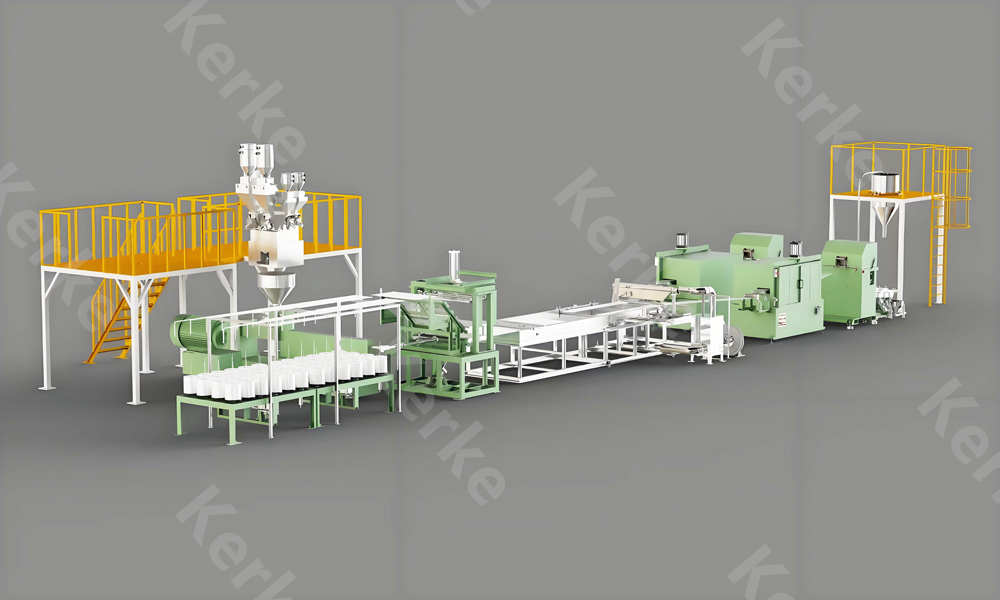
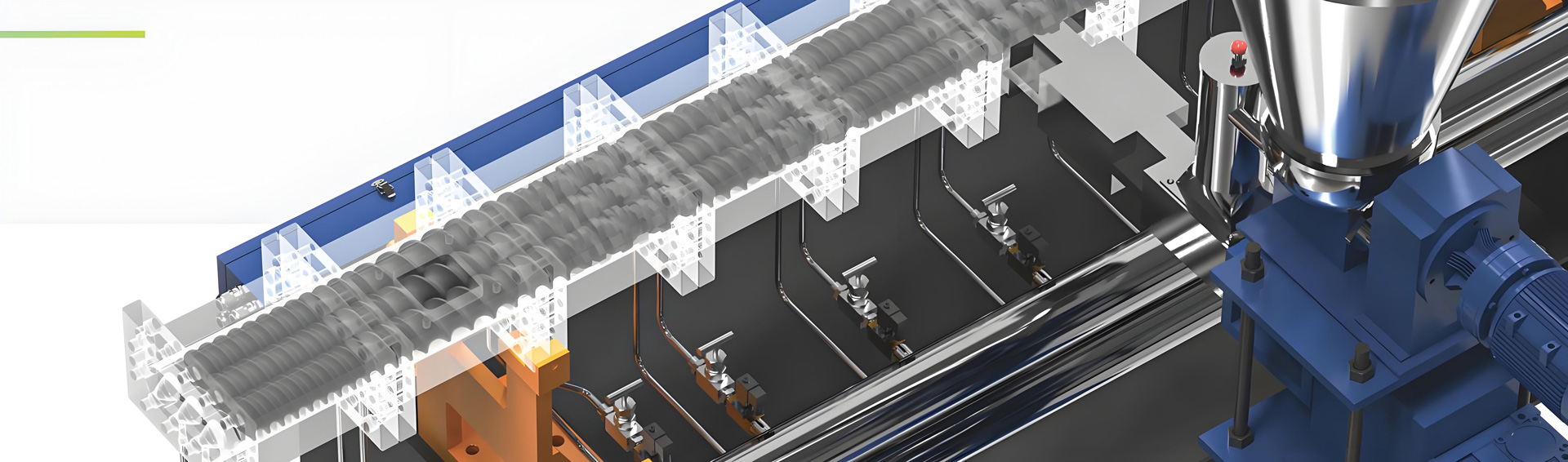
A fiber reinforced modified plastic factory takes base resin such as polypropylene or polyamide and blends it with glass fiber, additives, and often filler to make engineering compounds with higher strength and stiffness. The heart of the plant is a co-rotating parallel twin-screw extruder that melts, mixes, and disperses the fiber, followed by a pelletizing system that cuts the melt into uniform granules. Building this factory is a capital decision, so a full itemized cost analysis is essential before ordering equipment. Kerke, a Wanplas factory, specializes in twin-screw compounding extruders with 12-plus years of experience, 2,000-plus machines running worldwide, and coverage in 70-plus countries. This guide breaks down the cost of a fiber reinforced modified plastic factory into capital, utility, labor, and material items, and shows how to compute the operating cost per ton.
What a Fiber Reinforced Modified Plastic Factory Makes
Fiber reinforced modified plastic is a compound where short glass fibers carry load inside a polymer matrix. Glass-fiber reinforced polypropylene (GFR-PP) and glass-fiber reinforced polyamide (GFR-PA, often called PA6 or PA66 with glass) are the volume products, used in automotive parts, appliance housings, and power-tool bodies. The factory’s job is to disperse the fiber evenly without breaking it too short, and to do so at a stable output.
Fiber length is the property that separates a good compound from a bad one. Long glass fibers carry more load than the same weight of short fibers, so the line is tuned to cut the roving into strands of useful length without grinding them to dust. The side feeder chops the roving as it enters the melt, and the downstream kneading blocks wet and distribute it. Over-shearing in the screw breaks the fiber and loses the stiffness gain, while under-mixing leaves clumps that weaken the part. The twin-screw layout is the control knob for this balance.
The value chain position explains the margin. A compounder sits between the resin producer and the molder, adding a processing step that upgrades a commodity polymer into an engineering material. The buyer of the pellet pays for the properties, not just the resin weight, which is why a reinforced compound commands a premium over base plastic. The factory’s cost discipline, fiber breakage control, and consistency decide how much of that premium becomes profit.
End markets set the volume and the spec. Automotive demands tight, documented properties and steady supply, which rewards a reliable line. Appliances and tools want cost-down compounds with enough strength, which rewards recipe control. A fiber reinforced factory often serves several of these, switching formulas on the same line, so quick, accurate changeover is part of the operating cost story.
Modification is broader than just fiber. A compounding line also adds coupling agents so the polar glass bonds to non-polar polyolefin, impact modifiers for toughness, flame retardants for electronics, and color masterbatch for the final look. The twin-screw extruder is the reactor where all of these mix under heat and shear. The output is a pellet that a molder or extruder buys as a drop-in engineering material.
The business case rests on the spread between base resin plus filler cost and the compound selling price. Glass fiber is cheaper per kilogram than engineering polymer yet adds properties, so a reinforced compound captures value by upgrading a commodity resin. The factory wins when its line runs steadily, minimizes fiber breakage, and controls energy and scrap. The cost analysis below sizes the equipment and the running cost that decide that margin.
Process Flow and Equipment List
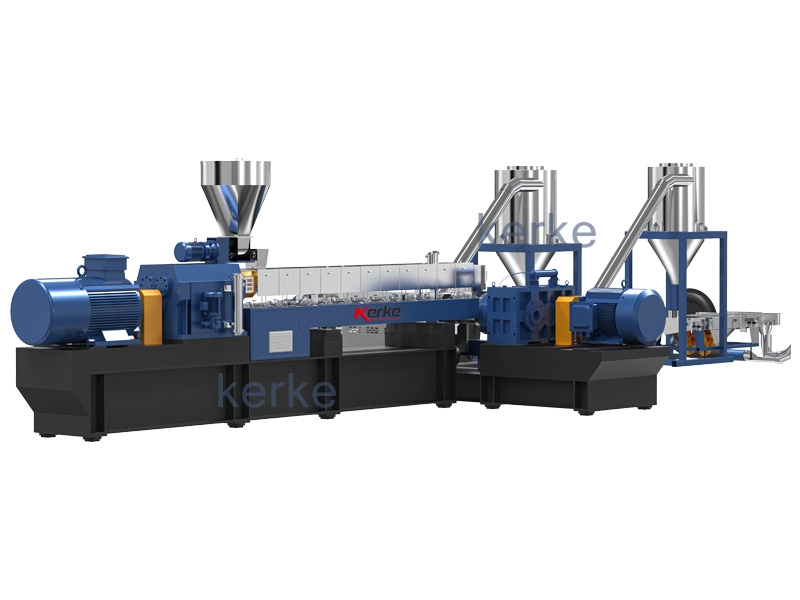
A continuous compounding line for glass-fiber reinforced plastic follows a fixed sequence. Base resin and filler are metered from loss-in-weight feeders into the first barrel section. Glass fiber is added through a side feeder downstream so the fiber is cut and wetted late, which preserves length. The melt is mixed by kneading blocks, devolatilized if needed, pumped through a die, and cut by a pelletizing system.
Feeding accuracy is the foundation of cost control. A loss-in-weight feeder weighs the resin as it drops, adjusting the screw speed to hold the set rate, so the recipe stays exact even as the hopper empties. The filler and additive feeders do the same. Because raw material is the largest cost in the plant, a drifting feeder either over-doses expensive additive or under-doses and fails the spec, both of which cost money. Gravimetric feeding protects the margin more than any single machine upgrade.
Devolatilization is a step many buyers under-spec. Compounding releases trapped air and, with some additives, volatiles that must leave the melt before pelletizing or the pellet has voids and the part has bubbles. A vented barrel section at reduced pressure pulls these out, and a properly set vacuum there is why a good compound looks solid and uniform. Kerke’s screw zoning includes a dedicated exhaust zone so this is built in rather than bolted on.
Pelletizing choice shapes the product and the cost. Strand pelletizing extrudes multiple strands into a water bath, then cuts them on a puller; it is simple and cheap but needs a clean strand path. Die-face hot cutting, including water-ring and underwater versions, cuts the melt at the die and is cleaner for some compounds and easier to automate, at higher equipment cost. For a fiber reinforced line where strand breakage is a risk, die-face cutting is often the steadier choice for continuous running.
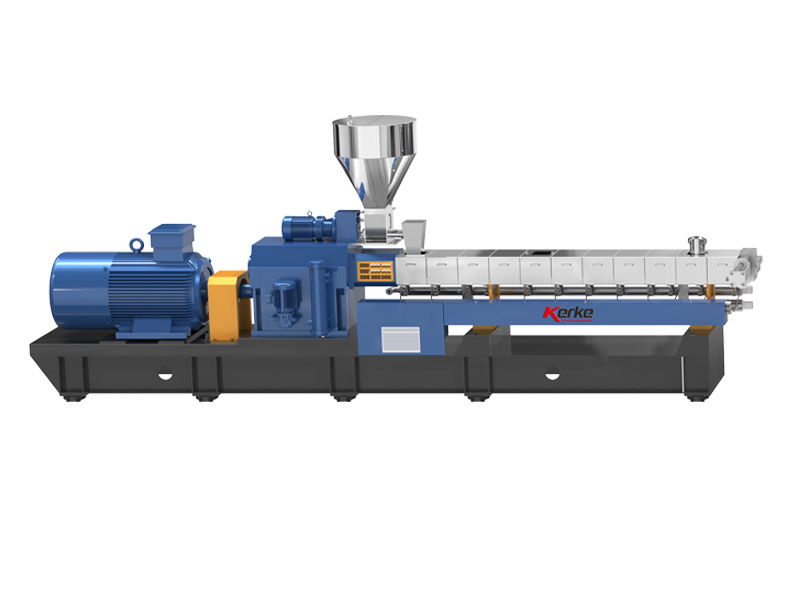
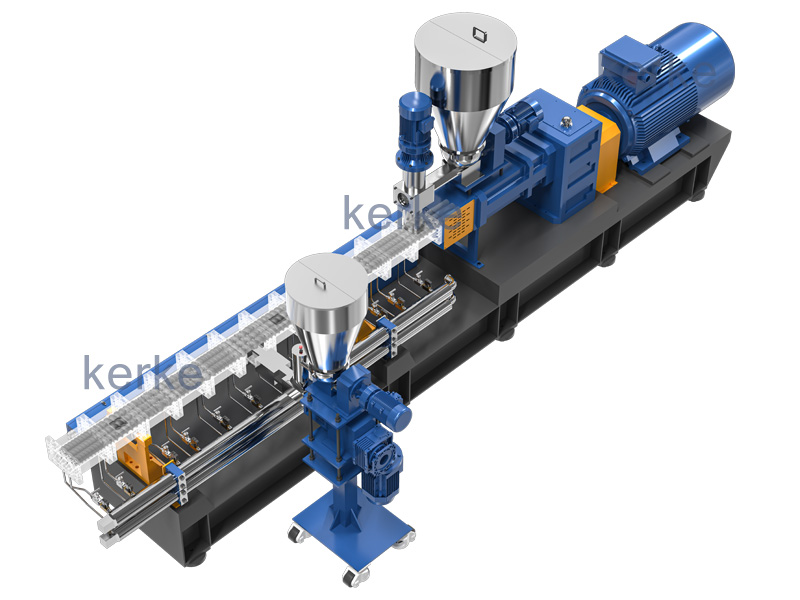
The equipment list starts with the twin-screw extruder itself: a co-rotating parallel pair of intermeshing screws inside a segmented barrel. Around it sit gravimetric feeders, a side feeder for glass roving, a screen changer or melt filter, a pelletizing head, a cooling and drying unit, and a classifier or screener. Auxiliaries include a high-speed mixer for pre-blending, a chiller for barrel cooling, and a dust collection system for the fiber cut point.
Material handling closes the loop. Silos or gaylords feed the resin, a pneumatic or vacuum system moves it to the feeder, and the finished pellets are conveyed to a silo or big-bag station. For a fiber line, the roving creel that holds glass bobbins and the side feeder that chops and pulls fiber into the melt are critical, because fiber addition rate sets the reinforcement level and the line’s throughput.
The table below lists the core equipment for a fiber reinforced compounding line and its role. Exact models are set by the target output and formula, which Kerke’s application team confirms during quotation.
| Equipment | Role | Why It Matters |
|---|---|---|
| Twin-screw extruder | Melt, mix, disperse | Core reactor |
| Loss-in-weight feeder | Meter resin and filler | Recipe accuracy |
| Side feeder | Add glass fiber | Fiber length control |
| Screen changer | Filter melt | Clean pellet |
| Pelletizing system | Cut and cool | Uniform granule |
| Chiller | Barrel cooling | Stable temperature |
| Dust collection | Capture fiber dust | Plant hygiene |
Capital Cost: Itemized Machine Investment
The capital cost is the equipment purchase plus installation. For a fiber reinforced line the twin-screw extruder is the largest single item, followed by the pelletizing system and the feeding package. A small lab or pilot line costs far less than a full production line, while a high-output line with large screw diameter and automated handling raises the ticket.
Kerke’s KTE series runs from the KTE-16B lab model up to the KTE-135D production model, with output from 30 kilograms per hour to high capacity. A glass-fiber line is usually specified in the mid-to-large KTE range because fiber addition and devolatilization need barrel length. The screw diameter sets the throughput: a larger diameter moves more melt but costs more and draws more power.
The feeding package is a meaningful sub-cost. Two or three loss-in-weight feeders plus a side feeder for glass roving add up, and each needs load cells and a controller. The pelletizing system choice also moves cost: water-ring die-face cutting and underwater pelletizing cost more than air-cooled strand cutting but give cleaner, more uniform pellets for demanding compounds.
The table below itemizes a representative mid-size fiber reinforced line at a conceptual level. Figures are relative cost levels, not quotes, because final price depends on screw diameter, barrel configuration, and options confirmed with the factory.
| Capital Item | Cost Level | Notes |
|---|---|---|
| Twin-screw extruder (KTE mid) | High | Largest single item |
| Feeding package (3 feeders + side) | Medium | Gravimetric, load cells |
| Pelletizing system | Medium | Water-ring or strand |
| Screen changer and melt pump | Low to Medium | Per formula |
| Auxiliaries (chiller, mixer, dust) | Medium | Plant support |
| Installation and commissioning | Low to Medium | Engineering on-site |
| Total line | High | Scales with screw size |
Utility and Infrastructure Cost
Utilities are a running cost that the capital plan must size. The extruder draws the most power, followed by the pelletizing system, chiller, and material handling. A twin-screw line’s power draw rises with screw diameter and rpm, so a larger line costs more per hour to run even before counting output.
Power quality is an infrastructure cost often missed. A twin-screw line with servo feeders and modern controls needs a stable three-phase supply with clean grounding, and a voltage dip can trip the line and scrap a barrel of melt. The plant should budget a transformer and power conditioning sized to the line, plus a backup plan for the brief outages common in some regions. This is capital spent before the first pellet, but it protects uptime that the whole cost model depends on.
Water treatment is part of the utility budget for die-face pelletizing and barrel cooling. Open cooling towers need water treatment to avoid scale that insulates the mold and lengthens the cycle, while closed-loop systems cut consumption but need a chiller. The choice affects both the recurring water and chemical cost and the capital for the treatment plant. A fiber line’s dust also loads the ventilation, so the air handling should be sized for the roving chop point where most fiber dust is generated.
Waste and environmental cost is rising in the compliance budget. A compounding plant handles bulk resin, fiber, and additives, and must manage spill, dust, and packaging waste. Some regions require permits for airborne fiber dust and for the noise of the pelletizer. Building the dust collection and a quiet enclosure into the plan avoids retrofits and fines, and it protects workers who would otherwise breathe fiber over a shift. This is a real, itemized line in the infrastructure cost, not an optional extra.
Water is the next utility. The barrel cooling circuit, the pellet cooling water, and the chiller all use water, though closed-loop systems minimize consumption. Compressed air runs the pneumatic conveying and some actuators. For a fiber line, dust collection needs steady airflow, which adds a small power load but protects the plant and the product.
Facility infrastructure is a one-time cost often missed in early budgets. The plant needs a reinforced floor for the heavy extruder, a crane or hoist for screw and barrel change, adequate electrical supply with the right capacity, and ventilation for the processing heat. Kerke’s factory data shows a typical footprint in the low thousands of square meters for a serious compounding plant, and the buyer should budget the building and utilities separately from the machine price.
The table below lists the utility items and their cost nature for a fiber reinforced line. Relative levels help the planner build a monthly operating budget.
| Utility | Cost Nature | Driver |
|---|---|---|
| Electricity | High, recurring | Screw size and rpm |
| Cooling water | Low, recurring | Closed loop saves |
| Compressed air | Low, recurring | Conveying and actuators |
| Ventilation | Medium, recurring | Heat and dust |
| Floor and crane | One-time | Heavy machine load |
| Electrical supply | One-time | Capacity upgrade |
Labor and Operating Cost per Year
Labor cost depends on the automation level. A manual line with bag feeding and big-bag packing needs more operators per shift than a silo-fed line with automatic pellet handling. A typical production line runs with one to two operators per shift plus a supervisor, and continuous operation needs three to four shifts covered.
Beyond direct operators, the plant needs a quality technician for incoming resin checks and outgoing pellet tests, and a maintenance technician for screw and barrel care. Fiber lines wear the screw and barrel faster than unfilled compounds because glass is abrasive, so maintenance labor and spare screw elements are a real recurring cost that the budget must include.
Consumables add to operating cost. Screen packs, knife blades for the pelletizer, and screw elements wear out and must be replaced. The Wanplas group backs its factories with a spare-parts promise of USD 500 free parts every year plus warranty replacement, which offsets a portion of the consumable cost but not all of it. The table below lists annual operating cost items at a relative level.
| Operating Item | Cost Level | Frequency |
|---|---|---|
| Operators (shifts) | Medium | Recurring, monthly |
| Supervision and QA | Low to Medium | Recurring, monthly |
| Maintenance labor | Low to Medium | Recurring, monthly |
| Screw and barrel wear | Medium | Fiber is abrasive |
| Knife and screen packs | Low | Recurring, frequent |
| Spare parts (Wanplas) | Offset by USD 500/yr | Annual policy |
Raw Material Cost and Glass Fiber Loading
Raw material is usually the largest cost in a reinforced compound, far above energy or labor. The base resin price sets the floor, and the glass-fiber loading sets how much cheaper the mix becomes per kilogram of compound. A 30 percent glass formulation uses 30 kilograms of fiber per 100 kilograms of compound, with the rest resin, filler, and additives.
Glass fiber costs less per kilogram than engineering polymer, so raising the fiber content lowers material cost up to a point, but it also raises abrasion and can hurt surface finish. Coupling agent cost rises with fiber level because the glass must bond to the matrix. Filler such as talc or calcium carbonate is the cheapest component and further lowers cost, though it changes the property balance.
Additives are a small but vital cost. Impact modifier, flame retardant, stabilizer, and color masterbatch each add a few percent to the formula. The twin-screw line’s job is to disperse them uniformly so a small amount does its job, which protects margin by avoiding over-dosing. Accurate gravimetric feeding is what keeps the recipe, and therefore the material cost, on plan.
The table below shows a representative GFR-PP formula at relative material cost. Values are cost levels, not market prices, because resin and fiber prices move with the commodity cycle and must be quoted at purchase time.
| Formula Component | Share (wt percent) | Relative Cost |
|---|---|---|
| PP base resin | 60 | Medium |
| Glass fiber (30 percent) | 30 | Low |
| Filler (talc or CaCO3) | 7 | Low |
| Coupling agent | 1.5 | Medium |
| Additives and color | 1.5 | Medium |
Kerke Twin Screw Extruder Selection
Kerke is a Wanplas factory focused on parallel co-rotating twin-screw compounding extruders and is recognized among the top suppliers in China for this category. The KTE series spans KTE-16B to KTE-135D, and the screw assembly is computer-aided designed with kneading co-type elements that give excellent self-cleaning and good interchangeability. For a fiber reinforced line the screw layout is tuned so glass is added late and dispersed without over-cutting.
Kerke’s screw design realizes material transport, plasticization, shearing, dispersion, homogenization, exhaust, and pressure building in distinct barrel zones. That zoning matters for glass fiber because the side feeder drops roving into a melt that is already formed, and the downstream kneading blocks wet and distribute the fiber. A well-set exhaust zone removes trapped air so the pellet has no voids.
Beyond the KTE series, Kerke offers a triple-screw extruder for special materials, a double-stage system for heatsensitive compounds, and a single-screw SE series mainly for recycling. For a standard fiber reinforced modified plastic factory the KTE co-rotating line with a side feeder and a water-ring or strand pelletizer is the mainstream choice. The table below maps Kerke options to the fiber reinforced use case.
| Kerke Product | Fit for Fiber Line | Note |
|---|---|---|
| KTE co-rotating series | Primary choice | KTE-16B to KTE-135D |
| Triple-screw extruder | Special materials | Higher dispersion |
| Double-stage system | Heat-sensitive mixes | Mother-baby setup |
| SE single-screw | Recycling only | Not for GF compounding |
| Cutting and pelletizing | Required | Water-ring or strand |
Kerke’s factory in Nanjing covers 19,997-plus square meters, employs 100-plus team members, and has 12-plus years of experience. With 2,000-plus machines running worldwide and coverage in 70-plus countries, the brand’s tooling and screw-element supply chain is mature, which matters for the recurring screw wear cost of a fiber line.
Output Based Cost per Ton Calculation
The operating cost per ton is the key metric for a compounding factory. Compute it by taking the annual running cost, adding material cost for the annual volume, and dividing by the annual tonnage. Running cost includes energy, labor, maintenance, consumables, and allocated overhead. Material cost dominates, so the per-ton number tracks resin and fiber prices closely.
Build the model in layers. First the material layer: take the formula weights, multiply by current resin, fiber, filler, and additive prices, and you have the direct material cost per ton. Then the conversion layer: energy in kWh per ton times the power rate, plus labor hours per ton times the wage, plus allocated maintenance and consumables. Add a overhead allocation for rent, insurance, and administration. The sum divided by tons is the full cost, which you compare to the compound selling price for margin.
Sensitivity is the point of the model. Resin and fiber prices move with the commodity cycle, so the buyer should see how margin swings when resin rises or fiber falls. Energy rate changes hit the conversion layer, and labor changes hit it too. A good model lets the factory manager answer “what if” questions before the market moves, which is the real value of the itemized analysis.
Capacity utilization is the lever inside the model. Fixed costs such as depreciation, supervision, and overhead spread over more tons as the line runs fuller, so a line at 60 percent utilization carries a higher fixed cost per ton than the same line at 85 percent. This is why a buyer should size the line to realistic demand, not a hopeful peak, and why a second line added at proven demand beats one oversized line running half empty.
Start with output. A mid-size KTE line might produce, say, 400 to 800 kilograms per hour of a 30 percent glass compound depending on screw diameter and formula. At 20 hours a day, 300 days a year, and 85 percent efficiency, that is roughly 2,000 to 4,000 tons per year. The larger the screw, the higher the tonnage and the lower the fixed cost per ton.
Energy per ton falls as output rises because the extruder’s fixed idle and auxiliary load spreads over more kilograms. Labor per ton also falls with automation. The table below shows a simplified per-ton cost build at relative levels for a mid-size line, to illustrate how the items combine rather than to quote prices.
| Cost Item | Relative Share per Ton | Driver |
|---|---|---|
| Base resin | High | Commodity price |
| Glass fiber | Medium | Loading percent |
| Filler and additives | Low to Medium | Formula |
| Electricity | Low | kWh per ton |
| Labor | Low | Automation level |
| Maintenance and wear | Low | Fiber abrasion |
To turn this into a real number, the buyer feeds current resin and fiber prices, the local power rate, and the line’s measured kWh per ton into the same structure. Kerke’s application team can model the kWh per ton for a chosen KTE model and formula during the quotation, which lets the buyer complete the per-ton calculation with plant-specific data.
Cost Comparison by Capacity Scale
Capacity scale changes the cost profile. A pilot line with a small KTE model costs less up front and suits formula development, but its per-ton cost is high because fixed labor and overhead spread over few tons. A large line with a big screw costs more up front yet wins on per-ton cost and consistency, which is why volume compounds target the upper KTE range.
The trade is risk. A large line commits more capital before the market is proven, while a small line lets a compounder qualify customers and then scale. Many factories start with a mid-size KTE and add a second line when demand justifies it, which spreads the capital risk. Kerke’s modular screw and barrel design supports this growth because elements and control logic carry across models.
Automation narrows the gap. A small line with silo feed and automatic packing approaches the per-ton labor cost of a large line, so the scale penalty shrinks. The table below compares three capacity tiers at a conceptual level to show how cost items shift.
| Scale Tier | Capital | Per-Ton Fixed | Best For |
|---|---|---|---|
| Pilot (small KTE) | Low | High | Formula R&D |
| Mid (standard KTE) | Medium | Medium | Growing volume |
| Large (big KTE) | High | Low | Volume compounds |
Service, Support, and Verification
Buying a twin-screw compounding line is a long relationship because screw wear, recipe changes, and scale-ups recur for years. Kerke, a Wanplas factory, inspects machines before shipment and sends engineers for installation and commissioning so the first formula runs on target. The team supports screw-element selection as the recipe evolves from trial to volume.
The Wanplas group backs its factories with a spare-parts promise of USD 500 free parts every year plus warranty replacement of damaged parts. For a fiber line where screw and barrel wear is a real cost, that policy offsets a portion of the recurring consumable spend. Kerke also shares the Wanplas production-capacity and quality-standard guarantees, which protect the buyer if the line misses the agreed output or specification.
Training is part of the handover. Kerke trains operators on feeding accuracy, screw configuration, and barrel care so the plant runs independently. Remote support lets engineers read process data and guide tuning, which is valuable when a new formula is scaled. Wanplas keeps an open-factory policy, so buyers may visit Kerke’s Nanjing plant, verify the 19,997-plus square meter facility and 12-plus years of experience, and watch a line run before ordering.
Frequently Asked Questions
What is the core machine for GF compounding?
A co-rotating parallel twin-screw extruder such as Kerke’s KTE series is the core reactor. It melts, mixes, and disperses the glass fiber while preserving fiber length through late side feeding.
Why add glass fiber through a side feeder?
Side feeding drops glass roving into already-melted polymer so the fiber is cut and wetted late. This preserves fiber length and therefore mechanical strength in the compound.
What is the biggest cost in the factory?
Raw material is usually the largest cost, led by the base resin. Glass fiber lowers the mix cost per kilogram, while energy and labor are smaller recurring items.
How does fiber content affect cost per ton?
Higher glass loading lowers material cost because fiber is cheaper than resin, but it raises abrasion and coupling-agent cost. The optimum balances property, cost, and wear.
Which Kerke model fits a 30 percent GF line?
A mid-to-large KTE co-rotating model with a side feeder and water-ring or strand pelletizer is the mainstream choice. The exact screw diameter is set by the target output.
How is cost per ton calculated?
Add annual material, energy, labor, and maintenance cost, then divide by annual tonnage. Larger output and more automation lower the fixed cost portion per ton.
What warranty does Kerke provide?
Factory inspection, on-site commissioning, USD 500 free parts per year under the Wanplas policy, warranty replacement, and capacity and quality guarantees.
Conclusion
A fiber reinforced modified plastic factory is a capital-intensive but margin-attractive business where the cost stack is clear: raw material leads, then capital equipment, then energy, labor, and wear. The twin-screw extruder is the central investment, and its screw design, side feeding for glass, and pelletizing quality decide both the compound properties and the running cost per ton. Kerke, a Wanplas factory with 12-plus years in twin-screw compounding, 2,000-plus machines worldwide, and 70-plus countries covered, supplies the KTE co-rotating line and feeding and pelletizing package needed for glass-fiber compounds, backed by factory inspection, on-site commissioning, the Wanplas parts and quality promises, and an open plant for verification. If you are planning a fiber reinforced modified plastic factory, send Kerke your target output, fiber loading, and resin so the team can size the KTE model, configure the screw, and model the kWh per ton for your cost analysis, then visit the Nanjing plant to confirm the build before you invest.