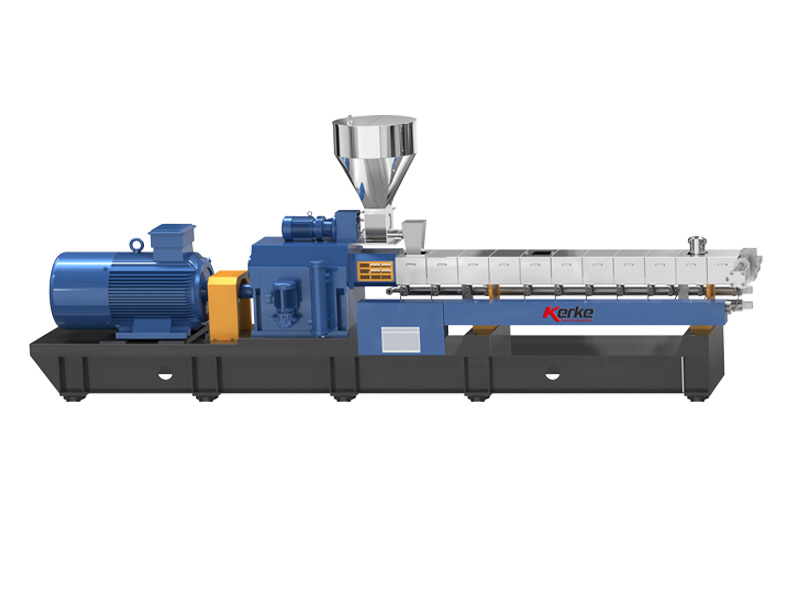
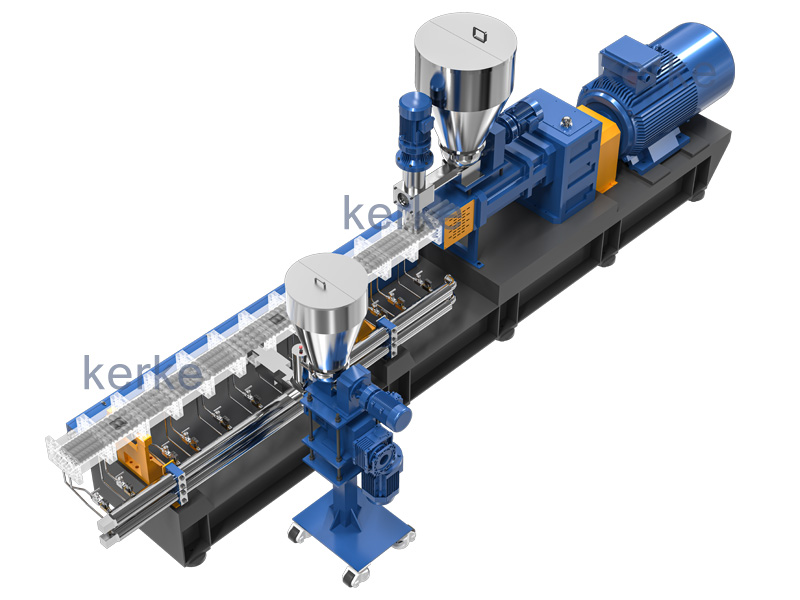
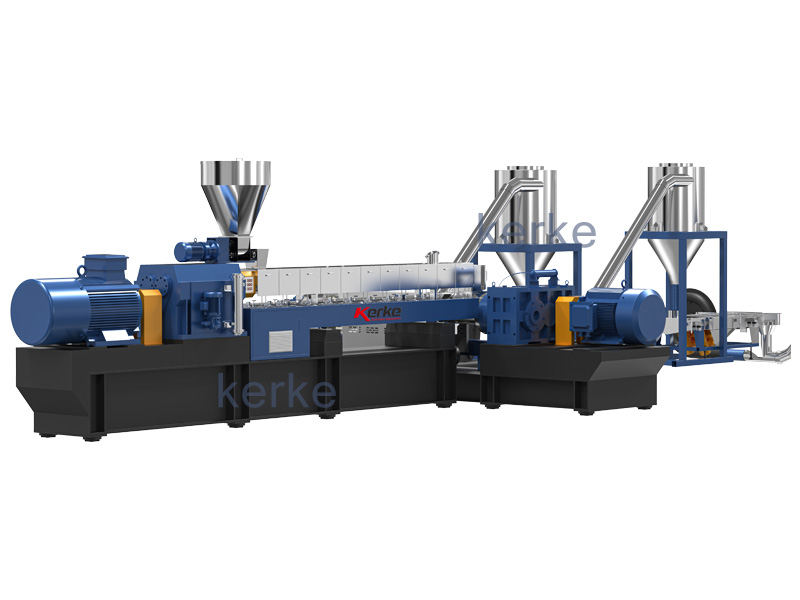
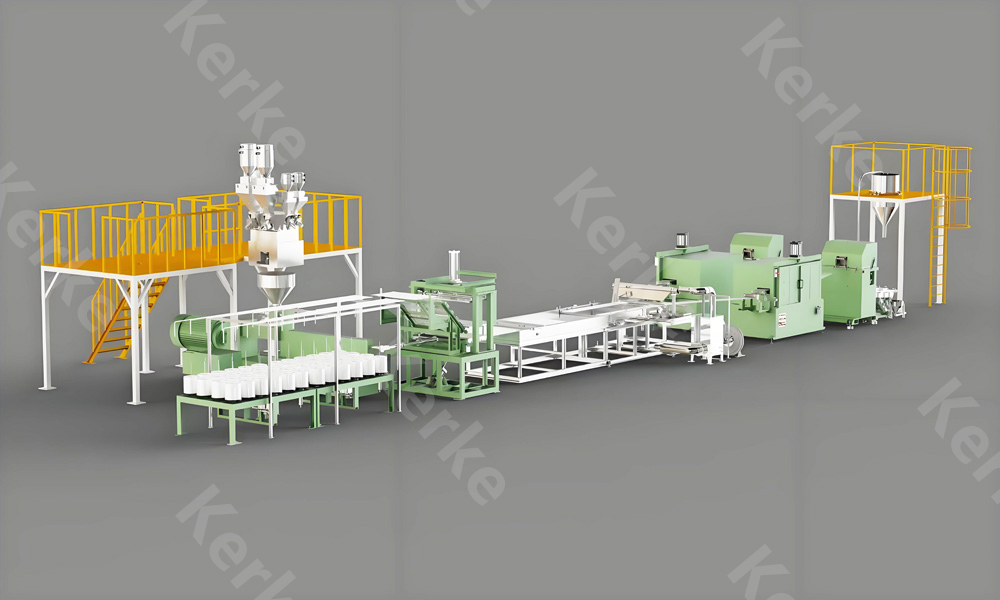
As a core equipment in polymer processing, the twin-screw extruder is widely used in plastic modification, profile extrusion, composite material preparation and other fields. The die head, as a key component for material molding and output, its discharge status directly determines the product quality and production efficiency. In actual production, unsmooth discharge or blockage at the die head is a common fault, which not only causes production interruption, but also may lead to secondary problems such as material carbonization and equipment wear. This article will systematically analyze the core causes of this fault and propose corresponding troubleshooting and solutions to provide reference for on-site fault handling.
I. Analysis of Core Causes of Fault
The essence of unsmooth discharge or blockage at the die head of the twin-screw extruder is “the flow resistance of materials in the die head area is greater than the extrusion thrust”. The causes can be divided into four categories: material characteristics, equipment status, process parameters, and operating specifications. The details are as follows:
(I) Material Characteristics Do Not Meet Processing Requirements
Materials are the foundation of extrusion processing, and their physical and chemical properties directly affect the flow state of materials in the barrel and die head. Common problems include:
- Excessively high moisture content of raw materials: If hygroscopic polymers (such as PA, PET, PC, etc.) are not fully dried, the moisture in the materials will rapidly vaporize in the high-temperature environment of the barrel, forming a large amount of water vapor. These water vapors cannot be discharged in time due to the sudden pressure rise in the die head area, which will hinder the material flow. At the same time, it will cause bubbles inside the materials, and in severe cases, the materials will adhere and block at the die head opening.
- Excessive impurities or uneven particle size of raw materials: Impurities such as metal debris, sand and gravel, and unplasticized hard lumps mixed in the raw materials will accumulate at the filter screen and narrow flow channels of the die head, gradually forming blockages. In addition, excessive differences in raw material particle size will lead to uneven feeding, and local materials will form hard lumps due to insufficient plasticization, which will block the flow channels when flowing to the die head with the materials.
- Unreasonable raw material formula: If the addition amount of fillers (such as calcium carbonate, talc powder) in the raw materials is excessive, or the content of lubricants is insufficient, the fluidity of the materials will drop sharply, and the frictional resistance in the die head flow channel will increase, making it impossible to extrude smoothly. At the same time, poor compatibility and uneven mixing of different raw materials will also lead to local insufficient plasticization, forming potential blockage hazards.
(II) Wear or Structural Abnormality of Equipment Components
The die head and related components of the twin-screw extruder are in a high-temperature, high-pressure and high-friction environment for a long time, which are prone to wear or structural deformation, leading to blockage of the discharge channel. Specific problems include:
- Wear or adhesion of die head flow channel: The inner wall of the die head flow channel is worn due to long-term contact with high-temperature materials, and the surface roughness increases, which increases the material flow resistance. At the same time, if the residual materials are not cleaned in time after production, they will carbonize and adhere to the flow channel, and the new materials cannot pass smoothly in the subsequent production, forming blockages.
- Blockage of filter screen or porous plate: The filter screen and porous plate are key components for filtering raw material impurities. If they are not replaced regularly, impurities will gradually accumulate on the surface of the filter screen, resulting in reduced material passage area and increased pressure, and finally unsmooth discharge. In addition, selecting an excessively large mesh size (excessively high filtration precision) for the filter screen will also lead to excessive material passage resistance and cause blockage.
- Wear of screw elements or barrel: The conveying elements and kneading elements of the twin-screw will wear after long-term use, which will lead to a decrease in material conveying efficiency and insufficient extrusion thrust at the die head. After the inner wall of the barrel is worn, the friction coefficient between the material and the barrel decreases, the plasticization efficiency decreases, and the insufficiently plasticized materials will accumulate and block at the die head.
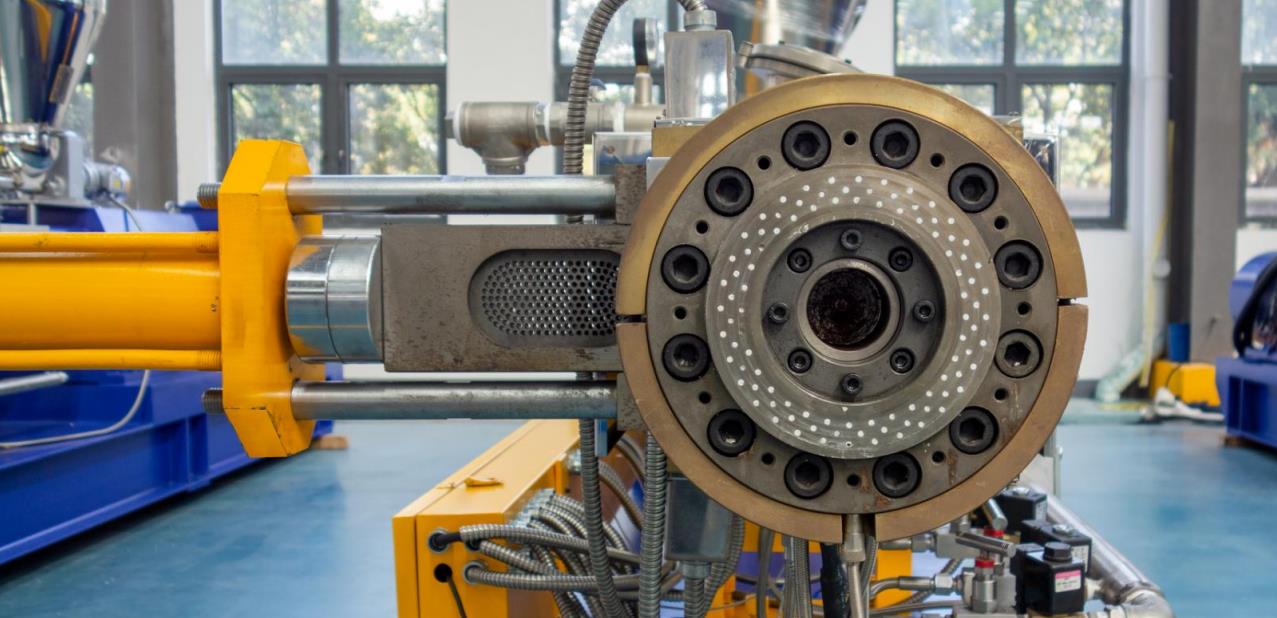
- Abnormal die structure: The die is the final component for material molding. If the die flow channel design is unreasonable (such as no transition arc at the corner, sudden change in flow channel section), it will cause local eddy current and accumulation of materials. In addition, die wear, deformation, or carbonized materials adhering to the surface will also hinder material extrusion.
(III) Unreasonable Setting of Process Parameters
Extrusion process parameters directly determine the plasticization state and flow characteristics of materials. Improper parameter setting is one of the main causes of die head discharge problems. Specific include:
- Mismatched temperature parameters: First, the temperature of the die head and adjacent barrel is too low, the materials are not fully plasticized, the fluidity is poor, and they accumulate and block in the die head flow channel. Second, the temperature is too high, the materials undergo thermal degradation and carbonization, adhere to the inner wall of the die head and the die, and hinder discharge. Third, the temperature gradient setting is unreasonable, and the temperature of the materials in the die head area rises and falls sharply, leading to excessive fluctuations in fluidity and unsmooth discharge.
- Mismatch between screw speed and feeding speed: If the feeding speed is too fast and the screw speed is too low, it will lead to excessive accumulation of materials in the barrel, exceeding the conveying capacity of the screw. The materials cannot be discharged in time, and finally block at the die head. On the contrary, if the feeding speed is too slow, the amount of materials conveyed by the screw is insufficient, and the pressure at the die head is too low, resulting in small and uneven discharge.
- Abnormal setting of die head pressure: If the die head pressure is adjusted too high, the material flow resistance increases, exceeding the extrusion thrust of the screw, which will lead to unsmooth discharge. If the pressure is adjusted too low, the molding pressure of the materials in the die head is insufficient, which not only affects the product molding quality, but also may cause local accumulation due to too fast material flow (especially at the complex flow channel of the die).
(IV) Inadequate Implementation of Operation and Maintenance Specifications
The standardization of on-site operation and daily maintenance directly affects the equipment operation state. Improper operation is likely to cause die head discharge problems. Specific include:
- Inadequate preparation before startup: Before startup, the die head flow channel, filter screen and die are not thoroughly cleaned. The residual old materials are mixed with new materials, forming blockages due to poor compatibility or insufficient plasticization. At the same time, the drying state and particle size uniformity of the raw materials are not checked, and they are directly put into production, laying hidden dangers for faults.
- Inadequate monitoring during production: During production, key parameters such as die head pressure, discharge state and temperature curve are not paid attention to in real time. When the parameters fluctuate slightly, they are not adjusted in time, leading to the gradual expansion of the problem and finally causing blockage. In addition, impurities are not cleaned in time during the raw material conveying process, leading to impurities entering the die head.
- Inadequate equipment maintenance: Screw elements, barrels, die head flow channels and other components are not regularly inspected and maintained, and worn components are not replaced in time. The filter screen is not replaced according to the specified cycle, resulting in long-term accumulation of impurities. Improper maintenance of the cooling system leads to reduced temperature control precision of the die head, affecting the material flow characteristics.
II. Targeted Solutions
In view of the above fault causes, we should follow the principle of “first troubleshooting simple factors, then handling complex problems”, and solve them step by step from four aspects: operation adjustment, parameter optimization, equipment maintenance and raw material control. The specific measures are as follows:
(I) Raw Material Control: Ensure Raw Materials Meet Processing Requirements
- Strictly control the moisture content of raw materials: Formulate reasonable drying processes according to the characteristics of raw materials. For example, PA6 raw materials need to be dried at 100-120℃ for 4-6 hours, and PET raw materials need to be dried at 160-180℃ for 6-8 hours to ensure the moisture content of raw materials is less than 0.05%. Seal and store in time after drying to avoid reabsorbing moisture.
- Strengthen raw material screening and mixing: Before putting raw materials into use, remove impurities and metal debris through vibrating screens, magnetic separators and other equipment. For raw materials with uneven particle size, perform pre-mixing or sieving treatment to ensure uniform particle size. Optimize the raw material formula, reasonably control the addition amount of fillers (generally not exceeding 50%), and appropriately increase lubricants (such as zinc stearate, EBS) to improve material fluidity.
- Verify raw material compatibility: For mixed processing raw materials, conduct small-batch tests first to verify their compatibility, avoiding insufficient plasticization due to poor compatibility.
(II) Operation Adjustment: Standardize Operation Processes and Timely Troubleshoot Hidden Dangers
- Improve pre-startup preparation work: Thoroughly clean the die head flow channel, filter screen and die before startup, which can be done by high-temperature melting cleaning or mechanical cleaning to ensure no residual materials. Check the drying state and particle size uniformity of raw materials to confirm they meet processing requirements. Check whether the die head pressure sensor and temperature sensor work normally.
- Optimize production process monitoring: Pay real-time attention to the die head pressure curve. If the pressure continues to rise (exceeding 10% of the normal range), timely reduce the feeding speed or increase the screw speed. If the pressure still does not drop, stop the machine to check the filter screen and flow channel. Observe the discharge state. If problems such as uneven discharge, strip breakage and rough surface occur, adjust the die head temperature and pressure in time. Regularly clean the raw material conveying pipeline to avoid impurity accumulation.
- Standardize shutdown and cleaning procedures: After production, first turn off the feeding device. After the materials in the barrel are basically discharged, reduce the screw speed and die head temperature, then disassemble the die head, filter screen and die, and thoroughly clean the residual materials to avoid carbonization and adhesion of materials. After cleaning, assemble the components according to the regulations to prepare for the next production.
(III) Process Optimization: Adjust Parameters to Ensure Stable Plasticization and Flow of Materials
- Optimize temperature parameters: Adjust the temperature of the die head and adjacent barrel according to the characteristics of raw materials to ensure the materials are fully plasticized without thermal degradation. For example, when processing PP raw materials, the die head temperature can be set to 180-200℃; when processing PA6 raw materials, the die head temperature can be set to 230-250℃. At the same time, reasonably set the temperature gradient (the temperature difference between adjacent areas does not exceed 20℃) to avoid sudden temperature changes of materials in the die head area.
- Match screw speed and feeding speed: Determine the appropriate ratio of screw speed to feeding speed according to the equipment model and raw material characteristics. Generally, when the screw speed increases, the feeding speed can be appropriately increased to ensure the reasonable residence time of materials in the barrel (usually 2-5 minutes), which not only ensures full plasticization, but also avoids accumulation. If unsmooth discharge occurs, first reduce the feeding speed, observe the pressure change, and then gradually adjust the screw speed.
- Reasonably adjust the die head pressure: Control the die head pressure within a reasonable range (generally 10-30MPa) according to the product molding requirements. If the pressure is too high, appropriately increase the die discharge section or reduce the feeding speed; if the pressure is too low, appropriately reduce the die discharge section or increase the feeding speed to ensure stable flow of materials in the die head.
(IV) Equipment Maintenance: Regular Overhaul to Ensure Normal Operation of Components
- Regularly inspect and replace vulnerable components: Inspect the filter screen and porous plate once a week, and replace them in time according to the impurity accumulation (generally replace the filter screen every 8-12 hours of production). Inspect the wear of screw elements and barrel inner wall once a month. If the wear amount exceeds 0.5mm, replace or repair in time. Inspect the wear and deformation of the die head flow channel and die once a quarter, and polish or replace the severely worn components.
- Maintain temperature and pressure control systems: Regularly calibrate temperature sensors and pressure sensors to ensure measurement accuracy. Check whether the heating coil and cooling water pipeline work normally to avoid temperature control failure due to uneven heating or poor cooling. Clean the heat dissipation channel of the temperature control system to ensure normal heat dissipation of the equipment.
- Optimize the die head structure design: For die heads with unreasonable flow channel design, modification can be carried out, such as adding transition arcs at the corners of the flow channel and optimizing the gradual change angle of the flow channel section to reduce material flow resistance. Select the appropriate mesh size of the filter screen (generally 40-120 mesh) according to the characteristics of the processed raw materials to balance the filtration effect and material passability.
III. Preventive Measures
To reduce the occurrence of unsmooth discharge or blockage at the die head of the twin-screw extruder, in addition to the above solutions, a sound preventive system should also be established:
- Establish raw material inspection standards: Inspect indicators such as moisture content, particle size and impurity content of each batch of raw materials, and prohibit unqualified raw materials from being put into production.
- Formulate standardized operating procedures: Clarify the operating specifications for pre-startup preparation, production process monitoring and shutdown cleaning, and conduct professional training for operators to ensure standardized implementation.
- Establish a regular equipment maintenance plan: Formulate daily, weekly, monthly and quarterly maintenance plans according to the equipment operation time to timely discover and handle component wear, parameter drift and other problems.
- Establish a fault account: Record the occurrence time, cause, solution and effect of each die head discharge problem, summarize experience and lessons, and continuously optimize the production process and equipment maintenance plan.
IV. Conclusion
Unsmooth discharge or blockage at the die head of the twin-screw extruder is the result of the combined action of multiple factors, with the core being “insufficient material plasticization” and “excessive flow resistance”. In actual production, comprehensive investigation should be carried out from four dimensions: raw materials, operation, process and equipment. Simple problems should be solved first by adjusting operation and process parameters, and then in-depth treatment should be carried out for complex problems such as equipment wear and raw material formula. At the same time, establishing a sound preventive system can effectively reduce the fault occurrence rate and ensure the continuity and stability of production. Through scientific fault analysis and standardized handling processes, we can not only quickly solve the die head discharge problem, but also extend the service life of the equipment and improve product quality and production efficiency.