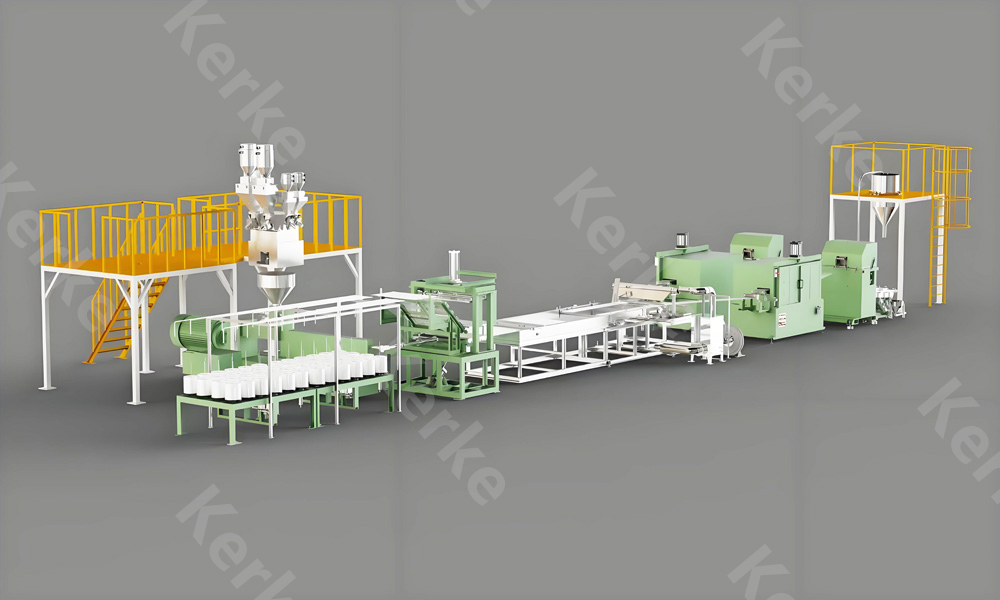
In fields such as plastic modification, masterbatch production, and polymer material processing, twin screw extruders have become core production equipment due to their excellent mixing effect, stable output, and wide applicability. As an enterprise with years of experience in the plastic machinery industry, Wanplas’ subsidiary Kerke Factory (official website: www.kerkeextruder.com) focuses on providing cost-effective twin screw extruders and one-stop solutions. Its products cover the entire scenario from experimental research and development to large-scale production, and cooperate with full-cycle service guarantees to create “efficiency empowerment” production advantages for global customers. This article will comprehensively analyze the core value of Wanplas-Kerke twin screw extruders from dimensions such as basic understanding, application fields, product selection, and service guarantees.
I. Basic Understanding: Core Definition and Working Principle of Kerke Twin Screw Extruders
1.1 Core Definition and Core Advantages
A Twin Screw Extruder (TSE) is a key equipment that completes material feeding, conveying, compressing, melting, mixing, degassing, pressure building, and extrusion molding through the coordinated rotation of two screws. Compared with single screw extruders, Kerke twin screw extruders have three core advantages: first, more uniform mixing effect, which can achieve precise dispersion and blending of various materials, especially suitable for the production of high-fill and high-demand modified materials; second, strong self-cleaning ability, the screws can scrape each other during rotation, reducing material residue and lowering the risk of degradation of heat-sensitive materials; third, stable output and wide adaptability, which can flexibly adjust parameters according to process requirements to adapt to material processing needs in different industries. As a high-tech enterprise, Kerke’s twin screw extruders have passed authoritative certifications such as SGS and TÜV Rheinland, and the quality and processing accuracy of core components are fully guaranteed.
1.2 Working Principle and Core Configuration
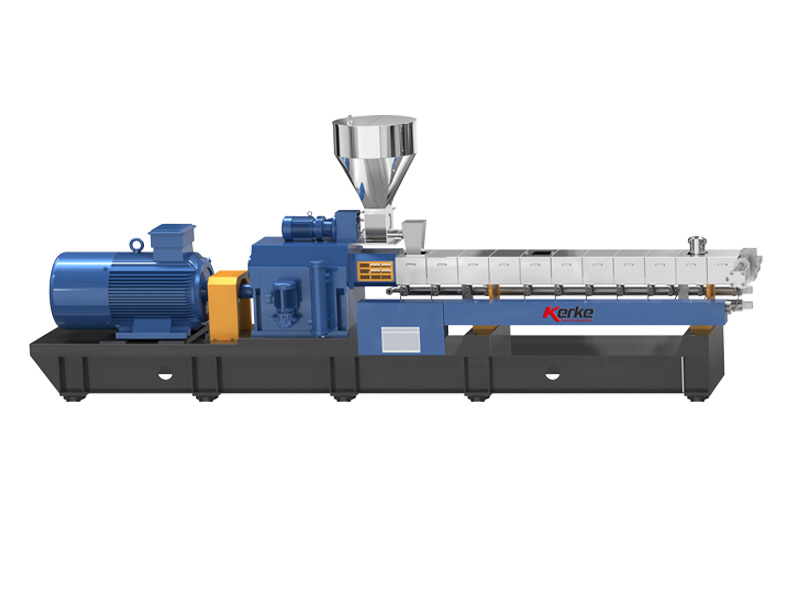
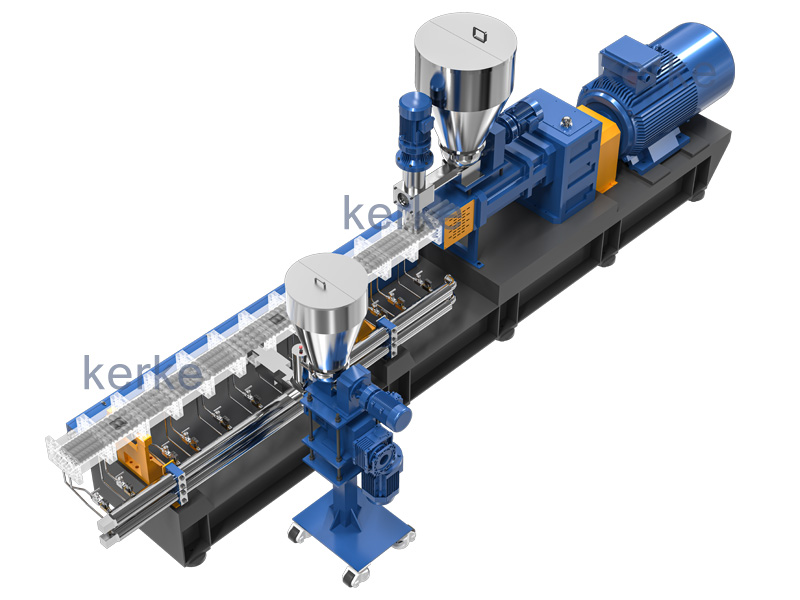
Kerke twin screw extruders adopt a co-rotating parallel configuration design. Through the combination of modular screw elements (conveying, kneading, mixing elements), the screw arrangement can be customized according to material characteristics and process requirements to achieve multi-functional and multi-purpose polymer material processing. Its working process follows the core logic of “feeding – melting – mixing – degassing – extrusion”: precise feeding is achieved through a volumetric metering feeding system, materials are melted in the barrel through heating and screw shearing, fully mixed by kneading elements, moisture or volatiles are removed through the degassing port, and finally formed into granules or specific profiles at the die head.
Compared with the co-rotating parallel configuration, Kerke can also provide customized solutions according to customer needs. Its mainstream co-rotating parallel design, relying on higher shearing efficiency and output advantages, is widely used in core scenarios such as plastic modification and masterbatch production. At the same time, the equipment adopts a Siemens PLC touch screen control system, which is easy and intuitive to operate, greatly improving the reliability and stability of system operation and reducing the learning cost of operators.
II. Application Fields: Full-Scenario Processing Solutions
Relying on a diversified product series, Kerke twin screw extruders fully cover multiple industries such as plastics, food, and pharmaceuticals, and can provide suitable equipment from laboratory research and development to industrial large-scale production. The specific application scenarios are as follows:
2.1 Core Application Industries
- Plastic and Polymer Processing Industry: This is the core application field of Kerke twin screw extruders, which can realize reinforcement modification (such as adding fillers like calcium carbonate, talc powder, titanium dioxide), functional modification (flame retardant, antistatic, antibacterial) of basic plastics such as PE, PP, EVA, as well as polymer alloying and plastic recycling granulation processes. Among them, the KTE series co-rotating parallel twin screw extruder unit is the main model in this field, with stable output and excellent mixing effect.
- Masterbatch Production Industry: To meet the production needs of color masterbatches, filler masterbatches, functional masterbatches, etc., Kerke has launched the KTE-T series co-rotating parallel triple screw mixing extruder unit, which has better dispersion and mixing effect than traditional twin screw extruders, can produce high-concentration color masterbatch materials, simplify production processes and reduce costs.
- Scientific Research and Laboratory Fields: The KTE series laboratory twin screw extruder is specially designed for formula development and small-batch trial production. It is suitable for scientific research institutes, university laboratories and enterprise R&D centers, and can complete formula extrusion granulation experiments of various new materials, providing data support for subsequent large-scale production.
- Other Segmented Industries: Relying on flexible process adaptability, the equipment can also be expanded to food and pharmaceutical fields, such as food raw material puffing and pharmaceutical granule preparation, to meet the compliance and processing requirements of different industries.
2.2 Typical Application Cases
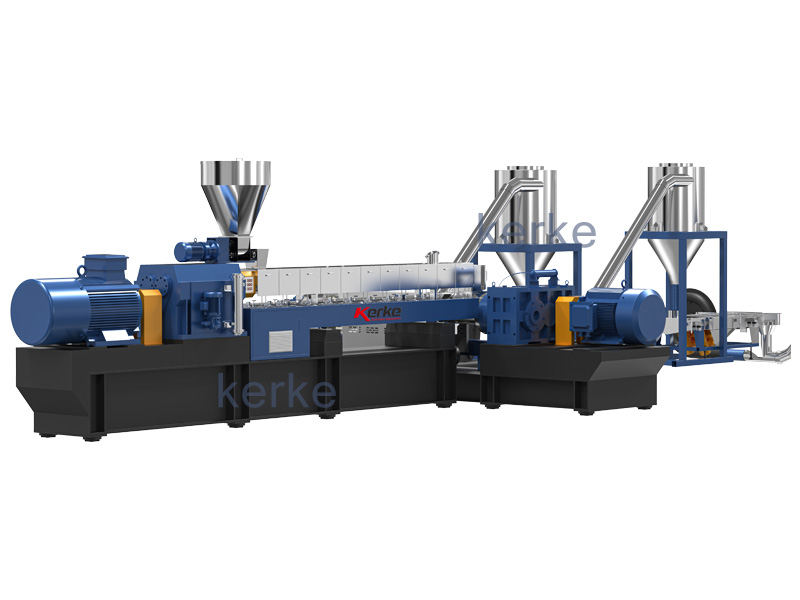
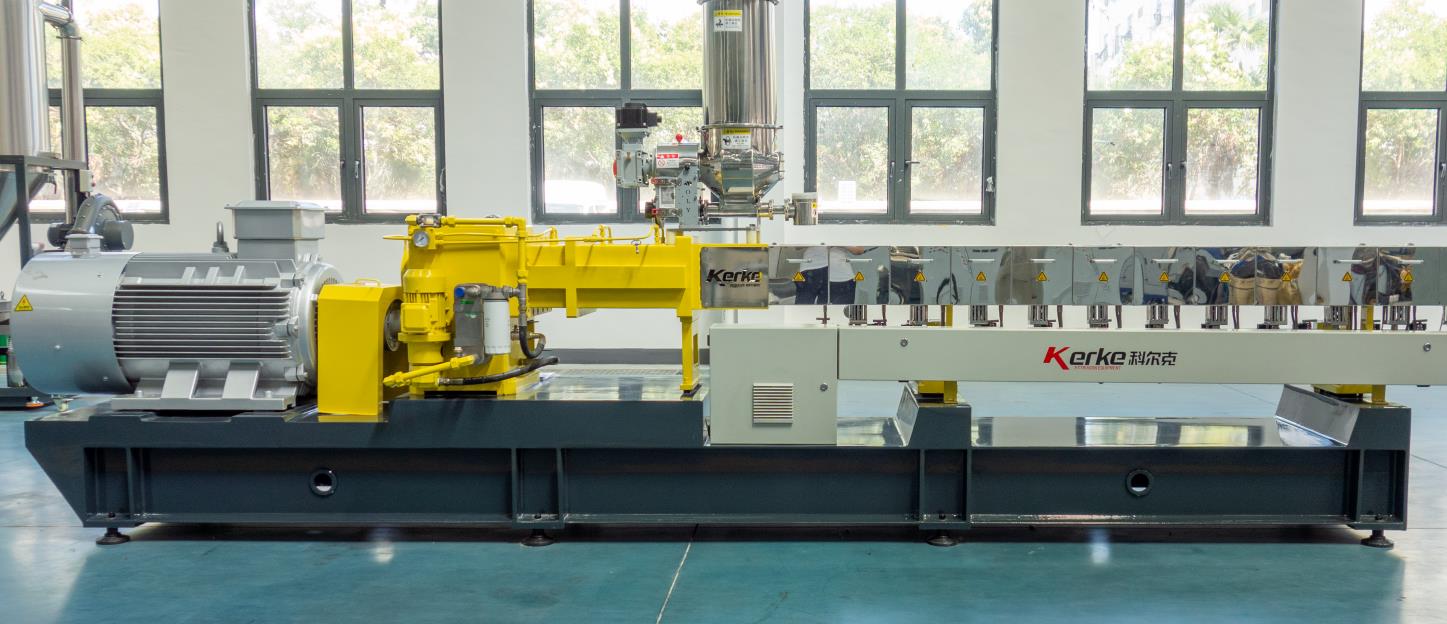
Taking the Kerke KTE-65B twin screw extruder as an example, it adopts air-cooled die-face granulation technology. The material does not come into contact with water throughout the process, avoiding secondary pollution of cooling water, and the granules are round and full. It is mainly used for reinforcement modification and granulation of moisture-sensitive materials, with a typical output of 200~500 kg/h, making it the preferred model for small and medium-sized plastic modification enterprises. The KTE/SE series twin-stage (twin screw + single screw) composite mixing extruder unit is suitable for deep mixing and large-scale production of high-difficulty materials, further improving output and product stability.
III. Product Selection: Kerke Core Series and Key Selection Guidelines
Selecting a suitable twin screw extruder needs to consider core factors such as output requirements, material characteristics, and process requirements. Relying on a rich product matrix, Kerke provides full-specification equipment from laboratory type to industrial production. At the same time, Wanplas provides professional pre-sales selection guidance to help customers accurately match their needs.
3.1 Kerke Core Product Series
| Product Series | Core Type | Key Parameters (Examples) | Core Applications |
| Laboratory Twin Screw Extruder (KTE Series) | Co-rotating Parallel Twin Screw | Optional screw diameter, easy operation, suitable for small-batch experiments | Formula development, laboratory trial production, scientific research and development |
| Industrial Co-rotating Parallel Twin Screw Extruder Unit (KTE Series) | Co-rotating Parallel Twin Screw | KTE-65B: Screw diameter 62.4mm, L/D ratio 36~68, speed 600rpm, power 75/110kW, output 200~500kg/h; KTE-75B: Suitable for higher output requirements | Plastic modification, masterbatch production, large-scale granulation |
| Triple Screw Mixing Extruder Unit (KTE-T Series) | Co-rotating Parallel Triple Screw | Excellent dispersion, high output, simplified production process | Production of high-concentration color masterbatches and high-performance polymer alloys |
| Twin-Stage Composite Mixing Extruder Unit (KTE/SE Series) | Twin Screw + Single Screw Composite | Deep mixing, stable output, suitable for complex materials | High-difficulty modified materials, recycled plastic granulation |
3.2 Key Selection Criteria
- Output and Specifications: Select the screw diameter and L/D ratio according to the production scale. Choose laboratory-type units for small-scale R&D, and industrial-type models such as KTE-65B and KTE-75B for medium and large-scale production. The L/D ratio of 36~68 can flexibly adapt to the residence time requirements of different materials.
- Material Characteristics: For heat-sensitive materials, priority should be given to the self-cleaning ability and temperature control accuracy of the equipment; for high-fill materials, attention should be paid to screw torque and shearing efficiency; for moisture-sensitive materials, air-cooled die-face granulation models (such as KTE-65B) can be selected to avoid moisture affecting product quality.
- Automation and Control Requirements: All Kerke series are equipped with Siemens PLC control systems as standard, which can meet basic automation needs; if there are higher-precision parameter control or data traceability requirements, Wanplas can provide customized upgrading solutions.
- Cost and Budget: Kerke products have a cost-effective advantage. At the same time, Wanplas provides new equipment customization and complete after-sales guarantees. Compared with used equipment, it can greatly reduce the risk of later maintenance and downtime losses.
IV. Supplier and Service: Wanplas Full-Cycle Guarantee System
The core of selecting extrusion equipment lies not only in product quality but also in full-cycle service guarantees. With years of industry experience, Wanplas has built a full-process service system covering pre-sales, in-sales, and after-sales. Cooperating with the high-quality production capacity of Kerke Factory, it provides customers with an integrated solution of “equipment + service”.
4.1 Core Supplier Advantages
As the core production factory under Wanplas, Kerke has a complete R&D, production, and testing system, owns a number of innovative inventions, is a high-tech enterprise, and its products have passed international authoritative certifications with reliable quality. Its sales network covers major cities in Greater China and is exported to the world, enabling quick response to customer needs in different regions. At the same time, Wanplas displays products through multiple platforms such as official website, Facebook, Twitter, and YouTube, and actively participates in international exhibitions, providing customers with multiple online and offline communication and understanding channels. Customers can also be invited to visit the factory to intuitively understand the production process and product quality.
4.2 Full-Cycle Service Guarantee
Pre-sales Service: Precise Adaptation and Professional Guidance
Wanplas’ pre-sales team will provide one-on-one product selection guidance according to the customer’s industry field, material characteristics, output requirements, etc., detailedly interpret the parameters and adaptation scenarios of each Kerke series model, and help customers fully understand product details. At the same time, it provides free process consultation to provide reference for customers to optimize production plans.
In-sales Service: Strict Quality Control and Efficient Delivery
After the customer places an order, Kerke Factory will complete the equipment production in strict accordance with the requirements, and conduct a 30-minute trial operation test on each product to ensure that the equipment performance meets the standards before delivery. For equipment installation, Wanplas will send professional engineers to assist on-site. For simple equipment, detailed documents or video guidance can be provided to ensure an efficient and smooth installation process. The equipment is packaged in wood, shipped from Shanghai Port, and supports multiple payment methods such as L/C, Western Union, and T/T, adapting to the transaction needs of global customers.
After-sales Service: Comprehensive Guarantee and Worry-Free Production
Wanplas’ after-sales service is one of its core competencies. The specific guarantees include: core components enjoy a 1-year warranty, and damaged components are replaced free of charge during the warranty period; 500 US dollars of free accessories are provided every year; if the equipment is damaged during transportation, replacement components are sent free of charge; if the customer finds that the quality does not meet the standards during on-site inspection, a full refund and 10% of the equipment price as compensation will be provided; if the equipment delivery is delayed, 100 US dollars will be compensated per day; if the actual output of the equipment does not meet the promised standard, 2,000~10,000 US dollars will be compensated according to the gap ratio. In addition, Wanplas also provides overseas engineer on-site services to ensure quick response to equipment failures and minimize customer downtime losses.
V. Operation, Maintenance and Troubleshooting
5.1 Basic Operation Specifications
Kerke twin screw extruders are easy to operate, and parameter setting and operation control can be completed relying on the Siemens PLC touch screen. The basic operation process includes: checking the status of equipment components (screws, barrels, feeding systems, heating systems) before starting up, starting heating after confirmation, starting screw rotation after the temperature reaches the set value, gradually adjusting the speed to the set value, and then starting the feeding system; real-time monitoring of temperature, pressure, speed and other parameters during production; before shutting down, stop feeding first, reduce the speed and turn off the heating after the materials in the barrel are emptied, and finally cut off the power supply. Wanplas will provide detailed operation manuals and video guidance, and can carry out on-site operation training to ensure that operators quickly master the skills.
5.2 Daily Maintenance Points
The core of daily maintenance is to extend the service life of the equipment and ensure stable operation. The key points include: regularly checking the wear of vulnerable parts such as screws and barrels, and replacing them in time; keeping the equipment clean, especially the feeding system and degassing port, to avoid material residue; regularly lubricating and maintaining core components such as gearboxes and motors; checking whether the electrical system connections are firm to ensure the normal operation of the control system. Wanplas’ after-sales team will formulate a regular maintenance plan for customers and provide relevant training to help customers master basic maintenance skills.
5.3 Common Faults and Solutions
- Unstable Extrusion Output: Possible causes include uneven feeding, fluctuating screw speed, and fluctuating material characteristics. Solutions: Check whether the feeding system is normal to ensure accurate metering; confirm that the screw speed parameters are stable; detect material characteristics such as humidity and particle size, and perform drying treatment if necessary.
- Material Degradation/Discoloration: Mostly caused by excessive heating temperature or too long material residence time. Solutions: Reduce the heating temperature of the corresponding section; adjust the screw speed or L/D ratio to shorten the material residence time; check whether the self-cleaning function of the equipment is normal.
- Excessively High Torque: It may be due to material overload, screw jamming, or insufficient material melting caused by low temperature. Solutions: Reduce the feeding speed; shut down the machine to check whether there is foreign matter jamming the screw; increase the heating temperature to ensure sufficient melting of materials.
- Extrudate Quality Defects (Bubbles, Black Spots): Bubbles are mostly due to moisture or volatiles in the material, which require enhanced material drying or improved degassing effect; black spots are mostly due to material impurities or equipment residue, which require cleaning the equipment and strictly controlling material purity.
If complex faults occur, customers can directly contact Wanplas’ after-sales team, and overseas engineers will respond in a timely manner to provide remote guidance or on-site maintenance services.
VI. Core Value of Wanplas-Kerke Twin Screw Extruders
Wanplas’ Kerke twin screw extruders, with the product advantages of “high efficiency, reliability, and wide adaptability”, combined with the “full-cycle and all-round” service guarantees, provide global customers with one-stop extrusion solutions from laboratory research and development to large-scale production. Its products cover a variety of core models, adapting to multiple industries such as plastic modification and masterbatch production. Relying on technical highlights such as Siemens control system and modular screw design, it achieves stable production and efficient processing; Wanplas’ pre-sales precise selection, in-sales strict quality control, and after-sales comprehensive guarantees completely solve customers’ worries.
Whether it is the cost control needs of small and medium-sized enterprises, the large-scale production needs of large enterprises, or the R&D needs of scientific research institutions, Wanplas-Kerke twin screw extruders can provide suitable solutions, truly realizing the brand concept of “Our efficiency, Your edge”, and helping customers build core advantages in the fierce market competition.