In the global adhesive industry, EVA hot melt adhesive has become a cornerstone material for countless manufacturing sectors, thanks to its eco-friendliness, fast curing speed, high viscosity, and versatile bonding capabilities. As a solvent-free, solid polymer adhesive that meets food-grade standards, it plays a crucial role in food packaging, furniture edge banding, footwear bonding, electronics assembly, and automotive interior manufacturing. This comprehensive guide will break down everything you need to know about EVA hot melt adhesive—from its basic definition and core characteristics to types, key applications, formulations, extruder selection, production processes, market prices, and trusted manufacturers. Whether you’re a procurement manager looking for high-quality EVA hot melt adhesive manufacturers, a production engineer optimizing processes, or a business owner seeking cost-effective bonding solutions, this article will help you leverage EVA hot melt adhesive to enhance product quality and reduce costs.

I. What Is EVA Hot Melt Adhesive? Definition & Core Composition
EVA hot melt adhesive is a 100% solid, solvent-free thermoplastic adhesive, widely recognized as the preferred general-purpose hot melt glue in many industries. It is primarily composed of Ethylene-Vinyl Acetate (EVA) copolymer as the base resin, combined with tackifiers, plasticizers, antioxidants, and fillers. At room temperature, it exists as a solid; when heated to a specific temperature (typically 130-180℃), it melts into a flowable liquid with strong adhesion. Once cooled below its melting point, it rapidly solidifies to form a durable bond—making it ideal for high-speed production lines.
The key component determining its performance is the Vinyl Acetate (VA) content in the EVA resin. Generally, VA content ranges from 5% to 45%: lower VA content (5%-15%) enhances rigidity and heat resistance, suitable for furniture edge banding EVA hot melt adhesive; while higher VA content (20%-40%) improves flexibility, adhesion, and transparency, perfect for food packaging EVA hot melt adhesive or flexible material bonding. This adjustability makes EVA hot melt adhesive adaptable to diverse bonding requirements across industries.
II. Core Characteristics of EVA Hot Melt Adhesive: Why It’s Widely Used
1. Solvent-Free & Eco-Friendly (Meets Food-Grade Standards)
Unlike solvent-based adhesives, EVA hot melt adhesive contains no volatile organic compounds (VOCs) or harmful solvents. It emits no toxic fumes during processing and meets global environmental standards such as RoHS and FDA requirements for food-grade EVA hot melt adhesive. This makes it ideal for industries with strict eco-requirements, including food packaging, children’s toy manufacturing, and medical device assembly.
2. Fast Curing & High Efficiency (Suitable for High-Speed Lines)
One of its most notable advantages is rapid curing. After application, it solidifies within seconds to minutes, depending on the formulation and environmental conditions. This allows for high-speed production lines—such as automatic carton sealing, bookbinding, and furniture edge banding machines—to operate efficiently, significantly boosting productivity for manufacturers.
3. Versatile Bonding Performance (High Viscosity for Multiple Substrates)
As a high-viscosity EVA hot melt adhesive, it exhibits excellent adhesion to a wide range of substrates, including paper, cardboard, plastic (PE/PP), wood, fabric, and metal. Whether bonding porous materials (like paper) or non-porous surfaces (like plastic films), EVA hot melt adhesive creates a strong, flexible bond that resists peeling and cracking—suitable for both general and special-purpose bonding needs.
4. Good Thermal Stability & Weather Resistance
High-quality EVA hot melt adhesive maintains stable performance within a temperature range of -40℃ to 80℃. It resists aging, oxidation, and moisture, ensuring long-term bond reliability even in harsh environments—from cold storage facilities (for cold-storage packaging EVA glue) to outdoor automotive applications.
5. Reworkable & Cost-Effective
If bonding errors occur, the adhesive can be reheated and repositioned. Additionally, its solid form simplifies storage and transportation (no risk of leakage), and its high bonding efficiency reduces material waste—lowering overall production costs for businesses sourcing from EVA hot melt adhesive suppliers.
III. Common Types of EVA Hot Melt Adhesive (By Application & VA Content)
EVA hot melt adhesives are classified based on VA content, application, and performance requirements. Below are the most widely used types searched by customers:
1. Low VA Content Type (VA 5%-15%) – Furniture Edge Banding Grade
Characterized by high rigidity and heat resistance, this type is known as furniture edge banding EVA hot melt adhesive. It is suitable for bonding materials that require structural stability, such as rigid packaging, woodworking (furniture edge banding, panel bonding), and electronic component fixing. It has a higher melting point (160-180℃) and excellent dimensional stability—key for furniture manufacturing.
2. Medium VA Content Type (VA 20%-28%) – General-Purpose High Viscosity Grade
This is the most versatile type, balancing flexibility, adhesion, and processability. As a general-purpose high viscosity EVA hot melt adhesive, it has a moderate melting point (140-160℃) and is widely used in general packaging (carton sealing, label bonding), footwear (sole-to-upper bonding), and textile lamination. Most mainstream EVA hot melt adhesives fall into this category, including the popular UE639 grade with 28% VA content—one of the best-selling products for EVA hot melt adhesive manufacturers.
3. High VA Content Type (VA 30%-40%) – Food-Grade & Cold-Resistant Grade
Offering superior flexibility and low-temperature adhesion, this type is ideal as food-grade EVA hot melt adhesive and cold-storage packaging EVA glue. It performs well on difficult-to-bond substrates like polyethylene (PE) and polypropylene (PP), making it suitable for cold-storage packaging, flexible film lamination (for food packaging), and automotive interior bonding. It has a lower melting point (130-150℃) for easy processing.
4. Special Functional Types (Searched by Specific Needs)
- Heat-resistant EVA hot melt adhesive: Formulated with high-melting-point resins, it withstands temperatures above 100℃, suitable for automotive underhood applications and high-temperature packaging.
- Low-temperature curing EVA glue: Cures at 100-120℃, ideal for heat-sensitive materials like foam, thin films, and electronic components.
- Flame-retardant EVA hot melt adhesive: Added with flame retardants, meeting UL94 standards for electronic and electrical applications (e.g., circuit board bonding).
IV. Key Applications of EVA Hot Melt Adhesive (High-Search Scenarios)
EVA hot melt adhesive’s versatility makes it indispensable across multiple high-search industries. Here are its most prominent applications:
1. Packaging Industry (Largest Application – Food Packaging & Carton Sealing)
This is the largest application sector, with food-grade EVA hot melt adhesive and carton sealing EVA glue being the most searched. It is used for carton sealing, case and tray forming, label bonding, and flexible packaging lamination. It ensures strong, tamper-proof bonds and adapts to high-speed packaging lines (up to 300 packs per minute). In food packaging, it meets FDA standards for indirect food contact—critical for food manufacturers.
2. Footwear & Textile Industry (Sole Bonding & Fabric Lamination)
It is a key material for footwear manufacturing, bonding soles (rubber, EVA foam) to uppers (leather, fabric) as footwear-specific EVA hot melt adhesive. Its flexibility accommodates foot movement, while its water resistance ensures durability in wet conditions. In textiles, it is used for fabric lamination (e.g., sportswear insulation) and hem bonding.
3. Woodworking & Furniture (Edge Banding & Assembly)
Furniture edge banding EVA hot melt adhesive is widely used for edge banding, panel bonding, and furniture assembly. It bonds wood to wood, wood to plastic, and wood to metal without causing wood warping (no moisture absorption). It cures quickly, reducing production cycle times for furniture manufacturers— a top concern for woodworking businesses searching for EVA glue suppliers.
4. Electronics & Electricals (Component Fixing & Insulation)
In electronics, flame-retardant EVA hot melt adhesive secures components (e.g., capacitors, resistors) to circuit boards, insulates wires, and bonds battery casings. Its low VOC emission and flame-retardant variants make it suitable for consumer electronics like smartphones and laptops—key for electronic manufacturers.
5. Automotive Industry (Interior Bonding & Sealing)
It is used for bonding automotive interiors (fabric, leather to dashboards, door panels) and sealing windshields asautomotive-grade EVA hot melt adhesive. High-temperature resistant formulations ensure performance under extreme engine bay conditions— a top requirement for automotive suppliers.
6. Bookbinding & Stationery (Wireless Bookbinding)
For wireless bookbinding, EVA hot melt adhesive provides strong, durable bonds between book spines and covers. It adapts to both high-speed and small-batch bookbinding machines, with fast curing to avoid page warping—popular among printing and stationery companies.
V. Typical Formulations of EVA Hot Melt Adhesive (By Application)
EVA hot melt adhesive formulations vary by application, but the core components and their typical ratios are as follows. For customized formulations (e.g., food-grade, high-heat resistant) tailored to specific needs, or for sourcing high-quality raw materials like eva masterbatch, professional EVA hot melt adhesive manufacturers like Kerke offer personalized solutions.
1. General-Purpose Packaging Grade Formulation (High Viscosity)
- EVA resin (VA 20%-28%, MFR 100-200): 35-45 parts
- Tackifier (rosin resin or terpene resin): 40-50 parts
- Plasticizer (paraffin wax or microcrystalline wax): 10-15 parts
- Antioxidant (e.g., 1010): 0.5-1 part
- Note: Cures in 5-10 seconds, suitable for carton sealing and label bonding—ideal as general-purpose EVA hot melt adhesive.
2. Footwear Grade Formulation (Flexible & Water-Resistant)
- EVA resin (VA 25%-30%, MFR 50-100): 40-50 parts
- Tackifier (hydrogenated rosin resin): 30-40 parts
- Plasticizer (synthetic wax): 10-15 parts
- Toughener (SBS or EVA wax): 5-10 parts
- Antioxidant: 0.5-1 part
- Note: Offers excellent flexibility and bond strength to leather and rubber—specialized footwear EVA hot melt adhesive.
3. Woodworking Grade Formulation (Edge Banding Specific)
- EVA resin (VA 15%-20%, MFR 20-50): 45-55 parts
- Tackifier (phenolic resin): 30-35 parts
- Plasticizer (microcrystalline wax): 5-10 parts
- Filler (talc powder): 5-10 parts
- Antioxidant: 0.5-1 part
- Note: High heat resistance and bond strength for edge banding—standard furniture edge banding EVA hot melt adhesive.
VI. Extruder Selection for EVA Hot Melt Adhesive Production
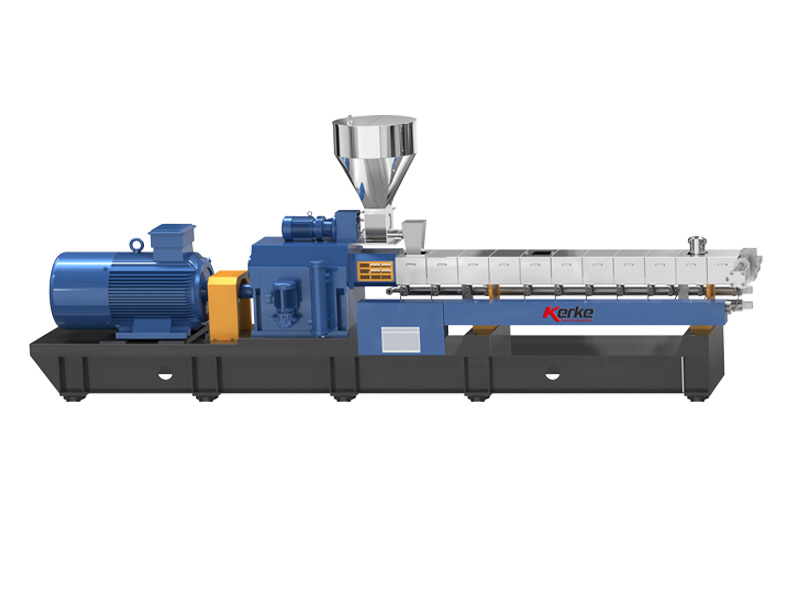
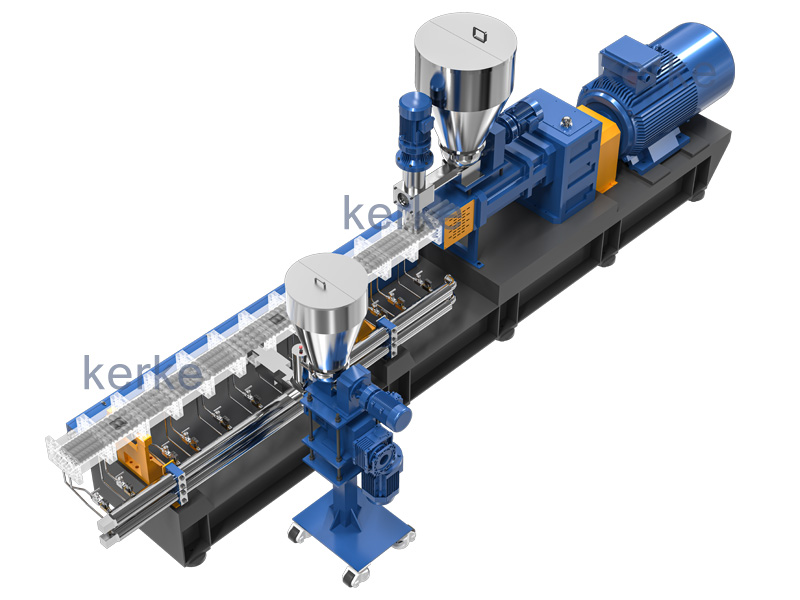
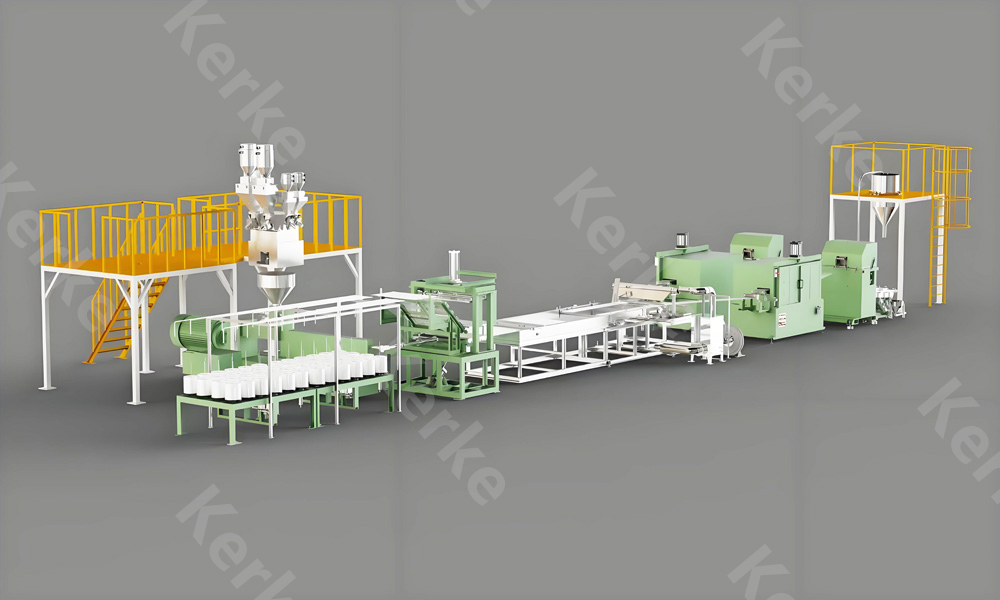
The quality of EVA hot melt adhesive depends heavily on extrusion equipment— a key concern for EVA hot melt adhesive manufacturers and large-scale users. Twin-screw extruders, especially parallel twin screw extruder models, are the industry standard, as they ensure uniform mixing, precise temperature control, and stable output.Kerke Extrusion Equipment, a renowned twin screw extruder manufacturer, specializes in machines optimized for EVA hot melt and eva masterbatch production. Below is a detailed guide to extruder selection:
1. Key Equipment Type: Twin-Screw Extruder
Parallel twin screw extruders (co-rotating type) are preferred for EVA hot melt adhesive production due to their strong shearing force and efficient mixing capabilities. As a leading twin screw extruder manufacturer, Kerke Extrusion Equipment’s parallel twin screw extruders are engineered to handle the viscous EVA resin (and eva masterbatch blends) and additive mixture effectively, ensuring all components are fully dispersed—critical for producing high-quality EVA hot melt adhesive.
2. Critical Selection Parameters
- Screw diameter: Determines production capacity. For small-batch production (20-100 kg/h), choose a 35-50 mm diameter; for large-scale production (200-500 kg/h), opt for 65-75 mm diameter (common for EVA hot melt adhesive suppliers).
- L/D ratio: A ratio of 28-40 is ideal. Longer screws (higher L/D) provide more mixing time, improving formulation uniformity.
- Temperature control: The extruder must have precise temperature zoning (accuracy ±2℃) to avoid EVA degradation (max temperature ≤200℃).
- Torque: High torque (50-60 N·m/cm³) ensures stable operation even with high-viscosity mixtures (e.g., high-viscosity EVA hot melt adhesive).
3. Auxiliary Equipment
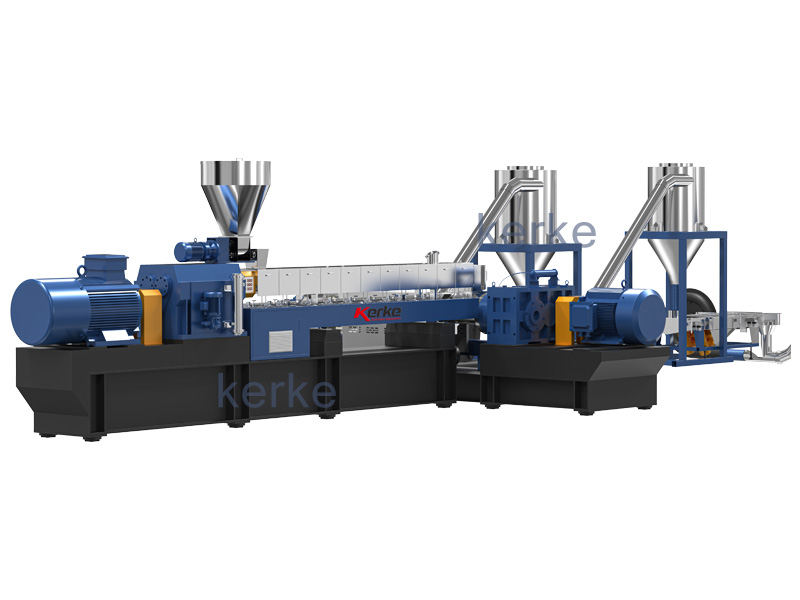
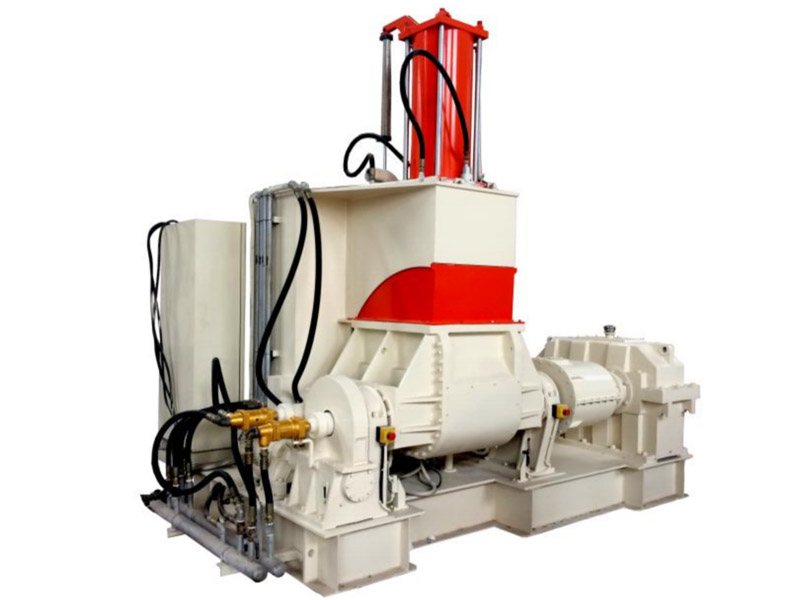
A complete production line includes: high-speed mixer (for raw material premixing, including eva masterbatch integration), forced feeder (stable material supply), parallel twin screw extruder (core mixing, supplied bytwin screw extruder manufacturerKerke Extrusion Equipment), pelletizer (air-cooled for EVA to avoid moisture absorption), and quality control system (viscosity and melting point testing)—essential for reliable EVA hot melt adhesive manufacturers.
VII. Production Process of EVA Hot Melt Adhesive
The production process of EVA hot melt adhesive involves six key steps, with strict control over temperature and mixing to ensure product consistency— a top priority for businesses choosing EVA hot melt adhesive suppliers:
1. Raw Material Preparation & Inspection
Select high-purity EVA resin (preferably derived from premiumeva masterbatch for consistent performance), tackifiers, plasticizers, and antioxidants. Conduct pre-inspection to ensure VA content, melt flow rate (MFR), and purity meet formulation requirements (critical for food-grade EVA hot melt adhesive). Dry EVA resin at 80-100℃ for 2-3 hours to remove moisture, which prevents bubbles in the final product.
2. Premixing
Add all raw materials to a high-speed mixer. Mix at 80-100℃ and 800-1200 rpm for 10-15 minutes. The heat generated by friction preheats the mixture, and high-speed stirring ensures initial dispersion of additives.
3. Melting & Mixing (Extrusion)
Feed the premixed material into the twin-screw extruder. The extruder’s temperature is zoned and controlled: feeding zone (100-120℃), melting zone (140-160℃), mixing zone (160-180℃), and die head (150-170℃). The screws’ shearing force fully melts and disperses the mixture, while a vacuum degassing port removes volatile impurities—key for eco-friendly EVA hot melt adhesive.
4. Pelletizing
The molten adhesive is extruded through the die head into strands. Use an underwater pelletizer for strand cutting, which produces uniform granules (2-4 mm in diameter). Underwater pelletizing offers advantages such as faster cooling, more consistent particle size, and reduced dust generation—making it well-suited for EVA hot melt adhesive production, as it avoids potential particle agglomeration issues associated with other cooling methods.
5. Quality Control Testing
Test key indicators of the finished pellets: melting point (80-120℃), viscosity (1000-5000 mPa·s at 160℃), curing time (3-15 seconds), and bond strength. For food-grade EVA hot melt adhesive, additional FDA compliance testing is required. Only products that meet industry standards are allowed to leave the factory.
6. Packaging & Storage
Package the qualified pellets in moisture-proof bags (25 kg/bag) and store in a dry, cool warehouse (temperature 5-35℃). Avoid direct sunlight and high humidity to prevent caking—standard storage advice fromEVA hot melt adhesive manufacturers.
VIII. Market Price of EVA Hot Melt Adhesive (2026 Updated)
The market price of EVA hot melt adhesive is one of the most searched topics, varying based on VA content, formulation complexity (e.g., food-grade, flame-retardant), and order quantity. As of 2026, the reference price range (USD per kg) is as follows:
- General-purpose high viscosity packaging grade (VA 20%-25%): $1.50 – $2.20
- Food-grade/footwear/textile grade (VA 25%-30%): $2.00 – $3.00
- High-performance special grade (heat-resistant/flame-retardant/automotive-grade): $2.80 – $3.80
Bulk orders (over 1000 kg) from EVA hot melt adhesive manufacturers typically enjoy a 5%-10% discount. Prices may fluctuate slightly with changes in raw material (EVA resin, rosin) costs.
IX. Recommended Supplier: Kerke Extrusion
For businesses seeking high-quality EVA hot melt adhesive, customized solutions, and reliable supply of both adhesives and production equipment (including parallel twin screw extruders and eva masterbatch), Kerke (adhesive specialist) and Kerke Extrusion Equipment (a trusted twin screw extruder manufacturer) are industry-leading partners with over 15 years of experience. Core advantages include:
- Customized Formulations: Tailor recipes for food-grade EVA hot melt adhesive, furniture edge banding EVA glue, flame-retardant, or automotive-grade variants—using high-quality eva masterbatch as needed—to your specific application and substrate requirements. Kerke works closely with Kerke Extrusion Equipment to ensure formulations match the performance ofparallel twin screw extruders.
- Strict Quality Control: Adopt advanced production lines and ISO 9001-certified quality management systems to ensure consistent performance across batches—critical for businesses needing stable EVA hot melt adhesive suppliers.
- Comprehensive Support: Provide one-stop services, including parallel twin screw extruder selection guidance (backed by Kerke Extrusion Equipment’s expertise as a twin screw extruder manufacturer), production process optimization (including eva masterbatch integration), and technical training for your team.
- Global Supply Capacity: Maintain large-scale production facilities and efficient logistics networks to deliver orders to over 50 countries within 7-15 business days—ideal for international buyers.
- Competitive Pricing: Leverage bulk raw material purchasing and optimized production processes to offer cost-effective solutions without compromising quality— a key factor for businesses comparing EVA hot melt adhesive prices.
Whether you need general-purpose, food-grade, or special-functional EVA hot melt adhesive, high-quality eva masterbatch, or a reliable parallel twin screw extruder from a trusted twin screw extruder manufacturer, Kerke and Kerke Extrusion Equipment’s team of experts will work with you to find the best solution. Contact them today for a free quote and sample testing— a common first step for businesses sourcing EVA hot melt adhesive and related production supplies.
In conclusion, EVA hot melt adhesive’s versatility, eco-friendliness, and cost-effectiveness make it a vital material for modern manufacturing. By choosing the right type (e.g., food-grade, high-viscosity), leveraging quality inputs like eva masterbatch, using advanced equipment such as parallel twin screw extruders from a reputable twin screw extruder manufacturer (Kerke Extrusion Equipment), and partnering with a reliable EVA hot melt adhesive manufacturer like Kerke, you can maximize its value for your business. Choose Kerke and Kerke Extrusion Equipment to ensure reliable quality, customized solutions, and professional support for all your adhesive and production equipment needs.