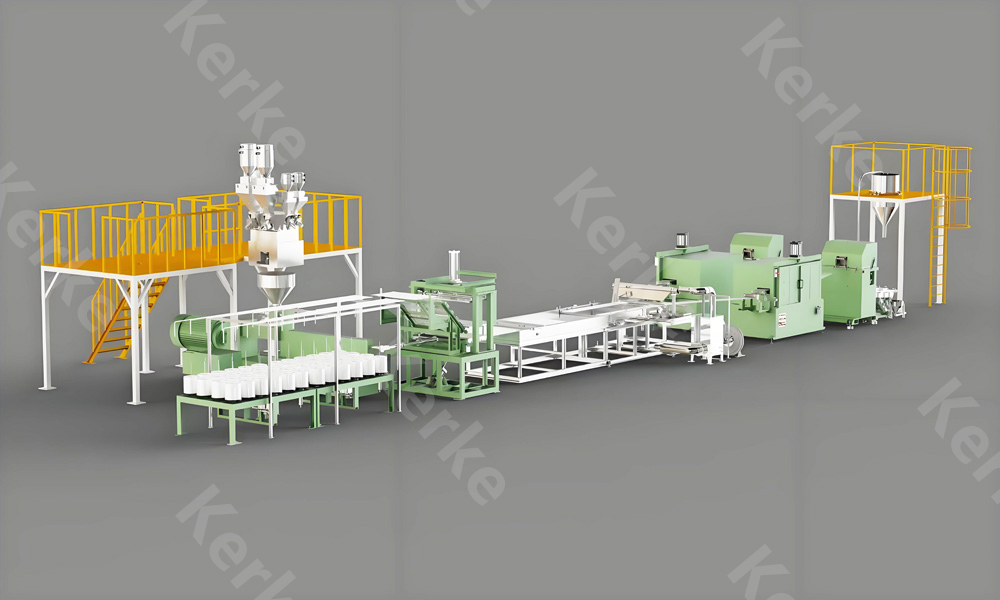
Introduction to Masterbatch Production Flow Optimization
Masterbatch production flow optimization represents a critical competitive advantage for plastic manufacturing facilities worldwide. Efficient production flow reduces operational costs, improves product consistency, increases throughput capacity, and enhances customer satisfaction through reliable delivery and quality. Modern masterbatch extruders integrate advanced technologies and design features that streamline production processes, eliminate bottlenecks, and create seamless manufacturing operations.
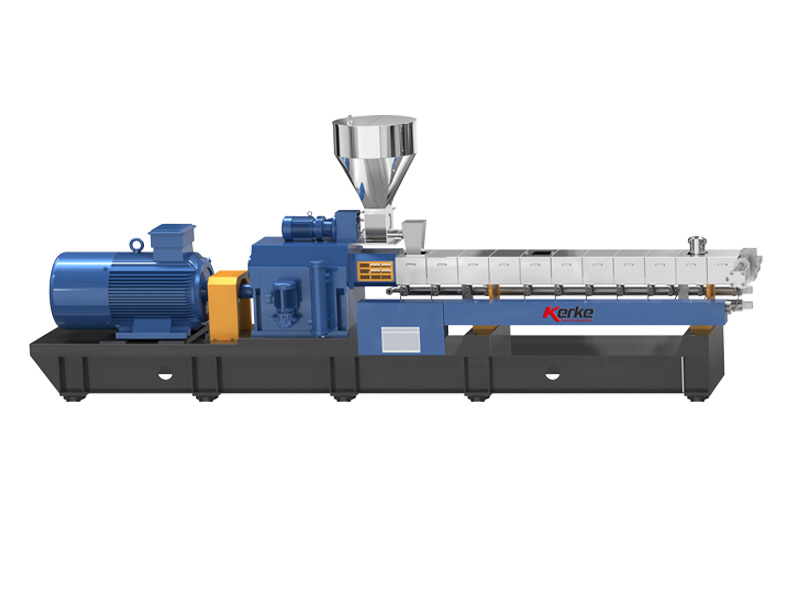
Kerke masterbatch extruders, with over 12 years of manufacturing experience and installations in more than 70 countries, deliver comprehensive solutions for efficient masterbatch production. The KTE series twin screw extruders, ranging from laboratory scale KTE-20B to large-scale KTE-135D production systems, incorporate design features and capabilities specifically optimized for masterbatch applications. These systems handle diverse masterbatch types including color masterbatch, filler masterbatch, additive masterbatch, and functional masterbatch for various industries including packaging, automotive, construction, and consumer goods.
Production flow optimization in masterbatch manufacturing involves multiple interconnected processes including raw material handling and dosing, compounding and mixing, pelletizing and cooling, quality control and testing, packaging and storage, and logistics and delivery. Each process must be carefully designed and integrated to achieve smooth, efficient operation. Advanced masterbatch extruders provide capabilities that optimize each process step and create seamless integration between processes, eliminating waste, reducing handling, and maximizing efficiency.
Raw Material Handling and Feeding System Optimization
Efficient raw material handling and feeding systems establish the foundation for streamlined masterbatch production flow. Traditional manual handling creates bottlenecks, quality variations, safety risks, and inefficiencies that limit overall production capacity and consistency. Modern automated feeding systems integrated with masterbatch extruders eliminate these issues and create reliable, efficient material supply to the compounding process.
Automated Bulk Material Handling
Automated bulk material handling systems eliminate manual material transfer between storage, processing, and production areas. Bulk silos, pneumatic conveying systems, and automated transfer systems move materials efficiently and reliably without manual intervention. This automation reduces labor requirements, eliminates material contamination risk, improves safety, and creates consistent material supply to production.
Kerke masterbatch extruder systems integrate with bulk handling infrastructure to receive materials directly from storage silos via pneumatic conveyors or vacuum transfer systems. This integration eliminates manual material handling, reduces dust generation, improves working environment, and ensures consistent material supply. Automated material handling can reduce material transfer time by 70-90% compared to manual methods, significantly improving overall production efficiency.
Precision Gravimetric Feeding
Precision gravimetric feeding systems deliver accurate, consistent material dosing to the extruder, ensuring masterbatch formulation accuracy and batch-to-batch consistency. Gravimetric feeders measure material by weight rather than volume, providing accuracy unaffected by material density variations. This precision reduces material waste, improves masterbatch quality, and eliminates costly rework or customer returns caused by formulation errors.
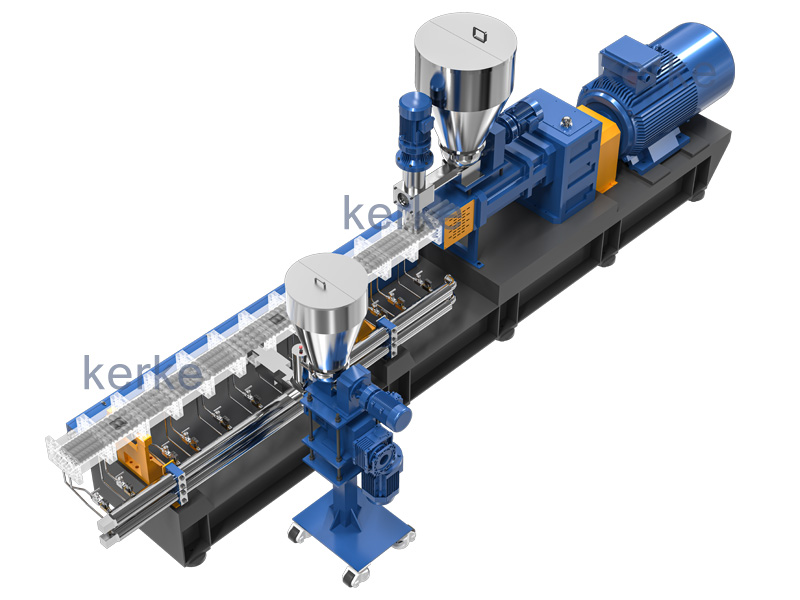
Kerke masterbatch extruders feature multiple feeding ports for integration of multiple gravimetric feeders handling different materials including base resin, pigments, fillers, and additives. The KTE-65B, for example, can be equipped with 4-6 gravimetric feeders for precise dosing of multiple components. Advanced feeder control systems integrated with the extruder control coordinate feeding rates with extruder throughput to maintain consistent formulation across varying production conditions. Gravimetric feeding typically achieves dosing accuracy within plus/minus 0.5%, compared to plus/minus 2-3% with volumetric feeding, significantly improving masterbatch quality consistency.
Loss-in-Weight Feeder Integration
Loss-in-weight feeder technology provides the highest level of dosing accuracy for critical masterbatch components requiring precise formulation. These feeders continuously monitor material weight in the hopper and adjust feed rate to maintain precise delivery to the extruder. This technology is particularly valuable for expensive pigments or additives where accurate dosing directly affects product quality and cost.
Kerke extruder systems support integration of loss-in-weight feeders for critical components while using more economical volumetric or gravimetric feeders for less critical materials. This approach optimizes cost-effectiveness while maintaining required dosing precision. Loss-in-weight feeding systems typically achieve accuracy within plus/minus 0.1-0.25%, enabling precise control of critical masterbatch formulations. The automated control integration with the extruder ensures coordinated operation even during startup, shutdown, and throughput changes.
Multi-Component Feeding Coordination
Masterbatch formulations typically require multiple components in specific ratios. Coordinating the feeding of multiple materials to maintain consistent formulation ratios presents significant challenges, especially during throughput changes, material changes, or process disturbances. Advanced feeding systems integrate multiple feeders with coordinated control to maintain consistent formulation regardless of operating conditions.
Kerke extruder control systems provide coordinated multi-feeder control that maintains precise formulation ratios across varying throughput levels. During startup, ramp-up, or throughput changes, the system automatically adjusts all feeder rates proportionally to maintain consistent formulation. This capability eliminates formulation variations that typically occur during production changes, reducing startup waste and improving overall yield. For color masterbatch production, this capability ensures consistent color across all production conditions, eliminating costly color corrections and customer returns.
Compounding Process Optimization
The compounding process represents the heart of masterbatch production, where materials are thoroughly mixed, dispersed, and compounded to achieve uniform masterbatch characteristics. Optimizing compounding processes improves dispersion quality, reduces energy consumption, increases throughput, and enhances product consistency. Modern twin screw masterbatch extruders incorporate advanced design features specifically optimized for efficient compounding.
Modular Screw Configuration
Modular screw configuration enables customization of mixing elements for specific masterbatch formulations and requirements. Different applications require different mixing profiles, with some applications requiring intensive dispersive mixing for pigment dispersion, while others require extensive distributive mixing for uniform additive distribution. Modular screw systems allow precise matching of mixing characteristics to application requirements.
Kerke KTE series extruders feature modular screw design with various element types including conveying elements, kneading blocks, mixing elements, and specialized dispersion elements. Screw configurations can be optimized for specific masterbatch types, with color masterbatch typically requiring more dispersive mixing elements for pigment dispersion, while filler masterbatch may require specific configurations for filler deagglomeration and distribution. The modular design allows rapid screw configuration changes when switching between different masterbatch types, reducing changeover time and increasing production flexibility.
Twin Screw Extruder Design Benefits
Twin screw extruder design provides significant advantages for masterbatch compounding compared to single screw alternatives. The intermeshing twin screws provide excellent self-cleaning action, preventing material buildup and degradation that could affect masterbatch quality. The positive displacement characteristic of twin screws provides consistent feeding and throughput, unaffected by material viscosity variations. The intensive mixing capability ensures thorough dispersion of pigments and additives, meeting stringent quality requirements.
Kerke co-rotating twin screw extruders provide excellent mixing efficiency while maintaining gentle material handling appropriate for sensitive pigments and additives. The intermeshing design creates shear and elongational flow that promotes dispersive mixing without excessive shear that could degrade heat-sensitive components. Twin screw design typically achieves 30-50% better dispersion quality compared to single screw extruders, reducing pigment requirements and improving cost-effectiveness. The self-cleaning action reduces purge material waste by 40-60% compared to single screw extruders during product changes.
Temperature Control Optimization
Precise temperature control throughout the extruder ensures consistent processing conditions and prevents thermal degradation of sensitive masterbatch components. Masterbatch formulations often contain thermally sensitive pigments, additives, or base polymers requiring careful temperature management to prevent color shifts, additive degradation, or polymer degradation that would affect masterbatch quality and performance.
Kerke masterbatch extruders feature advanced temperature control systems with multiple independently controlled barrel zones. The KTE-65B, for example, typically includes 8-10 temperature control zones for precise thermal profile management. Each zone features PID control with appropriate heater capacity and cooling capability to maintain setpoint temperature within plus/minus 1°C under varying operating conditions. Optimized thermal profile management prevents overheating in critical zones while ensuring adequate thermal energy for melting and mixing. Precise temperature control typically reduces thermal degradation by 60-80% compared to less controlled systems, significantly improving masterbatch quality consistency.
Ventilation and Degassing Optimization
Effective ventilation and degassing removes moisture, volatiles, and entrapped air from the compounding material, preventing defects that could affect masterbatch quality. Moisture can cause porosity and surface defects, while volatiles from decomposition or residual monomers can cause odor, bubbles, or surface imperfections. Efficient venting removes these contaminants, producing masterbatch with excellent quality and performance characteristics.
Kerke masterbatch extruders feature multiple venting zones with appropriate vacuum capability to remove moisture and volatiles effectively. Vent zones are positioned after material has been adequately melted and mixed but before final homogenization. The vented material passes under controlled vacuum conditions, removing moisture and volatiles while maintaining material flow. For applications requiring moisture removal, pre-drying of hygroscopic materials can be reduced or eliminated when effective extruder venting is employed, reducing energy consumption and processing time. Effective venting typically reduces moisture-related defects by 90% or more, significantly improving masterbatch quality.
Pelletizing and Finishing Process Optimization
Pelletizing and finishing processes convert extruded masterbatch strands into uniform pellets suitable for storage, handling, and downstream processing. Optimized pelletizing systems produce consistent pellet size, shape, and quality while maximizing throughput and minimizing waste. Advanced pelletizing technologies integrated with masterbatch extruders create seamless, efficient finishing operations.
Strand Pelletizing Systems
Strand pelletizing systems represent the most common and versatile method for masterbatch pelletizing. Extruded strands are cooled in water bath, dried, and cut into uniform pellets by rotary cutters. Strand pelletizing handles a wide range of materials, throughput rates, and pellet sizes, making it suitable for most masterbatch applications. Modern strand pelletizing systems incorporate features that improve efficiency, reduce waste, and enhance product quality.
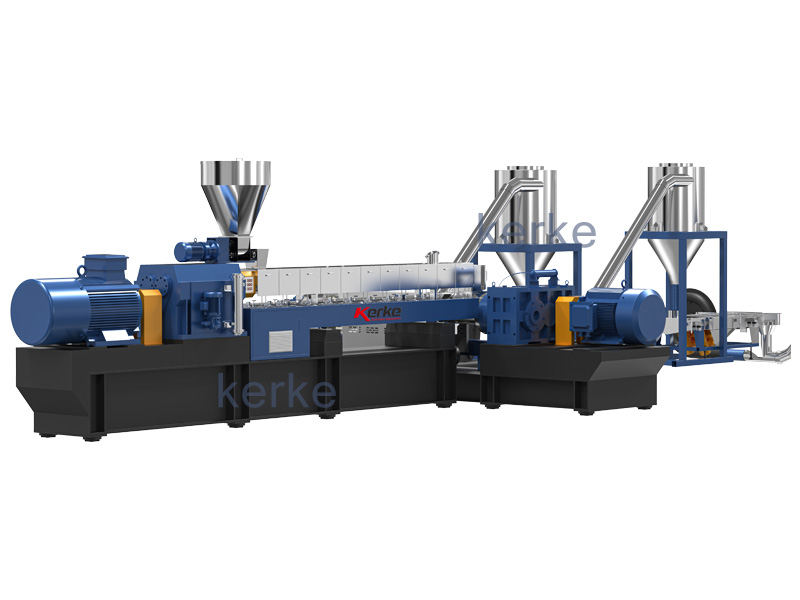
Kerke masterbatch extruder systems integrate advanced strand pelletizing equipment featuring automatic strand guidance to prevent strand tangling or breakage, precision cutting with minimal dust generation, and automatic pellet sizing. Integrated water bath temperature control ensures consistent strand cooling, affecting pellet shape and quality. Automatic strand monitoring detects strand breakage and initiates corrective action, reducing downtime and material waste. Strand pelletizing systems typically achieve pellet size consistency within plus/minus 10% of target size, ensuring uniform behavior in downstream processing.
Underwater Pelletizing Systems
Underwater pelletizing offers advantages for specific masterbatch applications, particularly high-throughput production or materials with specific thermal characteristics. Underwater pelletizing cuts strands immediately as they exit the die, with pellets solidifying in water. This method eliminates strand handling, reduces thermal stress on materials, and produces spherical pellets with excellent flow characteristics.
Kerke offers underwater pelletizing systems for high-capacity masterbatch production lines, particularly suited for high-throughput color masterbatch or filler masterbatch production. Underwater systems typically achieve 20-30% higher throughput compared to strand systems for equivalent equipment size, with lower energy consumption and reduced maintenance requirements. The spherical pellets produced provide excellent flow characteristics for downstream processing, reducing bridging or feeding issues. Underwater pelletizing systems are particularly cost-effective for production volumes exceeding 1000 kg/h, where increased throughput efficiency offsets higher initial investment.
Pellet Cooling and Drying Optimization
Proper pellet cooling and drying ensures pellets achieve appropriate temperature and moisture content for storage and handling. Inadequate cooling can cause pellet agglomeration or sticking during storage, while excess moisture can affect downstream processing and product quality. Optimized cooling and drying systems produce pellets with consistent characteristics suitable for bulk storage and handling.
Kerke pelletizing systems include optimized cooling and drying processes designed for masterbatch applications. Efficient water bath cooling provides rapid temperature reduction while maintaining strand integrity. Centrifugal dryers remove surface water without damaging pellets, while optional air drying systems remove residual moisture to achieve required moisture specifications. Integrated moisture monitoring ensures pellets meet moisture content requirements before packaging, preventing issues during storage or downstream processing. Proper cooling and drying reduces pellet agglomeration by 95% or more compared to inadequate systems, ensuring free-flowing pellets for easy handling and processing.
Automated Pellet Handling and Storage
Automated pellet handling and storage systems eliminate manual material transfer between pelletizing and packaging or storage areas. Pneumatic conveying, mechanical conveyors, or bulk handling systems move pellets efficiently to packaging silos or storage bins, creating seamless material flow and eliminating manual handling bottlenecks.
Kerke masterbatch production lines integrate automated pellet handling systems that transfer pellets directly from pelletizers to storage silos via pneumatic conveyors or enclosed belt conveyors. This automation eliminates manual pellet handling, reduces dust generation, improves working environment, and creates continuous material flow. Automated systems typically reduce material transfer time by 80-90% compared to manual handling, while eliminating product contamination risk. Bulk storage silos with appropriate dischargers enable efficient packaging or direct transfer to shipping containers, further streamlining material flow.
Quality Control and Testing Integration
Integrated quality control and testing systems ensure masterbatch quality meets specifications while minimizing production delays. Traditional offline testing methods create delays between production and feedback, allowing production of off-specification material before issues are detected. Online or at-line testing integrated with production provides real-time quality feedback, enabling rapid corrective action and minimizing waste.
Online Color Measurement
Online color measurement systems continuously monitor color properties of extruded masterbatch strands or pellets, providing immediate feedback for color consistency control. These systems use spectrophotometric technology to measure color characteristics and compare to target specifications, detecting color variations before they affect finished product quality.
Kerke color masterbatch production systems integrate online color measurement systems that provide real-time color monitoring. When color variations exceeding specified tolerances are detected, operators receive immediate alerts enabling rapid corrective action before significant off-specification material is produced. For automated production, systems can be configured to automatically adjust feeder rates or process parameters to correct color drift. Online color measurement typically reduces color-related waste by 70-90% compared to offline testing methods, while improving color consistency and customer satisfaction.
Online Melt Index Testing
Online melt index or viscosity testing monitors melt flow properties that indicate masterbatch composition and processing characteristics. Variations in melt index indicate formulation errors, degradation, or contamination that could affect masterbatch performance. Continuous monitoring provides early detection of issues before they cause significant production problems.
Kerke extruder systems can integrate online melt index or viscosity sensors that provide real-time monitoring of melt flow properties. This monitoring detects formulation variations, thermal degradation, or contamination issues early, enabling rapid correction before off-specification material accumulates. For masterbatch formulations where melt index is critical to performance, online monitoring ensures consistency and prevents customer issues related to processing variations. Online monitoring typically reduces formulation-related waste by 60-80% compared to offline testing methods.
Automated Sampling Systems
Automated sampling systems collect representative masterbatch samples at appropriate intervals for comprehensive quality testing. These systems eliminate manual sampling inconsistency, reduce sampling errors, and ensure regular quality monitoring without interrupting production flow. Automated samples are routed to testing laboratories or at-line analyzers for comprehensive quality evaluation.
Kerke production lines integrate automated sampling systems that collect samples at programmable intervals from the pellet stream. Samples are collected in appropriate containers and identified with batch information for traceability. Automated sampling ensures consistent sampling methodology, reduces labor requirements, and provides regular quality data without manual intervention. For critical applications, automated sampling can be synchronized with production changes to collect samples representing each production batch or formulation change, ensuring comprehensive quality monitoring.
Statistical Process Control Integration
Statistical process control (SPC) systems collect, analyze, and display quality data to identify trends, variations, and process capability issues. SPC provides objective, data-driven basis for process optimization and early warning of potential quality problems. Integrated SPC systems enable continuous quality improvement while maintaining production efficiency.
Kerke extruder control systems can be integrated with SPC software that automatically collects quality data from online analyzers and laboratory tests. The system analyzes data for trends, statistical control, and process capability, providing operators with actionable insights for process optimization. Control charts display key quality parameters in real-time, highlighting variations requiring attention. SPC integration enables proactive quality management, preventing quality issues before they affect customer deliveries. Continuous process improvement based on SPC data typically reduces quality variations by 50-70% over time while maintaining or improving production efficiency.
Packaging and Storage Optimization
Optimized packaging and storage systems handle finished masterbatch efficiently while protecting product quality and facilitating logistics. Automated packaging reduces labor requirements, eliminates packaging errors, and creates seamless material flow from production to shipping. Appropriate storage conditions protect masterbatch quality and ensure customer satisfaction.
Automated Packaging Systems
Automated packaging systems fill bags, containers, or bulk packaging with masterbatch pellets automatically, eliminating manual packaging labor and errors. Bagging systems fill and seal bags to precise weights, while bulk filling systems load pallets, bins, or shipping containers automatically. This automation reduces labor costs, eliminates weight variations, and increases packaging throughput.
Kerke masterbatch production lines integrate automated packaging systems suited to production volume and customer requirements. For smaller volumes, automated bagging systems fill and seal 25kg bags with weighing accuracy within plus/minus 0.2%. For larger volumes, bulk filling systems load shipping containers or bulk bags with precise weight control. Automated packaging typically reduces packaging labor by 80-95% compared to manual packaging while eliminating weight errors and reducing packaging time by 60-70%. Integrated labeling systems print batch numbers, product information, and traceability data automatically, ensuring complete identification and traceability.
Palletizing and Material Handling
Automated palletizing and material handling systems stack packaged bags or containers onto pallets automatically, creating stable loads for efficient storage and shipping. Robotic palletizers, conveyor systems, and stretch wrappers create complete handling systems that eliminate manual material handling while improving efficiency and safety.
Kerke packaging lines integrate automated palletizing systems that receive packaged bags or containers, stack them in stable patterns on pallets, and prepare loads for storage or shipping. Automated palletizing reduces manual labor requirements, eliminates heavy lifting, and creates consistent, stable pallets suitable for forklift handling. Integrated stretch wrapping secures loads for transport. Complete material handling automation from production to shipping eliminates bottlenecks and creates seamless material flow.
Storage Condition Management
Appropriate storage conditions protect masterbatch quality and prevent degradation during storage. Temperature, humidity, and light exposure can affect masterbatch color, performance, and processing characteristics. Managed storage environments ensure consistent product quality from production to customer delivery.
Kerke production facilities typically include controlled storage areas for finished masterbatch. Temperature control prevents thermal degradation that could affect pigment stability or additive performance. Humidity control prevents moisture absorption that could affect processing or product quality. Light protection prevents UV degradation of light-sensitive pigments. Appropriate storage conditions typically extend masterbatch shelf life by 50-100% compared to uncontrolled storage, reducing quality issues and customer returns.
Inventory Management Integration
Inventory management systems track masterbatch production, storage, and shipments, providing real-time visibility of inventory status and supporting efficient operations. Integration with production systems enables automatic inventory updates as products are manufactured, packaged, and shipped, reducing manual data entry and errors.
Kerke production management systems integrate inventory management with production control, providing real-time inventory visibility for production planning and customer order fulfillment. As products are completed and packaged, inventory is automatically updated, reducing manual tracking effort. Batch tracking ensures complete traceability from raw materials to customer delivery. Integrated inventory management typically reduces inventory carrying costs by 15-25% while improving order fulfillment accuracy and customer satisfaction.
Production Scheduling and Integration
Production scheduling and integration systems coordinate all production activities to maximize efficiency while meeting customer delivery requirements. Advanced scheduling considers multiple constraints including material availability, equipment capacity, production sequence requirements, and customer delivery dates, creating optimal production plans that minimize changeovers and maximize throughput.
Automated Production Scheduling
Automated production scheduling systems generate optimal production plans based on customer orders, material availability, equipment capacity, and changeover requirements. Advanced scheduling algorithms minimize non-productive time while meeting delivery commitments, maximizing overall production efficiency and equipment utilization.
Kerke production facilities utilize advanced production scheduling systems optimized for masterbatch manufacturing. The scheduling system considers factors including product compatibility (minimizing contamination risk during changeovers), sequence-dependent changeover times, equipment availability and maintenance schedules, and customer delivery priorities. Optimized scheduling typically reduces changeover time by 30-50% while improving on-time delivery performance to 95% or higher. Automated scheduling enables rapid response to customer demand changes while maintaining production efficiency.
Changeover Optimization
Changeover optimization reduces time required to transition between different masterbatch products or formulations. Efficient changeovers minimize production downtime, increase effective production time, and improve overall equipment effectiveness. Rapid changeover capabilities enable flexible production strategies and improved customer responsiveness.
Kerke masterbatch extruders incorporate design features that facilitate rapid changeover, including quick-disconnect feeders, accessible screw configuration changes, simplified die change procedures, and automated cleaning systems. Color-to-color changeovers can be completed in 30-45 minutes for similar formulations using advanced purge and cleaning procedures. Changeovers between significantly different products may require 2-4 hours depending on cleaning requirements. Optimized changeover procedures combined with scheduling that sequences compatible products can reduce total changeover time by 40-60% compared to unoptimized approaches, significantly increasing production efficiency.
Process Integration and Automation
Complete process integration and automation connects all production processes, control systems, and information systems into unified operations. Integration eliminates manual information transfer, reduces errors, and enables data-driven decision making. Automation of routine operations reduces labor requirements while improving consistency and quality.
Kerke masterbatch production systems provide comprehensive integration from raw material receipt to finished product shipment. Production control systems integrate with feeding systems, extruder controls, pelletizers, packaging equipment, and quality testing systems to create unified operations. Information systems integrate production, inventory, quality, and shipping data, providing comprehensive visibility into operations and supporting data-driven decision making. This integration typically reduces manual operations by 60-80% while improving information accuracy and operational visibility.
Production Monitoring and Analytics
Production monitoring and analytics systems collect, analyze, and display production data to enable performance monitoring, bottleneck identification, and continuous improvement. Real-time monitoring of throughput, efficiency, quality, and downtime provides visibility into production performance and highlights optimization opportunities.
Kerke production systems include comprehensive monitoring and analytics capabilities that track key performance indicators including overall equipment effectiveness (OEE), production efficiency, quality metrics, energy consumption, and downtime. Real-time dashboards display current performance, while historical analysis identifies trends and opportunities for improvement. Data-driven optimization based on production analytics typically improves OEE by 10-20% through targeted improvements. Continuous monitoring enables rapid response to issues, minimizing downtime and maximizing productivity.
Economic Benefits and Return on Investment
Investment in optimized masterbatch extruder systems delivers significant economic benefits through reduced operating costs, improved quality, increased throughput, and enhanced customer satisfaction. Return on investment analysis demonstrates the financial justification for advanced equipment and process optimization investments.
Production Cost Reduction
Optimized production flow reduces multiple cost components including labor, energy, material waste, and quality-related expenses. Automated material handling and packaging reduce labor requirements by 60-80%. Efficient processes and optimized screw configurations reduce energy consumption by 15-30%. Improved feeding accuracy and online quality monitoring reduce material waste by 50-70%. Reduced quality problems and customer returns decrease quality-related costs by 60-80%.
For a typical KTE-65B masterbatch extruder operating 6000 hours per year at 400 kg/h throughput, optimized production flow can reduce operating costs by approximately USD 0.05-0.10 per kg, representing annual savings of USD 120,000-240,000. These savings significantly improve profitability and justify investment in advanced equipment and process optimization.
Throughput and Capacity Utilization
Optimized production flow increases effective throughput and capacity utilization, allowing higher production from existing equipment or lower capital investment for required capacity. Reduced changeover time, minimized downtime, improved efficiency, and higher quality yield all contribute to increased effective capacity.
Kerke masterbatch extruders with optimized production flow typically achieve 70-85% OEE, compared to 50-65% for unoptimized systems. This improvement represents 20-30% higher effective production capacity without equipment investment. For KTE-65B with 500 kg/h maximum capacity, optimized flow can increase annual production from 1,500,000 kg to 1,800,000-2,100,000 kg, significantly increasing revenue and return on investment.
Quality Improvement Benefits
Improved quality reduces customer returns, warranty costs, and reputation damage while enhancing customer satisfaction and loyalty. Consistent, reliable quality increases customer confidence and enables premium pricing. Reduced quality issues decrease rework costs and increase effective production capacity.
For masterbatch production, improved quality reducing returns from 2% to 0.5% can save USD 50,000-100,000 annually for a typical production volume. Enhanced customer satisfaction and loyalty can increase sales volume by 5-10% through repeat business and referrals. Quality improvement benefits compound over time as reputation builds, creating long-term competitive advantage.
Investment Cost and Payback
Kerke masterbatch extruder systems represent significant investments but deliver rapid payback through operating cost reduction, increased throughput, and quality improvements. Laboratory-scale KTE-20B systems cost approximately USD 18,000-20,500, while production-scale KTE-65B systems cost approximately USD 50,000-70,000. Large-scale KTE-95B systems cost approximately USD 100,000-130,000. Complete production lines including auxiliary equipment and automation typically represent 1.5-2.5 times the base extruder cost.
For a KTE-65B-based production line with total investment of USD 100,000-150,000, annual operating cost savings of USD 120,000-240,000, increased revenue from capacity gains of USD 200,000-300,000, and quality improvement benefits of USD 50,000-100,000, total annual benefits reach USD 370,000-640,000. This investment delivers payback periods of 3-12 months, with returns over equipment service life of 300-500% or more. Investment in optimized masterbatch production flow represents exceptional return on investment with minimal risk.
Conclusion: Strategic Competitive Advantage
Masterbatch extruder systems optimized for production flow efficiency provide strategic competitive advantages in the global masterbatch market. Kerke twin screw extruders, with over 12 years of manufacturing experience and proven performance in over 70 countries, deliver comprehensive solutions for efficient, reliable masterbatch production.
Optimized production flow from raw material handling through shipping creates streamlined operations that minimize costs, maximize quality, and enhance customer satisfaction. Investment in advanced equipment and process integration delivers rapid payback and long-term competitive advantage. As masterbatch markets become increasingly competitive, producers with optimized, efficient production operations will capture growing market share through cost leadership and superior quality performance.
Kerke provides complete support for masterbatch production optimization including equipment design, process engineering, automation integration, and technical support. With Kerke masterbatch extruders and optimized production flow, producers can achieve operational excellence and sustainable competitive advantage in the dynamic global masterbatch market.