Understanding Material Homogeneity in Polymer Compounding
Material homogeneity represents critical quality parameter in polymer compounding directly affecting final product performance and consistency. Homogeneity refers to uniform distribution of additives, fillers, pigments, and polymer components throughout the compounded material without agglomerations, separation, or concentration gradients. Achieving superior homogeneity requires sophisticated mixing technology combined with precise process control throughout the compounding operation.
The importance of material homogeneity extends across virtually all compounding applications. For color masterbatch production, homogeneity ensures consistent coloration throughout end-use products preventing color variations or streaking. For filler-loaded compounds, uniform filler distribution ensures consistent mechanical properties, surface appearance, and processing characteristics. For additive masterbatch including flame retardants, UV stabilizers, or processing aids, homogeneity enables consistent additive performance and reliable end-product properties.
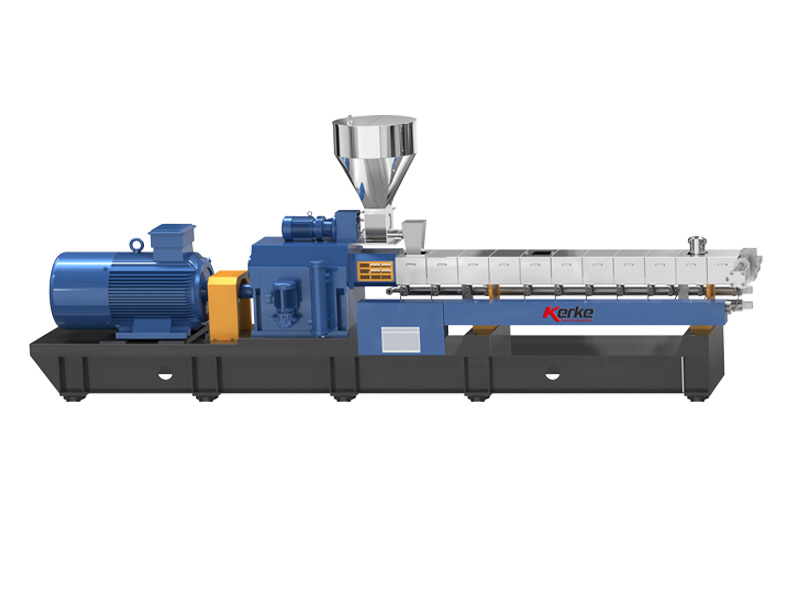
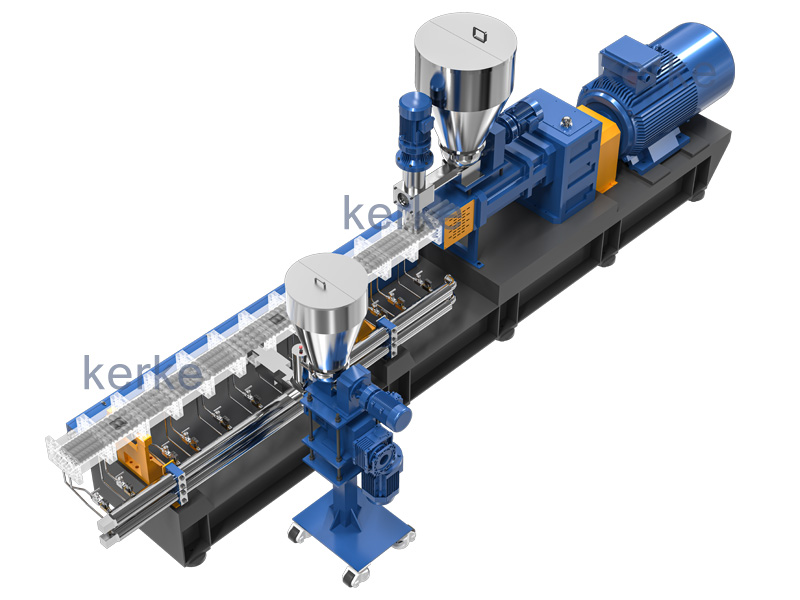
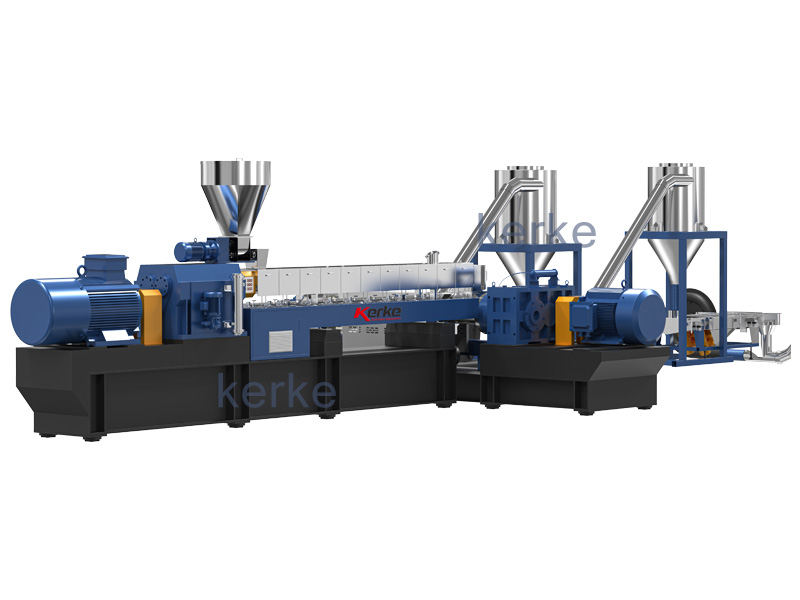
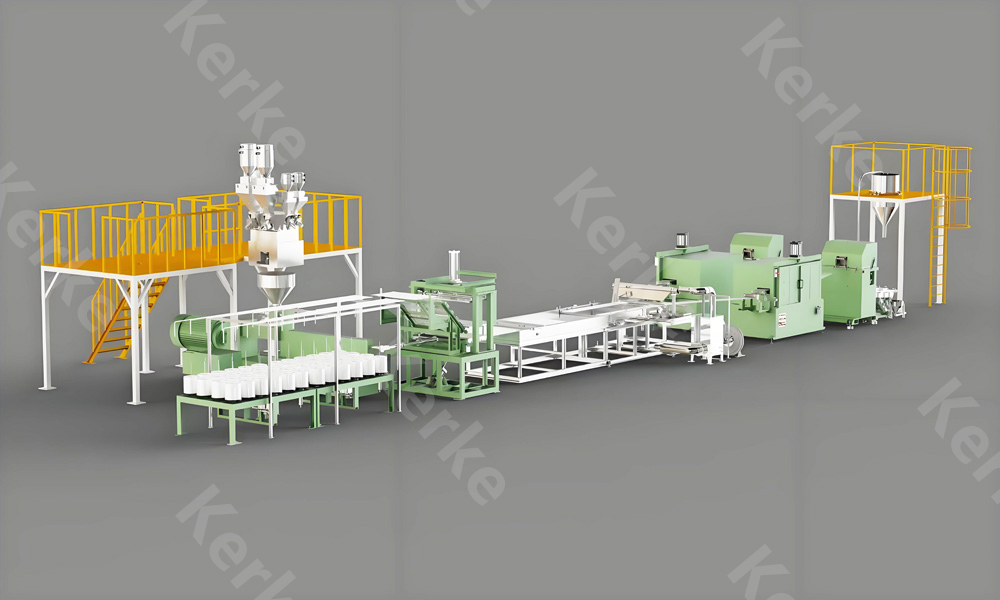
Kerke parallel co-rotating twin screw extruders provide exceptional mixing capability enabling superior material homogeneity through advanced screw design, optimized processing geometry, and sophisticated control systems. Over 12 years of specialization in twin screw extruder manufacturing provides deep understanding of mixing mechanisms and processing optimization strategies ensuring customers achieve exceptional material quality across diverse compounding applications.
Fundamentals of Twin Screw Mixing Mechanisms
Twin screw extruders provide superior mixing capability compared to single screw alternatives through multiple synergistic mechanisms operating simultaneously during material processing. Understanding these fundamental mixing mechanisms enables proper equipment selection and process optimization for specific compounding requirements.
Distributive Mixing
Distributive mixing refers to the mechanism by which material components are repositioned and distributed throughout the melt volume without necessarily reducing component size. This mechanism primarily accomplished through material division and recombination as melt passes through various screw elements. Kerke twin screw extruders feature specialized mixing elements including kneading blocks, reverse elements, and special mixing sections designed to maximize distributive mixing effectiveness.
The intermeshing action of co-rotating twin screws provides continuous material division and recombination as melt transfers between screws and between screw channels. This action creates thousands of mixing events throughout material residence time creating thorough component distribution. The modular screw design allows strategic placement of distributive mixing elements at optimal positions along extruder length ensuring comprehensive material processing.
Dispersive Mixing
Dispersive mixing refers to the mechanism by which solid particles, liquid droplets, or agglomerates are broken down into smaller units dispersed throughout the matrix material. This mechanism requires application of controlled shear stress sufficient to overcome cohesive forces within dispersed phase components while avoiding excessive shear causing thermal degradation or component damage.
Kerke twin screw extruders enable precise control over dispersive mixing intensity through adjustable screw speed, optimized kneading block geometry, and adjustable kneeding block stagger angle. High-performance mixing zones with narrow clearances between screws and barrel provide high shear conditions for effective dispersion of difficult-to-break components including pigments, nanofillers, and high-viscosity additives.
Convective Mixing
Convective mixing refers to the bulk material transport and exchange between screw channels providing repeated material exposure to various processing zones. Kerke intermeshing twin screw design provides excellent convective mixing through material transfer between screws and between forward and reverse flow regions.
This continuous material circulation ensures all material passes through high-intensity mixing zones multiple times during processing creating comprehensive treatment of entire material volume. The extended length-to-diameter ratio of Kerke extruders provides sufficient processing length for multiple mixing passes ensuring complete homogenization even for demanding applications.
Kerke Screw Design for Enhanced Homogeneity
Screw design represents primary factor determining achievable mixing effectiveness and resulting material homogeneity. Kerke modular screw design enables optimized element selection and arrangement for specific compounding applications providing customized solutions for various material systems.
Modular Screw Element System
Kerke modular screw system provides comprehensive element variety enabling configuration optimization for virtually any compounding requirement. Available elements include various conveying elements with different pitch and depth, kneading blocks with various widths and stagger angles, mixing elements with specialized geometries, and special purpose elements for specific applications.
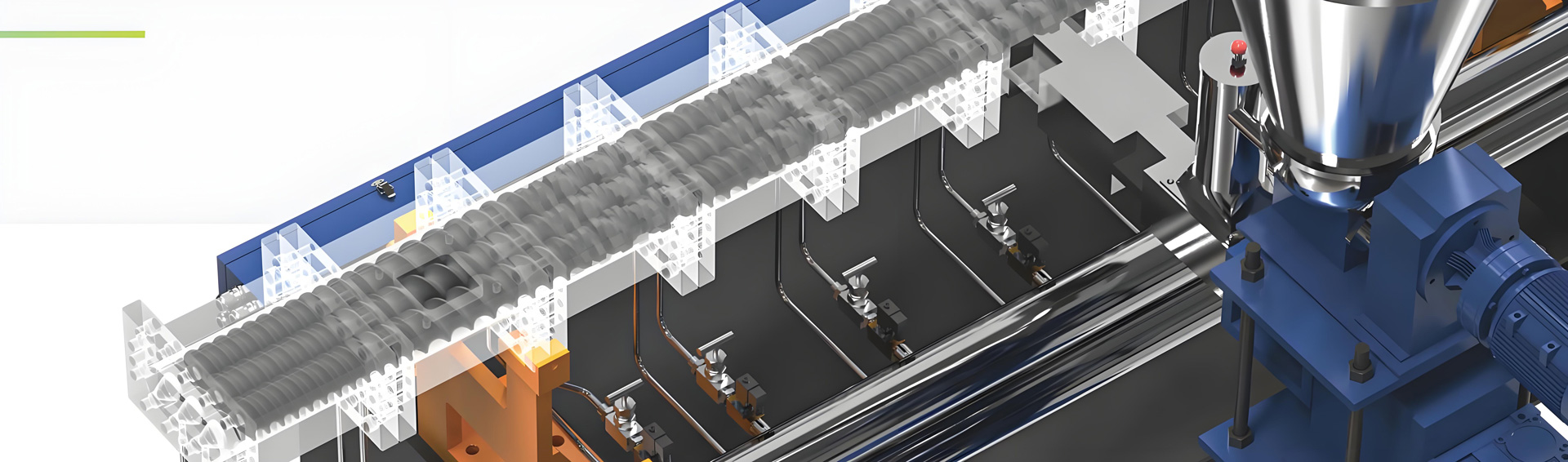
The computer-aided designed screw assemblies provide kneading co-type configurations with excellent self-cleaning function and good interchangeability. This modular approach enables rapid screw reconfiguration when processing different materials or optimizing formulations. All screw elements manufactured from W6Mo5Cr4V2 material providing excellent wear resistance and mechanical strength for extended service life.
Optimized Kneading Block Design
Kneading blocks represent primary mixing elements providing high-intensity dispersive and distributive mixing action. Kerke offers various kneeding block configurations including different block widths, stagger angles, and disc profiles optimized for specific mixing requirements. Wide kneading blocks provide higher mixing intensity with higher energy input, while narrow kneading blocks provide gentler mixing with reduced energy consumption.
The stagger angle between adjacent discs significantly affects mixing characteristics. Small stagger angles provide distributive mixing with minimal energy input, while large stagger angles provide high dispersive mixing capability. Kerke application engineering support provides expertise selecting optimal kneeding block configurations for specific materials and homogeneity requirements.
Reverse Flow and Mixing Sections
Reverse flow elements and dedicated mixing sections create regions where material experiences repeated processing ensuring complete homogenization. Kerke extruders feature multiple mixing sections strategically positioned along screw length where material receives intensive mixing treatment before proceeding to next processing stage.
These mixing zones particularly important for applications requiring high additive loading or difficult-to-disperse components. Multiple mixing passes ensure uniform distribution even for challenging materials. The excellent self-cleaning function prevents material stagnation and ensures consistent processing across entire material volume.
Process Parameters Affecting Homogeneity
Achieving optimal material homogeneity requires optimization of multiple process parameters working together with appropriate screw design. Understanding parameter interactions enables systematic process optimization for specific compounding applications.
Screw Speed and Residence Time
Screw speed directly affects mixing intensity and residence time both influencing achieved homogeneity. Higher screw speeds increase shear rates and mixing intensity improving dispersive mixing effectiveness. However, higher speeds also reduce residence time potentially limiting mixing completeness. Kerke variable frequency drives enable precise screw speed optimization finding optimal balance between mixing intensity and residence time.
For materials requiring intensive dispersive mixing including pigment dispersion or nanofiller incorporation, moderate screw speeds with extended residence time provide optimal results. For materials requiring primarily distributive mixing, higher screw speeds with shorter residence times provide adequate mixing while maximizing throughput.
Temperature Profile Optimization
Temperature profile significantly affects melt viscosity and flow behavior influencing mixing effectiveness. Kerke segmented barrel design with multiple independent heating zones enables precise temperature profile optimization for specific materials and processing requirements.
Lower melt viscosity reduces mixing resistance enabling improved distributive mixing but may reduce dispersive mixing effectiveness for components requiring shear stress for dispersion. Higher melt viscosity increases dispersive mixing effectiveness but may reduce distributive mixing efficiency. Optimal temperature profile balances these effects for specific materials and homogeneity requirements.
Feed Rate and Filling Degree
Feed rate and resulting filling degree affect mixing effectiveness through influence on residence time distribution and mixing zone utilization. Optimal filling ensures sufficient material in mixing zones for effective mixing without overfilling reducing effectiveness. Kerke loss-in-weight feeding systems provide precise feed control enabling filling degree optimization.
Underfilled conditions reduce mixing zone effectiveness due to insufficient material for complete element engagement. Overfilled conditions reduce mixing efficiency due to limited material movement between screw channels. Optimal filling provides maximum mixing effectiveness while maintaining acceptable residence time distribution.
Application-Specific Homogeneity Solutions
Different compounding applications present unique homogeneity challenges requiring specific equipment configuration and process optimization strategies. Kerke provides application-specific solutions addressing unique requirements across various compounding sectors.
Color Masterbatch Homogeneity
Color masterbatch production demands exceptional pigment dispersion quality ensuring consistent coloration and preventing pigment agglomerates causing color streaking or mottling in end products. Kerke screw configurations for color masterbatch emphasize high dispersive mixing capability with optimized kneeding block arrangements providing shear intensity sufficient for complete pigment dispersion without causing thermal degradation of sensitive organic pigments.
Multiple mixing zones ensure pigment receives sufficient treatment throughout processing ensuring uniform dispersion even for high pigment loadings. Temperature control optimized for specific pigment thermal stability preventing color shift or degradation. Kerke extruders achieve pigment dispersion quality down to sub-micron levels meeting demanding specifications for premium applications including automotive and consumer goods.
Filler Masterbatch Homogeneity
Filler masterbatch production requires uniform filler distribution throughout carrier resin ensuring consistent properties and preventing agglomerates causing processing difficulties or product defects. Kerke offers specialized screw configurations for filler masterbatch including dedicated filler incorporation zones providing gentle initial wetting followed by intensive mixing zones achieving uniform dispersion.
For highly loaded filler masterbatch formulations exceeding 70 percent loading, Kerke provides special screw designs optimizing residence time distribution and mixing energy input ensuring complete filler treatment throughout entire material volume. Wear-resistant barrel and screw construction handles abrasive fillers including calcium carbonate, talc, and glass fibers extending equipment life while maintaining mixing performance.
Additive Masterbatch Homogeneity
Additive masterbatch production requires uniform additive distribution and protection of sensitive additives from thermal degradation. Kerke provides screw configurations optimized for additive masterbatch including multiple additive feed points enabling sequential additive addition at optimal processing stages. Low-shear mixing zones protect thermally sensitive additives while providing sufficient mixing for uniform distribution.
For liquid additives, Kerke offers specialized injection systems providing precise dosing and rapid incorporation into polymer melt. Vacuum venting removes volatiles from certain additives preventing defects in final product. Optimized temperature profiles provide sufficient melting energy for carrier resin without exposing sensitive additives to excessive thermal stress.
Homogeneity Measurement and Quality Control
Effective quality control requires reliable methods for measuring material homogeneity ensuring products meet specifications. Various analytical techniques provide different perspectives on achieved homogeneity levels enabling comprehensive quality assessment.
Microscopic Analysis
Microscopic analysis including optical microscopy and scanning electron microscopy provides direct visualization of dispersed phase distribution throughout compounded material. These techniques reveal pigment agglomerate size, filler distribution uniformity, and additive dispersion quality. Kerke application engineering support provides expertise establishing appropriate microscopic evaluation criteria for various applications.
For color masterbatch, microscopic analysis confirms pigment dispersion quality and absence of agglomerates exceeding specified size limits. For filler compounds, analysis confirms filler distribution uniformity and absence of large filler agglomerates affecting mechanical properties. Image analysis software enables quantitative assessment of dispersion quality providing statistical metrics for process control.
Color Measurement
For color masterbatch applications, color measurement provides critical homogeneity assessment. Spectrophotometric measurement of color values including L, a, b coordinates enables quantification of color consistency. Color difference values (Delta E) below 1.0 represent excellent color homogeneity for most applications. Kerke systems achieve color variation below Delta E 1.0 ensuring exceptional color consistency.
In-line color measurement systems enable real-time monitoring of color homogeneity allowing immediate process adjustment if color variations detected. These systems particularly valuable for high-volume production ensuring consistent color quality throughout production runs.
Mechanical Property Testing
For filled compounds and additive masterbatch, mechanical property testing provides indirect homogeneity assessment. Uniform filler distribution provides consistent mechanical properties across samples from different production times. Tensile strength, impact resistance, and flexural modulus measurements demonstrate achieved homogeneity through property consistency.
Statistical analysis of property data including coefficient of variation provides quantitative homogeneity assessment. Low coefficient of variation values indicate excellent property consistency confirming uniform material homogeneity. Kerke systems achieve property variation below 5 percent coefficient for most filled compounds demonstrating superior homogeneity.
Cost Analysis for Homogeneity Optimization
Achieving superior material homogeneity requires appropriate investment in equipment and process optimization. Understanding cost implications enables informed investment decisions balancing homogeneity requirements with economic considerations.
Equipment Investment Requirements
Kerke twin screw extruders available in various sizes providing appropriate homogeneity capability for different production scales and investment levels. Laboratory scale KTE-20 model with 2-15 kg/h capacity provides research and development hominity optimization with investment approximately $18,000-$25,000.
Production scale KTE-36B model with 20-100 kg/h capacity provides commercial production homogeneity optimization with investment approximately $40,000-$55,000. This size provides excellent mixing capability for medium-scale production operations requiring high material quality.
Medium production KTE-65B model with 200-450 kg/h capacity provides industrial scale homogeneity optimization with investment approximately $70,000-$95,000. This size suits established production facilities with significant quality requirements and production volume.
Large scale KTE-75D model with 500-1000 kg/h capacity provides maximum scale hominity optimization with investment approximately $120,000-$160,000. This size serves major production operations with demanding homogeneity requirements and high production volume.
Operating Cost Implications
Superior homogeneity achievement affects operating costs through energy consumption, material utilization, and quality costs. Higher mixing intensity and extended residence time increase energy consumption by approximately 15-25 percent compared to baseline operation. However, improved material quality reduces scrap rates by 30-50 percent and material waste by 20-40 percent resulting in overall cost reduction.
For high-value applications where material quality directly impacts product performance or marketability, the value of superior homogeneity substantially exceeds increased energy costs. Color masterbatch for automotive applications commands premium prices requiring exceptional color consistency justifying additional processing costs for superior homogeneity.
Quality Cost Analysis
Quality costs including scrap, reprocessing, and customer returns represent significant cost components for compounding operations. Improved homogeneity directly reduces these quality costs through superior product consistency and reduced defect rates. Statistical process control data from Kerke installations demonstrate scrap rate reductions from 3-5 percent baseline to 0.5-1 percent with optimized hominity practices.
Customer returns due to color variations, property inconsistency, or surface defects represent major quality cost components significantly reduced through superior homogeneity. Customer satisfaction improvements provide additional economic benefits through enhanced reputation and repeat business.
Advanced Hominity Enhancement Technologies
Emerging technologies provide enhanced capability for achieving exceptional material hominity in challenging applications. Kerke incorporates these advanced technologies providing leading-edge solutions for demanding homogeneity requirements.
Ultrasonic Mixing Enhancement
Ultrasonic mixing technology provides enhanced dispersion capability through application of high-frequency ultrasonic vibrations creating cavitation and high shear zones. Kerke offers ultrasonic mixing enhancement options particularly beneficial for nanofiller dispersion and difficult-to-disperse pigments where conventional mixing approaches provide insufficient dispersion quality.
Ultrasonic enhancement reduces required processing time for achieving target dispersion quality by 30-50 percent while reducing overall energy input compared to increasing screw speed. This technology provides economic and quality benefits for demanding applications where dispersion quality represents critical quality parameter.
Static Mixer Integration
Static mixer elements integrated into die head provide final mixing action before pelletization ensuring final material homogeneity. Kerke offers static mixer options for applications requiring absolute maximum homogeneity including premium color masterbatch and highly filled compounds where any remaining inhomogeneity would be unacceptable.
Static mixers provide mixing action without moving parts requiring minimal maintenance while providing excellent distributive mixing for final homogeneity enhancement. This technology particularly valuable for applications with stringent quality requirements where final product consistency is non-negotiable.
Process Monitoring and Control
Advanced process monitoring including in-line rheology measurement, melt pressure analysis, and temperature profiling enables precise control of mixing conditions affecting homogeneity. Kerke PLC control systems integrate these monitoring capabilities providing automatic parameter adjustment maintaining optimal mixing conditions throughout production.
Predictive process control anticipates material property variations adjusting process parameters proactively maintaining consistent homogeneity. This advanced control capability reduces variability and ensures consistent product quality even with raw material variations.
Case Studies Demonstrating Hominity Excellence
Kerke has implemented numerous compounding systems demonstrating exceptional hominity achievement across diverse applications and production scales.
Premium Color Masterbatch Production
A premium color masterbatch manufacturer implemented Kerke KTE-75D system for automotive color masterbatch production. The system achieved pigment dispersion quality with agglomerate sizes below 1 micron and color variation below Delta E 0.5 across entire production run. The exceptional homogeneity enabled premium pricing and market leadership in demanding automotive color segment.
Investment of $145,000 achieved payback in 16 months through premium product pricing and reduced scrap rates. The system processes over 30 different color formulations with rapid changeover and consistent quality across all products. Customer satisfaction improved significantly with virtually no returns due to color quality issues.
Highly Filled Compound Production
A filled compound producer implemented Kerke KTE-95D system for 80 percent calcium carbonate filled PP compound. The system achieved uniform filler distribution with property variation coefficient below 3 percent across production. The superior homogeneity enabled consistent processing properties for downstream extrusion and injection molding customers.
Investment of $240,000 achieved payback in 18 months through reduced scrap rates and customer returns. The wear-resistant construction provides extended barrel and screw life exceeding 12 months even with abrasive filler loading, reducing maintenance costs and downtime significantly.
Nanocomposite Production
A nanocomposite manufacturer implemented Kerke KTE-65D system with ultrasonic mixing enhancement for nanoclay-reinforced polymer nanocomposite. The system achieved nanofiller dispersion with exfoliation degree exceeding 90 percent, providing significant property enhancement including 30 percent increase in modulus and 50 percent improvement in barrier properties.
Investment of $125,000 including ultrasonic enhancement achieved payback in 22 months through premium product pricing and unique market position. The exceptional nanofiller homogeneity enabled applications requiring property enhancement impossible with conventional filler approaches.
Conclusion: Achieving Superior Material Homogeneity
Superior material homogeneity represents achievable objective through appropriate equipment selection, process optimization, and quality control implementation. Kerke twin screw extruders provide foundation for exceptional homogeneity achievement through advanced screw design, precise process control, and comprehensive application support.
Key success factors include selecting appropriate screw configuration for specific materials, optimizing process parameters for target homogeneity level, implementing appropriate quality control measures, and maintaining equipment in optimal condition. Following these principles enables consistent production of materials with exceptional homogeneity meeting demanding specifications across diverse applications.
Investment in homogeneity optimization provides substantial economic benefits through reduced quality costs, premium product capability, and enhanced customer satisfaction. Kerke extensive experience and specialized twin screw extruder capability provide unique advantages helping customers achieve material quality excellence and market leadership.