Understanding Color Masterbatch for Plastic Film Applications
Color masterbatch for plastic film represents a critical component in the flexible packaging industry, enabling manufacturers to achieve vibrant, consistent colors while maintaining the mechanical properties and processing characteristics essential for film applications. Plastic film color masterbatch typically contains pigment concentrations ranging from 10% to 60%, with the specific formulation optimized for film processing requirements including low viscosity, excellent dispersion, and minimal effect on film optical properties. The thin film gauges typically ranging from 10 to 200 microns present unique challenges for color development, requiring masterbatch formulations with exceptional dispersion quality and color consistency. Understanding the fundamental principles of color masterbatch for film applications enables manufacturers to optimize their color development processes and achieve superior visual appeal while maintaining production efficiency.
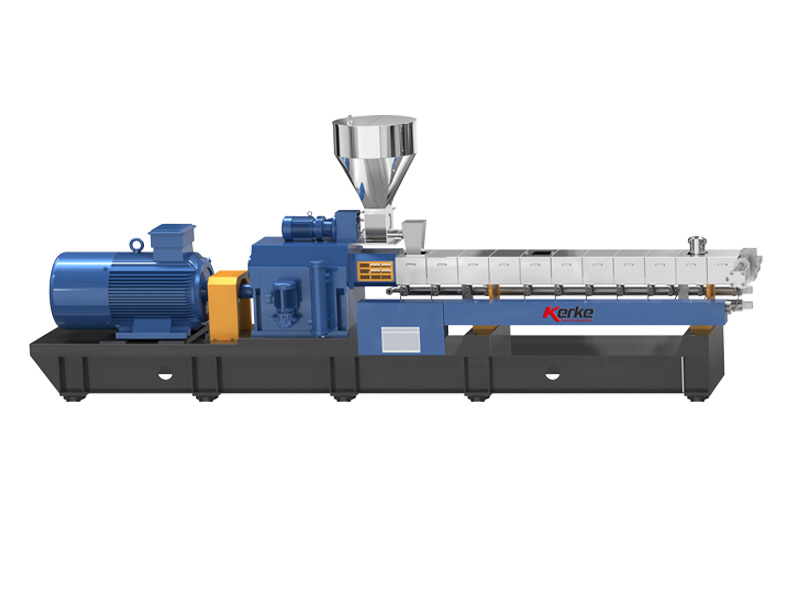
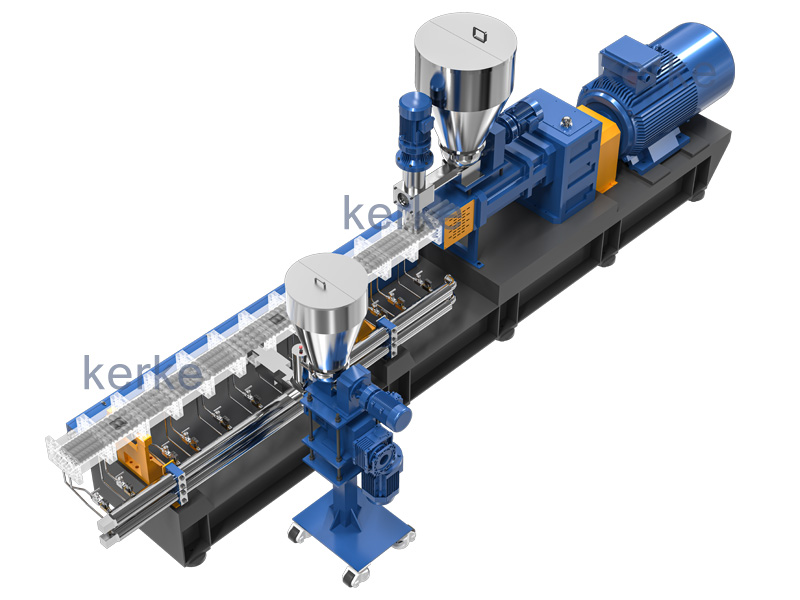
The selection of pigments for film applications requires careful consideration of multiple factors including thermal stability, lightfastness, migration resistance, and compatibility with film polymers. Organic pigments offer superior brightness and color strength but may have limitations in thermal stability. Inorganic pigments provide excellent thermal stability and lightfastness but may affect film clarity and transparency. Kerke Twin Screw Extruder systems are specifically engineered to achieve optimal pigment dispersion for film applications, ensuring uniform color development while maintaining film integrity. The production cost of film-grade color masterbatch ranges from $3,500 to $8,500 per ton depending on pigment quality and concentration, with premium specialty colors reaching $12,000 to $20,000 per ton. The investment in quality dispersion equipment for film-grade masterbatch typically ranges from $20,000 to $45,000 for specialized mixing elements designed to achieve the fine dispersion required for thin film applications.
Carrier resin selection for film color masterbatch typically focuses on polyethylene (LDPE, LLDPE, MDPE) and polypropylene depending on the film application requirements. LDPE-based masterbatch provides excellent compatibility with low-density films, LLDPE-based masterbatch offers superior strength and puncture resistance for stretch films, and polypropylene-based masterbatch serves cast and biaxially oriented polypropylene (BOPP) films. The carrier resin must have appropriate melt flow characteristics to ensure proper mixing and color distribution without affecting film processing parameters. Kerke Masterbatch Extruder models, particularly the KSE-75 and KSE-90 series, provide the necessary shear energy and thermal uniformity for achieving superior pigment dispersion while maintaining polymer integrity. The cost of film-grade carrier resins typically adds $1,500 to $2,800 per ton to masterbatch production costs, with specialty resins for high-performance films adding $3,000 to $5,500 per ton.
The film manufacturing process imposes specific requirements on color masterbatch that differ from other plastic applications. Film extrusion typically involves high shear rates, rapid cooling, and thin gauges that challenge color consistency and dispersion quality. The short residence times in film extrusion require masterbatch with excellent melt flow properties and rapid color development. The large surface area to thickness ratio makes color defects more visible and reduces tolerance for dispersion problems. Kerke Compounding Extruder technology can produce film-grade color masterbatch with optimized rheological properties, ensuring rapid color development and uniform distribution in film applications. The market price for standard film-grade color masterbatch ranges from $4,500 to $9,500 per ton, with specialty high-performance formulations commanding $8,000 to $18,000 per ton.
Color Consistency Optimization
Color consistency represents one of the most critical quality parameters for film applications, with even minor color variations potentially affecting product appearance, brand recognition, and consumer acceptance. Achieving consistent color across multiple production batches and throughout extended production runs requires comprehensive control of raw materials, processing parameters, and quality systems. The film industry demands exceptionally tight color tolerances, with typical Delta E requirements ranging from 0.5 to 1.5 for most applications and even tighter tolerances for premium products. Implementing systematic color consistency optimization enables manufacturers to meet these demanding requirements while maintaining production efficiency and cost control.
Raw material consistency provides the foundation for color consistency. Pigment quality variations between batches can cause significant color differences, requiring careful pigment selection and supplier qualification. Premium pigment manufacturers typically maintain pigment color tolerances within Delta E 0.3-0.5 between batches. However, even small variations become apparent in thin film applications. Implementing incoming pigment color testing and batch blending strategies can reduce color variations. Kerke Extruder quality control systems include comprehensive color measurement capabilities for raw material evaluation. The cost of pigment color testing typically ranges from $150 to $400 per batch, while batch blending systems cost $25,000 to $60,000 depending on capacity.
Carrier resin consistency significantly impacts color development and consistency. Variations in melt flow index, molecular weight distribution, and additive content can affect pigment dispersion and color intensity. Maintaining carrier resin specifications within tight tolerances ensures reproducible masterbatch performance. Premium resin suppliers typically maintain melt flow index tolerances of plus or minus 10%, with specialty grades offering plus or minus 5% tolerances. Kerke Twin Screw Extruder systems incorporate process control capabilities that compensate for minor resin variations, maintaining consistent masterbatch quality. The cost of premium consistency-grade carrier resins typically adds $400 to $900 per ton to production costs.
Processing parameter consistency is essential for maintaining color consistency throughout production runs. Key parameters including melt temperature, screw speed, throughput rate, and back pressure must be maintained within tight tolerances. Temperature variations as small as 5°C can cause perceptible color differences in film applications. Modern process control systems can maintain temperature tolerances of plus or minus 1-2°C across multiple barrel zones. Kerke Masterbatch Extruder systems feature advanced temperature control with multiple heating zones and precise PID controllers, ensuring consistent processing conditions. The investment in precision process control technology typically ranges from $35,000 to $90,000 for a complete masterbatch production line.
Statistical process control (SPC) systems enable continuous monitoring of color consistency and early detection of developing problems. Regular color sampling and measurement throughout production runs provides real-time data for process adjustment. SPC systems establish control limits based on historical data and alert operators when processes are trending toward out-of-specification conditions. Kerke Compounding Extruder technology integrates seamlessly with SPC systems, providing real-time process data for color consistency monitoring. The cost of implementing SPC for color consistency typically ranges from $20,000 to $50,000 for a complete system including color measurement instruments and data analysis software.
Color matching and formulation optimization ensure that masterbatch formulations achieve target colors within specified tolerances. Advanced color measurement systems with spectrophotometers enable precise color measurement and difference calculation. Color matching software can predict formulation adjustments needed to compensate for raw material variations or process changes. Kerke Extruder application engineers provide color matching support and formulation optimization services for film applications. The cost of color matching services typically ranges from $1,000 to $3,500 per color, while color measurement instruments range from $8,000 to $25,000 for film-grade spectrophotometers.
Pigment Dispersion Technology
Excellent pigment dispersion represents perhaps the most critical factor in achieving high-quality colored film. Poor dispersion causes color specks, streaks, and inconsistent appearance that are particularly visible in thin film applications. The small film thickness amplifies the visibility of pigment agglomerates, requiring dispersion quality that far exceeds requirements for thicker molded products. Achieving optimal dispersion requires understanding pigment characteristics, dispersion mechanisms, and processing equipment capabilities. Modern dispersion technology combines advanced mechanical energy with optimized dispersing agents to achieve pigment particle sizes typically below 5 microns for film-grade masterbatch.
Pigment particle size and surface area significantly influence dispersion quality and color development. Smaller pigment particles provide higher surface area for better color development but present greater dispersion challenges due to increased tendency toward agglomeration. Organic pigments typically have primary particle sizes ranging from 0.01 to 0.5 microns, while inorganic pigments range from 0.1 to 2.0 microns. The challenge lies in breaking down agglomerates and achieving uniform distribution of primary particles throughout the polymer matrix. Kerke Twin Screw Extruder systems incorporate high-shear mixing zones specifically designed to break down pigment agglomerates while preventing pigment degradation. The cost of pigment particle size analysis typically ranges from $200 to $500 per sample.
Dispersing agents and processing aids play a crucial role in achieving optimal pigment dispersion. These chemicals reduce pigment-particle attraction forces, improve wetting of pigment surfaces by the polymer matrix, and prevent reagglomeration after initial dispersion. Common dispersing agents include fatty acid amides, waxes, and specialty polymeric dispersants. The selection and dosage of dispersing agents significantly impacts dispersion quality, processing characteristics, and final film properties. Kerke Masterbatch Extruder formulations incorporate optimized dispersing agent packages specifically developed for film applications. The cost of dispersing agents typically adds $300 to $800 per ton to masterbatch production costs, with premium specialty dispersants adding $1,000 to $2,500 per ton.
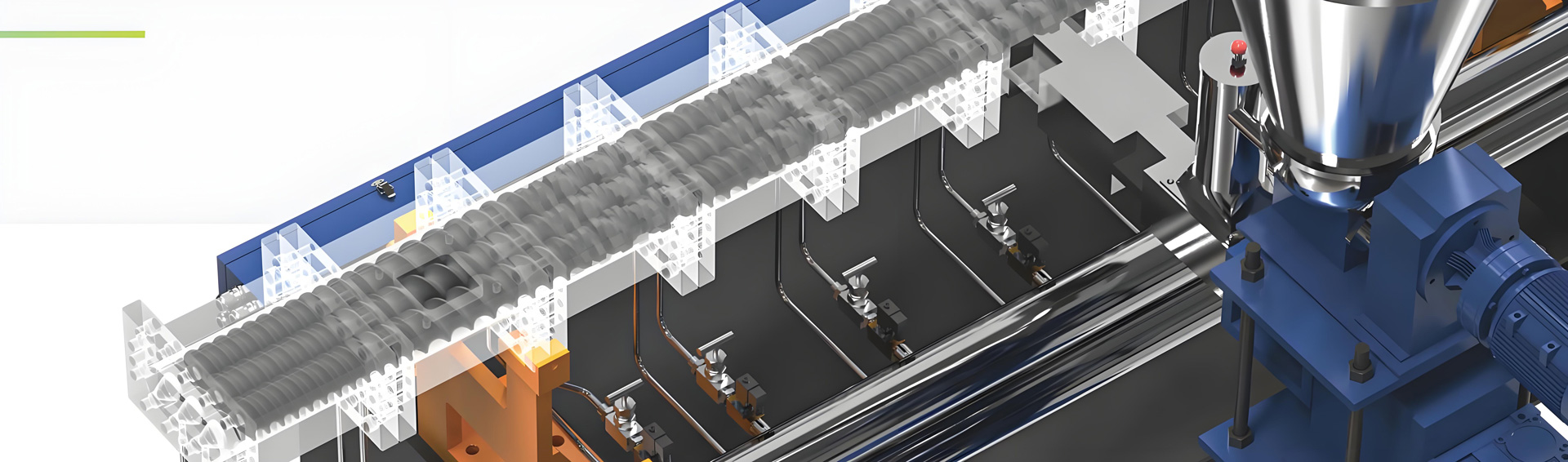
Mechanical dispersion through shear mixing represents the primary mechanism for breaking down pigment agglomerates. The amount and type of shear energy significantly influences dispersion quality. Co-rotating twin screw extruders provide superior dispersion capability compared to single screw systems, particularly for challenging organic pigments. Screw configuration design including mixing elements, kneading blocks, and reverse-conveying elements creates the shear conditions necessary for optimal dispersion. Kerke Compounding Extruder technology offers customizable screw configurations optimized for film-grade color masterbatch production. The cost of screw configuration optimization typically ranges from $15,000 to $40,000 for specialized film-grade designs.
Multiple pass processing through extrusion equipment can improve dispersion quality, particularly for challenging pigments or high pigment concentrations. A two-pass process where masterbatch is extruded, pelletized, and re-extruded can significantly improve dispersion uniformity. However, this approach increases production costs and requires additional equipment. Kerke Twin Screw Extruder systems can achieve excellent dispersion in a single pass through optimized screw design and process parameters. The additional cost for two-pass processing typically ranges from $400 to $800 per ton of masterbatch produced.
Dispersion quality assessment using microscopy and image analysis provides objective evaluation of dispersion effectiveness. Microscopic examination at 500x to 2000x magnification reveals pigment agglomerates and distribution uniformity. Image analysis software can quantify agglomerate size, number, and distribution. Film-grade color masterbatch typically requires maximum agglomerate size below 10-20 microns, with preferred agglomerate size below 5 microns for premium applications. Kerke Extruder quality control systems include microscopy and image analysis capabilities for dispersion assessment. The cost of microscopy and image analysis equipment ranges from $15,000 to $40,000 for a complete system.
Processing Guidelines for Film Applications
Optimal processing of color masterbatch for film applications requires attention to multiple factors including addition rates, mixing procedures, temperature profiles, and equipment configuration. Proper processing ensures consistent color development, prevents defects, and maximizes the value of masterbatch investment. Film applications present unique processing challenges due to high production speeds, thin gauges, and demanding appearance requirements. Following established processing guidelines helps manufacturers achieve reliable, high-quality colored film production.
Masterbatch addition rates for film applications are typically lower than for other plastic applications due to the thin film gauges and high surface area. Typical addition rates range from 1% to 6% depending on pigment strength, desired color intensity, and film thickness. Lighter colors and transparent films may require addition rates up to 8% to achieve adequate color development. Darker, saturated colors often require only 1-3% addition rates. Kerke Extruder application engineers provide addition rate recommendations based on specific color and application requirements. The cost of addition rate optimization testing typically ranges from $500 to $1,200 per color and application combination.
Dosing accuracy significantly impacts color consistency in film applications. Small variations in masterbatch addition rate can cause perceptible color differences due to the high sensitivity of color perception and the low addition rates used. Gravimetric dosing systems typically achieve accuracy of plus or minus 0.5% to 1.0%, providing adequate control for most film applications. Volumetric dosing systems offer lower cost but reduced accuracy, typically plus or minus 2% to 4%. For high-quality film applications, gravimetric dosing is strongly recommended. Kerke Masterbatch Extruder systems can be integrated with various dosing systems. The cost of gravimetric dosing systems for film applications typically ranges from $12,000 to $35,000 per station.
Pre-mixing color masterbatch with base resin before extrusion can improve color uniformity, particularly for light colors and transparent films. Tumble blending or batch mixing for 5-15 minutes ensures masterbatch distribution throughout the resin before entering the extruder. Pre-mixing becomes increasingly important as addition rates decrease below 2%. However, pre-mixing adds handling steps and potential contamination risks. Kerke Compounding Extruder masterbatch formulations are designed to achieve excellent distribution without pre-mixing, though pre-mixing can further enhance uniformity. The cost of pre-mixing equipment typically ranges from $8,000 to $20,000 for tumble blenders suitable for resin blending.
Processing temperature optimization is essential for achieving proper color development without degrading pigments or polymer. Different pigments have different thermal stability limits, with organic pigments typically more sensitive than inorganic pigments. Processing temperatures should be set to ensure adequate polymer melt flow while staying below pigment degradation temperatures. Typical processing temperatures for polyethylene film range from 180°C to 230°C, while polypropylene film typically processes at 190°C to 250°C. Kerke Twin Screw Extruder systems provide precise temperature control across multiple barrel zones, enabling optimization for specific masterbatch formulations. The cost of temperature profiling studies typically ranges from $800 to $2,000 per formulation.
Screw speed and shear rate influence both color development and film quality. Higher shear rates generally improve color development through enhanced mixing and dispersion but can increase melt temperature and potential polymer degradation. Optimal screw speed depends on equipment design, polymer type, and masterbatch characteristics. For film extruders, screw speeds typically range from 50 to 150 rpm depending on extruder size and film speed. Kerke Extruder application engineers provide screw speed recommendations based on specific application requirements. The cost of screw speed optimization studies typically ranges from $600 to $1,500 per application.
Die design and configuration significantly affect color uniformity across the film width. Poor die flow can cause color banding or uneven color distribution. Modern film dies incorporate spiral flow channels that promote uniform melt distribution. Regular die cleaning and maintenance are essential for preventing color contamination and maintaining uniformity. Kerke Compounding Extruder masterbatch formulations are designed for good flow characteristics through film dies. The cost of die optimization studies typically ranges from $2,000 to $5,000 per die design.
Common Problems and Solutions
Color masterbatch processing for film applications can encounter various problems that affect color quality, film appearance, or production efficiency. Understanding common problems, their causes, and effective solutions enables manufacturers to maintain high quality production while minimizing downtime and material waste. Early problem identification and rapid response prevents small issues from becoming major production disruptions.
Color specks and streaks represent one of the most common problems in colored film production. These visible defects typically result from poor pigment dispersion, pigment agglomeration, or contamination. Small pigment agglomerates that are acceptable in thicker molded products become highly visible in thin films. Solutions include improving dispersion through higher shear, optimizing dispersing agent dosage, reducing masterbatch addition rate while maintaining color strength through higher pigment loading, and implementing filtration before the die. Kerke Twin Screw Extruder systems can be configured with enhanced mixing elements to eliminate color specks. The cost of filtration systems for film extrusion typically ranges from $5,000 to $15,000 depending on filtration requirements.
Color variation across film width or through the production run indicates processing or raw material inconsistencies. Width variations typically result from die flow problems, screw design issues, or inadequate mixing. Run-to-run variations often stem from temperature fluctuations, speed changes, or raw material batch changes. Implementing process control systems, regular calibration, and consistent raw material quality reduces color variations. Kerke Masterbatch Extruder quality systems ensure consistent masterbatch characteristics between batches. The cost of process control implementation typically ranges from $25,000 to $70,000 for a complete system.
Poor color strength or washed-out appearance indicates insufficient pigment loading, poor pigment quality, or pigment degradation during processing. Solutions include increasing masterbatch addition rate, verifying pigment quality and specifications, reducing processing temperatures to prevent pigment degradation, and evaluating alternative pigments with higher color strength. Kerke Compounding Extruder technology can produce masterbatch with higher pigment concentrations while maintaining dispersion quality. The cost of reformulating for improved color strength typically ranges from $2,000 to $5,000 per color.
Gel formation or haziness in transparent or lightly colored films can result from masterbatch incompatibility, overheating, or crosslinking. Solutions include verifying masterbatch and resin compatibility, reducing processing temperatures, checking for contamination, and evaluating alternative carrier resins with better compatibility. Kerke Extruder application engineers can recommend compatible masterbatch formulations for specific film applications. The cost of compatibility testing typically ranges from $800 to $2,000 per resin/masterbatch combination.
Color change or fading during film storage or use indicates inadequate lightfastness or pigment migration. Lightfastness is particularly important for films exposed to sunlight such as agricultural films or outdoor packaging. Solutions include selecting pigments with appropriate lightfastness ratings, adding UV stabilizers to the formulation, and evaluating barrier coatings for additional protection. Kerke Twin Screw Extruder can produce masterbatch formulations with enhanced lightfastness for demanding applications. The cost of reformulating for improved lightfastness typically adds $500 to $1,500 per ton to masterbatch production costs.
Processing difficulties such as melt instability, surging, or poor melt strength can result from masterbatch affecting rheological properties. Solutions include optimizing carrier resin selection to match base resin rheology, adjusting processing temperatures, and evaluating processing aids to improve melt stability. Kerke Masterbatch Extruder formulations can be customized to minimize effects on film processing characteristics. The cost of rheological optimization typically ranges from $1,500 to $3,500 per formulation.
Quality Control Systems
Comprehensive quality control systems are essential for producing consistent, high-quality color masterbatch for film applications. Quality control encompasses raw material inspection, in-process monitoring, finished product testing, and application performance validation. Each quality control point contributes to overall product consistency and customer satisfaction. The film industry’s demanding requirements for color accuracy and appearance make quality control particularly critical compared to other plastic applications.
Raw material quality control ensures consistent incoming material quality for pigments, carrier resins, and additives. Pigment testing includes color measurement, particle size analysis, thermal stability assessment, and chemical analysis. Carrier resin testing includes melt flow index, density, molecular weight distribution, and additive content verification. Kerke Extruder quality control systems include comprehensive raw material testing capabilities. The cost of raw material testing typically ranges from $300 to $800 per material batch.
In-process quality monitoring tracks critical parameters during masterbatch production to ensure consistent product quality. Key monitoring points include melt temperature, pressure, torque, screw speed, and throughput rate. Color measurement during production enables real-time adjustment and early detection of color drift. Modern process control systems integrate color measurement for automated color consistency maintenance. Kerke Twin Screw Extruder systems feature advanced process control with color monitoring capabilities. The cost of in-process color monitoring systems typically ranges from $20,000 to $50,000 for a complete installation.
Finished product testing evaluates masterbatch characteristics including color accuracy, dispersion quality, pigment content, melt flow index, and thermal stability. Color accuracy measurement uses spectrophotometers with appropriate measurement geometry for film applications. Dispersion quality assessment includes microscopy and image analysis. Pigment content verification ensures correct concentration and batch-to-batch consistency. Kerke Masterbatch Extruder quality laboratories include comprehensive testing capabilities. The cost of quality testing equipment ranges from $30,000 to $80,000 for a complete film-grade masterbatch testing laboratory.
Batch-to-batch consistency verification ensures that different production batches produce equivalent color and performance. Statistical analysis of color measurements establishes control limits for color consistency. Tolerance testing validates that production batches remain within acceptable color limits. Kerke Compounding Extruder systems produce masterbatch with excellent batch-to-batch consistency, typically maintaining color within Delta E 0.5 to 1.0 for standard applications. The cost of consistency verification testing typically ranges from $200 to $500 per batch.
Application testing validates masterbatch performance in actual film production and end-use conditions. This testing includes film extrusion trials, color measurement on produced film, mechanical property testing, and performance evaluation under use conditions. Application testing ensures that masterbatch meets specific customer requirements and performs reliably in the intended application. Kerke Extruder application laboratories provide comprehensive testing services for film applications. The cost of application testing typically ranges from $1,500 to $4,000 per application and color combination.
Cost Analysis
Understanding the cost structure of color masterbatch production for film applications enables manufacturers to optimize their operations and make informed investment decisions. Cost analysis encompasses raw material costs, processing costs, equipment investment, and quality control expenses. This comprehensive view helps manufacturers evaluate production economics and develop competitive pricing strategies while maintaining profitability.
Pigment costs represent the most significant cost component for color masterbatch, typically accounting for 60-80% of raw material costs depending on color and pigment quality. Standard organic pigments range from $8,000 to $25,000 per ton. Premium high-performance pigments can cost $30,000 to $80,000 per ton or more. Inorganic pigments generally cost less, ranging from $3,000 to $15,000 per ton. For 40% pigment masterbatch using standard organic pigments, the pigment component costs approximately $3,200 to $10,000 per ton. Kerke Extruder can provide sourcing recommendations for pigments offering optimal balance of cost and performance. Bulk pigment purchasing contracts can reduce costs by 8-15% compared to spot market prices.
Carrier resin costs for film applications typically range from $1,500 to $3,000 per ton for standard polyethylene and polypropylene grades. Specialty resins for high-performance films can cost $4,000 to $7,000 per ton. Dispersing agents and processing aids add $300 to $800 per ton. Additional additives such as slip agents, antiblock agents, or UV stabilizers can add $500 to $1,500 per ton depending on formulation. Total raw material costs for standard film-grade color masterbatch typically range from $4,500 to $11,000 per ton, with specialty formulations reaching $12,000 to $25,000 per ton.
Processing costs include energy consumption, labor, equipment depreciation, and maintenance. Energy costs for masterbatch production typically range from $80 to $150 per ton. Labor costs average $50 to $120 per ton. Equipment depreciation based on 10-year equipment life represents $250 to $500 per ton. Maintenance costs average $50 to $100 per ton. Total processing costs typically range from $430 to $870 per ton. Kerke Twin Screw Extruder systems minimize processing costs through energy-efficient design and low maintenance requirements.
Equipment investment varies significantly based on production capacity and technology level. Small capacity lines (300-800 kg/hr) typically cost $320,000 to $480,000. Medium capacity lines (800-1,800 kg/hr) cost $480,000 to $750,000. High capacity lines (1,800-4,000 kg/hr) require investment of $750,000 to $1,300,000. Kerke Extruder offers a complete range of film-grade color masterbatch production lines with competitive pricing and advanced technology. The payback period for color masterbatch production equipment typically ranges from 2.5 to 4 years based on market demand and profit margins.
Quality control costs include testing equipment, laboratory operations, and personnel. Testing equipment investment ranges from $30,000 to $80,000 for a complete quality laboratory. Laboratory operating costs including consumables and maintenance average $40,000 to $100,000 annually depending on testing volume. Quality control personnel costs range from $80,000 to $150,000 annually depending on laboratory size and testing requirements. Total quality control costs typically range from $150,000 to $330,000 annually for a medium-sized operation.
Total production costs for standard film-grade color masterbatch typically range from $5,210 to $12,670 per ton, with specialty formulations reaching $13,130 to $26,170 per ton. Profit margins in the color masterbatch market typically range from 15-30% depending on color complexity, market competition, and value-added services. Market prices for standard film-grade color masterbatch range from $6,000 to $16,500 per ton, while specialty high-performance colors command $15,000 to $35,000 per ton. Kerke Extruder equipment enables production of high-quality color masterbatch that can command premium pricing in the market.
Kerke Equipment for Film Color Masterbatch
Kerke Extruder offers specialized equipment specifically designed for color masterbatch production for film applications, addressing the unique requirements of fine pigment dispersion and color consistency. The KSE series twin screw extruders provide superior dispersion, precise temperature control, and excellent product consistency essential for film-grade masterbatch production. Selecting the appropriate equipment depends on production requirements, color range complexity, and quality standards.
The KSE-75 Twin Screw Extruder represents an excellent choice for small to medium capacity film-grade color masterbatch production. With a 75mm screw diameter and L/D ratio of 40:1, this model provides throughput capacity of 300-800 kg/hr for color masterbatch applications. The advanced screw configuration with multiple mixing zones ensures optimal pigment dispersion while maintaining polymer integrity. The KSE-75 includes 10 heating zones for precise temperature control, critical for maintaining color consistency. Kerke Twin Screw Extruder technology enables excellent color consistency with typical Delta E values below 1.0. The base price for the KSE-75 film-grade system is approximately $300,000 to $420,000 depending on configuration and options.
The KSE-90 Twin Screw Extruder offers increased capacity and enhanced performance for larger film masterbatch production requirements. With 90mm screw diameter and L/D ratio of 44:1, this model achieves throughput of 600-1,500 kg/hr for color masterbatch. The KSE-90 features 12 heating zones, advanced mixing elements specifically designed for pigment dispersion, and integrated color monitoring capabilities. This model is ideal for manufacturers producing a wide range of colors for various film applications. The KSE-90 system typically costs $420,000 to $650,000 depending on automation level and additional features.
The KSE-110 Twin Screw Extruder provides the highest capacity for large-scale film color masterbatch production. With 110mm screw diameter and L/D ratio of 48:1, this model delivers throughput of 1,200-3,000 kg/hr. The KSE-110 incorporates the latest technology for energy efficiency, product consistency, and automation. This model is suitable for dedicated color masterbatch production facilities serving the growing flexible packaging market. The investment for a complete KSE-110 line typically ranges from $650,000 to $1,100,000 depending on configuration and automation level.
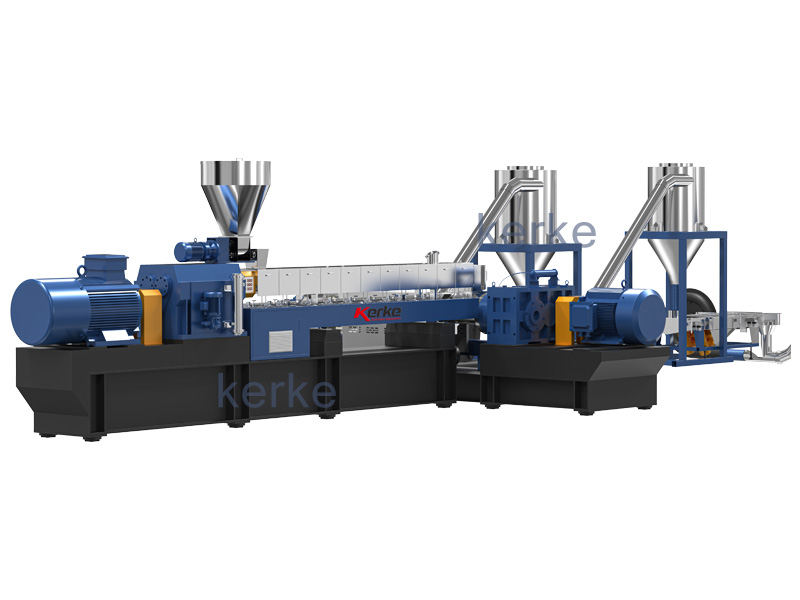
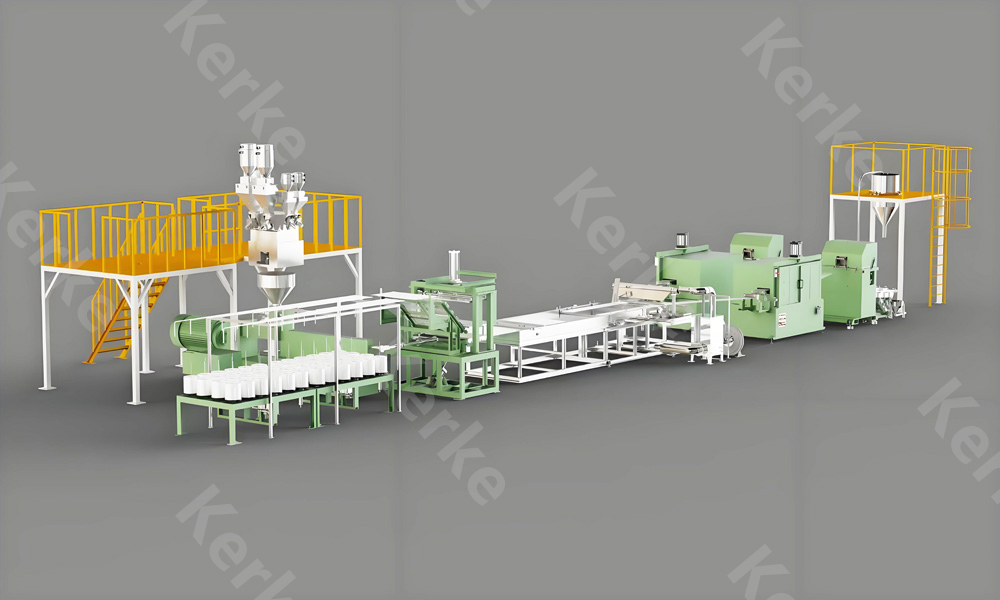
Kerke Film Color Masterbatch Compounding Systems include complete turnkey solutions for film-grade color masterbatch production. These systems integrate twin screw extruder, material handling equipment, precise feeding systems, cooling system, pelletizer, and comprehensive quality control equipment into a cohesive production line. The systems are designed for excellent pigment dispersion, tight color tolerances, and maximum uptime for demanding film applications. Turnkey system costs range from $400,000 for small capacity systems to $1,300,000 for high capacity, fully automated lines. Kerke Compounding Extruder technology ensures superior product quality and production efficiency for film color masterbatch.
Kerke Extruder also offers specialized components and accessories for film-grade color masterbatch production. These include high-precision gravimetric feeding systems for accurate pigment dosing, specialized mixing elements for challenging pigments, water ring pelletizing systems for uniform pellet size, and advanced color measurement systems. Gravimetric feeding systems cost $15,000 to $35,000. Specialized mixing elements range from $12,000 to $28,000. Water ring pelletizing systems cost $40,000 to $75,000. Advanced color measurement systems range from $15,000 to $40,000. Kerke Twin Screw Extruder systems integrate seamlessly with these components for complete production solutions tailored to film application requirements.
Market Trends and Future Outlook
The film color masterbatch market continues to evolve with advancing technology, changing consumer preferences, and emerging application requirements. Understanding current trends and future outlook helps manufacturers identify growth opportunities and make strategic investment decisions. The global film color masterbatch market is projected to grow at 5-7% annually through 2030, driven by increasing demand for flexible packaging and growing consumer interest in product appearance and brand differentiation.
Technology trends emphasize automation, digital color management, and advanced quality control. Industry 4.0 integration enables real-time color monitoring, automated recipe management, and predictive maintenance. Digital color management systems allow for precise color communication and specification across global supply chains. Kerke Masterbatch Extruder systems incorporate the latest automation and digital management capabilities. The investment in advanced automation and digital systems typically ranges from $40,000 to $120,000 for a complete system.
Product development trends include specialty effects such as metallic, pearlescent, and thermochromic colors for premium packaging applications. Sustainable and recyclable color masterbatch formulations address growing environmental concerns. Smart colors that change based on environmental conditions or provide authentication features represent emerging opportunities. Kerke Compounding Extruder technology supports formulation innovation through flexible processing capabilities and customizable screw configurations. The development cost for specialty effect colors typically ranges from $25,000 to $60,000 per color family.
Market growth is particularly strong in Asia Pacific, driven by expanding food packaging and consumer goods markets. China, India, and Southeast Asia represent high-growth regions for film color masterbatch. North America and Europe show moderate growth rates of 3-5% annually, with emphasis on sustainable and recyclable solutions. Kerke Extruder has established presence in key growth markets, providing local support and service for film color masterbatch production equipment.
Sustainability trends drive demand for recyclable color masterbatch formulations that do not interfere with plastic recycling processes. This includes masterbatch compatible with both mechanical and chemical recycling technologies. Bio-based carrier resins and sustainably sourced pigments are gaining market acceptance. Kerke Twin Screw Extruder systems can process both conventional and sustainable carrier resins, enabling manufacturers to adapt to changing market preferences. The cost premium for sustainable formulations typically ranges from 15-30% over conventional products.
Future market opportunities include color masterbatch for biodegradable films, smart films with color-changing properties, and antimicrobial colors for food packaging applications. Investment in R&D and equipment flexibility enables manufacturers to capture emerging market segments. Kerke Extruder modular design allows rapid adaptation to new formulations and product innovations as market requirements evolve. The investment in R&D capabilities typically ranges from $120,000 to $350,000 annually for competitive color masterbatch manufacturers serving the film market.
Conclusion
Color masterbatch for plastic film represents a vital component in the flexible packaging industry, enabling manufacturers to achieve vibrant, consistent colors while meeting demanding performance requirements. Success in film color masterbatch production and application requires understanding of color science, dispersion technology, quality control, and processing optimization. Investment in quality equipment from Kerke Extruder enables manufacturers to produce consistent, high-quality color masterbatch that meets the exacting requirements of film applications.
The comprehensive approach to film color masterbatch production, from pigment selection through quality control to market delivery, ensures product excellence and customer satisfaction. Kerke Twin Screw Extruder technology provides the foundation for achieving superior pigment dispersion, color consistency, and operational efficiency. Manufacturers investing in Kerke Extruder equipment benefit from competitive advantages in product quality, production efficiency, and market responsiveness.
The future of film color masterbatch production continues to evolve with advancing technology, changing market demands, and emerging applications. Companies maintaining technological leadership through equipment investment and process innovation will capture growth opportunities in this dynamic market. Kerke Extruder remains committed to advancing color masterbatch production technology, supporting manufacturers in achieving excellence in this critical industry segment.