The plastics industry continually seeks methods to improve material properties while managing production costs and sustainability objectives. Mineral fillers such as wollastonite provide an effective approach to enhancing polymer performance, offering stiffening effects, dimensional stability improvements, and cost reduction through partial replacement of expensive polymer resins. Among available mineral fillers, wollastonite stands out for its acicular particle morphology that provides reinforcement characteristics approaching those of glass fibers while enabling easier processing and better surface appearance in finished products.
Wollastonite filler masterbatch represents a concentrated preparation of surface-treated wollastonite particles dispersed in a carrier resin, designed for convenient incorporation into polymer systems. These masterbatches address the handling challenges associated with powdered mineral fillers, providing cleaner, more accurate addition while ensuring proper dispersion throughout the polymer matrix. For manufacturers seeking to improve their products through mineral reinforcement, understanding wollastonite filler masterbatch technology enables informed material selection and successful implementation.
This comprehensive guide examines the science and practice of wollastonite filler masterbatch production and application. We explore the unique characteristics of wollastonite as a mineral filler, the formulation considerations for effective masterbatch production, and the processing techniques that enable successful incorporation into polymer systems. Special attention focuses on the equipment capabilities necessary for producing high-quality wollastonite filler masterbatches that deliver consistent reinforcement effects.
What is Wollastonite Filler Masterbatch?
Wollastonite filler masterbatch is a concentrated composition containing processed wollastonite mineral particles dispersed in a polymer carrier, designed for incorporation into thermoplastic compounds to modify their mechanical, thermal, and processing characteristics. Unlike simple additive preparations, effective wollastonite masterbatch incorporates surface treatment technologies that improve particle-matrix adhesion and facilitate dispersion throughout the polymer system.
Wollastonite is a calcium metasilicate mineral with the chemical formula CaSiO3, occurring naturally in needle-like crystal formations that provide unique reinforcement capabilities. The aspect ratio of wollastonite particles, typically ranging from 3:1 to 20:1, creates interlocking structures within the polymer matrix that improve stiffness and dimensional stability while limiting flow in the melt state. This combination of reinforcement and viscosity modification enables manufacturers to tailor compound properties for specific processing and performance requirements.
Surface treatment of wollastonite particles proves essential for achieving effective reinforcement in polymer composites. Untreated wollastonite surfaces exhibit poor compatibility with many polymer systems, resulting in weak interfacial bonding and compromised mechanical properties. Silane coupling agents and other surface treatments modify the wollastonite surface chemistry to improve adhesion with specific polymer matrices, enabling transfer of stress from the polymer to the reinforcing particles and maximizing the benefits of wollastonite addition.
Role of Twin Screw Extruder in Wollastonite Filler Masterbatch Production
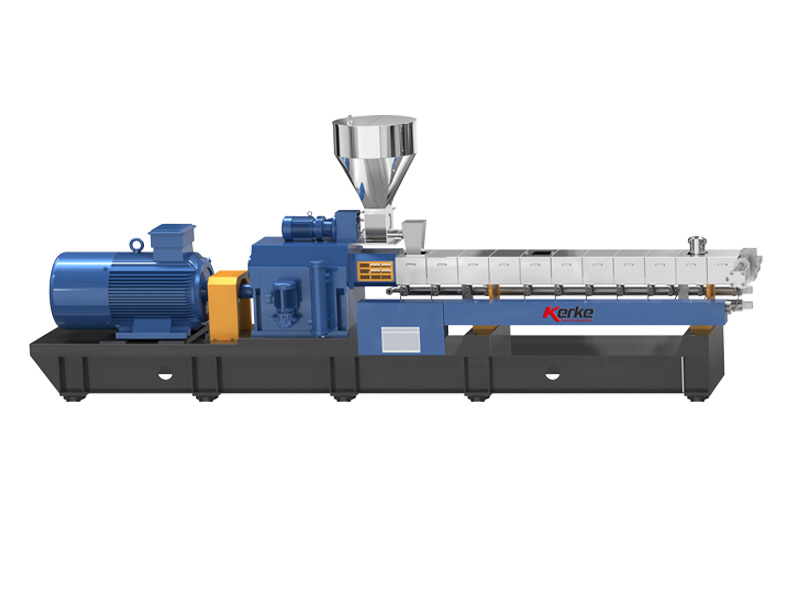
The production of effective wollastonite filler masterbatch demands exceptional mixing capabilities and robust equipment construction that twin screw extrusion technology provides. Nanjing Kerke Extrusion Equipment Co., Ltd has developed the KTE series compounding extruders specifically optimized for the challenging requirements of mineral-filled masterbatch production.
High filler loadings in wollastonite masterbatch create processing challenges that require specialized equipment capabilities. The KTE series extruders feature heavy-duty drive systems capable of handling the elevated torque requirements of high-viscosity mineral-filled compounds. Robust barrel and screw construction withstands the abrasive nature of mineral fillers, extending equipment life and maintaining processing precision throughout extended production runs.
Effective dispersion of wollastonite particles throughout the carrier resin requires intensive mixing that breaks apart agglomerates and distributes individual particles uniformly. The co-rotating, intermeshing screw configuration of twin screw extruders creates conditions ideal for this dispersion process, with kneading blocks and mixing elements providing the shear forces necessary for particle deagglomeration and distribution. Kerke screw designs incorporate specialized mixing geometries optimized for mineral-filled formulations.
Working Principle of Compounding Extruder
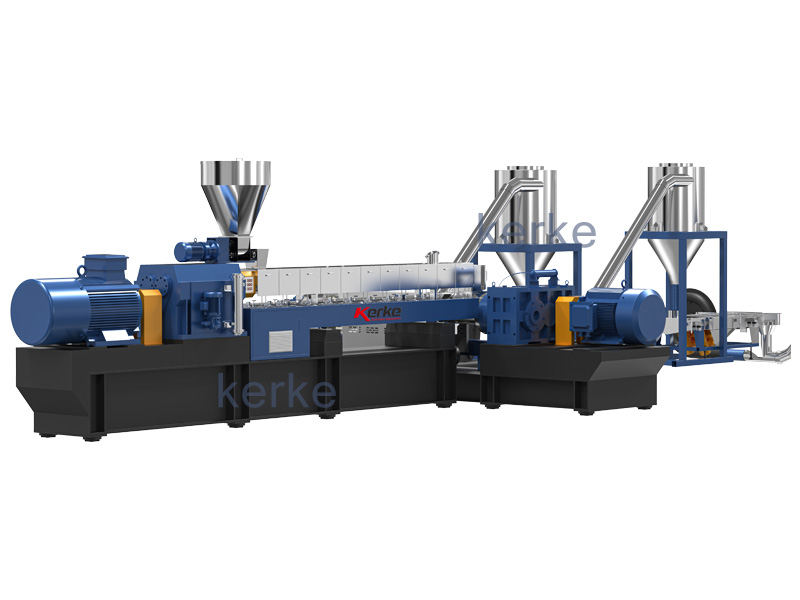
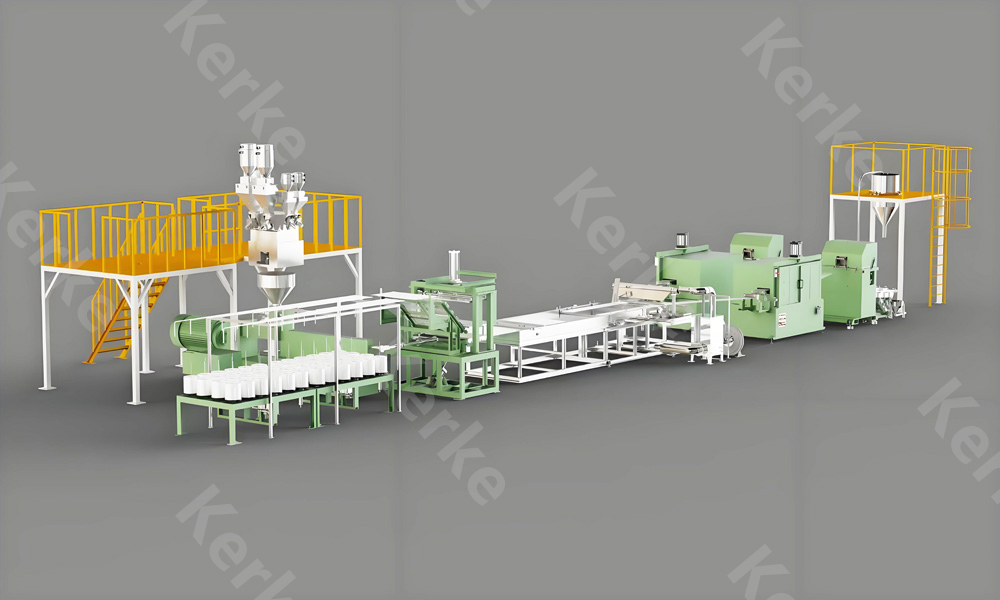
Understanding the operational principles of the compounding extruder provides context for the unique requirements of wollastonite filler masterbatch production. The twin screw extruder integrates feeding, melting, mixing, and discharge functions in a continuous process that transforms raw materials into finished masterbatch.
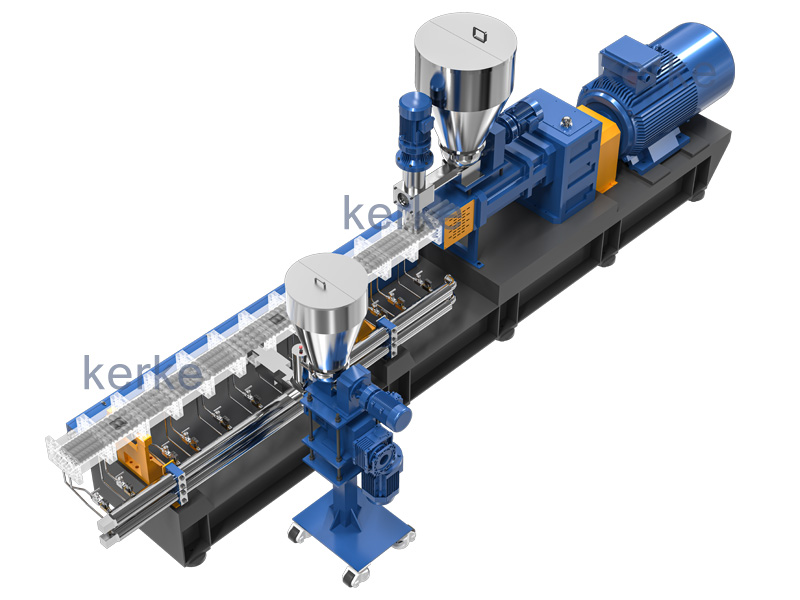
Feeding systems for wollastonite masterbatch production must handle both polymer resin and mineral filler materials with appropriate accuracy and reliability. Gravimetric feeders provide precise addition rates for both components, ensuring consistent filler loadings in finished products. Side-feeder configurations enable incorporation of mineral fillers at positions along the processing length where polymer melting has progressed sufficiently to create a molten matrix for particle incorporation and dispersion.
The melting and mixing section of the compounding extruder must accommodate the processing requirements of highly filled compounds. Extended barrel sections provide additional processing length for achieving adequate dispersion of high filler loadings. Screw configurations incorporating intensive mixing elements positioned after filler introduction ensure thorough incorporation and distribution of wollastonite particles throughout the polymer matrix.
Discharge and pelletization systems for mineral-filled masterbatches must address the abrasive nature of wollastonite particles. Wear-resistant pelletizing equipment extends maintenance intervals and ensures consistent pellet quality throughout production runs. The resulting masterbatch pellets exhibit the uniform composition and handling characteristics necessary for downstream polymer processing.
Kerke KTE Series Extruder Features
Nanjing Kerke Extrusion Equipment Co., Ltd has established its reputation through decades of engineering development supporting demanding compounding applications. The KTE series twin screw extruders incorporate features specifically designed for the challenging requirements of wollastonite filler masterbatch production.
The comprehensive range of KTE series models spans production capacities from laboratory development through high-volume commercial manufacturing. The KTE-16B laboratory extruder supports formulation development and small-batch production, while larger models including the KTE-52, KTE-65, KTE-90, and KTE-135 address commercial production requirements. This range enables consistent technology transfer from development to full-scale production.
Heavy-duty drive systems provide the torque capacity necessary for processing highly filled compounds. High-power motors drive robust gearboxes that transmit power to the screw system without compromise, even when processing the high-viscosity materials characteristic of wollastonite masterbatch formulations. This power capability enables consistent throughput rates that support economical production.
Wear-resistant construction throughout the processing section extends equipment life when processing abrasive mineral-filled materials. Hardened barrel liners, specialized screw element materials, and wear-resistant seals combine to provide reliable operation despite the demanding processing conditions. These construction features reduce maintenance requirements and ensure consistent processing performance throughout extended production campaigns.
Applications and Performance Benefits
Wollastonite filler masterbatch serves diverse applications across the plastics industry, with each application benefiting from the unique combination of reinforcement, thermal properties, and processing effects that wollastonite provides. Understanding these application areas helps manufacturers identify opportunities for wollastonite technology to improve their products and manufacturing operations.
Automotive Interior Components
Automotive interior applications demand materials combining good surface appearance, dimensional stability, and cost-effectiveness. Wollastonite reinforcement improves stiffness and reduces thermal expansion coefficients that could cause dimensional problems in components exposed to temperature variations. The improved heat deflection temperature enables thinner section designs while maintaining performance under elevated temperature conditions.
Surface appearance requirements in automotive interiors demand careful attention to wollastonite dispersion quality and particle size distribution. Properly formulated wollastonite masterbatches enable production of components with smooth surfaces suitable for visible applications without the fiber protrusion sometimes observed with glass fiber reinforcement. The acicular particle morphology creates less visible reinforcement effects compared to fibrous fillers.
Electrical and Electronics Components
Electrical and electronics applications benefit from the improved arc resistance and tracking resistance that wollastonite reinforcement provides in certain polymer systems. The mineral filler reduces the polymer content in composite formulations, potentially improving fire retardant performance and reducing smoke generation during combustion. Dimensional stability improvements prove particularly valuable in precision electrical components.
The thermal conductivity improvements that wollastonite provides benefit applications where heat dissipation is important. Electronic component housings and structural supports benefit from improved thermal management that protects sensitive components from overheating. The combination of thermal and mechanical property improvements makes wollastonite an attractive reinforcement option for demanding electronics applications.
Building and Construction Materials
Building and construction applications prioritize cost-effectiveness, durability, and weather resistance. Wollastonite reinforcement improves the stiffness and dimensional stability necessary for structural components while providing cost reduction through partial polymer replacement. Weather resistance improvements benefit exterior applications exposed to environmental conditions.
The high aspect ratio of wollastonite particles provides reinforcement effects that support downgauging initiatives, reducing material consumption while maintaining performance requirements. This combination of material efficiency and cost reduction aligns with sustainability objectives while supporting competitive pricing for construction applications.
Properties and Performance Characteristics
Wollastonite filler masterbatch modifies polymer properties across multiple performance categories, enabling manufacturers to tailor compounds for specific application requirements. Understanding these property modifications helps designers specify appropriate filler loadings and select masterbatch formulations that achieve target performance levels.
Mechanical Properties
Wollastonite reinforcement improves tensile strength, flexural modulus, and impact resistance compared to unfilled polymers when properly dispersed and bonded to the polymer matrix. The degree of property improvement depends on filler loading level, particle aspect ratio, surface treatment effectiveness, and compatibility between the wollastonite surface and the polymer matrix. Higher aspect ratio particles generally provide greater reinforcement effects but may create processing challenges.
Flexural modulus improvements of 50 to 100 percent are achievable with wollastonite loadings of 30 to 40 weight percent, depending on the base polymer and masterbatch formulation. These stiffness improvements enable section thickness reduction while maintaining structural performance, directly reducing material consumption and component weight in appropriate applications.
Thermal Properties
Wollastonite addition improves heat deflection temperature by increasing the effective glass transition temperature and reducing thermal expansion coefficients. Components requiring resistance to elevated temperature exposure benefit from these improvements, enabling use in applications where unfilled polymers would deform or lose stiffness.
Thermal conductivity improvements enable more effective heat dissipation in applications where thermal management is important. While wollastonite does not provide the thermal conductivity improvements of specialized conductive fillers, the modest improvements compared to unfilled polymers can benefit applications with moderate thermal management requirements.
Processing Characteristics
Wollastonite masterbatch affects melt flow behavior, increasing viscosity at low shear rates while potentially reducing viscosity at high shear rates characteristic of injection molding or extrusion processing. This complex rheological behavior requires formulation optimization for specific processing methods and part geometries.
Shrinkage reduction represents one of the most valuable processing benefits of wollastonite addition. Reduced mold shrinkage improves dimensional consistency and reduces warpage in injection molded parts. The improved dimensional stability simplifies mold design and reduces the need for conservative dimensional tolerances.
Formulation and Composition
Effective wollastonite filler masterbatch formulations require careful attention to raw material selection, surface treatment, and carrier compatibility. Formulation scientists must balance reinforcement effectiveness, processing behavior, and cost considerations to develop products meeting specific application requirements.
Wollastonite particle characteristics significantly influence final compound properties. Particle size distribution affects dispersion quality, surface appearance, and mechanical reinforcement effectiveness. High aspect ratio particles provide greater reinforcement but may create processing difficulties or surface appearance problems. The formulation scientist must select particle characteristics appropriate for the target application and processing method.
Surface treatment selection ensures adequate interfacial bonding between wollastonite particles and the polymer matrix. Silane coupling agents provide effective bonding for many polymer systems, with specific silane chemistries matched to polymer functionality. Amine-functional silanes work well with polyamides and other polymers with hydrogen bonding capabilities, while vinyl and methacrylate silanes provide effective bonding with polyolefins when properly formulated.
Carrier resin selection ensures compatibility between the masterbatch and the target polymer system. The carrier should exhibit good miscibility with the base polymer while providing appropriate melt flow characteristics for the intended processing method. Polypropylene and polyethylene carriers serve many general-purpose applications, while engineering polymer carriers may be required for demanding applications with specific compatibility requirements.
Production Process for Wollastonite Filler Masterbatch
The production of wollastonite filler masterbatch follows a systematic process that addresses the unique handling and processing challenges of mineral-filled compounds. Careful attention to process parameters ensures that wollastonite particles achieve adequate dispersion while maintaining equipment reliability and production efficiency.
Wollastonite raw material preparation includes particle size classification, surface treatment application, and quality verification before compounding. Surface treatments may be applied by the mineral supplier or incorporated during the masterbatch production process. The effectiveness of surface treatment application influences the reinforcement properties achievable in finished masterbatch products.
Compounding extrusion processes the formulation through conditions optimized for mineral-filled compounds. Processing temperatures must ensure complete polymer melting while avoiding thermal degradation. Screw speed and throughput rate determine residence time and shear intensity, requiring optimization to balance dispersion quality against equipment capacity and product quality.
Pelletization and packaging complete the production process, converting compounded material into finished masterbatch suitable for customer delivery. The underwater pelletization process provides rapid cooling and generates uniform pellets suitable for handling and storage. Quality testing verifies particle distribution, surface treatment effectiveness, and physical characteristics before release for shipment.
Technical Parameters and Specifications
Wollastonite filler masterbatch specifications encompass parameters that determine fitness for specific applications and processing methods. Understanding these specifications enables customers to select appropriate products for their requirements.
Filler loading level represents a primary specification parameter, typically ranging from 50 to 80 weight percent depending on the formulation and intended application. Higher loadings reduce addition rates required to achieve target filler levels in final compounds but may create dispersion or processing challenges. Formulation data sheets provide guidance on appropriate loadings for specific applications.
Particle size distribution and aspect ratio influence reinforcement effectiveness and surface appearance characteristics. Specifications should define acceptable particle size ranges and aspect ratio distributions that ensure consistent performance across production lots. Testing methods including laser diffraction and microscopy examination verify particle characteristics.
Moisture content specifications ensure that masterbatch does not introduce moisture-related defects in finished compounds. Wollastonite materials may absorb moisture during handling and storage, requiring drying before compounding or special processing techniques to remove moisture during extrusion. Finished masterbatch should meet moisture specifications appropriate for the target application.
Cost and Price Analysis
Understanding the economics of wollastonite filler masterbatch enables manufacturers to evaluate the cost-effectiveness for specific applications. The value proposition extends beyond purchase price to include property improvements, material reduction benefits, and processing efficiencies that may reduce total production costs.
Wollastonite mineral costs typically range from $200 to $500 per metric ton depending on purity, particle characteristics, and surface treatment. These costs compare favorably with polymer resin costs, creating opportunities for cost reduction through partial polymer replacement. The economics become more favorable as polymer prices increase relative to mineral filler costs.
Surface treatment and processing costs add to base mineral costs, with silane coupling agents typically ranging from $10 to $50 per kilogram depending on chemistry and application requirements. The additional cost of surface treatment must be evaluated against the property improvements achievable with improved interfacial bonding.
Commercial wollastonite filler masterbatches typically price from $2 to $8 per kilogram depending on filler loading, surface treatment complexity, and volume requirements. Standard 70 percent loading formulations may price in the $2 to $4 range, while specialty formulations with advanced surface treatments or engineering polymer carriers may exceed $6 per kilogram. The cost-effectiveness evaluation should consider both masterbatch price and the property improvements achievable at specific addition rates.
Equipment Selection Guide
Selecting compounding equipment for wollastonite filler masterbatch production requires evaluation of capabilities specific to mineral-filled compound processing. The demands of high filler loadings and abrasive materials influence equipment selection in ways that differ from standard masterbatch applications.
Torque capacity requirements increase significantly with filler loading, requiring equipment with robust drive systems capable of handling high-viscosity materials. Kerke offers the KTE series with motor power ratings and gearbox capacities appropriate for the most demanding mineral-filled compound production requirements. Equipment selection should verify that specified torque ratings accommodate the target filler loadings.
Wear resistance capabilities determine equipment life and maintenance requirements in mineral-filled compound production. Hardened barrel liners, specialized screw materials, and wear-resistant seals provide the durability necessary for reliable production. Equipment specifications should clearly define wear resistance characteristics and expected maintenance intervals for mineral-filled applications.
Feeding system capabilities must address the challenges of handling both polymer resin and mineral filler materials. Gravimetric feeding systems provide the accuracy necessary for consistent filler loadings, while side-feeder configurations enable effective filler incorporation at appropriate processing positions. Equipment selection should verify that feeding systems are appropriately configured for the target formulations.
Production Quality Control
Quality control for wollastonite filler masterbatch production addresses both compound characteristics and equipment performance considerations unique to mineral-filled formulations. Comprehensive quality systems ensure that products meet specifications while maintaining production efficiency.
Incoming material verification confirms that wollastonite and surface treatment materials meet specifications before production use. Particle size distribution, moisture content, and surface chemistry characterization verify raw material consistency. Only materials passing verification tests enter production use, preventing quality problems from substandard raw materials.
Process monitoring during production tracks parameters indicating equipment condition and product quality. Motor load, melt pressure, and temperature measurements reveal processing conditions and potential problems. Regular sampling enables quality testing that verifies dispersion quality and physical characteristics.
Finished product testing verifies that masterbatch meets specifications for filler loading, dispersion quality, and physical characteristics. Testing methods include gravimetric analysis for filler content, microscopy examination for dispersion quality, and physical property testing for melt flow and mechanical characteristics. Certificate of analysis documentation summarizes test results for each production batch.
Common Issues and Solutions
Wollastonite filler masterbatch applications may encounter problems related to dispersion, surface appearance, or processing behavior. Understanding common issues and their solutions enables manufacturers to address problems effectively and optimize their processes.
Poor mechanical properties in finished compounds typically indicate inadequate dispersion or insufficient interfacial bonding between wollastonite and the polymer matrix. Verify that masterbatch addition rates match specifications and that mixing during compound production provides adequate dispersion. If bonding appears insufficient, consider alternative masterbatch formulations with improved surface treatment for the specific polymer system.
Surface defects including pits, scratches, or rough texture may result from inadequate dispersion of wollastonite particles or from contamination in the compound. Ensure that masterbatch is properly dried before use and that compound production equipment is clean. Evaluate alternative masterbatch products with improved dispersion quality or smaller particle sizes for surface-critical applications.
Processing difficulties including surging, high pressure, or equipment overload indicate compatibility problems between the masterbatch and the processing equipment or polymer system. Verify that processing temperatures and screw configurations are appropriate for the specific masterbatch formulation. Consult with masterbatch suppliers regarding recommended processing conditions for their products.
Maintenance and Operation
Proper equipment maintenance for wollastonite filler masterbatch production addresses the increased wear rates associated with mineral-filled compound processing. Preventive maintenance programs must account for these accelerated wear patterns to maintain production quality and equipment reliability.
Wear component inspection and replacement becomes more critical in mineral-filled compound production. Barrel liners, screw elements, and seals experience accelerated wear rates that require more frequent inspection and replacement compared to unfilled compound processing. Establishing appropriate maintenance intervals based on production volumes ensures continued processing quality.
Equipment cleaning between production runs prevents cross-contamination that could affect product quality. Thorough purging of processing equipment removes residual materials before transitioning to different formulations. Dedicated cleaning compounds may be employed for thorough cleaning of equipment processing abrasive mineral-filled materials.
Process documentation captures the parameters and procedures that enable consistent production. Standard operating procedures define optimal processing conditions for specific formulations. Production logs record actual processing conditions, enabling identification of trends and problems that might affect product quality.
Market Trends and Industry Development
The wollastonite filler market continues to evolve in response to changing industry requirements, sustainability pressures, and technological developments. Understanding these trends helps manufacturers anticipate future opportunities and challenges.
Sustainability requirements drive increasing interest in mineral fillers as partial polymer replacements that reduce material consumption and associated environmental impacts. Wollastonite provides functional benefits that enable downgauging and material efficiency improvements beyond simple volumetric replacement. These sustainability benefits align with industry environmental objectives and regulatory pressures.
Electric vehicle applications create new requirements for polymer composites with enhanced thermal management, flame retardancy, and structural performance. Wollastonite reinforcement addresses some of these requirements while providing cost-effectiveness compared to alternative reinforcement technologies. The growth of electric vehicle production creates expanding opportunities for advanced filler masterbatch formulations.
Bio-based and recycled polymer applications increasingly require reinforcement strategies that maintain performance while meeting sustainability objectives. Wollastonite can provide effective reinforcement for these emerging polymer systems, though formulation optimization may be required to address the different surface characteristics and processing behaviors of sustainable polymer materials.
Why Choose Kerke Extruder
Nanjing Kerke Extrusion Equipment Co., Ltd provides the compounding equipment capabilities necessary for producing high-quality wollastonite filler masterbatches that meet demanding application requirements. Engineering excellence, manufacturing capability, and global support establish Kerke as a preferred partner for mineral-filled masterbatch production.
The KTE series twin screw extruders offer the torque capacity, wear resistance, and mixing performance necessary for effective wollastonite masterbatch production. Heavy-duty drive systems handle the high-viscosity materials characteristic of mineral-filled compounds. Wear-resistant construction extends equipment life while maintaining processing precision.
Kerke manufacturing facilities spanning nearly 20,000 square meters enable production of compounding equipment meeting the most demanding quality standards. Modern manufacturing equipment ensures precision fabrication of components for critical processing applications. Comprehensive quality management systems verify that every machine meets specifications for performance and reliability.
Global presence in over 70 countries ensures that Kerke customers receive responsive support regardless of location. Factory-trained distributors provide local sales and service capabilities, while Kerke technical specialists offer advanced support for complex applications. This global network supports long-term partnership and supply continuity that mineral-filled masterbatch producers require.
Frequently Asked Questions
What filler loading levels are available in wollastonite masterbatch?
Wollastonite masterbatches typically range from 50 to 80 percent filler loading depending on the formulation and carrier system. Lower loadings offer easier processing and better dispersion, while higher loadings provide cost-effective concentration. Technical data sheets specify loading levels and recommended addition rates for specific products.
How does wollastonite compare to glass fiber reinforcement?
Wollastonite provides lower reinforcement levels than glass fibers but offers advantages in surface appearance, processing ease, and dimensional stability. Wollastonite-reinforced compounds exhibit less warpage and smoother surfaces compared to glass fiber compounds at equivalent reinforcement levels. The choice depends on specific application requirements for mechanical properties, surface appearance, and processing characteristics.
Can wollastonite masterbatch be used with recycled polymers?
Yes, wollastonite can provide effective reinforcement for recycled polymers that may have degraded properties compared to virgin materials. However, recycled polymers may require additional testing to verify compatibility and optimal loading levels. Surface treatment effectiveness may also vary depending on the contamination levels and processing history of recycled materials.
What surface treatments improve wollastonite bonding?
Silane coupling agents provide effective interfacial bonding between wollastonite and polymer matrices. Amine-functional silanes work well with polar polymers, while vinyl and methacrylate silanes are effective with polyolefins. The specific silane selection depends on the target polymer system and performance requirements.
How does wollastonite affect mold shrinkage?
Wollastonite significantly reduces mold shrinkage compared to unfilled polymers. Typical shrinkage reductions range from 30 to 50 percent depending on filler loading and polymer type. This shrinkage reduction improves dimensional consistency and reduces warpage in injection molded parts.
What is the typical addition rate for wollastonite masterbatch?
Addition rates depend on the target filler loading in the final compound and the loading level in the masterbatch. For a 70 percent loading masterbatch, achieving a 30 percent final filler loading requires approximately 43 percent masterbatch addition by weight. Technical data sheets provide specific recommendations for each product.
Does wollastonite affect color development in finished products?
Wollastonite has a naturally white color that may affect the color of finished compounds. In highly loaded compounds, the mineral may limit the color saturation achievable or require adjusted colorant addition rates. Formulation optimization should consider the interaction between wollastonite and colorants for color-critical applications.
What processing modifications are needed for wollastonite-filled compounds?
Processing modifications may include increased barrel temperatures, modified screw configurations, and adjusted injection speeds. Higher melt viscosity requires appropriate equipment capacity. Consultation with masterbatch suppliers regarding recommended processing conditions helps optimize production for specific applications.
What technical support does Kerke provide for wollastonite masterbatch production?
Kerke technical specialists assist customers with equipment selection, process optimization, and troubleshooting for wollastonite filler masterbatch production. This support includes formulation review, processing recommendations, and equipment configuration guidance. Contact Kerke or authorized distributors for technical consultation.
Conclusion
Wollastonite filler masterbatch provides an effective technology for enhancing polymer properties across mechanical, thermal, and processing dimensions. The unique acicular morphology of wollastonite particles creates reinforcement effects that improve stiffness, dimensional stability, and heat resistance while enabling cost reduction through partial polymer replacement.
Producing effective wollastonite filler masterbatch requires compounding equipment capable of handling high-viscosity, mineral-filled compounds with consistent quality and reliability. The KTE series twin screw extruders from Nanjing Kerke Extrusion Equipment Co., Ltd provide these capabilities through heavy-duty construction, wear-resistant materials, and mixing performance optimized for mineral-filled formulations.
Understanding wollastonite technology empowers manufacturers to evaluate and implement reinforcement strategies that improve product performance while managing costs. As industry requirements continue to evolve toward higher performance, greater sustainability, and improved cost-effectiveness, wollastonite filler masterbatch will play an increasingly important role in enabling manufacturers to meet these challenging objectives.