In 2026, the global circular economy and carbon neutrality strategy have fully reshaped the plastic industry. Governments worldwide have issued mandatory recycled plastic usage quotas, carbon tariff policies, and plastic waste recycling regulations, forcing manufacturers to increase the proportion of recycled PP, PE, ABS, PC, and PET in production. However, waste plastic has inherent defects such as molecular chain degradation, impurity mixing, poor compatibility between different plastic components, low toughness, brittleness, and unstable mechanical properties. Direct use of recycled plastics will lead to cracked products, low impact resistance, unqualified dimensional stability, and inability to meet global product safety and environmental standards. Recycled plastic toughening compatibility masterbatch has become the most critical functional additive to solve these industry pain points.
Recycled plastic toughening compatibility masterbatch is a high-functional compound material composed of toughening agents, compatibilizers, coupling agents, antioxidants, and carrier resin. It is specially used to improve the impact toughness, interfacial compatibility, weather resistance, and processing fluidity of mixed recycled plastics. It can perfectly solve the incompatibility of mixed PP/PE, ABS/PC alloy recycled materials, restore mechanical properties of degraded waste plastics, and enable recycled plastics to replace virgin materials in packaging, home appliances, automotive parts, construction profiles, and daily plastic products. The global recycled plastic compatibilizer masterbatch market is growing at a CAGR of 7.1%, and will exceed $3.1 billion by 2032. It has become the most profitable and rigid-demand masterbatch category in the global plastic recycling track.
Nanjing Kerke Extrusion Equipment Co., Ltd., relying on more than 12 years of R&D and manufacturing experience in parallel co-rotating twin screw extruders, takes the official KTE series twin screw extruder as the core, and launches a complete set of customized production solutions for recycled plastic toughening compatibility masterbatch. Combined with the latest 2026 global plastic recycling policies, carbon neutrality requirements, and production technical bottlenecks, Kerke optimizes screw configuration, vacuum degassing system, multi-component precise feeding, low-shear high-mixing structure, and energy-saving control system. All equipment parameters, structural design, and supporting turnkey lines are completely consistent with the official product system of kerkeextruder.com, providing standardized and customizable compounding solutions for global masterbatch and plastic recycling manufacturers.
This 5000-word in-depth article focuses independently on recycled plastic toughening compatibility masterbatch, without adding customer cases and redundant contact information. It comprehensively analyzes 2026 global industry development trends, policy regulations, production technical pain points, Kerke targeted extrusion solutions, full-line configuration, process parameter optimization, quality control standards, global regional adaptation, and investment cost-benefit analysis. It is a professional technical guide for global manufacturers to build, upgrade, and expand toughening compatibilizer masterbatch production lines.
1. 2026 Global Recycled Plastic Masterbatch Industry Trends & Policy Constraints
1.1 Global Mandatory Recycled Plastic Quota & Carbon Neutrality Policy
2026 marks the full implementation of mandatory recycled plastic proportion standards in major economies. The European Union’s Circular Economy Action Plan requires all plastic products to contain 30% recycled materials by 2027; the U.S. EPA has issued recycled plastic packaging mandatory standards; Southeast Asia, the Middle East, and Latin America have successively introduced plastic waste import restrictions and domestic recycling industrial support policies. At the same time, carbon border adjustment mechanism (CBAM) has been officially applied to plastic products. High carbon emissions caused by inefficient recycling and compounding production will face additional carbon tariffs, forcing manufacturers to adopt high-efficiency, low-energy compounding production technology.
Under this policy background, the demand for recycled plastic toughening compatibility masterbatch has exploded. Without the modification of compatibilizer masterbatch, mixed recycled plastics cannot be used in high-end fields such as automobiles, home appliances, and food packaging. This makes professional twin screw extrusion production lines the necessary core equipment for the layout of the plastic recycling industry.
1.2 Technical Defects of Waste Plastics Create Rigid Demand for Modification Masterbatch
Waste plastic recycling inevitably produces mixed materials of different resin types, and long-term aging leads to molecular chain breakage and performance degradation. The main problems faced by recycled plastics include poor interfacial compatibility between heterogeneous plastics, low impact toughness, easy brittleness, poor weather resistance, many volatile impurities, and unstable molding fluidity. Traditional single-screw extruders cannot disperse toughening components and compatibilizer ingredients evenly, resulting in low-quality masterbatch that cannot repair recycled plastic performance. Only high-precision twin screw extrusion equipment can realize uniform mixing, molecular repair, and impurity removal, and produce qualified toughening compatibility masterbatch.
1.3 High Standard Requirements for Low Volatile & Environmentally Friendly Masterbatch
Global food contact, automotive interior, and medical plastic industries have put forward strict requirements for low VOC, low odor, and low volatile recycled modified materials. The toughening compatibility masterbatch must pass REACH, RoHS, and food-grade safety certifications, requiring the production process to realize vacuum degassing, low-temperature compounding, and no harmful additive precipitation. Ordinary extrusion equipment cannot remove volatile small molecules and residual moisture, resulting in excessive odor and volatile substances in the masterbatch, which cannot enter high-end application markets. This puts forward higher requirements for the degassing system and temperature control accuracy of extrusion equipment.
1.4 Production Pain Points Restricting the Development of Masterbatch Manufacturers
At present, global recycled plastic toughening masterbatch manufacturers generally face four major production bottlenecks: first, uneven dispersion of compatibilizers and toughening agents, resulting in unstable modified effect; second, difficult removal of volatile moisture and small molecules, leading to odor and bubbles; third, high energy consumption of traditional compounding lines, increasing carbon costs; fourth, unable to adapt to mixed raw materials of different proportions, poor production flexibility. These pain points can only be solved through targeted structural optimization and process customization of professional twin screw extruders.
2. Kerke KTE Series Twin Screw Extruder: Core Equipment Configuration
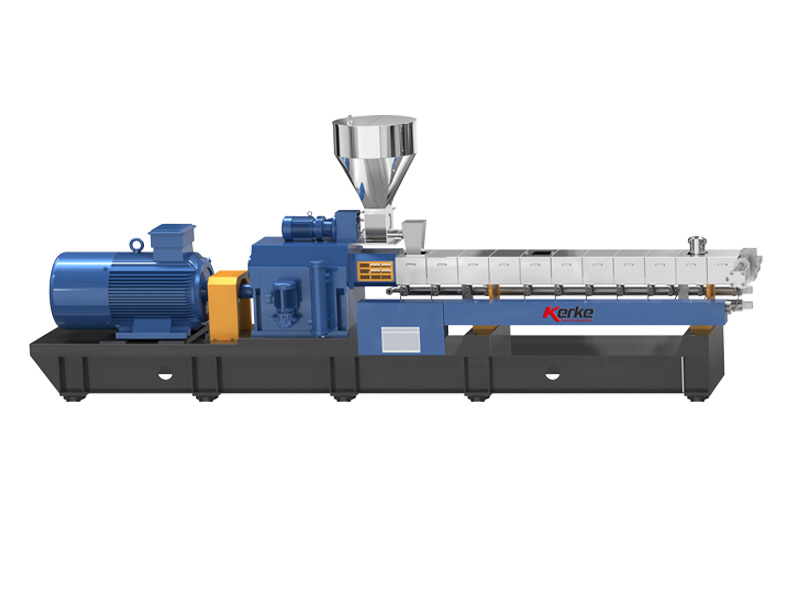
Kerke KTE series parallel co-rotating twin screw extruder is developed and manufactured independently by the company, specially adapted to the compounding and production characteristics of recycled plastic toughening compatibility masterbatch. The product line covers laboratory small-batch formula research and development, small and medium-sized factory conventional production, and large industrial high-volume continuous production, with complete standardized models and scalable turnkey supporting lines.
2.1 Full Range of KTE Extruder Models & Production Capacity
- KTE-35: Laboratory and pilot production model, hourly output 100-200kg, suitable for formula development, new product trial production and small-batch customized masterbatch production;
- KTE-50: Hot-selling mainstream model for small and medium-sized manufacturers, hourly output 300-500kg, balancing investment cost, energy consumption and production efficiency;
- KTE-65: High-efficiency medium and large production model, hourly output 500-800kg, suitable for large-scale supply to plastic recycling factories and modified material enterprises;
- KTE-75: Heavy-duty industrial continuous production model, hourly output 800-1200kg, supporting 24-hour uninterrupted operation for large industrial parks;
- KTE-135: Super-large capacity model, hourly output 1500-4000kg, customized for super-large recycled plastic modification industrial bases.
2.2 Core Structural Design Adapted to Toughening Compatibility Masterbatch
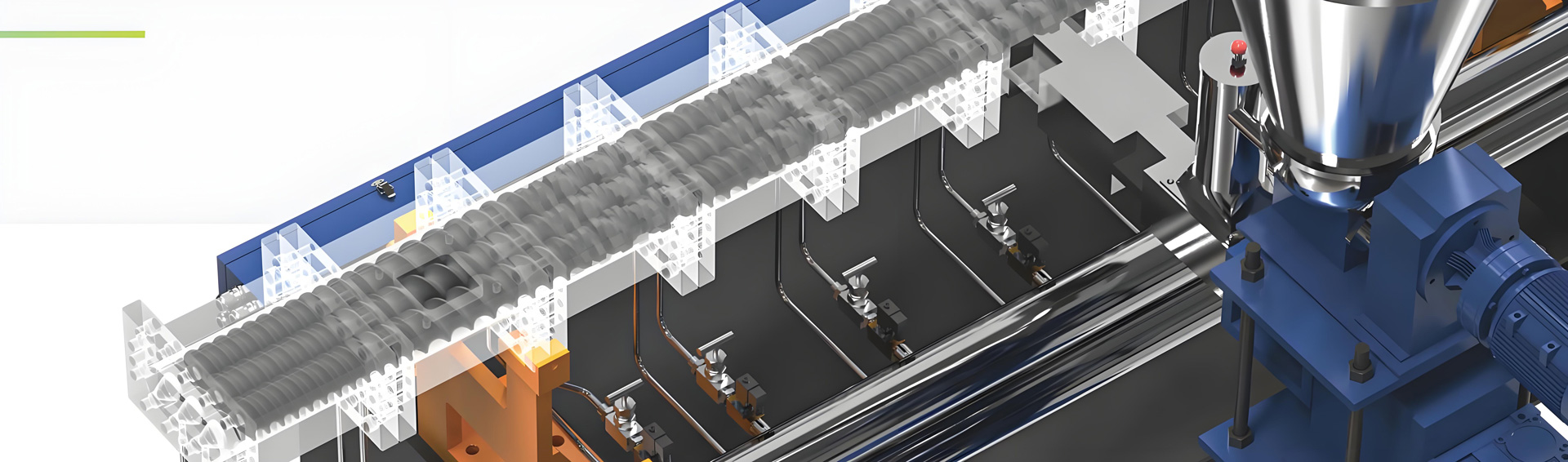
All KTE series extruders adopt modular combined design, which can be flexibly adjusted according to different masterbatch formulas and raw material ratios. The core structural advantages are reflected in the following aspects:
- High-torque heavy-duty gearbox: It can bear high-load compounding of high-proportion toughening powder and compatibilizer additives, with stable transmission and long service life;
- Modular screw combination: Equipped with conveying, shearing, kneading, mixing and self-cleaning elements, which can be matched in multiple schemes according to the proportion of recycled materials;
- Multi-stage independent temperature control: Each barrel section adopts independent heating and circulating cooling, with temperature control accuracy up to ±1°C, avoiding thermal decomposition of sensitive compatibilizer components;
- Multi-stage vacuum degassing system: Reserved two to three vacuum exhaust ports, which can effectively remove moisture, volatile small molecules and residual odor in raw materials;
- Wear-resistant barrel and screw: Made of high-alloy nitriding steel, specially adapted to long-term production of modified masterbatch containing powder additives, with anti-wear and anti-corrosion performance;
- Intelligent PLC touch screen control: Built-in dozens of preset production formulas for recycled masterbatch, one-click switching of process parameters, reducing technical operation threshold.
2.3 Complete Turnkey Production Line Supporting Configuration
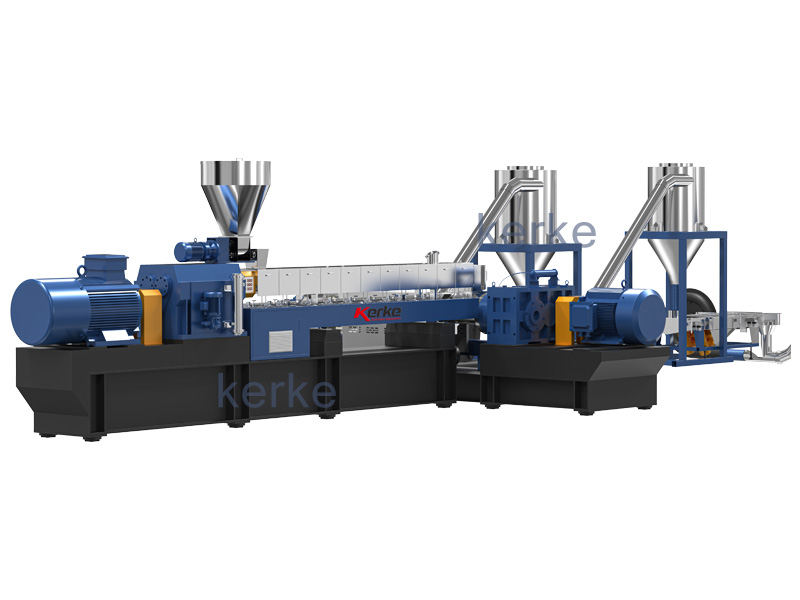
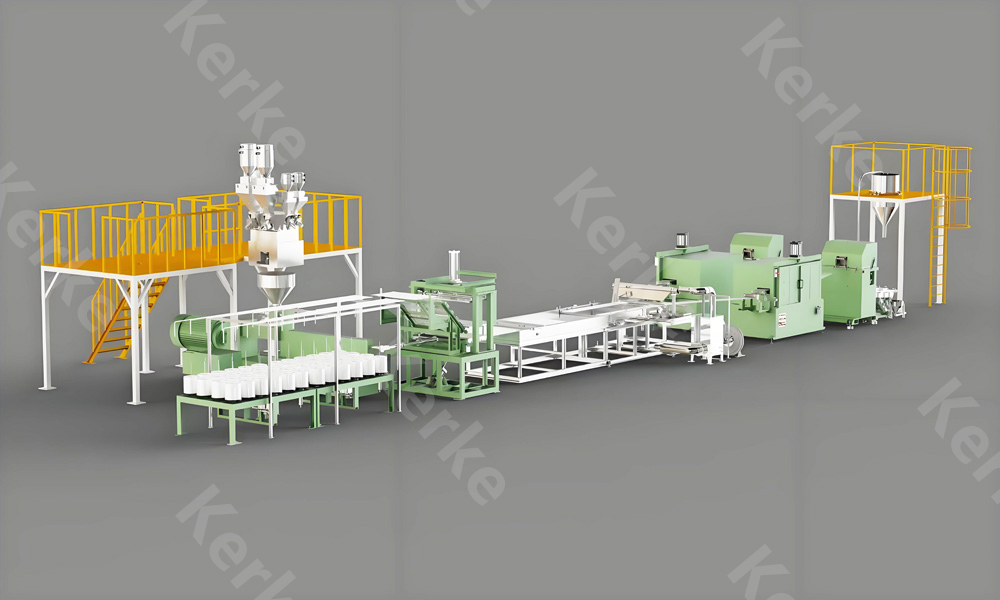
Kerke provides a full-process turnkey solution for recycled plastic toughening compatibility masterbatch, covering all links from raw material pretreatment to finished product packaging, without the need for manufacturers to independently match auxiliary equipment:
- Raw material mixing system: High-speed mixer with dust-proof and moisture-proof design, suitable for uniform mixing of resin, toughening powder, compatibilizer and antioxidant;
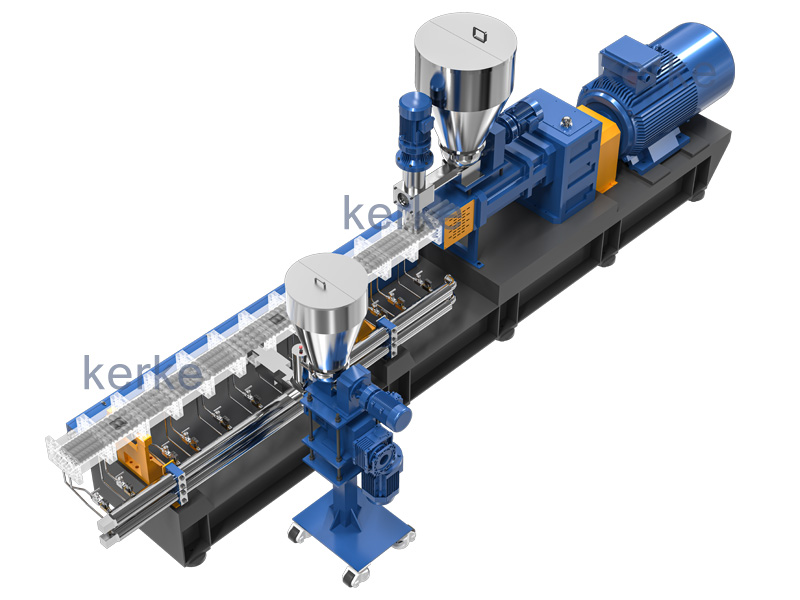
- Precision feeding system: Volumetric feeder and loss-in-weight feeder optional, supporting multi-component synchronous proportional feeding to ensure stable formula ratio;
- Core extrusion compounding system: KTE twin screw extruder with customized screw and temperature curve;
- Pelletizing system: Water-cooled strand pelletizing, air-cooled die-face pelletizing optional, adapting to different viscosity and melting index masterbatch;
- Post-processing system: Vibrating screen, automatic dryer, dust removal device and quantitative automatic packaging machine;
- Auxiliary system: Circulating water chiller, raw material conveyor, centralized dust removal equipment, adapting to factory standardized production layout.
3. Kerke Targeted Production Solutions for Recycled Toughening Compatibility Masterbatch
Aiming at the five major pain points of recycled plastic masterbatch production in 2026, Kerke relies on KTE twin screw extruder to launch independent and targeted technical solutions, focusing on solving compatibility dispersion, volatile odor removal, energy consumption control, raw material adaptability and stable continuous production.
3.1 Heterogeneous Plastic Compatibility Uniform Dispersion Solution
Mixed recycled plastics such as PP/PE, ABS/PC have different molecular structures and poor interfacial fusion. The traditional production process is prone to uneven distribution of compatibilizer, resulting in poor toughness modification effect and easy cracking of finished products. Kerke adopts low-shear high-mixing screw configuration, optimizes the arrangement of kneading blocks and mixing elements, forms multi-layer folding and circulating mixing in the extrusion barrel, and realizes nano-level uniform dispersion of toughening agents and compatibilizers. The modular screw can adjust the shear intensity according to different mixed recycled material ratios, avoid excessive shear damage to molecular chains, and maximize the recovery of mechanical properties of recycled plastics. This solution can increase the impact toughness of modified recycled plastics by 40%-70%, fully meeting the use standards of automotive parts and home appliance shells.
3.2 Multi-Stage Vacuum Degassing Low-Odor Production Solution
Waste plastics are easy to absorb moisture and contain residual volatile oil and small molecule impurities. Ordinary extrusion lines cannot completely remove odor and volatile substances, making the masterbatch unable to enter food contact and high-end automotive interior markets. Kerke’s solution is equipped with multi-stage vacuum negative pressure exhaust system and atmospheric exhaust ports. In the process of compounding and melting, moisture, volatile hydrocarbons and residual odor components are completely extracted in sections. Combined with precise low-temperature compounding control, it avoids the generation of new volatile substances caused by high-temperature decomposition. The produced masterbatch has low odor, low volatility, and can smoothly pass REACH, RoHS and food-grade environmental protection certification standards.
3.3 IE5 Energy-Saving Low-Carbon Compounding Production Solution
Under the background of global carbon tariffs and energy conservation policies, high energy consumption has become an important cost burden and policy restriction for masterbatch manufacturers. Kerke’s energy-saving solution is equipped with IE5 ultra-high efficiency permanent magnet motor, variable frequency drive system and ceramic infrared energy-saving heating ring. The optimized screw operation curve reduces idle power loss and shear heat generation. Compared with ordinary twin screw extruders, the overall energy consumption per kilogram of masterbatch is reduced by 30%. It not only reduces daily production electricity costs, but also reduces carbon emission indicators, helping manufacturers avoid carbon tariff costs and meet local green factory assessment standards.
3.4 Mixed Raw Material Wide Adaptation Solution
Recycled plastic raw materials in different regions have large differences in impurity content, aging degree and melt index. Ordinary extrusion lines are difficult to adapt to raw material fluctuations, resulting in unstable product quality. Kerke’s solution reserves adjustable process parameter space, and the screw speed, feeding speed, temperature curve and vacuum degree can be dynamically adjusted according to local recycled PP, PE, ABS, PET raw material characteristics. The side feeding system can add high-proportion toughening powder and compatibilizer in sections, solve the problem of powder bridging and uneven feeding, and realize stable production of qualified masterbatch with different proportions of local raw materials.
3.5 Low Scrap Rate 24/7 Continuous Stable Production Solution
Large-scale recycled masterbatch manufacturers need long-term uninterrupted production to meet market orders. The heavy-duty gearbox and reinforced frame design of KTE extruders adapt to 24-hour continuous operation. The self-cleaning screw structure avoids material residue and color cross-contamination during formula switching. The precise pelletizing and screening system controls the scrap rate below 1.5%, far lower than the industry average of 5%-8%. The online torque, temperature and pressure real-time monitoring system can early warn of equipment abnormalities, reduce unplanned downtime, and greatly improve production efficiency and output stability.
4. Production Process Optimization & Quality Control System
4.1 Standard Production Process Flow
Kerke summarizes the standardized process flow suitable for most recycled plastic toughening compatibility masterbatch production, which can be directly used by manufacturers for reference and production debugging:
- Raw material proportioning: Carrier resin, toughening agent, compatibilizer, antioxidant and processing auxiliary agent are proportioned according to the formula;
- High-speed mixing: Uniform mixing at constant temperature, remove surface moisture of powder materials;
- Precision feeding: Stable feeding by main feeder and side feeder according to production speed;
- Twin screw compounding: Segmented temperature control, low-shear high-mixing melting and modification;
- Multi-stage degassing: Vacuum exhaust to remove moisture, volatile substances and odor;
- Pelletizing forming: Water-cooled strand or air-cooled die-face pelletizing according to material fluidity;
- Drying and screening: Remove unqualified particles, dry to control moisture content below 0.05%;
- Automatic packaging: Quantitative sealing and packaging, finished product storage.
4.2 Key Process Parameter Control Standard
Aiming at the common PP/PE and ABS recycled modified masterbatch, Kerke formulates standardized parameter reference range to simplify customer debugging difficulty:
- Barrel processing temperature: 170℃-220℃, adjusted according to resin type, strictly controlled in ±1℃ to prevent auxiliary agent decomposition;
- Screw rotating speed: 280-520rpm, moderate shear to ensure mixing effect without damaging molecular chains;
- Vacuum degree: -0.06~-0.08MPa, maintain stable degassing effect;
- Material moisture content: Strictly controlled below 0.05% after drying, to avoid bubbles and poor toughness;
- Proportion of compatibilizer: 8%-15%, dynamically adjusted according to the aging degree of recycled materials.
4.3 Finished Product Quality Inspection Standard
The toughening compatibility masterbatch produced by Kerke production line can reach the following industry high standards: uniform particle size, no bubbles and impurities; excellent dispersion of functional additives; modified recycled plastic impact strength increased by more than 40%; low odor and low volatility; fully compliant with REACH, RoHS and environmental protection standards; stable melt index, no batch-to-batch quality difference.
5. Global Regional Adaptive Customization of Production Lines
Kerke carries out all-round localized adaptive design for recycled masterbatch production lines according to the voltage, climate, industrial environment and regulatory standards of different global regions, ensuring stable operation in all overseas markets:
- Power grid adaptation: Support global standard voltage such as 380V/415V/480V, 50Hz/60Hz, built-in voltage stabilization and anti-fluctuation design, adapting to unstable power grids in emerging markets;
- Climate adaptation: Dust-proof, waterproof and high-temperature resistant electrical cabinet design, enhanced cooling system, suitable for tropical high temperature, high humidity and dusty industrial areas;
- Language and operation adaptation: Multi-language touch screen interface, simple visualized operation logic, reducing the threshold for local workers to operate and debug;
- Environmental protection adaptation: Equipped with centralized dust removal and waste gas collection device, meeting global industrial environmental protection emission standards;
- Layout adaptation: Provide compact layout for small factories and standardized assembly line layout for large industrial parks, flexibly matching factory space planning.
6. Investment Cost & ROI Benefit Analysis
Taking the mainstream KTE-65 twin screw extruder turnkey production line as the analysis model, the annual output is calculated based on 8 hours of daily operation and 250 working days per year, analyzing the comprehensive cost and investment return of producing recycled plastic toughening compatibility masterbatch:
- Annual production capacity: 1200 tons of standard toughening compatibility masterbatch;
- Annual energy saving benefit: 30% lower than traditional extruders, saving a large amount of industrial electricity costs every year;
- Material saving benefit: Scrap rate controlled below 1.5%, reducing raw material waste compared with the industry average;
- Maintenance cost saving: Wear-resistant screw and barrel extend service life, reduce replacement frequency and daily maintenance workload;
- Comprehensive production cost reduction: The overall production cost per ton of masterbatch is reduced by 18%-25%;
- Investment return cycle: Under normal market sales conditions, the return cycle is controlled at 12-18 months, far better than the 24-36 months industry average.
Recycled plastic toughening compatibility masterbatch has high market demand and high profit margin. Equipped with Kerke high-efficiency twin screw extrusion line, manufacturers can quickly recover investment and form long-term stable profit growth in the context of the global circular economy boom.
7. FAQ: Technical & Production Questions for Recycled Masterbatch Manufacturers
7.1 Can your production line adapt to mixed recycled PP PE ABS raw materials?
Yes. Kerke KTE extruders adopt adjustable screw configuration and process parameters, which can perfectly adapt to mixed recycled plastics of different materials and aging degrees, and produce stable toughening compatibility masterbatch.
7.2 Can the equipment remove odor and volatile substances in recycled materials?
Equipped with multi-stage vacuum degassing system and low-temperature compounding technology, it can effectively remove moisture, residual oil and volatile odor molecules, meeting low-odor and environmental protection certification requirements.
7.3 What is the energy-saving effect compared with ordinary twin screw extruders?
Adopting IE5 energy-saving motor and optimized heating system, the comprehensive energy consumption is reduced by 30%, which can effectively reduce daily production costs and carbon emissions.
7.4 Is the screw and barrel suitable for long-term production of powder-filled masterbatch?
All wearing parts are made of high-alloy nitriding anti-wear steel, with a service life of 8-10 years under long-term compounding production of powder additives.
7.5 Can you customize the production line according to special masterbatch formulas?
Yes. We can customize screw combination, feeding mode, temperature curve and pelletizing system according to customer exclusive formulas and production needs.
7.6 Does the equipment meet global environmental protection and CE certification?
All KTE series extruders have CE, TUV and SGS certifications, and the production process meets global REACH, RoHS and carbon emission assessment standards.
7.7 What is the scrap rate of the entire production line?
Through precise extrusion compounding and automatic screening system, the overall scrap rate is stably controlled below 1.5%, which is far lower than the traditional production level.
8. Conclusion
2026 is a pivotal year for the global plastic circular economy and recycled material modification industry. With the full implementation of carbon tariffs, recycled plastic mandatory quotas and environmental protection certifications, recycled plastic toughening compatibility masterbatch has become an indispensable high-value additive in the plastic industry. Traditional backward extrusion equipment can no longer meet the requirements of high dispersion, low odor, low carbon and stable production, and upgrading to professional twin screw extrusion lines has become an inevitable choice for manufacturers.
Kerke KTE series parallel co-rotating twin screw extruders rely on professional compounding technology, standardized equipment manufacturing, and targeted customized solutions to solve the core pain points of recycled masterbatch production. From screw structure optimization, multi-stage vacuum degassing, IE5 energy saving, raw material wide adaptation to 24/7 stable production, all technical solutions are independently developed and designed for the characteristics of toughening compatibility masterbatch. The complete turnkey line configuration, standardized process parameters and global regional adaptive design provide reliable and cost-effective production equipment for small, medium and large manufacturers around the world.
In the future global circular economy market, Kerke will continue to focus on twin screw extrusion technology innovation, deeply layout in the field of plastic recycling and modified masterbatch production, and provide high-efficiency, low-carbon and compliant professional extrusion solutions for global customers, helping the plastic industry achieve green upgrading and sustainable development.
For more product parameters and customized solution details, please visit the official website: https://www.kerkeextruder.com