Heat-sensitive pigments and functional additives are core raw materials for manufacturing high-grade color masterbatch, functional masterbatch, weather-resistant masterbatch and special modified plastic products. These materials feature low thermal decomposition temperature, high shear sensitivity and poor high-temperature stability, which are extremely vulnerable to discoloration, molecular degradation, functional failure and carbonization deterioration during traditional extrusion compounding processes. Conventional single screw extruders and ordinary compounding equipment cannot balance mixing uniformity and thermal protection, often resulting in faded masterbatch colors, reduced additive activity, excessive volatile residues and high defective rates, seriously restricting the production quality and market application of high-performance masterbatch products.
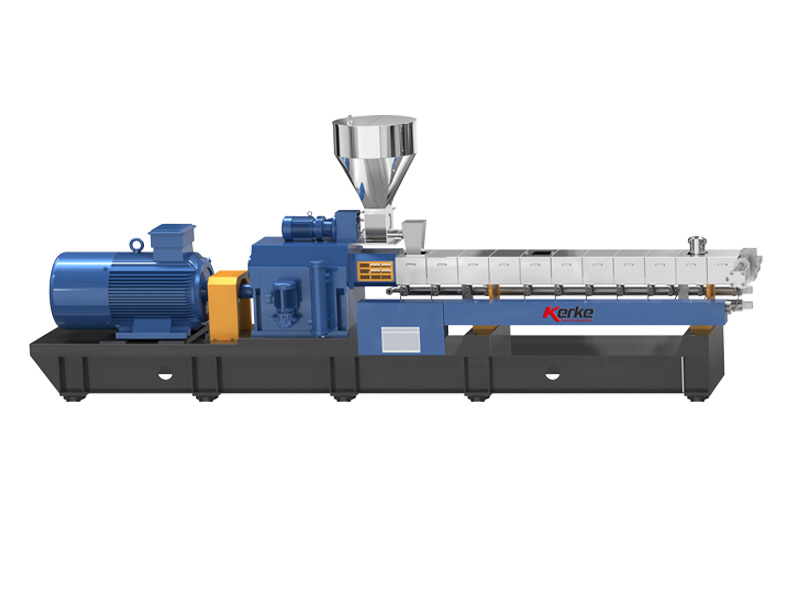
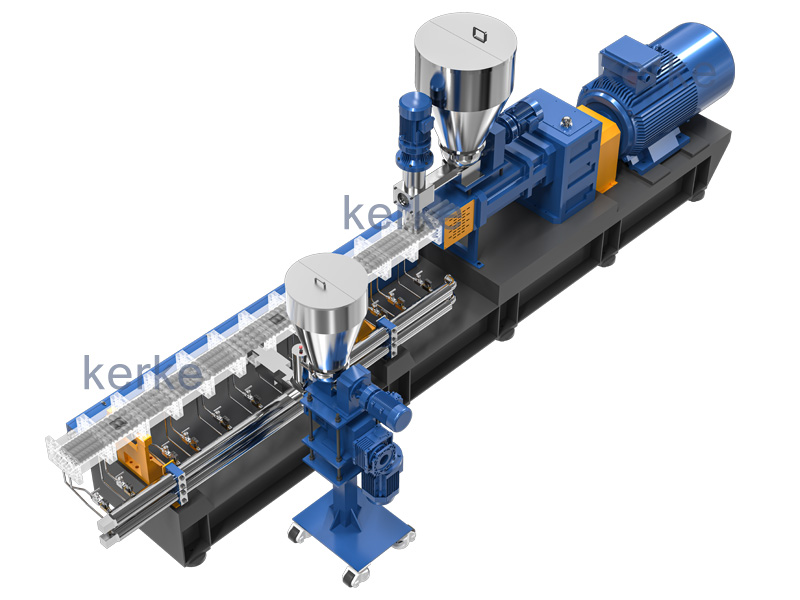
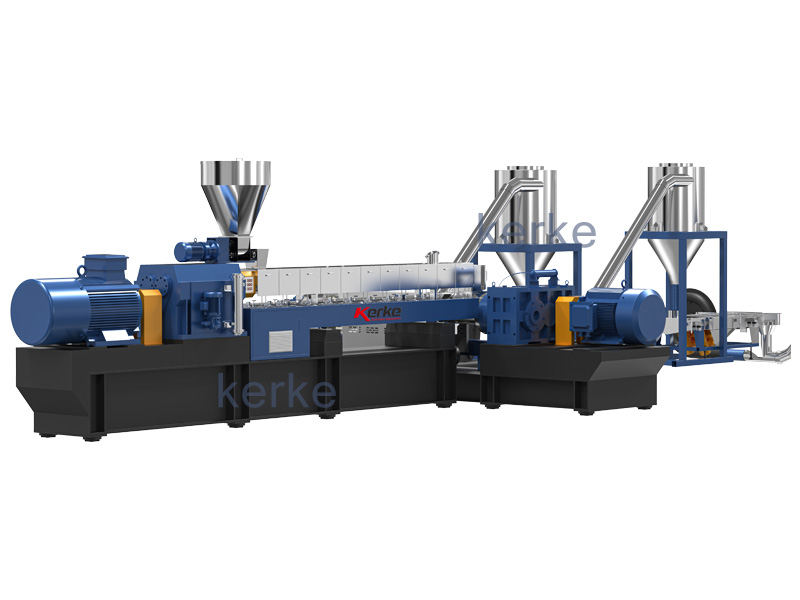
Professional twin screw extruder and masterbatch extruder equipment has become the standard configuration for heat-sensitive material processing in the global plastic modification industry by virtue of adjustable shear force, precise segmented temperature control, short material residence time and efficient degassing performance. As a professional manufacturer of high-precision compounding extruder and masterbatch production lines, Kerke Extruder has long focused on the process optimization of heat-sensitive pigments and additives compounding. The independently developed KTE series twin screw extruders adopt customized low-shear screw combination, intelligent constant temperature control system and professional heat-sensitive material processing technology, which can fully protect the activity of heat-sensitive components while achieving uniform dispersion, solving multiple pain points in the production of high-end masterbatch.
This article comprehensively analyzes the thermal failure mechanism of heat-sensitive pigments and additives, core technical advantages of Kerke masterbatch extruder in heat-sensitive material processing, detailed process adjustment strategies, equipment configuration schemes, investment cost budget and production benefit analysis. The full-dimensional content covers all key knowledge points that buyers and production technicians need to master, helping global users correctly select equipment, optimize processes, reduce production costs and improve the qualification rate of heat-sensitive masterbatch products.
1. Basic Characteristics and Processing Pain Points of Heat-Sensitive Pigments and Additives
1.1 Classification and Thermal Sensitivity Mechanism of Common Heat-Sensitive Materials
Heat-sensitive materials widely used in masterbatch production mainly include heat-fading pigments, photochromic pigments, high-grade organic colorants, antioxidant additives, light stabilizers, flame retardant additives and biodegradable functional modifiers. Different from ordinary inorganic pigments and general plastic additives, these materials have fragile molecular structures and narrow thermal processing windows, with decomposition temperatures mostly ranging from 180℃ to 240℃. Once exceeding the limit temperature or suffering excessive shear thermal accumulation, irreversible performance attenuation will occur.
Heat-sensitive organic pigments are prone to molecular chain fracture and chromogenic group failure under high temperature and strong shear, resulting in color deviation, color fading and poor color matching consistency of finished masterbatch. Functional additives such as antioxidants and UV stabilizers will lose chemical activity after overheating decomposition, making the masterbatch unable to provide long-term anti-aging and weather-resistant protection for downstream plastic products. Some low-temperature flame retardants will decompose and precipitate toxic volatile substances at excessive processing temperature, causing product safety hazards and environmental pollution problems.
In addition, most heat-sensitive additives have high shear sensitivity. Even if the overall temperature of the extrusion system is controlled within the standard range, local high temperature generated by excessive mechanical shear will also cause partial material degradation, resulting in inconsistent batch performance of masterbatch, surface spots and poor dispersion uniformity.
1.2 Common Production Defects Caused by Improper Equipment Processing
Using ordinary compounding extruders to process heat-sensitive masterbatch will lead to a variety of uncontrollable quality defects. The most common problem is color instability. Uncontrolled shear heat and temperature fluctuation cause different degrees of decomposition of heat-sensitive pigments in different production batches, resulting in obvious color difference between batches, which cannot meet the color matching requirements of high-end products such as automotive plastics, food packaging and electronic appliances.
The second major defect is functional failure of additives. Excessively long material residence time and uneven temperature distribution lead to massive inactivation of heat-sensitive functional additives. The produced functional masterbatch has unqualified anti-aging, flame retardant and toughening effects, with poor downstream application stability. At the same time, decomposed materials will produce tiny carbonized particles and volatile residues, causing surface defects such as black spots, bright spots and bubbles on the masterbatch particles, reducing product appearance grade and market competitiveness.
In terms of production efficiency and cost, mismatched equipment will lead to a defective rate of more than 10% for heat-sensitive masterbatch. A large amount of raw material waste and repeated debugging will greatly increase production costs, and frequent shutdown cleaning and parameter adjustment will also reduce continuous production capacity, bringing huge economic losses to masterbatch manufacturers.
1.3 Core Technical Requirements for Heat-Sensitive Masterbatch Extrusion Equipment
To realize stable production of high-quality heat-sensitive masterbatch, the extrusion equipment must meet three core technical requirements. First, ultra-low shear compounding capability. The equipment needs to complete uniform mixing and dispersion of pigments and additives under low shear state, avoid shear heat accumulation and protect the complete molecular structure of heat-sensitive materials. Second, high-precision segmented temperature control capability, which can accurately control the temperature of each extrusion section, eliminate local overheating, and keep the material always within the safe processing temperature window.
Third, short and controllable material residence time. The equipment needs to optimize the flow channel structure to reduce material retention dead corners, realize rapid material conveying and extrusion, shorten the high-temperature residence time of heat-sensitive materials, and avoid thermal degradation. In addition, the equipment needs to be equipped with efficient vacuum degassing system to discharge volatile gases generated by slight thermal decomposition, ensuring the purity and compactness of masterbatch particles. Only professional twin screw masterbatch extruders can fully meet the above comprehensive technical requirements.
2. Core Technical Advantages of Kerke Masterbatch Extruder for Heat-Sensitive Materials
2.1 Customized Low-Shear Screw Barrel System
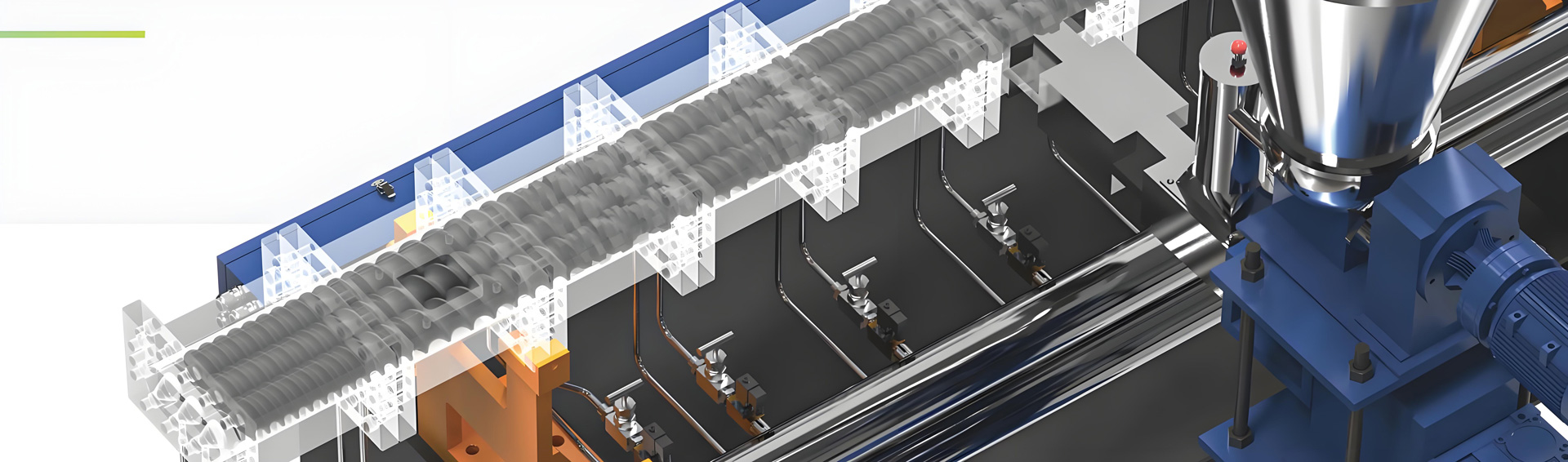
The screw combination is the core component that determines the shear strength and mixing effect of the extruder. Aiming at the processing characteristics of heat-sensitive pigments and additives, Kerke KTE series twin screw extruder abandons the high-shear screw configuration of ordinary compounding extruders, and adopts customized low-shear gentle mixing screw elements. The optimized screw structure reduces the number of strong shear kneading blocks, increases the proportion of conveying and stretching elements, and realizes material dispersion through stretching and folding instead of strong shear friction.
This structural design can fully mix pigments and additives evenly under the condition of minimum shear heat generation, completely avoiding molecular damage and thermal degradation of heat-sensitive materials caused by excessive shear force. The screw and barrel adopt high-precision mirror polishing treatment, with smooth internal flow channel and no material retention dead corners, which effectively prevents long-term high-temperature accumulation and carbonization of residual heat-sensitive materials, ensuring the consistency and purity of each batch of products.
Kerke supports personalized screw combination customization according to different heat-sensitive material characteristics. For ultra heat-fading sensitive pigments, ultra-low shear screw schemes are matched; for high-dispersion functional additives, balanced low-shear high-dispersion configurations are adopted, realizing one-to-one accurate matching of equipment and materials.
2.2 Multi-Zone Independent High-Precision Constant Temperature Control System
Temperature fluctuation is the primary cause of heat-sensitive material failure. Kerke masterbatch extruder is equipped with an upgraded multi-zone independent PID closed-loop temperature control system. The barrel and die head are divided into 6 to 8 independent temperature control zones according to the equipment model, each of which is equipped with independent heating modules and water circulation cooling modules, with a temperature control accuracy of ±0.5℃, far exceeding the ±2℃ accuracy of ordinary extruders.
The system can set independent optimal temperature values for feeding section, melting section, mixing section, exhaust section and die head section respectively, forming a gradient temperature curve suitable for heat-sensitive material processing. The low-temperature feeding zone avoids premature melting and adhesion of heat-sensitive additives, the stable-temperature mixing zone ensures uniform dispersion without overheating, and the low-temperature discharging zone reduces the final thermal exposure of materials. The real-time temperature monitoring and automatic adjustment function can eliminate temperature fluctuation caused by long-term continuous operation, ensuring that the whole extrusion process is always within the safe temperature range of heat-sensitive materials.
2.3 Short Residence Time and Efficient Material Conveying Design
The longer the high-temperature residence time of heat-sensitive pigments and additives, the higher the probability of thermal decomposition. Kerke twin screw extruder adopts optimized screw pitch and flow channel structure, which greatly improves the material conveying efficiency and shortens the material residence time in the barrel to 30 to 60 seconds, which is 40% shorter than that of ordinary compounding extruders. The rapid conveying and discharging mode effectively reduces the thermal history of heat-sensitive materials and fundamentally inhibits thermal degradation and activity attenuation.
At the same time, the equipment is designed with open-type exhaust ports and vacuum degassing devices at multiple positions, which can timely discharge trace volatile gases and moisture generated by slight heating of heat-sensitive materials, avoid gas wrapping and particle bubble defects, and further improve the compactness and surface finish of masterbatch particles. The fully streamlined flow channel design eliminates material stagnation areas, ensuring that all materials are discharged smoothly without residual deterioration.
2.4 Intelligent Parameter Locking and Stable Operation System
Heat-sensitive masterbatch production has extremely strict requirements for process parameter stability. Slight changes in screw speed, feeding speed and melt pressure will lead to inconsistent shear heat and temperature, resulting in batch quality differences. Kerke extruder is equipped with an intelligent PLC integrated control system, which can store multiple sets of mature process parameters for different heat-sensitive materials, realizing one-click calling and parameter locking.
During long-term continuous production, the system automatically calibrates speed, pressure and temperature parameters in real time to avoid parameter drift, ensuring that the shear force, temperature and residence time of each production batch remain consistent. The servo variable frequency feeding system realizes uniform and stable quantitative feeding, avoiding local material concentration and excessive shear caused by uneven feeding, and further improving the production stability of heat-sensitive masterbatch.
3. Professional Processing Technology for Different Heat-Sensitive Masterbatch Types
3.1 Processing Technology for Heat-Sensitive Organic Color Masterbatch
High-grade organic pigment masterbatch such as phthalocyanine pigments, azo pigments and high-temperature sensitive colorants are easy to fade and discolor during extrusion processing. When producing such masterbatch with Kerke masterbatch extruder, the overall processing temperature needs to be controlled below 200℃, and the temperature of the melting and mixing section is strictly limited to avoid exceeding the pigment decomposition threshold. Adopt ultra-low shear screw combination and appropriately reduce screw speed to cut down shear heat generation.
Match the low-speed uniform feeding mode to ensure full mixing of pigments and carrier resin under low heat conditions. The vacuum degassing system is turned on throughout the process to remove tiny air bubbles and volatile substances, preventing pigment oxidation and discoloration. Through this process, the produced organic color masterbatch has bright color, uniform coloring and no batch color difference, fully meeting the color matching standards of high-end plastic products.
3.2 Processing Technology for Functional Additive Masterbatch
Anti-aging masterbatch, UV-resistant masterbatch, low-temperature flame retardant masterbatch and toughening functional masterbatch contain a large number of heat-sensitive functional additives. For such products, Kerke compounding extruder adopts a segmented feeding process. The heat-sensitive functional additives are added from the rear side feeding port after the carrier resin is completely melted, which greatly shortens the high-temperature residence time of the additives and avoids thermal inactivation.
Set a low-temperature stable mixing section to ensure that the additives are evenly dispersed in the molten resin under low shear and low temperature conditions, giving full play to the functional characteristics of the additives. The precise temperature control system avoids local overheating and ensures that the activity retention rate of heat-sensitive additives is higher than 98%. The finished functional masterbatch has stable performance and long service life, which can provide stable functional protection for downstream plastic products.
3.3 Processing Technology for Special Photochromic and Thermochromic Masterbatch
Photochromic and thermochromic masterbatch are typical ultra-heat-sensitive products, whose color-changing functional groups will completely fail once overheated. In view of this feature, Kerke equips a special low-temperature compounding process scheme. The overall processing temperature is controlled at 160℃ to 180℃, and the whole process adopts ultra-low shear operation. The screw speed is stably controlled at a low frequency to eliminate shear heat accumulation.
Adopt the front-end melting and rear-end mixing process to separate the resin melting stage and functional pigment mixing stage, avoiding long-term high-temperature contact of color-changing pigments. After extrusion, the low-temperature rapid cooling pelletizing system is matched to quickly reduce the particle temperature, lock the functional activity of the pigments, and ensure that the finished masterbatch has sensitive and stable color-changing performance.
4. Equipment Configuration Scheme, Price and Investment Cost Analysis
4.1 Kerke Extruder Model Matching for Heat-Sensitive Masterbatch
Kerke KTE series twin screw extruders have complete model specifications to meet the production needs of small-batch trial production and large-scale mass production of heat-sensitive masterbatch. The KTE-35 small twin screw extruder is suitable for laboratory research and development, small-batch multi-variety heat-sensitive masterbatch production, with an hourly output of 50 to 120kg. It features flexible parameter adjustment and convenient material change, which is very suitable for enterprises with frequent product switching.
The KTE-52 medium twin screw compounding extruder is the mainstream model for heat-sensitive masterbatch mass production, with an hourly output of 200 to 380kg. It is equipped with standard low-shear screw system and multi-zone precise temperature control system, with stable operation and high cost performance, covering most medium-sized masterbatch production scenarios.
The KTE-65 and KTE-75 large twin screw extruders are used for large-scale standardized production of high-end heat-sensitive masterbatch, with an hourly output of 500 to 720kg. They are equipped with upgraded intelligent temperature control system and optimized low-shear screw combination, which can realize long-term stable high-output production while ensuring product quality.
4.2 Complete Equipment Price Reference
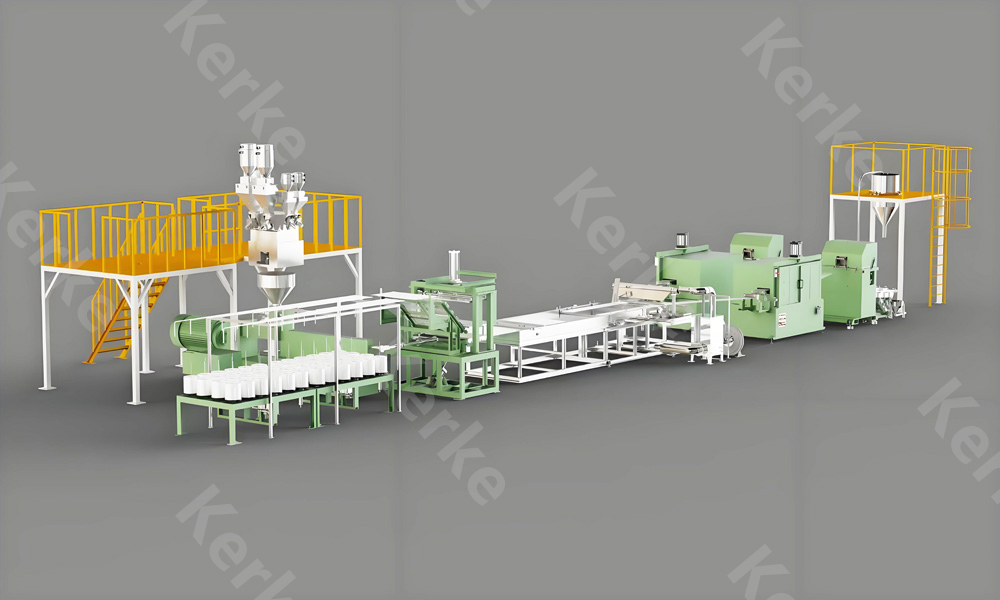
The complete set price of KTE-35 small heat-sensitive masterbatch extrusion line (including main extruder, feeding system, temperature control system, pelletizing system and electrical control system) ranges from 62,000 to 85,000 US dollars. This configuration is economical and practical, suitable for start-up enterprises and R&D institutions with limited production scale.
The complete set price of KTE-52 medium professional heat-sensitive masterbatch production line with standard low-shear configuration and precise temperature control is 108,000 to 145,000 US dollars. This is the most cost-effective configuration for commercial mass production, with balanced production capacity and product quality.
The complete set price of KTE-65 large high-end heat-sensitive masterbatch extrusion line with full intelligent configuration ranges from 168,000 to 210,000 US dollars. It is suitable for large-scale enterprises focusing on high-end functional masterbatch and special color masterbatch markets, with high automation and ultra-low defective rate.
4.3 Annual Operating Cost Breakdown
Taking the mainstream KTE-52 masterbatch extruder production line as an example, calculated based on 300 working days a year and 20 hours of continuous production per day, the annual comprehensive operating cost is analyzed as follows. The electricity cost is about 21,000 US dollars per year, thanks to Kerke's energy-saving optimization design, which saves nearly 20% of electricity consumption compared with ordinary extruders.
The daily maintenance and wearing parts replacement cost is about 1,200 to 2,000 US dollars per year. The low-shear screw and barrel have low wear degree, with long service life and low maintenance frequency. The labor cost is about 10,000 US dollars per year, and the highly automated equipment only needs 2 operators for two shifts.
The most critical cost saving point is raw material loss. Ordinary equipment has a defective rate of 10% to 15% when producing heat-sensitive masterbatch, while Kerke professional equipment controls the defective rate below 2%, saving more than 80,000 US dollars in raw material waste every year for medium-scale production lines. The comprehensive annual operating cost is far lower than that of ordinary extrusion equipment.
4.4 Investment Return Benefit Analysis
The market profit margin of high-end heat-sensitive masterbatch is much higher than that of ordinary masterbatch. Taking organic heat-sensitive color masterbatch as an example, the net profit per ton is about 300 to 500 US dollars. The annual output of KTE-52 production line can reach more than 500 tons, with an annual net profit of more than 150,000 US dollars. After deducting annual operating costs, the net income is considerable.
Based on the total investment of 125,000 US dollars for medium-sized standard equipment, the static investment payback period is only 10 to 12 months. For high-value-added photochromic and thermochromic masterbatch projects, the profit margin is higher, and the investment cost can be recovered in a shorter cycle. The professional heat-sensitive material processing capability of Kerke extruder can help enterprises quickly occupy the high-end masterbatch market and obtain long-term stable profit growth.
5. Daily Operation Specifications and Quality Control Guidelines
5.1 Standard Pre-Production Debugging Process
Before producing heat-sensitive masterbatch, it is necessary to clean the extruder screw, barrel and die head completely to avoid residual ordinary materials and impurities affecting product quality. Preheat each temperature zone in sections according to the preset heat-sensitive material temperature curve, and keep warm for enough time after reaching the standard temperature to ensure uniform temperature of each component.
Carry out low-speed trial extrusion first, observe the melt state and particle quality, fine-tune temperature parameters and screw speed, and formally start mass production after confirming no color deviation, no bubbles and uniform dispersion. It is forbidden to start production with high speed and high temperature to prevent instantaneous shear overheating and thermal degradation of heat-sensitive materials.
5.2 Key Points of Production Process Control
During continuous production, strictly lock the process parameters to avoid arbitrary adjustment of temperature, speed and feeding ratio. Regularly observe the particle color, surface state and dispersion uniformity every hour, and make production records. For heat-sensitive functional masterbatch, regularly sample and test functional indicators to ensure additive activity meets the standard.
When switching different heat-sensitive material formulas, thoroughly clean the equipment to avoid cross-contamination of residual materials, resulting in color difference and functional failure. Control the equipment operation load stably to avoid sudden speed increase and load fluctuation, which may cause instantaneous shear heat surge.
5.3 Common Faults and Optimization Solutions
Faded masterbatch color is mainly caused by excessive processing temperature or too high screw shear force, which can be solved by appropriately reducing the temperature of the mixing section and lowering the screw operating speed. Inconsistent color batch difference is caused by parameter drift, which needs to recalibrate the temperature control system and lock the operating parameters.
Insufficient functional activity of additives is mostly due to long material residence time, which can be optimized by increasing feeding speed and shortening high-temperature residence time. Particle bubbles and impurities are solved by strengthening vacuum degassing and thorough equipment cleaning. Kerke technical team provides one-on-one remote guidance for all common faults to help customers quickly optimize the process and stabilize product quality.
6. Advantages of Kerke Heat-Sensitive Masterbatch Extrusion Solution
6.1 Professional Material Adaptability Customization
Kerke has accumulated rich processing experience in heat-sensitive pigments and additive compounding. The technical team can formulate exclusive screw combination, temperature curve and process parameters according to the thermal sensitivity degree, material viscosity and application requirements of different heat-sensitive materials, realizing targeted customization of equipment and process, which cannot be achieved by ordinary universal extrusion equipment.
6.2 Ultra-Low Defect Rate and Stable Batch Quality
Relying on low-shear processing design and high-precision temperature control technology, Kerke masterbatch extruder effectively avoids thermal degradation and shear damage of heat-sensitive materials. The product batch consistency rate is higher than 98%, and the defective rate is controlled below 2%, which greatly reduces raw material waste and rework cost, and improves the market reputation of enterprise products.
6.3 Full-Lifecycle Technical Support
Kerke provides full-process services including pre-sales process scheme customization, in-sales equipment installation and commissioning, on-site technical training and after-sales lifelong technical support. Professional engineers debug the optimal production process for customers free of charge, teach heat-sensitive material production skills, and help customers quickly master stable production technology and maximize product benefits.
Conclusion
The processing of heat-sensitive pigments and additives has always been a difficult point in the masterbatch compounding industry, which puts forward extremely high requirements for the shear control, temperature control and process stability of twin screw extruder equipment. Ordinary compounding extruders are difficult to balance mixing uniformity and material thermal protection, resulting in widespread quality instability and high cost waste in heat-sensitive masterbatch production.
As a professional twin screw extruder and masterbatch extruder manufacturer, Kerke Extruder relies on customized low-shear screw technology, high-precision segmented temperature control system and mature heat-sensitive material processing technology to perfectly solve various production pain points of heat-sensitive masterbatch. With stable equipment performance, low comprehensive operating cost and full-process professional technical support, Kerke provides reliable high-efficiency and high-quality production solutions for global heat-sensitive masterbatch manufacturers, helping enterprises seize the high-end modified plastic market and achieve sustainable profit growth.