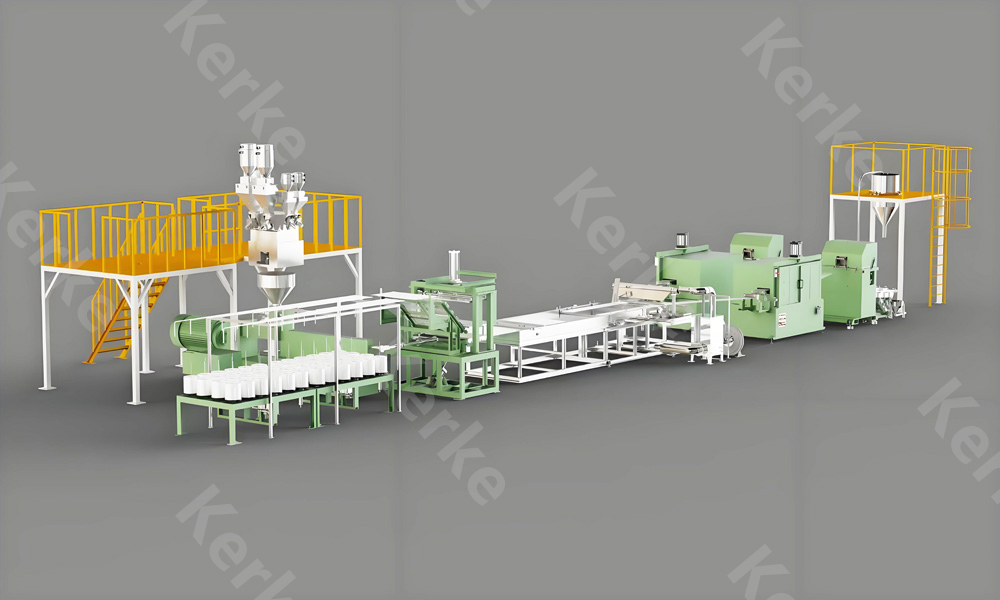
Heavy-duty masterbatch formulas represent the most challenging segment of plastic compounding production, covering high-filler color masterbatches, functional masterbatches, flame-retardant masterbatches, weather-resistant modified masterbatches, and high-viscosity special polymer blends. These formulas feature high filler loading rates, high melt viscosity, poor fluidity, and severe processing resistance, which easily cause insufficient plasticization, uneven dispersion, screw slipping, and equipment overload shutdown when processed by ordinary low-torque extruders. For masterbatch manufacturers, selecting a professional high torque masterbatch extruder is the core premise to ensure stable product quality, continuous high-output production, and lower unit production costs. A qualified high torque compounding extruder can fully shear, disperse and homogenize heavy-duty formulas, eliminate particle agglomeration, and maintain long-term stable operation under high-load working conditions.
Most small and medium-sized masterbatch producers face common pain points when upgrading production equipment: confusing the difference between ordinary twin screw extruders and high-torque heavy-duty compounding extruders, blindly pursuing high screw speed while ignoring torque density matching, and resulting in frequent equipment failure, low finished product qualification rate, and high comprehensive operating costs. Different from conventional low-filler masterbatch production equipment, high torque masterbatch extruders focus on torque density, load resistance, shear uniformity and structural stability, which are specially optimized for heavy-duty formula processing characteristics.
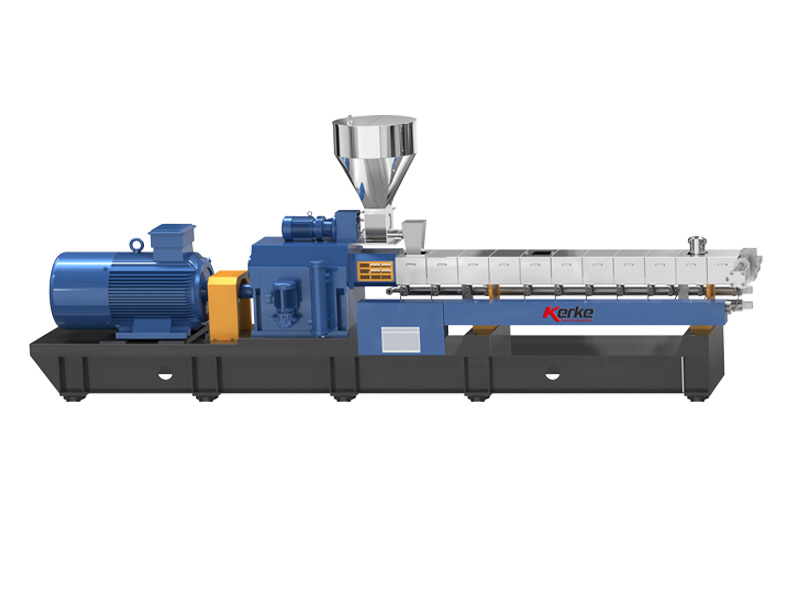
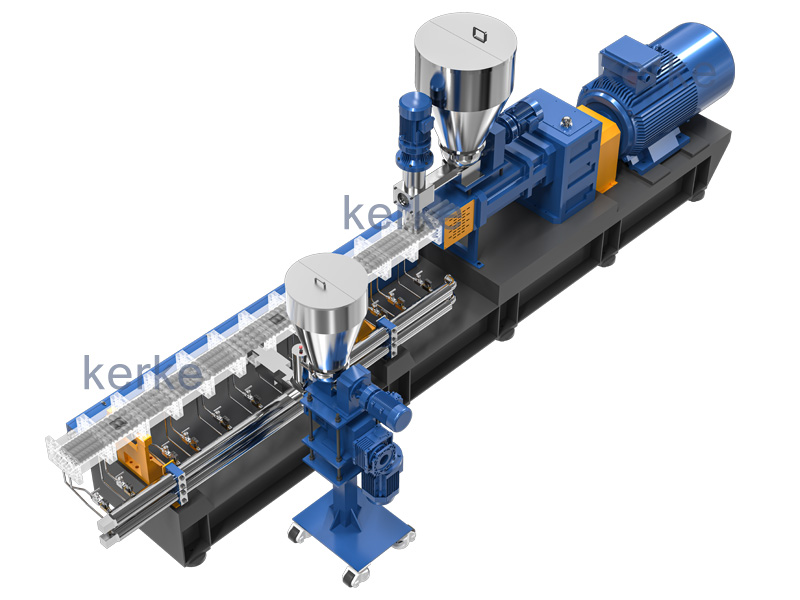
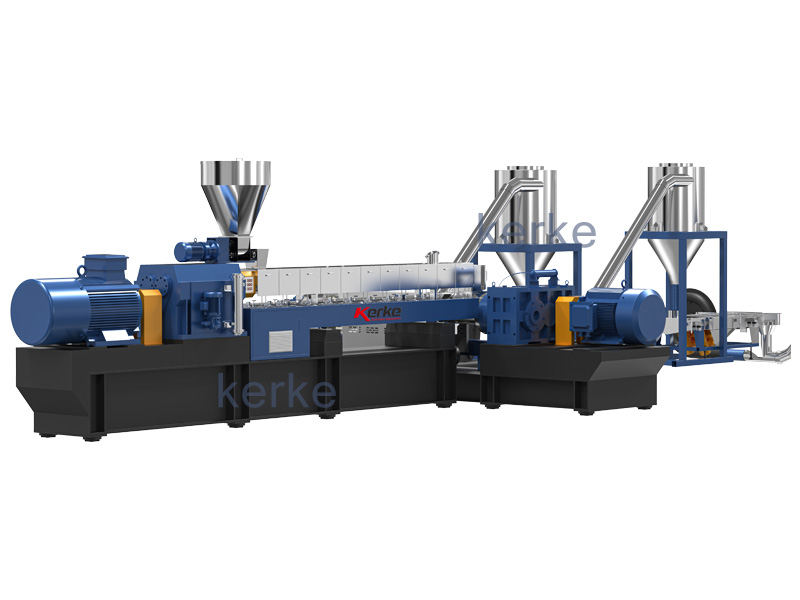
As a professional manufacturer of twin screw extruders and compounding extrusion equipment, Kerke independently develops and produces KTE series high torque co-rotating twin screw extruders, which are widely used in heavy-duty masterbatch compounding and granulation. With a torque density up to 11.5 Nm/cm³, Kerke high torque masterbatch extruders perfectly adapt to various high-filler, high-viscosity and high-load formula production needs. This article comprehensively analyzes the core characteristics of heavy-duty masterbatch formulas, key selection indicators of high torque extruders, equipment configuration differences, model matching schemes, cost and price analysis, and operation and maintenance precautions, providing systematic and practical selection guidance for global masterbatch production enterprises.
1. Understanding Heavy-Duty Masterbatch Formulas and Special Processing Requirements
1.1 Definition and Classification of Heavy-Duty Masterbatch Formulas
Heavy-duty masterbatch formulas refer to modified masterbatch products with high filler content, high viscosity, high shear resistance and complex component ratios, which are completely different from conventional low-filler color masterbatches with simple processing. According to functional characteristics and application scenarios, they are mainly divided into four core categories. The first is high-filler color masterbatches, with inorganic filler loading such as titanium dioxide, calcium carbonate and talc powder exceeding 50%, and individual formulas even reaching 70% to 80%, featuring extremely high processing resistance and poor melt fluidity.
The second is functional modified masterbatches, including flame retardant masterbatches, anti-aging masterbatches, weather-resistant masterbatches and toughening masterbatches. Such formulas contain a variety of powdered functional additives, which are prone to agglomeration and difficult to disperse evenly, requiring strong shear and homogenization capabilities of extrusion equipment. The third is high-viscosity special masterbatches such as SEBS, TPE and thermoplastic elastomer masterbatches, which have high melt viscosity and require continuous high torque output to ensure stable plasticization and granulation.
The fourth is recycled material modified masterbatches, which are mixed with multi-component recycled plastic materials, with unstable material properties and many impurities, requiring equipment with strong load resistance and adaptive processing capacity. All the above heavy-duty formulas cannot be stably produced by ordinary low-torque twin screw extruders, and must rely on professional high torque masterbatch extruders to complete efficient compounding and granulation.
1.2 Core Processing Challenges of Heavy-Duty Formulas
Heavy-duty masterbatch formulas bring multiple technical challenges to extrusion processing, which are also the fundamental reasons for eliminating ordinary low-torque extruders. First, high processing load and large torque demand. A large amount of inorganic fillers and functional powders will greatly increase the friction resistance between materials and screws and barrels, resulting in a sharp rise in equipment operating load. Ordinary extruders have insufficient torque reserve, which is easy to cause screw stalling, motor overload and automatic shutdown, seriously affecting production continuity.
Second, difficult uniform dispersion of fillers. High-content fillers are easy to agglomerate during melting and mixing. Low-torque extruders have weak shear force, which cannot fully break agglomerated particles, resulting in uneven color and inconsistent functional performance of finished masterbatches, failing to meet downstream product quality standards. Third, unstable melt plasticization. Heavy-duty formulas have complex component ratios, and mismatched shear and temperature will lead to local overheating decomposition or insufficient plasticization, producing defective products such as material spots and black particles.
Fourth, severe wear of vulnerable parts. High-hardness inorganic fillers will cause serious abrasion to screw elements and barrel inner walls. Ordinary extruders with ordinary material accessories have short service life, frequent replacement of vulnerable parts, and high maintenance costs. Only high torque compounding extruders with professional structural optimization and wear-resistant configuration can solve the above processing pain points in an all-round way.
2. Core Differences Between High Torque Extruder and Ordinary Twin Screw Extruder
2.1 Torque Density and Power Output Gap
Torque density is the most core indicator to distinguish high torque masterbatch extruders from ordinary twin screw extruders, and also the key parameter to determine the processing capacity of heavy-duty formulas. Torque density refers to the effective torque output per unit screw volume, which directly reflects the load resistance and shear capacity of the extruder. Ordinary twin screw extruders on the market have a torque density of 6 to 8 Nm/cm³, which is only suitable for low-filler color masterbatches and simple plastic blending production.
Kerke high torque masterbatch extruders adopt a self-developed high-precision heavy-duty gearbox, with a torque density up to 11.5 Nm/cm³, which is nearly 40% higher than that of ordinary models. The higher torque density enables the equipment to maintain stable and sufficient shear torque output under high-load heavy-duty formula processing conditions, avoiding screw slipping and insufficient shearing. In the case of the same screw diameter and rotating speed, Kerke high torque extruders can carry higher filler content formulas and achieve more uniform material dispersion effect.
In terms of power matching, ordinary extruders adopt conventional frequency conversion motors with low torque output at low speed, which cannot adapt to high-resistance processing. Kerke high torque compounding extruders are equipped with high-power servo motors and high-efficiency reduction gearboxes, which can output constant high torque in the full speed range, ensuring stable plasticization and compounding of heavy-duty formulas at low and medium speeds, and effectively avoiding material overheating and degradation caused by high-speed forced shearing.
2.2 Screw and Barrel Structural Configuration Differences
The screw and barrel are the core working parts of the masterbatch extruder, and the structural design and material configuration directly determine the equipment's adaptability to heavy-duty formulas. Ordinary twin screw extruders adopt ordinary nitrided steel screws and single-layer barrels, with low surface hardness and poor wear resistance. When processing high-filler heavy-duty masterbatches, the screws and barrels are quickly worn, resulting in reduced processing accuracy and shortened service life.
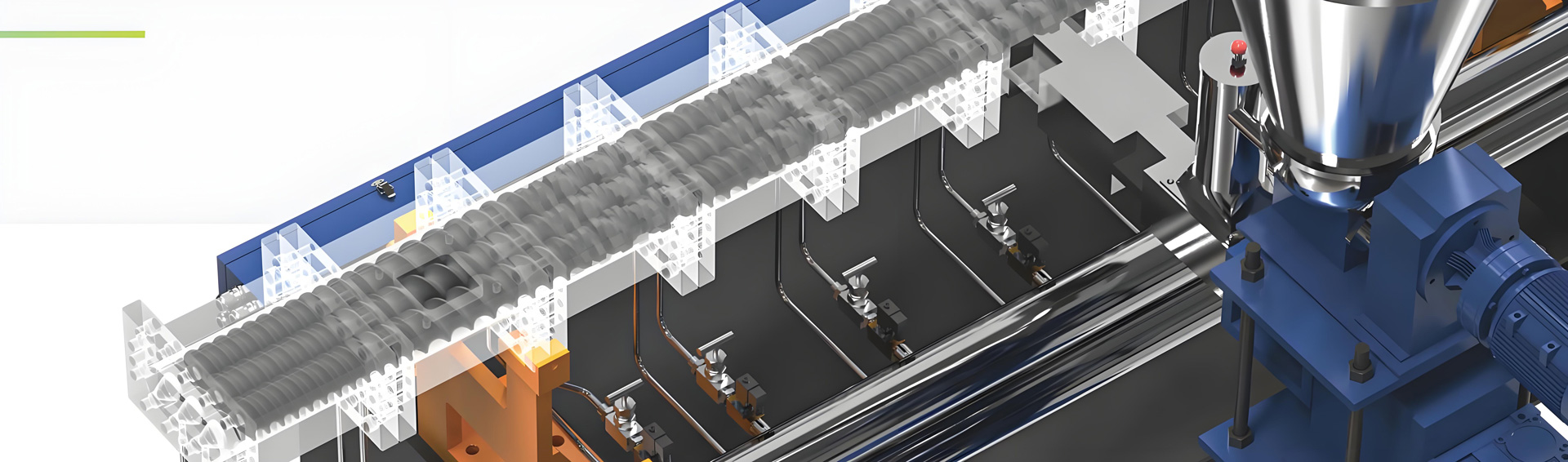
Kerke high torque masterbatch extruders are equipped with customized modular screw elements and bimetallic alloy barrels for heavy-duty working conditions. The screw elements are made of high-strength wear-resistant alloy steel, with overall quenching and tempering treatment, which has excellent wear resistance and fatigue resistance. The screw adopts a combined modular design, which can freely combine conveying, shearing, mixing and kneading elements according to different heavy-duty formula characteristics, realizing targeted shear and dispersion processing and avoiding excessive shearing or insufficient mixing.
The barrel adopts integral bimetallic centrifugal casting process, with the inner wall alloy layer thickness reaching 2-3mm, which can resist long-term abrasion of high-hardness fillers. At the same time, the barrel is equipped with independent segmented water circulation cooling channels, which can accurately control the processing temperature of each section, solve the problem of local overheating of heavy-duty formulas, and ensure the stability of melt quality. This professional wear-resistant and temperature control configuration is not available in ordinary low-torque extruders.
2.3 Operational Stability and Load Resistance Differences
In terms of operational stability, ordinary twin screw extruders have weak structural rigidity. Under long-term high-load operation of heavy-duty formulas, the gearbox and transmission structure are prone to vibration and displacement, resulting in unstable screw operation, uneven material extrusion, and increased defective rate. In addition, ordinary equipment has low overload protection capacity, and frequent overload shutdowns will occur when processing high-filler formulas, seriously reducing production efficiency.
Kerke high torque compounding extruders adopt an integral cast steel frame structure with high overall rigidity and strong shock resistance, which can maintain stable operation for a long time under high-load working conditions without vibration and displacement. The independently developed gearbox has high transmission efficiency and low operating noise, with a service life more than 30% longer than ordinary gearboxes. The equipment is equipped with intelligent overload protection system, which can automatically adjust the feeding amount and screw speed according to the material load, effectively avoiding motor burnout and mechanical failure caused by overload, and ensuring the continuity and stability of heavy-duty formula production.
3. Key Selection Criteria for High Torque Masterbatch Extruders for Heavy-Duty Formulas
3.1 Torque Density Matching According to Formula Filler Loading
Torque density matching is the primary principle for selecting high torque masterbatch extruders. Users need to select equipment with corresponding torque levels according to the filler content and formula viscosity of their own heavy-duty masterbatches. For conventional heavy-duty formulas with 30% to 50% filler content, the equipment torque density should not be lower than 10 Nm/cm³ to ensure sufficient shear dispersion capacity. For ultra-high filler formulas with filler content exceeding 50%, it is necessary to select equipment with a torque density of 11.5 Nm/cm³, which is the mainstream high-standard configuration for industrial heavy-duty masterbatch production.
In terms of torque value matching, small and medium-sized production lines with screw diameter of 36mm to 50mm need to have a maximum torque of more than 2000 N·m to adapt to most flame-retardant and high-filler color masterbatch production. Large-scale production lines with screw diameter of 65mm to 75mm need a maximum torque of more than 4500 N·m to meet the mass production needs of ultra-high filler heavy-duty formulas. Kerke KTE series high torque extruders cover all torque levels, which can realize accurate matching according to different formula parameters, avoiding equipment performance surplus or insufficient capacity.
3.2 Screw Length-Diameter Ratio and Modular Combination Design
The screw length-diameter ratio is a key parameter affecting the plasticization and dispersion effect of heavy-duty masterbatches. Heavy-duty formulas with complex components and high filler content require sufficient melting, shearing, mixing and exhaust time, so the screw length-diameter ratio cannot be too small. Ordinary masterbatch extruders usually adopt 32:1 length-diameter ratio, which is difficult to complete sufficient dispersion of high-filler formulas.
Kerke high torque masterbatch extruders are equipped with a standard 40:1 length-diameter ratio screw, which can be adjusted to 48:1 according to formula requirements. The longer length-diameter ratio provides sufficient processing stroke for heavy-duty formulas, realizing gradual melting, multi-stage shearing, uniform mixing and full exhaust, effectively eliminating bubbles and agglomerated particles inside the masterbatch. The modular screw combination design allows users to adjust the collocation of shear blocks, kneading blocks and conveying elements according to different formula characteristics, realizing personalized processing of different heavy-duty formulas and greatly improving the utilization rate of equipment.
3.3 Wear-Resistant Configuration Adapted to Long-Term Heavy-Load Production
Wear resistance is an essential selection indicator for heavy-duty masterbatch extruders, because high-hardness inorganic fillers will cause continuous abrasion to screws and barrels. When selecting equipment, users must focus on the material and process of core vulnerable parts. Qualified high torque compounding extruders must adopt bimetallic alloy barrels and high-alloy wear-resistant screws, and the alloy layer must have high hardness, high wear resistance and high temperature resistance.
Kerke high torque extruders adopt imported high-chromium molybdenum vanadium alloy materials for screw elements, with surface hardness up to HRC60-62, which can resist long-term abrasion of calcium carbonate, talc powder, titanium dioxide and other fillers. The barrel inner wall adopts thickened bimetallic alloy layer, which has excellent wear resistance and corrosion resistance, and the service life is more than twice that of ordinary nitride barrels. In addition, the equipment is equipped with wear-resistant end faces and high-strength sealing parts, which reduces the failure rate of vulnerable parts in heavy-load production and lowers long-term maintenance costs.
3.4 Intelligent Temperature Control and Exhaust System Configuration
Heavy-duty masterbatch formulas are sensitive to temperature changes, and excessive temperature will cause material decomposition and carbonization, while too low temperature will lead to insufficient plasticization and poor dispersion. Therefore, high-precision segmented temperature control system is a necessary configuration for high torque masterbatch extruders. When selecting equipment, it is necessary to confirm that the equipment has independent temperature control modules for each barrel section and die head, with temperature control accuracy within ±0.5℃.
Kerke high torque twin screw extruders are equipped with full intelligent segmented temperature control system, which supports automatic temperature adjustment and constant temperature maintenance, and can adapt to the processing temperature requirements of different heavy-duty formulas. At the same time, the equipment is equipped with multi-stage vacuum exhaust system, which can effectively remove moisture, volatile substances and gas generated in the melting process of heavy-duty formulas, avoid bubble defects inside masterbatch particles, and improve the compactness and surface smoothness of finished products. For moisture-sensitive functional masterbatches, the multi-stage exhaust configuration can greatly improve product qualification rate.
3.5 Production Capacity Matching and Line Speed Stability
Enterprises need to select high torque extruder models with matching production capacity according to their own daily output requirements. The production capacity of heavy-duty masterbatches is limited by formula resistance and equipment torque, and cannot be blindly compared with ordinary low-filler masterbatch output. Small batch trial production and small-scale production are suitable for KTE-36B and KTE-50 models, with hourly output of 80kg to 200kg, which can meet the production needs of small-batch multi-variety heavy-duty formulas.
Medium and large-scale mass production needs to select KTE-65 and KTE-75 large high torque extruders, with hourly output of 300kg to 600kg, which can realize continuous mass production of high-filler heavy-duty masterbatches. In addition to static production capacity, users need to pay attention to the long-term line speed stability of the equipment. High-quality high torque extruders can maintain stable speed and uniform extrusion volume under long-term high-load operation, without output fluctuation caused by load changes, ensuring consistent batch quality of masterbatches.
4. Kerke High Torque Masterbatch Extruder Typical Model Matching and Parameter Introduction
4.1 KTE-36B Small High Torque Compounding Extruder
The KTE-36B model is Kerke's small high torque twin screw extruder, specially designed for small-batch production, formula research and development and trial production of heavy-duty masterbatches. The equipment has a screw diameter of 36mm, a length-diameter ratio of 40:1, a torque density of 11 Nm/cm³, and a maximum screw speed of 600rpm. It is suitable for trial production and small-scale production of various flame-retardant masterbatches, anti-aging masterbatches and medium-filler color masterbatches, with a stable hourly output of 80 to 120kg.
The whole machine adopts modular design, with compact structure and small floor space, which is convenient for factory layout and equipment debugging. It is equipped with intelligent PLC centralized control system, realizing one-key parameter setting and automatic operation. The price of KTE-36B high torque masterbatch extruder is 48,000 to 58,000 US dollars, which is very suitable for new masterbatch enterprises, laboratory formula development and small-batch customized production scenarios. The equipment has low operation energy consumption and low maintenance cost, with a short investment return cycle.
4.2 KTE-50 Medium-Sized High Torque Masterbatch Extruder
KTE-50 is the most mainstream medium-sized high torque twin screw extruder of Kerke, which is widely used in mass production of various conventional heavy-duty masterbatches. The screw diameter is 50mm, the length-diameter ratio is 40:1, the torque density reaches 11.5 Nm/cm³, and the maximum torque output is 2100 N·m. The equipment can stably process high-filler formulas with filler content of 50% to 60%, with a stable hourly output of 180 to 250kg.
This model is fully upgraded in terms of wear resistance and load resistance, equipped with thickened bimetallic barrel and high-strength modular screw, which can adapt to long-term 24-hour continuous production. It supports multi-stage vacuum exhaust and high-precision temperature control, and the produced masterbatch has uniform dispersion and stable quality. The price of KTE-50 high torque compounding extruder is 68,000 to 78,000 US dollars. It is the preferred model for most medium-sized masterbatch production enterprises, balancing production capacity, equipment cost and operation stability.
4.3 KTE-65/KTE-75 Large High Torque Compounding Extruder
KTE-65 and KTE-75 are large-scale heavy-duty high torque twin screw extruders launched by Kerke for ultra-high filler masterbatch mass production. The screw diameters are 65mm and 75mm respectively, with a length-diameter ratio of 40:1 to 48:1, and the torque density is stably maintained at 11.5 Nm/cm³. The maximum torque output of KTE-65 is 4600 N·m, and the hourly output can reach 350 to 450kg; the maximum torque output of KTE-75 is 6800 N·m, and the hourly output is up to 500 to 600kg.
These two large models are specially optimized for ultra-high filler heavy-duty formulas with filler content higher than 60%, solving the problems of difficult dispersion, low output and easy wear of ultra-high filler masterbatches. The whole machine adopts heavy-duty cast steel structure and high-power servo drive system, with strong overload resistance and extremely stable long-term operation. The price of KTE-65 is 95,000 to 110,000 US dollars, and the price of KTE-75 is 120,000 to 140,000 US dollars, which is suitable for large-scale masterbatch manufacturers with large output and high-standard product requirements.
5. Comprehensive Cost and Price Analysis of High Torque Masterbatch Extruders
5.1 Initial Equipment Investment Cost
The initial investment cost of high torque masterbatch extruders is mainly affected by model specification, configuration level and functional customization. Compared with ordinary low-torque extruders, high torque compounding extruders have higher initial investment due to the adoption of high-grade gearboxes, wear-resistant alloy accessories and intelligent control systems. Small-sized KTE-36B models have the lowest initial investment, suitable for budget-limited small enterprises and laboratory projects.
Medium-sized KTE-50 models have moderate investment and the highest cost performance, which can meet the production needs of most heavy-duty masterbatches and is the mainstream choice in the market. Large-sized KTE-65 and KTE-75 models have high initial investment, but their high output and high stability can greatly reduce the unit production cost, which is more suitable for large-scale mass production projects. All Kerke high torque extruders adopt standardized modular production, with transparent pricing and no redundant configuration premium, ensuring that customers get the most cost-effective equipment matching.
5.2 Daily Operation and Maintenance Cost Analysis
In terms of energy consumption cost, Kerke high torque extruders adopt high-efficiency servo drive system, which can automatically adjust power output according to production load. Compared with ordinary extruders, the unit product energy consumption is reduced by 15% to 20%, saving a lot of electricity costs for long-term production. Taking the KTE-50 model as an example, the daily electricity cost can be saved by 30 to 50 US dollars, and the annual electricity saving benefit is considerable.
In terms of maintenance cost, the wear-resistant configuration of Kerke high torque extruders greatly reduces the replacement frequency of vulnerable parts. The service life of screws and barrels is more than 3 years, which is 2 times longer than that of ordinary equipment. The annual maintenance cost of small and medium-sized models is controlled within 3,000 to 5,000 US dollars, and the annual maintenance cost of large models is about 6,000 to 8,000 US dollars, which is far lower than the maintenance cost of ordinary extruders with frequent part replacement.
In terms of labor cost, the high degree of automation of the equipment realizes one-person operation of the whole line, reducing the number of on-site operators. Compared with semi-automatic ordinary extruders, each production line can save 1 to 2 operators, greatly reducing long-term labor expenditure.
5.3 Investment Payback Period Evaluation
Although the initial investment of high torque masterbatch extruders is slightly higher than that of ordinary equipment, the comprehensive economic benefits are far better. Due to the stable product quality and low defective rate, the waste loss of raw materials is greatly reduced. At the same time, the high continuous production efficiency improves the annual output of finished products and increases enterprise profits.
The investment payback period of Kerke KTE-36B small model is about 10 to 12 months, which is suitable for small-batch flexible production. The payback period of KTE-50 medium-sized mainstream model is 12 to 15 months, with stable and reliable returns. The payback period of large KTE-65/KTE-75 models is 18 to 22 months. Although the investment cycle is slightly longer, the long-term high-output and low-cost advantages can bring stable and high profits for large-scale production enterprises. The service life of all Kerke high torque extruders is more than 15 years, with ultra-long service cycle and extremely high long-term return on investment.
6. Common Selection Mistakes and Avoidance Methods
6.1 Blindly Pursuing High Speed While Ignoring Torque Matching
Many users mistakenly believe that the higher the screw speed, the higher the production efficiency, and blindly select high-speed low-torque extruders for heavy-duty formula production. In fact, heavy-duty masterbatches with high filler content and high viscosity cannot be processed by high-speed shearing. Excessively high speed will cause material overheating decomposition, serious screw wear and frequent equipment overload shutdown, resulting in increased defective rate and reduced actual output.
The correct selection principle is to prioritize torque density matching according to formula load, and then reasonably match the screw speed. High torque low-speed stable production is the core of heavy-duty masterbatch processing, which can ensure uniform material dispersion and stable equipment operation, and truly improve effective production efficiency and product qualification rate.
6.2 Ignoring Wear-Resistant Configuration and Purchasing Low-Cost Ordinary Models
Some enterprises only focus on the initial equipment price and choose low-cost ordinary twin screw extruders to produce heavy-duty masterbatches, resulting in frequent wear of screws and barrels in the later stage, frequent shutdown maintenance, and continuous increase of comprehensive production costs. Ordinary equipment lacks high-torque load resistance and professional wear-resistant configuration, which is completely unable to adapt to long-term heavy-load production of high-filler formulas.
Users must clearly recognize that high torque wear-resistant configuration is a necessary investment for heavy-duty masterbatch production. Although the one-time investment is slightly higher, it can avoid a large number of later maintenance costs and production shutdown losses, which is the most cost-effective choice for long-term stable production.
6.3 Unreasonable Matching of Screw Length-Diameter Ratio and Formula
Using a small length-diameter ratio screw to process complex heavy-duty formulas will lead to insufficient material melting, incomplete exhaust and uneven dispersion, resulting in unqualified product quality. If the length-diameter ratio is too large for simple medium-filler formulas, it will cause excessive material shearing, waste of equipment performance and increased energy consumption.
When selecting equipment, users need to match the screw length-diameter ratio according to formula complexity and filler content. Conventional heavy-duty formulas adopt 40:1 length-diameter ratio, and ultra-complex high-filler and high-volatility formulas can choose 48:1 lengthened screw to ensure sufficient processing stroke and qualified product quality.
7. Daily Operation and Maintenance Skills for High Torque Masterbatch Extruders
7.1 Standard Startup and Shutdown Operation Specifications
Standard startup and shutdown operation is the basis to maintain the long-term stability of high torque extruders. Before daily startup, it is necessary to check the lubrication state of the gearbox, the tightness of the transmission parts and the smoothness of the cooling system, and eliminate potential faults. Preheat the barrel and die head in sections according to the formula processing temperature, and keep constant temperature for 20 to 30 minutes after reaching the set temperature to ensure uniform heating of all parts of the equipment.
During startup, adopt low-speed no-load trial operation first, and gradually increase the feeding amount and screw speed after confirming that the equipment operates normally. Avoid sudden high-load startup to prevent instantaneous torque impact from damaging the gearbox and screw components. When shutting down, stop feeding first, continue empty running for 5 to 10 minutes to discharge the residual materials in the barrel, and then stop the equipment after cooling down appropriately, so as to avoid material carbonization and adhesion in the barrel affecting the next startup production.
7.2 Regular Wear Inspection and Vulnerable Parts Maintenance
For high torque extruders engaged in long-term heavy-duty masterbatch production, regular wear inspection of screws and barrels must be done. Check the wear degree of screw elements and barrel inner wall every month, and replace severely worn parts in time to avoid affecting material dispersion and extrusion stability. Clean the filter screen regularly according to production conditions to prevent impurities from blocking and causing pressure fluctuation in the extrusion cavity.
Check the gearbox oil quality and oil level every quarter, replace the lubricating oil regularly, and ensure the lubrication effect of the high-torque transmission system. Inspect the sealing parts and cooling pipeline joints regularly to avoid material leakage and water leakage faults. Scientific regular maintenance can maximize the service life of high torque extruders and maintain long-term stable processing performance.
7.3 Formula and Parameter Debugging Optimization Skills
When producing different heavy-duty masterbatch formulas, it is necessary to adjust the process parameters adaptively according to the formula characteristics. Appropriately reduce the screw speed for ultra-high filler formulas to ensure sufficient shearing and dispersion time, and increase the vacuum exhaust strength to remove internal gas. For high-viscosity elastomer masterbatches, appropriately adjust the segmented temperature curve to optimize the melting fluidity and avoid material overheating degradation.
Record the optimal process parameters of each formula and form a standardized parameter database, which can be called directly in subsequent production, reducing debugging time and defective product rate. Avoid long-term high-load limit operation of the equipment, reasonably control the operating torque within 80% of the maximum torque, and reserve sufficient load margin to ensure the stable operation of the equipment.
8. Kerke Professional Technical Support and After-Sales Service
Kerke provides full-cycle professional services for all high torque masterbatch extruders and compounding extruders. In the pre-sales stage, professional technical engineers conduct one-on-one communication according to customers' masterbatch formula type, filler content, production capacity requirements and factory conditions, recommend the most matching extruder model and configuration scheme, and avoid unreasonable equipment selection and over-investment.
During the equipment delivery period, all machines are fully assembled, debugged and trial-produced in the factory to ensure that the equipment performance meets the standard before delivery. After the equipment arrives at the customer's factory, professional after-sales engineers provide on-site installation, commissioning and formula debugging services to help customers quickly complete production line commissioning and reach full production capacity.
Kerke provides free professional training for customer operators and maintenance personnel, covering equipment operation specifications, formula parameter debugging, daily maintenance and common fault troubleshooting, enabling customers to independently complete daily production and equipment management. The company has a 24-hour remote technical support team to quickly respond to customer production problems, solve equipment faults and parameter debugging difficulties in the shortest time, and minimize production shutdown losses. Long-term spare parts supply guarantee ensures the timely replacement of vulnerable parts of the equipment and maintains the long-term stable operation of the production line.
Conclusion
Selecting a suitable high torque masterbatch extruder is the key to stable production of heavy-duty masterbatch formulas, and torque density, wear-resistant configuration, screw design and load resistance are the core selection indicators that cannot be ignored. Ordinary low-torque twin screw extruders are difficult to adapt to high-load, high-dispersion processing requirements of heavy-duty formulas, and will bring a series of problems such as unstable quality, low efficiency and high maintenance costs.
Kerke KTE series high torque twin screw extruders, with industry-leading 11.5 Nm/cm³ torque density, professional wear-resistant configuration, modular screw design and intelligent control system, fully meet the production needs of various heavy-duty masterbatch formulas. The complete model spectrum covers small trial production, medium batch production and large-scale mass production scenarios, with transparent and reasonable prices and excellent comprehensive cost performance.
For masterbatch manufacturing enterprises, investing in high-quality high torque compounding extruders can fundamentally solve the processing pain points of heavy-duty formulas, improve product quality and production efficiency, reduce long-term comprehensive operating costs, and effectively enhance market competitiveness. With reliable equipment performance, perfect technical support and comprehensive after-sales service, Kerke provides stable and efficient extrusion equipment solutions for global masterbatch compounding production.