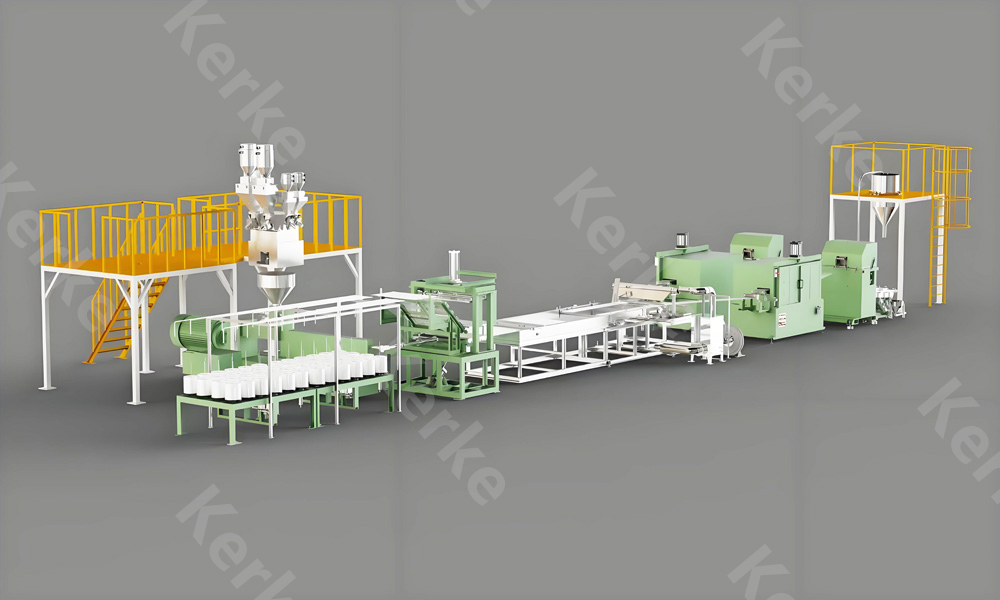
Modern masterbatch manufacturing relies heavily on streamlined automated production lines that combine three core process modules: extrusion, cooling, and cutting. These three procedures are not independent units in industrial production; instead, they form a closed-loop collaborative system that determines the final pellet quality, dimensional consistency, production efficiency, and operational cost of color masterbatches, functional masterbatches, and high-filler modified masterbatches. Disordered matching or asynchronous operation among extrusion, cooling, and cutting will directly cause common production defects including uneven pellet size, strand deformation, bubble inclusion, pellet adhesion, and inconsistent color dispersion, leading to high defective rates and increased production costs.
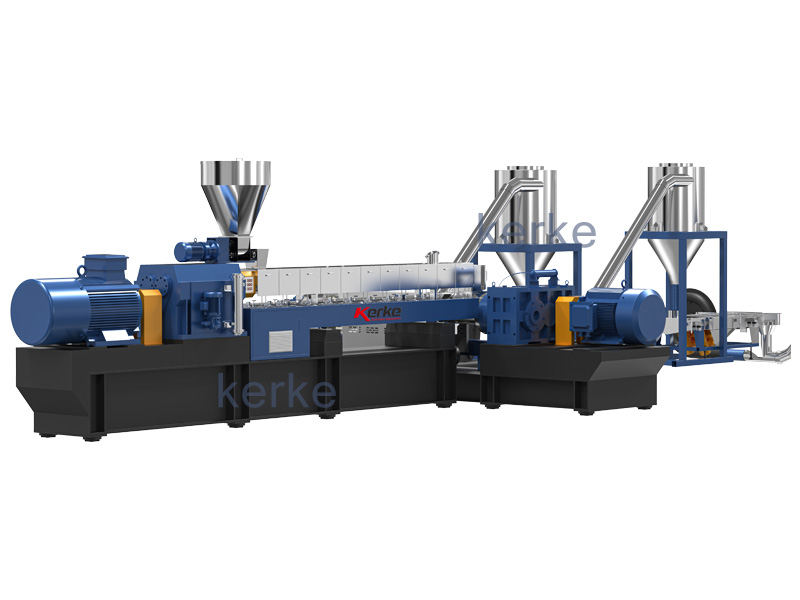
A fully integrated masterbatch extrusion line realizes synchronous linkage of material melting and extrusion, gradient cooling shaping, and fixed-length precision cutting through intelligent control and mechanical optimization. Each process parameter of the three modules is dynamically matched and adjusted in real time to adapt to different masterbatch formulas, carrier materials, and filler loading ratios. As a professional twin screw extruder manufacturer focusing on masterbatch compounding and extrusion equipment, Kerke optimizes the overall structural layout and process linkage logic of masterbatch extrusion lines, perfectly solving the problems of poor coordination, low stability, and high energy consumption of traditional split production lines. This article comprehensively analyzes the working principle, integration mechanism, core technical advantages, parameter matching rules, cost analysis, and fault optimization solutions of the three-in-one integrated system of extrusion, cooling, and cutting, providing systematic technical guidance for masterbatch production enterprises to optimize production lines.
1. Overview of Three-Core Process Integration in Masterbatch Extrusion Line
1.1 Independent Functions of Extrusion, Cooling and Cutting Modules
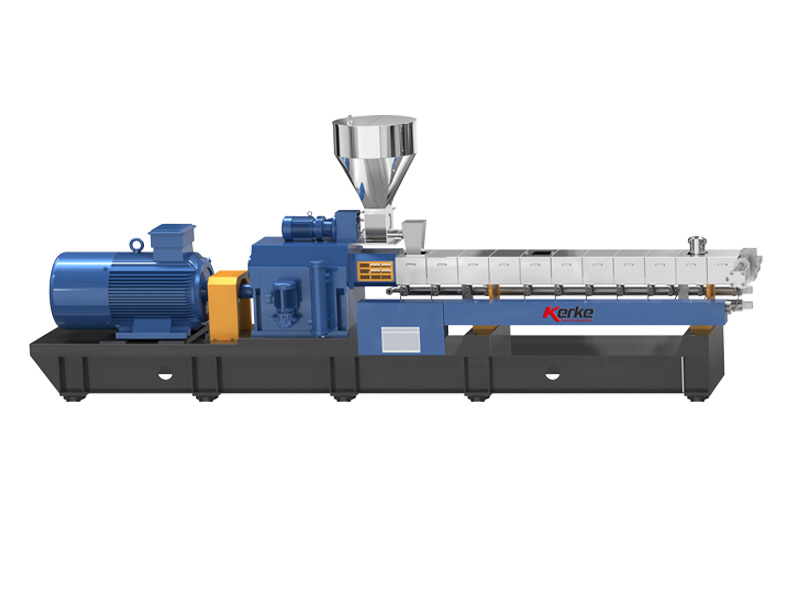
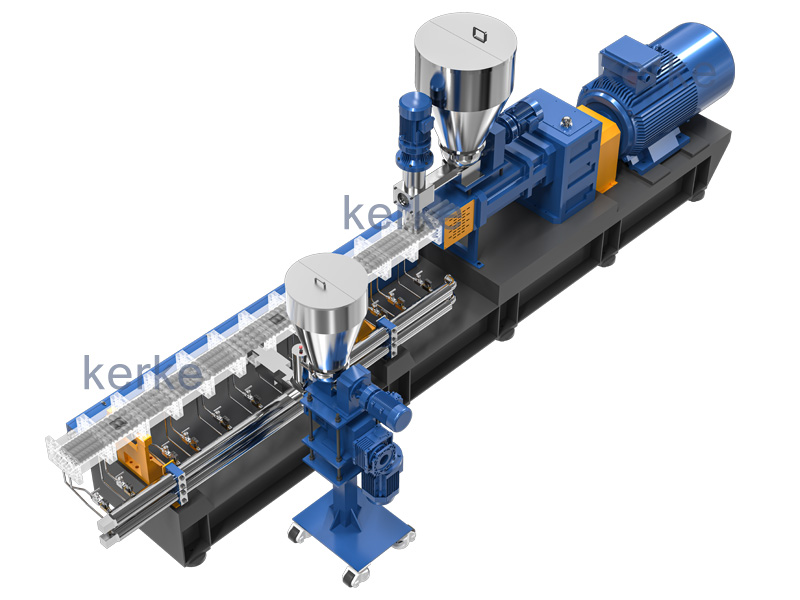
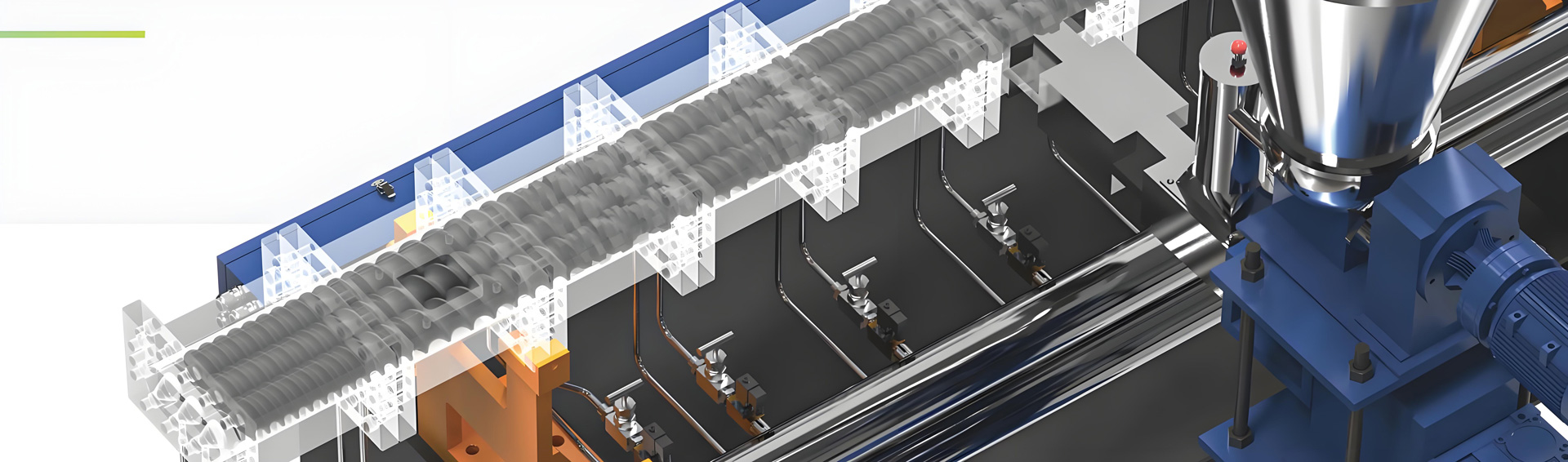
The extrusion module is the core melting and compounding unit of the entire production line, mainly composed of a twin screw extruder, feeding system, melt filtering system, and die head assembly. Its core function is to melt, shear, disperse, and homogenize mixed raw materials including plastic carriers, color pigments, functional additives, and inorganic fillers. Through high-torque screw shearing and segmented temperature control, the solid raw materials are completely converted into uniform molten melt, eliminating filler agglomeration and ensuring consistent component distribution of masterbatch materials, which is the foundation of finished product quality.
The cooling module is the key shaping unit connecting extrusion and cutting, mainly including water bath cooling trough, circulating water temperature control system, air drying device, and conveying traction mechanism. After the molten masterbatch is extruded into continuous linear strands through the die head, the high-temperature melt has no fixed shape and is prone to deformation and adhesion. The cooling module quickly and evenly reduces the strand temperature through gradient water cooling, solidifies the internal molecular structure of the strands, maintains stable linear shape and hardness, and removes surface moisture through air drying, creating qualified cutting raw materials for the subsequent pelletizing process.
The cutting module is the final forming and finishing unit of masterbatch production, consisting of a high-speed pelletizer, fixed-length positioning system, vibrating screening device, and finished product conveying system. Its core function is to perform fixed-length and fixed-point cutting on the cooled and dried solid strands to form uniform cylindrical masterbatch pellets. At the same time, it screens out unqualified fine materials, oversized particles and debris to ensure consistent pellet specifications and neat appearance of finished masterbatches, meeting the downstream plastic processing and blending standards.
1.2 Core Value of Integrated Collaborative Operation
Traditional backward masterbatch production equipment adopts split independent operation mode, where extrusion, cooling, and cutting are controlled separately with independent parameter settings and operating speeds. This discrete operation mode leads to serious process mismatch problems: excessive extrusion speed cannot be matched with cooling efficiency, resulting in soft unshaped strands that cannot be cut normally; insufficient cooling capacity causes pellet adhesion; mismatched cutting speed leads to uneven pellet length and irregular shapes, greatly reducing product qualification rate and production efficiency.
The integrated masterbatch extrusion line launched by Kerke realizes full-process linkage of the three modules through PLC centralized intelligent control system and mechanical synchronous transmission technology. The extrusion output, cooling water flow and temperature, traction speed, and cutting frequency are dynamically matched in real time, forming a closed-loop production logic of "stable extrusion – uniform cooling – precise cutting". This integrated operation mode effectively reduces manual parameter adjustment errors, reduces defective product rate by more than 90%, improves continuous production efficiency by 30% compared with traditional split lines, and greatly reduces long-term comprehensive production costs for enterprises.
In addition, the integrated structure optimizes the overall layout of the production line, reduces floor space, simplifies operation procedures, and realizes one-person full-line operation. It is suitable for mass production of various conventional and heavy-duty masterbatches such as high-filler color masterbatches, flame-retardant masterbatches, weather-resistant masterbatches, and toughening masterbatches, with strong formula adaptability and production stability.
2. Working Principle and Process Flow of Integrated Extrusion-Cooling-Cutting System
2.1 Full-Link Continuous Production Process Sequence
The integrated masterbatch extrusion line follows a continuous and uninterrupted production process sequence, with each link closely connected and mutually restricted. First, the raw material mixing system uniformly conveys the proportioned masterbatch raw materials to the twin screw extruder. Under the action of segmented temperature control and high-torque screw shearing, the raw materials complete melting, plasticization, filler dispersion, and vacuum exhaust in the extruder barrel to form high-purity and uniform molten melt.
The homogeneous melt passes through the precision filter screen to remove impurity particles, then is extruded into multiple uniform linear strands through the multi-hole die head at a constant pressure and speed. The high-temperature strands immediately enter the first-stage gradient water bath cooling area for rapid temperature reduction and preliminary shaping. With the traction of the synchronous traction device, the strands stably pass through the multi-stage cooling trough to complete deep cooling and solidification, and then enter the air drying unit to completely remove surface residual moisture.
The dried solid strands are stably conveyed to the high-speed pelletizer through the synchronous traction system. The cutting system automatically adjusts the blade rotating speed according to the strand conveying speed to complete fixed-length equal cutting. After cutting, the finished pellets pass through the vibrating screening equipment to remove unqualified particles and fine powder, and finally complete finished product collection and packaging. The entire process realizes fully automated continuous operation without manual intervention in the middle link, ensuring the continuity and stability of masterbatch production.
2.2 Synchronous Linkage Mechanism Between Modules
The core of integrated production lies in the real-time synchronous linkage between the three modules. Kerke masterbatch extrusion lines adopt a unified PLC control system to integrate all operation parameters of extrusion, cooling and cutting into one control terminal. The system collects real-time data including extruder screw speed, melt pressure, strand output speed, cooling water temperature and flow rate, traction conveying speed, and pelletizer cutting frequency, and forms a dynamic parameter matching algorithm to realize automatic adjustment of each link.
When the extruder screw speed increases and the strand output speed accelerates, the system will automatically increase the traction speed and cooling water flow rate to ensure that the strands obtain sufficient cooling time and cooling capacity, avoiding incomplete cooling caused by rapid conveying. At the same time, the pelletizer blade speed will be synchronously increased to match the fast strand conveying speed and ensure fixed-length cutting accuracy. On the contrary, when the extrusion speed decreases for formula switching or parameter debugging, the cooling and cutting parameters will automatically decrease synchronously to avoid excessive cooling and cutting waste.
In terms of mechanical linkage, the traction device adopts servo synchronous drive, which is mechanically locked with the extruder and pelletizer to eliminate speed deviation caused by independent transmission. This mechanical and electrical dual synchronous mechanism completely solves the asynchronous problem of traditional split equipment, ensures that each strand maintains consistent tension, cooling effect and cutting specification, and realizes batch consistency of finished masterbatch pellets.
3. Core Configuration and Technical Advantages of Each Integrated Module
3.1 Optimized Extrusion Module for Stable Melt Output
The extrusion module is the source of integrated production stability, and Kerke adopts self-developed KTE series high torque twin screw extruders as the core extrusion equipment, which is specially optimized for masterbatch compounding characteristics. The equipment adopts 11.5 Nm/cm³ high torque density design, equipped with modular alloy screws and bimetallic wear-resistant barrels, which can fully adapt to high-filler, high-viscosity heavy-duty masterbatch formula processing. The segmented intelligent temperature control system realizes precise temperature adjustment with an accuracy of ±0.5℃, effectively avoiding melt decomposition or insufficient plasticization, and ensuring uniform melt viscosity and stable strand output.
The melt filtering system adopts automatic screen changer, which can continuously filter impurities in the melt without stopping the machine, ensuring the purity of extruded strands. The multi-hole die head adopts precision flow channel design, with uniform melt discharge at each hole, consistent strand thickness, and no deviation or thin and uneven strands, laying a foundation for subsequent uniform cooling and precise cutting. Compared with ordinary low-torque extruders, Kerke extrusion modules have 40% higher shear dispersion capacity and 25% more stable output, which can adapt to long-term 24-hour continuous production.
3.2 Gradient Cooling Module for Strand Shaping Stability
Different from the one-time rapid cooling mode of traditional equipment, Kerke integrated production line adopts a multi-stage gradient cooling system, which is the key to avoid strand deformation and pellet adhesion. The cooling system is divided into three functional areas: preliminary shaping cooling area, deep solidification cooling area, and constant temperature buffering area. The first-stage low-temperature water bath (40-50℃) is used for preliminary shaping of high-temperature strands to prevent thermal shock from causing strand internal stress and brittle deformation; the second-stage normal temperature circulating water (25-35℃) realizes deep cooling and solidification of strands to fix the linear shape; the third-stage constant temperature water area buffers the strand temperature to ensure uniform overall hardness.
The circulating water system is equipped with independent temperature control and filtration devices, which can keep the cooling water temperature stable and water quality clean for a long time, avoid scale adhesion on the strand surface, and ensure smooth and flat strand appearance. The matched high-power air drying device adopts high-pressure uniform air supply design, which can completely remove surface moisture of cooled strands without damaging strand surface smoothness. This gradient cooling mode ensures that the strands have moderate hardness and toughness before cutting, avoiding cutting defects such as burrs, broken particles and uneven cuts caused by too soft or too hard strands.
3.3 Precision Cutting Module for Uniform Pellet Specification
The cutting module of Kerke integrated production line adopts high-speed servo pelletizer, which has the advantages of high cutting accuracy, stable operation and wide adaptability. The pelletizer is equipped with high-hardness alloy rotary blades and fixed blades, with sharp cutting edge and long service life, which can complete smooth cutting of various masterbatch strands without burrs and debris. The servo speed regulation system can realize stepless speed adjustment, and the cutting length can be accurately adjusted in the range of 2-5mm according to customer needs, with a length tolerance controlled within ±0.1mm.
In addition, the cutting module is equipped with an intelligent anti-jamming system. When individual strands are abnormal or blocked, the system will automatically trigger the protection mechanism, synchronously adjust the traction and cutting speed, and alarm to remind troubleshooting, effectively avoiding equipment jamming and material waste. The rear-end vibrating screening device can automatically screen unqualified fine powder and oversized particles, ensuring that the qualified rate of finished pellets reaches more than 99.5%, which is far higher than the industry average level.
4. Parameter Matching Rules for Integrated Production of Different Masterbatch Formulas
4.1 Conventional Low-Filler Color Masterbatch Parameter Matching
For conventional color masterbatches with filler content below 30% and low melt viscosity, the integrated production line adopts medium-speed and conventional cooling parameter matching. The extruder screw speed is controlled at 300-400rpm, the melt extrusion temperature is set at 180-210℃, and the strand output speed is stable at 15-20m/min. The cooling water temperature is maintained at 25-30℃, the water bath cooling length is 4-6m, which can quickly complete strand solidification. The pelletizer cutting speed is matched with the strand speed, and the conventional pellet length is set to 3mm.
This parameter matching scheme has high production efficiency and low energy consumption, and can realize high-speed continuous production of conventional color masterbatches. The integrated synchronous system ensures that the strands are cooled uniformly and cut neatly, with no color difference or specification deviation in batch products. The hourly output of Kerke KTE-50 production line under this formula can reach 200-250kg, with stable product quality and extremely low defective rate.
4.2 High-Filler Heavy-Duty Masterbatch Parameter Matching
High-filler masterbatches (filler content 50%-80%) such as high-calcium, high-titanium dioxide and flame-retardant masterbatches have high melt viscosity and poor fluidity, requiring low-speed high-torque extrusion and sufficient cooling time. The integrated system automatically adjusts to low-speed stable production mode: the extruder screw speed is controlled at 150-250rpm, the melt plasticization temperature is appropriately increased to 200-230℃ to ensure sufficient material melting and dispersion, and the strand output speed is reduced to 8-12m/min.
The cooling system extends the cooling stroke to 8-10m, adopts gradient cooling with water temperature from 45℃ to 25℃ to avoid internal stress of high-filler strands, and ensures full solidification of thick strands. The cutting system reduces the blade speed appropriately to match the low-speed conveying, ensuring that high-hardness high-filler strands are cut smoothly without chipping and powder falling. The integrated parameter matching completely solves the problems of difficult shaping and easy breaking of heavy-duty masterbatch strands, and the finished pellets have uniform density and stable performance.
4.3 High-Viscosity Elastomer Masterbatch Parameter Matching
For high-viscosity elastomer masterbatches such as TPE and SEBS, the melt has strong adhesion and slow heat dissipation. The integrated system adopts low-temperature slow extrusion and enhanced cooling mode. The extrusion temperature is controlled at 160-190℃ to avoid material overheating and adhesion, the screw speed is 200-300rpm, and the strand conveying speed is stable at 10-15m/min. The cooling system reduces the circulating water temperature to 20-25℃ and increases the water flow rate to accelerate surface heat dissipation, completely avoiding strand adhesion and winding.
The cutting module adopts flexible speed regulation and anti-adhesion blade design to ensure clean cutting of viscous strands and no residual adhesion on the blade surface. The synchronous linkage of the entire system ensures the continuous and stable production of elastomer masterbatches, effectively solving the industry pain points of easy adhesion and difficult cutting of viscous masterbatches.
5. Comprehensive Price and Operation Cost Analysis of Integrated Production Line
5.1 Equipment Investment Price of Kerke Integrated Extrusion Line
Kerke integrated masterbatch extrusion lines are divided into three mainstream models according to production capacity, covering small-batch trial production, medium batch production and large-scale mass production, with transparent and standardized pricing. The small-sized KTE-36B integrated line, including complete extrusion host, gradient cooling system, air drying device and precision cutting system, is priced at 48,000-58,000 US dollars, suitable for new enterprises and laboratory formula research and development, with compact structure and low initial investment.
The medium-sized mainstream KTE-50 integrated production line is the most cost-effective model, with a complete set of integrated equipment priced at 68,000-78,000 US dollars. It supports stable production of various conventional and medium-heavy duty masterbatches, with balanced production capacity and equipment cost, and is the preferred choice for most masterbatch manufacturers. The large-scale KTE-65/KTE-75 high-output integrated line is priced at 95,000-140,000 US dollars, equipped with extended cooling stroke and high-power cutting system, suitable for ultra-high filler masterbatch mass production projects with high output requirements.
5.2 Daily Operation and Maintenance Cost Saving Advantages
Compared with traditional split non-integrated production lines, Kerke integrated extrusion-cooling-cutting lines have significant cost-saving advantages in daily operation. In terms of energy consumption, the synchronous linkage system avoids invalid energy consumption caused by mismatched operation of each module. The overall energy consumption per unit product is reduced by 15%-20%, and the annual electricity cost of a single production line can be saved by 4,000-6,000 US dollars. The circulating water recycling system reduces water resource consumption by more than 60%, greatly saving water costs.
In terms of maintenance costs, the integrated mechanical and electrical linkage structure has low operation failure rate, and the wear degree of cutting blades, traction parts and cooling components is uniform and stable. The annual maintenance cost of medium-sized models is controlled within 3,000-4,500 US dollars, which is 30% lower than that of split equipment. In terms of labor costs, the highly integrated automatic operation realizes one-person full-line management, saving 1-2 operators compared with traditional equipment, and reducing annual labor expenditure by 25,000-40,000 US dollars.
5.3 Investment Payback Period Evaluation
Although the initial investment of integrated production lines is slightly higher than that of low-end split equipment, the excellent production stability and low defective rate bring higher economic benefits. The product qualification rate is increased from 90% of traditional equipment to 99.5%, greatly reducing raw material waste loss. The continuous stable production improves the annual effective output by more than 25%, and the unit product profit margin is significantly improved.
The investment payback period of KTE-36B small integrated line is 10-12 months, and the payback period of KTE-50 mainstream model is 12-15 months. The large high-output model can complete cost recovery within 18-22 months. The service life of all Kerke integrated production lines is more than 15 years, with long-term stable operation and almost no major equipment replacement costs, bringing long-term and stable investment returns for enterprises.
6. Common Integration Faults and Targeted Optimization Solutions
6.1 Strand Deformation and Uneven Cooling Caused by Asynchronous Speed
Speed asynchronous between extrusion output and traction cooling is the most common integration fault of traditional production lines. When the extrusion speed is faster than the traction speed, the strands will accumulate and bend in the cooling water tank, resulting in uneven cooling and winding adhesion; when the traction speed is too fast, the strands will be stretched and thinned, resulting in inconsistent strand thickness and uneven pellet size after cutting.
Kerke integrated system solves this problem fundamentally through full-process synchronous locking. The PLC system monitors the strand tension and speed in real time, automatically corrects the speed deviation of extrusion, traction and cutting, and maintains dynamic balance. For the slight speed deviation caused by formula switching and parameter adjustment, the system has automatic compensation function to ensure consistent strand tension and uniform cooling effect, completely eliminating strand deformation and winding faults.
6.2 Pellet Adhesion and Burr Defects Caused by Insufficient Cooling
Insufficient cooling stroke or unreasonable water temperature matching will lead to incomplete solidification of strands. The soft strands will adhere to each other after entering the cutting module, resulting in connected pellets, and the un-solidified strands are prone to burrs and irregular cuts during cutting, seriously affecting product appearance and quality.
The gradient cooling system of Kerke integrated line can adjust the cooling stroke and water temperature in real time according to the extrusion speed and formula characteristics. For high-speed production and high-viscosity formulas, automatically extend the cooling time and reduce the water temperature to ensure thorough solidification of strands. The matched high-efficiency air drying system completely removes surface moisture to avoid secondary adhesion of pellets, ensuring smooth and burr-free cutting of each pellet.
6.3 Dimensional Deviation of Pellets Caused by Cutting and Extrusion Mismatch
Mismatch between cutting frequency and extrusion output speed will lead to uneven pellet length, inconsistent weight of single pellet, and unqualified dimensional tolerance. Traditional split equipment requires manual frequent adjustment of cutting parameters, which has low adjustment accuracy and large error, resulting in unstable batch product quality.
The integrated synchronous system realizes one-key parameter linkage setting. After setting the target pellet specification, the system automatically matches the optimal combination of extrusion speed, cooling parameters and cutting frequency, with no manual adjustment required in the whole process. The cutting length tolerance is stably controlled within the international standard range, ensuring consistent pellet specifications in each batch of products and improving product market competitiveness.
7. Daily Operation and Maintenance Guidelines for Integrated Production Lines
7.1 Pre-Production Integrated Parameter Debugging
Before daily production, it is necessary to conduct integrated debugging of extrusion, cooling and cutting three modules. First, preheat the extruder in sections according to the masterbatch formula temperature requirements, and check the stability of melt pressure after constant temperature. Then test the operation of the cooling system, confirm that the circulating water temperature, flow rate and water level are normal, and check the air drying device for uniform air output. Finally, perform no-load trial operation of the cutting system to ensure stable blade operation and accurate speed regulation.
After the no-load debugging is completed, conduct low-speed material trial production, observe the strand molding effect, cooling uniformity and cutting pellet quality, fine-tune the synchronous parameters of each module, and start formal mass production after all indicators meet the standards. Standard pre-production debugging can effectively avoid integrated coordination faults and ensure stable production quality.
7.2 Daily Maintenance of Linkage Components
Daily maintenance focuses on the linkage transmission parts of the three modules. Regularly check the synchronous traction belt, transmission gear and servo motor operating status to ensure accurate speed transmission and no deviation. Clean the cooling water tank filter and pipeline scale every day to keep the cooling water circulating smoothly and the water quality clean, avoiding poor cooling effect caused by pipeline blockage.
Regularly clean the die head flow channel and cutting blade surface residual materials to prevent material carbonization from affecting strand quality and cutting accuracy. Check the sensor data of the PLC control system regularly to ensure real-time and accurate monitoring of extrusion speed, cooling temperature and cutting frequency, providing data support for integrated synchronous operation.
7.3 Regular System Calibration and Parameter Optimization
Calibrate the synchronous parameters of the integrated system every month to eliminate speed deviation and parameter error caused by long-term operation. According to the production frequency of different masterbatch formulas, optimize and store the matching parameter scheme of extrusion, cooling and cutting to form a standardized formula database, which can be called directly in subsequent production, reducing debugging time and improving production efficiency.
Regularly replace vulnerable parts such as cutting blades and filter screens to ensure the long-term stable operation of the integrated system. Scientific and standardized maintenance can maximize the service life of the equipment, maintain the high-precision integration coordination ability of the production line, and ensure long-term stable output of high-quality masterbatch products.
8. Kerke Full-Cycle Technical Support for Integrated Extrusion Lines
Kerke provides full-cycle professional technical services for all integrated masterbatch extrusion lines. In the pre-sales stage, professional engineers formulate personalized integrated system configuration schemes according to customers' masterbatch formula types, filler ratios, production capacity requirements and factory conditions, and recommend the most matching model and parameter configuration to avoid equipment performance surplus or insufficient capacity.
During equipment delivery, all production lines are fully assembled, debugged and trial-produced in the factory to verify the synchronization accuracy and production stability of extrusion, cooling and cutting modules, ensuring that the equipment meets the standard before delivery. After equipment arrival, professional after-sales engineers provide on-site installation, overall debugging and parameter matching training to help customers quickly master the integrated operation mode and realize rapid production capacity release.
Kerke provides long-term free technical training for operators and maintenance personnel, covering integrated parameter debugging, daily maintenance, common fault diagnosis and elimination, enabling customers to independently complete full-process production management. The 24-hour remote technical support team responds to customer production problems in real time, quickly solves integrated coordination faults and parameter mismatches, minimizes production shutdown losses, and provides reliable technical guarantee for customers' long-term stable production.
Conclusion
The integration of extrusion, cooling and cutting is the core symbol of modern automated and high-efficiency masterbatch extrusion lines, which fundamentally solves the quality and efficiency pain points of traditional split production equipment. The three modules realize complementary advantages and synchronous linkage through mechanical optimization and intelligent control, forming a closed-loop, efficient and stable masterbatch production process, which greatly improves product qualification rate and production efficiency, and reduces comprehensive production costs.
Kerke integrated masterbatch extrusion line relies on mature twin screw extrusion technology, gradient cooling shaping technology and high-precision servo cutting technology to realize seamless docking and dynamic matching of the three core processes. The equipment has strong adaptability to formulas, stable operation performance and high cost performance, covering the production needs of all types of masterbatches. For masterbatch manufacturing enterprises, choosing Kerke integrated extrusion-cooling-cutting production line is an effective way to upgrade production technology, improve product competitiveness and reduce long-term operating costs, helping enterprises occupy a favorable position in the fierce market competition.