1. Introduction to Barium Sulfate Masterbatch and High-Gloss Industrial Applications
1.1 Basic Definition and Core Characteristics of Barium Sulfate Masterbatch
Barium sulfate masterbatch is a high-performance functional filler masterbatch widely used in the plastic processing industry, formulated with high-purity barium sulfate powder as the core functional filler, matched with carrier resin, dispersants, lubricants, and special processing additives. Unlike ordinary calcium carbonate and talc masterbatches, barium sulfate masterbatch features ultra-high whiteness, excellent light transmittance, uniform particle size distribution, and stable chemical inertness. Its most prominent advantage is the ability to significantly improve the surface gloss, smoothness, and texture of plastic products without affecting the original mechanical properties of base materials, making it the preferred filler material for high-gloss plastic product manufacturing.
In the field of modified plastics, barium sulfate masterbatch belongs to high-end functional filling materials. The high-purity precipitated barium sulfate raw material has fine and uniform particles, low oil absorption value, and good compatibility with PP, PE, ABS, PVC, and other common plastic resins. After professional compounding and granulation processing by professional Masterbatch Extruder equipment, the prepared masterbatch has excellent dispersion performance, which can avoid particle agglomeration and surface defects in plastic molding, and ultimately endow products with mirror-level high-gloss surface effect, as well as excellent weather resistance, acid and alkali resistance, and dimensional stability.
1.2 Market Demand and Industrial Value of High-Gloss Barium Sulfate Masterbatch
With the continuous upgrading of consumer and industrial plastic product quality standards, the market demand for high-surface-quality plastic products is increasing year by year. Traditional inorganic filler masterbatches often cause problems such as dull product surface, poor gloss, and reduced toughness, which cannot meet the production requirements of high-end plastic parts, packaging materials, and decorative materials. High-gloss barium sulfate masterbatch perfectly solves this industry pain point, and is widely used in high-gloss plastic injection parts, cosmetic packaging, food packaging films, automotive interior and exterior plastic parts, electronic product casings, and architectural decorative plastic profiles.
At present, the global high-gloss plastic product market is developing rapidly, and the demand for high-quality barium sulfate masterbatch maintains a steady growth trend. High-quality barium sulfate masterbatch not only improves the appearance grade of plastic products but also reduces the production cost of enterprises by replacing expensive pure resin materials. The professional processing technology supported by high-precision Compounding Extruder equipment determines the dispersion uniformity, filling ratio, and final gloss performance of barium sulfate masterbatch, which is the core link to ensure product market competitiveness.
1.3 Technical Requirements for High-Grade Barium Sulfate Masterbatch Production
The production of high-gloss barium sulfate masterbatch has extremely strict technical requirements, which are far higher than those of ordinary filling masterbatches. First, the filler dispersion performance is extremely demanding. Barium sulfate ultra-fine powder is prone to agglomeration during processing, and insufficient dispersion will lead to tiny particles on the product surface, affecting gloss flatness. Second, the processing temperature needs precise control. Excessively high temperature will cause additive decomposition and yellowing of masterbatch, while excessively low temperature will lead to incomplete plasticization and poor combination of filler and resin.
In addition, the uniformity of material mixing, stability of extrusion granulation, and consistency of finished particle size will directly affect the high-gloss effect of downstream plastic products. Ordinary single-screw extrusion equipment cannot meet the high-precision compounding and dispersion requirements of high-grade barium sulfate masterbatch. Only professional Twin Screw Extruder equipment with strong shear dispersion, uniform plasticization, and stable extrusion performance can complete the mass production of qualified high-gloss barium sulfate masterbatch.
2. Kerke Professional Extrusion Equipment for Barium Sulfate Masterbatch Production
2.1 Core Equipment Model and Brand Advantages
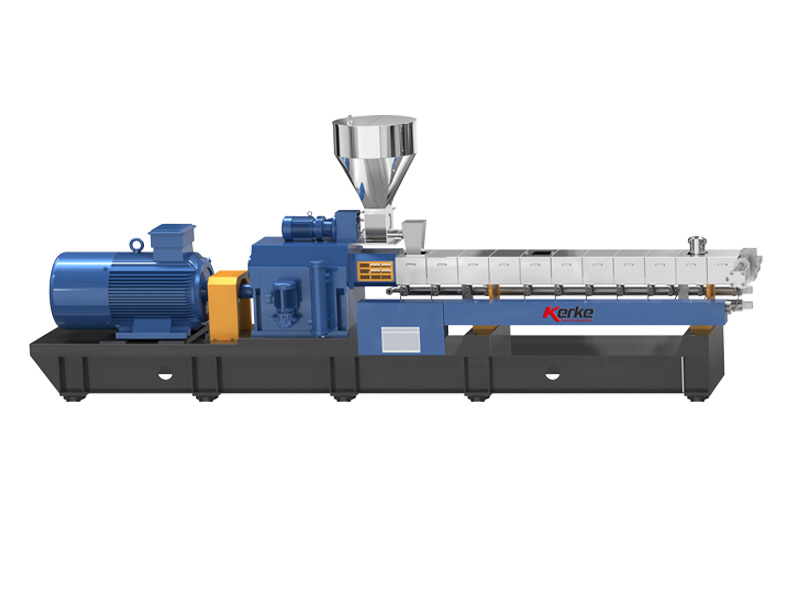
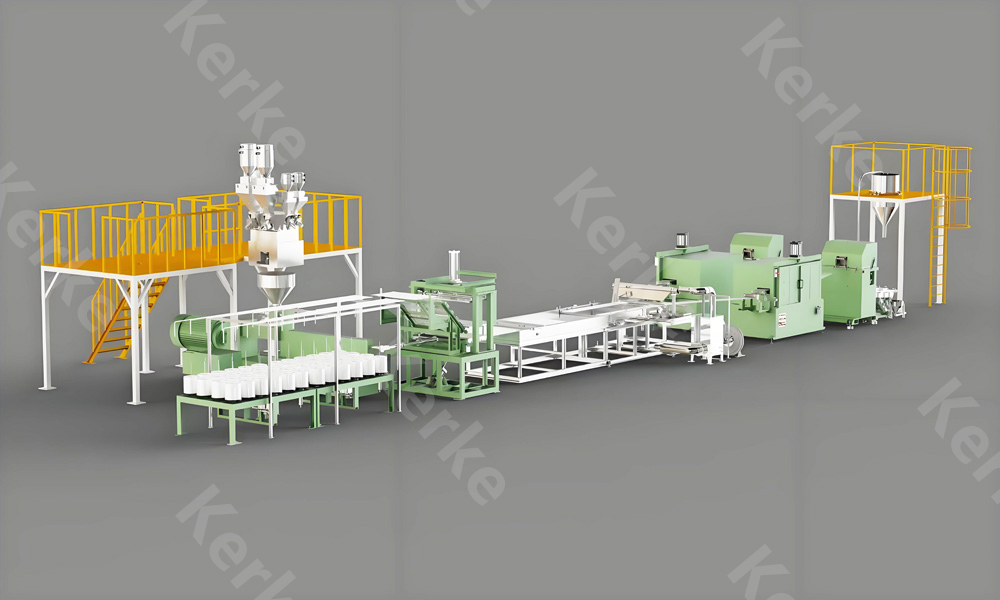
Kerke is a professional manufacturer of high-end plastic compounding and masterbatch granulation equipment, focusing on the research and development, production, and customization of Twin Screw Extruder, Masterbatch Extruder, and Compounding Extruder series equipment. For the production of high-gloss barium sulfate masterbatch with high dispersion and high precision requirements, Kerke provides customized twin-screw compounding extrusion production lines, which are specially optimized for the processing characteristics of barium sulfate ultra-fine powder, solving the common problems of poor dispersion, unstable gloss, and low filling rate in traditional masterbatch production.
Kerke twin-screw masterbatch extrusion equipment has independent core research and development technology, adopts optimized screw combination design, segmented precise temperature control system, and high-efficiency dispersion structure, which can realize uniform mixing, full plasticization, and stable granulation of high-filling barium sulfate materials. The equipment is widely recognized in the high-end masterbatch manufacturing industry for its stable operation, excellent finished product quality, and low energy consumption, and has become the mainstream equipment choice for high-gloss functional masterbatch production enterprises at home and abroad.
2.2 Performance Advantages of Kerke Twin Screw Extruder for Masterbatch Compounding
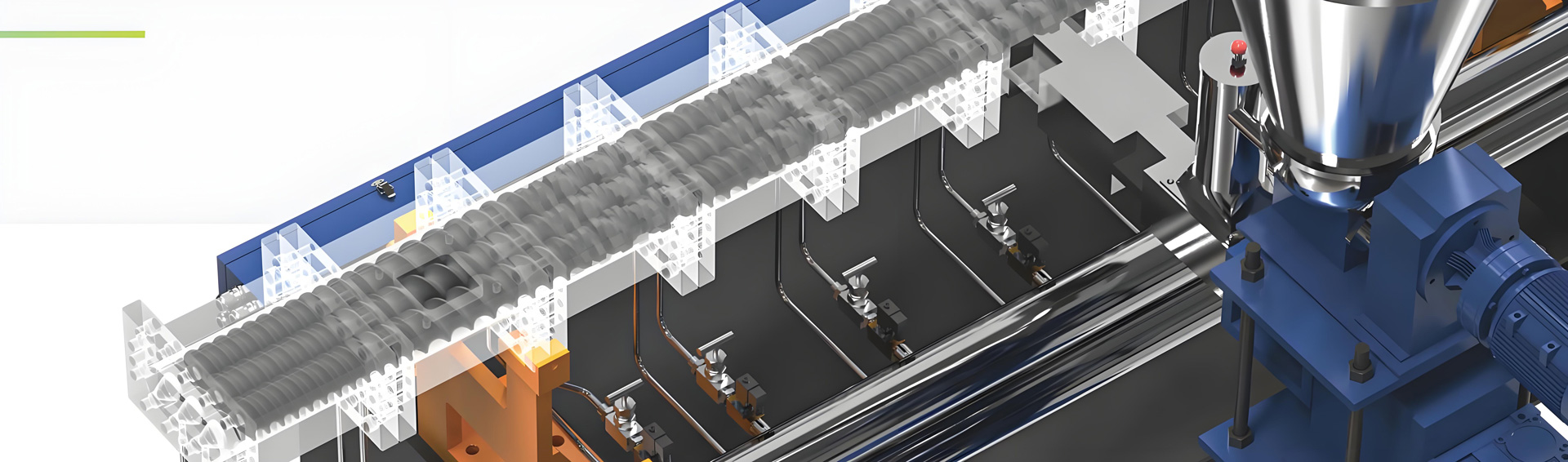
As the core equipment of barium sulfate masterbatch production, Kerke Twin Screw Extruder adopts an innovative parallel co-rotating twin-screw structure, with high shear force and strong mixing and dispersion capacity. For ultra-fine barium sulfate powder that is easy to agglomerate, the equipment can fully break up particle agglomerates through multi-stage shear, stretching, and mixing processes, realizing uniform dispersion of filler in the carrier resin, which is the key to ensuring the high-gloss effect of downstream products. Compared with traditional extrusion equipment, Kerke twin-screw equipment has more flexible screw combination, which can adjust the shear and mixing intensity according to different filling ratios and formula systems of barium sulfate masterbatch.
The equipment is equipped with a full-automatic PLC intelligent control system, realizing precise segmented temperature control from feeding, plasticizing, shearing to extrusion granulation. The temperature control accuracy reaches ±1℃, effectively avoiding material yellowing, additive failure, and plasticization inconsistency caused by temperature deviation, and ensuring the color stability and gloss uniformity of high-gloss barium sulfate masterbatch. At the same time, the servo energy-saving drive system reduces the comprehensive energy consumption of equipment operation by more than 30% compared with traditional equipment, helping enterprises reduce long-term production costs.
2.3 Professional Configuration of Kerke Masterbatch Extruder for High-Gloss Products
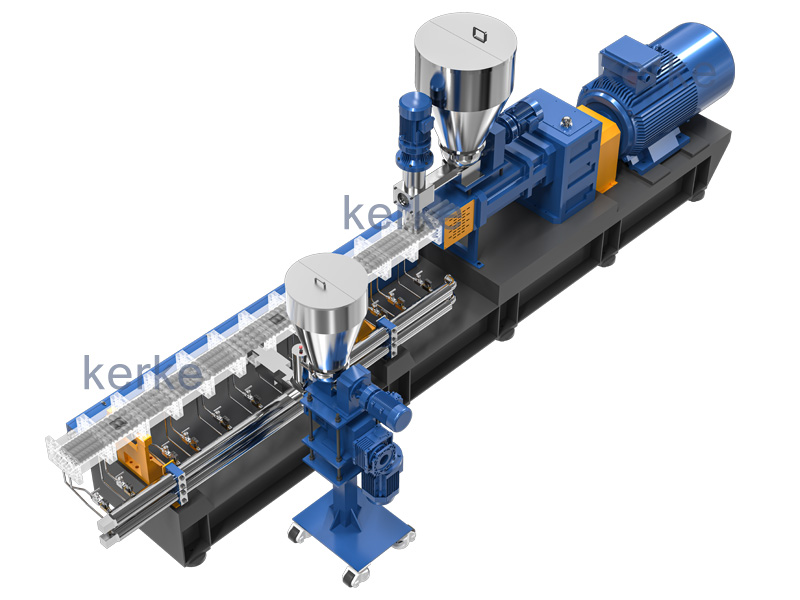
Kerke special Masterbatch Extruder for barium sulfate high-gloss masterbatch is optimized in structural configuration for the characteristics of high-filling ultra-fine powder materials. The equipment adopts a large-capacity forced feeding structure, which solves the problem of difficult feeding and unstable feeding of light specific gravity and easy floating barium sulfate powder, ensuring stable and uniform material supply in the extrusion process. The high-precision screw and barrel are made of wear-resistant alloy materials, which have excellent wear resistance and corrosion resistance, adapting to the long-term processing of high-hardness barium sulfate filler, and avoiding equipment wear affecting product precision.
The extrusion die head adopts a high-precision mirror polishing design, with smooth discharge channel and no dead corners, which avoids material residue and carbonization, ensures flat and smooth surface of masterbatch particles, and fundamentally guarantees the high-gloss foundation of downstream plastic products. The matched underwater granulation or water-cooled strand granulation system can produce uniform and smooth masterbatch particles with consistent size, no burrs, and no hollow defects, improving the comprehensive quality grade of barium sulfate masterbatch.
2.4 Compounding Extruder Technical Optimization for High-Filling Barium Sulfate Formula
In view of the high-filling production demand of barium sulfate masterbatch, Kerke Compounding Extruder carries out targeted optimization of compounding technology and structural parameters. The optimized screw element combination strengthens the pre-dispersion and intermediate shearing process of ultra-fine powder, realizing stable production of high-filling formulas with barium sulfate content up to 70%-85%. Under the premise of ensuring full dispersion of fillers, it avoids excessive shear damage to the resin matrix, maintains the excellent mechanical properties of the masterbatch, and ensures that downstream products have both high gloss and good toughness and strength.
The equipment is equipped with a professional vacuum exhaust system, which can effectively remove moisture, volatile substances, and air bubbles in the mixed materials, avoid pore defects inside the masterbatch, and further improve the compactness and gloss performance of finished products. This targeted compounding optimization technology makes Kerke extrusion equipment far superior to ordinary extrusion equipment in the production of high-gloss barium sulfate masterbatch, and can meet the high-standard production needs of high-end market products.
3. Complete Production Process of High-Gloss Barium Sulfate Masterbatch
3.1 Raw Material Selection and Formula Proportioning Standards
The production of high-gloss barium sulfate masterbatch starts with strict raw material selection. It is necessary to select high-purity precipitated barium sulfate powder with particle size of 3000-8000 mesh, high whiteness, low impurity content, and uniform particle distribution. Ultra-fine and high-purity raw materials are the basic guarantee for the high-gloss effect of finished products. The carrier resin is selected according to downstream product application scenarios, including PP, PE, ABS, PVC, and other high-compatibility resins. In addition, high-efficiency dispersants, lubricants, brightening agents, and anti-aging additives are added in proportion to improve the dispersion performance and surface gloss of the masterbatch.
The formula proportion needs to be accurately adjusted according to the target gloss grade and filling demand. For high-gloss decorative products, the proportion of barium sulfate filler is controlled at 60%-75%, with a small amount of high-efficiency dispersant to ensure full dispersion; for high-filling cost-effective products, the filling ratio can be increased to 80%-85%, and the formula is optimized through Kerke Compounding Extruder’s strong dispersion performance to balance product gloss and production cost.
3.2 Raw Material Mixing and Pretreatment Process
Before extrusion granulation, all raw materials need to undergo strict pretreatment and high-speed mixing. First, remove moisture and impurities from barium sulfate powder and carrier resin through drying equipment to avoid bubble defects in masterbatch particles. Then put the proportioned raw materials into a high-speed mixing machine for uniform mixing. The mixing process is carried out in stages, first mixing the filler and dispersant fully to realize surface modification of barium sulfate powder, then adding carrier resin and auxiliary agents for secondary uniform mixing, to ensure that all materials are fully fused and laid a foundation for subsequent extrusion compounding.
The standardized pretreatment process can effectively solve the problem of powder agglomeration and uneven additive distribution, reduce the processing pressure of the Twin Screw Extruder, and ensure the consistency of material properties in the subsequent extrusion process, which is an indispensable link for producing high-stability high-gloss masterbatch.
3.3 Twin Screw Extrusion Compounding and Granulation Process
The uniformly mixed raw materials are stably fed into the Kerke Twin Screw Extruder through an automatic feeding system. Through the multi-stage segmented temperature control system of the equipment, the materials are gradually heated, plasticized, sheared, and mixed. The twin-screw meshing structure produces strong shear and stretching force, which fully disperses the barium sulfate filler in the molten resin matrix, eliminates particle agglomeration, and realizes uniform compounding of materials. The vacuum exhaust device removes internal air bubbles and volatile substances to ensure the compactness of the molten material.
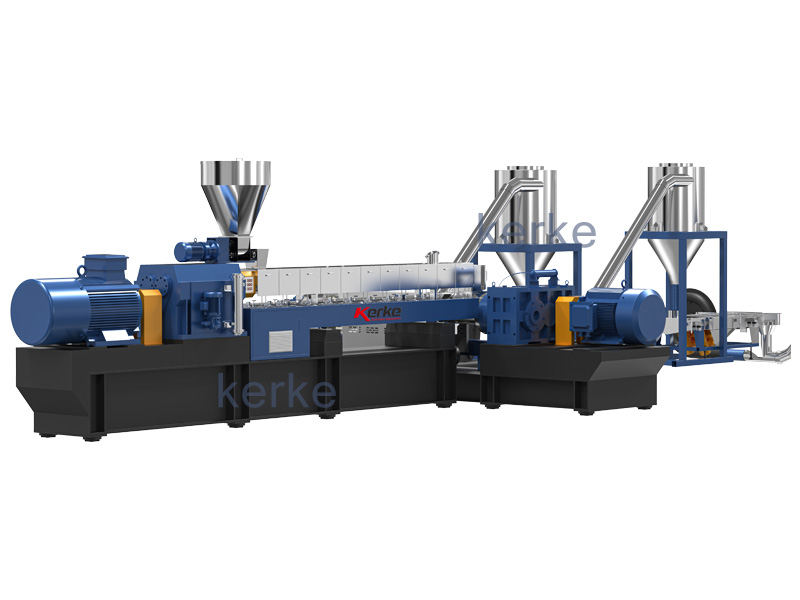
After full compounding and plasticizing, the uniform molten material is extruded through the high-precision die head of the Masterbatch Extruder to form uniform material strips. The material strips enter the granulation system after cooling and shaping, and are cut into uniform cylindrical masterbatch particles by high-speed cutting equipment. The whole extrusion and granulation process is fully automated, with stable parameter control and consistent product quality, which can realize continuous and large-scale production of high-gloss barium sulfate masterbatch.
3.4 Post-Processing and Finished Product Quality Inspection
The granulated barium sulfate masterbatch needs to go through cooling, screening, and de-dusting post-processing procedures to remove fine powder, uneven particles, and impurities generated during granulation, ensuring uniform particle size and clean surface of finished masterbatch. Then conduct comprehensive quality inspection, including particle size uniformity, whiteness test, dispersion performance test, melt index test, and downstream product gloss detection.
Qualified high-gloss barium sulfate masterbatch has uniform particles, pure color, no fine powder, and excellent dispersion. After being applied to plastic products, it can significantly improve the surface gloss and smoothness of products, without color difference, pitting, and dullness. All qualified products are sealed and packaged to avoid moisture and dust pollution, ensuring stable performance during storage and transportation.
4. 2026 Complete Project Cost and Equipment Price Analysis
4.1 Kerke Core Extrusion Equipment Price Quotation
The FOB price of Kerke standard small and medium-sized Twin Screw Extruder for barium sulfate masterbatch production is $32,800-$38,500. This standard model is suitable for small and medium-sized masterbatch enterprises with daily output of 3-5 tons, with stable compounding performance, precise temperature control, and high cost performance, fully meeting the conventional production needs of high-gloss barium sulfate masterbatch.
The upgraded high-precision Masterbatch Extruder model with enhanced dispersion performance is priced at $39,200-$45,800. This model is optimized for high-filling and ultra-high-gloss masterbatch production, equipped with upgraded wear-resistant screw elements, high-precision temperature control system, and intelligent feeding adjustment device, with stronger dispersion capacity and more stable product consistency, suitable for high-end masterbatch production enterprises with strict quality requirements.
The large-scale high-output Compounding Extruder for mass production is priced at $46,500-$52,800, supporting daily output of 8-12 tons, with higher production efficiency and automatic production level, suitable for large-scale professional masterbatch manufacturing factories.
4.2 Auxiliary Equipment and Production Line Configuration Cost
A complete high-gloss barium sulfate masterbatch production line needs to be equipped with supporting auxiliary equipment including high-speed mixing machine, automatic feeding machine, drying dehumidifier, cooling water circulation system, granulation unit, screening and de-dusting equipment, and finished product detection device. The total procurement cost of the full set of auxiliary equipment is $8,200-$11,500. The price difference is determined by the automation degree and processing capacity of auxiliary equipment, which can be matched according to the enterprise’s production scale demand.
4.3 Plant Construction, Installation and Commissioning Cost
The masterbatch production line covers a small standardized industrial plant area, and the equipment foundation fixing, power distribution layout, and dust-proof workshop transformation cost is $3,800-$5,200. Kerke provides professional overseas on-site installation, debugging, and technical docking services, with a one-time technical service fee of $2,800-$3,500. Professional commissioning can quickly adjust equipment parameters to the optimal production state, ensuring that the produced barium sulfate masterbatch meets high-gloss quality standards and avoiding product quality problems caused by parameter errors.
4.4 Daily Operation and Annual Maintenance Cost
Kerke energy-saving extrusion equipment has low daily operating energy consumption. The comprehensive daily electricity and water cost of the full production line is $80-$130 according to different production outputs. The highly automated production mode only requires 1-2 operators to complete the whole line operation, greatly saving long-term labor costs for enterprises.
The annual routine maintenance cost of Twin Screw Extruder and supporting equipment includes screw cleaning, wear-resistant parts replacement, parameter calibration, and equipment lubrication, with a total annual cost of $900-$1,500. The equipment has a service life of more than 12 years, with low failure rate and stable long-term operation performance, and the comprehensive operating cost is far lower than that of traditional extrusion equipment.
4.5 Project Investment Return and Benefit Analysis
High-gloss barium sulfate masterbatch belongs to high-value-added functional plastic raw materials, with stable market demand and high profit margins. The total investment of a complete set of Kerke barium sulfate masterbatch production line is about $45,000-$70,000 according to different equipment configurations. For small and medium-sized production lines with conventional configuration, the comprehensive investment return cycle is 10-12 months. For high-end high-gloss masterbatch production projects with high product added value, the return cycle can be shortened to 8-10 months.
The project has low investment risk, wide downstream application market, and strong market anti-risk ability. Long-term stable production can bring continuous and stable economic benefits to enterprises, with excellent industrial investment value.
5. Key Technical Points for High-Gloss Effect Improvement
5.1 Filler Dispersion Technology Core
The core factor determining the gloss performance of barium sulfate masterbatch products is the dispersion uniformity of barium sulfate filler. Insufficient dispersion will lead to particle agglomeration, forming tiny protrusions and pitting on the surface of plastic products, resulting in reduced gloss and dull surface. Kerke Twin Screw Extruder realizes multi-stage shear and dispersion of ultra-fine powder through optimized screw combination design, fully breaks up powder agglomerates, and makes the filler uniformly distributed in the resin matrix, which is the key technical support for obtaining mirror-level high-gloss surface.
5.2 Precise Temperature Control Technology
Processing temperature directly affects the plasticization degree of resin and the stability of functional additives. Excessively high temperature will cause decomposition of brightening agents and lubricants, resulting in product yellowing and gloss reduction; excessively low temperature will lead to incomplete resin plasticization, uneven material fusion, and rough product surface. Kerke Masterbatch Extruder adopts independent multi-stage temperature control, accurately matching the optimal processing temperature of barium sulfate formula, ensuring full plasticization of materials and stable performance of functional additives, and maximizing the gloss enhancement effect of masterbatch.
5.3 Formula and Processing Parameter Matching Optimization
Different application scenarios require targeted optimization of masterbatch formulas and extrusion processing parameters. For high-gloss packaging film products, low-shear and high-dispersion processing parameters are adopted to ensure ultra-smooth film surface; for high-hardness high-gloss injection-molded parts, appropriately increase screw shear strength and filling ratio to balance product gloss and structural strength. Kerke professional technical team can provide targeted formula and parameter debugging schemes according to customer product demands, to ensure the best high-gloss application effect of masterbatch.
6. Main High-Gloss Application Scenarios of Barium Sulfate Masterbatch
6.1 High-End Plastic Packaging Materials
High-gloss barium sulfate masterbatch is widely used in cosmetic packaging, food packaging, daily chemical product packaging and other high-end packaging fields. The masterbatch can significantly improve the surface gloss and transparency of packaging products, make the packaging appearance more high-grade, and has good chemical stability, which will not react with internal packaging contents, ensuring product safety. At the same time, it can replace part of the resin raw materials, effectively reducing the production cost of packaging enterprises.
6.2 Automotive Plastic Parts and Interior Decorations
Automotive interior and exterior plastic parts have extremely high requirements for surface gloss, weather resistance and texture. Barium sulfate masterbatch produced by Kerke Compounding Extruder has stable performance and excellent weather resistance, which can keep the surface gloss of automotive plastic parts unchanged for a long time, avoid fading and dullness caused by long-term sunlight exposure and temperature change, and is an ideal functional material for high-gloss automotive plastic parts.
6.3 Electronic Product Casings and Household Appliance Parts
Electronic product casings and household appliance plastic parts pursue high-gloss mirror appearance and stable dimensional performance. The application of barium sulfate masterbatch can make the product surface smooth and delicate, with uniform gloss, and improve the product grade and market competitiveness. At the same time, the excellent dimensional stability of the masterbatch can effectively avoid product deformation and shrinkage, ensuring the assembly accuracy of electronic and electrical products.
6.4 Architectural Decorative Plastic Profiles
High-gloss plastic profiles, decorative plates and other architectural decoration products require beautiful appearance and strong weather resistance. Barium sulfate masterbatch can improve the surface gloss and anti-aging performance of profiles, make the decorative effect more excellent, and adapt to long-term outdoor and indoor decoration use, with stable performance and long service life.
7. Equipment Operation, Maintenance and Fault Optimization
7.1 Standard Operation Specifications for Extrusion Equipment
Before starting the Kerke Twin Screw Extruder and Masterbatch Extruder every day, operators need to check the equipment power system, transmission system, temperature control system, and feeding system to ensure that all parts are in normal working state. Preheat the equipment in stages according to the barium sulfate masterbatch processing formula, and start trial extrusion after the temperature reaches the standard and stabilizes. After trial production and sampling inspection confirm that the masterbatch gloss and dispersion performance are qualified, formal batch production can be carried out.
During the production process, real-time monitor the extrusion temperature, screw speed, feeding volume and granulation state, adjust parameters timely according to material changes, and ensure the stability of masterbatch quality. After daily production, clean the residual materials in the screw, barrel and die head to avoid material carbonization and residue affecting subsequent product gloss quality.
7.2 Regular Equipment Maintenance and Calibration
Carry out weekly maintenance on the Compounding Extruder equipment, including lubricating transmission bearings, cleaning cooling system filter elements, and checking the tightness of pipeline connections. Conduct monthly professional calibration of temperature control accuracy, screw running speed and feeding precision to ensure the long-term stable processing precision of the equipment. Regularly polish and maintain the extrusion die head to keep the discharge channel smooth and flat, ensuring the consistent high-gloss performance of batch products.
7.3 Common Production Problems and Solutions
In the production process of high-gloss barium sulfate masterbatch, common problems include insufficient product gloss, uneven particle color, and poor dispersion. Insufficient gloss is mostly caused by incomplete material plasticization or insufficient filler dispersion, which can be solved by appropriately adjusting processing temperature and screw shear parameters. Uneven particle color is caused by unstable feeding and uneven material mixing, which can be improved by calibrating the feeding system and optimizing the mixing process. Poor dispersion can be solved by adjusting the screw combination and increasing vacuum exhaust efficiency.
Kerke equipment is equipped with an intelligent fault prompt system, which can quickly locate abnormal problems in the production process. The professional technical team provides long-term technical support to help customers solve production difficulties and ensure stable output of high-quality high-gloss barium sulfate masterbatch.
8. Market Development Trend and Industry Prospect
8.1 Development Trend of High-Gloss Functional Masterbatch Industry
With the continuous upgrading of plastic product quality in various industries, high-gloss, high weather resistance, and high stability functional masterbatches will become the mainstream development direction of the masterbatch industry. Traditional low-end filling masterbatches will be gradually eliminated by the market, and high-value-added barium sulfate high-gloss masterbatches have broad market development space. The market puts forward higher requirements for masterbatch dispersion, gloss stability and environmental protection performance, which also promotes the continuous upgrading of masterbatch extrusion compounding equipment.
8.2 Future Upgrading Direction of Extrusion Compounding Equipment
Future Twin Screw Extruder, Masterbatch Extruder and Compounding Extruder equipment will develop towards higher intelligence, higher dispersion precision, lower energy consumption and stronger environmental protection performance. Intelligent parameter adaptive adjustment, automatic formula matching, and unmanned continuous production will become the standard configuration of high-end masterbatch production equipment. Kerke will continue to focus on the technical research and development of masterbatch professional extrusion equipment, continuously optimize equipment dispersion performance and production efficiency, and provide more professional and efficient production solutions for global high-gloss barium sulfate masterbatch manufacturing enterprises.
9. Conclusion
Barium sulfate high-gloss masterbatch is an indispensable high-performance functional material in the field of high-end plastic processing, and its product quality and high-gloss application effect are completely dependent on professional compounding and extrusion granulation technology. High-quality Twin Screw Extruder, Masterbatch Extruder and Compounding Extruder equipment is the core foundation for producing high-dispersion, high-gloss, high-stability barium sulfate masterbatch. Kerke professional extrusion equipment, with targeted structural optimization, precise processing technology and stable operation performance, perfectly solves the technical pain points of poor dispersion and insufficient gloss of traditional masterbatch products.
The complete set of barium sulfate masterbatch production line has reasonable investment cost, stable production efficiency and excellent product profit margin, which is very suitable for the upgrading and new construction of functional masterbatch production projects. Through standardized equipment operation, scientific formula debugging and regular equipment maintenance, enterprises can give full play to the performance advantages of Kerke extrusion equipment, produce high-standard high-gloss barium sulfate masterbatch, seize the high-end functional masterbatch market, and obtain stable and long-term market competitive advantages and economic benefits.