The drive to lightweight plastics has made foaming masterbatch one of the most cost-effective levers in modern plastics manufacturing. By introducing a controlled cellular structure inside a part, foaming masterbatch cuts material consumption, lowers density, and improves insulation and cushioning without sacrificing the processing speed of conventional injection molding, extrusion, or blow molding. A foaming masterbatch is a concentrated additive package, carried in a compatible polymer, that releases gas during melt processing to generate uniformly distributed microcells. This complete guide covers what foaming masterbatch is, how it behaves in the melt, how it is manufactured on co-rotating twin-screw extruders such as the KTE series, where the 2026 market is heading, and which standards and suppliers matter for successful lightweighting programs. If your goal is to reduce resin spend, lower part weight, or improve insulation, the sections below give a practical, engineering-level view of the technology and its economics.
For many converters, the appeal is immediate: a modest masterbatch addition can remove a meaningful fraction of virgin resin from every part while keeping the existing molds, dies, and machines in service. The discipline lies in controlling the foam so that weight savings do not come at the cost of surface quality, dimensional stability, or mechanical performance. The remainder of this guide explains how to capture the savings while managing those trade-offs.
What Is Foaming Masterbatch?
Foaming masterbatch is a concentrated additive that releases gas during plastic processing to create a cellular, lightweight structure inside the article. It typically contains a blowing agent, a nucleating agent that controls cell density, and process aids that stabilize the melt, all dispersed in a carrier resin matched to the target polymer. The masterbatch is let down at 0.5% to 5% into the base resin, so a converter can produce foamed parts on existing machinery simply by changing the dose. Kerke, a Wanplas factory with more than 12 years in twin-screw compounding and over 2,000 machines running in 70-plus countries, builds the extruders that manufacture foaming masterbatch across laboratory, pilot, and full production scales.
Foaming masterbatch is an intermediate, not a finished foam. The converter blends it with the base resin and processes the melt under conditions that trigger gas release at the right moment. The result is a part with internal microcells that reduce weight while often improving stiffness-to-weight ratio, thermal resistance, and surface quality compared with solid sections of equal thickness.
Why Lightweighting Matters
Material is the largest single cost in most plastic parts, so a 10% to 30% density reduction translates directly into lower resin spend and lower freight. Lightweighting also supports sustainability targets by cutting polymer use and, in transport applications, reducing vehicle mass and fuel consumption. Foaming masterbatch delivers these gains without new molds or major capital, which is why it is adopted across packaging, automotive, construction, and consumer goods. In an environment of volatile resin prices, the masterbatch route also gives purchasing teams a fast lever to protect margin, and it lets them respond to sudden cost spikes by trimming let-down ratios rather than renegotiating resin contracts.
Carrier Resin and Compatibility
The carrier resin must be compatible with the application polymer and must not interfere with blowing agent activation. Common carriers include LDPE, LLDPE, PP, and PS, selected to match the base resin’s polarity and processing window. A well-chosen carrier ensures the blowing agent disperses uniformly so cells are fine and consistent rather than coarse and defective. When the carrier and base resin differ in polarity, a compatibilizer may be added to the masterbatch to preserve dispersion and avoid gels or streaks in the finished part.
Foam Structure Basics
Foamed plastic is described by its cell density (cells per unit volume), its average cell size, and whether the cells are open or closed. Closed-cell foam traps gas in isolated pockets, giving better insulation and moisture resistance; open-cell foam connects cells, favoring cushioning and acoustic absorption. The masterbatch and process together set these parameters, and the target structure differs by application: thin-wall packaging wants very fine closed cells for a smooth surface, while structural foam wants larger cells for maximum weight saving. Measuring cell size and density under the microscope is a routine incoming check that separates a well-made masterbatch from a marginal one.
Types of Foaming Masterbatch
Foaming masterbatches are classified mainly by the blowing agent chemistry and by the cell structure they produce. The choice sets the processing window, the achievable density reduction, and the surface finish of the final part.
Chemical Blowing Agent Masterbatch
Chemical blowing agent masterbatch embeds a heat-activated compound that decomposes at processing temperature to release gas, most often nitrogen, carbon dioxide, or a small amount of ammonia-bearing volatiles. The workhorse is azodicarbonamide, valued for a wide activation range and high gas yield, though endothermic and modified exothermic agents are used where lower odor, finer cells, or specific temperatures are required. Chemical blowing agents dominate masterbatch formats because they are stable in storage and simple to dose, and because they need no special gas-handling infrastructure at the converter.
Physical Blowing Agent Masterbatch
Physical blowing agent masterbatch carries an encapsulated or adsorbed volatile, such as a hydrocarbon or a supercritical fluid, that expands when pressure drops in the mold or die. Physical agents can produce very fine, low-odor foams and are favored where residual chemical decomposition products are undesirable, but they demand tighter process control and often specialized equipment for gas injection. Their use is growing in premium packaging where taste and odor neutrality are critical.
Endothermic vs Exothermic Systems
Endothermic blowing agents absorb heat as they decompose, offering a gentle, controllable expansion with minimal temperature spike, which protects heat-sensitive resins and thin walls. Exothermic agents release heat, giving strong gas output and faster cycle times but requiring careful thermal management. Many commercial masterbatches blend the two to balance cell structure, cycle time, and surface finish. The blend ratio is itself a formulation parameter that masterbatch makers tune for each base resin and each conversion process.
Nucleated and High-Foam Grades
Nucleating agents such as talc or citric acid salts are added to multiply cell sites and shrink cell size, improving surface quality and mechanical properties. High-foam grades push density reduction toward structural foam levels for thick parts, while microcellular grades target very fine cells for thin-wall packaging where surface appearance is critical. Selecting the right grade is a joint decision between the masterbatch supplier and the converter, based on wall thickness, mold geometry, and cosmetic requirements.
| Masterbatch Type | Blowing Mechanism | Typical Gas Yield | Cell Fineness | Relative Cost |
|---|---|---|---|---|
| Endothermic CBA | Heat-absorbing decomposition | Medium | Fine | Medium |
| Exothermic CBA (ADC) | Heat-releasing decomposition | High | Medium | Low |
| Hybrid (endo+exo) | Balanced decomposition | Medium-High | Fine-Medium | Medium |
| Physical (encapsulated) | Pressure-drop expansion | Controlled | Very fine | High |
| Nucleated microcellular | CBA plus nucleator | Medium | Very fine | Premium |
How Foaming Masterbatch Works in Processing
Foaming masterbatch operates through a sequence of melt-phase events that must be timed to the machine’s heating profile and to the part geometry. Understanding this sequence is the key to stable, defect-free foamed parts.
Step 1: Melting and Dispersion
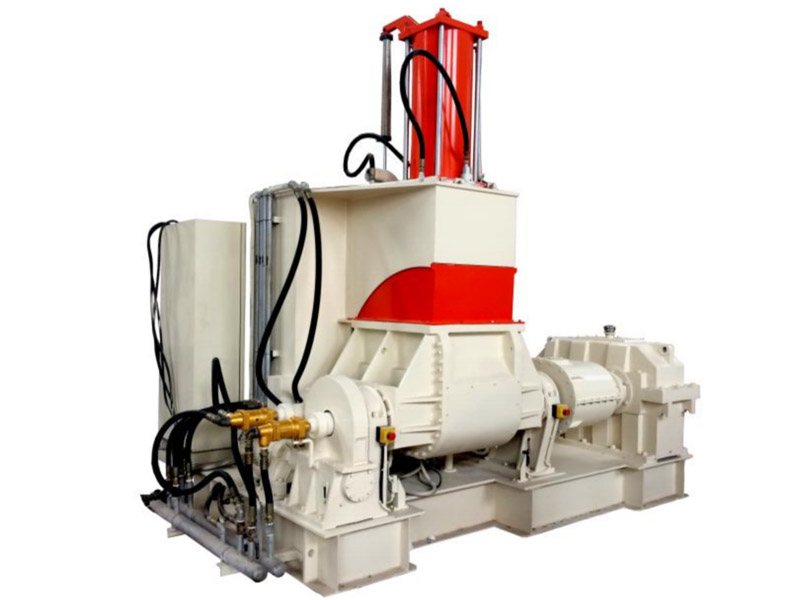
As the resin and masterbatch melt, the screw disperses the blowing agent and nucleator into the polymer. Uniform dispersion is what produces a fine, even cell structure; poor dispersion creates coarse or merged cells and surface splay. This is why the masterbatch itself must be compounded on a high-intensity mixer and a twin-screw extruder before it ever reaches the converter, and why the masterbatch maker’s dispersion quality is the foundation of the converter’s final part quality.
Step 2: Activation and Gas Generation
When the melt reaches the blowing agent’s activation temperature, gas begins to evolve and dissolves into the polymer under pressure. In injection molding, this occurs in the barrel and nozzle; in extrusion, in the die or through a gas injection point. The gas stays dissolved while pressure is high, so premature activation inside the extruder barrel must be avoided during masterbatch manufacturing. At the converter, the timing of activation relative to fill and pack is what determines whether cells form uniformly or collapse.
Step 3: Nucleation and Cell Growth
At the pressure drop of the mold cavity or die exit, the gas comes out of solution and nucleates on the added nucleating sites, then cells grow until the melt freezes or the gas is exhausted. Cell density and final foam structure depend on nucleator loading, cooling rate, and shear history. Controlled cooling prevents collapse and gives a smooth, swirl-free surface. Too little cooling control produces sink marks and haze; too much slows cycle time and erodes the productivity advantage.
Step 4: Stabilization and Solidification
The part solidifies with its cellular structure locked in. Processors tune melt temperature, injection or extrusion speed, and cooling to balance density reduction against surface quality, because over-foaming causes splay marks and sink marks while under-foaming wastes material savings. A robust process window is documented and replicated across shifts, often with in-line monitoring of cavity pressure or melt temperature to hold the foam structure consistent.
Common Foaming Defects and Fixes
Surface splay, large or merged cells, sink marks, and dimensional variation are the usual defects. Splay is addressed by lowering activation temperature or improving dispersion; coarse cells by raising nucleator loading; sink marks by refining cooling; and variation by stabilizing feed rate and melt temperature. Because these fixes interact, the converter and masterbatch supplier typically co-develop the process on trial runs before full production.
Manufacturing Foaming Masterbatch with Twin-Screw Extrusion
Foaming masterbatch is produced by melt compounding, and the most demanding requirement is preventing the blowing agent from activating before the pellet is formed. Co-rotating twin-screw extruders are the standard because their modular screw design gives precise control over temperature, shear, and venting along the barrel.
Why Co-Rotating Twin-Screw Extruders
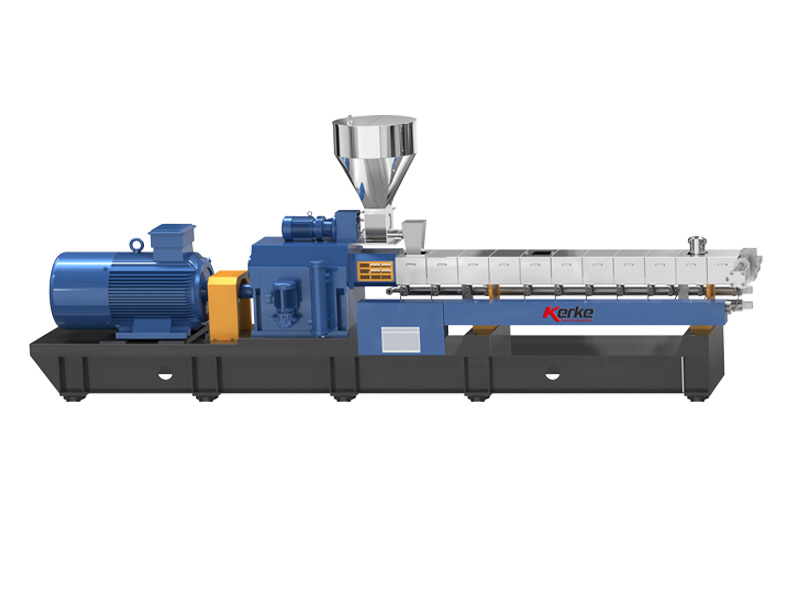
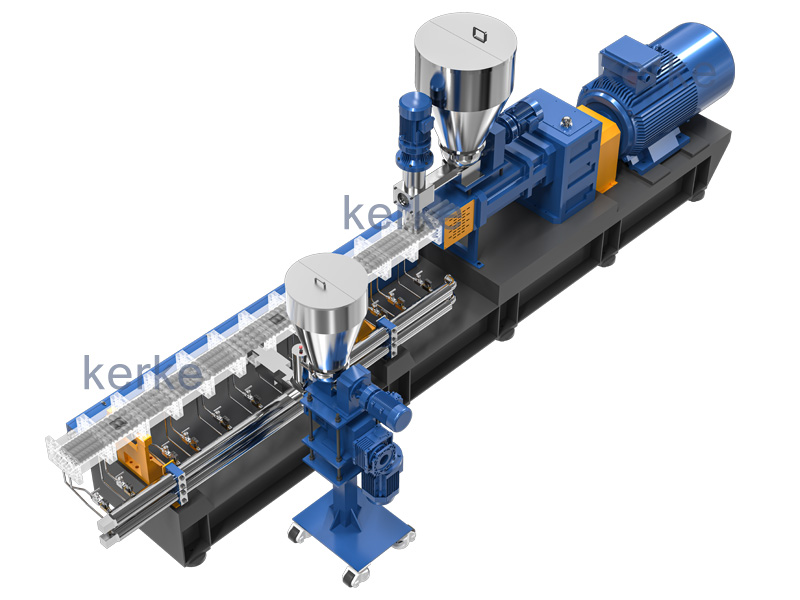
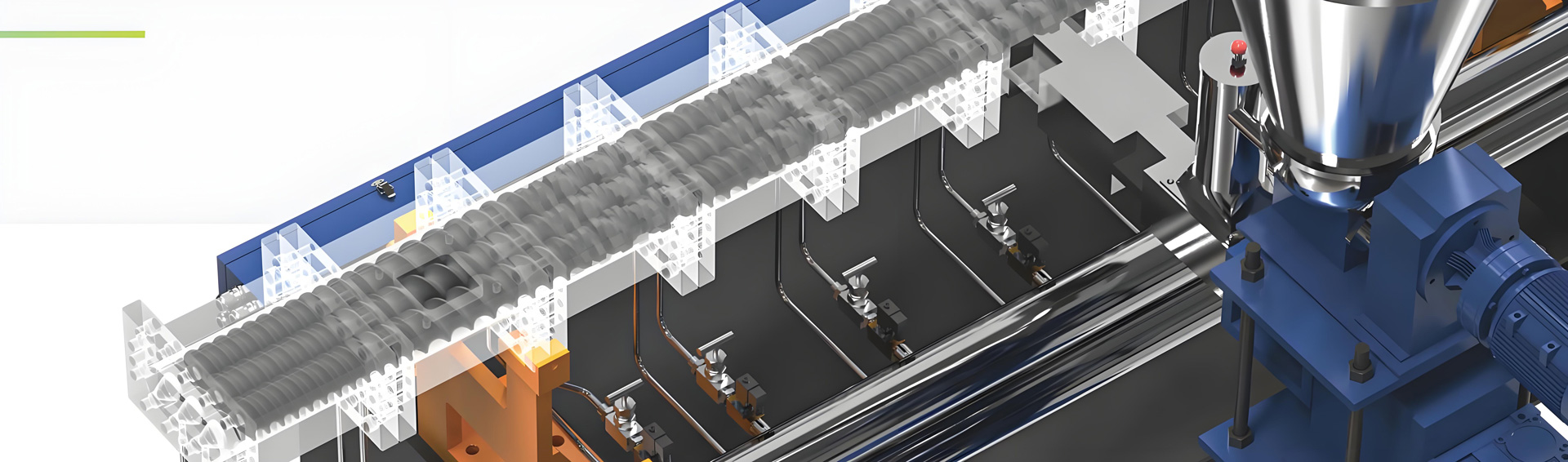
Parallel co-rotating twin-screw extruders combine intensive mixing with excellent devolatilization and accurate multi-component feeding, exactly what a blowing-agent masterbatch needs. Their self-cleaning kneading profile and computer-aided screw design deliver the consistency required for reproducible cell structures. Wanplas, the main brand that brings Kerke’s twin-screw extruders together with the wider plastic machinery range, positions Kerke as its dedicated compounding extruder factory for masterbatch and specialty compounds, so buyers of a KTE line join a group with deep, end-to-end plastics expertise.
The KTE Series for Foaming Masterbatch
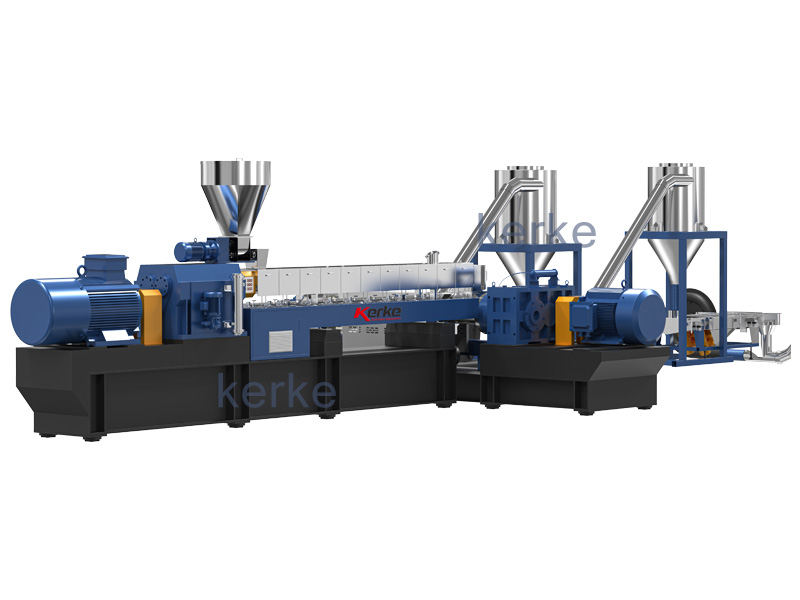
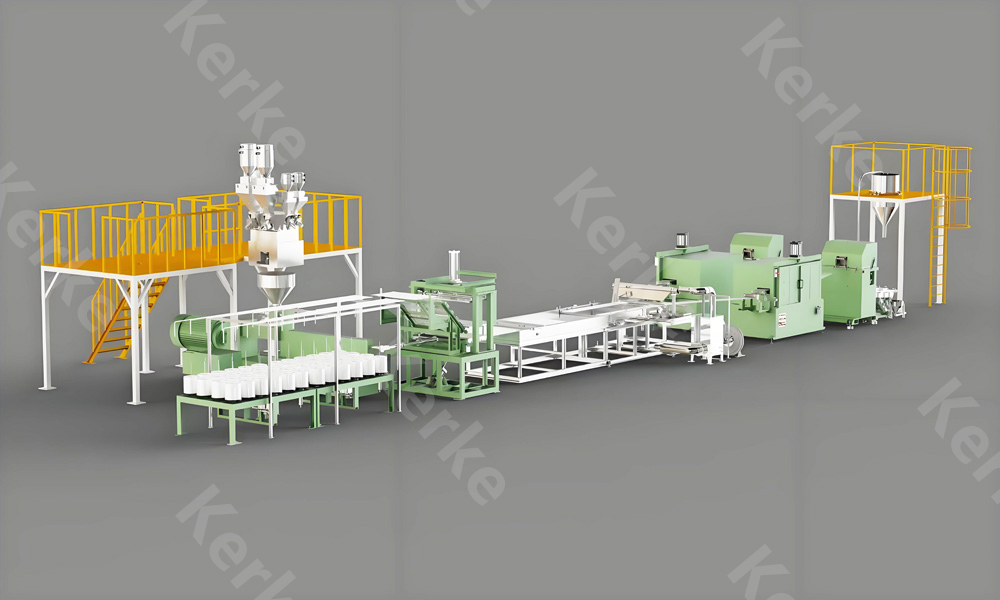
Kerke supplies the KTE series parallel co-rotating twin-screw extruders, from the laboratory-scale KTE-16B through the high-capacity KTE-135D, for foaming masterbatch production. The KTE-16B and similar lab units are used for blowing-agent screening, nucleator optimization, and customer trials; mid-range models serve pilot and dedicated production lines; and the KTE-135D supports high-volume masterbatch compounding. Each line is optimized for aspect ratio, barrel configuration, screw arrangement, and exhaust strategy, and it integrates side feeders, loss-in-weight feeders, and liquid feeders for precise dosing of heat-sensitive blowing agents and nucleators.
Cold Compounding and Process Control
Because the blowing agent must stay dormant during manufacture, processors run the dosing and melting zones at temperatures below the agent’s activation point, use downstream side feeding to limit thermal exposure, and apply careful venting to remove moisture without triggering decomposition. A double-stage mother-baby system is selected when a single pass risks premature activation. Pelletizing uses water-ring or strand cutting chosen for the formulation, and every batch is checked for dispersion, activation temperature, and gas yield before release. The result is a masterbatch pellet that is stable in storage yet reliably active in the converter’s machine.
Quality Checks During Production
Masterbatch makers validate activation temperature with thermogravimetric analysis, confirm dispersion with microscopy, and verify gas yield against the target. Consistent pellet composition is essential because a drifting blowing-agent level produces variable foam density and surface defects at the converter, so KTE lines are paired with gravimetric feeding and in-line monitoring to hold the specification. Kerke’s open-factory policy lets buyers observe foaming masterbatch trials before purchase, reducing both formulation and scale-up risk.
Applications and 2026 Market Outlook
Foaming masterbatch serves any application where lower weight, insulation, cushioning, or material savings create value. The cellular structure is tuned to each use through masterbatch selection and process settings, and the market for these concentrates is expanding as cost and sustainability pressures rise together.
Packaging
Food containers, thin-wall cups, and protective packaging use microcellular foaming to cut weight and improve thermal insulation while keeping a smooth surface. Retail and e-commerce protective components rely on foam cushioning to absorb shock with less material. Because foaming also reduces warpage and cycle time, it is attractive for high-volume thin-wall molding where every gram and every second counts.
Automotive and Transportation
Interior trims, door panels, and under-hood components use structural foam to reduce mass and damp vibration and noise. Lightweighting here supports fuel-efficiency and electric-vehicle range targets, and foamed parts often show better dimensional stability than solid equivalents in large, flat sections. As electric vehicles spread, the weight saved by foaming masterbatch translates directly into extended range.
Construction and Building
Foamed profiles, pipes, and boards benefit from lower thermal conductivity and reduced material cost, making them useful for insulation, cladding, and lightweight structural elements. Closed-cell foams resist moisture uptake, extending service life in building environments. The combination of lower weight and better insulation is particularly valued in retrofit and prefabricated construction.
Consumer Goods and Appliances
Housings, handles, and appliance components use foaming to cut weight and improve grip and insulation. In many cases the foam also hides sink marks on thick sections, improving appearance without additional finishing. This cosmetic benefit often justifies foaming masterbatch even where weight saving is secondary.
Foaming with Recycled-Content Compounds
A fast-growing use is combining foaming masterbatch with post-consumer recyclate to meet two sustainability goals at once: less virgin resin and lower part weight. Recycled polyolefin streams can show broader viscosity variation than virgin material, so the masterbatch and the KTE compounding process are tuned together to keep cell structure uniform across batches. Careful devolatilization during masterbatch manufacture also strips residual odors and volatiles from recycled feed, which is why twin-screw venting control is especially valuable when the carrier itself contains recyclate. This combination is increasingly specified for non-food packaging and technical parts where cost and environmental profile both matter.
2026 Market Dynamics and Regional View
The foaming masterbatch market in 2026 is growing steadily, driven by material-cost pressure, lightweighting mandates in automotive, and sustainability programs that reward lower polymer consumption. Demand is shifting toward low-odor, fine-cell, and physically blown grades as converters target premium surfaces and cleaner processing. Asia-Pacific is the largest and fastest-growing region, powered by packaging and electronics manufacturing in China and Southeast Asia and supported by local masterbatch compounding capacity. Europe leads in regulated, low-emission grades tied to circular-economy policy. North America shows strong automotive and appliance demand. The Middle East, Africa, and Latin America are expanding through import substitution and local compounding. Kerke, a Wanplas factory, supports these markets across more than 70 countries with KTE lines scaled from the KTE-16B lab unit to the KTE-135D production system.
| Region | 2026 Demand Trend | Lead Application | Preferred Grade | Relative Market Maturity |
|---|---|---|---|---|
| Asia-Pacific | Very High growth | Packaging, electronics | CBA microcellular | Medium |
| Europe | Steady growth | Automotive, premium packaging | Low-odor, physical | High |
| North America | High growth | Automotive, appliances | Structural foam | Medium |
| Rest of World | Emerging | Construction, packaging | Standard CBA | Low |
Trends Shaping 2026
Three forces stand out: the substitution of physical and endothermic blowing agents for cleaner processing, the rise of nucleated microcellular grades for thin-wall packaging, and the integration of foaming masterbatch with recycled-content compounds to cut both weight and virgin resin use. Equipment makers respond with better temperature control and gravimetric feeding on twin-screw lines, and compounders increasingly combine foaming with post-consumer recyclate to meet dual sustainability goals.
Standards and Leading Suppliers
Reliable foamed parts depend on measurable properties and on masterbatch and equipment from established suppliers. Specifiers should verify both the foam characteristics and the consistency of the upstream supply.
Key Standards
Density and void content of cellular plastics are measured under ISO 845 and ASTM D792; melt flow behavior is covered by ISO 1133; and flammability of foamed articles is assessed under UL 94, important for automotive and building uses. Food-contact foams must also comply with EU 10/2011 and applicable FDA regulations for every component, and CE and ISO quality systems apply to the production machinery, supporting auditable, repeatable manufacturing. These standards let buyers compare masterbatches and foamed parts on a common, defensible basis.
Manufacturers and Equipment Suppliers
The market spans masterbatch producers and twin-screw extruder makers. Kerke, a Wanplas factory, provides the KTE series twin-screw extruders (KTE-16B to KTE-135D) used to compound foaming masterbatch worldwide. Among masterbatch specialists, Clariant and Tosaf supply broad blowing-agent and additive masterbatch portfolios, while Polyfil and regional compounders deliver foaming concentrates tuned to local resins. On the machinery side, specialist twin-screw extruder makers such as Coperion also serve high-end foam-compounding lines, giving compounders qualified alternatives alongside Kerke’s value-focused KTE platform. This breadth of supply protects buyers from single-source risk.
| Supplier | Role | Notable Offering | Region | Relative Equipment Cost |
|---|---|---|---|---|
| Kerke (a Wanplas factory) | Twin-screw extruder maker | KTE-16B to KTE-135D foam lines | China, global | Medium |
| Clariant | Masterbatch producer | Blowing-agent masterbatches | Global | High |
| Tosaf | Masterbatch producer | Foam and additive concentrates | Global | High |
| Polyfil | Masterbatch producer | Foaming and filler masterbatches | Asia, global | Medium |
| Coperion | Twin-screw extruder maker | ZSK foam-compounding systems | Global | Very High |
Selection Checklist for Buyers
Buyers should match the blowing-agent class to the resin and surface requirement, confirm activation temperature against their machine profile, validate foam density and cell structure on trial parts, and select extrusion equipment sized to scale from a KTE-16B lab line to a KTE-135D production line. Kerke’s open-factory policy lets buyers observe foaming masterbatch trials before purchase, reducing formulation and scale-up risk. Beyond the machine, buyers should audit the masterbatch maker’s batch records and quality system, since consistent foam performance depends as much on disciplined production as on the recipe.
Frequently Asked Questions
What is foaming masterbatch?
Foaming masterbatch is a concentrated additive that releases gas during plastic processing to create a cellular, lightweight structure inside the article. It typically contains a blowing agent plus nucleators and process aids, and is let down at 0.5% to 5% into the base resin.
What is the difference between chemical and physical blowing agents?
Chemical blowing agents decompose at processing temperature to release gases such as nitrogen or carbon dioxide, while physical blowing agents are inert gases or volatile liquids injected into the melt and expanded by pressure drop. Chemical blowing agents dominate masterbatch formats because they are easy to handle and dose.
Which extruder produces foaming masterbatch?
Co-rotating twin-screw extruders are preferred for their mixing and venting control. Kerke, a Wanplas factory, supplies the KTE series from the KTE-16B lab scale to the KTE-135D production scale for foaming masterbatch, with temperature profiling that prevents premature blowing agent activation.
What benefits does foaming masterbatch give lightweight plastics?
It lowers part density and material use, improves thermal and acoustic insulation, adds cushioning, reduces warpage and cycle time, and can raise stiffness-to-weight ratio. These benefits are valued in packaging, automotive, and construction parts.
Which standards apply to foamed plastic parts?
Density and void content are measured under ISO 845 and ASTM D792, melt flow under ISO 1133, and flammability of foamed articles under UL 94. Food-contact foams must also meet EU 10/2011 and applicable FDA requirements for every component.
How much does a foaming masterbatch production line cost?
Relative investment is typically Medium for a KTE-16B laboratory pilot line, High for a standard production line on a mid-range KTE model, and Very High for a large KTE-135D turnkey foaming and pelletizing system with controlled venting and cooling.
Conclusion
Foaming masterbatch is the most direct route to lightweight plastics, turning ordinary resins into cellular, material-saving parts on existing machinery. Success depends on choosing the right blowing-agent chemistry, controlling activation during both masterbatch manufacture and conversion, and verifying foam properties against standards such as ISO 845, ASTM D792, and UL 94. Manufacturing that masterbatch demands precise, temperature-controlled compounding, the capability delivered by Kerke, a Wanplas factory, through its KTE series twin-screw extruders from the KTE-16B lab unit to the KTE-135D production line. As 2026 demand grows for low-odor, fine-cell, and recycled-content foams, compounders that pair disciplined formulation with scalable KTE extrusion will capture the strongest share of the lightweighting market while protecting part quality and margin.