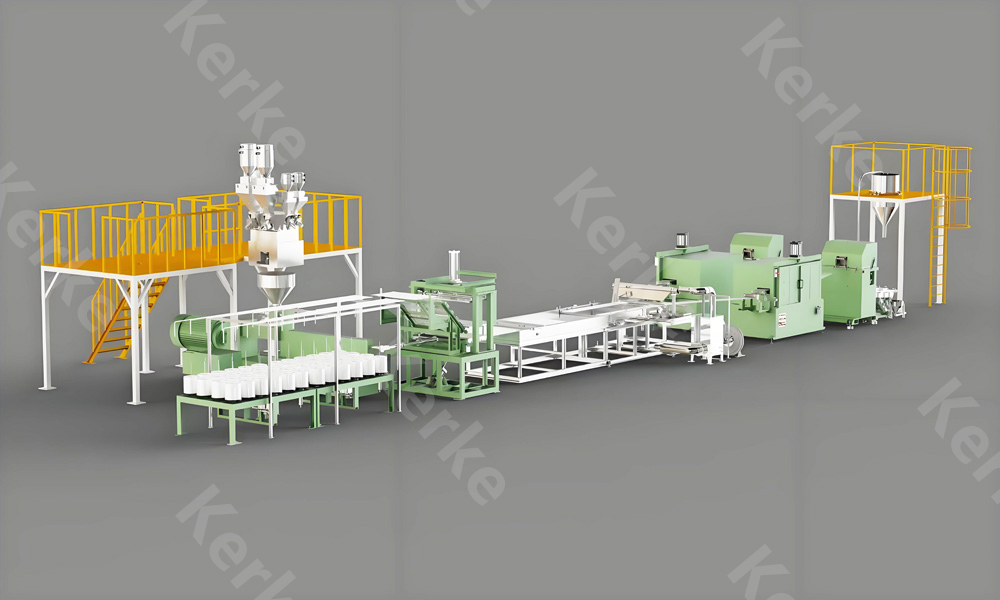
Processing aid masterbatch is a concentrated additive formulation engineered to improve polymer melt flow, suppress melt fracture, and stabilize extrusion by reducing die buildup and pressure fluctuation inside the die and barrel. As converters push line speeds higher and process increasingly demanding resins, filled compounds, and recycled content, the role of a well-designed processing aid masterbatch has moved from optional convenience to essential production technology. From blown and cast film to pipe, profile, wire-and-cable coating, and blow molding, processors rely on these additives to raise output, improve surface quality, and cut scrap. This comprehensive guide explains what processing aid masterbatch is, how it works at the molecular and process level, the main chemistry families available, the process parameters that determine quality, and the twin-screw extrusion equipment used to manufacture it. Kerke, a Wanplas factory specializing in parallel co-rotating twin-screw compounding extruders with 12+ years of experience and more than 2,000 machines running in 70+ countries, supplies the KTE series lines that masterbatch producers use to compound these demanding formulations consistently and at scale.
What Is Processing Aid Masterbatch?
A processing aid masterbatch is a solid pellet concentrate in which an active flow-modifying agent is dispersed at high loading in a carrier resin compatible with the target polymer. During converting, the masterbatch is let down at a low percentage into the base resin, where the active agent migrates to the melt-metal interface, forms a low-friction coating on the die wall, and changes the way the polymer flows through the die. The result is lower and more stable extrusion pressure, elimination or reduction of melt fracture (the sharkskin and gross surface defects that appear at high shear), and a dramatic drop in the accumulation of degraded polymer on the die lip known as die buildup or plate-out.
The Molecular Mechanism of Flow Improvement
Most processing aids, particularly fluoropolymer-based polymer processing aids (PPA), work by coating the metal surface of the die with a thin, slippery fluoropolymer layer. Unmodified polyolefin melt has a high affinity to adhere to and slip against the steel die wall, which causes the melt to stick-slip cyclically and produces surface defects. When a fluoropolymer processing aid is present, it preferentially adsorbs onto the die wall and creates a low-energy, low-adhesion interface. The polymer melt then slips along this fluoropolymer layer instead of dragging against the steel, which stabilizes flow and suppresses the oscillations that cause melt fracture.
Non-fluoropolymer processing aids such as silicones, acrylics, and脂肪酸 amides and waxes operate through related but distinct mechanisms. Silicone fluids reduce internal and external friction and improve metal release. Acrylic processing aids, common in PVC and engineering compounds, increase melt strength and promote fusion while reducing plate-out. Fatty acid amides and hydrocarbon waxes act primarily as external lubricants and metal-release agents. Selecting the right mechanism depends on the base resin, the defect being solved, the processing temperature, and the end-use regulatory requirements.
Why Masterbatch Delivery Is Superior
Processing aids are almost never added neat. Delivering them as a masterbatch provides precise, repeatable dosing at low addition rates (commonly 0.5 percent to 5 percent of total compound), uniform dispersion through the finished product, and the handling convenience of a free-flowing pellet that works with standard feeders. Direct addition of neat powders or liquids is messy, dusty, and difficult to meter accurately, and it risks local over-concentration that can cause haze, bloom, or equipment contamination. Masterbatch also lets compounders pre-disperse difficult actives such as fluoropolymers, which require strong shear to break into the fine, uniform domains that deliver consistent performance.
The performance of a processing aid masterbatch is determined as much by how it is compounded as by its chemistry. Poor dispersion leaves agglomerates that act as stress concentrators and gloss-reduction sites, while over-shearing can degrade thermally sensitive actives. The twin-screw compounding step therefore defines the ceiling on masterbatch quality, which is why equipment selection is central to this guide.
How Processing Aid Masterbatch Is Produced
Processing aid masterbatch is manufactured by continuous melt compounding on a co-rotating, intermeshing twin-screw extruder. The process transforms raw active powders, carrier resin, and optional co-additives into a uniform pellet ready for converter use. The same fundamental line architecture applies whether producing a laboratory batch for formula development or a full-scale commercial run.
Feed Preparation and Metering
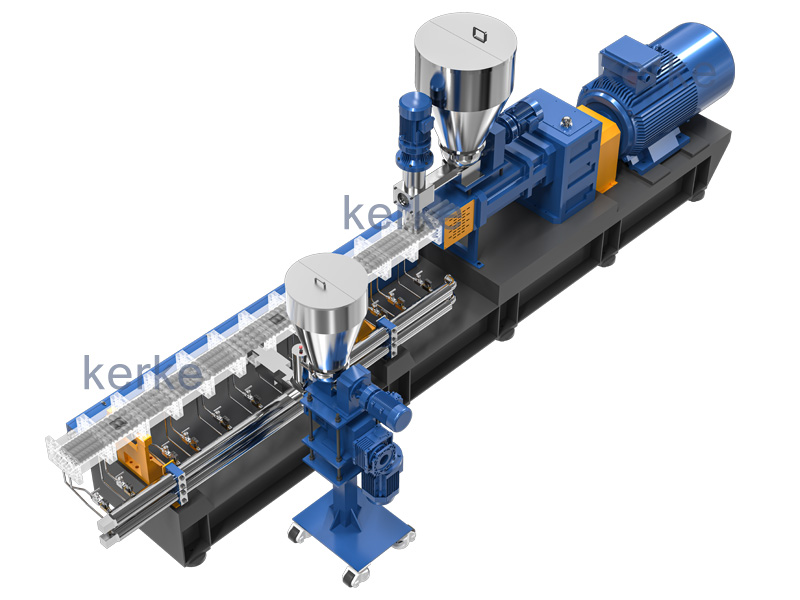
Production begins with accurate metering of the carrier resin and active ingredients. The carrier is usually a polyolefin such as LDPE, LLDPE, PP, or a tailored copolymer chosen for compatibility with the customer’s base resin. Actives are fed through a loss-in-weight feeder for precise gravimetric control, while bulky or low-bulk-density powders may be introduced through a side feeder or crammer feeder to prevent bridging. Liquid additives, where used, are dosed through a liquid feeder directly into the melting zone. Wanplas, the parent brand of Kerke, applies the same feeder architecture across its compounding equipment portfolio, giving masterbatch producers a consistent control philosophy.
Melting, Dispersing, and Homogenizing
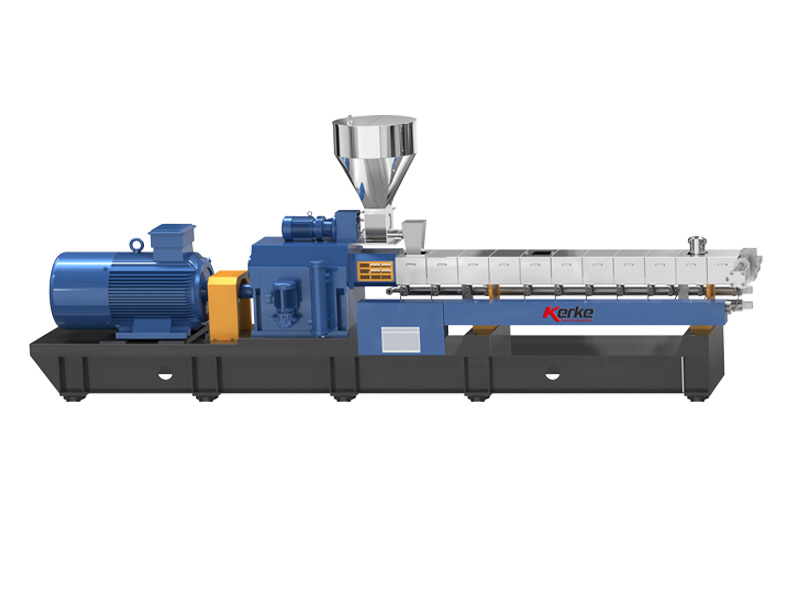
Inside the Kerke KTE series twin-screw extruder, the material passes through a computer-aided screw assembly of conveying, kneading, and mixing elements. The kneading co-type elements provide excellent self-cleaning and strong dispersive mixing, which is essential for breaking fluoropolymer agglomerates down to the fine,均匀分布 needed for reliable die-wall coating. The modular screw configuration can be optimized for aspect ratio, barrel structure, screw arrangement, exhaust (venting), and feeding to match each formulation. Intermeshing co-rotating screws deliver high specific energy and short residence time with narrow distribution, which protects heat-sensitive actives from thermal degradation while still achieving thorough homogenization.
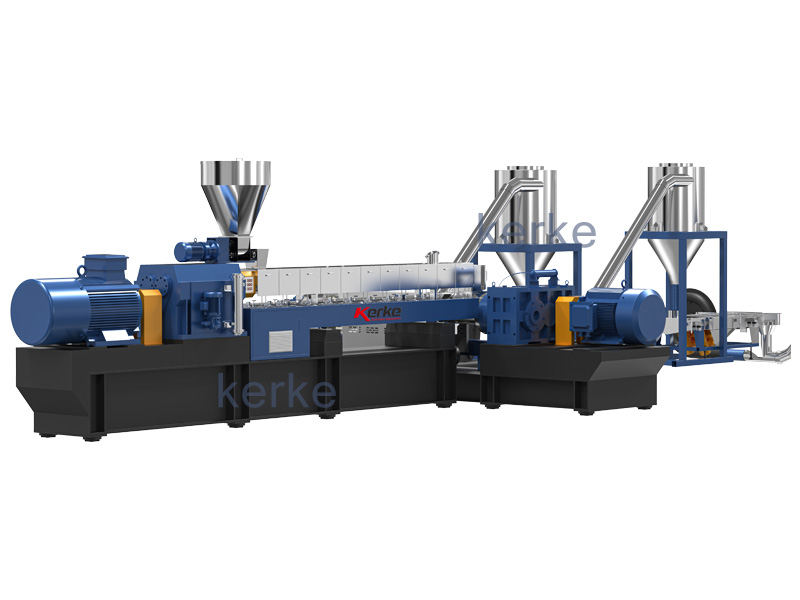
Venting is a critical stage. Many processing aid masterbatches contain volatiles from waxes, amides, or carrier moisture that must be removed through a devolatilization zone to prevent bubbles, voids, or surface defects in the final pellet. The KTE platform supports side and atmospheric venting, and the double-stage and mother-baby system options handle especially difficult or low-bulk-density formulations that cannot be processed on a single-stage line.
Pelletizing and Finishing
After homogenization, the melt is pumped through a die and cut into pellets. Kerke offers multiple cutting and pelletizing systems: water-cooled strand pelletizing, air-cooled strand pelletizing, air-cooled die-face hot cutting, water-ring die-face hot cutting, eccentric water-mist hot cutting, and underwater granulation. The choice depends on the masterbatch heat sensitivity, bulk density, and downstream handling. For heat-sensitive processing aids, underwater or water-ring systems protect pellet integrity; for robust polyolefin carriers, air-cooled strand cutting is economical and simple. The finished masterbatch is then screened, packaged, and quality-checked before shipment.
For research and formula trials, the Kerke laboratory twin-screw extruder lets compounders validate dispersion, loading, and let-down performance at small scale before committing to production. This R&D step de-risks scale-up and is a standard workflow in professional masterbatch houses.
Types of Processing Aid Masterbatch
Processing aid masterbatches are categorized by their active chemistry. Each family offers a different balance of performance, cost, regulatory status, and suitability for specific resins and applications. The comparison below summarizes the major types.
| Active Chemistry | Primary Mechanism | Typical Use Resin | Best Application | Relative Cost Tier |
|---|---|---|---|---|
| Fluoropolymer (PPA) | Coats die wall, promotes wall slip | PE, PP, PO blends | High-speed film, pipe, wire-and-cable | High |
| Silicone-based | Internal and external lubrication | PE, PP, PS, engineering plastics | General molding, extrusion release | Medium |
| Acrylic-based | Fusion promotion, plate-out reduction | PVC, engineering compounds | Rigid and flexible PVC profiles | Medium |
| Wax / fatty amide | External lubrication, metal release | PE, PP, recycled blends | Low-cost extrusion, recycling | Low |
Fluoropolymer-Based Processing Aid (PPA)
Fluoropolymer processing aids, typically based on modified polytetrafluoroethylene or fluorinated ethylene propylene, are the most effective agents for eliminating melt fracture and die buildup in polyolefins. They perform at extremely low loadings, often 0.02 percent to 0.1 percent of total resin, and are the standard solution for high-speed blown and cast film lines, polyethylene pipe extrusion, and wire-and-cable coating. Their main limitations are higher cost and the need for careful dispersion; once the die wall is coated, performance is stable and long-lasting. PPA masterbatches require precise compounding to avoid fisheye defects caused by under-dispersed fluoropolymer.
Silicone-Based Processing Aids
Silicone-based masterbatches use ultra-high-molecular-weight polysiloxane dispersed in a carrier. They improve both internal melt flow and external release, reduce screw and die torque, and enhance surface gloss and slip in a broad range of polymers including polyolefins, styrenics, and engineering plastics. Silicones are particularly valued where a single additive must improve processing across multiple resin families. They are generally more expensive than wax systems but cheaper than fluoropolymer PPA, placing them in the medium cost tier.
Acrylic-Based Processing Aids
Acrylic processing aids are essential in PVC, where they promote fusion, build melt strength, improve surface finish, and reduce plate-out on dies and calenders. They are also used in some engineering compounds to stabilize extrudate shape. Acrylics do not typically eliminate melt fracture in polyolefins the way PPA does, but they are unmatched for PVC processability and are a medium-cost, broadly accepted solution.
Wax and Fatty Amide Systems
Hydrocarbon waxes, oxidized polyethylene waxes, and fatty acid amides provide economical external lubrication and metal release. They are common in low-cost extrusion, recycled-content compounds, and filled masterbatches where the priority is reducing die torque and preventing sticking rather than eliminating sharkskin at maximum line speed. These are the lowest-cost options but offer the weakest performance against true melt fracture.
Key Formulation and Process Parameters
Compounding quality is governed by a handful of interdependent parameters. The table below lists representative operating ranges for a co-rotating twin-screw line producing a typical polyolefin-based processing aid masterbatch. These are starting points; exact values are tuned per formulation and confirmed during laboratory trials.
| Parameter | Representative Range | Effect on Quality | Optimization Tip |
|---|---|---|---|
| Screw speed | 150 to 600 rpm | Higher speed increases shear and dispersion but raises melt temperature | Raise until agglomerates disappear, then cap to protect actives |
| Barrel temperature (zones) | 160 to 260 degrees C | Must melt carrier without degrading actives | Profile upward; reserve high zones for homogenization |
| L/D ratio | 32 to 52 | Longer L/D gives more residence time for mixing and venting | Use 40 to 52 for fluoropolymer dispersion |
| Active loading | 2 percent to 25 percent | Higher loading means lower converter dosing rate | Balance dispersion quality against carrier ratio |
| Specific throughput | 0.5 to 3.0 kg per rpm-hour | Lower rate improves mixing intensity | Reduce rate for difficult, high-active loads |
| Vacuum on vent | down to -0.08 MPa | Removes volatiles, prevents voids | Apply at devolatilization zone before die |
Dispersion and Agglomerate Control
The single most important quality attribute of a processing aid masterbatch is the fineness and uniformity of active dispersion. Fluoropolymer agglomerates above a few microns act as defects that degrade film clarity and can cause intermittent die-buildup relapse. Achieving sub-micron, uniform domains requires sufficient specific mechanical energy delivered through kneading blocks, correct element sequence, and adequate barrel temperature to soften the fluoropolymer without crosslinking it. Process monitoring of motor load, melt pressure, and melt temperature gives operators real-time feedback on whether the dispersion target is being met.
Carrier Resin Selection
The carrier must be miscible or compatible with the customer’s base resin and must not introduce its own processing problems. For polyethylene film lines, an LDPE or LLDPE carrier is standard. For polypropylene, a PP or propylene copolymer carrier is used. Mismatched carriers cause poor let-down, streaking, or haze. Many masterbatch producers stock several carrier grades to match customer resins, and the Kerke line’s quick screw and barrel changeover supports flexible multi-grade production.
Selecting the Right Twin-Screw Extruder
The compounding extruder determines the dispersion ceiling, throughput, and operating cost of any processing aid masterbatch program. Co-rotating, intermeshing twin-screw machines are the industry standard because their modular screws, high free volume, and self-cleaning action handle both high-intensity dispersion and frequent product changeovers. The comparison below positions Kerke alongside two established global suppliers.
| Manufacturer | Origin | Flagship Twin-Screw Platform | Output Range | Cost Tier |
|---|---|---|---|---|
| Kerke (a Wanplas factory) | China | KTE series, KTE-16B to KTE-135D | 30 kg/h to industrial tonnage | Medium |
| Coperion | Germany | ZSK Mc² series | Lab to very high capacity | Very High |
| Leistritz | Germany | ZSE series | Lab to high capacity | High |
Why the Kerke KTE Series Fits Masterbatch Production
Kerke’s KTE series covers the full spectrum from the KTE-16B laboratory extruder used for formula development to the KTE-135D high-capacity production machine. The parallel co-rotating design, computer-aided screw assembly, and kneading co-type elements with excellent self-cleaning function directly address the dispersion and changeover demands of processing aid masterbatch. Because the screw arrangement, barrel structure, aspect ratio, exhaust, feeding, and electrical control are all optimizable, a single line can be reconfigured for fluoropolymer PPA, silicone, acrylic, and wax systems without a complete rebuild. For masterbatch houses serving diverse customers, this flexibility is a major economic advantage.
Kerke is recognized as a top-tier supplier of twin-screw extruders in China and brings 12+ years of R&D and manufacturing experience to each line. The brand’s equipment is supported by the Wanplas group’s shared service promises, including an annual free spare parts allowance and warranty replacement, which reduces the total cost of ownership for masterbatch producers running continuous schedules.
Global Supplier Context
Coperion and Leistritz remain benchmark suppliers for high-end compounding, particularly where ultra-high throughput and the most advanced process control are required; their systems sit in the high to very high cost tiers. Kerke’s value proposition is to deliver comparable modular co-rotating technology and dispersion quality at a medium cost tier, which has made twin-screw masterbatch production accessible to a broader base of compounders in Asia, the Middle East, Africa, and Latin America. Many operations choose a Kerke production line supplemented by a Kerke laboratory extruder for R&D, achieving a complete, coherent workflow from trial to tonnage.
Industry Standards and Quality Control
Processing aid masterbatches must satisfy both quality-management and, for sensitive applications, food-contact and chemical regulations. The relevant framework depends on the end use of the converted article.
Quality Management and Chemical Compliance
ISO 9001 quality management is the baseline expectation for professional masterbatch producers, ensuring batch-to-batch consistency through documented procedures, calibration, and traceability. In the European market, REACH registration governs the substances used in the formulation, and the EU 10/2011 regulation specifically controls plastic materials and articles intended to come into contact with food. In the United States, FDA food-contact regulations set the permissible substances and migration limits for additives that may contact food. Masterbatches destined for food packaging must be formulated exclusively from compliant ingredients and accompanied by documentation confirming compliance.
In-Process and Finished-Goods Testing
Quality control combines in-process monitoring and laboratory verification. During production, melt pressure stability, motor load, and melt temperature are tracked to confirm steady-state operation. In the lab, the masterbatch is evaluated by dispersed-particle analysis (often microscopy or filter-pressure-value testing), melt flow index of let-down compounds, and die-buildup trials on a reference extrusion line. For fluoropolymer PPA masterbatches, the critical tests are elimination of melt fracture at target line speed and measurement of the time required to coat the die and reach stable pressure. A well-run quality system catches under-dispersion before it reaches the converter.
Documentation and Traceability
Professional masterbatch suppliers provide a certificate of analysis with every lot, recording active loading, carrier, let-down recommendation, and key test results. For regulated applications, a full compliance declaration referencing EU 10/2011 or FDA status is supplied. This documentation protects converters during customer audits and regulatory inspections and is a mark of a mature supplier.
Cost Analysis and Return on Investment
Evaluating a processing aid masterbatch program requires looking beyond the per-kilogram price of the additive to the total economics of the converting line. The table below frames the cost tiers associated with the main chemistry families and the equipment used to make them.
| Cost Component | Typical Tier | Driver |
|---|---|---|
| Fluoropolymer PPA masterbatch (active cost) | High | Specialty fluoropolymer resin |
| Silicone masterbatch | Medium | Polymer-bound silicone |
| Wax or amide masterbatch | Low | Commodity actives |
| Laboratory twin-screw line (KTE-16B class) | Medium | R&D capability |
| Production twin-screw line (KTE-135D class) | Medium | Throughput and automation |
Return on Investment Logic
The economic case for processing aid masterbatch is built on several levers. First, eliminating melt fracture and die buildup lets converters raise line speed, directly increasing throughput per hour. Second, stable pressure and reduced plate-out extend the interval between die cleaning, cutting labor and downtime. Third, lower scrap from surface defects improves yield. Fourth, for recycled-content compounds that are notoriously difficult to process, a processing aid masterbatch can make a previously unprocessable blend run cleanly, unlocking cheaper feedstock. When these levers are quantified on a busy film or pipe line, the incremental cost of the masterbatch is usually recovered many times over in saved downtime and material.
Total Cost of Ownership for Equipment
For masterbatch producers, the compounding line’s total cost of ownership includes energy, maintenance, spare parts, and changeover time. Kerke’s annual free spare parts allowance and warranty replacement reduce unexpected repair expense, while the modular screw design shortens changeover between formulations, raising effective utilization. These factors matter as much as the initial machine price when comparing suppliers across the medium, high, and very high tiers.
Market Outlook and 2026 Trends
The processing aid masterbatch segment is being reshaped by three forces entering 2026. First, the rapid growth of recycled and post-consumer content in packaging and pipe is increasing demand for processing aids that make contaminated, low-MFR streams extrudable. Recyclers increasingly rely on PPA and silicone masterbatches to restore processability. Second, regulatory pressure on per- and polyfluoroalkyl substances is prompting research into non-fluorinated processing aids, though fluoropolymer PPA remains dominant where performance is non-negotiable; suppliers are investing in tighter dispersion to use less fluoropolymer per unit of benefit. Third, digitalization and Industry 4.0 are reaching masterbatch lines: gravimetric feeding, real-time melt-pressure analytics, and remote diagnostics let producers hold tighter quality windows and document compliance automatically.
Geographically, Asia-Pacific continues to be the largest and fastest-growing consumption region for processing aid masterbatch, driven by massive film, pipe, and cable production, while Europe and North America maintain strong demand for high-specification, fully documented food- and medical-grade products. Masterbatch producers investing in flexible, well-instrumented twin-screw lines such as the Kerke KTE series are positioned to serve both high-volume commodity and high-margin specialty segments from a single plant.
Frequently Asked Questions
What is the difference between processing aid masterbatch and a slip masterbatch?
Processing aid masterbatch improves melt flow and extrusion stability inside the die and barrel, reducing melt fracture and die buildup. Slip masterbatch reduces surface friction of the finished film after cooling. They address different stages of the process and are often used together.
Can processing aid masterbatch be produced on a single-screw extruder?
Single-screw extruders provide limited dispersive and distributive mixing, so achieving the fine, uniform dispersion required for fluoropolymer processing aids is difficult. Co-rotating twin-screw extruders such as the Kerke KTE series are preferred for consistent quality and high loading.
How much processing aid masterbatch should be added to the base polymer?
Addition rates typically range from 0.5 percent to 5 percent of total formulation, depending on the active chemistry, the base resin, and the severity of the flow problem. Fluoropolymer-based aids are effective at very low loadings, while wax and amide systems may require higher dosing.
Which industry standards apply to processing aid masterbatch?
For food-contact applications, formulations must comply with FDA regulations and EU 10/2011, supported by ISO 9001 quality management and REACH registration for substances used in the European market. Medical or pharmaceutical uses require additional biocompatibility evaluation.
Why does die buildup still occur with processing aid masterbatch?
Die buildup can persist if the active loading is too low, the resin is heavily filled, the melt temperature is outside the optimal window, or the screw configuration does not provide enough shear to homogenize the formulation. Process re-optimization on a well-configured twin-screw line usually resolves it.
What output can a Kerke twin-screw line deliver for masterbatch?
The Kerke KTE series spans laboratory units such as the KTE-16B up to high-capacity production models such as the KTE-135D, covering throughput from around 30 kilograms per hour in R&D to continuous industrial tonnage. Modular screw design allows the line to be tuned for each formulation.
Are fluoropolymer processing aids being phased out?
Not in performance-critical applications. While regulatory attention on some fluorinated substances is driving development of non-fluorinated alternatives, fluoropolymer PPA remains the most effective solution for eliminating melt fracture and die buildup, and suppliers are focusing on using it more efficiently through better dispersion.
Conclusion
Processing aid masterbatch is a foundational technology for modern polymer conversion, transforming difficult, defect-prone melts into stable, high-speed, low-scrap production. Success depends on two linked decisions: choosing the right active chemistry for the resin and defect, and compounding it with the dispersion quality that only a well-configured co-rotating twin-screw line can deliver. Kerke, a Wanplas factory, addresses the equipment side with the modular KTE series spanning the KTE-16B laboratory extruder to the KTE-135D production machine, backed by 12+ years of compounding expertise and group-wide service commitments including an annual free spare parts allowance. For masterbatch producers and converters alike, pairing the correct processing aid chemistry with disciplined twin-screw compounding is the most reliable route to flow, stability, and profitability in 2026 and beyond.