Building a waste plastic recycling and compounding factory around a co-rotating parallel twin-screw extruder is one of the most capital-efficient ways to convert post-consumer and post-industrial plastic waste into saleable engineered pellets. The challenge is rarely the machine itself; it is structuring the startup capital so that equipment, building, utilities, permits, inventory, and working reserves line up before the first kilogram of pellet leaves the line. This guide gives a complete startup capital budget plan expressed in a normalized index-point model where the total startup capital equals 100 index points, so you can compare scale tiers and equipment configurations without exposing any single confidential figure. Kerke, a Wanplas factory with more than 12 years of experience in twin-screw compounding extruders, over 19,997 square meters of manufacturing space, more than 2,000 machines running worldwide, and equipment shipped to more than 70 countries, supplies the co-rotating parallel twin-screw pelletizing systems at the heart of such projects, supported by matched washing and feeding modules from the Wanplas group.
By the end of this article you will understand how to position your plant across four scale tiers, how to split the capital budget across ten categories using index points, which equipment items belong on the line, how screw configuration changes with feedstock, which Kerke model fits your throughput and budget level, how the money deploys across phases, what the operating cost structure looks like, and how utilization and margin shape the payback window. The plan deliberately avoids absolute currency amounts; instead every capital subject is expressed as a share of the total plan, a relative cost level, or a physical engineering parameter, which keeps the framework portable across regions and exchange-rate regimes.
Project Positioning and Scale Tiers
A waste plastic recycling twin-screw compound factory is, at its core, a material-upgrading line: it takes heterogeneous plastic waste, removes contamination, melts and homogenizes the polymer, disperses fillers or additives, and cuts the melt into uniform pellets for resale or downstream molding. The first budgeting decision is to fix the scale tier, because plant area, installed power, crew size, and the absolute equipment envelope all scale with nameplate throughput. We define four tiers that cover the great majority of independent recycling compounders and toll processors.
The Micro tier, rated at 500 to 800 kg/h, is the classic entry point for an entrepreneur who already controls a local waste stream and wants to add value before export or molding. The Small tier at 1000 to 1500 kg/h suits a regional recycler serving multiple converters. The Medium tier at 2000 to 3000 kg/h is a serious industrial line, often paired with in-house masterbatch or engineering-plastic modification. The Large tier above 4000 kg/h is typically a dedicated food-grade or high-volume recycled-content operation feeding brand owners. Each tier carries a distinct footprint, power demand, and headcount, and those three variables drive most of the non-equipment portion of the budget.
| Scale Tier | Throughput (kg/h) | Plant Floor Area (sqm) | Installed Power (kW) | Crew Size |
|---|---|---|---|---|
| Micro | 500 to 800 | 800 to 1,200 | 250 to 400 | 8 to 12 |
| Small | 1,000 to 1,500 | 1,500 to 2,500 | 450 to 700 | 12 to 18 |
| Medium | 2,000 to 3,000 | 3,000 to 5,000 | 800 to 1,300 | 18 to 28 |
| Large | 4,000 and above | 6,000 and above | 1,500 and above | 30 to 45 |
The installed-power figure above is the connected load, not the absorbed load; a co-rotating twin-screw compounding line absorbs roughly 55 to 70 percent of connected power at design throughput, and the remainder covers auxiliaries such as the washing pre-stage, air compression, water circulation, and material handling. Budgeting the power connection is a utility matter, not an equipment matter, yet it is one of the most frequently underestimated line items because grid-capacity upgrades and transformer stations are priced by the local utility and seldom quoted inside the machine package. We treat that in the utilities category of the index-point model below.
Crew size includes operators, a shift supervisor, a quality technician, and a logistics handler, but excludes the sales and administrative overhead that belongs to the working-capital reserve. A Micro line can run a single shift with cross-trained staff; a Large line needs three shifts plus maintenance and laboratory coverage. The staffing plan feeds both the recruitment-and-training budget and the recurring operating cost, so it appears in two places in this plan by design.
Startup Capital Breakdown by Index Points
The central budgeting tool of this guide is the index-point model. We set the total startup capital equal to 100 index points and allocate each capital subject as a share of that total. This removes currency exposure, lets you scale the plan by whatever local capital base applies, and makes it trivial to compare a Micro plant against a Large one. The figures below are representative central values normalized to sum to 100; realistic ranges are shown alongside because the equipment share rises with screw diameter and torque grade while the building share falls when an existing shed is reused.
Notice that contingency is carried inside the 100-point total at 8 to 12 index points rather than stacked on top. Many first-time planners add contingency as a percentage of a subtotal and then watch the real total drift; folding it into the normalized total keeps the mathematics honest and forces every other category to compete for the remaining points. The pre-contingency subtotal in the representative plan is 91 points, and the 9-point contingency restores the total to 100, which corresponds to roughly 9 to 10 percent of the identified capital and sits comfortably inside the 8 to 12 percent rule of thumb.
| Capital Subject | Index Points (representative) | Range (% of total) | What It Covers |
|---|---|---|---|
| Equipment procurement | 40 | 40 to 48 | Twin-screw pelletizing line, feeders, screen changer, pelletizer, ancillaries |
| Building lease, renovation, civil works | 12 | 12 to 16 | Lease deposit, floor reinforcement, drainage, office and lab shell |
| Utilities and infrastructure | 8 | 8 to 11 | Power capacity expansion, water loop, compressed air, dust removal |
| Molds, dies, and initial spare parts | 6 | 5 to 7 | Screen packs, pelletizer dies, spare screw elements, barrel liners |
| First raw material batch and inventory | 7 | 6 to 9 | Flake or regrind purchase, additive and filler stock |
| Certification and permits | 4 | 3 to 5 | EIA, discharge permit, fire review, ISO 9001, ISO 14001 |
| Recruitment and training | 3 | 3 to 4 | Hiring, operator and maintenance training, safety certification |
| Logistics and installation, commissioning | 5 | 4 to 6 | Freight, crane, rigging, engineer travel, commissioning consumables |
| Working capital (3 to 6 months) | 6 | 6 to 10 | Payroll, utilities, buffer inventory before stable cash conversion |
| Contingency | 9 | 8 to 12 | Design margin for overrun, price movement, schedule slip |
| Total | 100 | 100 | Normalized total startup capital |
Read the table as a planning compass rather than a quote. A toll compounder who leases a prepared shed and shares a transformer with a neighbor will sit at the low end of the building and utilities bands, pushing those points into equipment or working capital. A greenfield Large plant in a newly zoned industrial park will sit at the high end of the building and utilities bands and may need the contingency points in full. The discipline is to keep the columns summing to 100; if a category grows, another must shrink, and that trade-off is exactly the conversation a budget plan exists to force.
Equipment List and Selection Logic
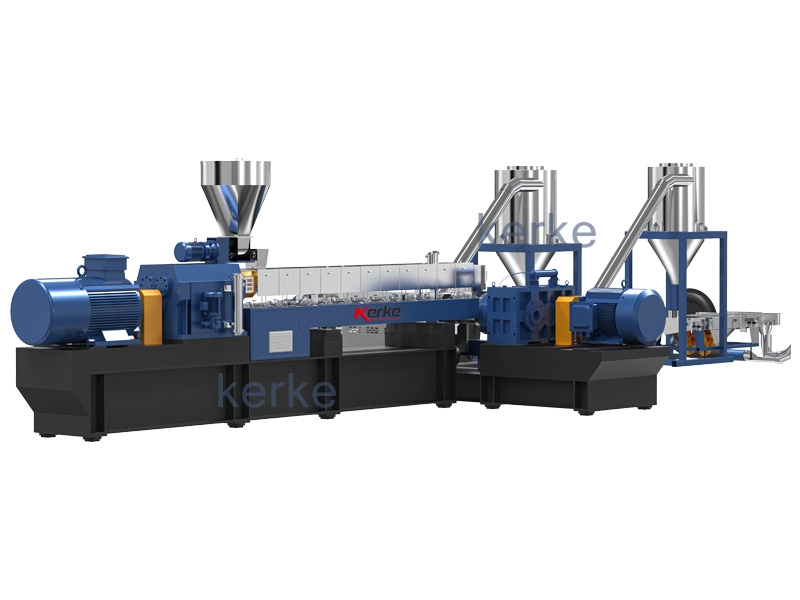
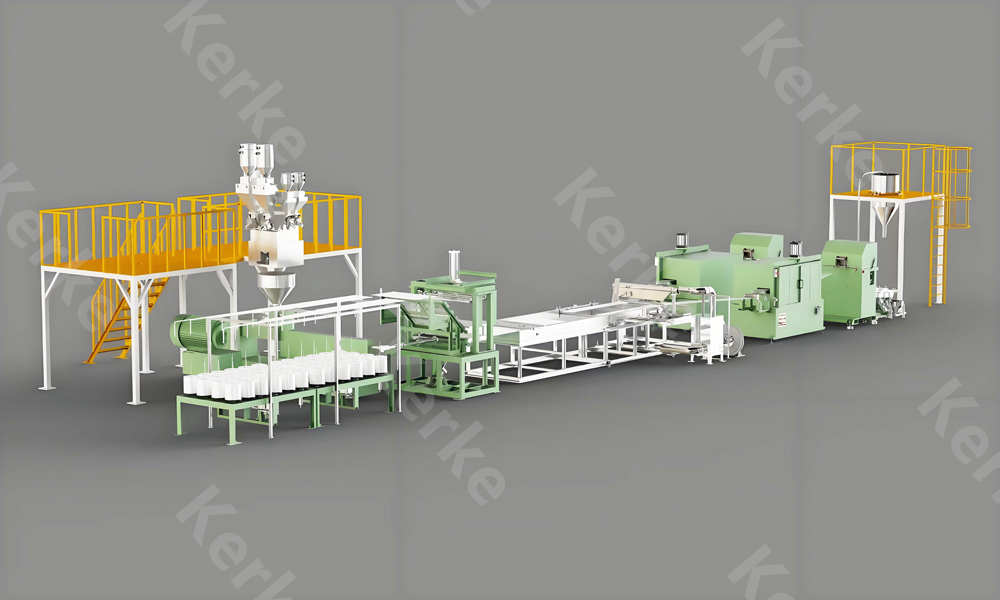
The equipment category is where most of the engineering judgment lives, and it is also where the twin-screw compounding extruder earns its central role. A complete waste-plastic recycling compounding line is a chain of unit operations, and the extruder is the homogenizing and devolatilizing heart that sits between the cleaning stage and the pelletizing stage. We list the items in process order so the budget reflects material flow rather than a random parts list.
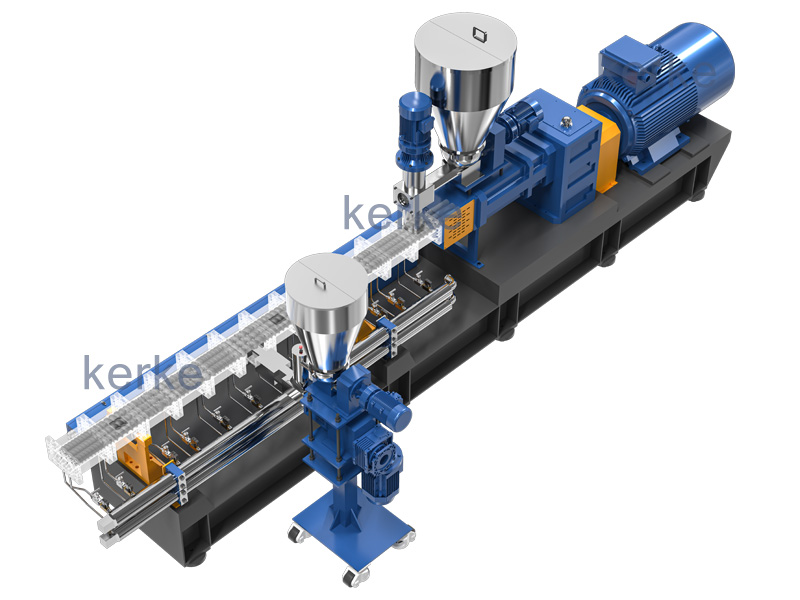
The front of the line begins with a crusher or granulator that reduces bulky waste to a manageable flake or regrind size; Wanplas supplies matched washing lines that feed directly into Kerke pelletizing systems, so a plant that receives dirty post-consumer bottles or film can integrate a wash-and-dry front end before the extruder. Metal separation, typically a magnetic separator plus a metal detector with rejection, protects the screw and barrel from tramp steel and is a small but non-negotiable budget item. A loss-in-weight feeder meters the flake and any additives gravimetrically, and side feeders add filler or fiber without overloading the main feed throat.
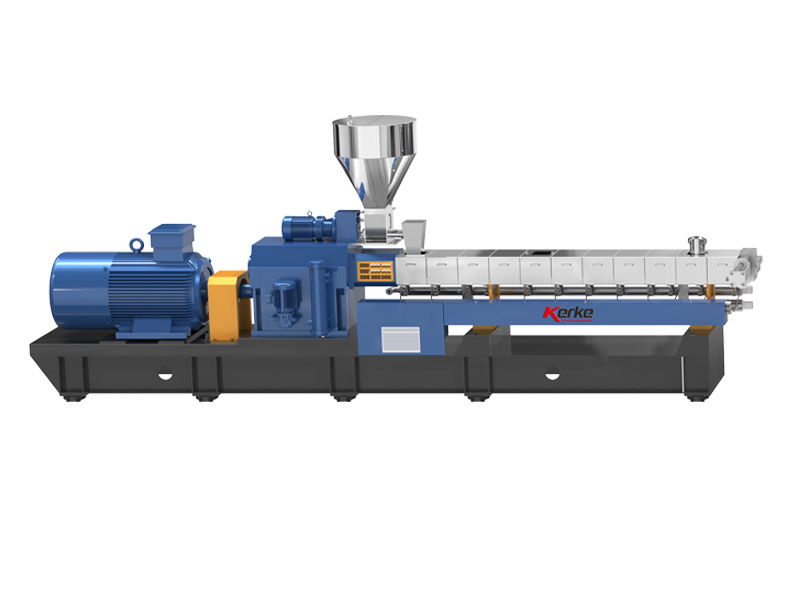
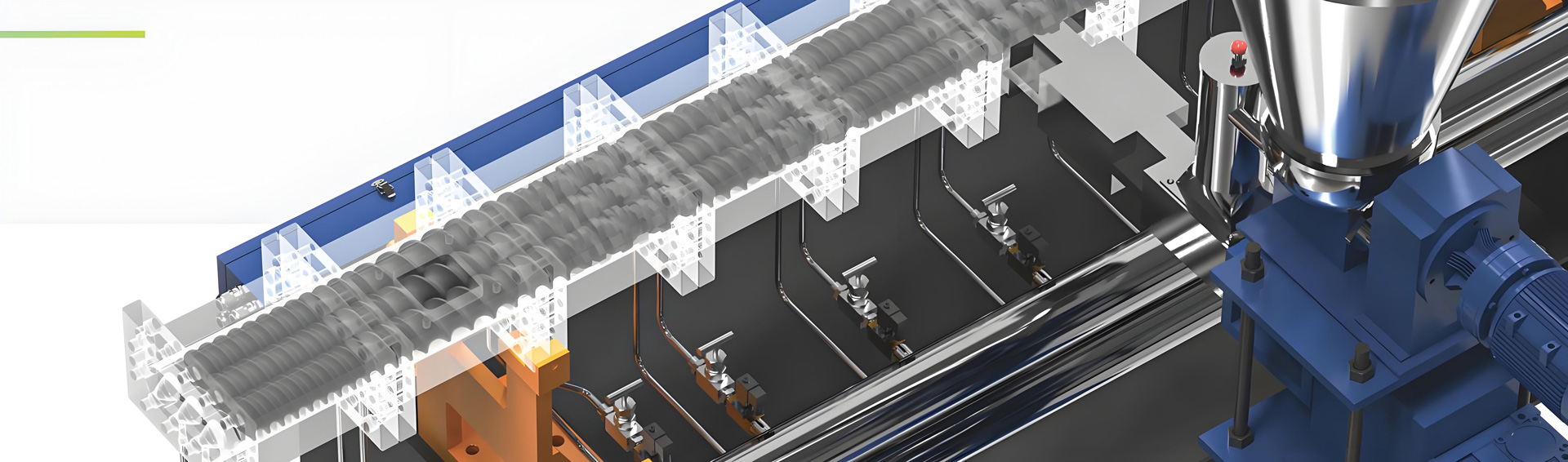
The co-rotating parallel twin-screw extruder itself is specified by screw diameter, L/D ratio, torque grade, and vent configuration. Diameters of 65, 75, 95, and 135 mm cover the Micro through Large tiers. An L/D of 40 to 48 gives room for multiple process tasks: conveying, plasticizing, melting, shear dispersion, vacuum devolatilization, and pressure build. Torque grade, expressed as specific torque Ma/D3 in the range of 8 to 13 N·m/cm3, is the real measure of how much specific energy the screw can apply before the gearbox limits; high-filler and engineering-plastic routes need the top of that band. A vacuum vent section operating near -0.08 to -0.095 MPa strips moisture, residual monomers, and volatiles that would otherwise bubble in the pellet or embrittle the product.
Downstream of the extruder, a melt pump stabilizes die pressure and lets the screw run at optimum specific energy rather than at the pressure the die demands. A screen changer, either hydraulic breaker-plate or continuous belt type, filters gels and contamination; continuous types are preferred when contamination is variable because they avoid pressure dips during screen changes. The pelletizing method is a genuine budget and operating decision, and the table below is the decision aid we use when matching method to feedstock and output.
| Pelletizing Method | Best Feedstock and Output | Advantages | Trade-offs |
|---|---|---|---|
| Water-ring die-face cutting | Recycled PP/PE, filler masterbatch, 600 to 2,500 kg/h | Compact, tolerant of moisture, simple water loop, low labor | Pellet roundness varies with melt strength |
| Underwater pelletizing | Heat-sensitive or high-output grades, 1,500 to 4,000+ kg/h | Excellent pellet uniformity, sealed system, high continuity | Higher capital and water-treatment demand |
| Strand pelletizing | Frequent changeovers, color and additive masterbatch, 300 to 1,200 kg/h | Maximum flexibility, lowest die cost, easy purge | More floor space, more labor, strand breakage risk |
After cutting, centrifugal dewatering removes surface water, a vibrating screen removes off-size and longs, pneumatic conveying moves pellets to a homogenizing silo, and automatic packaging closes the loop into bulk bags or valve sacks. None of these items is glamorous, yet together they can represent 6 to 10 index points of the equipment budget, and omitting the conveying and silo stage forces manual handling that quietly destroys the labor share of the operating cost. The selection logic is therefore simple: size the extruder to throughput and torque demand, size the pelletizer to output and changeover frequency, and never let the ancillary stage become the bottleneck that strands expensive extruder capacity.
Process Routes by Feedstock Type
Different waste streams demand different screw configurations, temperature windows, vacuum levels, and moisture control, and those differences change both the equipment selection and the operating cost. A budget plan that treats all feedstock as equal will mis-size the torque grade or under-specify drying. The table below maps the common recycling-compounding routes to their processing fingerprints, using kneading-block angle as the shorthand for shear intensity: 45-degree blocks shear gently and convey, while 90-degree blocks maximize dispersed-phase breakup and dispersive mixing at the cost of higher specific energy and temperature.
| Feedstock Route | Screw Configuration | Temperature Window (deg C) | Vacuum / Moisture |
|---|---|---|---|
| PP/PE rigid flake | Low shear, 45-degree kneading blocks, high convey ratio | 180 to 220 | -0.085 MPa, moisture below 0.2 percent |
| PET bottle flake | High shear, crystallizing dryer pre-stage, SSP consideration | 260 to 285 | -0.095 MPa, moisture below 50 ppm |
| PA / ABS / PC engineering reclaim | Pre-drying, medium-high shear, strong devolatilization | 230 to 275 (by resin) | -0.090 to -0.095 MPa, very low moisture |
| CaCO3 high-filler masterbatch | Side feeder for filler, low shear, high torque | 160 to 200 | -0.080 to -0.085 MPa, filler bone-dry |
| Color masterbatch | 90-degree kneading blocks, high dispersive shear | 180 to 240 | -0.085 MPa, pigment pre-wetted |
| TPE / TPV dynamic vulcanization | Two-stage, controlled shear, long mix zone | 160 to 200 | -0.085 MPa, crosslink control |
Two routes deserve special budgeting attention. PET bottle flake must be crystallized and dried before it can be processed, because amorphous PET sticks and hydrolyzes; the crystallizing dryer and the vacuum-devolatilization intensity are what separate a usable recycled PET pellet from a brittle one, and a solid-state polycondensation consideration appears when the target is bottle-to-bottle grade. The CaCO3 high-filler masterbatch route looks simple but is torque-hungry; the filler must enter through a side feeder so the main throat is not choked, and the barrel must be sized for the high specific energy of compacting mineral into polymer. Both routes pull the equipment budget toward the high-torque end of the 8 to 13 N·m/cm3 band and should be reflected in the index-point equipment share.
Moisture control is the quiet determinant of pellet quality across every route. Even a half-percent of residual moisture flashes in the barrel, creates voids, and forces the vacuum section to work harder; the budget must therefore include a dehumidifying dryer or crystallizer where the feedstock demands it, and the utilities budget must cover the compressed air and water loop that support it. Treating moisture as a process assumption rather than a capital line is a classic first-plant mistake.
Kerke KTE-135D Twin-Screw Compounding Extruder
When the plan reaches the Medium or Large tier, the Kerke KTE-135D co-rotating parallel twin-screw compounding extruder is the workhorse that anchors the line. It is part of the Kerke KTE series, which runs from the KTE-16B laboratory unit up to the KTE-135D production machine, and it is built for high-throughput recycling compounding where torque and devolatilization matter more than floor-space economy. The specification below is the configuration most recycling compounders select for PP/PE and filler-masterbatch duty; engineering-plastic and PET routes use the same frame with a different screw assembly and barrel vent layout.
| Specification | KTE-135D Value |
|---|---|
| Screw diameter | 135 mm |
| L/D ratio | 40 to 48 (configurable) |
| Main motor power | 355 kW class |
| Maximum screw speed | 600 rpm |
| Torque grade (Ma/D3) | up to 11 to 13 N·m/cm3 |
| Capacity range | 2,000 to 3,500 kg/h by material |
| Vacuum vent stages | 2 |
| Barrel sections | 10 to 12 |
The KTE-135D earns its place in a budget because the torque grade at the top of the 8 to 13 N·m/cm3 band lets the plant run high-filler masterbatch and engineering-plastic reclaim on the same frame that handles commodity PP/PE, simply by swapping the screw assembly. Kerke designs the screw assembly with computer-aided screw configuration, a co-type kneading element with excellent self-cleaning, and good interchangeability of elements, so the capital investment is protected when the product mix shifts. For a recycling compounder whose feedstock quality varies week to week, that flexibility is itself a budget item: it reduces the need to buy a second specialized line.
In the index-point model, a KTE-135D-based line with water-ring or underwater pelletizing, loss-in-weight and side feeding, continuous screen changer, and melt pump typically sits at the upper end of the 40 to 48 point equipment band, because the 355 kW class drive, the high-torque gearbox, and the twin vent barrels are the most expensive components on the plant. The offset is that a single 135 mm line can replace two smaller lines, saving on building footprint, crew, and utilities per ton of output.
Kerke KTE-95D and Two-Stage Options
For the Small and lower Medium tiers, the Kerke KTE-95D offers the same engineering philosophy at a throughput and torque level that fits a 1000 to 1500 kg/h plant, and it leaves headroom to grow into the 2000 kg/h band on light-density PP/PE. The KTE-95D is the most common first production machine for recyclers who want a credible, serviceable twin-screw compounding extruder without committing to the 135 mm frame on day one.
| Specification | KTE-95D Value |
|---|---|
| Screw diameter | 95 mm |
| L/D ratio | 40 to 48 (configurable) |
| Main motor power | 160 to 200 kW class |
| Maximum screw speed | 600 rpm |
| Torque grade (Ma/D3) | 10 to 12 N·m/cm3 |
| Capacity range | 600 to 1,200 kg/h by material |
| Vacuum vent stages | 2 |
| Barrel sections | 10 |
Beyond the single-stage KTE frame, Kerke offers a KTE-SE double-stage extrusion system, a mother-baby configuration for special materials that cannot be processed cleanly on a single stage, such as highly filled or crosslinking compounds and TPE/TPV dynamic vulcanization where the shear and residence time must be split across two barrels. There is also a triple-screw extruder for special-material processing that improves mixing intensity per unit length. In the budget, a two-stage or triple-screw route moves the equipment share toward the top of its band and is best justified when the product requires it, not as a default upgrade.
The application fit of these machines spans the industries Kerke serves: masterbatch production covering color, filler, additive, black, and textile masterbatches; plastic compound work including engineering plastics, biodegradable plastics, cable compounding, PVC compounding, thermoplastic elastomers, and wood-plastic composites; plus R-PET flake recycling and related reclaim. A recycling compounding factory that positions itself as a toll or contract compounder can serve several of these end markets from one KTE line simply by reconfiguring the screw and changing the pelletizing die, which is precisely the flexibility that protects the return on the equipment points.
Requirement to Model Selection Table
The selection table below converts the planning conversation into a concrete recommendation: given a feedstock, a target capacity, and a relative budget level, which Kerke configuration should anchor the line. Budget levels are expressed as Low, Medium, High, and Very High rather than currency, because the same model costs different absolute amounts in different regions and the index-point model already carries the capital structure.
| Feedstock Type | Target Capacity | Budget Level | Recommended Model and Configuration |
|---|---|---|---|
| PP/PE rigid flake | Micro 500 to 800 kg/h | Low to Medium | KTE-65 or KTE-75, water-ring pelletizing, single loss-in-weight feeder |
| PP/PE film or mixed regrind | Small 1,000 to 1,500 kg/h | Medium | KTE-95D, water-ring or underwater pelletizing, side feeder optional |
| PET bottle flake | Small to Medium | Medium to High | KTE-95D or KTE-135D, crystallizing dryer, high vacuum, underwater pelletizing |
| CaCO3 high-filler masterbatch | Medium 2,000 to 3,000 kg/h | Medium | KTE-135D, twin side feeders, high-torque screw, water-ring pelletizing |
| Color or additive masterbatch | Small to Medium | Medium to High | KTE-95D, high-dispersion 90-degree kneading screw, strand or water-ring cutting |
| TPE / TPV dynamic vulcanization | Medium | High | KTE-SE double-stage system, controlled shear, long mix zone |
| PA / ABS / PC engineering reclaim | Small to Medium | Medium to High | KTE-95D or KTE-135D, pre-drying, strong devolatilization, high vacuum |
Use the table as the bridge between the index-point budget and the equipment quote. Once the model and configuration are fixed, the equipment share of 40 to 48 points can be apportioned: extruder frame and gearbox dominate, pelletizer and screen changer form the next band, and feeders, dryer, and conveying close the category. A recycler who is unsure of final mix should bias toward the KTE-95D with a high-torque screw and a side feeder, because that configuration covers the widest feedstock range and preserves the option to add a second line later without duplicating utilities.
Capital Deployment Timeline
A budget is only useful if its timing matches the cash outflow. The index-point model distributes the 100 points across project phases, and the duration of each phase determines when the cash is needed. The table below shows a representative deployment: the equipment manufacture and milestone payments absorb the largest block because twin-screw compounding extruders are built to order, while site and permitting consume calendar time early but a smaller share of points.
| Project Phase | Share of Total Index Points | Duration (weeks) | What Happens |
|---|---|---|---|
| Site selection, lease, civil works, permits | 22 | 6 to 10 | Lease, floor reinforcement, EIA and discharge filing, fire review |
| Equipment manufacture and milestone payments | 48 | 12 to 18 | Extruder build, pelletizer, feeders, factory acceptance test |
| Installation, commissioning, utilities | 18 | 6 to 10 | Rigging, power connection, water loop, commissioning runs |
| Trial production and initial inventory | 12 | 3 to 5 | First batches, lab validation, working inventory build |
| Total | 100 | 27 to 43 | Before sustained ramp-up |
Two timing risks matter most. First, equipment manufacture and permitting run in parallel but are governed by different clocks; a late environmental permit can strand a finished extruder in a warehouse and burn working-capital points with no output. Second, the trial-production points are spent before revenue begins, so the working-capital reserve must be sized for the full gap between first cash outflow and stable cash conversion. A prudent planner holds the contingency points partly as timing buffer, not only as price buffer.
Operating Cost Structure by Share
Startup capital is only half the story; the operating cost structure determines whether the plant earns back its points. We express operating cost as a share of total operating spend rather than an absolute number, because electricity, labor, and wear parts scale with local tariffs and wages. The single largest recurring item is electricity, dominated by the extruder drive and the melt pump, and its intensity is set by the specific energy of the formulation.
| Operating Cost Element | Share of Operating Cost | Key Driver |
|---|---|---|
| Electricity | about 40 percent | 180 to 350 kWh per ton by material and process |
| Labor | about 18 percent | Crew size, shift pattern, automation level |
| Wear parts (screw, barrel) | about 11 percent | Screw and barrel life 8,000 to 20,000 hours by abrasion |
| Molds, dies, screen packs | about 7 percent | Pelletizer die wear, screen consumption |
| Water and utilities | about 5 percent | Cooling, compressed air, washing pre-stage |
| Material loss and scrap | about 4 percent | Yield, off-spec recycle, devolatilization loss |
| Packaging | about 6 percent | Bulk bags, valve sacks, labeling |
| Maintenance and miscellaneous | about 9 percent | Lubrication, sensors, planned downtime |
The electricity band of 180 to 350 kWh per ton is the figure a recycler should memorize. Light PP/PE flake with water-ring cutting sits near the low end; PET and high-filler masterbatch with intensive dispersion and drying sit near the high end. Because electricity is the largest share, the torque-grade choice and the L/D selection directly shape the operating budget: a screw configured for the lowest specific energy that still meets quality saves points every hour the line runs. Wear parts are the second structural item; abrasive fillers such as CaCO3 shorten screw and barrel life toward the 8,000-hour end, so a high-filler plant must budget more frequent element replacement, while clean PP/PE can approach the 20,000-hour end and barely register in the cost.
Material loss and scrap at about 4 percent of operating cost is deceptively small in points but large in margin, because every lost kilogram carries the full processing energy already spent. Driving yield up through stable feeding, good devolatilization, and tight screen control is the cheapest way to improve return, and it is an operating discipline rather than a capital purchase. This is why the budget reserves mold, die, and screen points: skimping there raises scrap and quietly erodes the payback.
Risk and Return Analysis
The return on a recycling compounding factory is governed by two independent levers: capacity utilization and gross margin per ton. Utilization rises as the plant climbs its ramp curve and as yield matures; margin per ton is set by the gap between flake purchase cost and pellet selling price, which for recycled content moves with the underlying resin market. The budget plan cannot control the market, but it can control how much utilization and margin the capital structure needs in order to recover.
The ramp curve is the first risk. A new line rarely runs at nameplate in month one; typical maturity sees 40 to 55 percent utilization in the trial quarter, 60 to 75 percent by the second quarter, and 80 to 90 percent only after process stabilization and a secured offtake. Yield maturity runs in parallel: first batches carry higher scrap, and the 4 percent material-loss share in the operating table assumes a matured line, not a commissioning line. A budget that assumes 90 percent utilization from month one will overstate recovery and under-size the working-capital reserve.
Feedstock price transmission is the second risk, and the logic is reassuring rather than alarming. Because both the input flake and the output pellet are polymer-linked, a rise in virgin-resin price tends to lift both recycled-flake cost and recycled-pellet price, compressing the absolute spread but preserving a stable margin per ton in many cycles. The budget therefore treats margin as a Low, Medium, or High band rather than a fixed number, and the sensitivity matrix below shows the payback window in months across the utilization and margin combinations.
| Utilization Level | Low Margin (months) | Medium Margin (months) | High Margin (months) |
|---|---|---|---|
| 60 percent utilization | 48 to 60 | 36 to 46 | 28 to 36 |
| 75 percent utilization | 38 to 48 | 28 to 36 | 22 to 28 |
| 90 percent utilization | 30 to 40 | 22 to 28 | 16 to 22 |
Read the matrix as a policy tool. If your offtake is uncertain, hold the plan at the 75 percent utilization row and the Medium margin column, and confirm the payback window of 28 to 36 months is acceptable before committing the equipment points. If you can secure a long-term flake supply and a fixed pellet offtake, the 90 percent row and High margin column bring recovery inside 16 to 22 months, which is where a recycling compounding project becomes strategically attractive rather than merely viable. The contingency points exist precisely so that a slip from 90 to 75 percent utilization does not flip the project from attractive to marginal.
Service and Support Commitment
A startup capital budget is only as safe as the equipment supplier’s support during the dangerous first year. Kerke, a Wanplas factory, builds the twin-screw compounding extruder but also stands behind the running line through the Wanplas group commitments. The support structure protects the early operating cost and shortens the ramp curve, which is where most budgets are won or lost.
Factory acceptance testing is performed before shipment so the line is validated under load rather than discovered deficient on site. Installation and commissioning are carried out by engineers who set the screw configuration, calibrate the loss-in-weight feeders, tune the vacuum vents, and verify the pelletizing quality. Operator and maintenance training covers screw-element更换, barrel care, screen-changer service, and the devolatilization setup that keeps moisture and volatiles within spec. Remote monitoring and diagnostics let the engineering team read process data and advise on adjustments without waiting for a site visit, which is especially valuable during the trial-production phase when utilization is still low.
Under the Wanplas group policy, Kerke supports running lines with USD 500 free parts/year plus warranty replacement of damaged components, which directly offsets the wear-parts share of the operating cost during the ramp-up when scrap and adjustment consume more spare elements than steady state. The open-factory policy welcomes customers to audit the manufacturing base, review the screw-assembly process, and validate quality systems before committing capital, which de-risks the equipment points in the budget. Together these commitments turn the equipment category from a one-time purchase into a supported production asset.
Frequently Asked Questions
What plant area and footprint should I reserve for a waste plastic recycling twin-screw compounding line?
A Micro line rated at 500 to 800 kg/h typically occupies 800 to 1,200 sqm of floor area, while a Large line above 4,000 kg/h needs 6,000 sqm or more once you include receiving, washing, extrusion, pelletizing, silo, laboratory, and finished-goods storage. Reserve at least 30 percent buffer beyond the equipment envelope for material buffers, forklift lanes, and future expansion.
What share of the startup capital should the twin-screw pelletizing line itself absorb?
In the index-point model where total startup capital equals 100 points, the core twin-screw pelletizing line and its direct downstream equipment usually absorb 40 to 48 index points. The exact share rises for high-torque, large-diameter configurations and falls when the plant reuses an existing building or shares utility capacity with an adjacent operation.
Which pelletizing method fits a recycled PP/PE compounding plant: water-ring, underwater, or strand?
Water-ring die-face cutting suits most recycled PP/PE and filler masterbatch lines because it is compact and tolerates moderate moisture. Underwater pelletizing is preferred for heat-sensitive or high-output grades above about 2,000 kg/h. Strand pelletizing remains the most flexible for frequent formula changeovers and low-to-medium output, at the cost of more floor space and labor.
How do I size screw diameter and torque grade for a given feedstock and capacity?
Match screw diameter to target throughput and torque grade Ma/D3 to the specific energy demand of the formulation. Low-shear PP/PE flake runs comfortably at 8 to 10 N·m/cm3, while high-filler masterbatch and dynamic-vulcanization TPE need 11 to 13 N·m/cm3. A 95 mm screw covers 600 to 1,200 kg/h, and a 135 mm screw covers 2,000 to 3,500 kg/h depending on bulk density and shear history.
What certifications and permits are typically required before a recycling compounding factory can start?
Expect an environmental impact assessment, a wastewater and exhaust discharge permit, fire safety review, and management-system certification such as ISO 9001 and ISO 14001. Food-contact or export-grade pellets may add further documentation. Budget these permit and certification items at roughly 3 to 5 index points of the total plan and start them early because lead times are unrelated to equipment manufacture.
How long does it take to move from site selection to full-capacity production?
A realistic end-to-end timeline runs 30 to 60 weeks. Site selection, lease, civil works, and permits take 6 to 10 weeks; equipment manufacture and milestone payments span 12 to 18 weeks; installation and commissioning add 6 to 10 weeks; trial production needs 3 to 5 weeks; and ramp-up to design capacity typically consumes another 12 to 24 weeks as yield and utilization mature.
How does feedstock price volatility transmit into the project payback, and can the budget absorb it?
Recycled-flake purchase cost and pellet selling price move together, so margin per ton is more stable than absolute revenue. The budget absorbs volatility through the working-capital reserve and contingency index points; the payback sensitivity matrix shows that holding utilization at 75 percent or above keeps recovery inside a comfortable month range even when gross margin contracts to the Low band.
What spare-parts and service policy should I expect from the equipment supplier?
A credible supplier provides factory acceptance testing, on-site installation and commissioning, operator training, remote diagnostics, and an open-factory visit policy. Under the Wanplas group commitment, Kerke supports running lines with USD 500 free parts/year plus warranty replacement of damaged components, which protects the early-operation cost structure during the ramp-up phase.
Conclusion
A waste plastic recycling twin-screw compound factory is a capital project best planned in shares, not in isolated figures. By fixing the scale tier, allocating the 100 index points across equipment, building, utilities, molds and spares, inventory, permits, people, logistics, working capital, and contingency, and then timing those points against a realistic deployment calendar, you remove the two biggest sources of budget failure: currency guesswork and schedule blind spots. The Kerke KTE series, from the KTE-95D through the KTE-135D and the KTE-SE double-stage system, gives a recycler a torque-rated, devolatilizing, reconfigurable twin-screw compounding extruder that protects the equipment points as the feedstock mix changes, while the Wanplas group supplies matched washing and feeding modules and stands behind the line with factory testing, commissioning, training, remote support, and USD 500 free parts/year.
If you are scoping a recycling compounding project, send your target feedstock, desired throughput, and available plant area, and the engineering team will return a tailored configuration with a full index-point budget and a ramp-up plan sized to your offtake. You are welcome to visit the factory to audit the screw-assembly process and validate the quality systems before any capital is committed, and to request a sample trial run on your own material so the payback window in this guide becomes a measured number rather than an estimate.