1. Introduction to Carbon Black Black Masterbatch
Carbon black black masterbatch is a high-concentration functional color additive widely used in the global plastic and polymer processing industry. Formulated with high-purity carbon black pigment as the core functional component, matched with compatible carrier resin, high-efficiency dispersing agents, lubricants, and processing stabilizers, this masterbatch delivers ultra-high blackness, excellent tinting strength, superior ultraviolet resistance, and durable weather resistance for various plastic products. Compared with direct carbon black powder feeding during plastic processing, pelletized carbon black masterbatch effectively solves common industrial problems such as dust pollution, uneven pigment dispersion, low pigment utilization rate, and unstable product color consistency, becoming the mainstream coloring solution for high-standard black plastic manufacturing.
Carbon black black masterbatch is applicable to diverse processing scenarios including plastic injection molding, blow molding, film blowing, profile extrusion, and pipe production. It serves core industries such as packaging plastics, automotive exterior and interior parts, electronic appliance casings, architectural plastic profiles, agricultural plastic products, and industrial engineering plastics. Beyond basic coloring functions, high-quality carbon black masterbatch also enhances plastic product anti-aging performance, UV shielding ability, mechanical toughness, and static conductivity in specific formulas, greatly extending the service life of finished polymer products.
The overall performance of carbon black black masterbatch is highly dependent on compounding and extrusion processing technology and equipment performance. Due to the ultra-fine particle size and strong agglomeration characteristics of carbon black powder, ordinary processing equipment cannot fully disperse pigment aggregates, resulting in insufficient blackness, surface color spots, and poor batch stability. Professional twin screw extruders, masterbatch extruders, and compounding extruders are essential core equipment for high-quality carbon black masterbatch production. As a professional manufacturer of precision polymer extrusion equipment, Kerke provides customized extrusion solutions for carbon black masterbatch production, solving industry pain points of poor dispersion, low tinting efficiency, and unstable quality, helping enterprises achieve high-efficiency and low-cost standardized production.
2. Basic Composition and Working Principle of Carbon Black Masterbatch
2.1 Core Formula Components and Functions
A standard industrial-grade carbon black black masterbatch consists of three indispensable core components, with formula ratios scientifically adjusted according to application scenarios and performance requirements. The first component is carbon black pigment, the functional core of the masterbatch, accounting for 18% to 40% of the total formula mass. High-grade masterbatch adopts high-purity super-fine carbon black with small particle size, high specific surface area, and strong tinting power, which ensures deep pure black tone and excellent covering performance. Conventional industrial formulas use medium-particle carbon black to balance coloring effect and production cost, while high-concentration masterbatch for high-end scenarios supports carbon black content up to 40% to reduce customer addition dosage.
The second component is carrier resin, which acts as the pigment carrier and matrix bonding medium. Common carrier materials include PE, PP, ABS, PVC, and PET resins, selected based on the base material of downstream finished products to ensure excellent compatibility. Reasonable carrier resin matching avoids product blooming, delamination, surface frosting, and poor bonding strength caused by incompatible materials. The third component is functional auxiliary additives, including dispersing agents, processing lubricants, heat stabilizers, and anti-aging agents. Dispersing agents break carbon black powder agglomerates and promote uniform pigment distribution in the resin matrix; lubricants reduce extrusion processing resistance and improve masterbatch fluidity; stabilizers prevent carbon black and resin from high-temperature decomposition and aging during extrusion and secondary processing.
2.2 Coloring and Functional Working Mechanism
The excellent black coloring performance of carbon black masterbatch originates from the strong light absorption characteristics of carbon black particles. Ultra-fine carbon black particles can absorb almost all visible light bands, avoiding light reflection and transmission, thus forming a deep pure black visual effect on the surface of plastic products. Uniformly dispersed carbon black particles form a dense light-absorbing network inside the polymer matrix, achieving high hiding power that completely covers the background color and internal impurities of the base resin, eliminating product color difference and background transmission problems.
In addition to basic coloring, carbon black particles have excellent ultraviolet shielding performance. They can absorb and scatter ultraviolet rays in natural light, preventing polymer molecular chain degradation and aging caused by UV radiation, significantly improving the weather resistance and anti-yellowing performance of outdoor plastic products. For conductive and anti-static plastic products, high-content carbon black masterbatch can form a continuous conductive network inside the material, endowing products with stable anti-static and conductive functions, meeting the production requirements of electronic packaging and industrial anti-static plastic parts.
2.3 Classification of Carbon Black Masterbatch by Performance Grade
According to carbon black purity, concentration, dispersion effect, and application scenarios, carbon black black masterbatch is divided into three mainstream grades. Economical general-grade masterbatch adopts medium-carbon-content ordinary carbon black formula, suitable for low-end indoor plastic products with low appearance requirements, featuring low production cost and basic coloring function. Standard industrial-grade masterbatch uses high-purity carbon black and optimized dispersion formula, with uniform color, stable batch consistency, and good weather resistance, widely used in daily plastic products, packaging films, and common profiles.
High-end high-purity black masterbatch adopts super-fine high-color carbon black and full-process precision compounding technology, with ultra-high blackness, no color spots, excellent dispersion, and ultra-low impurity content, meeting the production standards of automotive plastics, medical packaging, high-gloss electronic casings, and outdoor long-life plastic products. Different grades of masterbatch have strict requirements on extrusion processing equipment and process parameters, and only professional compounding extruders can meet high-grade product production standards.
3. Core Performance Indicators of Qualified Carbon Black Masterbatch
3.1 Blackness and Tinting Strength
Blackness is the most intuitive core indicator of carbon black masterbatch, usually tested and quantified by the CIE Lab color system. The L value represents product brightness; the lower the L value, the higher the blackness and the purer the black tone. High-quality industrial black masterbatch maintains an L value below 18, while high-end high-gloss black masterbatch can reach an L value below 15, presenting a deep jet black effect. Tinting strength reflects the effective coloring capacity of carbon black pigments, determining the minimum addition ratio in downstream processing. High-tinting-strength masterbatch can achieve full black coloring with an addition amount of 2% to 4%, effectively reducing customer raw material costs.
Unqualified masterbatch often has high L value, insufficient blackness, grayish tone, or inconsistent black depth in different batches, which leads to dim appearance of finished plastic products and fails to meet market appearance standards. Stable blackness and tinting strength are the basic guarantees for batch production consistency of carbon black masterbatch.
3.2 Pigment Dispersion Uniformity
Dispersion performance is the key technical indicator that determines the comprehensive quality of carbon black masterbatch. Carbon black powder has ultra-fine particle size and high surface activity, which is prone to agglomeration during feeding and melting. Qualified masterbatch requires all carbon black particles to be uniformly dispersed in a single particle state in the carrier resin without macroscopic agglomerates, particle clusters, or local pigment accumulation. Industry standard dispersion testing adopts microscope grading method and filter pressure value detection, with qualified products reaching grade 6 or above in dispersion grading and stable filter pressure value within the standard range.
Poor dispersion will lead to obvious quality defects in downstream products, including surface black spots, particle protrusions, uneven gloss, and local gray tone. In severe cases, carbon black agglomerates will block processing molds and filter screens, causing frequent shutdowns of customer production lines and increasing production loss rates. The dispersion effect is mainly determined by the shearing and mixing performance of twin screw compounding extruders and process parameter matching.
3.3 Carbon Black Content and Purity Stability
Effective carbon black content directly determines the coloring efficiency and cost performance of masterbatch. According to industry standards, conventional carbon black masterbatch has a pigment content of 18% to 30%, and high-concentration products can reach 35% to 40%. Each batch of products needs to maintain stable pigment content to avoid coloring deviation caused by concentration fluctuation. Impurity content is also a key inspection indicator; unqualified raw materials and incomplete processing filtration will introduce metal impurities, dust, and residual auxiliary aggregates, resulting in product surface defects and reduced mechanical properties.
Stable carbon black content and high purity ensure that the masterbatch has consistent coloring effect and processing adaptability in long-term batch use, avoiding product quality fluctuations caused by formula deviation and impurity interference.
3.4 Weather Resistance and Anti-Aging Performance
Weather resistance determines the long-term service stability of black plastic products in outdoor natural environments. High-quality carbon black masterbatch can effectively resist ultraviolet radiation, high-temperature aging, and humidity erosion, maintaining stable black tone without fading, discoloration, or whitening for a long time. Low-quality masterbatch has poor UV shielding ability, and finished products are prone to aging, fading, and surface chalking after outdoor use, greatly shortening product service life.
The weather resistance of masterbatch is affected by carbon black grade, auxiliary formula, and extrusion processing technology. Precise temperature control during extrusion avoids functional additive decomposition, ensuring the long-term anti-aging and UV-resistant performance of the masterbatch.
3.5 Processing Fluidity and Matrix Compatibility
Excellent fluidity ensures that carbon black masterbatch can be quickly and evenly melted and mixed with base resin during secondary processing, with fast color development and no material accumulation or poor melting. Good compatibility means no chemical reaction, precipitation, blooming, or delamination between masterbatch and various plastic substrates, ensuring stable bonding performance and uniform surface gloss of finished products. Masterbatch with poor fluidity and compatibility will cause uneven coloring, product warping, and reduced surface finish, affecting product yield.
4. Key Factors Affecting Carbon Black Masterbatch Quality
4.1 Raw Material Grade and Formula Rationality
The grade of carbon black pigment is the foundation of masterbatch quality. High-specific-surface super-fine carbon black provides higher blackness and tinting strength, while low-purity carbon black contains excessive impurities, leading to grayish tone and poor weather resistance. The matching ratio of carrier resin and additives also plays a decisive role in product performance. Excessively high dispersant content will reduce product mechanical properties, while insufficient dispersant cannot break pigment agglomerates; mismatched carrier resin will cause poor compatibility and processing difficulties.
4.2 Extrusion Compounding Processing Technology
Extrusion compounding is the core process of masterbatch molding and functionalization. Temperature parameters are the most critical process indicators: excessively low temperature leads to incomplete resin melting, insufficient pigment wetting, and poor dispersion; excessively high temperature causes carbon black oxidation decomposition and additive failure, resulting in reduced blackness and aging resistance. Screw speed and feeding speed matching determine material shearing uniformity; unreasonable speed ratio will cause local overheating, material retention, and batch quality deviation.
4.3 Extrusion Equipment Performance and Precision
Ordinary single screw extruders only have simple conveying and melting functions, lacking strong shearing and forced mixing capacity, and cannot completely break carbon black agglomerates, resulting in poor dispersion and unstable coloring. Professional twin screw extruders and masterbatch extruders have efficient shear mixing and uniform conveying performance, which can fully disperse high-concentration carbon black pigments and stabilize formula consistency. Equipment temperature control accuracy, screw configuration, feeding stability, and vacuum exhaust capacity directly determine the final quality grade of carbon black masterbatch.
4.4 Post-Processing and Storage Management
Unreasonable cooling, pelletizing, and drying processes after extrusion will cause masterbatch moisture absorption, particle adhesion, and internal residual stress, affecting secondary processing fluidity and coloring uniformity. Long-term storage in high-temperature, high-humidity, and dusty environments will lead to pigment re-agglomeration, additive precipitation, and moisture residue, resulting in decreased product performance and batch color difference in subsequent use.
5. Kerke Professional Extrusion Equipment for Carbon Black Masterbatch Production
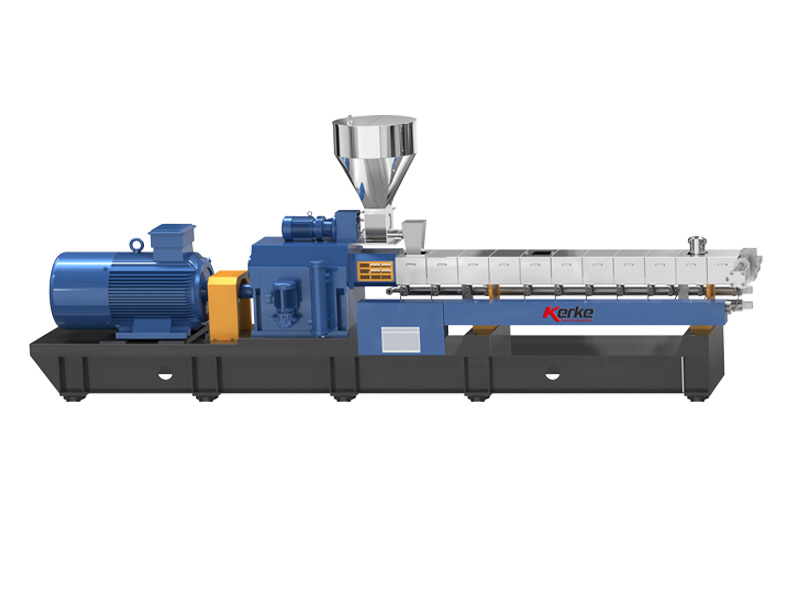
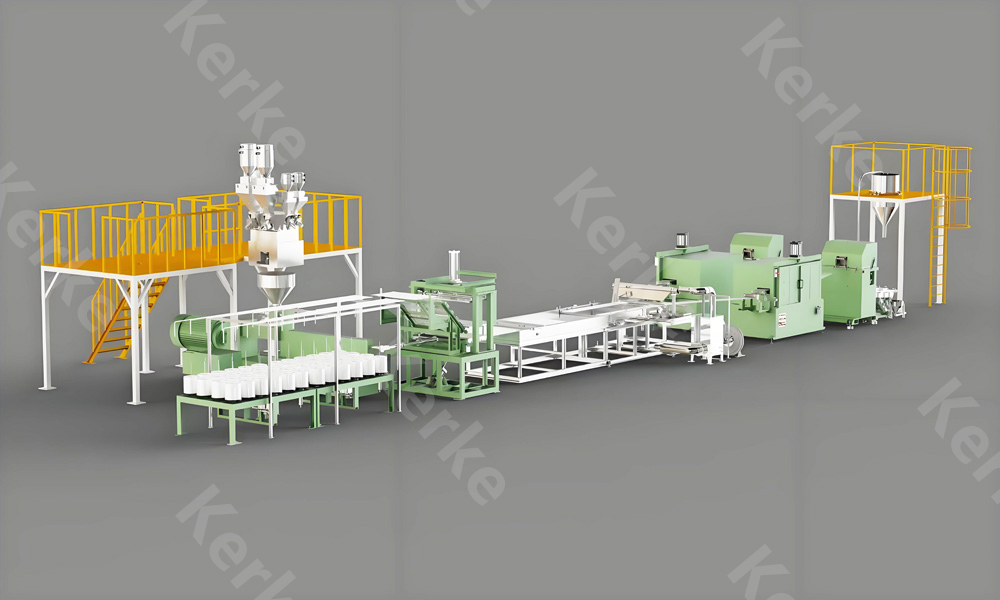
Kerke is a professional R&D and manufacturing enterprise focusing on twin screw extruders, masterbatch extruders, and compounding extruders, with rich technical accumulation and practical experience in carbon black black masterbatch production. Aiming at the characteristics of carbon black’s easy agglomeration, difficult dispersion, and high processing precision requirements, Kerke’s series extrusion equipment adopts optimized shear screw combination, high-precision segmented temperature control, stable quantitative feeding system, and high-efficiency vacuum exhaust structure, which can fully break pigment agglomerates, realize uniform dispersion of high-concentration carbon black, and stably produce high-blackness, high-consistency black masterbatch. The following is the detailed introduction and cost performance analysis of Kerke’s core applicable models.
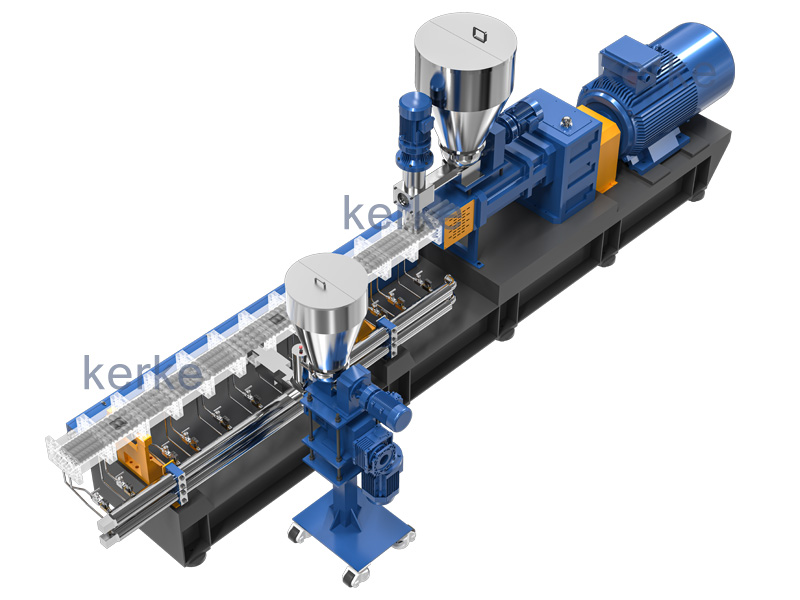
5.1 Kerke Laboratory Twin Screw Extruder for Formula R&D and Small Batch Production
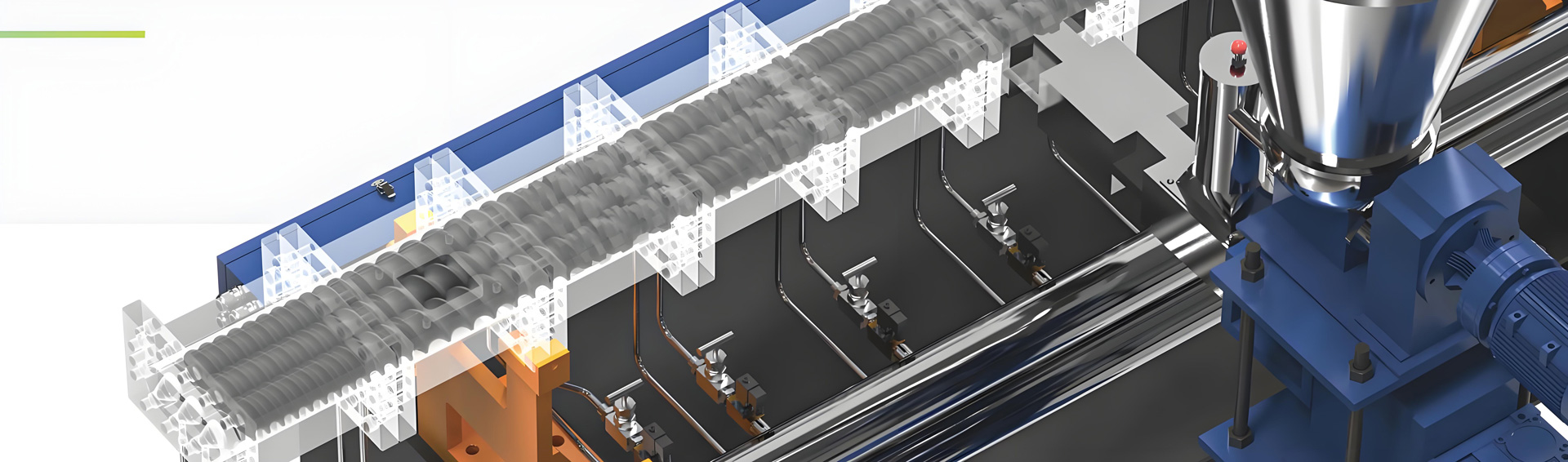
This laboratory twin screw extruder is specially developed for carbon black masterbatch formula testing, new product R&D, and small-batch customized production. It adopts parallel co-rotating twin screw structure with freely combined screw elements, which can flexibly adjust shear strength and mixing intensity according to different carbon black concentrations and formula systems, avoiding pigment decomposition and re-agglomeration. The equipment is equipped with a high-precision segmented temperature control system with a control accuracy of ±1℃, which can accurately match the narrow processing temperature window of carbon black masterbatch, effectively preventing high-temperature oxidation and low-temperature incomplete melting defects.
Equipped with a micro quantitative feeding device, it realizes stable and uniform feeding of ultra-fine carbon black powder and auxiliary materials, ensuring accurate formula ratio and consistent product performance for each test batch. The compact structure supports flexible parameter adjustment and fast formula iteration, which is very suitable for masterbatch enterprises to carry out new product development and small-batch high-end customized orders. The 2026 FOB price of this laboratory twin screw extruder ranges from $19,000 to $23,500. The annual operation and maintenance cost is controlled at $850 to $1,300, mainly including screw wear detection, temperature calibration, and daily lubrication maintenance, with low trial production cost and high R&D efficiency.
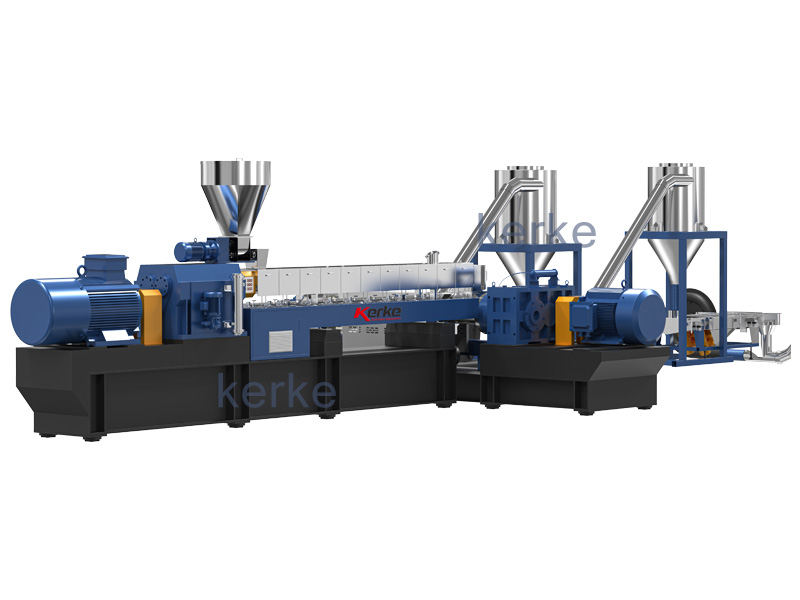
5.2 Kerke Standard Masterbatch Extruder for Mass Production of Conventional Black Masterbatch
Kerke standard masterbatch extruder is a special customized model for large-scale mass production of general and industrial-grade carbon black masterbatch, optimized for high-concentration carbon black compounding process characteristics. The equipment adopts an enhanced shear and gradual mixing screw combination design, which can fully break nano and micron carbon black agglomerates in the melting stage, realize uniform dispersion of high-content carbon black in the carrier resin, and significantly improve masterbatch blackness, tinting strength, and color uniformity. The independent high-power vacuum exhaust system thoroughly removes moisture, volatile impurities, and air bubbles in raw materials, eliminating product surface pits, color spots, and gray tone defects.
This masterbatch extruder supports 24-hour continuous stable operation, with high production efficiency and ultra-stable batch quality consistency, fully adapting to mass production of PE, PP, ABS, and PVC universal carbon black masterbatch. It can stably control product blackness deviation and dispersion grade within industry high-standard ranges. The 2026 FOB price of this standard model ranges from $33,000 to $39,500. Compared with ordinary mixed extruders, it reduces the product unqualified rate caused by poor dispersion by more than 80%, saving a large amount of raw material waste and reprocessing costs for enterprises. The annual comprehensive maintenance cost is about $1,600 to $2,100, with low long-term operating cost and outstanding cost performance for medium and large-scale mass production lines.
5.3 Kerke High-End Compounding Extruder for High-Purity Black Masterbatch
Kerke high-end compounding extruder is oriented to high-standard production scenarios such as high-gloss automotive black parts, electronic appliance casings, food-grade packaging materials, and outdoor weather-resistant plastic products. The equipment adopts anti-pollution high-wear alloy screw and barrel, which avoids metal impurity precipitation causing masterbatch blackness reduction and surface defects. The full closed-loop intelligent control system realizes automatic linkage of feeding, temperature control, screw speed, vacuum exhaust, and pelletizing speed, realizing unmanned precise production.
The optimized multi-stage low-shear uniform mixing structure ensures full dispersion of high-concentration carbon black without pigment oxidation and decomposition, maximizing the retention of pigment blackness and weather resistance. The finished masterbatch features ultra-high pure black tone, no color spots, excellent dispersion, and zero batch color difference, fully meeting high-end market product standards. The 2026 FOB price of this high-end compounding extruder ranges from $46,500 to $53,800. Although the initial equipment investment is relatively high, it helps enterprises produce high-value-added high-end black masterbatch products, greatly improving product profit margins and market competitiveness. The equipment has an extremely low annual failure rate, with annual maintenance cost stably controlled below $2,600, bringing excellent long-term comprehensive economic benefits.
6. Complete Quality Control System for Carbon Black Masterbatch Production
6.1 Strict Raw Material Incoming Inspection
Establish a standardized raw material incoming inspection mechanism to strictly screen carbon black pigments, carrier resins, and auxiliary additives. Test the particle size distribution, specific surface area, purity, and tinting strength of carbon black raw materials to eliminate low-purity, high-impurity, and inferior pigments with unstable coloring performance. Inspect the melting index, compatibility, and purity of carrier resins to ensure matching with downstream product application scenarios. Verify the high-temperature resistance, dispersion activity, and stability of dispersants and stabilizers to avoid auxiliary failure causing product quality defects. Only raw materials that pass all performance tests can be put into production.
6.2 Full-Process Online Production Monitoring
Realize real-time full-process monitoring of extrusion compounding production. Regularly calibrate the segmented temperature control system of the twin screw extruder and masterbatch extruder to ensure stable temperature in each processing section and avoid quality problems caused by local overheating or insufficient melting. Monitor the feeding speed and material uniformity in real time to prevent formula ratio deviation caused by unstable feeding. Observe the melting state, material fluidity, and exhaust effect of molten materials during operation, adjust screw speed and process parameters in time to ensure full mixing and uniform dispersion of carbon black and resin. Conduct regular sampling and testing of semi-finished products to track real-time changes in blackness and dispersion performance.
6.3 Finished Product Standard Testing
After pelletizing and drying, all finished carbon black masterbatch must undergo comprehensive performance testing before delivery. Use a professional color difference meter to test Lab color values, blackness, and tone uniformity of each batch of products. Adopt microscope grading method and filter pressure value method to detect pigment dispersion grade to ensure no agglomeration defects. Test carbon black content by thermogravimetric analysis to confirm formula concentration compliance. Conduct high-temperature aging test and ultraviolet weather resistance test to verify long-term product stability. All products that meet industry standards can be packaged and delivered, and unqualified products will be reprocessed uniformly.
6.4 Batch Consistency and Traceability Management
Unify production process parameters and equipment operating standards for each batch of carbon black masterbatch to eliminate quality deviation caused by random parameter adjustment. Establish complete batch production files, including raw material batch information, equipment operation parameters, production time, and finished product test data, realizing full-process quality traceability. Regularly compare and analyze quality data of different batches, continuously optimize formulas and process parameters, and improve the overall stability and consistency of masterbatch products.
6.5 Standardized Storage and Transportation Control
Finished carbon black masterbatch needs to be stored in a dry, constant-temperature, dust-free warehouse environment to avoid moisture absorption, dust pollution, and high-temperature aging. Adopt sealed moisture-proof packaging to prevent carbon black pigment re-agglomeration and additive precipitation caused by long-term air contact. Avoid high-temperature exposure and severe extrusion during transportation to ensure that the particle integrity, fluidity, and coloring performance of finished products remain unchanged, ensuring stable quality for downstream customer processing.
7. Common Quality Defects, Causes and Solutions of Carbon Black Masterbatch
7.1 Insufficient Blackness and Grayish Tone
Insufficient blackness and grayish tone are the most common quality defects of carbon black masterbatch, mainly caused by low-grade carbon black raw materials, insufficient pigment addition ratio, excessive extrusion temperature leading to carbon black oxidation decomposition, and poor pigment dispersion. The targeted solutions include replacing high-purity high-tinting-strength carbon black pigments, optimizing formula proportion to ensure effective pigment content, refining extrusion temperature parameters to avoid overheating oxidation, and adopting high-shear Kerke twin screw extruders to strengthen pigment dispersion and release maximum coloring activity.
7.2 Poor Dispersion and Surface Color Spots
Product color spots, particle protrusions, and uneven coloring are caused by incomplete breaking of carbon black agglomerates, unreasonable screw shear configuration, unstable feeding, and insufficient pre-dispersion of raw materials. The improvement measures include upgrading professional masterbatch compounding extruders, optimizing screw shear and mixing combination to adapt to carbon black dispersion characteristics, stabilizing quantitative feeding accuracy, adding high-efficiency special dispersants, and implementing raw material pre-dispersion treatment before production to eliminate pigment agglomerates from the source.
7.3 Low Tinting Strength and Poor Covering Power
Low tinting strength and insufficient background covering power result from incomplete pigment dispersion, damaged carbon black activity due to high-temperature processing, and unreasonable formula matching. Enterprises can solve this problem by adjusting extrusion process parameters to optimize dispersion effect, reducing excessive processing temperature to protect pigment activity, optimizing the ratio of dispersants and lubricants to enhance pigment wetting performance, and screening low-activity raw materials to ensure stable tinting performance of each batch of masterbatch.
7.4 Poor Weather Resistance and Easy Fading
Finished plastic products fade, chalk, and age quickly after outdoor use, mainly due to the use of low weather resistance carbon black raw materials, insufficient anti-aging additives, and high-temperature decomposition of functional components during extrusion. The solutions are to select high weather resistance carbon black pigments, optimize the anti-aging and UV-resistant auxiliary formula, strictly control extrusion processing temperature to retain additive activity, and use high-precision compounding extruders to ensure uniform distribution of functional components in the resin matrix.
7.5 Obvious Batch Color Difference
Batch quality deviation and inconsistent black tone are caused by unstable equipment operation parameters, inconsistent raw material batches, and imperfect process management. Standardize production parameter files, unify raw material supply standards, adopt Kerke intelligent automatic extrusion equipment to eliminate manual parameter adjustment errors, and strengthen batch sampling detection and data comparison to completely solve batch color difference defects.
8. High-Quality Production Optimization Strategies for Carbon Black Masterbatch
8.1 Targeted Formula Optimization
Formulate differentiated formula systems according to different product application scenarios. For ordinary indoor low-demand products, balance formula cost and basic coloring performance to realize economical production; for high-end outdoor, automotive, and electronic products, select high-purity super-fine carbon black, high weather resistance additives, and high-compatibility carrier resins to maximize product performance. Optimize the proportion of dispersants and lubricants to ensure both excellent dispersion effect and good processing fluidity, avoiding excessive additives affecting product mechanical properties and surface gloss.
8.2 Precision Extrusion Process Tuning
Establish segmented gradient temperature control standards suitable for carbon black masterbatch compounding. Set low temperature for feeding section to prevent powder bridging and material decomposition, medium temperature for melting section to ensure full resin melting and pigment wetting, and constant temperature for mixing and extrusion section to stabilize material fluidity. Reasonably match screw speed and feeding speed to form stable shear mixing state, avoid local material retention and overheating, and ensure consistent processing quality of each batch of materials.
8.3 Professional Equipment Upgrade and Intelligent Production
Eliminate ordinary single screw extruders with insufficient shear and mixing capacity, and upgrade to Kerke professional twin screw extruders, masterbatch extruders, and compounding extruders. Rely on equipment’s high-precision temperature control, stable quantitative feeding system, efficient shear mixing structure, and intelligent parameter management function to fundamentally solve common quality problems such as poor dispersion, insufficient blackness, and unstable batch quality. Store mature process formulas through intelligent systems to realize one-click parameter calling and standardized production, reducing human error.
8.4 Full-Cycle Quality Management System
Build a closed-loop full-cycle quality management system covering raw material inspection, process monitoring, finished product testing, batch traceability, and after-sales feedback. Standardize operator operating procedures through regular professional training to avoid human operation errors. Establish regular equipment maintenance and calibration mechanisms to ensure long-term stable and high-precision operation of extrusion equipment. Continuously optimize production formulas and process schemes based on market feedback and product usage data to continuously improve the comprehensive quality of carbon black masterbatch.
9. Conclusion
Carbon black black masterbatch is an indispensable core functional coloring material in the plastic processing industry, and its blackness, dispersion, tinting strength, and weather resistance directly determine the appearance quality and service life of downstream plastic products. Product quality defects such as insufficient blackness, color spots, poor weather resistance, and batch color difference are mainly caused by unreasonable formulas, backward processing technology, and insufficient extrusion equipment performance. Scientific formula matching, precise process control, and high-performance professional extrusion equipment are the three core elements of high-quality carbon black masterbatch production.
Kerke series twin screw extruders, masterbatch extruders, and compounding extruders are professionally optimized for the processing characteristics of carbon black masterbatch, which can effectively solve the industry pain points of difficult carbon black dispersion, easy pigment agglomeration, and unstable batch quality. With efficient shear mixing performance, high-precision intelligent control, and stable continuous operation capacity, Kerke equipment helps masterbatch enterprises achieve high-efficiency, low-cost, and high-standard carbon black masterbatch production. Combined with a complete set of standardized quality control systems, enterprises can significantly improve product market competitiveness, stabilize product quality consistency, and obtain better economic benefits in the fiercely competitive masterbatch market.