1. Introduction to TiO2 White Masterbatch in Plastic Compounding
TiO2 white masterbatch is one of the most widely used color masterbatch materials in the global plastic manufacturing industry, serving as the core whitening and opacifying additive for plastic extrusion, injection molding, blow molding, and film production processes. Formulated with high-purity titanium dioxide powder as the main functional pigment, coupled with carrier resin, dispersing agents, lubricants, and auxiliary processing additives, TiO2 white masterbatch delivers excellent whitening power, hiding power, color stability, and weather resistance for various plastic products. Compared with direct titanium dioxide powder feeding in plastic processing, masterbatch-form TiO2 features better dispersion performance, lower dust pollution, higher utilization rate, and more stable finished product color consistency, making it the mainstream whitening solution for modern high-standard plastic production.
In industrial production scenarios including packaging films, plastic profiles, household appliances, automotive plastic parts, and daily plastic products, the whitening performance of TiO2 masterbatch directly determines the appearance quality, market grade, and service life of final plastic products. Unstable whitening effect, insufficient hiding power, uneven color dispersion, and poor weather resistance are the most common quality defects in mass production, which will lead to batch product unqualified problems and increase enterprise production costs. Therefore, in-depth understanding of TiO2 masterbatch whitening mechanism, key performance indicators, influencing factors, and standardized quality control systems is essential for plastic compounding manufacturers to stabilize product quality and improve market competitiveness.
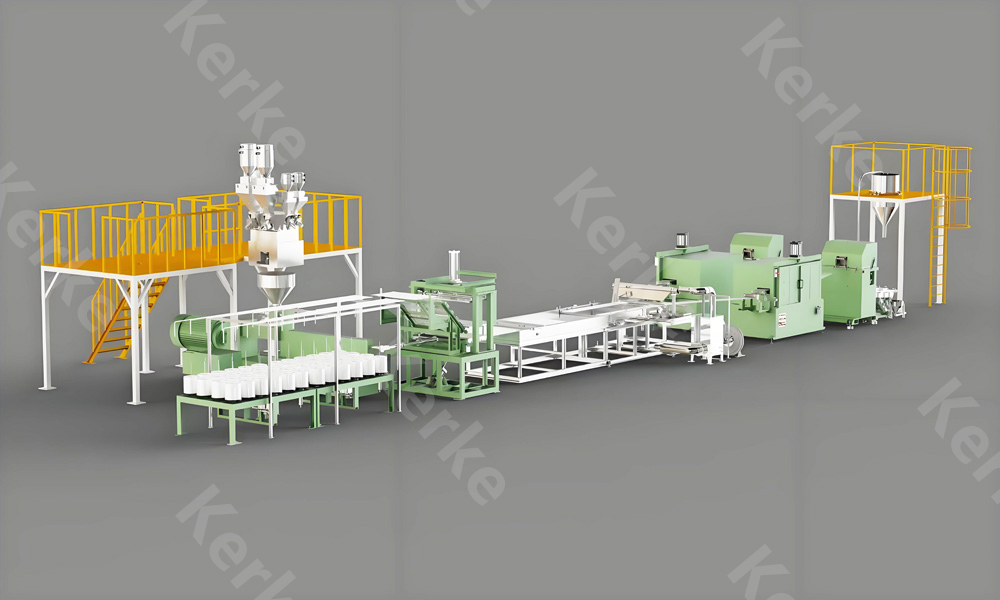
The production quality of high-performance TiO2 white masterbatch is closely related to compounding extrusion equipment performance. Professional twin screw extruders, masterbatch dedicated extruders, and plastic compounding extruders are the core equipment that determines masterbatch dispersion uniformity, pigment activity retention, and formula stability. Kerke, as a professional manufacturer of high-precision plastic compounding extrusion equipment, provides full-series twin screw extruder and masterbatch extrusion solutions tailored for TiO2 white masterbatch production, solving common industry pain points such as poor dispersion, low whitening efficiency, and unstable batch quality, helping enterprises achieve standardized and high-efficiency masterbatch production.
2. Basic Composition and Whitening Mechanism of TiO2 White Masterbatch
2.1 Core Raw Material Composition
A standard high-quality TiO2 white masterbatch consists of three core components: functional pigment, carrier resin, and processing auxiliary agents. The functional pigment is rutile titanium dioxide powder, which accounts for 40% to 70% of the total formula proportion and undertakes the main whitening and opacifying functions. Rutile TiO2 is preferred over anatase TiO2 for industrial plastic masterbatch production due to its higher refractive index, stronger ultraviolet resistance, better weather resistance, and higher coloring strength, which can ensure long-term stable whitening effect of plastic products.
The carrier resin is selected according to the application scenario of the final plastic products, including PE, PP, ABS, PET, and PVC carrier materials. The carrier resin needs to have good compatibility with the base plastic of finished products to avoid delamination, blooming, and color difference defects. Dispersing agents and lubricants are key auxiliary components, which can break TiO2 powder agglomerates, promote uniform pigment dispersion in molten resin, reduce internal friction during extrusion processing, and improve masterbatch molding fluidity and surface smoothness.
2.2 Optical Whitening and Opacifying Mechanism
The excellent whitening performance of TiO2 white masterbatch originates from the high refractive index characteristics of titanium dioxide particles. Rutile TiO2 has a refractive index of 2.71, which is far higher than that of ordinary plastic resin materials ranging from 1.45 to 1.55. When evenly dispersed in plastic substrates, TiO2 particles form a large number of light refraction and reflection interfaces inside the material, which can fully reflect visible light of all bands, presenting a pure white visual effect on the product surface.
In addition to light reflection whitening, TiO2 particles also have strong light scattering and shielding capabilities. They can effectively shield the background color of plastic substrates, cover the yellowish background of raw materials and internal impurity colors, and achieve uniform and pure white appearance of finished products. At the same time, TiO2 can absorb ultraviolet light, avoid plastic aging and yellowing caused by ultraviolet radiation, and maintain long-term whitening stability of outdoor plastic products.
2.3 Key Differences Between Rutile and Anatase TiO2 Masterbatch
Rutile TiO2 white masterbatch has higher coloring strength and hiding power, with pure blue-phase white tone, which can neutralize the yellowish tendency of plastic products and improve the bright white visual effect. It features excellent weather resistance and aging resistance, suitable for outdoor plastic products, automotive plastics, and long-service-life plastic materials. Anatase TiO2 masterbatch has low cost but weak weather resistance, easy powder falling and yellowing after long-term use, and is only suitable for low-end indoor disposable plastic products. High-standard industrial production almost adopts rutile TiO2 formula to ensure stable product quality.
3. Core Whitening Performance Indicators of TiO2 White Masterbatch
3.1 Whiteness and Hue Uniformity
Whiteness is the most intuitive performance indicator of TiO2 white masterbatch, usually tested by CIE Lab color measurement system, including L value, a value, and b value. The L value represents brightness, with a higher value indicating higher product whiteness; the b value represents yellow-blue phase, and a negative b value indicates blue-phase pure white, which is the optimal tone for high-quality white plastic products. Qualified high-grade TiO2 white masterbatch needs to maintain stable Lab value in different production batches, with whiteness deviation controlled within a tiny range to avoid batch color difference.
Hue uniformity refers to the consistent white tone of masterbatch in different particle positions and different batches. Poor dispersion caused by unreasonable extrusion processing will lead to local pigment aggregation, resulting in inconsistent surface whiteness, color spots, and partial yellowing of finished products, seriously affecting product appearance grade.
3.2 Hiding Power and Coloring Strength
Hiding power refers to the ability of TiO2 masterbatch to cover the background color of plastic substrates, which determines the minimum addition ratio of masterbatch in production. High hiding power masterbatch can achieve full background coverage with a low addition amount of 1% to 3%, reducing raw material costs while ensuring uniform white color. Coloring strength reflects the pigment activity and effective utilization rate of TiO2 masterbatch. High-quality masterbatch with sufficient dispersion treatment has high coloring strength, no pigment waste, and stable color development effect.
Insufficient hiding power is mainly caused by incomplete dispersion of TiO2 powder and excessive pigment agglomeration. Undispersed pigment aggregates cannot form effective light reflection interfaces, resulting in reduced whitening efficiency and increased masterbatch dosage in actual production.
3.3 Dispersion Performance
Dispersion performance is the core technical indicator that determines the comprehensive quality of TiO2 white masterbatch. Uniformly dispersed TiO2 particles exist in single particle state inside the masterbatch, which can give full play to whitening and hiding performance. Poor dispersion will form micron-level pigment agglomerates, leading to surface particle protrusions, white spots, and poor smoothness of finished plastic products. In severe cases, it will cause mold blockage and screen mesh blockage during product processing, affecting production continuity.
The dispersion effect of masterbatch is mainly determined by compounding extrusion equipment performance and process parameter matching. High-precision twin screw extruders can realize strong shearing and uniform mixing of pigments and resins, fully breaking powder agglomerates, which is the key equipment to ensure excellent dispersion of TiO2 masterbatch.
3.4 Weather Resistance and Anti-Yellowing Performance
Weather resistance determines the long-term whitening stability of white plastic products in natural environments such as sunlight, high temperature, and humidity. High-quality rutile TiO2 masterbatch can effectively isolate ultraviolet radiation, inhibit plastic molecular aging and degradation, and avoid product yellowing, fading, and discoloration. Low-quality masterbatch with impure raw materials or insufficient processing treatment is prone to accelerated aging and yellowing after outdoor use, greatly shortening product service life.
3.5 Processing Fluidity and Compatibility
Excellent fluidity ensures that TiO2 masterbatch can be evenly mixed with base resin during secondary processing, with fast melting and uniform color development. Good compatibility means no chemical reaction between masterbatch and base resin, no blooming, precipitation, or surface frosting defects. Masterbatch with poor fluidity and compatibility will cause uneven local color, material stratification, and reduced product surface gloss.
4. Main Factors Affecting TiO2 Masterbatch Whitening Quality
4.1 Raw Material Grade and Formula Ratio
The purity and particle size distribution of titanium dioxide powder directly affect the basic whitening performance of masterbatch. High-purity rutile TiO2 with uniform particle size distribution has stable light reflection performance and uniform color development. Impure TiO2 raw materials contain iron oxide, silicon dioxide, and other impurity components, which will cause yellowish tone and reduced whiteness of masterbatch. In addition, unreasonable matching ratio of pigment, carrier, and additives will lead to insufficient dispersion or excessive lubrication, affecting whitening effect and processing performance.
4.2 Extrusion Compounding Processing Technology
Extrusion compounding is the core process of masterbatch production, and process parameters directly determine pigment dispersion uniformity and formula stability. Too low extrusion temperature leads to incomplete resin melting, insufficient pigment wetting, and poor dispersion effect; too high temperature will cause additive decomposition and TiO2 pigment activity attenuation, reducing whitening efficiency and causing yellowing. Unreasonable screw speed and feeding speed will lead to uneven material shearing, local overheating, and inconsistent batch quality.
4.3 Extrusion Equipment Precision and Performance
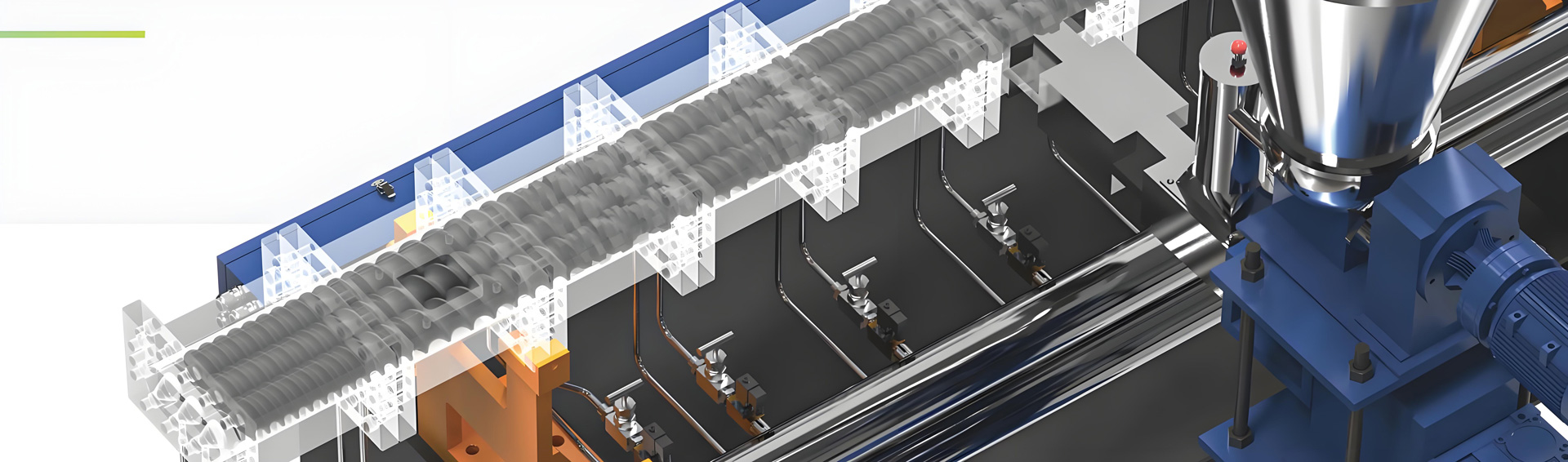
Ordinary single screw extruders have weak shearing and mixing capacity, which cannot fully break TiO2 powder agglomerates, resulting in poor masterbatch dispersion and unstable whitening effect. Professional twin screw compounding extruders have strong forced mixing and high-shear dispersion capacity, which can realize uniform mixing of high-concentration pigments and resins, fully release pigment activity, and maximize whitening performance. Equipment precision, screw configuration, temperature control accuracy, and feeding uniformity all affect the final masterbatch quality.
4.4 Post-Processing and Storage Environment
Improper cooling, pelletizing, and drying processes after extrusion will cause masterbatch surface moisture, particle adhesion, and internal residual stress, affecting secondary processing fluidity and color uniformity. Long-term storage in high temperature and high humidity environment will cause masterbatch moisture absorption, additive precipitation, and pigment partial agglomeration, leading to decreased whitening performance and product color difference in subsequent use.
5. Kerke Professional Extrusion Equipment for TiO2 White Masterbatch Production
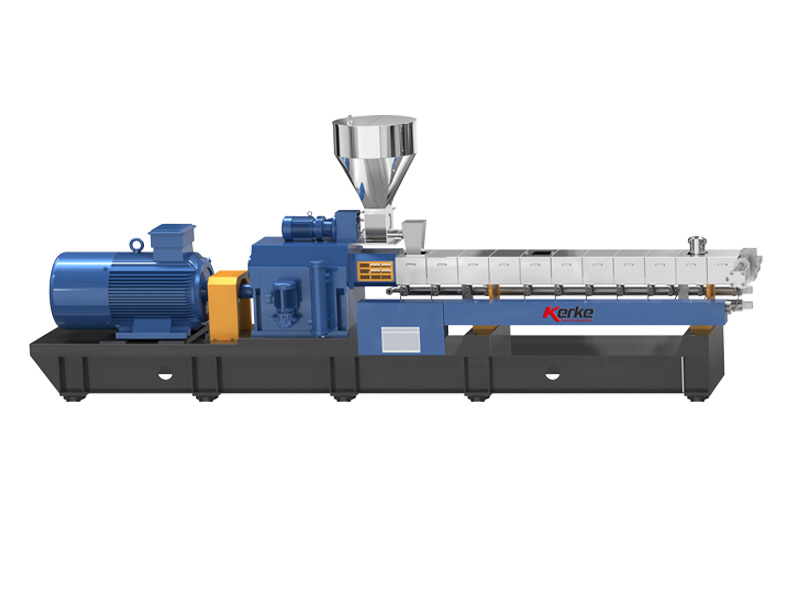
Kerke focuses on the research and development and manufacturing of twin screw extruders, masterbatch extruders, and plastic compounding extruders, providing targeted high-efficiency production equipment solutions for TiO2 white masterbatch manufacturing. Aiming at the industry pain points of easy pigment agglomeration, insufficient dispersion, unstable whitening performance, and low batch consistency in masterbatch production, Kerke’s full-series compounding extrusion equipment adopts optimized screw combination, precise segmented temperature control, uniform feeding system, and high-efficiency mixing structure, which can fully release TiO2 pigment whitening activity, ensure uniform dispersion, and stabilize finished product quality. The following is the detailed introduction and cost analysis of Kerke’s core applicable models.
5.1 Kerke Small Batch Twin Screw Extruder for Laboratory and Pilot Production
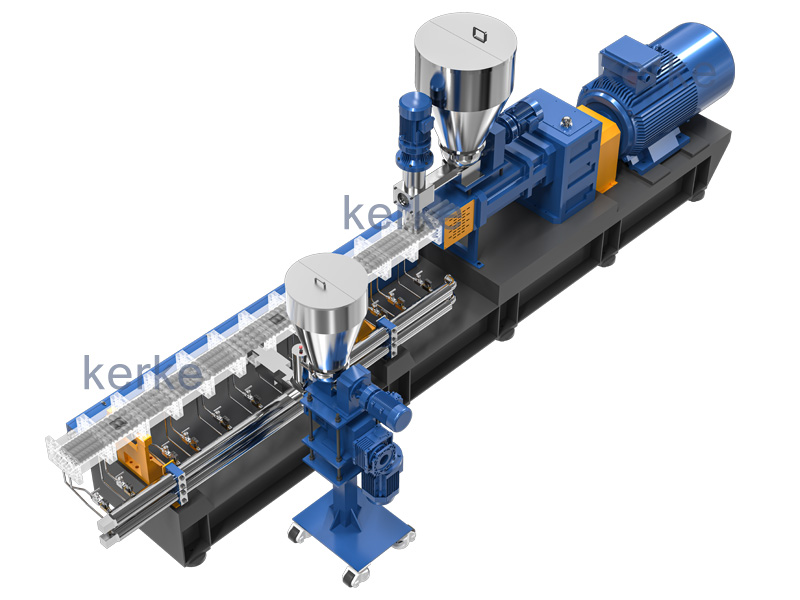
This small twin screw extruder model is specially designed for TiO2 masterbatch formula research and development, laboratory testing, and small-batch trial production. It adopts parallel twin screw structure with customizable screw elements, which can adjust shearing and mixing intensity according to different TiO2 formula concentrations to avoid pigment decomposition and agglomeration. The equipment is equipped with high-precision segmented temperature control system, with temperature control accuracy up to ±1℃, which can precisely match the melting and processing temperature requirements of white masterbatch formula, effectively preventing high-temperature yellowing and additive failure.
Equipped with quantitative micro-feeding device, it realizes uniform and stable feeding of TiO2 powder and auxiliary materials, ensuring consistent formula ratio of each batch of masterbatch and stable whitening performance. The whole machine has compact structure, low energy consumption, and convenient parameter adjustment, which is very suitable for masterbatch enterprises to carry out new formula development and small-batch customized production. The 2026 FOB price of this laboratory twin screw extruder ranges from $18,000 to $22,000. The annual operating and maintenance cost is controlled at about $800 to $1,200, mainly including screw wear inspection, temperature calibration, and daily lubrication maintenance, with extremely low trial production cost and high formula verification efficiency.
5.2 Kerke Standard Masterbatch Extruder for Medium-Scale Mass Production
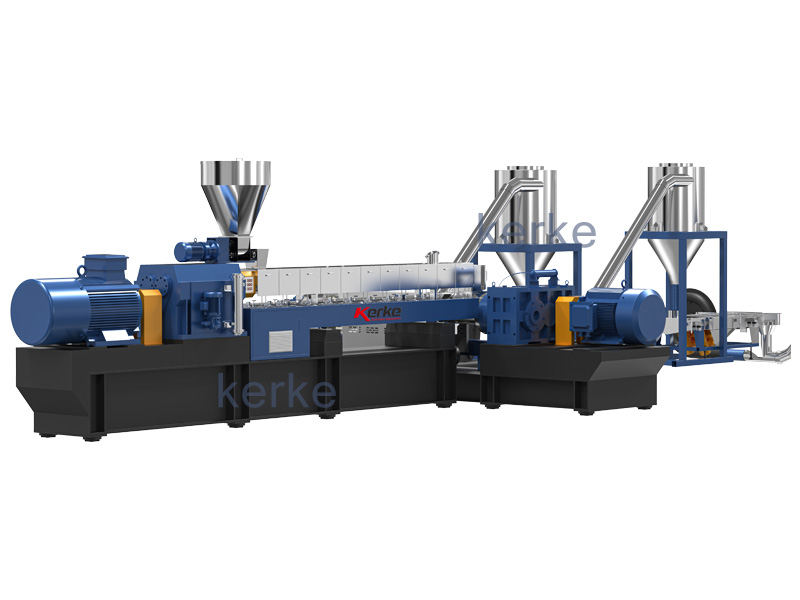
Kerke standard masterbatch extruder is a special customized model for mass production of conventional TiO2 white masterbatch, optimized for high-concentration titanium dioxide pigment compounding process. The equipment adopts enhanced shear screw combination design, which can fully break nano and micron TiO2 powder agglomerates, realize uniform dispersion of high-content pigments in carrier resin, and significantly improve masterbatch whiteness, hiding power, and color uniformity. The independent vacuum exhaust system effectively removes moisture and volatile impurities in raw materials, avoiding product surface bubbles, color spots, and yellowing defects.
This masterbatch dedicated extruder supports continuous 24-hour stable operation, with high production efficiency and stable batch quality consistency. It is suitable for mass production of PE, PP, ABS universal TiO2 white masterbatch, and can stably control product whiteness deviation within professional industry standards. The FOB price of this standard model ranges from $32,000 to $38,000. Compared with ordinary mixed extruders, it reduces the product unqualified rate caused by poor dispersion by more than 85%, greatly saving raw material waste and reprocessing costs. The annual comprehensive maintenance cost is about $1,500 to $2,000, with low long-term operating cost and significant cost-performance advantages for medium-scale masterbatch production lines.
5.3 Kerke High-End Compounding Extruder for High-Purity White Masterbatch
Kerke high-end compounding extruder is oriented to high-standard high-purity TiO2 white masterbatch production scenarios such as food-grade packaging materials, medical plastic products, and high-gloss household appliance plastics. The equipment adopts high-precision alloy screw and barrel with anti-pollution and anti-wear treatment, which avoids metal impurity precipitation causing masterbatch color pollution and whiteness reduction. The full closed-loop automatic control system realizes intelligent linkage of feeding, temperature control, screw speed, and pelletizing speed, realizing unmanned stable production.
The optimized multi-stage mixing and gradual shearing structure ensures that high-concentration TiO2 pigments are fully dispersed without high-temperature decomposition, maximizing the retention of pigment whitening activity and weather resistance. The finished masterbatch has pure blue-phase white tone, excellent dispersion, high hiding power, and ultra-low batch color difference, fully meeting high-end market product standards. The FOB price of this high-end compounding extruder ranges from $45,000 to $52,000. Although the initial equipment investment is high, it can help enterprises produce high-value-added high-end white masterbatch products, significantly improving product profit margins. The annual failure rate is extremely low, and the annual maintenance cost is stably controlled below $2,500, with excellent long-term comprehensive economic benefits.
6. Systematic Quality Control Standards for TiO2 White Masterbatch Production
6.1 Raw Material Incoming Inspection Control
Establish strict raw material incoming inspection system to screen qualified TiO2 powder, carrier resin, and auxiliary materials. Test the whiteness, particle size distribution, impurity content, and coloring strength of titanium dioxide raw materials to eliminate unqualified pigments with low purity and yellowish tone. Inspect the compatibility and melting index of carrier resin to ensure matching with product application scenarios. Verify the purity and high-temperature resistance of dispersing agents and lubricants to avoid auxiliary decomposition causing masterbatch quality defects. Only raw materials that pass all inspection indicators can be put into production.
6.2 Online Production Process Quality Monitoring
Realize full-process monitoring of extrusion compounding production process. Regularly check and calibrate equipment temperature control system to ensure stable segmented temperature and avoid local overheating yellowing or insufficient melting. Monitor feeding uniformity in real time to prevent formula ratio deviation caused by unstable feeding speed. Observe the melting state and material fluidity of molten materials during extrusion, adjust screw speed and process parameters in time to ensure full mixing and uniform dispersion of pigments. Regularly sample and test semi-finished products to track real-time changes in whiteness and dispersion performance.
6.3 Finished Product Routine Testing Standards
After masterbatch pelletizing and drying, conduct comprehensive performance testing of finished products. Use professional color difference instrument to test Lab color value, whiteness, and hue uniformity of each batch of products. Carry out dispersion performance test to observe whether there are pigment agglomerates and color spots in the product. Test hiding power and coloring strength to verify masterbatch whitening efficiency. Conduct high-temperature aging test and weather resistance test to ensure long-term color stability. All products that meet the standard indicators can be packaged and delivered, and unqualified products need to be reprocessed and rectified in time.
6.4 Batch Consistency and Traceability Management
Unify production process parameters and equipment operating standards for each batch of TiO2 masterbatch to avoid quality deviation caused by parameter adjustment chaos. Establish batch production records, including raw material batch information, equipment operating parameters, production time, and testing data, to realize full-process product quality traceability. Regularly compare and analyze quality data of different batches, optimize production formulas and process parameters continuously, and improve the overall stability of masterbatch whitening quality.
6.5 Finished Product Storage and Transportation Quality Control
Store finished TiO2 white masterbatch in dry, constant temperature, and dust-free warehouse environment to avoid moisture absorption, dust pollution, and high-temperature aging. Adopt sealed packaging to prevent additive precipitation and pigment agglomeration caused by long-term air contact. Avoid extrusion and high-temperature exposure during transportation to ensure that the whitening performance and particle state of finished products are not affected, ensuring stable quality when customers use the products.
7. Common Whitening Quality Defects and Solutions of TiO2 Masterbatch
7.1 Insufficient Whiteness and Yellowish Tone
Insufficient whiteness and yellowish background tone are the most common quality defects, mainly caused by low-purity TiO2 raw materials, excessive processing temperature leading to pigment aging and decomposition, insufficient pigment addition ratio, and poor dispersion. The solutions include replacing high-purity rutile titanium dioxide raw materials, optimizing extrusion temperature parameters to avoid overheating, appropriately adjusting formula pigment proportion, and using high-shear twin screw extruder to strengthen pigment dispersion and release whitening activity.
7.2 Uneven Dispersion and Local Color Spots
Uneven dispersion and surface color spots are caused by insufficient equipment shearing capacity, unreasonable screw configuration, unstable feeding, and agglomeration of raw material powder. The improvement measures are to upgrade professional masterbatch compounding extruder, optimize screw shearing and mixing combination, stabilize quantitative feeding, add high-efficiency dispersing agents, and pre-disperse raw materials before production to eliminate powder agglomerates.
7.3 Poor Hiding Power and Low Coloring Efficiency
Low hiding power is mainly due to incomplete pigment dispersion, single particle failure to fully expand light reflection area, and unreasonable formula matching. It can be solved by adjusting extrusion process parameters to improve dispersion effect, optimizing additive ratio to enhance pigment wetting performance, and detecting and screening low-activity TiO2 raw materials to ensure high coloring strength of masterbatch.
7.4 Poor Weather Resistance and Easy Yellowing After Use
Short service life and easy yellowing of products are caused by the use of anatase TiO2 raw materials, insufficient ultraviolet resistance of formula, and high-temperature decomposition of functional additives. The solutions are to fully adopt rutile high weather resistance titanium dioxide, add anti-ultraviolet auxiliary agents appropriately, strictly control extrusion processing temperature to retain additive activity, and use high-precision compounding equipment to ensure uniform distribution of functional components.
7.5 Batch Color Difference and Unstable Quality
Batch quality deviation is caused by unstable equipment operating parameters, inconsistent raw material batches, and imperfect process management. Enterprises need to establish standardized production parameter files, unify raw material supply standards, adopt automatic intelligent extrusion equipment to improve parameter stability, and strengthen batch sampling detection and data comparison to eliminate batch color difference defects.
8. Optimization Strategies for High-Quality TiO2 White Masterbatch Production
8.1 Formula System Optimization
According to different product application scenarios, formulate targeted TiO2 masterbatch formula system. For ordinary indoor plastic products, balance cost and whitening performance to realize economical formula matching; for high-end outdoor and food-grade products, select high-purity rutile TiO2, high weather resistance additives, and high-compatibility carrier resins to maximize product quality. Optimize the proportion of dispersing agents and lubricants to ensure both excellent dispersion performance and good processing fluidity, avoiding excessive additives affecting product whiteness and compatibility.
8.2 Extrusion Process Parameter Fine-Tuning
Formulate segmented temperature grading standards suitable for TiO2 masterbatch compounding. Set low temperature feeding section, medium temperature melting section, and stable temperature mixing section to ensure gradual melting of resin, full wetting of pigments, and no high-temperature decomposition. Match screw speed and feeding speed reasonably to form stable material shear and mixing state, avoid material retention and local overheating, and ensure consistent processing state of each batch of materials.
8.3 Equipment Upgrade and Intelligent Production
Eliminate ordinary single screw extruders with poor mixing performance and upgrade to Kerke professional twin screw compounding extruders and masterbatch special extruders. Rely on equipment’s high-precision temperature control, stable feeding system, and high-efficiency shearing and mixing structure to fundamentally solve dispersion and quality stability problems. Realize intelligent production parameter management, store mature process formulas, avoid manual parameter adjustment errors, and improve production standardization level.
8.4 Full-Cycle Quality Management Mechanism
Build a full-cycle quality management system covering raw material inspection, process monitoring, finished product testing, and after-sales tracking. Regularly train operators to standardize operating procedures and avoid quality problems caused by human operation errors. Regularly maintain and calibrate extrusion equipment to ensure stable equipment performance and long-term high-precision operation. Continuously optimize production schemes according to market feedback and product usage data to improve the comprehensive quality of TiO2 white masterbatch.
9. Conclusion
TiO2 white masterbatch’s whitening performance and quality stability are determined by raw material formula, extrusion compounding equipment, processing technology, and standardized quality control system. Common quality defects such as insufficient whiteness, uneven dispersion, poor weather resistance, and batch color difference will seriously affect the appearance quality and market value of downstream plastic products, bringing economic losses to production enterprises. Scientific understanding of masterbatch whitening mechanism and core performance indicators is the premise of realizing high-quality production.
The selection of high-performance professional extrusion equipment is the core guarantee to improve masterbatch quality. Kerke series twin screw extruders, masterbatch extruders, and compounding extruders are professionally optimized for TiO2 white masterbatch production characteristics, which can effectively solve various quality pain points in traditional production, improve pigment dispersion efficiency and whitening performance, and stabilize batch product consistency. Combined with standardized raw material management, precise process control, and perfect quality detection system, enterprises can achieve high-efficiency, low-cost, and high-quality TiO2 white masterbatch production, effectively improving product market competitiveness and industrial production benefits.