Introduction
Barium sulfate (BaSO₄) filler masterbatch has emerged as a premium functional additive in the plastics industry, offering exceptional performance characteristics for specialized applications requiring high density, excellent surface finish, and superior gloss properties. As manufacturers seek advanced materials that combine aesthetic appeal with functional performance, barium sulfate has become an essential component in high-end plastic applications ranging from automotive components to consumer electronics housings. This comprehensive guide explores the properties, applications, production processes, and processing technologies of barium sulfate filler masterbatch, with particular focus on production using advanced twin screw extruders from Kerke Extrusion Equipment.
Barium sulfate distinguishes itself among inorganic fillers through its unique combination of high density (approximately 4.5 g/cm³), excellent X-ray opacity, superior chemical inertness, and exceptional surface finish characteristics. Barium sulfate filler masterbatch consists of high-concentration barium sulfate particles uniformly dispersed in a carrier resin matrix, enabling precise control over filler incorporation while maintaining processing efficiency. The resulting materials exhibit unmatched surface quality, high density for specialized applications, and excellent radiation shielding properties.
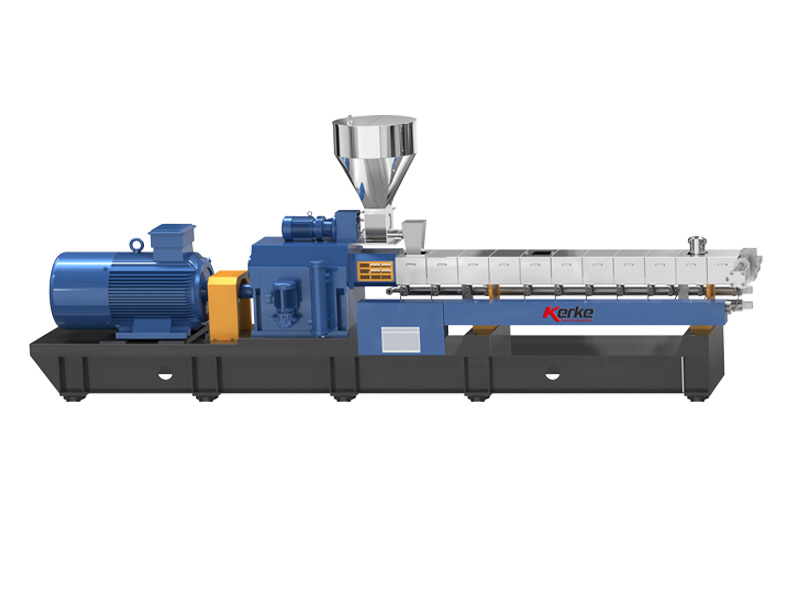
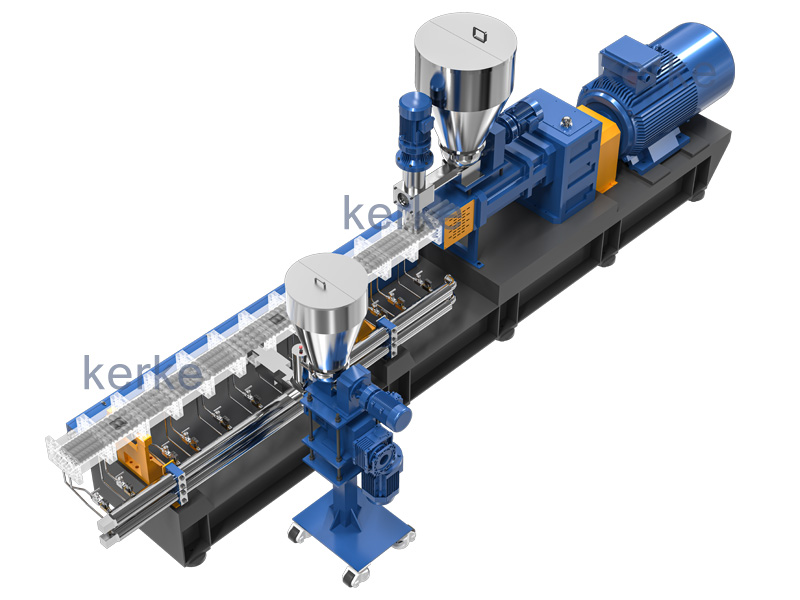
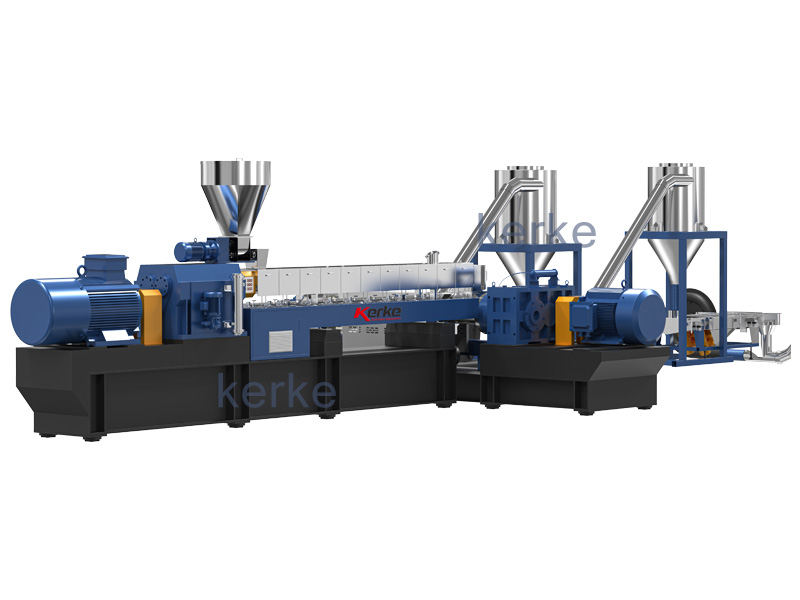
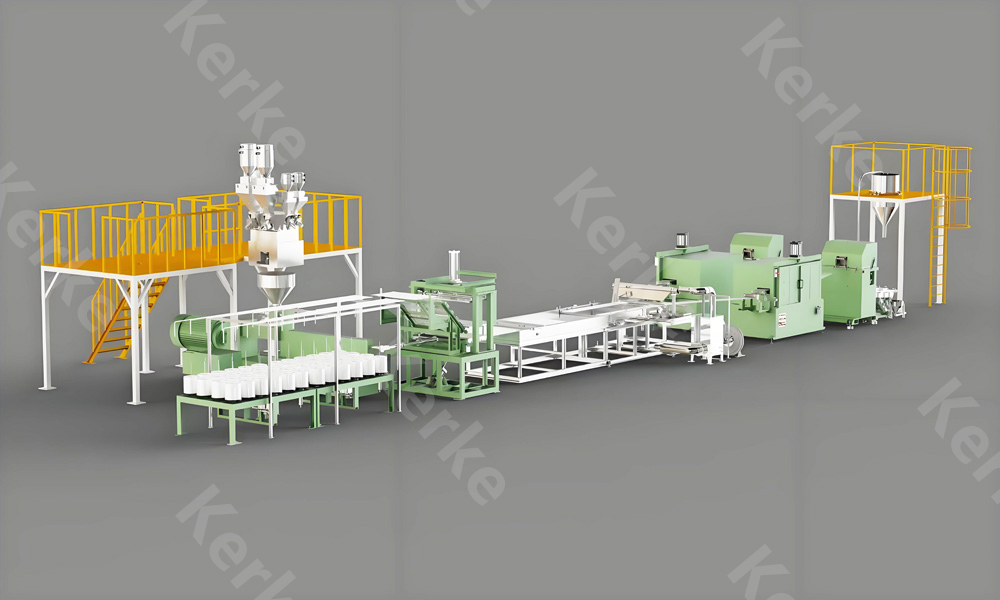
The production of barium sulfate filler masterbatch demands sophisticated processing equipment capable of achieving ultra-fine particle dispersion and maintaining surface quality. Kerke Extrusion Equipment provides state-of-the-art twin screw extruders specifically designed for barium sulfate masterbatch production, ensuring the exceptional quality required for high-end applications in automotive, electronics, and specialty consumer products.
Properties and Characteristics of Barium Sulfate Filler Masterbatch
Understanding the exceptional properties of barium sulfate filler masterbatch is essential for selecting appropriate formulations for demanding applications. The unique characteristics of barium sulfate particles provide performance advantages that distinguish them from other inorganic fillers.
Physical Properties
Barium sulfate filler masterbatch exhibits distinctive physical properties that make it ideal for high-end applications:
High density: Barium sulfate has one of the highest densities among commonly used inorganic fillers at approximately 4.5 g/cm³, nearly double the density of calcium carbonate (2.7 g/cm³) and significantly higher than talc (2.7-2.8 g/cm³). This high density enables specialized applications requiring weighting or mass properties, while also providing excellent radiation shielding characteristics.
Particle size and morphology: Barium sulfate particles are available in a wide range of sizes, from sub-micron (less than 1 micrometer) to 10-20 micrometers for general applications. For high-gloss applications requiring excellent surface finish, ultra-fine grades with particle sizes below 2 micrometers are preferred. The particles typically have a cubic or near-spherical morphology that contributes to smooth surface characteristics.
Refractive index: Barium sulfate has a high refractive index of approximately 1.64, which contributes to excellent light reflection and surface gloss enhancement properties. This optical property makes barium sulfate ideal for applications requiring superior surface appearance and light reflectivity.
Chemical Properties
The chemical characteristics of barium sulfate contribute to its exceptional stability and compatibility with polymer systems:
Chemical inertness: Barium sulfate is chemically inert and does not react with acids, bases, or most common chemicals encountered in plastic processing and end-use environments. This exceptional chemical stability ensures long-term performance without degradation or property changes, even in harsh chemical environments.
Thermal stability: Barium sulfate exhibits outstanding thermal stability, maintaining its properties at temperatures exceeding 1500°C. This thermal stability far exceeds the requirements of standard thermoplastic processing, ensuring that barium sulfate does not decompose or degrade during extrusion, injection molding, or other high-temperature processing operations.
Radiation opacity: Barium sulfate has excellent X-ray absorption properties due to the high atomic weight of barium atoms. This characteristic makes barium sulfate-filled polymers ideal for radiation shielding applications and for creating components with controlled X-ray opacity in medical imaging equipment.
Optical and Surface Properties
Barium sulfate filler masterbatch provides exceptional optical and surface characteristics that distinguish it from other fillers:
High gloss enhancement: The combination of high refractive index and fine particle size enables barium sulfate to significantly enhance surface gloss in molded parts. Parts containing barium sulfate filler masterbatch exhibit superior surface shine and reflectivity compared to parts containing other fillers, making them ideal for aesthetic applications.
Surface smoothness: Barium sulfate particles contribute to exceptionally smooth surface characteristics in molded parts. The fine particle size and appropriate surface treatments enable the filler to integrate seamlessly into the polymer matrix without creating surface roughness or defects, resulting in premium surface finish quality.
Light reflection: The high refractive index of barium sulfate provides excellent light reflection properties, making barium sulfate-filled materials ideal for applications requiring light reflection or where bright, attractive surface appearance is desired. This characteristic is particularly valuable in consumer electronics housings and automotive exterior components.
Mechanical Properties
The mechanical effects of barium sulfate filler on polymer matrices are generally favorable for many applications:
Density increase: The high density of barium sulfate significantly increases the density of filled polymers, with density increases of 0.5-1.5 g/cm³ achievable depending on loading level. This property is valuable for applications requiring weighting, balance, or specific mass characteristics.
Dimensional stability: Barium sulfate provides excellent dimensional stability to polymers, reducing shrinkage during cooling and minimizing thermal expansion. This characteristic is valuable for precision components requiring tight tolerances and dimensional consistency.
Stiffness enhancement: Barium sulfate provides moderate to high stiffness improvement to polymer matrices, with increases in flexural modulus typically ranging from 30% to 150% depending on filler loading and particle size. This stiffness enhancement is valuable for structural applications requiring rigidity.
Applications and Industrial Uses
Barium sulfate filler masterbatch finds specialized applications in industries where high-end performance, surface quality, or specific functional properties are required. The following sections explore key application areas and specific uses within each industry.
Automotive Industry
The automotive industry represents one of the most significant application areas for barium sulfate filler masterbatch, particularly for exterior and aesthetic components:
Exterior trim and components: Barium sulfate-filled polymers are extensively used in automotive exterior applications including front grilles, wheel arch liners, exterior trim pieces, and body panel components. The high gloss and surface smoothness provided by barium sulfate create premium appearance that enhances vehicle aesthetics and quality perception.
Interior decorative components: For interior applications requiring premium surface finish, barium sulfate masterbatch is used in instrument panel decorative trim, console inserts, door trim accents, and other decorative components where surface quality and appearance are critical design elements.
Under-hood applications: Barium sulfate’s thermal stability and chemical inertness make it suitable for under-hood components including sensor housings, connector housings, and heat shields where thermal resistance and chemical stability are required while maintaining surface quality.
Consumer Electronics
Consumer electronics manufacturers value barium sulfate filler masterbatch for its exceptional surface finish and aesthetic enhancement properties:
Electronic device housings: Barium sulfate-filled polymers are ideal for electronic device housings including smartphones, tablets, laptops, and consumer electronics. The high gloss and surface smoothness create premium appearance, while the radiation opacity provides electromagnetic shielding properties beneficial for electronic applications.
Display components: For display bezels, frame components, and front panels, barium sulfate masterbatch provides excellent surface characteristics that enhance product appearance and quality perception. The high gloss properties are particularly valuable for display-related components where visual appeal is critical.
Connector and interface components: Barium sulfate-filled polymers are used in connectors, interface components, and peripheral housings where surface finish quality and dimensional stability are important for proper fit and premium appearance.
Medical and Healthcare
Barium sulfate filler masterbatch finds specialized applications in medical and healthcare sectors, particularly where radiation opacity is required:
Medical device components: Barium sulfate-filled polymers are used in medical device components where X-ray visibility is beneficial for device placement verification during medical procedures. The controlled X-ray opacity allows medical devices to be clearly visible in medical imaging while maintaining polymer processing characteristics.
Radiation shielding components: For applications requiring radiation shielding, barium sulfate-filled polymers provide effective shielding while maintaining design flexibility and processing advantages over metal alternatives. Applications include protective housings, radiation-blocking components, and medical imaging equipment components.
Dental and orthopedic applications: Barium sulfate-filled polymers are used in certain dental and orthopedic applications where high density and X-ray opacity are beneficial properties. The chemical inertness of barium sulfate ensures biocompatibility for appropriate medical applications.
Specialty Consumer Products
Barium sulfate filler masterbatch is valued in specialty consumer products where premium appearance and specific properties are required:
Luxury consumer goods: For luxury consumer goods such as high-end appliances, premium kitchen equipment, and upscale consumer products, barium sulfate filler provides the premium surface finish and high gloss characteristics that consumers expect from luxury products.
Weighted components: Applications requiring weighting or balance properties utilize barium sulfate filler to achieve desired mass characteristics while maintaining design flexibility. Applications include weighted handles, balance weights, and components requiring specific mass distribution.
Sports and leisure equipment: Barium sulfate-filled polymers are used in sports and leisure equipment where density enhancement and surface quality are desired, including golf club components, fishing equipment, and premium recreational products.
Production Process and Processing Technology
The production of high-quality barium sulfate filler masterbatch requires advanced processing technologies capable of achieving ultra-fine particle dispersion and maintaining surface quality. This section details the production process and highlights specialized technologies from Kerke Extrusion Equipment.
Raw Material Selection
Quality production begins with careful selection of raw materials, including barium sulfate powder, carrier resins, and surface treatment agents:
Barium sulfate grade selection: The choice of barium sulfate grade significantly affects masterbatch properties and performance. For high-gloss applications, ultra-fine grades with particle sizes below 2 micrometers and narrow size distribution are essential. Surface-treated grades with silane or other coupling agents improve compatibility and dispersion. Purity levels should exceed 98% barium sulfate for optimal performance.
Carrier resin selection: The carrier resin must be compatible with target applications and provide appropriate processing characteristics. For high-gloss applications, high-purity polyolefins with excellent flow characteristics are preferred. Common carrier resins include polyethylene (particularly LLDPE for flexibility) and polypropylene for higher temperature applications.
Surface treatment and compatibilizers: Advanced surface treatment technologies using silanes, titanates, or specialized coupling agents improve barium sulfate dispersion and interfacial adhesion with polymer matrices. Compatibilizers such as maleic anhydride grafted polymers further enhance compatibility, particularly at high filler loadings.
Kerke Twin Screw Extruder Technology
Kerke Extrusion Equipment offers specialized twin screw extruders designed specifically for barium sulfate filler masterbatch production:
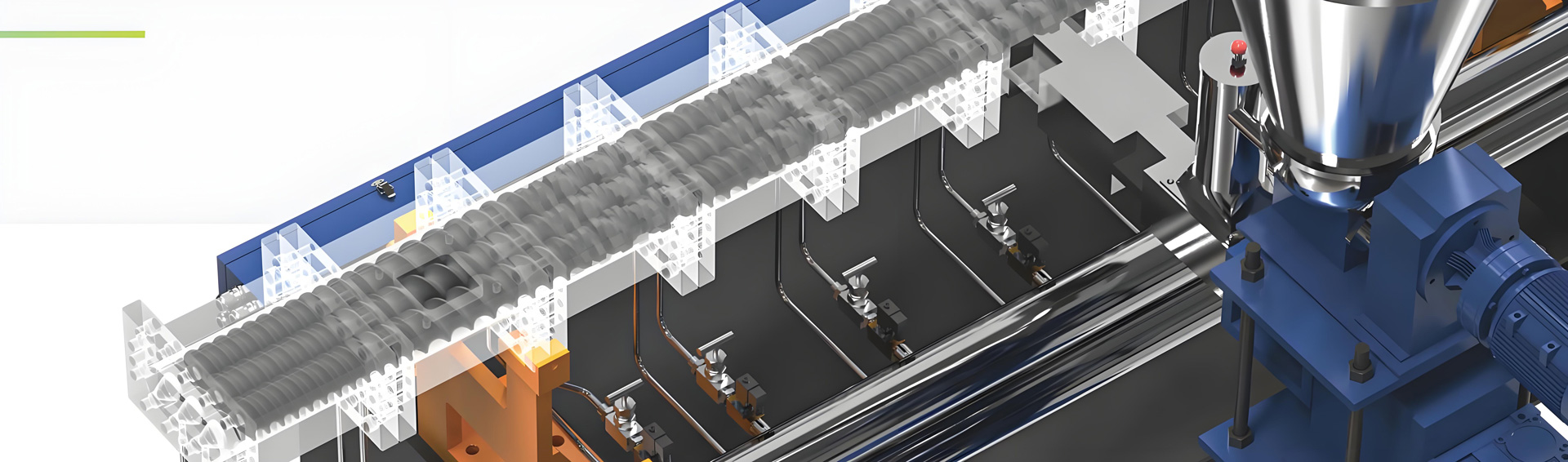
Advanced mixing technology: Kerke KTE Series extruders feature advanced mixing element configurations optimized for ultra-fine particle dispersion. The screw design incorporates distributive and dispersive mixing elements arranged to achieve complete deagglomeration of barium sulfate particles and uniform distribution throughout the polymer matrix.
Temperature precision: Multi-zone temperature control with accuracy within ±1°C ensures precise thermal management throughout the extruder. This precision is critical for maintaining consistent melt viscosity, which directly affects dispersion quality and surface characteristics of the final product.
Pressure control systems: Advanced pressure monitoring and control systems maintain optimal melt pressure throughout the extruder, particularly important for high-density fillers that can significantly increase melt viscosity. Pressure control ensures consistent processing conditions and product quality.
High-Gloss Processing Techniques
Achieving high-gloss surface characteristics requires specialized processing techniques:
Particle deagglomeration: Complete deagglomeration of barium sulfate particles is essential for achieving smooth surface characteristics. Kerke extruders incorporate high-shear mixing zones specifically designed to break up particle agglomerates without excessive thermal stress that could affect polymer quality.
Distribution optimization: Uniform distribution of fine barium sulfate particles throughout the polymer matrix is critical for consistent surface characteristics. Advanced screw configurations with carefully spaced mixing elements ensure uniform particle distribution while maintaining process efficiency.
Surface quality preservation: Processing conditions are optimized to preserve surface quality and prevent particle damage or surface contamination that could affect final product gloss. Kerke extruders incorporate smooth barrel surfaces and gentle conveying elements to maintain particle integrity and surface quality.
Quality Control for Surface Finish
Rigorous quality control ensures consistent high-gloss surface characteristics:
Surface gloss measurement: Gloss meter measurements according to ASTM D523 or ISO 2813 standards verify that masterbatch produces the required surface gloss in molded test parts. Gloss values exceeding 85-90 gloss units at 60° measurement angle are typical for high-gloss barium sulfate formulations.
Surface roughness analysis: Surface roughness measurements using profilometry assess surface smoothness and detect any surface irregularities that could affect gloss quality. Surface roughness values below 0.2 micrometers Ra are typically required for high-gloss applications.
Particle dispersion analysis: Microscopic examination or laser diffraction analysis verifies that barium sulfate particles are properly dispersed and distributed throughout the polymer matrix. Agglomerates larger than 5-10 micrometers can affect surface quality and must be eliminated through appropriate processing.
Equipment Cost and Investment Analysis
Investment in advanced processing equipment for barium sulfate filler masterbatch production represents significant capital expenditure but offers excellent returns through premium product positioning and market differentiation.
Kerke Extruder Investment
Kerke Extrusion Equipment offers premium twin screw extruders suitable for barium sulfate filler masterbatch production:
KTE-65HG model: The 65mm screw diameter extruder with high-gloss optimization provides production capacity of 250-400 kg/h for barium sulfate masterbatch, with investment cost of $350,000-$520,000. This specialized model includes premium features such as high-precision temperature control, advanced mixing configuration for ultra-fine dispersion, and surface quality preservation technology.
KTE-75HG model: The 75mm screw diameter extruder achieves 400-650 kg/h production capacity, with investment cost of $520,000-$780,000. This high-capacity model includes all advanced features of the KTE-65HG plus enhanced automation and process control for large-scale high-gloss masterbatch production.
KTE-95HG model: The 95mm screw diameter extruder provides 650-1000 kg/h production capacity, with investment cost of $800,000-$1,150,000. This premium large-scale extruder incorporates state-of-the-art technology for the highest quality barium sulfate masterbatch production, including advanced process control, automated quality monitoring, and surface quality assurance systems.
Complete Production Line Investment
A complete barium sulfate filler masterbatch production line requires specialized auxiliary equipment:
Feeding systems: Precision gravimetric feeding systems with anti-contamination features cost $55,000-$150,000. Barium sulfate’s high density requires feeders specifically designed to handle dense materials while maintaining accuracy within ±0.2% for consistent formulation control.
Particle processing equipment: Additional equipment for particle deagglomeration and treatment costs $30,000-$80,000. This equipment may include high-shear mixers for deagglomeration, surface treatment application systems, and particle size verification equipment.
Quality control equipment: Surface gloss meters, profilometers, and microscopy equipment cost $25,000-$65,000. Specialized testing equipment is essential for verifying high-gloss characteristics and surface quality required for premium applications.
Complete line investment: A complete production line including extruder, feeding systems, quality control equipment, and auxiliary systems typically costs $800,000-$1,800,000 depending on production capacity and level of automation and quality control integration.
Operating Cost Analysis
Understanding operating costs is essential for economic planning and profitability analysis:
Raw material costs: Raw materials account for 55-70% of total production costs. Barium sulfate represents the primary cost component, priced at $1,200-$2,500 per metric ton for ultra-fine high-purity grades suitable for high-gloss applications. Surface-treated grades command premium prices at the upper end of this range.
Energy costs: Energy consumption during extrusion represents 15-25% of total production costs. Barium sulfate’s high density increases energy consumption compared to lighter fillers, with typical energy requirements 25-35% higher than calcium carbonate processing at equivalent loading levels.
Labor and overhead costs: Labor costs typically account for 10-18% of total production costs, varying with production volume, automation level, and quality control requirements. High-quality production with extensive testing increases labor requirements but justifies higher product prices.
Market Pricing and Profitability
Barium sulfate filler masterbatch commands premium pricing due to specialized performance characteristics:
Premium formulation pricing: Standard barium sulfate masterbatch with 40-50% filler loading typically ranges from $3.50 to $6.00 per kilogram. High-gloss ultra-fine grades command prices of $5.00-$9.00 per kilogram due to premium raw material costs and specialized processing requirements.
Specialized application pricing: Radiation-opacity grades and medical-grade formulations command prices of $7.00-$12.00 per kilogram due to additional quality requirements, specialized testing, and regulatory compliance costs. These formulations target specialized markets with higher profit margins.
Profit margin analysis: Gross profit margins for barium sulfate masterbatch production typically range from 35-55%, with net profit margins of 12-25% after accounting for all operating expenses. The premium pricing of barium sulfate masterbatch provides significantly higher margins compared to standard fillers.
High Gloss and Surface Quality Enhancement
Achieving superior surface gloss represents one of the primary advantages of barium sulfate filler masterbatch. This section explores factors affecting surface quality and techniques for optimization.
Factors Influencing Surface Gloss
Multiple factors contribute to the surface gloss characteristics of barium sulfate-filled polymers:
Particle size and distribution: Smaller particle sizes with narrow size distribution contribute to smoother surface characteristics and higher gloss. For optimal gloss, barium sulfate particles should have median diameter below 2 micrometers with 95% of particles below 5 micrometers. Broader particle size distributions can cause surface roughness and reduced gloss.
Particle surface treatment: Surface treatment of barium sulfate particles with silanes or other coupling agents improves dispersion and reduces surface defects. Properly treated particles integrate more completely into the polymer matrix, creating smoother surfaces and enhancing gloss characteristics.
Processing conditions: Extrusion temperature profile, screw speed, and mixing intensity all affect surface quality. Optimized processing conditions achieve complete dispersion without excessive shear that could degrade polymer or damage particle surfaces. Temperature profiles should provide adequate melt flow without thermal degradation.
Surface Quality Optimization Techniques
Advanced techniques enable optimization of surface gloss and quality:
Multi-stage dispersion: Implementing multi-stage dispersion processes with progressively finer mixing stages improves particle deagglomeration and distribution. Kerke extruders incorporate specialized screw configurations that provide progressive deagglomeration from coarse to fine mixing stages.
Temperature profile optimization: Precise temperature control along the extruder barrel optimizes melt viscosity for ideal particle dispersion. Lower temperatures in initial stages prevent premature melting and allow gradual mixing, while appropriate temperatures in later stages ensure adequate melt flow for complete dispersion.
Post-extrusion processing: Additional processing after extrusion, such as additional mixing or filtration, can further improve surface quality. Melt filtration systems can remove any remaining agglomerates or contaminants that could affect surface characteristics.
Quality Assurance for Gloss Characteristics
Comprehensive quality assurance ensures consistent high-gloss performance:
Gloss measurement protocols: Standardized gloss measurement using calibrated gloss meters at 60° measurement angle provides consistent assessment of surface gloss. Multiple measurements across sample surfaces identify any variations or defects affecting gloss uniformity.
Visual inspection protocols: Visual inspection by trained personnel identifies surface defects that may not be detected by gloss meters alone. Standardized lighting conditions and inspection protocols ensure consistent quality assessment.
Customer specification compliance: Testing against customer gloss specifications ensures that masterbatch meets specific application requirements. Detailed documentation of test results provides traceability and quality assurance for premium applications.
High Density Applications and Special Properties
The high density of barium sulfate enables specialized applications where mass properties are critical. This section explores unique applications leveraging barium sulfate’s density advantages.
Weighting and Balance Applications
Barium sulfate’s high density enables precise weighting and balance applications:
Weighted handles and grips: Barium sulfate-filled polymers are used in weighted handles for tools, sports equipment, and consumer products where balanced weight distribution enhances usability and user experience. The high density enables precise weight control without excessive volume increase.
Balance weights and counterweights: Applications requiring balance weights or counterweights utilize barium sulfate filler to achieve desired mass characteristics while maintaining design flexibility. Applications include automotive balance components, industrial equipment counterweights, and precision instruments requiring mass properties.
Acoustic and vibration damping: The high density of barium sulfate provides effective mass loading for acoustic and vibration damping applications. Barium sulfate-filled polymers are used in sound-dampening components, vibration isolation mounts, and acoustic enclosures where mass loading improves damping performance.
Radiation Shielding Applications
Barium sulfate’s radiation opacity makes it ideal for radiation shielding applications:
Medical imaging components: Barium sulfate-filled polymers are used in medical imaging equipment components including X-ray tube housings, detector housings, and radiation shields. The controlled X-ray opacity allows equipment manufacturers to optimize radiation protection while maintaining design flexibility.
Radiation protective equipment: Personal protective equipment for radiation workers incorporates barium sulfate filler to provide radiation shielding while maintaining comfort and usability. Applications include protective aprons, thyroid shields, and specialized radiation-blocking components.
Nuclear industry applications: Barium sulfate-filled polymers find applications in nuclear industry for radiation shielding components, protective barriers, and equipment housings requiring radiation protection. The chemical inertness ensures long-term stability in radiation environments.
Acoustic and Vibration Applications
The mass loading provided by barium sulfate density enhances acoustic and vibration performance:
Speaker and audio equipment: Barium sulfate-filled polymers are used in speaker enclosures, audio equipment housings, and acoustic dampening components where mass loading improves acoustic performance and reduces resonance.
Automotive NVH reduction: For noise, vibration, and harshness (NVH) reduction in vehicles, barium sulfate-filled polymers are used in interior components, acoustic barriers, and vibration dampening elements where mass loading contributes to noise and vibration reduction.
Industrial equipment enclosures: Industrial equipment requiring acoustic isolation uses barium sulfate-filled polymers for enclosures and housings where mass loading improves acoustic isolation and vibration damping performance.
Maintenance and Troubleshooting
Proper maintenance of processing equipment and effective troubleshooting are essential for consistent barium sulfate filler masterbatch production with high-gloss quality requirements.
Equipment Maintenance
Specialized maintenance practices ensure consistent performance and product quality:
Surface quality preservation: Maintaining smooth barrel surfaces and polished screw elements is critical for preserving surface gloss characteristics. Regular inspection and maintenance prevent surface damage or wear that could introduce defects affecting final product gloss.
Temperature sensor calibration: Precise temperature control is essential for consistent surface quality. Regular calibration of temperature sensors ensures accuracy within ±1°C, preventing temperature variations that could affect dispersion and surface characteristics.
Feeding system maintenance: Gravimetric feeders require regular calibration to maintain feeding accuracy, particularly important for high-density materials like barium sulfate. Check and clean feed screws, replace worn components, and verify scale calibration according to manufacturer recommendations.
Common Processing Issues
Understanding and resolving common processing issues improves production efficiency and product quality:
Surface gloss reduction: Decreased surface gloss can result from particle agglomeration, improper particle size distribution, or processing conditions causing particle surface damage. Solutions include optimizing mixing configuration, improving particle treatment, and adjusting processing parameters to maintain particle integrity.
Surface defects: Surface imperfections including scratches, pits, or contamination can reduce gloss quality. Solutions include maintaining clean processing equipment, preventing contamination, and optimizing processing conditions to preserve surface quality.
Inconsistent dispersion: Non-uniform barium sulfate distribution causes property variations and surface quality inconsistencies. Solutions include optimizing screw configuration for better mixing, improving compatibilizer usage, and adjusting processing parameters for adequate dispersion.
Quality Control Challenges
Addressing quality control challenges ensures consistent high-quality production:
Gloss measurement variability: Variations in gloss measurements can result from sample preparation, measurement technique, or instrument calibration. Implementing standardized measurement procedures and regular instrument calibration ensures consistent assessment of surface quality.
Particle size control: Maintaining consistent particle size distribution between production batches requires careful raw material selection and processing control. Implementing particle size analysis and maintaining supplier specifications ensures consistency.
Contamination prevention: Barium sulfate’s high density makes contamination from other materials particularly problematic for surface quality. Implementing strict material handling procedures, dedicated equipment, and contamination prevention measures maintains product purity and surface quality.
FAQ
What is the typical filler loading range for barium sulfate masterbatch?
Barium sulfate filler masterbatch typically contains 30% to 60% barium sulfate by weight, with most formulations for high-gloss applications ranging between 40% and 50% loading. The specific loading depends on surface quality requirements, application properties, and cost considerations. Higher loadings provide greater density enhancement and potential cost savings but may reduce gloss quality and processability.
How does barium sulfate compare to titanium dioxide for gloss enhancement?
Barium sulfate provides excellent gloss enhancement comparable to titanium dioxide but at significantly lower cost. While titanium dioxide offers higher refractive index and potentially higher maximum gloss, barium sulfate provides excellent gloss for most applications while offering additional advantages including high density and radiation opacity. The cost advantage of barium sulfate makes it particularly attractive for applications where good but not extreme gloss is required.
Can barium sulfate filler masterbatch be used in food contact applications?
Barium sulfate filler masterbatch can be formulated for food contact applications using food-grade barium sulfate and carrier resins that comply with relevant regulations such as FDA 21 CFR and EU 10/2011. However, barium sulfate is not commonly used in direct food contact due to its high density and potential settling concerns. Applications include food packaging containers where the barium sulfate-containing material does not directly contact food, such as outer packaging or secondary containers.
What makes barium sulfate suitable for radiation shielding applications?
Barium sulfate’s high radiation opacity results from the high atomic weight of barium atoms, which effectively absorb X-rays and gamma radiation. This property, combined with the material’s chemical inertness and stability, makes barium sulfate ideal for radiation shielding applications. The ability to incorporate barium sulfate into polymers provides design flexibility compared to metal shielding materials while maintaining effective radiation protection.
How does processing barium sulfate differ from processing other fillers?
Barium sulfate processing differs from other fillers primarily due to its high density and the premium quality requirements for high-gloss applications. The high density increases energy requirements and may require specialized feeding equipment. The premium quality requirements demand more stringent particle dispersion control, surface quality preservation, and quality assurance compared to standard filler applications. Kerke extruders specifically designed for barium sulfate processing address these unique requirements.
Conclusion
Barium sulfate filler masterbatch represents a premium functional additive offering exceptional performance for specialized applications requiring high gloss, high density, or unique functional properties. The distinctive characteristics of barium sulfate, including its high refractive index, exceptional chemical inertness, thermal stability, and radiation opacity, make it an irreplaceable material for automotive exterior components, consumer electronics housings, medical devices, and numerous other high-end applications.
Kerke Extrusion Equipment provides state-of-the-art twin screw extruders specifically designed for barium sulfate filler masterbatch production, enabling manufacturers to achieve the exceptional quality required for premium applications. The company’s commitment to advanced processing technology and quality control ensures that customers receive equipment capable of producing the highest quality barium sulfate masterbatch with consistent high-gloss characteristics and surface quality.
As industries continue demanding premium materials with superior aesthetic characteristics and specialized functional properties, barium sulfate filler masterbatch will maintain its position as a critical material for high-end applications. Understanding its properties, production processes, and unique advantages is essential for businesses seeking to leverage this premium filler in their products and achieve market differentiation through superior quality and performance.