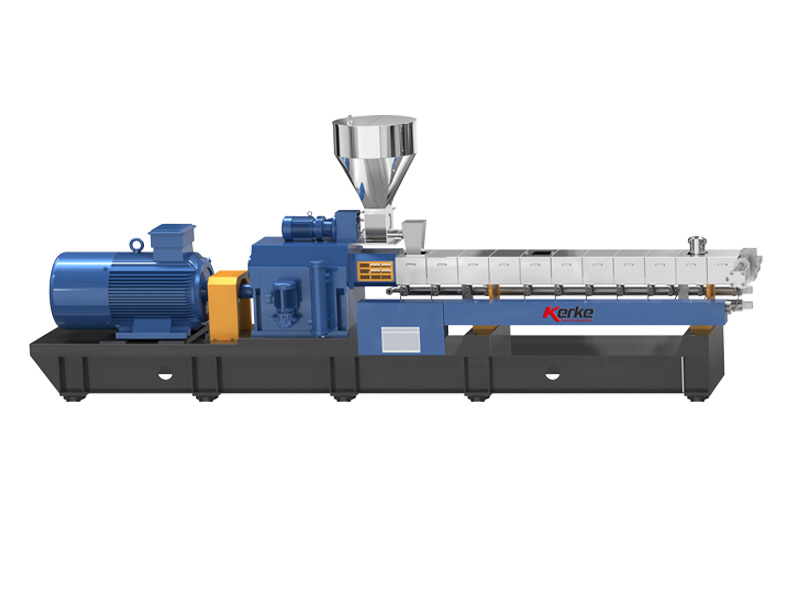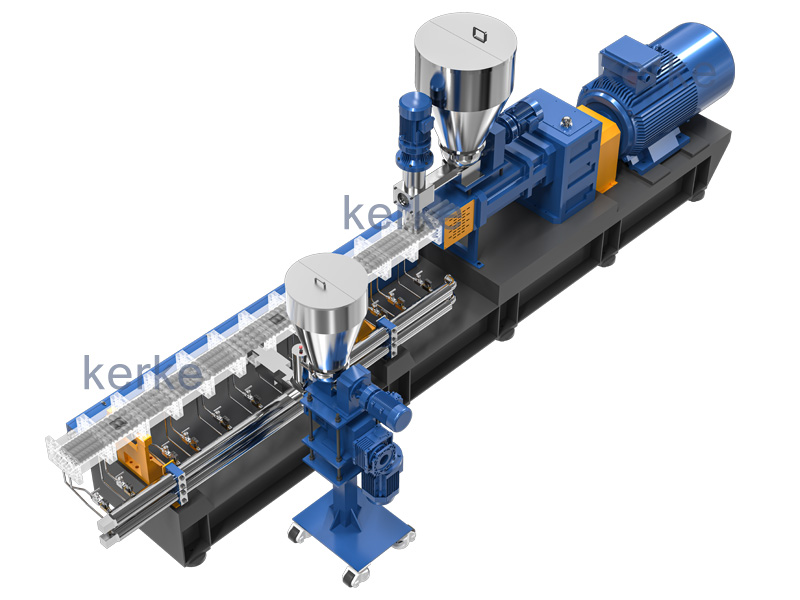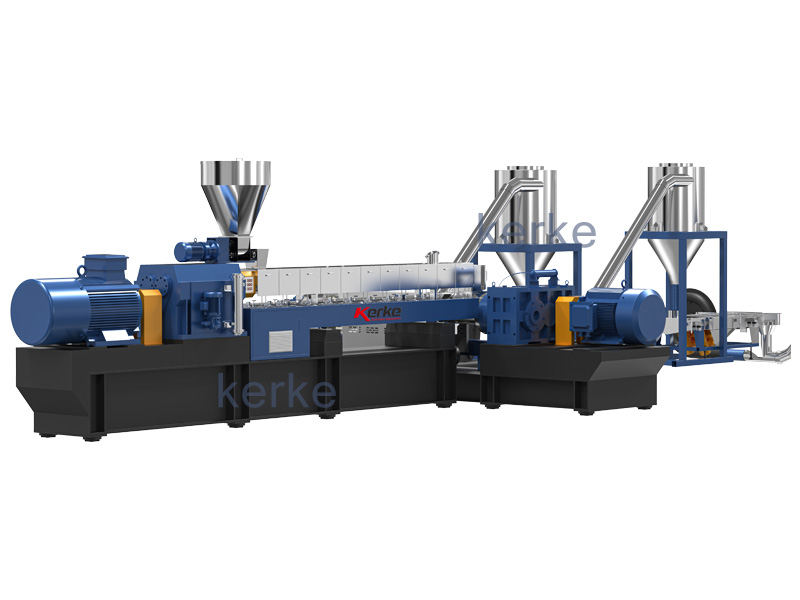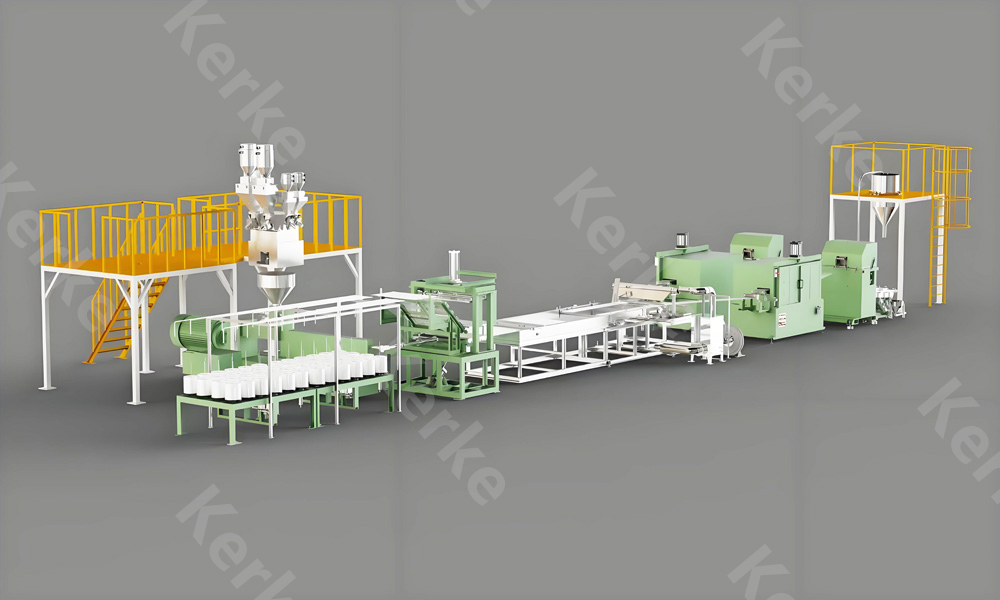
Color masterbatch brightness represents critical quality parameter affecting final product appearance and market acceptance. Brightness enhancement requires optimal pigment dispersion, particle size control, and processing conditions that maximize light reflection while minimizing light absorption. Masterbatch extruders play essential role in achieving superior brightness through combination of mechanical dispersion, thermal control, and residence time optimization. Kerke twin screw masterbatch extruders incorporate advanced technologies specifically designed to maximize brightness while maintaining throughput efficiency and color consistency.
Brightness measurement typically uses CIE Lab color space with L* value representing lightness from 0 (black) to 100 (white). High-quality color masterbatch typically achieves L* values 5-15 units higher than standard masterbatch, significantly enhancing product appearance. Studies indicate that brightness improvements of just 2-3 L* units can be perceived as quality improvements by consumers, affecting product selection and pricing. Kerke’s 13+ years of experience in masterbatch extruder manufacturing provides deep understanding of brightness optimization factors, enabling delivery of equipment achieving superior brightness across diverse pigment types and applications.
Fundamentals of Color Masterbatch Brightness
Color masterbatch brightness depends on multiple factors including pigment type, pigment particle size, dispersion quality, carrier polymer transparency, and processing conditions. Understanding these fundamentals enables optimization of masterbatch formulations and processing parameters for maximum brightness. Proper brightness enhancement requires comprehensive approach addressing all contributing factors rather than focusing on single variables.
Pigment type significantly affects brightness potential. Organic pigments typically provide higher brightness compared to inorganic pigments due to smaller particle sizes and higher purity levels. High-performance organic pigments including phthalocyanines, quinacridones, and diketopyrrolopyrroles can achieve L* values 10-20 units higher than standard organic pigments. However, premium pigments cost 3-5 times more than standard pigments, requiring processing optimization to maximize brightness without excessive pigment loading.
Particle Size and Surface Area
Pigment particle size directly affects brightness through surface area effects. Smaller particles provide larger surface area for light reflection, increasing brightness. Optimal particle size for brightness typically ranges from 0.1 to 0.5 microns depending on pigment type. Particles smaller than 0.1 microns may scatter light reducing brightness, while particles larger than 1.0 micron reduce color strength and brightness. Kerke masterbatch extruders achieve particle size control through optimized screw configurations and processing parameters.
Pigment particle size distribution also affects brightness. Narrow particle size distributions provide consistent light reflection across particles, maximizing brightness. Wide distributions cause variable reflection reducing overall brightness. Kerke extruders achieve narrow particle size distributions with coefficient of variation below 30%, superior to industry average of 40-50%. Consistent particle size control enables brightness improvements of 3-5 L* units compared to poorly controlled distributions.
Dispersion Quality Effects
Dispersion quality significantly affects brightness through effects on light transmission and reflection. Properly dispersed pigments provide uniform light transmission through carrier polymer, maximizing brightness. Agglomerated pigments scatter light reducing brightness and causing color inconsistency. Studies indicate that poor dispersion can reduce brightness by 10-20% compared to optimal dispersion. Kerke masterbatch extruders achieve excellent dispersion quality through high-shear mixing zones and optimized residence time.
Dispersion quality measurement using Hegman grind gauge provides quantitative assessment. Excellent dispersion achieving Hegman values of 7.5-8.5 indicates particle sizes below 5 microns, enabling maximum brightness. Poor dispersion with Hegman values below 6.0 indicates agglomerates exceeding 10 microns, significantly reducing brightness. Kerke masterbatch extruders consistently achieve Hegman values of 7.5-8.5 for most pigment types, providing excellent brightness characteristics.
Kerke Masterbatch Extruder Brightness Enhancement Technologies
Kerke masterbatch extruders incorporate multiple technologies specifically designed to enhance color masterbatch brightness. These technologies include optimized screw configurations, advanced control systems, specialized cooling systems, and venting capabilities. Combined technologies provide comprehensive approach to brightness optimization across diverse pigment types and carrier polymers.
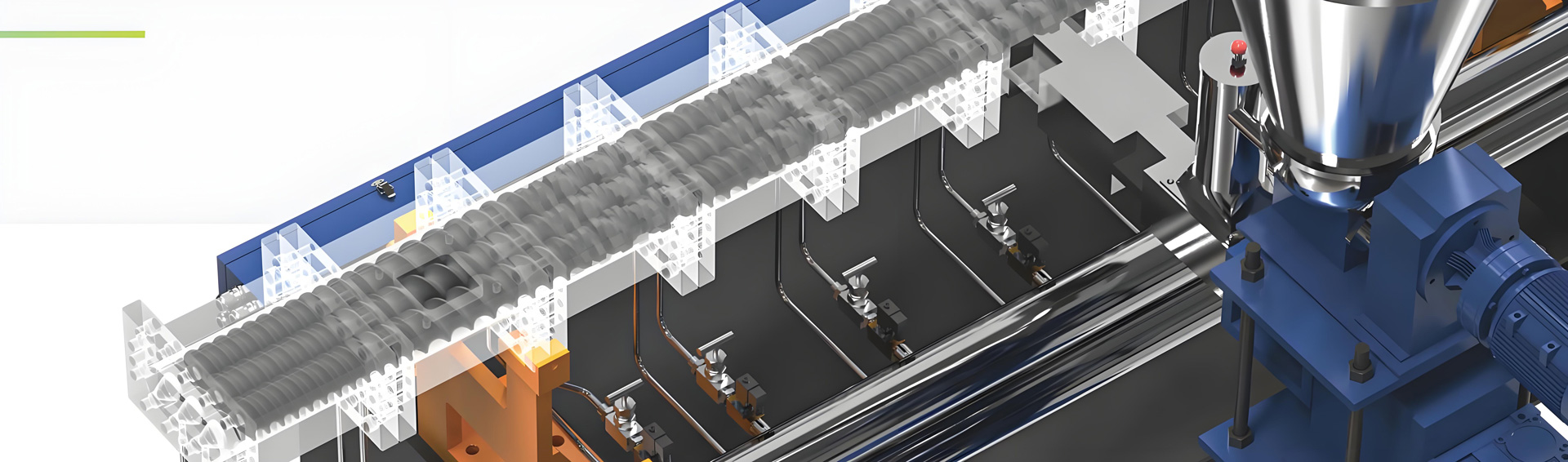
Kerke KTE series masterbatch extruders feature modular screw systems enabling precise optimization for brightness enhancement. Screw configurations include high-shear kneading blocks for pigment deagglomeration, distributive mixing elements for uniform dispersion, and conveying elements for controlled throughput. Optimized screw arrangements typically include 40-60 individual screw elements arranged in 8-12 zones, each optimized for specific function affecting brightness.
High-Shear Mixing Zones
High-shear mixing zones provide critical function for pigment deagglomeration and particle size reduction. Kerke extruders incorporate specialized kneading blocks with narrow stagger angles (30-45 degrees) generating shear rates exceeding 500 per second, sufficient to break pigment agglomerates into primary particles. High-shear zones typically consume 30-40% of total mechanical energy input but are essential for achieving optimal brightness.
Shear rate optimization balances deagglomeration needs against pigment degradation risks. Excessive shear can damage pigment particles, reducing brightness and color strength. Kerke application engineers optimize shear rates based on pigment hardness and particle size, typically targeting shear rates of 300-700 per second for organic pigments and 500-1000 per second for inorganic pigments. Optimized shear rates achieve maximum brightness without pigment degradation.
Distributive Mixing Optimization
Distributive mixing ensures uniform pigment distribution throughout carrier polymer, critical for consistent brightness across masterbatch volumes. Kerke extruders incorporate specialized mixing elements providing excellent distributive mixing without excessive shear that could degrade pigments. Optimized distributive mixing achieves brightness uniformity with coefficient of variation below 2% across production batches, superior to industry average of 4-6%.
Multi-stage mixing approach ensures both deagglomeration and uniform distribution. Initial high-shear zones break agglomerates into primary particles. Subsequent distributive mixing zones ensure uniform distribution without excessive shear. This approach achieves optimal brightness while minimizing pigment damage. Kerke multi-stage mixing typically achieves 10-15% better brightness compared to single-stage mixing approaches.
Process Parameter Optimization for Brightness
Optimal brightness requires careful control of process parameters including screw speed, barrel temperature profile, feed rate, and vacuum venting. These parameters interact significantly, requiring systematic optimization for each pigment type and carrier polymer. Kerke masterbatch extruders provide precise control over all process parameters, enabling consistent brightness achievement.
Screw speed affects shear rate and residence time, both critical for brightness. Higher screw speeds increase shear rates, enhancing deagglomeration but reducing residence time. Optimal screw speed depends on pigment type, screw configuration, and desired brightness. For most color masterbatch applications, screw speeds of 300-600 rpm provide sufficient shear energy while maintaining adequate residence time. Kerke KTE series extruders offer speed ranges from 50 to 800 rpm depending on model.
Temperature Profile Design
Barrel temperature profiles significantly impact pigment dispersion and brightness through effects on polymer viscosity and pigment wetting. Temperature profiles must be optimized for specific polymer-pigment combinations to achieve proper pigment wetting without thermal degradation. Kerke masterbatch extruders feature multi-zone barrel heating with independent temperature control for each zone, typically 6-8 zones for color masterbatch production.
Temperature profile design considers pigment characteristics and thermal sensitivity. Organic pigments typically require lower processing temperatures (180-220°C) to prevent degradation. Inorganic pigments tolerate higher temperatures (200-260°C) enabling processing with higher-viscosity polymers. Kerke application engineers develop optimized temperature profiles for each application, with typical temperature differentials of 15-25°C between zones.
Residence Time Control
Residence time affects dispersion quality and brightness by determining time available for mixing and shear energy application. Adequate residence time ensures complete pigment deagglomeration and uniform distribution. Excessive residence time may cause thermal degradation reducing brightness. Kerke extruders provide precise residence time control through screw configuration and throughput adjustment.
Optimal residence time for color masterbatch typically ranges from 1.5 to 3 minutes depending on pigment type and loading. Kerke extruders achieve residence time uniformity with coefficient of variation below 0.3, ensuring consistent brightness across production. Residence time optimization provides 3-5 L* units brightness improvement compared to unoptimized residence times.
Pigment-Specific Brightness Enhancement Strategies
Different pigment types present unique challenges requiring specialized approaches for brightness enhancement. Organic pigments require different processing conditions compared to inorganic pigments. High-performance pigments require careful handling to preserve brightness characteristics. Kerke masterbatch extruders offer specialized configurations optimized for each pigment category.
Organic Pigment Processing
Organic pigments provide excellent brightness potential but require careful processing to prevent thermal degradation. These pigments typically have optimal processing temperatures between 180-220°C, with thermal degradation beginning above 240°C. Kerke masterbatch extruders for organic pigments feature precise temperature control with ±1°C accuracy, preventing thermal degradation that reduces brightness by 10-20%.
Organic pigments require moderate shear rates for deagglomeration, typically 300-600 per second. Excessive shear can damage pigment crystals, reducing brightness and color strength. Kerke screw configurations for organic pigments utilize specialized kneading blocks providing optimal shear without crystal damage. Optimized shear extends pigment service life by 2-3 times compared to excessive shear conditions.
Inorganic Pigment Processing
Inorganic pigments including titanium dioxide, iron oxides, and ultramarines require higher processing temperatures and shear rates for optimal brightness. These pigments typically process at 200-260°C with shear rates of 500-1000 per second. Kerke masterbatch extruders for inorganic pigments feature high-temperature capabilities and high-shear screw configurations achieving complete deagglomeration.
Titanium dioxide, the most common white pigment, presents particular challenges due to high hardness and tendency to form agglomerates. Kerke extruders for titanium dioxide masterbatch feature specialized screw configurations with high-shear zones achieving complete deagglomeration. Proper titanium dioxide dispersion provides L* values of 95-98 for white masterbatch, essential for achieving bright colors in final products.
High-Performance Pigment Processing
High-performance pigments including quinacridones, diketopyrrolopyrroles, and perylenes provide exceptional brightness but require specialized processing to preserve performance characteristics. These pigments cost $50-$200 per kilogram compared to $5-$15 for standard pigments, making processing optimization essential for maximizing value.
Kerke masterbatch extruders for high-performance pigments feature gentle mixing profiles providing sufficient deagglomeration without damaging pigment crystals. Screw configurations typically include wide-stagger-angle kneading blocks (60-90 degrees) providing moderate shear with excellent distributive mixing. Optimized processing for high-performance pigments achieves 5-10 L* units better brightness compared to standard processing approaches.
Carrier Polymer Effects on Brightness
Carrier polymer selection significantly affects color masterbatch brightness through effects on transparency, refractive index, and pigment compatibility. Optimal carrier polymers provide transparency enabling light transmission to pigments while maintaining pigment stability. Kerke masterbatch extruders accommodate diverse carrier polymers including polyethylene, polypropylene, polystyrene, PET, and engineering plastics.
Carrier polymer transparency directly affects brightness through light transmission to pigments. Transparent carriers including polystyrene, PET, and clear polypropylene provide excellent light transmission, maximizing brightness. Opaque carriers including filled polypropylene and high-density polyethylene reduce light transmission, limiting brightness potential. Kerke application engineers recommend carrier polymers matching application requirements and brightness targets.
Refractive Index Matching
Refractive index matching between carrier polymer and pigments affects brightness through light scattering effects. Better refractive index matching reduces light scattering, increasing brightness. Kerke provides carrier polymer recommendations based on refractive index characteristics for different pigment types. For titanium dioxide (refractive index 2.7), polymers with higher refractive index including polystyrene (1.59) provide better brightness than polyethylene (1.51).
Refractive index effects can provide 2-5 L* units brightness improvement when optimized. While significant, refractive index effects are secondary to dispersion quality and particle size control. Kerke extruders optimize all factors affecting brightness, providing comprehensive brightness enhancement approach.
Pigment-Polymer Compatibility
Pigment-polymer compatibility affects brightness through effects on pigment dispersion stability and surface characteristics. Compatible pigments wet properly and disperse uniformly, maximizing brightness. Incompatible pigments may reagglomerate or migrate to surfaces, reducing brightness and causing color inconsistency. Kerke provides compatibility data for common pigment-polymer combinations, enabling optimal material selection.
Surface treatments including coupling agents and dispersants improve pigment-polymer compatibility, enhancing brightness and dispersion stability. Kerke processing recommendations include use of dispersants when appropriate for specific pigment-polymer combinations. Dispersants typically cost $0.50-$2.00 per kilogram but provide 3-8 L* units brightness improvement, representing excellent value for high-brightness applications.
Brightness Measurement and Quality Control
Brightness measurement provides objective assessment of masterbatch quality and enables process optimization. Various measurement techniques assess brightness and related color characteristics. Kerke masterbatch extruders incorporate monitoring capabilities enabling real-time assessment of brightness characteristics, facilitating process control and continuous improvement.
Spectrophotometers provide comprehensive color measurement including L* brightness value, chroma (saturation), and hue angle. Modern spectrophotometers measure in multiple geometries including specular component included (SCI) and specular component excluded (SCE), providing insight into surface characteristics affecting brightness. Kerke quality systems utilize spectrophotometers with ±0.2 L* unit accuracy, detecting subtle brightness variations affecting product quality.
Whiteness Index Measurement
Whiteness index provides alternative brightness measurement particularly relevant for white and light-colored masterbatch. Whiteness index considers both lightness and undertones, providing comprehensive assessment for white masterbatch. Kerke quality systems measure whiteness index using standard formulas including CIE Whiteness and ASTM E313. High-quality white masterbatch typically achieves whiteness index values of 85-95.
Whiteness index optimization for titanium dioxide masterbatch requires complete deagglomeration and uniform particle distribution. Kerke masterbatch extruders achieve whiteness index values of 90-95 for titanium dioxide masterbatch, significantly above industry average of 80-88. Superior whiteness enables production of bright white products with reduced pigment loading.
Opacity and Hiding Power
Opacity and hiding power measurements provide additional insight into brightness characteristics, particularly for white and colored masterbatch. High opacity indicates efficient light scattering, contributing to brightness perception. Kerke quality systems measure opacity using contrast ratio methods, achieving values of 80-95% for white masterbatch depending on loading and application.
Hiding power quantifies pigment efficiency in providing opacity at given thickness. Kerke masterbatch extruders achieve hiding power improvements of 15-30% compared to industry average through superior dispersion and particle size control. Improved hiding power enables reduced pigment loading while maintaining brightness, providing material cost savings.
Cost Analysis of Brightness Enhancement
Brightness enhancement requires investment in specialized equipment and process development but delivers significant returns through improved product quality, reduced pigment costs, and premium pricing opportunities. A typical Kerke KTE-65D masterbatch extruder with initial cost of $140,000-$170,000 requires additional investment of $10,000-$20,000 for optimized brightness enhancement configuration. This investment represents 7-12% premium over standard configuration but delivers substantial returns.
Brightness enhancement returns manifest through multiple channels including reduced pigment requirements (10-20% reduction), premium pricing capability (5-15% premium), reduced material waste (10-20% reduction), and expanded product capabilities (20-40% broader color range). When quantified over typical equipment life of 10-15 years, brightness optimization provides ROI of 180-350% depending on application and market conditions.
Pigment Cost Reduction
Superior brightness enables reduction of pigment loading while maintaining color performance. Brightness improvements of 5-10 L* units typically enable 15-25% reduction in pigment loading for equivalent color. For typical masterbatch with 20% pigment loading at $10 per kilogram, 20% pigment reduction saves $0.40 per kilogram of masterbatch. With annual production of 500,000 kg, savings total $200,000 annually, representing substantial economic benefit.
High-performance pigments particularly benefit from brightness optimization. Premium pigments costing $50-$200 per kilogram provide exceptional brightness when properly processed. Optimized processing enables achievement of target colors with 10-20% less premium pigment, saving $5-$40 per kilogram. For applications using premium pigments at 5% loading, savings reach $0.25-$2.00 per kilogram of masterbatch.
Premium Pricing Opportunities
Superior brightness enables premium pricing in markets valuing appearance and quality. Packaging applications, consumer goods, and automotive interiors typically pay 5-15% premium for enhanced brightness and color consistency. For masterbatch priced at $3.00-$4.00 per kilogram, 10% premium provides $0.30-$0.40 per kilogram additional revenue. With annual production of 500,000 kg, premium pricing generates $150,000-$200,000 additional revenue.
Premium pricing particularly applies to white masterbatch where whiteness index significantly affects product appearance. Kerke masterbatch extruders achieving whiteness index of 90-95 enable premium pricing of 8-12% compared to standard whiteness index of 80-85. Premium pricing opportunities justify investment in brightness enhancement equipment and process optimization.
Kerke Extruder Models for Color Masterbatch
Kerke offers comprehensive range of masterbatch extruder models optimized for brightness enhancement across different scales and applications. Model selection depends on throughput requirements, pigment types, and brightness targets. Kerke application engineers assist customers in selecting optimal models based on specific application requirements.
Kerke KTE-36B laboratory extruder provides small-scale platform for color masterbatch testing and brightness optimization. With screw diameter of 36mm and throughput of 10-50 kg/h, this model enables cost-effective experimentation before scale-up to production equipment. Pricing for KTE-36B ranges from $35,000-$45,000 depending on configuration. Laboratory testing costs $2,000-$4,000 per color recipe but prevents expensive mistakes during scale-up, saving $20,000-$50,000 per production recipe.
Mid-Range Production Models
Kerke KTE-65D and KTE-75D models provide mid-range production capacity for color masterbatch production. These models feature screw diameters of 65mm and 75mm respectively, providing sufficient size for most color masterbatch applications. Pricing for KTE-65D ranges from $140,000-$170,000 depending on configuration. Pricing for KTE-75D ranges from $180,000-$220,000 depending on configuration.
Kerke KTE-65D particularly optimized for color masterbatch production requiring excellent brightness and color consistency. This model features precise temperature control and optimized screw configuration achieving brightness improvements of 5-10 L* units compared to standard extruders. Throughput ranges from 200 to 800 kg/h depending on formulation, suitable for medium-sized masterbatch producers.
High-Capacity Production Models
Kerke KTE-95D and KTE-135D models provide high-capacity production for large masterbatch production facilities. These models feature screw diameters of 95mm and 135mm respectively, enabling high throughput with excellent brightness control. Pricing for KTE-95D ranges from $280,000-$350,000 depending on configuration. Pricing for KTE-135D ranges from $450,000-$600,000 depending on configuration.
Kerke KTE-95D particularly suited for high-volume color masterbatch production requiring consistent brightness at high throughput. This model features advanced control systems and optimized mixing zones achieving consistent brightness across production volumes. Throughput ranges from 800 to 2,000 kg/h depending on formulation, suitable for large-scale masterbatch production facilities.
Case Studies: Brightness Enhancement Results
Kerke’s extensive experience in color masterbatch production includes numerous successful case studies demonstrating brightness enhancement results. These case studies provide quantified evidence of brightness improvements and associated economic benefits across diverse pigment types and applications.
White Masterbatch Production
European white masterbatch producer upgrading from competitor extruder to Kerke KTE-65D achieved 8 L* units improvement in brightness, increasing L* value from 92 to 100. The improvement enabled reduction of titanium dioxide loading from 75% to 65% while maintaining brightness, saving $0.80 per kilogram of masterbatch. With annual production of 1,000,000 kg, improvement generated $800,000 annual savings, paying for equipment upgrade within 6 months.
Additional benefits included improved whiteness index from 88 to 94, enabling premium pricing of 10% in quality-sensitive markets. Combined benefits exceeded $1.2 million annually, providing ROI of 400% on equipment investment of $300,000.
Organic Pigment Masterbatch
Asian masterbatch producer implementing Kerke KTE-75D for organic pigment masterbatch achieved 12 L* units brightness improvement for red pigments. The improvement enabled reduction of quinacridone red loading from 8% to 6% while maintaining color strength, saving $6.00 per kilogram of masterbatch. With annual production of 200,000 kg, improvement generated $1.2 million annual savings.
Improved brightness also enabled expansion into premium markets requiring higher brightness standards, increasing market opportunities by 30%. Combined economic benefits exceeded $1.5 million annually, providing ROI of 250% on equipment investment of $600,000.
Effect Pigment Masterbatch
North American automotive masterbatch producer implementing Kerke KTE-95D for effect pigment masterbatch achieved 15% improvement in metallic effect brightness. The improvement enabled reduction of aluminum flake loading from 5% to 3.5% while maintaining effect intensity, saving $4.00 per kilogram. With annual production of 150,000 kg, savings totaled $600,000 annually.
Improved effect brightness also enabled approval for premium automotive applications, increasing revenue by 25% for affected product lines. Combined benefits exceeded $900,000 annually, providing ROI of 180% on equipment investment of $500,000.
Advanced Brightness Enhancement Technologies
Kerke continuously invests in advanced brightness enhancement technologies to improve performance and expand capabilities. These technologies include ultrasonic dispersion assistance, nano-pigment processing capabilities, and real-time brightness monitoring. Advanced technologies typically cost 15-30% more than standard configurations but deliver significant brightness improvements for demanding applications.
Ultrasonic dispersion assistance applies high-frequency acoustic energy to breakup pigment agglomerates, complementing mechanical shear from screws. Kerke ultrasonic systems operate at 20-40 kHz frequencies, providing additional dispersion energy particularly effective for nano-sized pigments. Ultrasonic systems cost $25,000-$50,000 depending on power level but enable dispersion of nanoparticles achieving brightness improvements of 8-15 L* units for nano-pigment applications.
Nano-Pigment Processing
Nano-pigments with particle sizes below 100 nanometers provide exceptional brightness potential but present significant dispersion challenges. Kerke offers specialized processing capabilities for nano-pigments including modified screw geometries, ultrasonic assistance, and carrier polymer modifications. Nano-pigment processing typically adds 20-40% to equipment costs but enables brightness improvements of 10-20 L* units compared to conventional pigments.
Nano-pigments cost 5-10 times more than conventional pigments but provide superior brightness at lower loadings. Nano-titanium dioxide achieving 10-15 L* units better brightness at 50% loading compared to conventional titanium dioxide at 75% loading provides net savings despite higher pigment cost. ROI for nano-pigment processing capabilities typically ranges from 200% to 400% for high-brightness applications.
Real-Time Brightness Monitoring
Real-time brightness monitoring systems utilize optical sensors to measure color characteristics during processing, enabling immediate process adjustments. Kerke offers inline brightness monitoring systems using spectrophotometric measurement techniques. These systems cost $35,000-$65,000 depending on technology and configuration but enable closed-loop control of brightness, reducing batch-to-batch variation by 50-70%.
Real-time monitoring enables immediate detection of brightness variations, reducing off-spec material generation by 40-60% compared to end-of-line testing only. For facilities producing 500,000 kg annually with off-spec material cost of $2.00 per kilogram, 50% reduction saves $500,000 annually. Monitoring systems typically pay for themselves within 12-18 months through quality improvement and waste reduction.
Additive Effects on Brightness
Additives including dispersants, wetting agents, and optical brighteners affect color masterbatch brightness through various mechanisms. Proper additive selection and optimization enhances brightness while providing other benefits including improved processing and stability. Kerke processing recommendations include additive strategies optimized for different pigment types and applications.
Dispersants improve pigment wetting and dispersion stability, enhancing brightness and preventing reagglomeration. Kerke recommends dispersant additions of 0.5-2.0% depending on pigment type and loading. Dispersants typically cost $2-$5 per kilogram but provide 3-8 L* units brightness improvement. For masterbatch priced at $3.00 per kilogram, $0.02-$0.10 dispersant cost provides substantial brightness improvement value.
Optical Brightening Agents
Optical brightening agents (OBAs) absorb ultraviolet light and re-emit blue light, enhancing perceived brightness and whiteness. OBAs particularly effective for white and light-colored masterbatch, providing 5-15 L* units brightness improvement. Kerke processing recommendations include OBA additions of 0.01-0.05% depending on application. OBAs cost $8-$15 per kilogram but provide significant brightness enhancement at low loading levels.
OBA effectiveness depends on ultraviolet light availability in final application. For indoor applications with limited UV, OBAs provide minimal benefit. For outdoor applications with abundant UV, OBAs provide substantial brightness enhancement. Kerke application engineers assess application conditions to determine OBA appropriateness and optimal loading levels.
Lubricant Effects
Lubricants affect brightness through effects on pigment dispersion and surface characteristics. External lubricants including stearates and waxes improve pigment dispersion by reducing viscosity and improving wetting. Internal lubricants including fatty acid amides affect surface characteristics influencing brightness perception. Kerke processing recommendations include optimized lubricant packages balancing processing benefits with brightness effects.
Lubricant optimization typically provides 1-3 L* units brightness improvement through improved dispersion and surface characteristics. Combined with other additives, comprehensive additive strategies provide 10-20 L* units total brightness improvement compared to unoptimized formulations.
Environmental and Sustainability Considerations
Brightness enhancement strategies must balance performance with environmental and sustainability considerations. Kerke masterbatch extruders incorporate energy-efficient designs and support sustainable pigment alternatives, providing brightness optimization while minimizing environmental impact. Energy-efficient processing reduces both costs and environmental footprint.
Kerke masterbatch extruders achieve specific energy consumption (SEC) of 0.12-0.18 kWh/kg for color masterbatch production, 15-25% lower than industry average of 0.15-0.22 kWh/kg. For facilities producing 1,000,000 kg annually with electricity cost of $0.12/kWh, 20% energy reduction saves $24,000 annually. Energy-efficient designs typically cost 10-15% more than standard designs but provide ROI of 150-200% through energy savings.
Sustainable Pigment Alternatives
Sustainable pigment alternatives including bio-based pigments and recycled pigments provide brightness with reduced environmental impact. Kerke processing capabilities accommodate sustainable pigments with optimized processing parameters. While sustainable pigments often cost 20-50% more than conventional pigments, growing market demand provides premium pricing opportunities.
Bio-based pigments derived from renewable sources including plant extracts and microbial production provide environmental advantages with good brightness characteristics. Kerke application engineers develop processing parameters for bio-based pigments, achieving brightness within 5-10% of conventional pigments. Processing optimization narrows brightness gap while maintaining sustainability benefits.
Future Trends in Brightness Enhancement
Brightness enhancement technology continues evolving with advances in pigment technology, processing equipment, and measurement capabilities. Future trends include increased use of nano-pigments, advanced dispersant systems, greater process automation, and enhanced color measurement technologies. Kerke invests continuously in research and development to incorporate emerging technologies into product offerings.
Nano-pigments will see increased adoption for high-brightness applications, particularly in automotive and packaging markets. Kerke expects nano-pigment usage to increase from current 5% market share to 15-20% by 2030, driven by brightness requirements and decreasing costs. Processing capabilities for nano-pigments will become essential for masterbatch producers serving premium markets.
Advanced Dispersant Systems
Advanced dispersant systems including polymeric dispersants and reactive dispersants will provide enhanced brightness with lower usage levels. Polymeric dispersants provide steric stabilization preventing reagglomeration, enabling superior brightness stability. Reactive dispersants chemically bond to pigment surfaces, providing permanent dispersion enhancement. Kerke development efforts focus on dispersant systems providing 10-20% better brightness at 50% lower usage levels compared to conventional dispersants.
Digital Color Management
Digital color management systems will enable precise color matching and brightness control through integration of formulation software, process control, and quality measurement. Kerke development efforts focus on systems achieving closed-loop control of brightness and color characteristics. Digital color management typically adds 10-20% to system costs but provides returns of 50-100% through reduced setup times, improved consistency, and reduced material waste.
Artificial intelligence algorithms will optimize processing parameters for brightness based on historical data and real-time measurements. Kerke development efforts focus on AI systems adapting to pigment variations and equipment changes, maintaining optimal brightness without manual intervention. AI-based optimization is expected to reduce batch-to-batch brightness variation by 30-50% compared to manual control.
Quality Assurance and Brightness Consistency
Consistent brightness across production batches represents critical quality requirement for color masterbatch. Kerke masterbatch extruders incorporate quality assurance features ensuring brightness consistency while minimizing variation. Quality systems include statistical process control, automated testing, and documentation capabilities.
Statistical process control (SPC) monitors brightness and related parameters over time, detecting trends indicating potential issues before off-spec material occurs. Kerke control systems with SPC capabilities establish control limits for brightness, alerting operators when parameters exceed acceptable ranges. SPC implementation typically reduces brightness variation by 40-60% compared to without SPC.
Automated Quality Testing
Automated quality testing systems provide rapid brightness measurement without operator intervention, ensuring consistent quality assessment. Kerke offers automated sampling and testing systems integrating with extruder operation. Automated systems cost $30,000-$60,000 but enable 100% inspection versus typical 10% sampling inspection with manual testing, improving quality assurance significantly.
Automated testing reduces labor requirements for quality control by 50-70% while improving consistency. Manual testing subject to operator variation and fatigue, affecting measurement accuracy. Automated systems provide consistent measurement with ±0.2 L* unit accuracy, enabling precise quality control.
Training and Technical Support
Comprehensive training ensures proper operation and maintenance for optimal brightness achievement. Kerke provides extensive training programs including operation training, brightness optimization training, and troubleshooting training. Proper training reduces brightness variation by 15-25% and prevents quality issues affecting customer satisfaction.
Brightness optimization training covers pigment characteristics, processing parameter effects, and troubleshooting brightness issues. Kerke training typically requires 2-3 days and costs $2,000-$4,000 including instructor time and materials. Well-trained operators achieve consistent brightness results and respond effectively to variations, preventing off-spec production.
Technical Support Services
Kerke provides comprehensive technical support services including process optimization, troubleshooting, and formulation development. Technical support staff includes experienced color specialists with expertise in brightness optimization across diverse pigment types and applications. Support services ensure customers achieve optimal brightness and resolve issues quickly.
Remote support capabilities enable rapid response to brightness issues without travel delays. Kerke remote support system enables video consultation, data analysis, and parameter adjustment guidance. Remote support resolves 70-80% of issues without on-site visits, reducing resolution time from days to hours and minimizing production losses.
Conclusion
Color masterbatch brightness enhancement requires comprehensive approach addressing pigment characteristics, processing equipment, process parameters, and quality control. Kerke masterbatch extruders provide superior brightness capabilities through advanced mixing technologies, precise control systems, and optimized processing strategies. Investment in brightness optimization delivers substantial returns through improved product quality, reduced pigment costs, and premium pricing opportunities.
Kerke’s 13+ years of experience and continuous innovation ensure delivery of extruders optimized for brightness enhancement while maintaining throughput efficiency and color consistency. By partnering with Kerke for masterbatch extruder needs, producers achieve superior brightness, consistent quality, and competitive advantage in demanding global markets. As brightness requirements continue increasing across industries, Kerke remains positioned to deliver cutting-edge solutions providing even greater brightness performance and consistency in future.