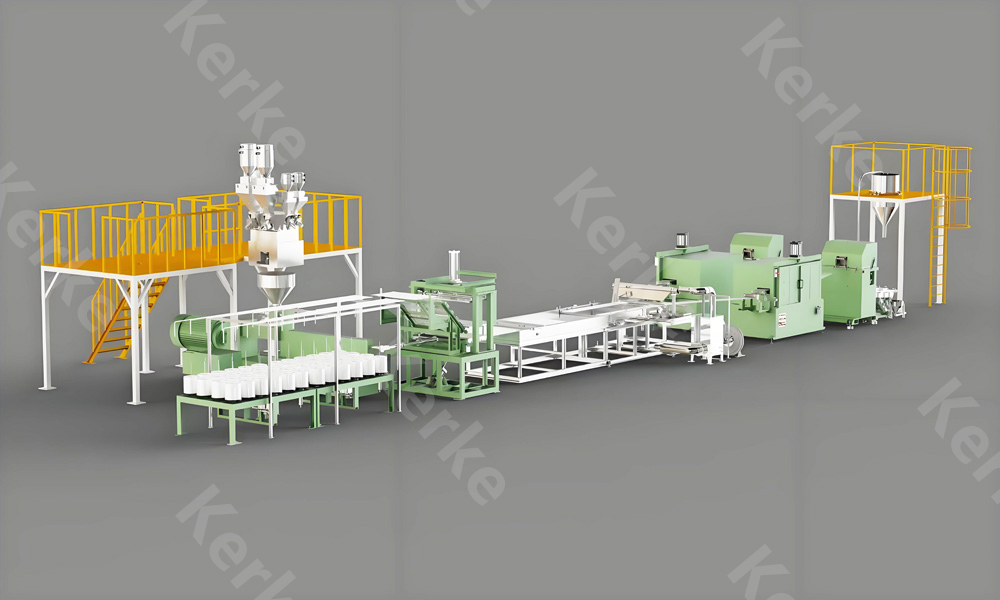
Introduction to the Challenge of Heat Sensitivity in Plastics
Processing heat-sensitive plastics such as PVC (Polyvinyl Chloride), TPU (Thermoplastic Polyurethane), EVA (Ethylene Vinyl Acetate), and certain biodegradable polymers (like PLA) presents unique and severe challenges. These materials have very narrow processing windows; if the temperature exceeds a certain threshold by even 10 degrees Celsius, they degrade, discolor (yellowing or browning), release corrosive gases (like HCl from PVC), or lose their physical properties (elasticity in TPU). A standard extruder, which relies heavily on friction and external heating, can easily destroy these materials in seconds, resulting in tons of scrap. A specialized masterbatch extruder designed for heat-sensitive applications must prioritize temperature control, efficient cooling, and gentle shear. This article explores the engineering solutions used in Kerke twin screw extruders to process these challenging materials successfully and profitably.
The Specific Challenge of PVC and Corrosive Gas Management
PVC is arguably the most difficult material to process due to its thermal instability. It begins to degrade at temperatures only slightly above its melting point (around 180-200 degrees Celsius). Degradation releases hydrogen chloride (HCl) gas, which is highly corrosive to standard steel extruder components and dangerous to operators. Furthermore, degraded PVC forms “fish eyes” (unmelted gels) and turns yellow, ruining the aesthetic quality of the final product. To handle this, the extruder must have excellent corrosion resistance. Kerke Extruder uses specialized barrel coatings, such as chrome plating or bimetallic liners (like 38CrMoAlA nitrided steel), that resist acid corrosion from HCl.
The cost of these specialized materials adds roughly 10-15% to the machine price compared to a standard carbon steel machine, but it is essential for longevity. Without it, a standard steel barrel could be pitted and ruined in a matter of weeks. Additionally, the venting system must be robust to handle the gas evolution. A vacuum pump with high capacity (e.g., a Roots blower) is required to pull out the gas without allowing air to be sucked in, which would oxidize the PVC and cause yellowing. The cost of a corrosion-resistant extruder is higher, but the alternative—frequent barrel replacement and massive scrap rates—is far more expensive. A factory processing PVC must calculate the cost of corrosion into their ROI; a Kerke machine minimizes this risk through material selection and surface treatment technology.
Advanced Barrel Cooling Systems and “Cold Wall” Technology
The most critical feature for heat-sensitive materials is the cooling capacity. Standard extruders often use simple cooling fans or single-pass water jackets. However, for PVC or TPU, this is insufficient. High-performance masterbatch extruders use “high-efficiency” cooling systems with spiral cooling channels machined directly into the barrel, close to the inner bore. This allows for rapid heat extraction. The water flow is controlled by proportional valves linked to the melt temperature sensors in real-time.
Some advanced systems use chilled water (5-10 degrees Celsius) even when processing materials that melt at 150 degrees. The goal is to create a “cold wall” effect where the barrel surface is kept cool, and the heat is generated primarily by the controlled shear of the screws, not by the heaters. This prevents the material from sticking to the barrel and degrading (a phenomenon called “scorching” or plate-out). The cost of installing a high-capacity industrial chiller and cooling tower is significant (approx. $8,000 to $15,000 for a dedicated system), but it is mandatory for PVC compounding to ensure product quality and operator safety. Without precise cooling, the process is uncontrollable, and the scrap rate can exceed 20%.
Screw Design for Low Shear and Gentle Mixing
For heat-sensitive materials, high shear is the enemy because shear generates heat. The screw configuration must be designed for “distributive mixing” rather than “dispersive mixing.” This means using fewer kneading blocks and more conveying elements. The kneading blocks that are used should have a shallow angle (30 degrees or 45 degrees) to minimize pressure build-up and heat generation. The screw root diameter is often larger (i.e., shallower flights) to reduce the volume of material being sheared at any moment, lowering the torque and temperature rise.
Kerke engineers design specific “PVC screw” or “TPU screw” profiles. These screws have a lower compression ratio to avoid adiabatic compression heating. The mixing sections are placed further downstream, after the material has fully melted, to minimize the residence time at high temperature. For very sensitive materials like TPU, which can degrade in seconds at high shear, the screws might be designed with larger clearances (within safety limits) to reduce shear stress. The trade-off is that mixing efficiency might be slightly lower, requiring perhaps a longer L/D (length to diameter) ratio (e.48:1 or 52:1 instead of 40:1) to compensate for the gentler mixing. A longer machine costs more (approx.10% more per unit length), but it is necessary to achieve dispersion without degradation. The cost of this custom engineering is justified by the ability to process high-value engineering thermoplastic urethanes without burning them.
Venting and Devolatilization for Sensitive Polymers
Many heat-sensitive polymers are also hygroscopic (absorb moisture) or contain volatile plasticizers (like in PVC or TPU). Moisture turns into steam at processing temperatures, creating bubbles (voids) in the extrudate. Steam also causes hydrolysis in polymers like PET or PC, breaking the molecular chains and reducing strength. A twin screw extruder excels here because it can handle high vacuum (up to 50 mbar absolute) while still conveying a viscous melt. The vent port is often equipped with a vacuum pump of high capacity.
For PVC, removing moisture and residual monomers (like Vinyl Chloride) is critical for health and safety regulations. The vent design is crucial. Upstream of the vent, the screw elements build pressure to “seal” the vent and prevent air from being sucked in. Downstream, the screws are open to allow the volatiles to escape easily. If the vent is not designed correctly, the material can “foam” or surge out of the vent. Kerke uses simulation software and decades of experience to ensure the vent is located at a point where the melt has sufficient surface renewal but is not so fluid that it flows out. Proper venting allows the processor to run at lower temperatures because the volatiles (which act as plasticizers) are removed, stabilizing the melt viscosity. This directly improves product consistency and reduces the risk of thermal degradation.
Residence Time Distribution (RTD) Control and Side Stuffing
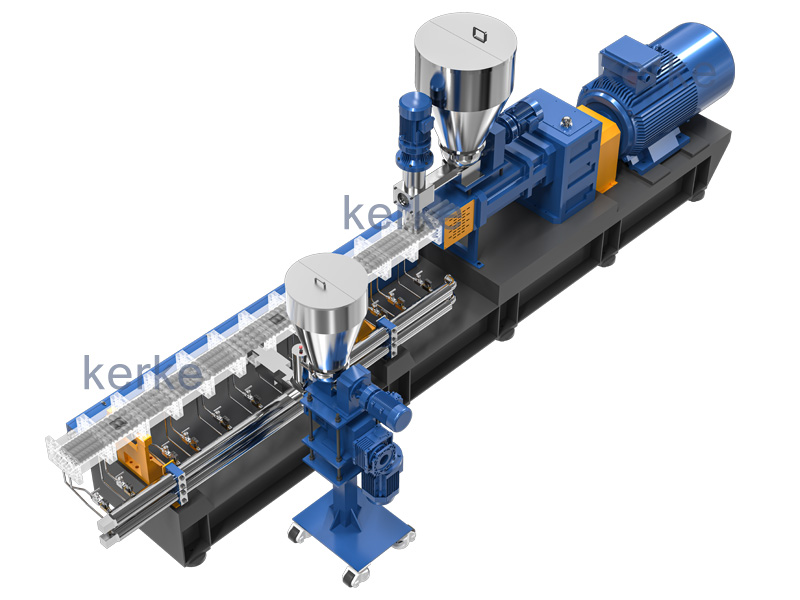
Residence time is the duration a particle of plastic spends inside the extruder. For heat-sensitive materials, the RTD must be narrow and short. A wide RTD means some material stays too long (degrades) while some leaves too early (unmixed). Twin screw extruders have a narrower RTD than single-screw extruders because the positive displacement pushes material through in a “plug flow” manner. However, for ultra-sensitive materials, even this might not be enough. Kerke offers side-stuffing ports that allow liquid additives (like heat-sensitive stabilizers or liquid colorants) to be injected directly into the melt at the very end of the process, minimizing their exposure to heat and shear.
This ensures that the expensive heat-sensitive additives remain active in the final product. For example, in PVC, liquid stabilizers are often added; if they are added too early, they evaporate or degrade. Side injection solves this. The cost of adding a side feeder is approximately $2,000 to $4,000, but it is vital for functional masterbatches (e.g., antioxidant or UV stabilizer masterbatches for sensitive films). This feature adds value to the machine by enabling the production of high-tech compounds that competitors with simpler equipment cannot make.
Temperature Control Precision and Sensor Redundancy
Standard temperature control might have a hysteresis of +/- 5 degrees Celsius. For PVC, a spike to 205 degrees can be disastrous. High-end masterbatch extruders use dual or triple thermocouples per zone, with redundant sensors. The control system uses PID auto-tuning algorithms to anticipate temperature changes. For example, if the screw speed increases, the controller pre-emptively opens the cooling valve before the temperature actually rises. This predictive control keeps the melt temperature stable within +/- 1 degree Celsius.
The cost of high-precision sensors and advanced controllers is a small fraction of the machine price (approx 2-3%) but prevents entire batches of scrap. A single batch of degraded PVC compound can cost $2,000 to $5,000 in raw materials alone, plus disposal fees and lost production time. This precision pays for itself instantly. Furthermore, data logging of temperature profiles is essential for quality certification (like ISO 9001 or medical device standards), providing traceability that justifies the higher cost of the control system. Kerke’s SCADA systems record every degree of temperature fluctuation, ensuring accountability and process repeatability.
Material Handling and Feeding Systems for Sensitive Polymers
Heat generation starts in the hopper. If the material bridges or rat-holes, it stops flowing, and the screws run empty. When new material finally drops in, it hits a hot barrel and can flash-degrade instantly. To prevent this, side-mounted hoppers or loss-in-weight feeders with agitators are used to ensure consistent feeding. For PVC powder, which has poor flowability, a forced feeder (screw feeder) is mandatory. It compacts the powder and pushes it into the extruder, preventing air entrapment. Air pockets compress and heat up adiabatically, causing local degradation.
The cost of a proper feeding system (hopper loader, vibratory feeder, loss-in-weight system) is roughly $5,000 to $10,000, but it is essential for stabilizing the process and protecting the heat-sensitive material from the moment it enters the machine. Without a consistent feed, temperature control is impossible. The investment in feeding technology is a prerequisite for processing difficult materials profitably. It transforms a batch process into a continuous, stable operation, which is the foundation of profitability in compounding.
Cost Implications of Processing Heat-Sensitive Materials
Processing heat-sensitive materials requires a premium machine. A standard masterbatch extruder might cost $50,000, but a PVC-specialized line with corrosion-resistant barrels, high-capacity cooling, and specialized screws might cost $75,000 to $90,000. The additional $25,000 to $40,000 is an investment in capability. If a factory tries to process PVC on a standard machine, the costs include: frequent screw and barrel replacement (due to corrosion), high scrap rates (10-20% due to yellowing/gels), potential safety hazards from gas leaks, and lost production time. The “cost of non-compliance” is much higher than the price of a proper machine.
Furthermore, specialized machines command higher processing fees. A factory with a Kerke PVC extruder can charge a premium for compounding services because they guarantee color stability, no gels, and regulatory compliance (like FDA or REACH). This increases revenue per ton. The ROI on a heat-stable extruder is calculated not just on efficiency, but on the ability to enter markets that are closed to competitors with inferior equipment. For example, the medical PVC market or high-end TPU film market requires equipment that can guarantee zero degradation. The premium price of the machine is the ticket to these high-margin markets.
Conclusion
Handling heat-sensitive plastic materials is one of the most demanding tasks in polymer extrusion. It requires a machine that acts less like a simple heater and more like a precision thermal manager. Through the use of specialized screw geometries, aggressive cooling systems, corrosion-resistant materials, and precise process control, masterbatch extruders from Kerke Extrusion can successfully process PVC, TPU, PLA, and other delicate polymers without degradation. While the capital cost of such equipment is higher than standard machines, the ability to produce high-quality, degradation-free compounds opens up lucrative market segments and avoids the costly pitfalls of scrap, equipment damage, and safety violations. For manufacturers looking to expand into sensitive polymer compounding, investing in a dedicated, heat-stable extrusion system from a specialist like Kerke is the only viable path to long-term profitability and quality assurance. The machine pays for itself by enabling the production of compounds that simply cannot be made on cheaper equipment.