Introduction to Process Optimization in Compounding
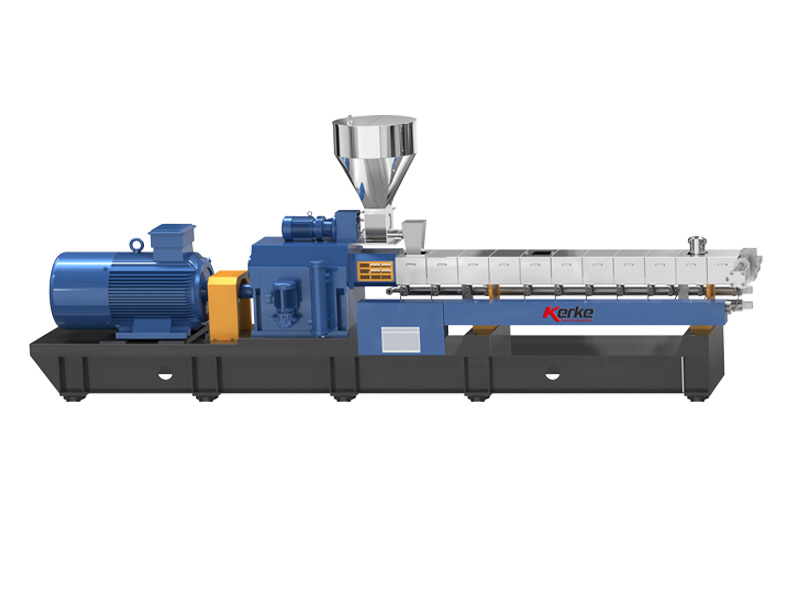
A compounding extruder is a highly versatile machine, but its performance is entirely dependent on how well it is tuned to the specific rheological properties of the formulation. A recipe that works perfectly for a polypropylene (PP) talc filler might fail completely when switched to a polyamide (PA) glass fiber compound. The transition requires significant adjustments to process parameters to maintain product quality, maximize throughput, and minimize specific energy consumption. Mastering these adjustments is a critical skill for process engineers. This guide provides a detailed, technical overview of the key parameters operators must adjust, using the advanced control capabilities of modern Kerke compounding extruders as a reference point. Failure to adjust parameters correctly can lead to surging, degradation, poor dispersion, and excessive wear on the machine.
Understanding and Setting the Temperature Profile
The temperature profile is the foundation of extrusion control. It is not a single number but a gradient of temperatures along the barrel, typically divided into the feed zone, compression zone, mixing zone, and metering zone. For heat-sensitive materials like PVC or TPU, the feed and compression zones must be kept relatively cool to prevent material bridging and premature melting, which can cause torque instability. A common mistake is setting the hopper temperature too high, which causes the pellets to stick together and stop flowing.
For semi-crystalline polymers like Nylon or PET, the barrel temperature must be set above the melting point but safely below the degradation threshold. In a Kerke extruder, the barrel is divided into 8 to 12 independent heating zones. When switching formulations, the operator must ramp temperatures up or down gradually to avoid thermal shock to the steel components. The cost of incorrect temperature settings is high: too low leads to unmelted “fish eyes” and high torque; too high leads to polymer degradation, gels, and yellowing. A typical adjustment might involve increasing the mixing zone temperature by 10 to 15 degrees Celsius to lower viscosity and improve dispersion, but this must be balanced against the risk of thermal degradation. The heating bands themselves consume significant power; optimizing the profile to use the minimum necessary heat saves electricity and reduces cooling water usage.
Screw Speed and Shear Rate Management
Screw speed, measured in revolutions per minute (RPM), is the primary lever for controlling throughput and shear rate. Higher speeds generate more frictional heat (viscous dissipation), which can raise the melt temperature without external heating. This is beneficial for energy saving but dangerous for heat-sensitive formulations like PVC or EVA, where high speeds can cause “fish eyes” or gas formation. The relationship between speed and torque is linear in the feed-limited region but becomes pressure-limited at higher speeds.
Operators must adjust the speed to maintain the amperage within the motor’s safe operating range, typically 80-90% of the maximum rating for optimal efficiency. For high-viscosity compounds like UHMWPE or heavily filled masterbatches (70% CaCO3), high torque is required, and the speed may need to be reduced to prevent stalling the motor. Kerke extruders use high-power inverter-controlled motors that allow for precise speed adjustments from 0 to maximum RPM. The “sweet spot” is where throughput is maximized without exceeding the torque limit or causing excessive melt temperature rise. Adjusting speed is “free” in terms of direct cost, but running too fast for a given formulation increases specific energy consumption (kW/kg) and wear on the screws. The cost of excessive wear includes more frequent screw and barrel replacement, which can cost thousands of dollars per changeover.
Feed Rate and Gravimetric Control Systems
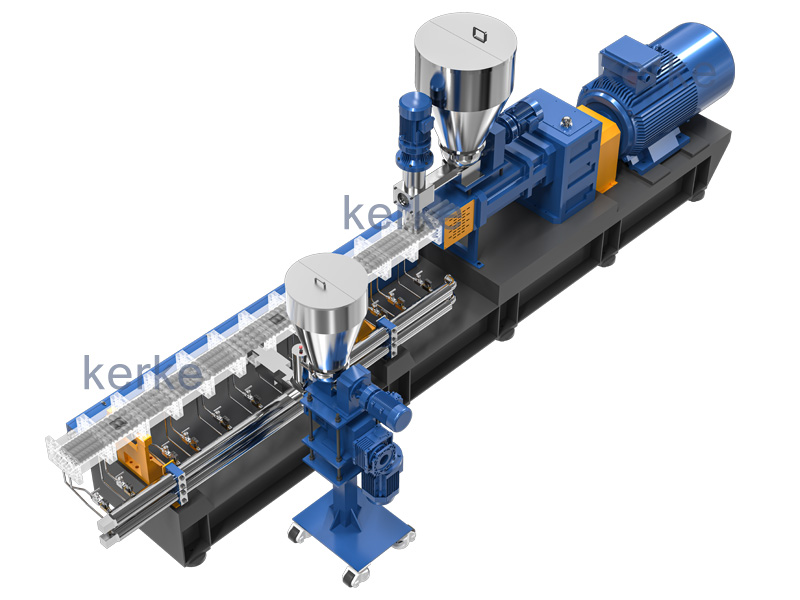
The feed rate determines the fill factor of the extruder. If the feed rate is too low, the screws are not fully filled, leading to poor mixing, self-heating issues, and surging. If the feed rate is too high, the motor will overload, and material will back up into the hopper, potentially causing a safety hazard. Modern compounding lines use loss-in-weight (LIW) gravimetric feeders that communicate directly with the extruder’s main drive via fieldbus protocols.
When changing formulations, especially those with different bulk densities (e.g., switching from heavy calcium carbonate to light carbon black or glass fibers), the feeder calibration and screw speed must be adjusted. Kerke systems allow for the storage of hundreds of recipes in the HMI touchscreen. The operator simply selects the new formulation, and the feeders automatically adjust their speed to match the target throughput and ratio. This automation reduces setup time from hours to minutes. The cost benefit here is a massive reduction in material giveaway during start-up and changeover. Incorrect feed rates can lead to “starving” the extruder, which causes surging and inconsistent product dimensions, leading to entire batches being scrapped. The cost of scrap material alone justifies the investment in high-precision gravimetric feeders, which typically cost between $10,000 and $20,000 per feeder.
Vacuum and Venting Parameters
For compounds requiring devolatilization (removal of moisture, monomers, or solvents), the vacuum level and vent block configuration are critical parameters. If the vacuum is too high, polymer can be sucked out of the vent (carryover), creating a mess and significant product loss. If the vacuum is too low, moisture and volatiles remain in the melt, causing bubbles (voids) in the final pellets or molded parts. This is particularly critical for engineering plastics like PC, ABS, or PET.
Adjustments depend heavily on the viscosity of the melt. High viscosity materials require a deeper vacuum (lower absolute pressure, e.g., 10-20 mbar) to pull out volatiles because the bubbles have a harder time escaping the viscous matrix. Kerke extruders often use multi-stage vacuum systems with condensers to trap volatile organics before they reach the vacuum pump. When processing highly hygroscopic materials like Nylon 6, the vacuum pump capacity must be sufficient to handle the volume of water vapor being removed (which can be several percent of the throughput). The cost of poor vacuum adjustment is significant: rejected batches due to foaming or hydrolysis degradation can cost $5,000 to $10,000 per incident. Investing in a high-capacity vacuum system (an added cost of roughly $5,000 to $15,000 depending on size) pays for itself by ensuring dry material and high-quality output, especially for medical or food-contact applications where moisture is unacceptable.
Die Pressure and Pelletizing Speed Synchronization
The pressure at the die head is a critical indicator of the mixing quality and melt temperature. It is a result of the resistance to flow through the die holes. Operators monitor die pressure to ensure it stays within a safe range (e.g., 100-200 bar for a typical strand pelletizer). If pressure spikes suddenly, it could indicate a plugged screen pack or a temperature drop in the melt causing a viscosity increase. If pressure is too low, the material might not be compacted enough, leading to airy, low-density pellets that float or break easily.
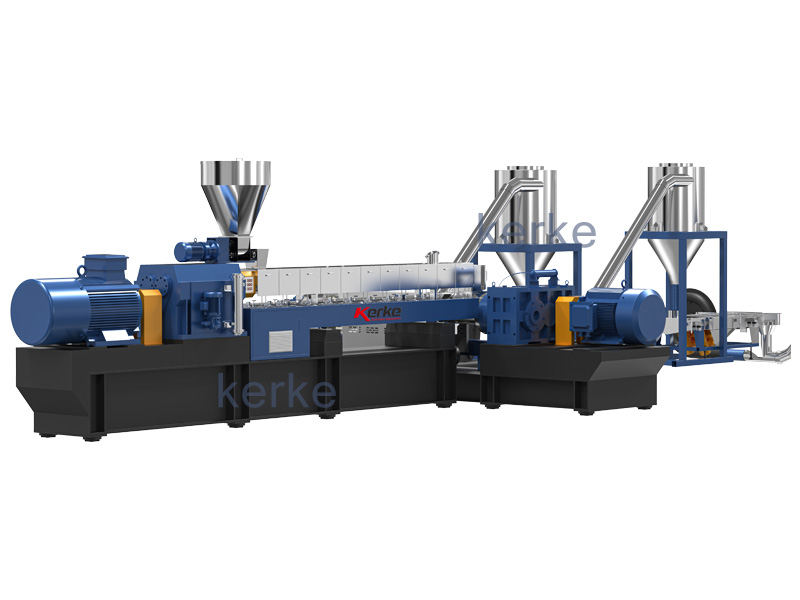
The pelletizer (water ring, underwater, or strand cutter) must be perfectly synchronized with the extruder speed. If the extruder speeds up to increase throughput, the pelletizer cutter must speed up proportionally to maintain the correct pellet length. Kerke systems offer fully automatic synchronization where the pelletizer drive follows the main extruder drive. Manual adjustment leads to off-spec pellet lengths (too long causes bridging in the hopper, too short creates dust). Dust is a major problem as it cannot be reused easily and represents lost material. Automatic systems have a higher upfront cost (approx. 10-15% more for the control system) but reduce operating costs significantly by minimizing waste and labor intervention. The cost of manual mis-synchronization can be 5-10% of total production in lost material.
Specific Parameter Adjustments for Common Formulation Scenarios
Let us analyze three common scenarios. First, for Glass Fiber Reinforced (LFT) compounds: Screw speed should be kept moderate to prevent fiber breakage (typically 200-300 RPM for a 75mm machine). The temperature should be kept on the lower end of the polymer’s melting range to minimize moisture absorption. Special low-shear screw elements with wide flights are used. Second, for Flame Retardant (FR) ABS: High mixing intensity is needed to disperse the FR agent (often a powder). Temperatures must be controlled tightly (within +/- 2 degrees) to prevent degradation of the brominated compounds. A high-shear kneading block section is essential. Third, for Color Masterbatch: High shear in the kneading zones is essential to break down pigment agglomerates. The temperature profile is often higher to ensure good wetting of the pigment by the carrier resin. Each of these requires a unique “recipe” of speed, temperature, and feed rates. The cost of developing these recipes is time, but once saved in the Kerke PLC, they become a valuable intellectual property asset that ensures consistent production regardless of which operator is on shift.
Troubleshooting and the Cost of Common Adjustment Errors
Errors in parameter adjustment are among the most costly issues in a compounding plant. For example, setting the barrel temperature 20 degrees too high for a sensitive polymer like TPU can degrade the entire batch, resulting in a loss of raw materials (often $2,000-$5,000) plus disposal fees and lost machine time. If the feed rate is set 10% too high for a reactive extrusion, the residence time might be too short, leading to incomplete reaction and off-spec product that must be sold as scrap or re-compounded (doubling energy costs). Over-adjusting the vacuum can pull expensive additives out of the vent, literally throwing money away.
A well-trained operator using a Kerke extruder’s advanced control system with data logging can avoid these pitfalls. The system can trend torque and pressure over time, allowing the operator to see if a parameter change is having a negative effect before it ruins a batch. The investment in training operators (approx. $2,000 per person for a certified course) is minimal compared to the cost of scrap. A rule of thumb in the industry is that scrap should not exceed 2% of total production. Good parameter adjustment and process control keep this number low, directly impacting the bottom line. The cost of poor control is not just the scrap itself, but the inefficiency of running a line that is constantly stopping and starting to fix problems.
Conclusion
Adjusting a compounding extruder is a complex science that requires a deep understanding of polymer rheology, additive characteristics, and mechanical engineering. It is not a “set it and forget it” process. By mastering temperature profiles, screw speeds, feed rates, and vacuum levels, manufacturers can produce a wide variety of high-quality compounds on a single machine. Kerke Extruder’s advanced control systems, with their recipe storage, data logging, and automation capabilities, simplify this process significantly. While the initial cost of a programmable, precision extruder is higher than a basic model, the flexibility and reduction in waste make it a financially sound choice for any serious compounding business. Proper parameter adjustment is the key to unlocking the full profitability and quality potential of your extrusion asset. It transforms the machine from a simple conveyor of plastic into a precision chemical reactor.