The Fundamental Mechanics of Twin Screw Mixing
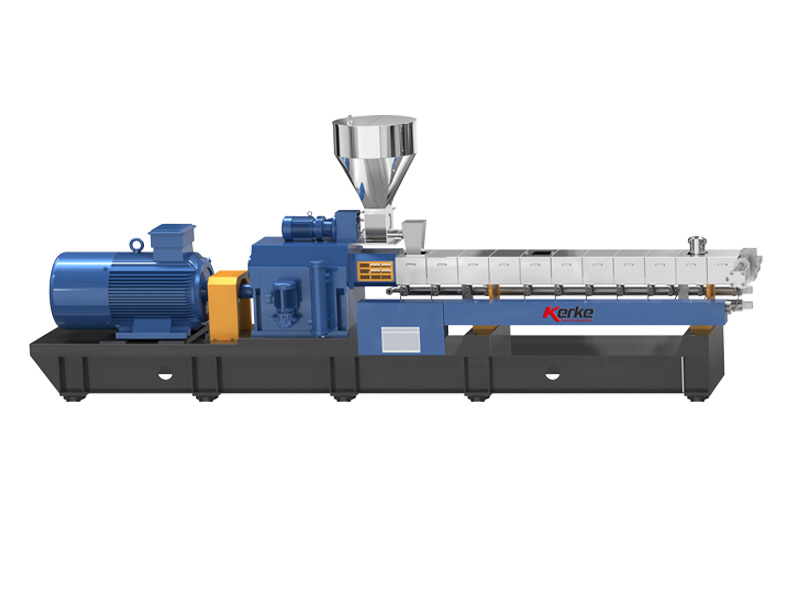
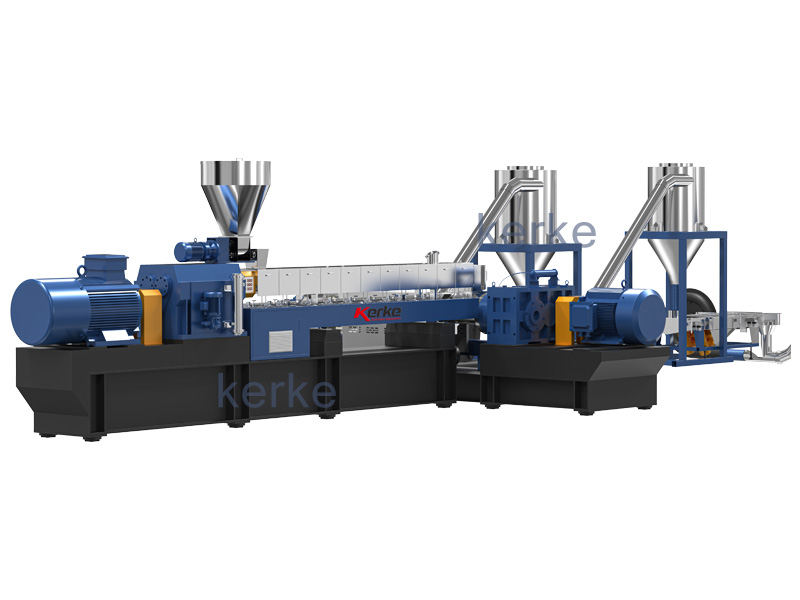
Achieving a perfectly homogeneous compound is the Holy Grail of polymer processing. Whether the goal is to break down agglomerates of carbon black, distribute glass fibers evenly in a nylon matrix, or dissolve a compatibilizer into a polymer blend, the quality of the final product depends entirely on the mixing efficiency. A twin screw extruder is uniquely suited for this task because it operates on the principle of positive displacement combined with intense mechanical shear. Unlike single-screw extruders, where mixing is largely chaotic and dependent on turbulence, the intermeshing co-rotating screws of a twin screw extruder create a controlled, repetitive, and high-intensity mixing environment. This article explores the intricate mechanisms that allow these machines to achieve uniformity that other technologies simply cannot match.
Dispersive Mixing: Breaking Down Agglomerates
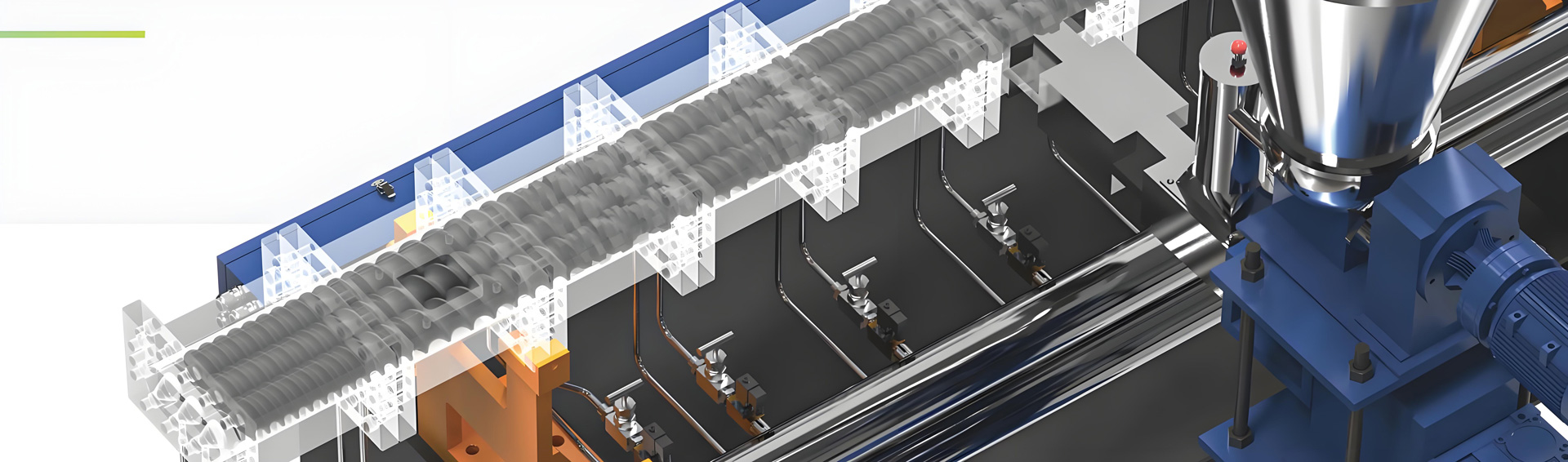
Dispersive mixing is the process of reducing the particle size of a dispersed phase, such as pigment agglomerates or filler bundles. This requires high shear stress to overcome the cohesive forces holding the particles together. In a twin screw extruder, dispersive mixing primarily occurs in the kneading blocks. These are screw elements with staggered teeth that do not fully intermesh, creating a narrow gap through which the polymer melt is forced.
As the material passes through these gaps, it experiences extreme shear rates. The intensity of this shear can be precisely controlled by the design of the kneading blocks. For instance, a kneading block with a 90-degree stagger angle provides maximum shear and is ideal for breaking down tough agglomerates like titanium dioxide or carbon black. Conversely, a 30-degree angle provides more conveyance with less shear, suitable for gentle mixing. Kerke Extrusion engineers utilize computational fluid dynamics (CFD) to simulate the flow patterns inside these blocks, ensuring that the stress applied is sufficient to break agglomerates without degrading the polymer matrix. The cost of achieving superior dispersion is justified by the performance gains; for example, well-dispersed carbon black provides better UV protection and conductivity at lower loadings, saving on additive costs.
Distributive Mixing: Spreading Particles Evenly
While dispersive mixing breaks particles down, distributive mixing ensures they are spread evenly throughout the carrier polymer. This is critical for additives like flame retardants, antistatic agents, or stabilizers, where localized “hot spots” of high concentration can lead to property failures or surface defects. Distributive mixing relies on the repeated reorientation and stretching of fluid layers.
In a twin screw extruder, the intermeshing action of the screws constantly divides and recombines the material stream. Every time a particle of additive crosses the centerline between the two screws, the number of fluid layers containing that additive doubles. This exponential multiplication of layers—often referred to as “layer multiplication”—ensures that even at very low concentrations (e.1% by weight), the additive is uniformly distributed. Specialized mixing elements, such as pineapple mixers or Maddock mixers, are often used in the metering zone to further enhance this effect. The precision of this process means that manufacturers can use less expensive additives more efficiently, as there is no need to “over-dose” to ensure coverage in all areas. This directly impacts the formulation cost-efficiency.
The Role of Modular Screw Configuration
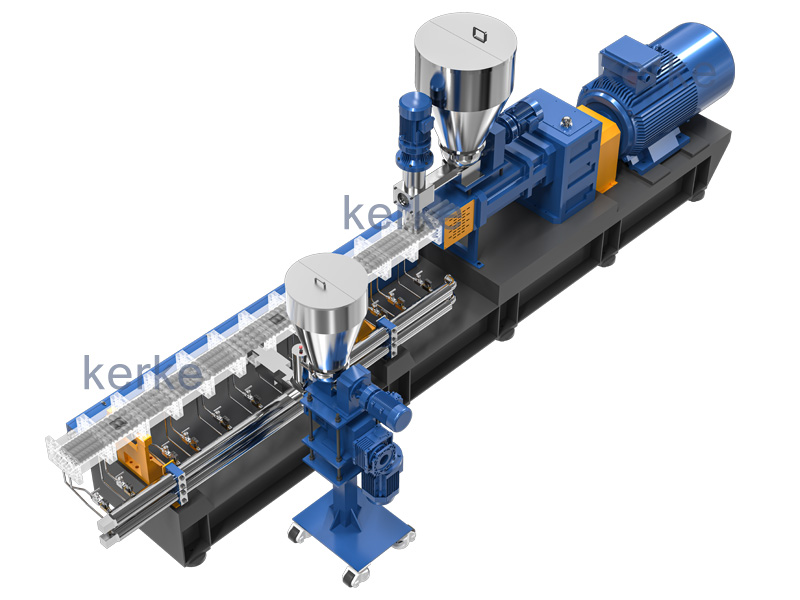
The greatest strength of a co-rotating twin screw extruder is its modularity. The screw is not a monolithic piece of metal but a shaft onto which various functional elements are mounted. This allows for the creation of a “custom recipe” for the screw geometry tailored to a specific compounding task. A typical compounding screw might be divided into several functional zones: a feeding zone, a melting zone, a high-shear mixing zone, a devolatilization zone, and a final metering zone.
Kerke Extruder takes this modularity to the next level by offering a vast library of screw elements. For a glass-fiber reinforced compound, the screw might include gentle conveying elements to prevent fiber breakage, followed by a specialized mixing section that wets out the fibers without chopping them. For a highly viscous masterbatch, the screw might feature high-compression kneading blocks to generate the pressure needed for dispersion. This customization ensures that the energy input is applied exactly where it is needed, avoiding over-processing which can degrade the polymer and waste energy. The cost of designing a custom screw profile is an upfront engineering expense, but it pays dividends in throughput rates and product quality consistency over the machine’s lifespan.
Temperature Control and Thermal Homogeneity
Uniform mixing is impossible without precise temperature control. Temperature variations within the melt can cause viscosity differences, leading to flow instabilities and poor mixing. Twin screw extruders excel here because the material is constantly being stirred, which eliminates “stagnant” zones where heat can build up. The barrel is typically divided into multiple independently controlled heating and cooling zones (often 8 to 12 zones on a production line).
Advanced systems use dynamic temperature control, where the cooling channels react instantly to spikes in melt temperature caused by increased shear. This prevents “hot spots” that could cause the polymer to degrade or cross-link, creating gels and specks. Kerke machines often incorporate highly responsive thermocouples placed directly in the melt channel (where possible) or very close to the barrel wall. The cost of this precision is higher than simple band heaters, but the reduction in scrap due to thermal degradation—which can easily run 5-10% on poorly controlled lines—makes it a necessary investment for high-quality compounding.
Vacuum Degassing as a Mixing Enhancement
Moisture and volatile by-products act as barriers to mixing. They create bubbles and voids that prevent intimate contact between the polymer and the additive. Therefore, efficient devolatilization is a form of mixing. Twin screw extruders are uniquely capable of handling high vacuum (down to 10-50 mbar absolute) while still conveying a viscous melt. The vent port is strategically placed where the material is fully melted but not yet pressurized for discharge.
The screw design around the vent is critical. Upstream of the vent, the screw elements build pressure to “seal” the vent and prevent air from being sucked in. Downstream, the screw elements are open to allow the melt to expand and release volatiles. The surface renewal rate of the melt as it passes over the vent determines the efficiency of gas removal. Kerke extruders use specialized vent geometries and high-capacity vacuum pumps (like Roots blowers) to ensure that even highly viscous polymers like PET or PC are effectively degassed. A clean, dry melt mixes significantly better, leading to higher mechanical properties in the final product. The cost of a robust vacuum system adds roughly $5,000 to $10,000 to the line cost, but it is essential for producing engineering-grade compounds.
Residence Time Distribution (RTD) and Plug Flow
The amount of time a particle spends in the extruder—and the consistency of that time—is crucial for uniform mixing. In a single-screw extruder, the residence time distribution is broad; some material exits quickly while some stays for a very long time. This leads to a mix of under-processed and over-processed material. Twin screw extruders, due to their positive displacement nature, approximate “plug flow.” This means the material moves through the barrel like a solid piston, with very little back-mixing.
A narrow RTD ensures that all particles experience the same thermal and shear history. This is vital for reactive compounding, such as grafting maleic anhydride onto polypropylene. If the residence time varies, some chains will be grafted while others remain unmodified, resulting in inconsistent product performance. The cost of achieving a narrow RTD lies in the precision manufacturing of the screws and barrel to minimize clearance gaps, which allows for better control of the flow. Kerke’s tight manufacturing tolerances ensure that the RTD is as narrow as possible, guaranteeing batch-to-batch consistency that is critical for downstream processors like injection molders.
Scale-Up Challenges and Geometric Similarity
When moving from a lab-scale extruder to a production machine, maintaining mixing uniformity is a major engineering challenge. Simply making a larger screw does not guarantee the same results. Kerke Extruder addresses this by maintaining geometric similarity across different machine sizes. The ratio of flight depth, screw diameter, and channel width is kept consistent. This ensures that the shear rates and flow patterns observed in the lab are replicated in the production plant.
The price of a compounding extruder scales non-linearly with size. A 35mm lab extruder might cost $30,000, while a 120mm production line can exceed $250,000. However, the cost per kilogram of production decreases significantly with scale because throughput increases roughly with the square of the diameter, while power consumption increases less aggressively. Investing in a larger, well-designed extruder often eliminates the need for a secondary re-compounding step, which would double the processing cost. The initial higher capital expenditure for a properly scaled machine is offset by the massive increase in efficiency and the elimination of re-work.
Conclusion
The ability of a twin screw extruder to achieve uniform mixing is a result of a sophisticated interplay between mechanical design, thermal management, and process control. Through the synergistic combination of high-shear kneading blocks for dispersion, distributive mixing elements for homogenization, precise temperature control, and efficient devolatilization, machines like those from Kerke Extrusion produce compounds with superior physical and aesthetic properties. For manufacturers, this uniformity translates to higher product value, reduced waste, and the ability to formulate complex recipes that competitors using simpler equipment cannot match. The investment in a high-quality twin screw extruder is an investment in the fundamental quality of the product, providing a sustainable competitive advantage in the marketplace.