Introduction
Screw wear represents one of the most significant operational challenges in high-speed compounding extruder operation, directly affecting product quality, production efficiency, and operating costs. As compounding processes increasingly demand higher throughput, improved mixing quality, and extended service intervals, screw wear management has become a critical aspect of equipment operation and maintenance. This comprehensive guide examines the causes of screw wear, prevention strategies, maintenance practices, and equipment selection considerations that minimize wear and maximize extruder service life.
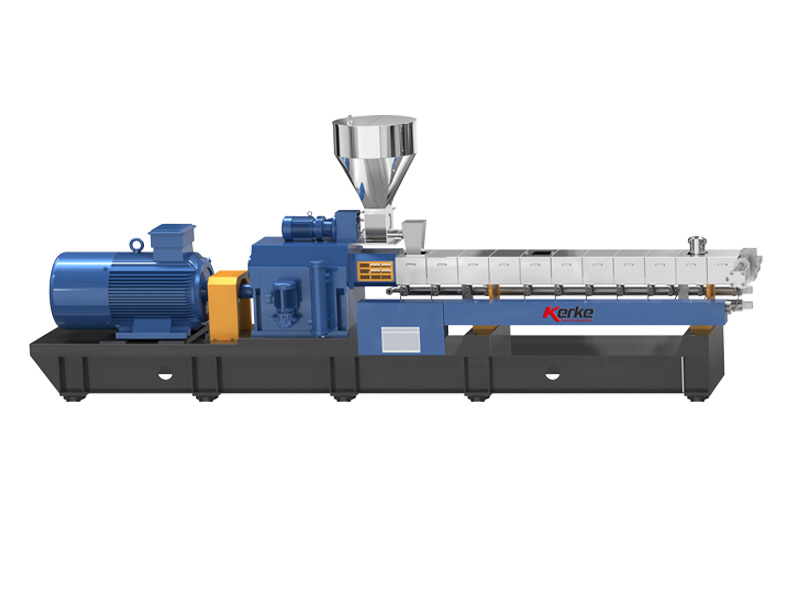
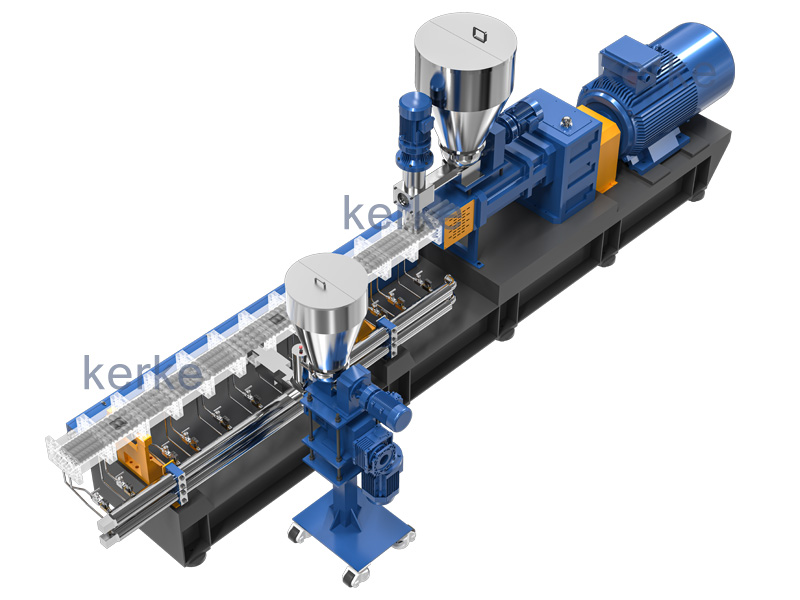
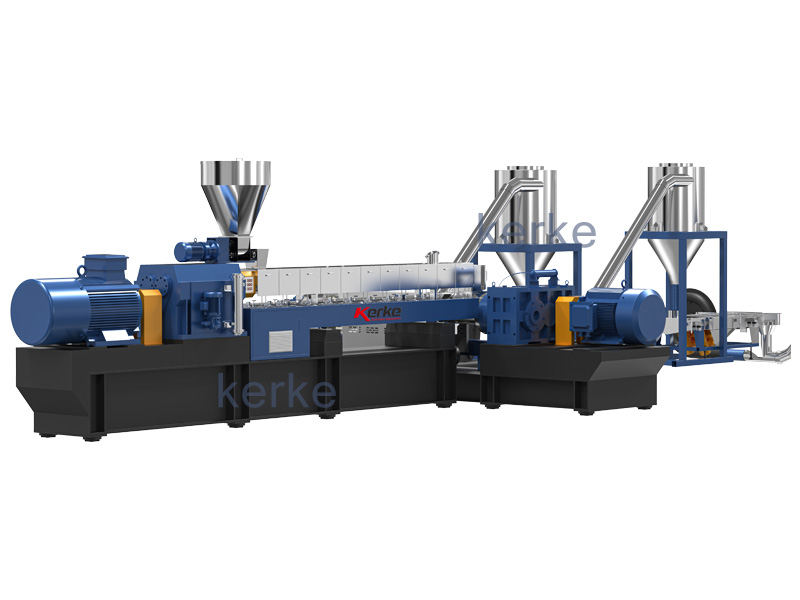
High-speed compounding extruders, particularly twin screw configurations like Kerke’s KTE Series, operate under demanding conditions with elevated shear rates, high temperatures, and abrasive material handling. These conditions accelerate wear mechanisms, requiring comprehensive understanding and proactive management to maintain equipment performance. Screw wear affects not only the extruder itself but also product quality through changes in mixing performance, melt temperature profiles, and throughput capacity.
The economic impact of screw wear extends beyond replacement costs. Worn screws reduce production efficiency through decreased throughput rates, increased energy consumption, and higher scrap rates. Quality degradation necessitates additional quality control measures and potential product rejections. Understanding and implementing effective wear prevention strategies provides substantial economic benefits through extended equipment service life, reduced maintenance costs, and improved operational efficiency.
Understanding Screw Wear Mechanisms
Effective screw wear prevention begins with understanding the fundamental wear mechanisms that operate during compounding extruder operation. Multiple wear mechanisms act simultaneously, with their relative importance depending on material characteristics, processing conditions, and equipment design. Identifying the dominant wear mechanisms in your specific application enables targeted prevention strategies.
Abrasive Wear
Abrasive wear occurs when hard particles in the material being processed contact and abrade screw surfaces. This represents one of the most common and significant wear mechanisms in compounding applications, particularly when processing fillers, reinforcements, or pigments. Common abrasive materials include calcium carbonate, talc, glass fibers, titanium dioxide, carbon black, and various mineral fillers.
The severity of abrasive wear depends on multiple factors including particle hardness, particle shape, concentration, and processing conditions. Sharp, angular particles cause more severe wear than rounded particles. Higher filler concentrations accelerate wear rates. Higher screw speeds increase wear due to increased particle velocity and contact frequency. Processing temperature also influences abrasive wear, with lower temperatures typically increasing wear due to reduced polymer lubrication effects.
Typical abrasive wear rates vary significantly based on application. For moderate filler loadings (10-30%) with calcium carbonate, screw wear might be 0.5-1.0 mm per year of continuous operation. High-concentration glass fiber reinforced compounds (30-40% glass fiber) might cause wear rates of 1.5-3.0 mm per year. Understanding these wear rates helps predict maintenance intervals and budget for replacement costs.
Adhesive Wear
Adhesive wear occurs when material bonds to screw surfaces and is subsequently torn away, removing material from the screw surface. This wear mechanism is particularly problematic with sticky materials, high shear conditions, or when processing materials with high melt adhesion to metal surfaces. Polymers that exhibit adhesion to metal include polyvinyl chloride (PVC), polyamide (PA), and some engineering plastics.
Adhesive wear manifests as material buildup, galling, and surface pitting. The wear process begins with polymer adhesion to the screw surface, followed by material accumulation and eventual removal under shear forces. This cyclic process gradually erodes screw surfaces, changing geometry and reducing performance. Processing temperature significantly affects adhesive wear, with temperatures near polymer glass transition or melting points typically increasing adhesive behavior.
Surface treatments and coatings can significantly reduce adhesive wear. Chromium nitride coatings, tungsten carbide coatings, and various specialized surface treatments provide low-friction surfaces that resist material adhesion. These treatments typically cost $15,000-30,000 for complete screw treatment on mid-size extruders, but can extend screw service life by 2-4 times compared to untreated screws in adhesive wear applications.
Corrosive Wear
Corrosive wear results from chemical attack on screw materials by processing materials or their degradation products. This wear mechanism is particularly relevant when processing materials containing halogens, acids, or other chemically aggressive substances. Materials that can cause corrosive wear include PVC (releasing HCl), certain flame retardants, and acidic fillers.
Corrosive wear accelerates other wear mechanisms by creating roughened surfaces that increase abrasive wear and material adhesion. The combined effect of chemical attack and mechanical wear can be particularly damaging. Processing temperature influences corrosive wear through increased chemical reaction rates at elevated temperatures. Corrosive wear also creates stress concentrations that can lead to cracking or fatigue failures.
Corrosion-resistant materials provide protection against corrosive wear. Stainless steel screws (typically 440C or similar grades) offer excellent corrosion resistance but reduced wear resistance compared to tool steel screws. Stainless steel screws typically cost 2-3 times more than standard tool steel screws, with replacement costs of $40,000-60,000 for mid-size twin screw configurations. The extended service life in corrosive applications often justifies the higher initial investment.
Thermal Fatigue
Thermal fatigue occurs from cyclic thermal stress during normal extruder operation, particularly during startup, shutdown, and process condition changes. Repeated heating and cooling cycles create thermal expansion and contraction that can lead to surface cracking and eventual material loss. This wear mechanism is particularly relevant for extruders with frequent production changes or demanding startup/shutdown procedures.
The severity of thermal fatigue depends on temperature variation magnitude and frequency. Large temperature changes (such as from cold startup to 300°C operation) create substantial thermal stress. Frequent production changes requiring temperature adjustments accelerate fatigue damage. Processing high-temperature materials like PEEK or LCP increases thermal stress due to larger temperature differences.
Gradual heating and cooling procedures can significantly reduce thermal fatigue. Controlled startup procedures that gradually raise temperatures minimize thermal shock. Similarly, controlled shutdown procedures allow gradual cooling rather than rapid quenching. Modern PLC control systems can automate these procedures, reducing thermal fatigue and extending screw service life. The control system typically costs $10,000-15,000 but provides substantial service life benefits.
Material Selection and Screw Design
Proper material selection and screw design represent the foundation for effective screw wear prevention. The choice of screw material, surface treatments, and geometry determines inherent wear resistance and service life. Kerke’s KTE Series extruders offer multiple material and design options optimized for different wear conditions.
Base Material Selection
Screw base material selection significantly impacts wear resistance and service life. Kerke’s KTE Series extruders typically use W6Mo5Cr4V2 high-speed steel as standard material for screw elements. This tool steel provides excellent combination of wear resistance, toughness, and tempering resistance at elevated processing temperatures.
The W6Mo5Cr4V2 material has typical hardness of 58-62 HRC after heat treatment, providing good wear resistance while maintaining sufficient toughness for impact resistance during operation. This material represents a cost-effective choice for general compounding applications with moderate wear conditions. Replacement screws using standard material typically cost $25,000-40,000 for mid-size twin screw configurations depending on screw diameter and length.
For high-wear applications, upgraded materials provide enhanced performance. Powder metallurgy high-speed steels, such as ASP 2052 or similar grades, offer 2-3 times the wear resistance of conventional high-speed steels. These materials use advanced powder metallurgy processing to create uniform microstructures with exceptionally fine carbide distribution. Upgraded material typically adds 50-80% to screw replacement cost, with total screw costs of $40,000-70,000 for mid-size configurations.
Surface Treatments and Coatings
Surface treatments and coatings provide enhanced wear resistance without requiring complete material replacement. These treatments modify screw surfaces to improve hardness, reduce friction, or provide corrosion resistance. Kerke’s KTE Series extruders offer multiple surface treatment options optimized for different wear mechanisms.
Nitriding treatments, particularly plasma nitriding, increase surface hardness and create wear-resistant surface layers. Plasma nitriding produces surface hardness of 65-70 HRC, significantly improving abrasive wear resistance. The treatment process costs $8,000-12,000 for complete screw treatment and typically extends service life by 1.5-2 times compared to untreated screws in abrasive applications.
Chromium nitride (CrN) and titanium nitride (TiN) coatings provide excellent wear resistance and reduced friction. These PVD (physical vapor deposition) coatings typically have thicknesses of 2-5 microns and hardness values of 2000-3000 HV. The coatings are particularly effective for reducing adhesive wear and improving release properties. Complete coating treatment costs $15,000-25,000 but can extend service life by 3-4 times compared to untreated screws in appropriate applications.
Tungsten carbide coatings provide the highest wear resistance for the most demanding abrasive applications. These coatings, applied through thermal spray processes, create extremely hard surfaces with excellent abrasive wear resistance. Tungsten carbide coatings typically cost $20,000-35,000 for complete screw treatment and are justified only in the most severe wear conditions where conventional materials would require replacement every few months.
Screw Geometry Optimization
Screw geometry affects wear patterns and rates through its influence on shear rates, residence time, and material flow patterns. Optimizing screw geometry for specific applications can significantly reduce wear rates while maintaining processing performance. Kerke’s modular KTE Series screw design enables geometry optimization without complete screw replacement.
Flight depth affects shear rates and wear patterns. Deeper flights typically reduce shear rates and associated wear, but may reduce mixing performance. Shallower flights increase shear rates for improved mixing but accelerate wear. The optimal flight depth balances mixing requirements with wear considerations. For abrasive applications, moderately deep flights (typically 0.15-0.20D, where D is screw diameter) often provide good compromise between wear resistance and mixing performance.
Flight thickness influences structural integrity and wear resistance. Thicker flights provide more material to accommodate wear before screw geometry changes affect performance. However, excessively thick flights reduce free volume and throughput. Kerke’s standard flight thickness represents a balance between these competing requirements, with thicker flights available for high-wear applications as custom options.
Mixing element selection significantly impacts wear rates. Kneading blocks and mixing discs provide intensive mixing but increase wear due to restricted flow and high shear. For high-wear applications, staggered kneading blocks with reduced overlap reduce wear while maintaining acceptable mixing quality. Kerke’s modular screw system allows mixing element optimization for specific applications, enabling wear reduction without complete screw replacement. Individual mixing elements typically cost $300-800 each, allowing targeted replacement of worn sections rather than complete screw replacement.
Processing Parameter Optimization
Optimizing processing parameters represents a cost-effective approach to screw wear prevention without requiring equipment modifications or replacement. Adjustments to processing conditions can significantly affect wear rates while maintaining product quality. Understanding the relationship between processing parameters and wear enables targeted optimization.
Screw Speed Optimization
Screw speed directly influences wear rates through its effect on shear stress and particle velocity. Higher screw speeds increase shear rates and accelerate most wear mechanisms. However, higher speeds also improve throughput and mixing performance. Finding the optimal screw speed balances productivity with wear considerations.
Wear rates typically increase proportionally to screw speed raised to a power between 1.5 and 2.5, depending on the dominant wear mechanism. For abrasive wear, the relationship is approximately proportional to speed squared. Doubling screw speed might quadruple abrasive wear rates. This relationship makes screw speed a powerful lever for wear control.
For typical compounding applications, operating at 60-80% of maximum rated screw speed often provides good balance between productivity and wear. Kerke’s KTE-75D extruder, with maximum screw speed of 800 rpm, typically operates most efficiently at 480-640 rpm for high-wear applications. This speed reduction might reduce throughput by 20-35% but can extend screw service life by 2-3 times, providing overall economic benefit when replacement costs and downtime are considered.
Temperature Profile Optimization
Temperature profile affects multiple wear mechanisms through its influence on material viscosity, polymer behavior, and chemical reactions. Proper temperature optimization reduces wear while maintaining product quality. The optimal temperature profile depends on material characteristics and processing requirements.
For abrasive applications, maintaining barrel temperature at the low end of recommended range typically reduces wear. Higher temperatures reduce polymer viscosity, providing better lubrication that reduces abrasive particle contact with screw surfaces. However, excessively high temperatures may cause material degradation and increase corrosive or adhesive wear. The optimal temperature minimizes viscosity while avoiding degradation.
Kerke’s KTE Series extruders feature precise multi-zone temperature control that enables temperature profile optimization. Typical temperature profiles for abrasive masterbatch applications might include: Feed zone: 150-180°C (for polypropylene carrier) Compression zone: 180-200°C Mixing zone: 200-220°C Metering zone: 220-240°C Die zone: 230-250°C These temperatures balance material melting and mixing with wear considerations. The precise optimization requires trial runs with wear monitoring to find the optimal profile for specific applications.
Throughput Optimization
Throughput affects wear rates through its influence on material residence time, shear rates, and filling degree. Higher throughput reduces residence time, potentially reducing wear. However, higher throughput also increases total material processed per unit time, affecting cumulative wear. The optimal throughput considers both per-hour wear rates and total production volume.
Filling degree represents a critical factor in wear optimization. Underfilled operation allows material to slip and accelerate, increasing abrasive particle velocity and associated wear. Overfilled operation increases material pressure and frictional heating, potentially accelerating various wear mechanisms. The optimal filling degree typically ranges from 60-80% of maximum volumetric capacity, providing good material engagement without excessive pressure.
Throughput optimization for wear reduction involves balancing productivity against cumulative wear. Operating at 70-80% of maximum throughput might provide optimal economics for high-wear applications. While this reduces hourly production, the extended service life and reduced replacement frequency often provide better overall economics. Kerke’s KTE-75D, with maximum throughput of 1000 kg/h, might operate most economically at 700-800 kg/h for high-wear applications, balancing throughput against screw replacement costs.
Material Preparation and Pre-Treatment
Material preparation and pre-treatment can significantly reduce wear by modifying material characteristics before they enter the extruder. Pre-drying, pre-mixing, and surface treatments reduce wear mechanisms by improving material flow, reducing abrasive particle sharpness, and optimizing material distribution.
Drying hygroscopic materials before processing reduces wear by eliminating moisture that can cause steam explosions and accelerate corrosive wear. Proper drying to moisture content below 0.02% prevents steam formation and associated erosion. Kerke recommends dehumidifying dryers for materials requiring moisture control. A dehumidifying dryer for KTE-75D capacity (1000 kg/h) typically costs $25,000-40,000 but can significantly extend screw service life and improve product quality.
Pre-mixing fillers and additives with polymer carriers before extrusion reduces concentration gradients that cause localized high-wear areas. Masterbatch production inherently involves pre-mixing, but additional high-shear mixing can further improve distribution. High-shear mixers costing $8,000-15,000 can provide additional protection against uneven wear patterns.
Filler surface treatments reduce abrasive characteristics and improve adhesion to polymer carriers. Coupling agents such as silanes can modify filler surface properties, reducing abrasive wear. Surface-treated fillers typically cost 10-30% more than untreated fillers but can reduce screw wear by 30-50%, justifying the additional material cost for high-wear applications.
Maintenance and Inspection Practices
Effective maintenance and inspection practices enable early detection of screw wear, allowing planned replacement rather than emergency failures. Systematic maintenance programs significantly extend screw service life while minimizing unscheduled downtime. Kerke’s KTE Series extruders are designed to support comprehensive maintenance programs.
Regular Inspection Protocols
Regular screw inspections provide critical information about wear progression and enable predictive maintenance planning. Inspection intervals depend on application severity, with high-wear applications requiring more frequent monitoring. For typical abrasive applications, monthly inspections during the first year of operation provide baseline data for predicting replacement intervals.
Inspection procedures include visual examination of screw surfaces, measurement of critical dimensions, and documentation of wear patterns. Key measurements include flight thickness, flight depth, and outer diameter at multiple locations. Kerke provides inspection templates and specifications that define acceptable wear limits for different screw components.
Inspection costs include labor time for screw removal, inspection, and reinstallation. For a mid-size KTE-75D extruder, complete screw inspection typically requires 8-12 hours of skilled technician time, costing approximately $800-1200 in labor. While this represents a recurring cost, it provides substantial value through predictive maintenance planning and prevention of catastrophic failures.
Wear Trend Analysis
Wear trend analysis involves tracking wear measurements over time to predict replacement intervals and identify abnormal wear patterns. Systematic trend analysis enables replacement scheduling during planned shutdowns rather than emergency situations, reducing production disruption and maintenance costs.
Wear typically follows predictable patterns, with initial rapid wear followed by slower steady-state wear. For abrasive applications, initial wear rates of 0.1-0.2 mm/month during the first 2-3 months typically decrease to 0.05-0.1 mm/month thereafter. Tracking these patterns enables accurate prediction of when replacement will be required.
Kerke’s KTE Series extruders include optional monitoring systems that track screw wear through indirect measurements such as motor torque, melt pressure, and temperature profiles. Changes in these parameters often correlate with screw wear, enabling continuous wear monitoring without stopping production for inspection. Advanced monitoring systems typically cost $15,000-25,000 but provide substantial value through reduced inspection frequency and predictive maintenance capability.
Targeted Replacement Strategies
Targeted replacement strategies optimize screw maintenance by replacing only worn sections rather than complete screw assemblies. Kerke’s modular screw design enables element-by-element replacement, reducing replacement costs by 50-70% compared to complete screw replacement.
Typical wear patterns show non-uniform wear across the screw length, with the highest wear occurring in high-shear mixing zones. For twin screw extruders, kneading block sections typically wear fastest, while conveying sections show slower wear. Targeted replacement of only the worn mixing sections, while retaining less-worn conveying sections, significantly reduces replacement costs.
Individual screw element replacement costs vary by size and complexity. For KTE-75D extruder components, typical element costs include: Standard conveying elements: $300-500 each Kneading blocks: $500-800 each Mixing discs: $400-600 each Restrictor elements: $400-700 each By replacing only worn elements rather than complete screw assemblies, maintenance costs can be reduced from $40,000-60,000 for complete screw replacement to $8,000-15,000 for targeted element replacement.
Preventive Replacement Scheduling
Preventive replacement scheduling involves planned screw replacement before wear affects product quality or causes failures. This approach avoids quality problems and emergency downtime while maximizing screw service life. Proper scheduling requires understanding wear rates and the relationship between wear and performance.
Product quality provides the primary criterion for determining acceptable wear limits. As screws wear, mixing performance decreases, potentially causing dispersion quality problems, color inconsistencies, or filler distribution issues. Establishing quality thresholds that trigger replacement prevents scrap production and customer complaints.
Kerke recommends establishing preventive replacement schedules based on wear trend analysis and quality monitoring. For typical abrasive applications, preventive replacement when wear reaches 1.0-1.5 mm from nominal dimensions often provides optimal economics. This replacement point balances maximizing service life against maintaining quality. Preventive replacement typically reduces scrap rates by 50-70% compared to reactive replacement after quality problems occur.
Equipment Selection for Wear Resistance
Selecting equipment specifically designed for wear resistance provides the foundation for effective screw wear management. Kerke’s KTE Series extruders incorporate multiple design features and options that enhance wear resistance for demanding applications.
Extruder Size and Capacity
Extruder size selection affects wear rates through its influence on specific throughput (throughput per unit screw surface area). Larger extruders operating at lower specific throughput typically exhibit reduced wear rates compared to smaller extruders operating at higher specific throughput.
For example, achieving 500 kg/h throughput with a KTE-65D (screw diameter 62.4 mm, maximum throughput 600 kg/h) requires 83% of maximum capacity, creating high specific throughput and associated wear rates. The same 500 kg/h throughput on a KTE-75D (screw diameter 71 mm, maximum throughput 1000 kg/h) represents only 50% of maximum capacity, reducing specific throughput by approximately 40% and corresponding wear rates.
Larger extruders have higher initial costs but provide extended service life and reduced maintenance costs. KTE-75D extruders typically cost 20-30% more than KTE-65D models ($80,000-120,000 vs $60,000-90,000), but may provide 2-3 times longer screw service life in high-wear applications, justifying the higher initial investment.
Drive System Capacity
Drive system capacity affects wear through its influence on torque reserve and power delivery. Adequate torque capacity allows screw operation at optimal speeds for wear reduction while maintaining required throughput. Insufficient torque capacity forces operation at higher speeds to achieve required throughput, accelerating wear.
Kerke’s KTE Series extruders offer multiple drive options to match application requirements. The KTE-75D model provides drive options from 200 kW to 315 kW motor power. Selecting the higher power option (315 kW) provides approximately 60% more torque at 480 rpm compared to the standard option, allowing operation at lower speeds while maintaining throughput. The higher power option adds approximately $15,000-20,000 to equipment cost but can reduce screw wear by 30-50% through lower screw speed operation.
Variable frequency drives (VFDs) provide additional flexibility for wear optimization by enabling precise speed control. VFDs allow operation at optimal speed points rather than fixed speeds, enabling wear reduction while maintaining productivity. KTE Series extruders include VFDs as standard equipment, providing inherent capability for speed optimization.
Barrel and Feeding System Design
Barrel and feeding system design affect wear through their influence on material flow and distribution. Proper material feeding and distribution reduce localized high-wear areas and promote uniform wear across screw surfaces.
Barrel liner materials significantly affect barrel wear, which indirectly affects screw wear. Worn barrels create clearance that allows material bypass and changes in flow patterns, potentially accelerating screw wear. Bi-metallic barrel liners with wear-resistant alloys provide extended barrel service life, reducing the indirect effects on screw wear. Bi-metallic barrels typically cost 30-50% more than standard monolithic barrels but provide 2-4 times service life extension.
Feeding system design affects material distribution and wear patterns. Proper feed throat geometry and main feeder sizing ensure uniform material entry and distribution across the screw length. Kerke’s KTE Series extruders feature optimized feed throat designs that promote even material distribution, reducing localized high-wear areas. Side feeder positions are optimized to introduce additives at locations that minimize abrasive wear to critical screw sections.
Economic Analysis of Wear Prevention
Effective screw wear prevention involves economic considerations balancing prevention costs against the costs of wear-induced problems. Understanding the economics enables optimal investment in wear prevention strategies that maximize overall profitability.
Direct Wear Costs
Direct wear costs include screw replacement costs, barrel replacement costs, and associated maintenance expenses. These costs represent the most visible economic impact of screw wear but often represent only a portion of the total economic impact.
Screw replacement costs for mid-size Kerke extruders typically range from $25,000-70,000 depending on material, size, and configuration. Standard W6Mo5Cr4V2 screws for KTE-75D extruders cost approximately $35,000-45,000. Upgraded materials with powder metallurgy steels or surface treatments cost $50,000-70,000. Barrel replacement costs add $40,000-60,000 for complete barrel assembly or $8,000-15,000 for individual section replacement.
For high-wear applications requiring annual screw replacement, direct replacement costs represent significant annual expenses. However, these costs must be evaluated against the economic benefits of continued production and product quality. Preventive maintenance programs that extend service life from 12 months to 24 months reduce annual replacement costs by 50%, providing substantial economic benefits.
Indirect Wear Costs
Indirect wear costs often exceed direct replacement costs and include production downtime, quality losses, energy efficiency reductions, and capacity limitations. These costs are less visible but have substantial economic impact.
Production downtime for screw replacement typically ranges from 8-24 hours for mid-size extruders, including screw removal, installation, and restart procedures. At a typical production value of $200-400 per hour for compounding operations, downtime costs represent $1,600-9,600 per replacement event. Frequent replacements due to accelerated wear create substantial cumulative downtime costs.
Quality losses from worn screws include increased scrap rates, customer returns, and additional quality control requirements. As screws wear, dispersion quality deteriorates, potentially causing off-spec production. Scrap rates typically increase from 1-2% with new screws to 3-5% with worn screws, representing substantial material and productivity losses. At material costs of $1.50-3.00/kg, scrap costs for a KTE-75D operating at 500 kg/h range from $15-50 per hour, significantly impacting profitability.
Prevention Investment Analysis
Investment in wear prevention strategies must be evaluated against the total economic impact of wear. Various prevention strategies provide different returns on investment depending on application specifics.
Upgraded screw materials and surface treatments typically provide 2-4 times service life extension for 50-100% additional cost. For example, tungsten carbide coating costing $25,000 that extends service life from 12 months to 36 months reduces annualized screw cost from $35,000 to $20,000, providing annual savings of $15,000. This represents a 60% return on investment.
Processing parameter optimization requires minimal investment but provides substantial benefits. Operating at 75% of maximum screw speed instead of 90% reduces throughput by 17% but typically extends screw service life by 50-100%. The economic analysis depends on production capacity constraints and margin, but for many applications, the reduced downtime and replacement costs justify the speed reduction.
Total Cost of Ownership Analysis
Total cost of ownership analysis considers all costs associated with screw operation over equipment life, including purchase cost, maintenance costs, downtime costs, quality costs, and energy costs. This comprehensive analysis provides the best basis for wear prevention investment decisions.
A simplified total cost of ownership comparison illustrates the economic benefits of wear prevention strategies: Option A – Standard screws, maximum speed operation: Initial screw cost: $35,000 Annual replacement: $35,000 Downtime cost: $5,000 Quality impact: $15,000 Total annual cost: $55,000 Option B – Coated screws, reduced speed operation: Initial screw cost: $60,000 Annual replacement: $20,000 Downtime cost: $2,000 Quality impact: $5,000 Total annual cost: $27,000 This analysis shows that while coated screws cost more initially and reduce throughput, the total annual cost is reduced by over 50%, providing substantial economic benefit. The optimal choice depends on specific production capacity requirements and profit margins.
Conclusion
Screw wear in high-speed compounding extruders represents a significant operational challenge with substantial economic impact. However, comprehensive understanding of wear mechanisms, combined with effective prevention strategies, enables management of wear rates and extension of service life. Kerke’s KTE Series extruders provide the foundation for effective wear management through modular design, multiple material options, and advanced features.
Successful screw wear prevention requires a multi-faceted approach combining proper material selection, processing parameter optimization, systematic maintenance practices, and appropriate equipment selection. No single strategy provides complete protection, but the combination of complementary approaches provides comprehensive wear management. Economic analysis confirms that investment in prevention strategies typically provides excellent returns through extended service life, reduced downtime, and improved quality.
As compounding applications continue to demand higher performance from extruders, effective screw wear management becomes increasingly critical. Implementing the strategies outlined in this guide enables manufacturers to achieve productivity goals while controlling operating costs and maintaining product quality. Regular review and adjustment of wear prevention strategies based on operating experience ensures continued optimization and maximum economic benefit.