Introduction
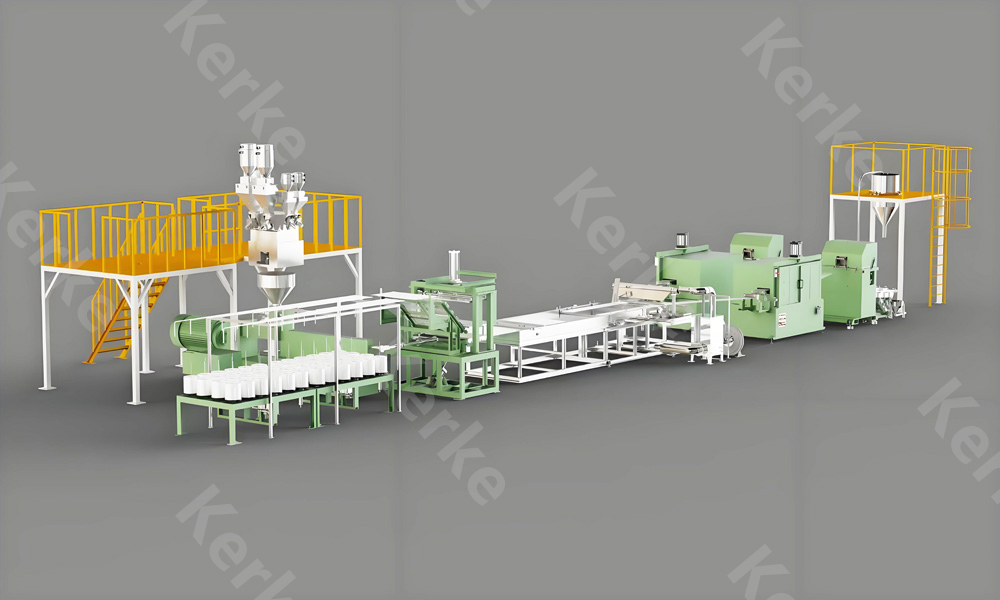
Selecting the appropriate motor power for your masterbatch extruder machine represents a critical decision that directly impacts production efficiency, product quality, and operational costs. The motor serves as the heart of your extrusion system, providing the torque and speed necessary to process your specific materials through the twin screw configuration. This comprehensive guide explores the key factors influencing motor power selection, calculation methods, and practical considerations for ensuring optimal performance across various masterbatch applications.
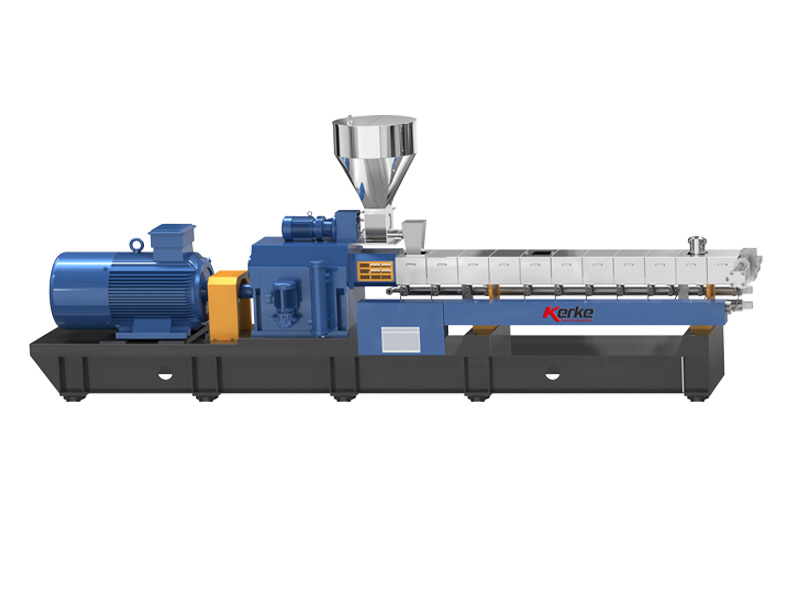
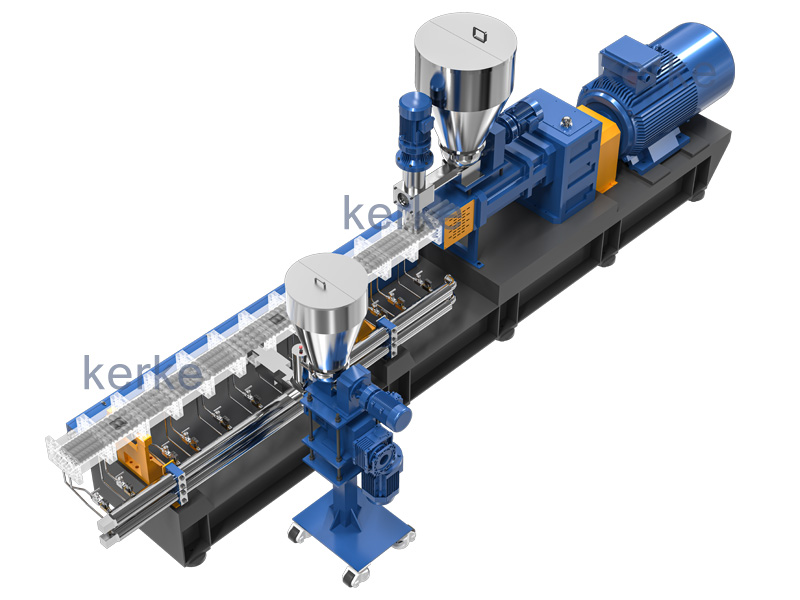
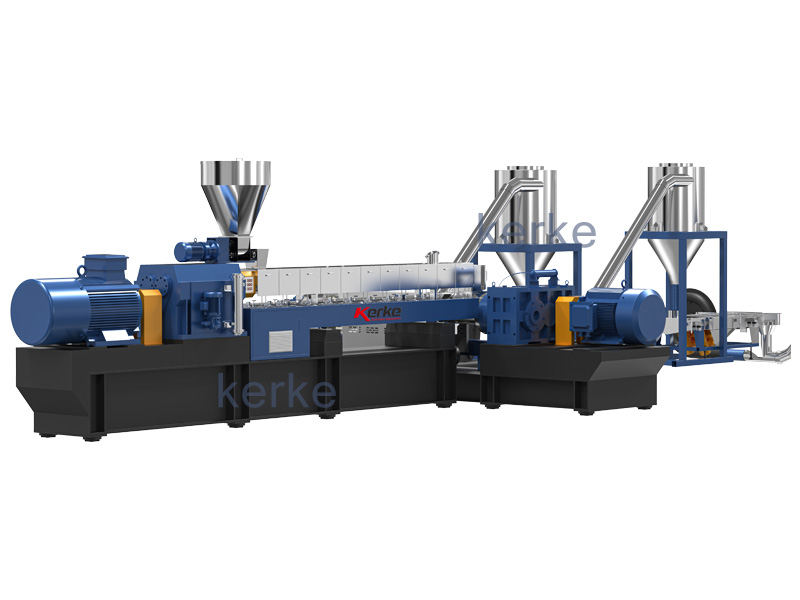
The masterbatch extrusion process involves significant energy input for melting, mixing, and dispersing pigments and additives within polymer carriers. Twin screw extruders, particularly from Kerke’s KTE Series, require carefully matched motor power to handle the varying loads encountered during production cycles. Insufficient motor power leads to production bottlenecks, quality issues, and potential equipment damage, while oversized motors waste energy and increase initial investment unnecessarily.
Understanding the relationship between motor power, material characteristics, processing conditions, and production requirements enables informed decision-making. This guide provides practical methodologies for motor power selection that balance performance requirements with economic considerations, ensuring your masterbatch extruder operates efficiently across its intended production range while maintaining product quality and operational reliability.
Understanding Motor Power Requirements
Motor power requirements for masterbatch extruders depend on multiple interrelated factors including material characteristics, screw configuration, production throughput, and processing temperature. The motor must provide sufficient torque to overcome resistance from melting high-viscosity materials, pumping molten polymer through die openings, and driving the intensive mixing elements characteristic of twin screw configurations. Power requirements vary significantly between different masterbatch types and processing conditions.
Material characteristics represent the primary factor influencing motor power requirements. Different polymers exhibit varying melt viscosities and processing characteristics. For example, polypropylene typically requires less power than polycarbonate due to lower viscosity and processing temperatures. Pigment loading levels also impact power requirements significantly. Higher pigment concentrations increase melt viscosity and resistance to flow, requiring more power for effective processing. Additive types, such as flame retardants or reinforcing fillers, further modify power requirements based on their interaction with the polymer matrix.
Screw configuration directly influences power requirements through mixing intensity and pumping characteristics. Aggressive screw configurations with multiple kneading blocks and reverse elements create higher resistance requiring more power. Conversely, more gentle configurations optimized for low-shear applications require less power. The modular design of Kerke’s KTE Series extruders allows screw configuration optimization for specific applications, but this must be considered when selecting motor power to ensure adequate capacity across all intended configurations.
Key Factors Affecting Motor Power Selection
Multiple technical and operational factors must be evaluated when selecting motor power for masterbatch extruders. These factors interact with each other, creating a complex decision matrix that requires careful analysis and consideration of your specific application requirements. Understanding these factors enables systematic evaluation of power requirements rather than relying on general rules of thumb that may not apply to your situation.
Material Properties and Viscosity
Material properties, particularly melt viscosity at processing temperatures, represent the most significant factor affecting motor power requirements. Different polymers and masterbatch formulations exhibit vastly different flow characteristics that directly impact resistance through the extruder. For instance, processing titanium dioxide white masterbatch at high concentrations requires significantly more power than producing light color masterbatch at low concentrations due to the massive viscosity difference.
Temperature-dependent viscosity changes must be considered in power selection. Many materials exhibit significant viscosity reductions with temperature increases, allowing lower power operation at higher temperatures. However, thermal stability limits and degradation risks constrain practical operating temperatures, requiring sufficient motor power for safe processing temperatures. The relationship between temperature, viscosity, and power consumption must be understood for each material system to optimize both power requirements and product quality.
Material thermal properties also influence power requirements. High specific heat capacity materials require more energy for melting, directly impacting power needs. Thermal conductivity differences affect heating requirements and temperature uniformity, indirectly influencing motor power through changes in melt viscosity and flow characteristics. Understanding these material-specific factors enables more accurate power requirement calculations.
Production Throughput Requirements
Desired production throughput directly influences required motor power. Higher throughput rates require larger motors to maintain adequate melt pressure and mixing intensity. The relationship between throughput and power is not linear but depends on material characteristics and processing conditions. For many materials, doubling throughput requires approximately 1.6 to 1.8 times more power due to increased resistance and mixing requirements.
Production flexibility requirements influence power selection. If your extruder must handle varying throughput levels across different products, sufficient motor power must accommodate the highest demand while maintaining efficiency at lower production rates. Kerke’s KTE Series offers variable speed motors that can optimize power consumption across different production levels, but the maximum capacity determines the power rating required.
Peak versus average power requirements must be considered for production planning. Startup conditions, material changeovers, and processing variations create power demand peaks that exceed average operating requirements. Adequate motor capacity must accommodate these peak demands while maintaining efficient operation during normal production. Oversizing for peak conditions wastes energy, while sizing only for average conditions risks production interruptions during peak demand periods.
Screw Configuration and Mixing Intensity
Screw configuration significantly impacts power requirements through its effect on mixing resistance and pumping characteristics. Kneading blocks, reverse conveying elements, and restrictive mixing barriers all increase resistance requiring more power. The modular screw design of KTE Series extruders allows configuration optimization, but this must be matched with adequate motor power to ensure capability across all intended configurations.
Mixing intensity requirements vary significantly between different masterbatch types. Color masterbatch production typically requires high dispersion quality driving the need for intensive mixing elements and higher power. Filler masterbatch production may require less intensive mixing depending on filler type and dispersion requirements. Understanding the mixing intensity required for your specific applications enables appropriate motor power selection.
Screw diameter and length-to-diameter ratio affect power requirements through their influence on material residence time and pumping characteristics. Larger diameter screws generally require more power due to increased material volume and greater torque requirements. Longer L/D ratios provide more mixing length but also increase resistance, requiring sufficient motor capacity to maintain desired throughput and mixing intensity.
Processing Temperature and Thermal Management
Processing temperature indirectly affects motor power requirements through its influence on material viscosity and thermal degradation characteristics. Higher processing temperatures generally reduce melt viscosity, decreasing power requirements. However, increased heating energy and potential thermal degradation create counterbalancing factors that must be considered in overall power selection.
Temperature uniformity requirements influence power selection. Applications requiring tight temperature control may need more power to maintain uniform thermal conditions, particularly with materials having high thermal sensitivity or poor thermal conductivity. The advanced thermal management systems in Kerke extruders help maintain temperature uniformity but require adequate power capacity to operate effectively.
Thermal degradation limits constrain practical processing temperatures for many materials. This requires sufficient motor power to process at safe temperatures rather than relying on temperature reduction for viscosity control. Understanding thermal degradation characteristics of your materials enables appropriate power selection that ensures safe processing conditions without sacrificing productivity.
Kerke KTE Series Motor Power Specifications
Kerke’s KTE Series twin screw extruders offer a comprehensive range of motor power options designed to match various masterbatch production requirements. The series spans from laboratory-scale machines with small motors to large production extruders with powerful drive systems, enabling selection based on specific application needs and production scale. Understanding the available power options and their applications enables optimal equipment selection.
The KTE Series motor power range extends from 2.2 kW in the KTE-16 laboratory model up to 500 kW in the large KTE-135D production machine. This broad range covers virtually all masterbatch production requirements from small-scale testing and sample production to high-volume commercial manufacturing. The series classification into A, B, and D types provides additional options for matching power characteristics to application requirements.
Price points for KTE Series extruders vary significantly based on motor power and overall configuration. Laboratory models with lower motor power typically range from $15,000 to $30,000, while mid-range production machines fall between $80,000 and $200,000 depending on capacity. Large production models with high power motors can exceed $300,000. These price ranges include the complete extruder system with motor, drive, and control systems.
Laboratory Scale Options
Laboratory-scale KTE Series extruders provide ideal solutions for formulation development, small-batch production, and research applications. The KTE-16 with 2.2 kW motor offers low-power operation ideal for testing and development work. This model handles production rates of 1-5 kg/h, making it perfect for small-scale masterbatch production and formulation optimization.
The KTE-20 with 4 kW motor provides slightly higher capacity for laboratory-scale production. At approximately $20,000-$30,000 depending on configuration, this model offers an excellent balance between capability and cost for development work. The 2-15 kg/h production rate enables meaningful batch sizes while maintaining laboratory-scale operation.
These laboratory models typically include energy-efficient motors designed for variable speed operation, allowing precise control over processing conditions. The low power requirements make them economical for continuous operation in research and development environments while providing sufficient capacity for meaningful production runs.
Mid-Range Production Models
Mid-range KTE Series models offer versatile power options for moderate production requirements. The KTE-36B with 18.5-22 kW motor and KTE-36D with 22-37 kW motor provide significant capacity for color masterbatch production. These models handle production rates from 20 kg/h up to 200 kg/h depending on configuration and material.
Price points for these mid-range models typically fall between $45,000 and $80,000, depending on motor power and additional features. The KTE-50B and KTE-50D models with 55-75 kW and 75-90 kW motors respectively offer higher capacity for production rates from 80 kg/h to 300 kg/h. These models are priced between $70,000 and $120,000 depending on configuration.
These mid-range models incorporate advanced motor technologies including variable frequency drives for speed control and energy optimization. The moderate power requirements enable efficient operation while providing sufficient capacity for commercial production of various masterbatch types. Modular design allows configuration changes without requiring motor upgrades in many cases.
High-Capacity Production Models
High-capacity KTE Series models provide substantial motor power for large-scale masterbatch production. The KTE-75B with 132-160 kW motor and KTE-75D with 200-315 kW motor handle production rates from 300 kg/h to 1000 kg/h. These models are ideal for high-volume production environments where productivity and efficiency are paramount.
The largest models including KTE-95B with 250-315 kW motor and KTE-135D with 500-1000 kW motor provide maximum capacity for industrial-scale production. These models, priced between $150,000 and $350,000 depending on configuration, handle production rates up to 4000 kg/h, making them suitable for the most demanding production environments.
These high-capacity models incorporate advanced motor and drive technologies designed for continuous operation under demanding conditions. Energy efficiency features including regenerative drives and intelligent power management help offset the high power requirements, reducing operating costs despite the substantial motor capacity.
Power Calculation Methods
Several calculation methods can help determine appropriate motor power for masterbatch extruder applications. These methods range from empirical formulas based on experience to detailed analytical approaches considering specific material and processing characteristics. Using multiple calculation approaches provides validation and confidence in power selection decisions.
Empirical Power Calculation
Empirical power calculation methods rely on industry experience and established relationships between key parameters. One common approach uses the relationship between throughput, specific power consumption, and material characteristics. The formula: Power (kW) = Throughput (kg/h) x Specific Power (kWh/kg) provides a starting point for power estimation.
Specific power consumption values vary by material type and processing conditions. Typical values range from 0.6-1.0 kWh/kg for color masterbatch production to 0.8-1.4 kWh/kg for filled or reinforced masterbatch. These empirical values provide reasonable estimates but should be verified against actual processing conditions when possible.
Applying this empirical method to a color masterbatch production example requiring 500 kg/h throughput: Power = 500 kg/h x 0.8 kWh/kg = 400 kW. This calculation suggests the need for a substantial motor, aligning with KTE-75D or KTE-95D models that provide the necessary capacity for high-volume production.
Specific Energy Requirement Method
The specific energy requirement method considers the energy needed for melting, mixing, and pumping processes separately, providing a more detailed analysis. Melting energy depends on material specific heat capacity and temperature increase from ambient to processing temperature. Mixing energy depends on the dispersion quality required and material characteristics. Pumping energy depends on die pressure and throughput requirements.
For a typical polypropylene color masterbatch, melting energy might be approximately 0.4 kWh/kg, mixing energy 0.3 kWh/kg, and pumping energy 0.2 kWh/kg, totaling 0.9 kWh/kg specific energy requirement. Multiplying by desired throughput provides the power requirement. This method provides more insight into energy distribution between different process stages but requires detailed material property data.
This method also allows optimization by identifying which process stages contribute most to power requirements. If melting energy represents the dominant factor, preheating systems might reduce motor power requirements. If mixing energy dominates, screw configuration optimization might reduce power needs. This analytical approach enables targeted improvements to power efficiency.
Load Factor Considerations
Load factor represents the ratio of actual power usage to motor rated capacity and must be considered in power selection. Motors should operate between 70-90% of rated capacity for optimal efficiency. Operating below this range wastes energy through inefficiency, while operating above risks overload and reduced motor life.
Variable load conditions in masterbatch production require careful load factor consideration. Startup conditions typically require higher power than steady-state operation due to cold material and initial heating. Material variations and batch changes also create load fluctuations. Sufficient motor capacity must accommodate these variations while maintaining efficient operation during normal production.
The variable speed drives in KTE Series extruders help optimize load factor by adjusting motor speed to match actual power requirements. This capability enables more efficient operation across varying production conditions, reducing energy waste while maintaining adequate power for peak demand conditions. Understanding your load factor requirements helps select appropriate motor size and drive capabilities.
Economic Considerations
Motor power selection involves significant economic considerations beyond the initial equipment cost. Operating costs, energy efficiency, and total cost of ownership must be evaluated to make economically sound decisions. Balancing initial investment with long-term operational costs optimizes the overall economics of your masterbatch production system.
Initial Investment vs Operating Cost
Initial investment costs correlate directly with motor power capacity, but operating costs depend heavily on actual power consumption and efficiency. Oversized motors represent wasted initial investment and continue wasting energy through inefficient operation. Conversely, undersized motors risk production interruptions and quality problems that may cost far more than the difference in equipment cost.
The price premium for higher motor power varies by model size. For KTE Series extruders, upgrading from standard to higher power motor typically adds 15-25% to equipment cost. However, this premium may be offset by improved production capacity and flexibility that increases revenue potential. The specific economics depend on your production requirements and utilization patterns.
Financing considerations affect power selection decisions. Higher power machines represent larger capital investments but may qualify for more favorable financing terms due to higher capacity and production potential. Lease options and payment terms can make higher power machines more accessible despite the larger upfront cost.
Energy Efficiency and Operating Cost
Energy efficiency represents a major factor in operating costs for motor power selection. Modern high-efficiency motors with power factor correction and variable speed drives can reduce energy consumption by 15-30% compared to standard motors. Kerke’s KTE Series incorporates these advanced motor technologies as standard equipment, helping offset the operating cost impact of higher power requirements.
Energy costs vary significantly by region but typically represent 30-50% of total operating costs for masterbatch production. A 200 kW motor operating continuously might consume $150,000-$250,000 annually in energy costs at typical industrial rates. Efficiency improvements that reduce energy consumption by just 5% save $7,500-$12,500 annually, quickly justifying investment in higher-efficiency equipment.
Peak demand charges from utilities add another economic consideration. Large motors create peak demand that increases utility costs through demand charges. Staggered startup procedures, load shedding, and power factor correction help reduce these charges. Kerke’s intelligent control systems incorporate these features to minimize peak demand charges.
Total Cost of Ownership Analysis
Total cost of ownership analysis provides comprehensive economic evaluation considering initial investment, operating costs, maintenance requirements, and equipment lifespan. This analysis often reveals that higher initial investment in appropriate motor power provides better long-term economics through improved efficiency, reduced downtime, and extended equipment life.
Maintenance costs correlate with motor size and utilization. Larger motors require more comprehensive maintenance programs but benefit from economies of scale that reduce maintenance per unit of production. The KTE Series design minimizes maintenance requirements through high-quality components and robust construction, regardless of motor power level.
Equipment lifespan considerations affect economic analysis. Appropriately sized motors operating within optimal load ranges typically achieve longer life than oversized motors operating inefficiently or undersized motors subjected to overload conditions. The expected 15-20 year lifespan of KTE Series extruders when properly maintained provides substantial production value over the equipment life.
Selection Process and Decision Making
The motor power selection process should follow a systematic approach considering all relevant factors and validating decisions through analysis. This systematic approach ensures comprehensive consideration of all requirements and risks, leading to optimal power selection that meets both current needs and future requirements.
Requirements Definition
Begin the selection process by thoroughly defining your requirements including production capacity, material types, product specifications, and operational constraints. Document minimum and desired production rates, material formulations with their characteristics, quality requirements, and any special processing conditions. This requirements definition provides the foundation for power evaluation.
Consider future expansion plans when defining requirements. Anticipated growth in production volume or addition of new product lines may justify higher power capacity to avoid future upgrades. The modular design of KTE Series extruders enables some future expansion without complete machine replacement, but motor power typically represents a fixed constraint.
Operational constraints including available utilities, facility space, and labor considerations should be documented. These constraints may influence power selection decisions, particularly regarding electrical capacity limitations or space constraints that affect equipment size and configuration.
Material and Process Analysis
Analyze the specific materials and processes to understand power requirements in detail. Conduct material testing when possible to determine actual viscosity and processing characteristics. Review process requirements including mixing intensity, temperature control needs, and special processing conditions that affect power consumption.
Pilot production trials using laboratory-scale equipment provide valuable data for power requirement prediction. Kerke’s laboratory extruders enable testing of materials and processes under controlled conditions, generating data that can be scaled to production equipment. This testing approach reduces uncertainty in power requirement estimation.
Consult with material suppliers regarding processing recommendations and power requirements. Material manufacturers often have experience processing their materials and can provide guidance on power requirements. Combine this supplier information with your own analysis and testing to develop comprehensive understanding of power needs.
Power Requirement Calculation
Apply multiple calculation methods to estimate power requirements, comparing results for consistency. Use empirical formulas based on throughput and specific energy consumption as a starting point. Apply analytical methods considering material properties and process requirements for detailed understanding. Compare results and investigate any significant discrepancies.
Include safety factors and contingency in your power calculations. A 10-20% safety factor provides margin for unexpected variations and future changes. This contingency prevents operational constraints due to underestimated power requirements while avoiding excessive oversizing that wastes capital and energy.
Consider peak versus average power requirements in your calculations. Startup conditions, material changes, and processing variations create power peaks that must be accommodated. Motor capacity must handle these peak conditions while maintaining efficient operation during average demand periods.
Economic Evaluation
Evaluate economic implications of different power options considering initial investment, operating costs, and total cost of ownership. Calculate energy costs based on your utility rates and expected operating patterns. Compare these costs across different motor power options to understand the economic tradeoffs.
Consider production revenue implications of different power options. Higher power machines may enable greater production capacity and flexibility, potentially increasing revenue. Evaluate whether the additional revenue justifies the higher investment and operating costs associated with larger motors.
Perform sensitivity analysis on key assumptions including energy costs, production rates, and equipment utilization. This analysis helps understand how robust your economic decision is to changes in these assumptions. Kerke’s sales engineers can assist with this analysis using their experience with similar applications.
Vendor Selection and Specification
Select qualified vendors with experience in masterbatch extruder applications. Kerke’s extensive experience in twin screw extruder manufacturing and global installation base provides confidence in equipment selection and support capabilities. Evaluate vendors based on technical capability, experience, support infrastructure, and total value proposition.
Detailed specifications should document motor power requirements, drive system characteristics, and control capabilities. Specify power supply requirements including voltage, frequency, and amperage needs. Include requirements for variable speed control, soft start capabilities, and any special drive features needed for your application.
Request performance guarantees and support commitments in vendor specifications. Kerke provides comprehensive support including installation assistance, training, and ongoing technical support. These support elements contribute significantly to successful equipment operation and should be included in vendor selection criteria.
Implementation and Optimization
After selecting appropriate motor power, proper implementation and ongoing optimization ensure realizing the full benefits of your selection. Installation considerations, start-up procedures, and continuous monitoring contribute to optimal equipment performance and long-term satisfaction.
Installation Considerations
Proper electrical infrastructure is critical for supporting the selected motor power. Verify that your electrical supply can handle the motor’s power requirements including starting currents and peak demands. Install appropriate protection systems including circuit breakers, thermal overload protection, and ground fault protection as recommended by the manufacturer.
Consider power quality requirements including voltage regulation, harmonics, and power factor. Large motors can affect power quality, potentially causing problems with other equipment. Kerke’s drive systems incorporate power factor correction and harmonic filtering to minimize these effects, but installation should still consider potential impacts.
Implement monitoring systems to track actual power consumption and motor performance. This monitoring provides data for ongoing optimization and helps identify developing issues before they cause problems. KTE Series extruders include built-in power monitoring that can be integrated with facility management systems.
Start-Up and Commissioning
Follow manufacturer recommended start-up procedures to ensure proper motor operation. Gradual load buildup during initial operation helps condition the motor and identify any issues before reaching full production. Kerke provides comprehensive start-up support including commissioning services to ensure proper equipment operation.
Verify motor operation through load testing at various production rates. This testing confirms that the motor performs as expected under actual processing conditions and provides baseline data for ongoing monitoring. Document performance during commissioning to establish reference conditions.
Train operators on proper motor operation and monitoring procedures. Understanding normal operating parameters and recognizing early warning signs of problems enables proactive maintenance and prevents unexpected downtime. Kerke provides training programs tailored to your specific equipment and application.
Ongoing Optimization
Continuously monitor power consumption patterns to identify optimization opportunities. Variable speed drives enable power adjustment based on actual requirements, reducing energy waste during low-demand periods. Implement production scheduling to optimize motor utilization and minimize peak demand charges.
Regular maintenance of motors and drive systems maintains efficiency and prevents degradation. Follow manufacturer maintenance schedules including lubrication, inspection, and testing. KTE Series extruders are designed for long life with proper maintenance, maintaining efficiency over many years of operation.
Periodic evaluation of motor sizing versus actual requirements confirms that the selected power remains appropriate. Changes in production requirements, material specifications, or processing conditions may affect power needs. Re-evaluation ensures continued optimal operation and identifies opportunities for upgrades or modifications if needed.
Conclusion
Selecting appropriate motor power for your masterbatch extruder requires comprehensive consideration of material characteristics, processing requirements, production throughput, and economic factors. The KTE Series from Kerke offers a comprehensive range of power options designed to match virtually any masterbatch production requirement, from laboratory-scale testing to high-volume commercial production. Understanding the relationships between these factors enables informed decision-making that balances performance requirements with economic considerations.
Power selection represents a critical investment decision with long-term implications for production capability, operating costs, and product quality. Applying systematic evaluation methods including empirical calculations, material analysis, and economic evaluation ensures comprehensive consideration of all relevant factors. Collaboration with experienced manufacturers like Kerke provides additional expertise and validation of your selection process.
The modular design and advanced technology of KTE Series extruders provides flexibility and optimization capabilities that maximize the value of your motor power investment. Variable speed drives, energy-efficient motors, and intelligent control systems enable optimal power utilization across varying production conditions. This technology, combined with proper installation, commissioning, and ongoing optimization, ensures your equipment performs at peak efficiency throughout its service life.
As your production requirements evolve, the principles outlined in this guide provide a framework for re-evaluating power requirements and making appropriate equipment adjustments. Understanding the fundamental relationships between motor power and production requirements enables continuous optimization of your masterbatch production system, maintaining competitive advantage through efficient, high-quality operation.